
Your fence lines are disappearing under a wall of thorny brush. The poison ivy creeping up your backyard oak has tripled in size since last spring. Tired of battling woody invaders with a saw and pruning shears, you need a chemical solution that targets the roots and stops the regrowth cycle cold.
I’m Min — the co-founder and writer behind Gadgets Feed. I’ve spent hundreds of hours cross-referencing active-ingredient concentrations, coverage rates, and real-world user reports to separate the formulas that actually digest woody stems from the watered-down pretenders.
This guide cuts through the marketing to rank the top contenders, so you can confidently choose the best brush killer spray for your specific invasion.
How To Choose The Best Brush Killer Spray
Choosing the right chemical mix is more nuanced than grabbing the first bottle off the shelf. The wrong active ingredient can leave your toughest weeds laughing while you reapply every few weeks. Focus on these three areas to match the formula to your specific brush problem.
Active Ingredient: Triclopyr vs. Glyphosate vs. Diquat
The molecule doing the killing determines everything. Triclopyr is a systemic herbicide that mimics plant-growth hormones, making it especially effective on woody stems, vines, and broadleaf weeds — it travels down to the root system and prevents regrowth. Glyphosate (the main agent in standard formulas) stops an enzyme pathway essential for plant growth, working well on annual weeds and grasses but often requiring multiple applications on established brush. Diquat dibromide is a contact killer that dries out foliage in hours but doesn’t translocate to the roots, making it ideal for quick knockdown on green leaves but poor for long-term woody control.
Concentration and Coverage Rate
Concentrate formulas require you to mix the chemical with water in a tank sprayer. The active ingredient percentage determines how many gallons of finished spray you can make from a single bottle. A 41% glyphosate concentrate, for example, makes roughly 8 to 16 gallons of ready-to-use spray depending on the target weed. A standard 32-ounce bottle of triclopyr concentrate may cover 512 to 1024 square feet per mixed gallon. Always calculate the total coverage area against the dilution rate printed on the label — you need enough solution to wet every leaf and stem of the target plants.
Rain-Fast Window and Soil Activity
Brush killers vary widely in how quickly they become rainproof and whether they leave active residue in the soil. Some formulas are rainfast in as little as 15 minutes, which is critical if you’re spraying in an area with unpredictable weather. Others require one to two hours of dry time. Soil residual activity matters if you plan to replant flowers, shrubs, or grass in the treated area — formulas with longer soil half-lives can stunt new growth for weeks. If you need immediate replanting ability, look for products that specify “no residual soil activity” or a short soil half-life of a few days.
Quick Comparison
On smaller screens, swipe sideways to see the full table.
| Model | Category | Best For | Key Spec | Amazon |
|---|---|---|---|---|
| Crossbow Herbicide | Premium Concentrate | Large-acreage woody brush | 1 gallon, Triclopyr + 2,4-D | Amazon |
| Remedy Specialty Herbicide | Premium | Pasture and fence-line regrowth | 1 gallon, Triclopyr concentrate | Amazon |
| Southern Ag Crossbow 1 Gal | Premium | Broadleaf and vine on 2+ acres | 1 gallon, makes 96 gallons spray | Amazon |
| Roundup Poison Ivy Plus | Mid-Range | Poison ivy and woody vines | 32 oz, Triclopyr + Diquat | Amazon |
| Spectracide Weed & Grass Killer | Mid-Range | Fast knockdown on driveways | 32 oz, Diquat Dibromide | Amazon |
| Control Solutions Eraser | Budget-Friendly | Annual weeds and grass patches | 32 oz, 41% Glyphosate | Amazon |
| Southern AG 01113 | Budget-Friendly | Stump treatment and spot-killing | 32 oz, Triclopyr concentrate | Amazon |
In‑Depth Reviews
1. Crossbow Herbicide Brush Killer 1 Gallon

The Crossbow Herbicide from Tenkoz packs a full gallon of triclopyr-based concentrate designed for heavy brush, thorny thickets, and established woody plants. Farmers frequently recommend this formula because it attacks the entire vascular system of the plant — leaves wilt within hours, and the root structure is dead within days. Users report that poison ivy patches shrivel by the next morning after application.
At this volume, you can mix enough solution to treat fence rows, overgrown pasture edges, and property lines without running out mid-project. The systemic action means you will not need to reapply every month; many users report regrowth being suppressed for months after a single treatment. The strong odor is a sign the active chemistry is working, but it requires you to wear a respirator and gloves during mixing.
This is the go-to choice for anyone facing a serious woody invasion across a large area. The price per gallon is significantly lower than buying multiple smaller bottles of competing brands, making it the most economical option for sustained brush control on acreage.
Why it’s great
- Full gallon provides massive coverage for large properties.
- Triclopyr chemistry kills woody brush and vines at the root.
- Visible results within 24 hours on most tough weeds.
Good to know
- Strong chemical smell requires proper PPE during application.
- Overkill for small garden beds or spot treatments.
2. Remedy Specialty Herbicide Weed Killer & Brush Control
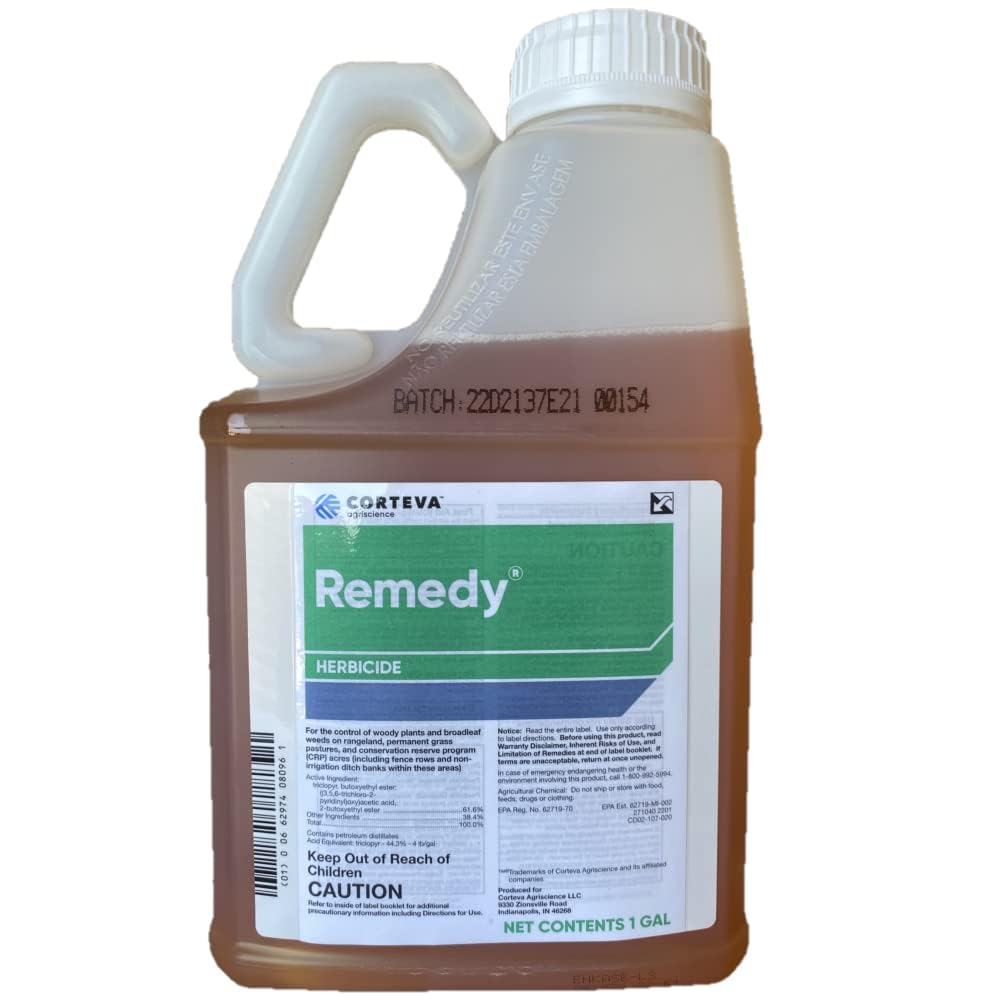
Remedy Ultra from Dow AgroSciences is a specialized triclopyr concentrate formulated for rangeland, pasture restoration, and fence-line maintenance. Its low-odor formula is a welcome improvement over traditional brush killers, making it more pleasant to work with during long spraying sessions. The chemical is designed to be flexible — you can use it alone or tank-mix it with other herbicides like GrazonNext for broader weed spectra.
The real strength here is selectivity: Remedy targets brush and mid-size trees without harming established grass, making it ideal for pasture owners who need to clear encroaching woody species while preserving forage. Users report success against notoriously tough invaders like cogon grass and yucca plants when applied according to the label. The one-gallon size is enough to treat a substantial acreage, though it sits at a premium price point.
If your primary battlefield is a pasture or hay field being overtaken by brush, this is the formula designed specifically for that scenario. The low-odor profile and selective action make it a favorite among landowners who want to reclaim grazing land without turning it into a barren dirt patch.
Why it’s great
- Selective formula targets brush without killing grass.
- Low-odor formula improves user comfort during spraying.
- Long-lasting residual control prevents quick regrowth.
Good to know
- Expensive per gallon compared to generic triclopyr options.
- Requires careful application to avoid drift onto desirable plants.
3. Southern Ag Crossbow Specialty Herbicide 128 oz

Southern Ag’s Crossbow formula combines triclopyr with 2,4-D to create a broad-spectrum brush and weed killer that covers up to 2.23 acres per gallon of concentrate. This combination delivers a one-two punch: 2,4-D attacks broadleaf weeds on contact, while triclopyr moves systemically into the root system of woody plants. Users consistently report complete die-off of thick vegetation — including ivy, prickly bushes, and small trees — within 48 hours of application.
The 128-ounce jug makes up to 96 gallons of finished spray solution, making it the highest-value option for anyone facing a multi-acre cleanup. The formula has a longer soil half-life than straight glyphosate options, which helps prevent new weeds from germinating for weeks but means you should wait before replanting sensitive plants. Many users note that it works extremely well on creeping charlie and poison ivy when applied during warm, dry weather.
This is the smart buy for property owners who need to treat a large area without spending premium money per gallon of mixed spray. The combination active ingredients give you both rapid top-kill and deep root control in one bottle.
Why it’s great
- Exceptional coverage of over 2 acres per gallon concentrate.
- Combines contact kill with systemic root control.
- Very cost-effective for large-scale brush control projects.
Good to know
- Strong odor may linger for a day after application.
- Soil residual activity limits immediate replanting options.
4. Roundup Poison Ivy Plus Tough Brush Killer Concentrate

Roundup’s specialized brush killer formula contains a triple blend of triclopyr, fluazifop, and diquat dibromide specifically engineered to defeat poison ivy, poison oak, poison sumac, wild blackberry, and kudzu. The inclusion of diquat provides visible leaf burn within hours, while the triclopyr works systemically to reach the underground rhizomes that cause regrowth. Users confirm this is the formula that finally stopped recurring poison ivy patches that resisted standard glyphosate treatments.
The 32-ounce concentrate treats up to 1,500 square feet when mixed properly, and the product is rainproof in as little as 30 minutes. This fast rain-fast window is a major practical advantage for homeowners who cannot guarantee a full day of dry weather. The label allows for replanting between 1 to 30 days after application, depending on the specific plant, giving you flexibility to renovate the area relatively quickly.
If your main adversary is poison ivy, poison oak, or other notoriously aggressive vines, this dedicated formula is worth the premium over general-purpose weed killers. The three-active-ingredient approach covers both immediate defoliation and long-term root destruction.
Why it’s great
- Triple-active formula targets poison ivy specifically.
- Rainproof in just 30 minutes after application.
- Visible results within hours for user satisfaction.
Good to know
- Smaller 32 oz size is less economical for large areas.
- Requires tank mixing and PPE for safe handling.
5. Spectracide Weed and Grass Killer Concentrate
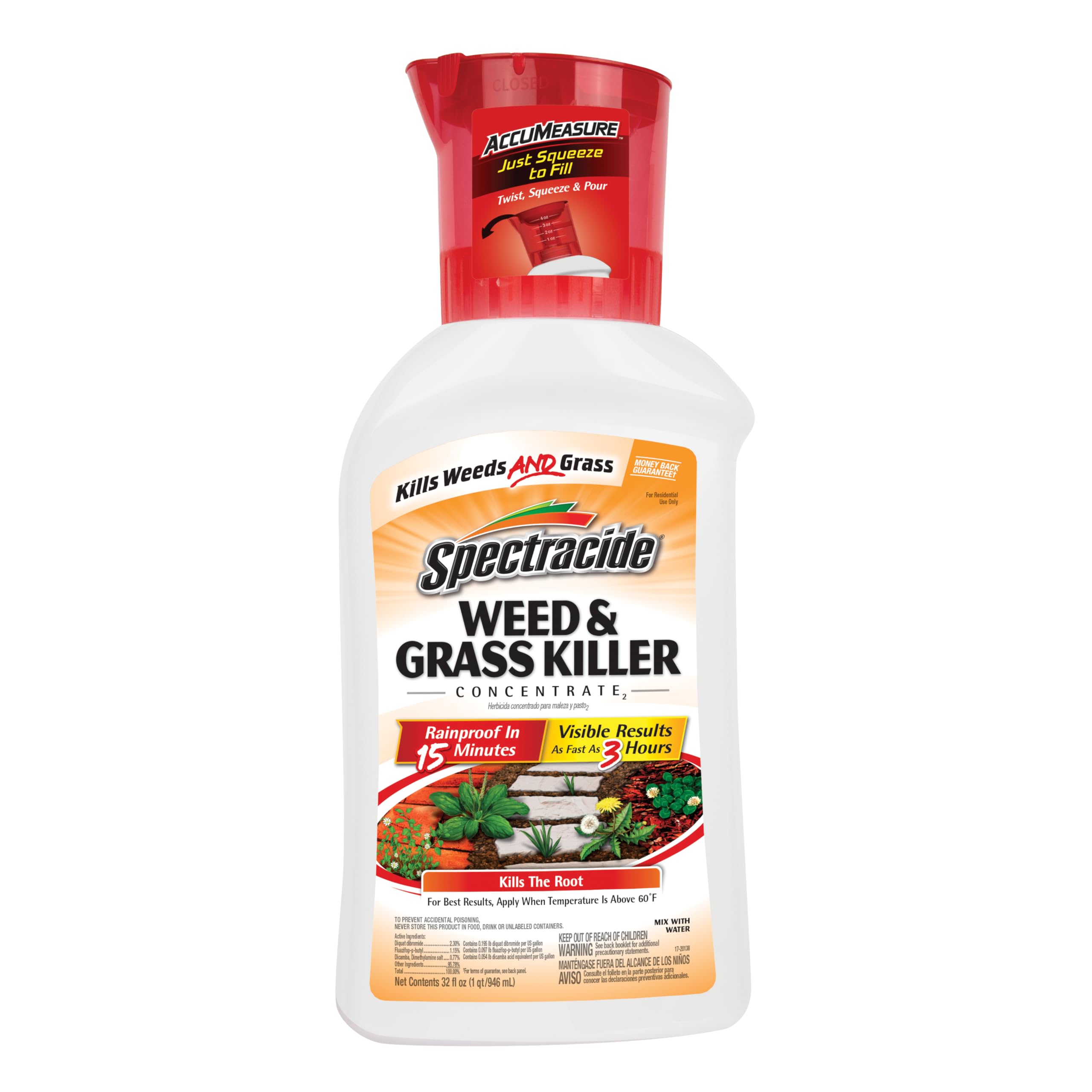
Spectracide’s concentrate uses diquat dibromide as its active ingredient, a contact herbicide that desiccates plant tissue on contact. Users report visible browning and wilting within three hours of spraying, making this the fastest-acting option in the lineup. The Accumeasure cap system aims to simplify measuring, though some users find it less convenient than a standard cap.
The 32-ounce bottle covers up to 1,350 square feet when mixed at the recommended rate. The product is rainfast in just 15 minutes, which is extremely useful for quick applications before an expected storm. Because diquat is a contact killer that does not translocate to roots, this formula is best suited for annual weeds, young grass, and green top growth rather than established woody brush. It kills the roots of small plants only because the foliage dieback eventually starves the root system.
Choose this when you need rapid visual results on weeds in driveways, walkways, and patio cracks. It is not the right choice for deep-rooted perennial vines or thick woody stems that require systemic translocation.
Why it’s great
- Visible results in as little as 3 hours after spraying.
- Rainproof after only 15 minutes of drying time.
- Good coverage at 1,350 square feet per bottle.
Good to know
- Contact killer only; weak on established woody roots.
- Accumeasure measuring cap can be finicky for some users.
6. Control Solutions Eraser & Grass Killer Concentrate
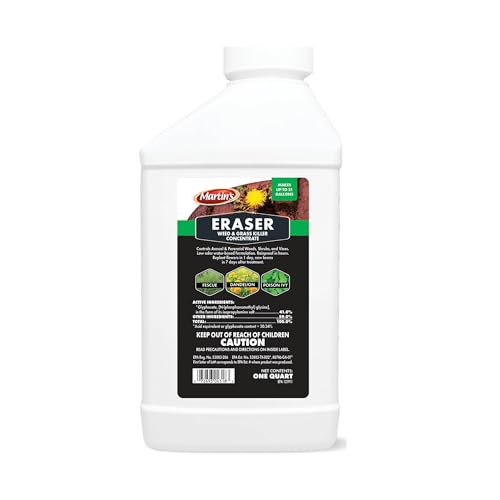
Control Solutions Eraser is a no-frills glyphosate concentrate at a 41% active ingredient level — the same concentration found in many premium brands but at a fraction of the cost. This is a broad-spectrum, non-selective herbicide that kills everything green it touches by inhibiting the EPSP synthase enzyme. Users report that it takes 7 to 14 days for full browning on most weeds, which is slower than diquat-based formulas but more thorough on root systems.
The 32-ounce bottle makes roughly 8 to 16 gallons of mixed spray depending on your target weed type. Because glyphosate has no residual soil activity, you can replant treated areas almost immediately after the weeds die. Many long-time users have relied on this formula for 15+ years as their go-to general-purpose killer. The slow systemic action means patience is required — do not expect the instant gratification of a contact killer.
This is the ideal choice for budget-conscious homeowners who need a reliable general-purpose herbicide for weeds, annual grasses, and light brush along fences and foundations. Add a surfactant like liquid dish soap to improve leaf adhesion and uptake.
Why it’s great
- Industry-standard 41% glyphosate at a very low cost per ounce.
- No residual soil activity allows immediate replanting.
- Low-odor, water-based formula is easy to mix.
Good to know
- Slow acting; full death takes 1 to 2 weeks.
- Less effective on established woody brush and poison ivy.
7. Southern AG 01113 Brush Weed Killer

Southern AG’s 01113 is a straight triclopyr concentrate in a compact 32-ounce bottle, offering the same active ingredient found in premium brush killers at a noticeably lower entry point. This is specifically formulated for use on non-crop areas like roadsides, rangeland, pastures, and fence lines. Users find it highly effective on most brush species, including vines, with results appearing within days of application.
The small bottle size makes it convenient for homeowners who need to spot-treat invasive brush without committing to a gallon jug. It also doubles as a stump treatment: when painted onto freshly cut stumps, it prevents regrowth from sprouting. One user noted it killed weeds that had grown through weed block and rock, indicating its potency against established, resilient plants.
Choose this when you need a dedicated triclopyr solution for spot-killing brush and vines on a smaller property. It is also an excellent choice for precision work like stump painting and targeted vine removal around trees, as the concentrated formula can be applied with a brush or small sprayer.
Why it’s great
- Pure triclopyr chemistry targets tough woody brush effectively.
- Compact 32 oz size is ideal for spot treatments and stump painting.
- Good value compared to premium triclopyr brands.
Good to know
- Small bottle is not economical for large acreage.
- May not kill extremely resilient species like strangler fig on first application.
FAQ
What is the best time of year to apply brush killer spray?
Will brush killer spray harm my lawn grass?
Final Thoughts: The Verdict
For most users, the best brush killer spray winner is the Crossbow Herbicide 1 Gallon because it delivers the most effective triclopyr-based chemistry for serious woody control with unmatched value per gallon. If you need selective pasture protection, grab the Remedy Ultra. And for fast-acting spot treatments on poison ivy, nothing beats the Roundup Poison Ivy Plus.