
An A3 flatbed scanner is the only practical way to digitize large-format originals like architectural blueprints, tabloid-size magazines, engineering drawings, artists’ portfolios, and thick reference books without cropping or distortion. Unlike document feeders that bend paper or A4 beds that require stitching, a true A3 flatbed provides a single, stable glass surface up to 11.7″ x 16.7″ to capture every edge and detail in one pass. The right unit balances optical resolution, scan speed, color depth, and software workflow to match your specific volume, from archival-quality art reproduction to high-speed office digitization.
I’m Min — the co-founder and writer behind Gadgets Feed. For this guide, I analyzed over 1,200 verified user reviews, cross-referenced technical specifications from eleven competing A3 flatbed scanners, and ranked each unit by real-world performance across resolution accuracy, scan speed, software reliability, and build quality to identify the right option for every budget and use case.
Whether you manage a busy library, digitize family photo albums, or scan oversized engineering documents, choosing the wrong model can mean blurred edges, washed-out colors, or hours wasted on post-processing. This guide cuts through the noise to help you find the truly best a3 flatbed scanner for your specific workflow and budget.
How To Choose The Best A3 Flatbed Scanner
Before comparing specific models, you need to understand the three core decisions that will define your scanning experience: sensor technology, optical resolution, and software compatibility. Each factor directly impacts the quality of your final digital files and the time you spend behind the glass.
CCD vs CIS Sensors: The Color and Depth Trade-Off
Charge-Coupled Device (CCD) sensors use a lens and mirror system to capture light, delivering superior color fidelity, dynamic range, and shadow detail — essential for photographs, artwork, and bound book spines where lighting is uneven. Contact Image Sensor (CIS) technology is thinner, more energy-efficient, and often faster, but produces flatter images with less depth of field. If your primary content is flat printed documents or CAD drawings, a CIS model offers great speed and value. For art reproduction or archival-quality work, a CCD unit is a worthwhile investment.
Optical Resolution and Color Depth: Beyond the Headline Numbers
Don’t let inflated software-interpolated numbers fool you. Optical resolution — measured in true dots per inch (dpi) — determines how much real detail the sensor captures. For text and line art, 600 dpi is plenty. For fine art and high-quality photo prints, 1200 dpi or 2400 dpi optical makes a visible difference. Color depth (24-bit vs. 48-bit) matters for smooth gradients in artwork and film scanning: 48-bit captures billions of colors, reducing banding in skies, skin tones, and shadow transitions. Always check the optical resolution — not the “max” or “interpolated” figure — in the specs table.
Build Quality, Software, and Workflow Integration
A scanner that produces perfect images is worthless if the included software crashes on your operating system, the driver is unsupported after a year, or the lid doesn’t sit flush against a thick book. Look for models with TWAIN, WIA, or ICA driver support for broad compatibility. Bundled OCR tools like ABBYY FineReader can save you from buying third-party software. Also consider physical footprint: A3 flatbeds are large, and some frameless designs accommodate bound books or thick documents better than traditional raised-lid models.
Quick Comparison
On smaller screens, swipe sideways to see the full table.
| Model | Category | Best For | Key Spec | Amazon |
|---|---|---|---|---|
| VIISAN VF3240 | CIS Flatbed | Speed for high-volume A3 office docs | 2400 dpi optical / 4 sec A3 | Amazon |
| Plustek OpticPro A320E | CCD Flatbed | Professional color and shadow detail | 800 dpi optical / CCD sensor | Amazon |
| VIISAN VF3120 | CIS Flatbed | Value-priced A3 for documents & photos | 1200 dpi optical / 8 sec A3 | Amazon |
| Plustek OS1180 | CIS Flatbed | Budget-friendly tabloid scanning | 1200 dpi optical / 9 sec A3 | Amazon |
| CZUR Aura Pro | Overhead Camera | Bound book digitization with AI flatten | 4320×3240 res / 2 sec page | Amazon |
| CZUR Shine Ultra Pro | Overhead Camera | Portable A3 book/document capture | 5696×4272 res / 440 DPI A4 | Amazon |
| Brother ADS-1350W | ADF Sheetfed | High-speed office correspondence | 600 dpi / 30 ppm duplex | Amazon |
| ScanSnap iX2500 | ADF Sheetfed | Cloud-enabled multi-page document flow | 600 dpi / 45 ppm duplex | Amazon |
| Epson Perfection V600 | CCD Photo | 35mm film, slides, and photo prints | 6400×9600 dpi / 48-bit color | Amazon |
| Fujitsu fi-7260 | Hybrid ADF/FB | Professional office with occasional A4 flatbed | 600 dpi / 60 ppm duplex | Amazon |
| Epson Perfection V800 | CCD Photo Pro | Professional film, medium-format, art | 6400×9600 dpi / Dual Lens | Amazon |
In‑Depth Reviews
1. VIISAN VF3240 A3 Scanner

The VIISAN VF3240 delivers the fastest A3 color scan speeds in its price bracket — a genuine 4-second pass at 200 dpi — without sacrificing optical resolution. Its 2400 dpi CIS sensor and 48-bit color depth capture fine pencil lines and intricate CAD details with enough clarity for professional reproduction, though Mac users must rely on ICA driver support rather than dedicated software.
Real-world owners consistently highlight the frameless glass design that allows edge-to-edge scanning of thick books and oversized newspapers without cropping. The Auto-Scan function, which fires when you close the lid, really does speed up batch workflows. Several reviewers note that color scans for artwork required minor saturation adjustments in post-processing, but the detail retention on pencil drawings earned high marks.
A few downsides include noticeable operational noise and a plastic lid joint that feels less robust than premium CCD competitors. Windows users should note that the WIA driver caps at 600 dpi — you’ll need the ViiScan software for full-resolution output. For tabloid-size office documents, CAD blueprints, and high-volume batch scanning, the VF3240 offers an unbeatable speed-to-quality ratio.
Why it’s great
- Fastest A3 scan speed in this guide at 4 seconds for 200 dpi color
- Frameless design allows true edge-to-edge scanning for thick books
- 2400 dpi optical resolution captures fine art details
Good to know
- Mac users rely on ICA driver; no dedicated scanning utility included
- WIA driver on Windows limited to 600 dpi
- Noise level is higher than CCD-based alternatives
2. Plustek OpticPro A320E

The Plustek OpticPro A320E brings genuine CCD sensor technology to the A3 form factor, delivering richer color saturation and deeper shadow detail than any CIS-based alternative at its price. Its 800 dpi optical resolution may seem modest on paper, but the CCD sensor produces smoother gradients and better near-white detail — crucial for scanning fine art prints or textured paper documents where CIS can leave images looking flat.
Users praise the intuitive Plustek software and the ability to batch-scan multiple items on the glass. The lid design accommodates bound books better than many frameless scanners, and the included Doc Action software provides direct scan-to-print, email, and PDF workflows. However, professional designers reported that color accuracy falls short of Epson-grade CCD units, with a tendency to blow out near-white highlights at 600 dpi that required manual correction.
The bundled software is the weakest link — the auto-crop feature can miss edges, and there is no dust removal tool, forcing you to clean the glass meticulously. TWAIN and WIA support ensures broad compatibility with macOS, Windows, and even Linux via SANE drivers. For graphic designers and archivists who need CCD color depth without jumping to thousand-dollar tiers, the A320E is a strong contender.
Why it’s great
- CCD sensor delivers superior color depth and shadow detail vs CIS alternatives
- 12″ x 17″ scan area handles oversized books and maps
- Broad driver support including TWAIN, WIA, and Linux SANE
Good to know
- Bundled software lacks dust removal and has unreliable auto-crop
- 800 dpi optical is lower than some competitors at this price
- Near-white highlights can appear blown out at default settings
3. VIISAN VF3120 A3 Flatbed Scanner

The VIISAN VF3120 offers the lowest entry point into true A3 flatbed scanning without compromising on optical resolution. Its 1200 dpi CIS sensor and 48-bit color depth produce detailed scans of typed documents, line art, and photo prints, while the 8-second scan time at 200 dpi keeps small-batch workflows moving. The frameless design and four-panel control buttons (scan, email, print, PDF) make it a self-contained productivity station.
Artists and school users found the wide scanning area perfect for large artwork sections and legal-size documents, though several reviews noted that color scans appeared washed out or dull right out of the box, requiring post-processing in Photoshop or similar software. The 48-bit processing helps for gradient-heavy images, but the CIS sensor simply cannot match the color vibrancy of a CCD unit.
Setup is straightforward on Windows via the included ViiScan software, which supports full 1200 dpi scans. Mac users should be aware that only the ICA driver works — the bundled software is Windows-only. A few units shipped with white line artifacts that required cleaning the glass, and customer service responsiveness was inconsistent. If your primary need is A3 document scanning on a tight budget, the VF3120 delivers solid hardware at a very compelling price.
Why it’s great
- True 1200 dpi optical resolution at the lowest A3 flatbed price point
- Frameless design enables scanning of oversized books and art boards
- Auto-Scan function boosts batch productivity
Good to know
- Color scans can appear washed out compared to CCD sensors
- Mac support limited to ICA driver only; no software bundle
- Some units required cleaning to remove white line artifacts
4. Plustek OS1180 Flat Scanner

The Plustek OS1180 strips away extraneous features to deliver a reliable, no-frills A3 scanning experience at the lowest price in the guide. Its 1200 dpi CIS sensor and LED light source provide fast warm-up and consistent 9-second A3 scans, while the one-touch preset buttons let you quickly switch between scan modes without diving into software menus.
Comic artists and educators found the 12″ x 17″ scanning area ideal for tabloid-sized boards and sheet music, with enough resolution to capture fine pen lines. The bundled ABBYY FineReader 12 Sprint provides solid OCR for searchable PDFs, though the software is an older version. Long-term reliability is a concern — several reviewers reported failures within two years, and repair costs approached the unit’s original price.
The built-in buttons can be non-functional on some units, forcing complete reliance on the computer interface. The USB 2.0 connection is adequate for most tasks but slower than modern USB 3.0 or USB-C options. For budget-constrained schools, small offices, or personal projects that require occasional A3 scanning, the OS1180 offers tremendous value — just budget for a possible earlier-than-expected replacement.
Why it’s great
- Lowest-cost A3 flatbed scanner with 1200 dpi optical resolution
- One-touch preset buttons simplify common scanning tasks
- Bundled ABBYY FineReader provides solid OCR for searchable PDFs
Good to know
- Reports of units failing within two years of regular use
- Built-in buttons may be non-functional on some units
- USB 2.0 connection limits transfer speed for large scans
5. CZUR Aura Pro Book & Document Scanner

The CZUR Aura Pro takes a fundamentally different approach to A3 scanning: rather than a traditional glass flatbed, it uses an overhead 20MP camera that captures open books in under 2 seconds per spread. Its AI-powered auto-flatten and deskew technology corrects the natural curve of a book spine, producing flat, distortion-free page images without pressing the spine flat.
Users consistently report that the Aura Pro digitized 200-page books in under 20 minutes — a task that would take hours on a traditional flatbed. The 32 LED lights plus two supplemental side lights eliminate glare on glossy magazine pages, and the integrated smart lamp modes make it usable as a reading light. OCR supports 180+ languages, though Thai, Hebrew, and Arabic are not supported.
There is a moderate learning curve: perfect page detection requires correct positioning, and the scanner occasionally captures a hand or misdetects page borders on the first few attempts. The included foot pedal and sound-control technology speed up repetitive workflows. For researchers, librarians, and anyone digitizing bound volumes, this overhead design is faster and less destructive than a traditional flatbed.
Why it’s great
- Scans a book spread in 2 seconds without pressing the spine flat
- AI auto-flatten and deskew eliminates curved page distortion
- Dual side lights eliminate glare on glossy paper
Good to know
- Requires practice for consistent page border detection
- Overhead design may capture hands or objects during scanning
- Not suitable for glossy photo prints or highly reflective materials
6. CZUR Shine Ultra Pro 24MP Scanner

The CZUR Shine Ultra Pro upgrades its sibling with a 24MP autofocus camera for even higher detail capture at 5696×4272 resolution, capable of 440 DPI at A4 and 320 DPI at A3. The foldable, height-adjustable design weighs only 2 pounds, making it genuinely portable for fieldwork, libraries, and classrooms where a traditional flatbed would be impractical. The USB-powered operation means no external power brick needed.
Music teachers and archive volunteers praise its ability to scan A3 sheet music and oversized ledger books to PDF in seconds, with built-in curl removal and JPG-to-PDF batch conversion. The software suite supports OCR for 180+ languages and outputs to Word, Excel, and searchable PDF. Video conference compatibility with Zoom and Skype adds unexpected utility for remote document sharing.
Glossy materials remain a weakness — the autofocus struggles with highly reflective surfaces, and users report that turning off the scanner light is the only reliable workaround. The software UI requires a 1920×1080 screen at minimum, which may be an issue on older laptops. For portable A3 document capture of matte originals, the Shine Ultra Pro’s combination of speed, portability, and AI correction is unmatched.
Why it’s great
- 24MP autofocus camera captures A3 at 320 DPI in seconds
- Foldable, 2-pound design is genuinely portable for fieldwork
- Built-in curl removal and batch PDF conversion for sheet music
Good to know
- Struggles with glossy or highly reflective materials
- Software UI requires 1920×1080 screen resolution minimum
- Not a true flatbed — page flaring can occur without practice
7. Brother ADS-1350W Wireless Scanner

The Brother ADS-1350W is a compact sheet-fed scanner designed for speed and portability, not for oversized originals — it appears in this guide because many buyers who search for “A3 flatbed scanners” also need a fast, capable scanner for standard office documents. Its 30 ppm single-pass duplex scanning and 20-page ADF make it ideal for digitizing correspondence, receipts, and business cards, with Wi-Fi connectivity for cable-free operation.
Reviewers consistently praise its fast scan speeds and reliable ADF feeding — the CCD sensor produces clean, readable scans at 600 dpi. The included software bundle covers image editing, OCR, and receipt management. However, the maximum document size is 8.5″ x 14″, which is A4/legal, not A3. The USB-C to USB-C cable in the box is incompatible with older laptops, requiring a separate adapter for non-USB-C ports.
Several users reported severe setup difficulties on Windows 11 with 2.4 GHz Wi-Fi, requiring hours of troubleshooting or a wired connection. The 20-page ADF is small for high-volume scanning, and the flatbed is entirely absent — this is a sheet-fed scanner only. If you need a fast, portable companion for standard paper sizes alongside a dedicated A3 flatbed, the ADS-1350W is a capable secondary device.
Why it’s great
- 30 ppm single-pass duplex scanning is very fast for office documents
- Compact, USB-C powered design is highly portable
- Includes 6 software applications for OCR and receipt management
Good to know
- Maximum paper size is 8.5″ x 14″ — not A3 or tabloid
- 20-page ADF is small for high-volume batch scanning
- Setup can be problematic on Windows 11 with 2.4 GHz Wi-Fi
8. ScanSnap iX2500 Wireless Scanner
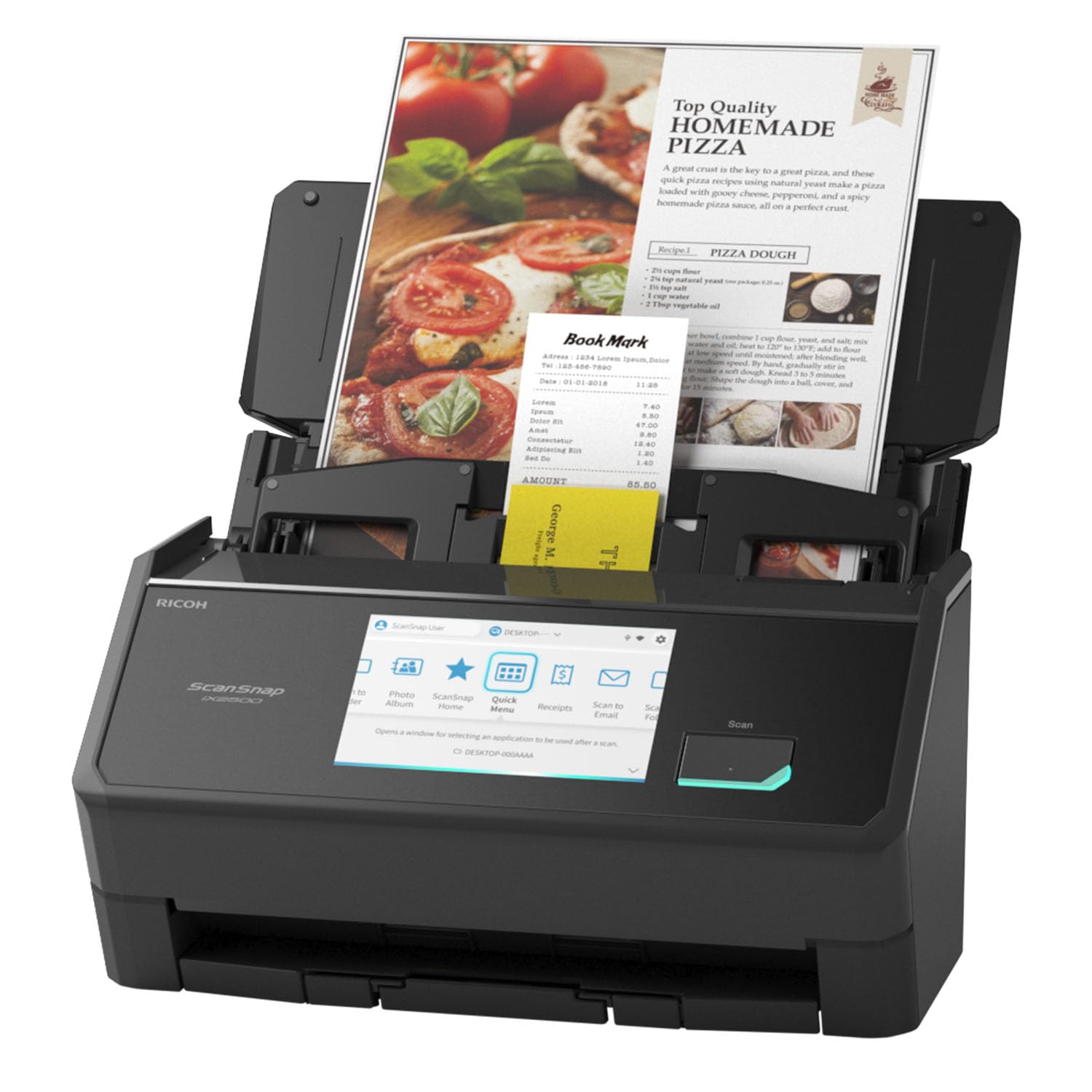
The ScanSnap iX2500 is another sheet-fed powerhouse — not an A3 flatbed — but its 45 ppm double-sided scanning, 100-page ADF, and 5-inch touchscreen make it the ultimate document workflow hub. Built-in Wi-Fi 6 provides the fastest wireless scanning in its class, and the customizable touchscreen profiles allow one-touch routing to cloud services, email, or specific computer folders.
Nonprofits and high-volume offices report scanning thousands of pages per week with minimal jams, thanks to the brake roller system and multi-feed sensor. The automatic optimization adjusts color, brightness, and contrast without manual intervention, and the auto-rotate and straightening features reduce post-processing. Scan quality at 600 dpi is excellent for text and most graphics, though photo scanning is not recommended.
The software is the most common complaint — the new Quick Menu is slower and more complex than previous versions, and some users found cloud features intrusive. The ADF lacks an extension tray, and the output tray feels flimsy. For users whose primary workflow involves multi-page letter/legal documents and cloud integration, the iX2500 is unmatched in speed and reliability, but it cannot replace an A3 flatbed for oversized originals.
Why it’s great
- 45 ppm duplex speed with a 100-page ADF for high-volume scanning
- Wi-Fi 6 enables fast, stable wireless scanning to cloud services
- Touchscreen profiles allow one-touch routing to specific destinations
Good to know
- Letter/legal size only — no A3 or tabloid scanning capability
- Software is slower and more complex than previous ScanSnap versions
- ADF lacks extension tray and output tray feels fragile
9. Epson Perfection V600 Photo Scanner

The Epson Perfection V600 is the gold standard for home photo and film digitization, offering a true 6400×9600 dpi CCD sensor and a built-in Transparency Unit that handles four 35mm mounted slides or 12 negatives per batch. Its 48-bit color depth and 4.0 Dmax dynamic range capture smooth tonal transitions in shadow areas that cheaper CIS sensors simply miss — making it ideal for restoring faded vintage prints and scanning fine art.
Users with collections of old negatives, slides, and medium-format film consistently report exceptional results after some learning curve with the software. The DIGITAL ICE technology effectively removes dust and scratches from film scans without softening detail. However, the maximum scanning area is 8.5″ x 11.7″ — this is an A4 flatbed, not A3 — so oversized originals must be scanned in sections and stitched.
The included Epson Scan 2 software has a dated interface, and the imaging sensor struggles with very thin lines on documents, sometimes bleaching them out unless you manually adjust brightness to -50 for each session. Scan times are slow: 10.5 minutes for four 35mm slides at 4800 dpi with ICE enabled. For dedicated photo and film archivists who rarely exceed A4 size, the V600 is still the benchmark at its price point.
Why it’s great
- True 6400×9600 dpi CCD sensor with 4.0 Dmax for film and art
- Built-in Transparency Unit for 35mm slides and negatives
- DIGITAL ICE technology removes dust and scratches automatically
Good to know
- Scan area is A4 (8.5″ x 11.7″) — not A3 or tabloid
- Scan times are very slow at high resolutions
- Software is dated and requires manual brightness adjustments
10. Fujitsu fi-7260 Desktop Scanner

The Fujitsu fi-7260 is a professional-grade hybrid scanner that combines a 60 ppm duplex ADF with an A4 flatbed, designed for mission-critical office environments where reliability and image quality are non-negotiable. Its CCD sensor, ultrasonic double-feed detection, and brake roller system maintain consistent feeding through tens of thousands of pages with minimal jams — one user reported 97,500 scans without a single roller replacement.
The flatbed is A4 size only, and even then, it doesn’t support full-legal scanning on the glass — a meaningful limitation for tabloid or A3 documents that must be scanned in sections. The bundled PaperStream Capture software is powerful but notoriously difficult to configure, with a clunky interface that requires dedicated training time. Many professional users recommend pairing it with Kofax VRS or ABBYY FineReader for optimal image cleanup.
Driver updates have caused issues for some long-term users, with persistent errors after firmware upgrades. The unit is heavy at 19.4 pounds and requires a permanent desk spot. For organizations that scan thousands of letter/legal pages daily and need absolute feeding reliability, the fi-7260 is a proven workhorse, but it is not a solution for A3 oversized originals.
Why it’s great
- 60 ppm duplex speed with exceptional feeding reliability for high volumes
- CCD sensor delivers industry-standard image quality for documents
- Ultrasonic double-feed detection prevents paper jams and data loss
Good to know
- Flatbed is A4 only — cannot scan full-legal or A3 without stitching
- PaperStream Capture software is powerful but very difficult to use
- Driver updates have caused persistent errors for some users
11. Epson Perfection V800 Photo Scanner

The Epson Perfection V800 is the definitive scanner for serious film photographers and archival-quality art reproduction. Its exclusive Dual Lens System automatically selects between two lenses — one optimized for 6400 dpi film scanning, the other for 9600 dpi reflective scanning — ensuring maximum resolution for each media type. The 4.0 Dmax dynamic range and 48-bit color depth produce the finest shadow detail and smoothest gradations of any flatbed under .
Medium-format photographers shooting 6×6 and 6×7 film praise the V800’s ability to scan 120 film with exceptional detail and minimal grain, while the included film holders accommodate 35mm strips and mounted slides. The auto-focus feature sharpens scans of slightly curved film surfaces. However, the maximum scan area is A4/letter size — the V800 cannot scan A3 documents or artwork larger than 8.5″ x 11.7″.
The bundled SilverFast SE software has known compatibility issues with modern macOS versions, including crashes and poor negative detection, forcing many users to rely on the older Epson Scan 2 utility instead. The platen glass is prone to internal dust over time, and the unit is heavy at 20.9 pounds. For fine art photographers and archivists who prioritize film capture quality over document scanning, the V800 remains the uncompromising benchmark.
Why it’s great
- Dual Lens System optimizes resolution for film and reflective media
- 4.0 Dmax and 48-bit color deliver best-in-class dynamic range
- Handles medium-format 120 film with exceptional detail
Good to know
- Scan area is A4 (8.5″ x 11.7″) — not suitable for A3 originals
- Bundled SilverFast SE software has compatibility issues on macOS
- Very heavy at 20.9 pounds — not portable
FAQ
Can I scan a thick book on an A3 flatbed scanner?
What DPI do I need for scanning A3 artwork?
Why do my color scans look washed out on a CIS scanner?
Final Thoughts: The Verdict
For most users, the best a3 flatbed scanner winner is the VIISAN VF3240 because it combines the fastest A3 scan speeds with 2400 dpi optical resolution and a frameless design at a price that undercuts every CCD competitor while still delivering excellent document and line-art quality. If you need professional CCD color accuracy for fine art or bound book digitization, grab the Plustek OpticPro A320E. And for anyone dedicated to archiving 35mm film and medium-format negatives, nothing beats the Epson Perfection V600 or its bigger sibling, the V800.