
Optical zoom remains the single feature that separates a real camera from a smartphone. When you need to capture a distant bird, a performer on stage, or a subject across a conference room, digital cropping — no matter how many megapixels — destroys detail. True optical zoom uses glass and focal length to magnify without loss, making it the defining spec for anyone who shoots wildlife, sports, events, or travel. The challenge is finding the right balance between reach, image stabilization, and sensor quality across wildly different price tiers.
I’m Min — the co-founder and writer behind Gadgets Feed. For this guide, I spent hours combing through technical datasheets, customer field reports, and real-world sample images to isolate which zoom cameras deliver on their telephoto promises without hiding behind marketing numbers.
Whether you need a pocketable travel companion or a PTZ unit for streaming, this analysis of the best camera optical zoom options on the market will help you match reach to your specific shooting scenario.
How To Choose The Best Camera Optical Zoom
Selecting a zoom camera means navigating three interconnected variables: focal length range, aperture brightness at the long end, and stabilization effectiveness. A 60x zoom lens sounds impressive, but if the aperture narrows to f/6.5 at 1200mm, you lose so much light that the shutter speed drops and images turn soft. Beginners often fixate on the zoom number alone without considering the supporting specs that make that zoom usable in real-world conditions.
Focal Length and Optical Zoom Ratio
The zoom ratio (e.g., 25x, 30x, 125x) tells you how many times the maximum focal length exceeds the minimum. A 24–600mm lens offers a 25x zoom range. The critical detail is the starting point — a 24mm wide-angle gives you more versatility for landscapes than a 28mm start. Check the millimetre equivalents, not just the multiplier, to understand how much reach you actually gain at the telephoto end.
Image Stabilization Type and Stops
At focal lengths beyond 300mm, camera shake becomes the biggest enemy of sharpness. Optical Image Stabilization shifts lens elements to counter movement, delivering 3 to 5 stops of correction. Digital stabilization crops the frame and reduces resolution. For handheld telephoto shooting, optical stabilization is non-negotiable — look for specifications that state the number of stops (e.g., 4.0-stop VR) rather than just the presence of the feature.
Sensor Size and Low-Light Performance
Superzoom cameras typically use 1/2.3-inch sensors, which force higher ISO values in dim conditions and introduce noise. Larger sensors like 1-inch or Micro Four Thirds handle low light better but are rarely paired with extreme zoom ranges in compact bodies. Decide which trade-off matters more: the ability to shoot at 1200mm in daylight, or cleaner images at 400mm in overcast or indoor settings.
Quick Comparison
On smaller screens, swipe sideways to see the full table.
| Model | Category | Best For | Key Spec | Amazon |
|---|---|---|---|---|
| Nikon COOLPIX P1100 | Premium Superzoom | Wildlife and extreme telephoto | 125x optical zoom (24–3000mm) | Amazon |
| Panasonic LUMIX FZ80D | Mid-Range Superzoom | Versatile travel and wildlife | 60x optical zoom (20–1200mm) | Amazon |
| Panasonic LUMIX TZ/ZS99 | Premium Compact | Concert and travel pocket zoom | 30x LEICA zoom (24–720mm) | Amazon |
| Canon PowerShot V1 | Hybrid Vlogging | Content creation and streaming | 16–50mm F2.8-4.5 lens (3.1x) | Amazon |
| TONGVEO PTZ Camera | PTZ Conference | Church and meeting room streaming | 20x optical zoom, 1080p 60fps | Amazon |
| iuZee 4K PTZ Camera | 4K PTZ System | Professional live streaming | 20x optical zoom, 4K 30fps | Amazon |
| Kodak PIXPRO AZ255 | Value Superzoom | Budget wildlife and vlogging | 25x optical zoom (24–600mm) | Amazon |
| Kodak PIXPRO FZ45 | Entry-Level Compact | Casual everyday snapshots | 4x optical zoom (27mm wide) | Amazon |
In‑Depth Reviews
1. Nikon COOLPIX P1100

The Nikon COOLPIX P1100 sits at the top of the superzoom pyramid with a staggering 125x optical zoom that reaches an equivalent of 24–3000mm. No other compact camera in this roundup comes close to that telephoto ceiling. The Dual Detect Optical VR delivers 4.0 stops of stabilization, which is essential when you are framing a subject at 3000mm — without it, every heartbeat shows up as camera shake. The 16MP sensor captures 4K UHD video and supports RAW format, giving you flexibility in post-processing that JPEG-only cameras cannot match.
The dedicated Bird-watching mode, selectable directly from the mode dial, optimizes shutter speed and focus tracking for avian subjects. The Macro mode focuses as close as 1 cm, revealing details that the zoom range alone would not capture. The customizable control ring lets you assign manual focus, exposure compensation, or white balance to a physical control — a rare tactile advantage in the superzoom category. The rotating LCD screen aids in overhead or ground-level compositions that would otherwise require contortion.
Users consistently praise the image clarity at extreme distances, with several reporting sharp captures of wildlife from over half a mile away. The main trade-off is weight: at over 1.4 kg, the P1100 is not a pocket camera. The lens extends significantly at full zoom, and without a tripod, video at 3000mm can exhibit micro-vibrations. The F2.8–F8.0 aperture range means you lose light quickly at the long end, so bright outdoor conditions are where this camera truly shines.
Why it’s great
- 125x optical zoom provides the longest reach available in a compact superzoom body
- Dual Detect Optical VR delivers 4.0-stop stabilization for handheld telephoto shooting
- RAW format support preserves editing flexibility that JPEG-only cameras lack
Good to know
- Heavy build requires a tripod for stable video at maximum zoom extension
- Aperture narrows significantly at the long end, demanding good light conditions
2. Panasonic LUMIX FZ80D

The Panasonic LUMIX FZ80D packs a 60x optical zoom covering 20–1200mm, a range that handles sweeping landscapes and distant wildlife without changing lenses. The Power Optical Image Stabilizer minimizes blur at the telephoto end, making handheld shots at 1200mm more practical than the raw focal length suggests. The 16MP sensor records 4K video and supports 4K Photo mode at 30 fps, letting you extract 8MP stills from video bursts — useful for capturing split-second action.
The 0.39-inch OLED viewfinder provides a bright composition tool for bright outdoor conditions where the 3-inch LCD might wash out. USB-C charging simplifies travel power management, though the included battery delivers roughly 1.5 hours of continuous shooting. The F2.8–F5.9 aperture is noticeably brighter at the wide end than many superzoom competitors, helping to keep ISO lower in the first third of the zoom range.
Users highlight the camera’s value proposition for beginners entering wildlife or sports photography, noting that the zoom quality remains clean without the distortion common in cheaper optics. The learning curve is steeper than a basic point-and-shoot due to the sheer number of menu options and physical controls. The 1/2.3-inch sensor struggles in low light beyond ISO 800, and some users report that the in-camera charging is slow, recommending an external charger for faster turnaround.
Why it’s great
- 60x optical zoom offers an exceptional reach-to-price ratio for wildlife and sports shooters
- Power O.I.S. enables usable handheld shots at 1200mm in good light
- 4K Photo burst mode captures fleeting moments at 30 frames per second
Good to know
- Small sensor produces noticeable noise in dim conditions above ISO 800
- Extensive menu system requires time to learn for full control
3. Panasonic LUMIX TZ/ZS99

The Panasonic LUMIX TZ/ZS99 (also sold as the TZ99) crams a 24–720mm LEICA DC Vario-Elmar lens into a body that fits into a jeans pocket. The 30x optical zoom covers everything from group photos at 24mm to stage performers at 720mm, and the 5-Axis HYBRID O.I.S. compensates for hand shake impressively well given the camera’s weight of roughly 300g. The 20.3MP 1/2.3-inch sensor captures 4K video at 30p and supports 4K PHOTO burst mode at 30 fps.
The 1,840k-dot tiltable touchscreen is a significant upgrade from fixed-LCD competitors, allowing waist-level and overhead compositions for concert or crowd shooting. Bluetooth 5.0 and the dedicated Send Image button enable quick wireless transfers to a smartphone without needing to dive into menus. The F3.3–F6.4 aperture is average for this class, but the LEICA lens coating helps control flare and chromatic aberration better than generic optics.
Users consistently report great color accuracy straight out of camera, with minimal editing needed for sharing. The stepped zoom feature — which locks onto specific focal lengths — and Lens Position Resume (which returns to the last zoom position after power-off) are thoughtful additions for repeat framing. The autofocus can hunt in low contrast or dark environments, and the small sensor means images above ISO 1600 show visible noise. Several users also mention that the LCD is difficult to read in direct sunlight, making the viewfinder essential on bright days.
Why it’s great
- 30x LEICA zoom fits in a pocket, ideal for concerts and travel where bulk is a concern
- 5-Axis HYBRID O.I.S. delivers steady handheld footage at 720mm
- Tiltable touchscreen and Bluetooth 5.0 simplify composition and sharing on the go
Good to know
- Small sensor limits usable ISO to 1600 before noise becomes visible
- Autofocus struggles in low-contrast or dimly lit scenes
4. Canon PowerShot V1

The Canon PowerShot V1 takes a different approach to zoom by prioritizing sensor quality over reach. The 1.4-type 22.3MP sensor is substantially larger than the 1/2.3-inch sensors in superzoom cameras, delivering significantly better dynamic range and low-light performance. The built-in 16–50mm F2.8-4.5 lens (35mm equivalent) offers a 3.1x optical zoom — modest by superzoom standards, but the F2.8 aperture at the wide end lets in more light, keeping ISO low in indoor and evening environments.
Canon engineered the V1 with a built-in cooling fan, enabling long recording sessions without overheating — a common limitation in compact cameras used for livestreaming or vlogging. The Canon Log 3 gamma curve records 10-bit color depth starting at ISO 800, giving video editors latitude to grade footage without banding. The hybrid autofocus system with 100 AF points locks onto subjects quickly, and eye detection works reliably for solo presenters.
Users praise the image quality for a compact camera, noting that the sensor rivals much larger setups in controlled lighting. The lack of optical image stabilization is a notable gap — electronic stabilization works but introduces crop and is not effective for walking footage. The SD card slot sits under the battery door, which can be blocked by an L-plate or quick-release mount. No battery charger is included; USB-C charging is the only option, which slows down multi-battery workflows.
Why it’s great
- Large 1.4-type sensor provides superior low-light performance and dynamic range
- Built-in cooling fan enables unlimited 4K recording for streaming and vlogging
- Canon Log 3 with 10-bit color depth gives video editors professional grading options
Good to know
- No optical image stabilization limits handheld video to static or slow pans
- 3.1x optical zoom range is modest compared to dedicated superzoom alternatives
5. TONGVEO Conference Room PTZ Camera
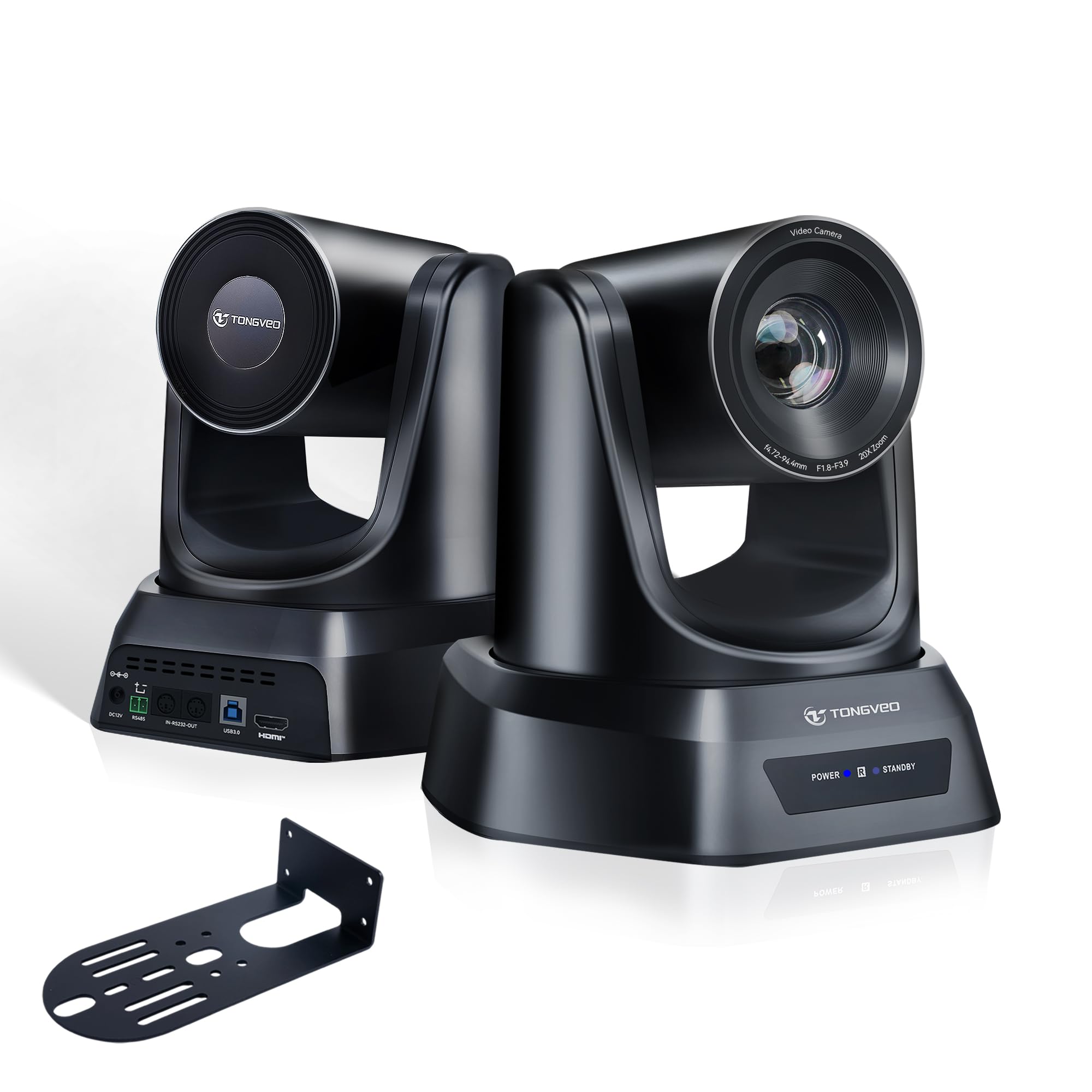
The TONGVEO PTZ camera brings 20x optical zoom to the conference room and streaming environment, where subject distance varies from a speaker at a podium to a presenter across a large boardroom table. The 1/2.8-inch CMOS sensor captures 1080p video at 60fps, delivering smooth motion for live broadcasts. The AI auto tracking system supports single-person tracking and multi-person auto framing, automatically adjusting pan, tilt, and zoom to keep the subject centered without manual intervention.
Connectivity covers HDMI and USB 3.0 outputs, enabling plug-and-play compatibility with OBS, Zoom, Teams, and YouTube. The PTZ mechanism supports 350 degrees of pan and 180 degrees of tilt with near-silent motor operation, and the 255 preset positions allow quick switching between speaker, whiteboard, and audience angles. The included remote control handles preset recall, though line-of-sight is required for reliable operation.
Users in church and education settings report that the 20x zoom captures clear video from distances over 60 feet, with smooth tracking transitions that maintain framing. The initial setup can require firmware updates to fix occasional freezing, and the remote requires direct line-of-sight to the IR receiver. Overall, users consistently rate the value highly, noting that the image quality and tracking performance compete with units costing significantly more.
Why it’s great
- 20x optical zoom captures clean 1080p video from 60+ feet in conference and worship settings
- AI auto tracking with 255 presets eliminates the need for a dedicated camera operator
- HDMI and USB 3.0 outputs enable plug-and-play integration with major streaming platforms
Good to know
- Occasional firmware updates needed to resolve stability issues in long-term use
- Remote control requires direct line-of-sight to the IR sensor on the camera
6. iuZee 4K UHD PTZ Camera
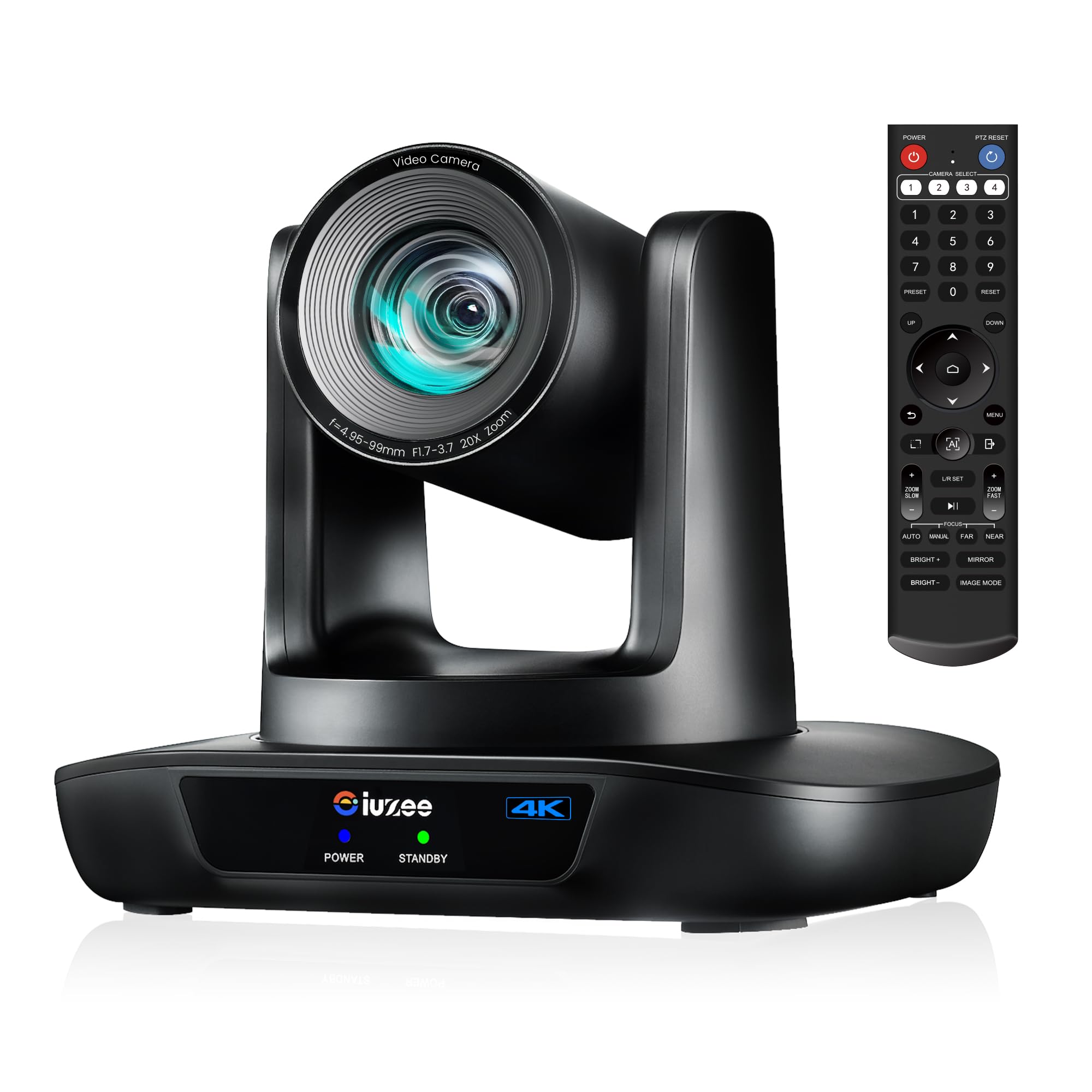
The iuZee PTZ camera upgrades the standard 1080p PTZ formula to 4K resolution at 30fps using a 1/2.8-inch 8.29MP CMOS sensor. The 20x optical zoom lens with a 63-degree wide-angle start captures detailed close-ups of speakers while maintaining the context of the room. Advanced 2D/3D noise reduction technology cleans up the image in low-light church or conference environments where ceiling lights are the only source.
The AI tracking system uses facial recognition and human body tracking to deliver millisecond-level response speeds, with a continuous tracking function that maintains lock even when the subject is temporarily obscured. Three simultaneous outputs — USB 3.0, HDMI, and LAN — support MJPEG, YUY2, H.264, and H.265 encoding. Power over Ethernet (PoE) simplifies installation by carrying power and data through a single Ethernet cable, eliminating the need for a separate power outlet near the camera.
Users report excellent color reproduction and low-light performance for the price point, with several noting that the camera elevates the production quality of worship services and classroom recordings. The included remote control supports 10 presets directly, with up to 255 available via software control. No built-in microphone is included, so external audio capture is required for any applications needing room sound. The manual and remote control layout have a learning curve, but users emphasize that the image quality and tracking reliability justify the investment.
Why it’s great
- 4K 30fps resolution with 20x optical zoom delivers professional detail for streaming and recording
- PoE support simplifies installation with single-cable power and data transmission
- AI tracking maintains subject lock even during temporary occlusion for uninterrupted coverage
Good to know
- No built-in microphone requires separate audio capture solution
- Remote control and manual layout have a learning curve for new users
7. Kodak PIXPRO AZ255

The Kodak PIXPRO AZ255 offers a 25x optical zoom with a 24–600mm equivalent range, giving beginners a genuine telephoto reach without the price tag of a premium superzoom. The 16MP BSI CMOS sensor captures 1080p Full HD video, and the built-in Optical Image Stabilization helps counteract hand shake at the long end of the zoom. The 3-inch LCD screen provides composition flexibility, and the camera runs on standard AA batteries, which are convenient for travel despite shorter lifespan per set.
The F3.7 maximum aperture at full telephoto is on the darker side, meaning you will need good daylight or a tripod for sharp results at 600mm. The Macro mode allows close focusing for small subjects, and the camera includes customizable settings for manual exposure control as you build skills. The body is bulkier than a pocket compact but lighter than a DSLR, making it a practical choice for day hikes or casual wildlife outings.
Users consistently rate this camera as an excellent starter for anyone interested in photography, particularly because the zoom delivers clean results without the distortion common at lower price points. Several users note that the auto setting handles most situations well, while the manual controls provide room to grow. The lack of an included SD card and the need for an external card reader for phone transfers are minor inconveniences mentioned by several buyers.
Why it’s great
- 25x optical zoom covers 24–600mm for telephoto learning without breaking the budget
- BSI CMOS sensor improves low-light sensitivity compared to traditional CCD sensors
- AA battery power is convenient for travel where proprietary chargers are unavailable
Good to know
- F3.7 aperture at 600mm requires good lighting or a tripod for sharp results
- Body is too large for pocket carry, requiring a dedicated bag or strap
8. Kodak PIXPRO FZ45 Bundle

The Kodak PIXPRO FZ45 is the entry point for anyone who wants a dedicated camera with optical zoom without spending on enthusiast-tier hardware. The 4x optical zoom with a 27mm wide-angle lens covers basic composition needs — group shots, travel landmarks, and everyday snapshots — while the 16MP sensor records 1080p Full HD video. The extended bundle includes a 64GB SD card, card reader, protective case, tabletop tripod, and cleaning kit, providing everything a first-time camera owner needs to start shooting immediately.
The simple controls and lightweight body make this camera approachable for children, seniors, or anyone intimidated by complex menus. The 2.7-inch LCD screen is sufficient for composition and review, though it lacks a viewfinder for bright outdoor use. Powered by two AA batteries, the camera offers solid battery life for casual outings, and the alkaline cells are easy to replace anywhere in the world.
Users highlight the beginner-friendly nature and the surprisingly crisp image quality for the price range, with several noting that the camera delivers exactly what it promises without hidden complexity. The 4x zoom is modest — do not expect to capture distant wildlife or stadium performers. The battery compartment feels slightly fragile, and the lack of built-in flash limits use in dim environments. For pure zoom reach, this camera sits at the opposite end of the spectrum from the superzoom models, but for its intended casual use, the value is undeniable.
Why it’s great
- 4x optical zoom with 27mm wide-angle covers everyday shooting needs for beginners
- Bundle includes SD card, case, tripod, and cleaning kit for immediate out-of-box use
- AA battery power and lightweight design make it ideal for casual family photography
Good to know
- 4x zoom range is limited compared to superzoom alternatives in the same budget tier
- No built-in flash and fragile battery compartment design noted by multiple users
FAQ
How many times optical zoom do I need for wildlife photography?
Can I use a superzoom camera for professional event photography?
What is the difference between optical zoom and digital zoom in video?
Does image stabilization matter more for stills or video with superzoom cameras?
Final Thoughts: The Verdict
For most users, the best camera optical zoom winner is the Panasonic LUMIX FZ80D because it delivers 60x optical zoom with effective Power O.I.S. at a price that balances reach and image quality for wildlife, sports, and travel beginners. If you need extreme telephoto reach and are willing to manage the weight and tripod requirements, grab the Nikon COOLPIX P1100. And for pocketable zoom that goes to concerts and family trips without a camera bag, nothing beats the Panasonic LUMIX TZ/ZS99.