
The headphone jack is gone, and the sad little dongle in your USB-C port is robbing your music of detail, power, and soundstage. A dedicated amplifier for your phone is the only way to restore proper voltage, drive high-impedance headphones, and eliminate the noise floor that makes silence sound like static.
I’m Min — the co-founder and writer behind Gadgets Feed. I specialize in deconstructing the technical specifications, codec support matrices, and output power figures that separate a well-engineered DAC/amp from a marketing shell, particularly in the portable audio category.
After comparing the measured output power, chipset choices, wireless codec stacks, and real-world compatibility data of the top models available today, this guide breaks down the only amplifiers that deliver a true upgrade over your phone’s built-in audio. Here is my selection for the best amplifier for phone.
How To Choose The Best Amplifier For Your Phone
Choosing the right amplifier for your phone comes down to understanding your headphones and your use case. A portable DAC/amp is a bottleneck-breaker only if its power output, connection type, and codec support match your gear. Overlook any one of these, and you are just buying a more expensive dongle.
Power Output (mW) and Impedance Matching
The most critical spec is milliwatts (mW) at a given impedance, usually 32Ω. If you own sensitive IEMs (like a 16Ω driver), even 30mW is plenty. If you own full-sized headphones like the Sennheiser HD 600 or Beyerdynamic DT 990 (250Ω), you need at least 100mW to achieve proper dynamic range. Balanced 4.4mm connections typically double the voltage compared to 3.5mm single-ended, making high-impedance loads much easier to drive cleanly.
Bluetooth vs. Wired Connection
Bluetooth amplifiers offer freedom from your phone’s cable, but they impose a codec-dependent ceiling on audio quality. LDAC (up to 990 kbps) and aptX Adaptive are the only wireless codecs that approach lossless transparent quality. AAC is acceptable for Apple devices, while standard SBC is a downgrade. If you want bit-perfect audio, a wired USB DAC is the only path; it bypasses the phone’s internal DAC entirely and delivers unaltered data to the amplifier chip.
DAC Chip and File Format Support
The DAC chip is the core of the amplifier. Cirrus Logic CS43131 and CS43198, along with the ESS ES9219C, are the current gold standards. They natively support high-resolution formats up to PCM 384kHz/32-bit and DSD256 or DSD512. MQA unfolding is a bonus for Tidal subscribers. Look for a DAC that specifies native decoding rather than software-based downsampling for the formats you listen to.
Quick Comparison
On smaller screens, swipe sideways to see the full table.
| Model | Category | Best For | Key Spec | Amazon |
|---|---|---|---|---|
| iFi Hip-dac 3 | Premium | Dedicated battery-powered DAC for high-impedance headphones | 400mW @ 32Ω Balanced | Amazon |
| FiiO BTR7 | Premium | Bluetooth wireless DAC with app-based parametric EQ | 320mW @ 32Ω Balanced | Amazon |
| HiBy FC4 | Mid-Range | Dual-CS43131 wired DAC with color screen and PEQ | 340mW @ 32Ω Balanced | Amazon |
| Fosi Audio DS2 | Mid-Range | Ultra-low noise floor with 4.4mm balanced output | 170mW @ 32Ω Balanced | Amazon |
| Moondrop Dawn Pro 2 | Mid-Range | Dual-CS43198 dongle with 100-level DAC volume control | 124mW @ 32Ω Balanced | Amazon |
| FiiO JadeAudio KA1 | Budget-Friendly | Ultra-compact wired dongle for IEMs and sensitive headphones | 32bit/384kHz + MQA 8x | Amazon |
| HiBy W3 II | Budget-Friendly | Bluetooth receiver with LDAC and NFC for car or portable use | LDAC + UAT 192kHz | Amazon |
In‑Depth Reviews
1. iFi Hip-dac 3 Portable USB DAC Headphone Amplifier

The iFi Hip-dac 3 is a self-contained powerhouse with its own internal battery, ensuring it never drains your phone. It delivers a massive 400mW into 32Ω via the 4.4mm balanced output, which is enough to drive demanding full-sized headphones like the Sennheiser HD 600 or Hifiman Sundara to satisfying levels. The Burr-Brown True Native DAC handles PCM up to 384kHz and DSD256 natively, and it fully unfolds MQA for Tidal subscribers.
The revised internal power supply components significantly lower the noise floor compared to the previous generation, creating a dead-silent background that reveals micro-details in complex tracks. The physical PowerMatch switch lets you toggle gain to match headphone impedance, while XBass provides a tasteful analog low-frequency boost that doesn’t muddy the mids.
It includes USB-C to USB-C and USB-A to USB-C cables, plus a Lightning adapter for older iPhones. The aluminum enclosure is rugged and pocket-friendly, though the unit is slightly larger than a simple dongle. The battery life holds at about eight hours of continuous playback at moderate volume.
Why it’s great
- High 400mW balanced output drives demanding headphones easily
- Burr-Brown DAC delivers smooth, detailed sound with low noise
- PowerMatch and XBass analog tuning offer real utility
Good to know
- Lacks Bluetooth connectivity; wired only
- Bulky compared to dongle-style DAC/amps
2. FiiO BTR7 Headphone Amp Bluetooth Receiver

The FiiO BTR7 is the most feature-rich Bluetooth amplifier for your phone, combining a Qualcomm Bluetooth 5.1 chipset with dual ESS ES9219C DACs. It supports every high-res wireless codec including LDAC at 990 kbps, aptX Adaptive, aptX LL, and AAC, ensuring lossless transmission from both Android and iOS devices. The combination delivers 320mW into 32Ω via the 4.4mm balanced output, easily powering 300-ohm Sennheiser HD 660S2 without breaking a sweat.
The built-in battery decouples the amplifier from your phone’s power supply, preventing battery drain during extended listening sessions. The full-color screen displays codec info, sample rate, and volume level, while the FiiO Control app provides access to a parametric EQ with customizable bands. The cVc 8.0 microphone allows for clear hands-free calling, and the 3.5mm single-ended output works with any headphone.
The aluminum and glass construction feels premium, though the screen and app interface have a learning curve. Battery life is around eight hours depending on codec and output power.
Why it’s great
- Full LDAC and aptX Adaptive support for near-wireless Hi-Res audio
- Independent battery preserves phone charge during use
- Parametric EQ via companion app offers deep customization
Good to know
- Menu navigation and app interface can be confusing
- Battery life shorter than previous BTR models
3. HiBy FC4 USB DAC MQA Dongle
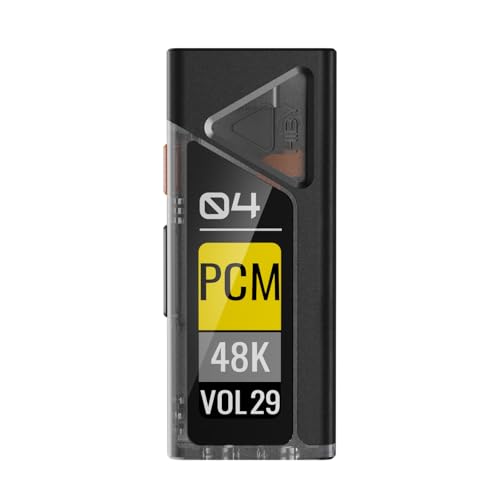
The HiBy FC4 punches above its weight with dual Cirrus Logic CS43131 DACs in a precision differential architecture, delivering 340mW into 32Ω through the 4.4mm balanced output—enough to drive demanding planar magnetic headphones. The inclusion of two femtosecond-grade audio oscillators minimizes jitter, resulting in a clean, stable clock for decoding PCM up to 768kHz/32-bit and DSD512. It fully unfolds MQA up to 8x, making it an excellent companion for Tidal Masters.
The 1.1-inch color OLED screen displays real-time sample rate, volume level, and gain status without relying on an app. Eight preset EQs and a professional-grade parametric equalizer are available through the on-device controls. The CNC-machined aluminum and translucent PC housing keeps the weight at only 21 grams, making it incredibly portable.
It supports UAC 1.0 and 2.0 automatically, ensuring seamless compatibility with PS4, PS5, and Nintendo Switch for low-latency gaming audio. The 3.5mm single-ended output is also present for everyday headphones.
Why it’s great
- Exceptional 340mW balanced output for the size and price
- Built-in OLED screen shows all relevant playback info
- UAC 1.0/2.0 auto-switching works with all game consoles
Good to know
- May have compatibility quirks with some DAPs
- No Bluetooth functionality
4. Fosi Audio DS2 USB C Headphone Amp DAC Dongle

The Fosi Audio DS2 is engineered around two Cirrus Logic CS43131 DAC chips configured to deliver a nearly inaudible noise floor of just 1μV. With a total harmonic distortion of 0.0001% and a signal-to-noise ratio of 130dB, this dongle is built for analytical listening. It outputs 170mW per channel into 32Ω via the 4.4mm balanced connection, enough to drive demanding IEMs and mid-impedance headphones to high volumes.
The independent 60-step volume buttons provide precise level control that bypasses the coarse volume steps of iOS and Android, and the volume memory function retains your preferred setting between sessions. The DS2 works plug-and-play with iPhone 15, iPad Pro, modern Android phones, and desktop computers without requiring driver installation. The all-metal CNC-machined housing is shock-resistant and comfortable to grip.
The included USB-C cable feels cheap, but the DAC performance itself rivals more expensive competition. Some users report that the power draw on iPhone is noticeable, consuming around 16% battery per two hours of playback.
Why it’s great
- Ultra-low 1μV noise floor makes it ideal for sensitive IEMs
- Independent volume buttons avoid smartphone volume compression
- Solid metal build survives daily travel
Good to know
- Included USB-C cable is low quality and may need replacement
- Moderate power drain on smartphone batteries
5. Moondrop Dawn Pro 2 Decoder Headphone Amplifier
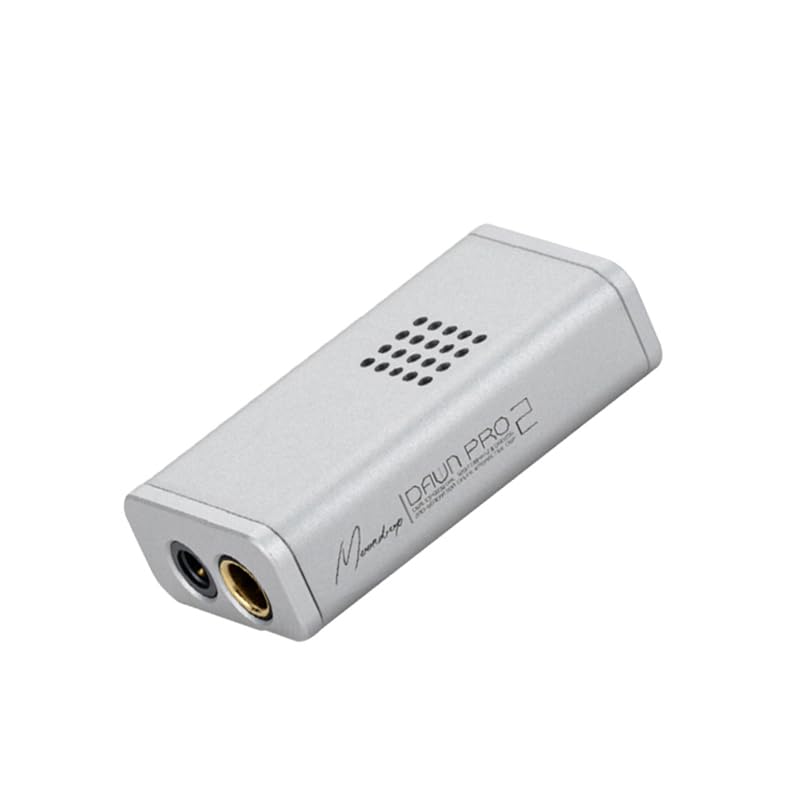
The Moondrop Dawn Pro 2 houses dual flagship Cirrus Logic CS43198 DAC chips with three independent LDO regulators that isolate power delivery to the decoding and digital sections. This design achieves a balance between output power and timbre preservation, delivering 124mW into 32Ω via the 4.4mm balanced output. The 100-level near-lossless DAC volume control adjusts gain in the analog domain, preventing signal compression from digital volume sliders.
The aviation-grade aluminum alloy body features CNC heat dissipation vents located directly over the chipset, which keeps the unit cool during extended listening. The Moondrop Link app unlocks an interactive DSP platform with a professional-grade parametric equalizer, including a headphone frequency response database for reference tuning. This makes the Dawn Pro 2 the most versatile option for users who want to tailor their sound signature precisely.
The 4Vrms output voltage provides ample headroom for most IEMs and sensitive over-ear headphones. However, the factory EQ resets when the device is unplugged, requiring you to reload your profile each time, which can be an annoyance.
Why it’s great
- Comprehensive DSP and parametric EQ via Moondrop Link app
- Analog 100-level volume control preserves signal integrity
- Effective heat dissipation design prevents thermal throttling
Good to know
- Custom EQ settings reset when unplugged
- Some units may have loose 4.4mm jack tolerances
6. FiiO JadeAudio KA1 Tiny USB DAC Dongle

The FiiO JadeAudio KA1 is an ultra-compact USB dongle weighing just 10 grams with dimensions of 43x15x8mm, making it the most pocket-friendly entry point into high-resolution audio. It supports PCM up to 32-bit/384kHz and native DSD512 decoding, and includes full MQA 8x rendering for Tidal streaming. The all-metal aluminum housing is surprisingly solid for a device this small.
The KA1 works with Android smartphones, iOS devices (via Lightning adapter), tablets, and Windows or macOS computers with a standard USB-C connection. It gets warm during operation, which is a sign of proper power management rather than a defect. The sound quality is a noticeable step up from the typical USB-C dongle, delivering a wider soundstage, clearer highs, and tighter bass with compatible IEMs and headphones.
The built-in cable is a weak point; the stress relief at the USB-C connector is minimal and prone to fraying with frequent bending. The companion app offers limited functionality and is not essential for daily use.
Why it’s great
- Remarkably small and lightweight; easy to keep on keychain
- Full MQA unfolding and DSD512 compatibility
- Clear improvement over standard USB-C dongles
Good to know
- Attached cable has durability concerns over long-term use
- Does not support simultaneous charging
7. HiBy W3 II Headphone Amp Bluetooth 5.2 Receiver

The HiBy W3 II is a purpose-built Bluetooth receiver that pairs with your phone wirelessly and connects to any wired headphone via its 3.5mm output. It uses the latest Bluetooth 5.2 SoC with support for LDAC, aptX, aptX HD, AAC, and HiBy’s proprietary UAT codec that pushes the wireless sample rate to 192kHz. NFC one-tap pairing simplifies the initial setup with compatible phones.
The CS43131 integrated DAC and amplifier combination delivers 95mW of power—adequate for most portable IEMs and sensitive over-ear headphones like the Philips X2 or Koss KPH40. The Bluetooth range is exceptional, maintaining a stable connection across an entire house. Car mode is a standout feature: the W3 II powers on and automatically connects to your smartphone when the car starts.
The HiByBlue controller app provides real-time readout of sample rate, Bluetooth codec, battery level, and a five-band equalizer. While the 95mW output is not enough to fully drive 300-ohm audiophile headphones, it offers excellent value for casual listeners and commuters who want to cut the cable without sacrificing sound quality.
Why it’s great
- Supports LDAC and UAT codecs for high-quality wireless streaming
- NFC pairing and car auto-connect for convenience
- Extremely compact with robust Bluetooth range
Good to know
- Output power is limited; struggles with high-impedance headphones
- Battery life is adequate but not class-leading
FAQ
Will an amplifier for my phone damage my IEMs?
Does Bluetooth LDAC sound as good as a wired USB connection?
Final Thoughts: The Verdict
For most users, the amplifier for phone winner is the iFi Hip-dac 3 because its balanced output, internal battery, and analog tuning switches deliver the cleanest, most powerful sound for both IEMs and demanding headphones in a fully portable package. If you want wireless freedom with app-based parametric EQ, grab the FiiO BTR7. And for pure value in a wired dongle, nothing beats the HiBy FC4.