
A weak or undersized battery cable is the single most common point of failure in any high-current 12V system — it chokes your starter motor, dims your inverter output, and silently robs your battery bank of usable power. Choosing the correct gauge, conductor material, and lug configuration isn’t just about connectivity; it’s about ensuring every amp your battery produces actually reaches its destination without being lost as heat inside a strand of aluminum pretending to be copper.
I’m Min — the co-founder and writer behind Gadgets Feed. I’ve spent hundreds of hours dissecting battery cable specifications, cross-referencing strand counts with SAE and ASTM standards, and analyzing real-user feedback to find the sets that deliver verified performance instead of marketing fluff.
This guide breaks down the seven most compelling options on the market right now, covering everything from budget-friendly CCA wire kits to premium ultra-flexible pure copper builds, so you can confidently select the right best battery cables for your specific vehicle, solar array, or marine application.
How To Choose The Best Battery Cables
Selecting battery cables comes down to matching three variables: the electrical load (in amps), the total circuit length (round-trip), and the operating environment (engine bay heat vs. marine moisture). Getting the gauge wrong by even one size can drop system voltage enough to stall a starter or overheat the wire itself.
Gauge and Ampacity: Match the Load
The American Wire Gauge (AWG) standard defines how much current a cable can safely carry. For a typical car starter drawing 150-250A, 4 AWG is the minimum for short runs; 2 AWG or 1/0 AWG is safer for longer distances or higher loads like inverters and winches. Always consult a wire ampacity chart specific to copper or CCA conductors — never guess based on cable diameter alone.
Conductor Material: Pure Copper vs. CCA
Pure copper (OFC) offers the lowest resistance per gauge and handles higher current without heating. Copper-clad aluminum (CCA) is lighter and cheaper but has roughly 40% higher resistance — meaning you need to go up one gauge size to match copper’s performance. For critical systems like engine starting or inverters, pure copper is worth the premium. For audio ground wires or light-duty accessories, CCA can save money without issue.
Lug Quality and Crimp Integrity
A poorly crimped lug creates a high-resistance connection that heats up, arcs, and eventually fails. Look for tinned (tin-plated) copper lugs — the plating resists corrosion in marine and battery-acid environments. The best kits include pre-crimped and heat-shrunk terminations or provide enough lugs and shrink tubing for custom-length builds. If you crimp your own, use a hydraulic crimper; hammer-style crimpers rarely produce gas-tight connections.
Quick Comparison
On smaller screens, swipe sideways to see the full table.
| Model | Category | Best For | Key Spec | Amazon |
|---|---|---|---|---|
| WindyNation 2 AWG Kit | Premium | High-amp custom builds | 2 AWG, pure copper, 600V | Amazon |
| iGreely 2 AWG Kit | Premium | Ultra-flexible welding cable | 2 AWG, 1070-strand, pure copper | Amazon |
| Ruikarhop 1/0 AWG CCA Kit | Mid-Range | Solar and camper wiring | 1/0 AWG, CCA, 250A capacity | Amazon |
| A ABIGAIL 4 AWG (6 ft) | Mid-Range | Inverter and RV battery | 4 AWG, pure copper, pre-crimped | Amazon |
| TUELETFU 4 AWG (5 ft) | Mid-Range | Amplifier and inverter | 4 AWG, pure copper, 5 ft pair | Amazon |
| GEARit 4 AWG CCA Spool | Budget | Bulk ground/power wire | 4 AWG, CCA, 25 ft roll | Amazon |
| A ABIGAIL 2 AWG (2 ft) | Budget | Quick terminal replacement | 2 AWG, pure copper, pre-crimped | Amazon |
In‑Depth Reviews
1. WindyNation 2 AWG Battery Cable Kit (10 ft Red + 10 ft Black + Lugs + Shrink)
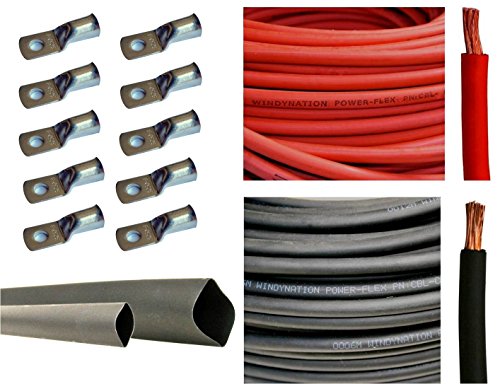
This WindyNation kit delivers the full package: 20 feet total of fully annealed pure copper cable in 2 AWG, ten tinned copper lugs (3/8″), and three feet of black heat shrink tubing. The multi-strand conductor is exceptionally flexible for its gauge — users report routing it easily through tight engine-bay corners — and the EPDM jacket resists engine heat and solvents better than standard PVC.
Test data from verified buyers shows the 2 AWG cable carried a 2800A load for six seconds before the jacket softened, confirming the conductor is true to its ASTM-spec ampacity. The long-shanked lugs accept both crimping and soldering, and the flared barrel design makes wire insertion straightforward. A small number of users noted the included heat shrink lacks adhesive lining, so for marine applications you may want to substitute adhesive-lined polyolefin tubing.
For anyone building a dual-battery setup, a winch power feed, or a high-current inverter connection, this kit provides professional-grade materials at a fraction of buying components separately. The pure copper conductor means you can run the full rated current without the voltage drop penalty that CCA cables incur — making this the best overall choice for demanding 12V installations.
Why it’s great
- True pure copper, fully annealed per ASTM — lowest resistance per gauge
- Highly flexible 2 AWG with EPDM jacket for heat and solvent resistance
- Complete kit with lugs and heat shrink — ready for custom-length builds
Good to know
- Included heat shrink is non-adhesive — not ideal for submerged marine use
- Requires a heavy-duty crimper; bench vice works as alternative
2. iGreely 2 AWG Welding Battery Cable Kit (10 ft Red + 10 ft Black + Lugs + Shrink)

The iGreely 2 AWG cable uses 1070 strands of 0.2mm copper — roughly double the strand count of a typical battery cable — which gives it a welding-cable level of flexibility that makes routing in tight engine compartments effortless. Each kit includes ten feet each of red and black pure copper cable, plus five 5/16″ and five 3/8″ tinned copper lugs and matching heat shrink tubing.
The EPDM jacket is thick and solvent-resistant, and the cable meets IEC 60245-6:1994 standards for welding cable construction. Real-world users have successfully used it for dual-battery setups in trucks, solar battery bank interconnects, and high-amp inverter feeds. The tinned lugs feature a closed-end design to keep moisture and acid away from the conductor, and the flared barrel entry makes crimping cleaner compared to budget alternatives.
Where this kit shines is in builds where the cable must bend sharply — connecting batteries in parallel inside a cramped golf-cart compartment, for example, or routing from a winch solenoid tucked behind a bumper. The extra strand count means less hand fatigue during installation and less spring-back when you release the cable.
Why it’s great
- Ultra-flexible 1070-strand pure copper — routes like welding cable
- Includes both 5/16″ and 3/8″ tinned copper lugs for terminal compatibility
- EPDM jacket resists heat, solvents, and abrasion
Good to know
- Some users found a faint odor from new jacket that fades in a few days
- No SAE J1127/J1128 certification printed on cable
3. Ruikarhop 1/0 AWG CCA Battery Cable Kit (20 ft Red + 20 ft Black + Lugs + Shrink)

The Ruikarhop kit steps up to 1/0 AWG — the thickest gauge in this guide — using copper-clad aluminum (CCA) construction to keep cost manageable while still delivering a 250A current rating. With 20 feet of red and 20 feet of black cable, plus twenty terminal connectors and 3:1 heat shrink tubing, this is the only kit here that provides bulk wire for long-run solar or camper installations right out of the box.
CCA cable is roughly 40% more resistive than pure copper, but 1/0 AWG CCA still carries more current per foot than 4 AWG pure copper — making it a smart trade-off when you need very long runs or high ampacity without spending premium money. The flexible PVC jacket is impact-resistant and color-coded for polarity, and the included lugs crimp easily, though some users note they can split if over-crimped with a vise rather than a proper hydraulic tool.
This kit is ideal for connecting a lithium battery bank in a camper, feeding a large solar inverter, or wiring a high-power trolling motor. Just remember that for the same gauge, CCA cable is thicker in diameter than copper, so check terminal clearance before committing to 1/0 AWG lugs.
Why it’s great
- 40 ft total of 1/0 AWG — generous length for long or multiple runs
- 250A ampacity at a budget-friendly CCA price point
- Complete all-in-one kit with lugs and heat shrink
Good to know
- CCA conductor requires upsizing one gauge vs. pure copper for same current
- Supplied lugs can deform if crimped too aggressively
4. A ABIGAIL 4 AWG Battery Cable (6 ft, Red + Black, 3/8″ Lugs)
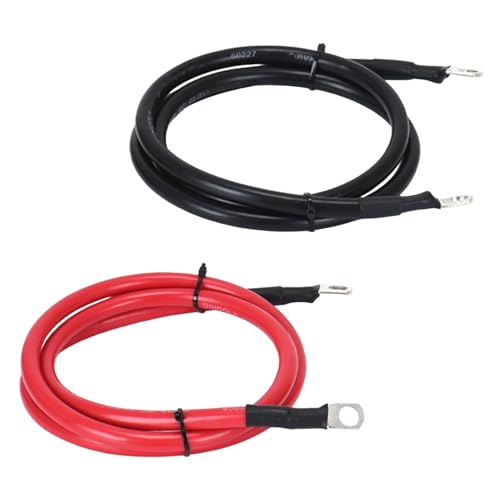
A ABIGAIL’s 4 AWG set is a pre-built, no-solder solution for standard inverter and battery-interconnect jobs. Each six-foot cable is terminated with a 3/8″ tinned copper lug on both ends, sealed with heat shrink tubing, and made from pure copper conductor with a flexible PVC jacket. This is a grab-and-go kit — you measure the distance, bolt the lugs, and tighten.
The tinned lugs provide corrosion resistance that matters in marine and engine-bay environments, and the flame-retardant PVC jacket passes basic abrasion checks. Buyers have used it for solar battery bank connections, RV dual-battery setups, and power inverter feeds with consistent reports of solid crimp quality and no lug separation during installation. The cable is rated for 12V DC use, making it suitable for most automotive and solar applications up to around 150 amps for short runs.
At this length, it’s a perfect match for connecting two batteries in series or parallel, or for wiring a mid-size inverter mounted near the battery. If you need something shorter, A ABIGAIL also offers the same construction in a 2-foot 2 AWG version.
Why it’s great
- Fully pre-assembled — no crimping or soldering required
- Pure copper conductor with tinned lugs for corrosion resistance
- Consistent crimp quality across all four terminations
Good to know
- PVC jacket is less heat-resistant than EPDM for extreme engine-bay use
- Fixed 6 ft length — not adjustable for custom routing
5. TUELETFU 4 AWG Battery Cable (5 ft, Red + Black, 3/8″ Lugs)

TUELETFU’s 4 AWG cable set offers the same pure copper construction and pre-terminated 3/8″ tinned lugs as the A ABIGAIL option above, but in a slightly shorter (5 ft) and more budget-conscious package. This length is particularly well-suited for wiring a 1000W inverter mounted close to the battery — multiple reviews confirm a direct fit in Subaru Outback and similar compact installs without excess cable to tuck away.
The conductor is pure copper with a sturdy PVC jacket, and each cable end is sealed with heat shrink. One review noted the crimps were not fully compressed on two of the four ends, requiring re-crimping — a reminder that pre-assembled cables should be visually inspected and tug-tested before final installation. The tinned lugs are solid and the cable itself is flexible enough for most routing scenarios.
For the price, this is a strong competitor in the 4 AWG pre-terminated segment. If you need a reliable pair of cables for a golf cart battery interconnect, a camper auxiliary battery, or a stereo amplifier feed, this set delivers pure copper performance without the premium markup of longer or higher-gauge kits.
Why it’s great
- Pure copper conductor for full current delivery without voltage drop
- Pre-terminated with tinned lugs — ready to bolt on
- Good value for the 5 ft pair length
Good to know
- Inconsistent crimp tension reported on some units — inspect before use
- Shorter length may not reach remote battery or inverter positions
6. GEARit 4 Gauge CCA Wire (25 ft, Black + Red)

GEARit’s 4 AWG CCA wire is a bulk spool designed for users who need to cut custom-length runs for multiple devices. Each 25-foot roll (sold in pairs — one red, one black) gives you enough wire for a complete car amplifier power and ground circuit, trolling motor wiring, or several 12V accessory feeds. The CCA construction keeps the cost down, making it a practical choice for projects where the wire is not in a critical starting or inverter circuit.
The flexible PVC jacket is soft-touch and easy to strip, and the 8 mm diameter handles routing inside conduit or along chassis rails without stiffness. As a CCA conductor, it’s about 1.6 times more resistive than pure copper, so the same gauge will run hotter under load — but for audio systems drawing under 100A, this is rarely a problem. Buyers appreciate the clear color coding and consistent jacket thickness along the full length.
If your project requires multiple short jumpers or a single long ground run, buying this bulk wire is more economical than buying pre-terminated cable sets. Just factor in that you’ll need to supply your own lugs and heat shrink — and crimp each termination carefully, since under-crimping is the most common failure with DIY battery cables.
Why it’s great
- High value for bulk wire — 25 ft per color at entry-level pricing
- Soft-touch PVC jacket is easy to strip and flexible for routing
- Clear red/black polarity identification along the full length
Good to know
- CCA conductor has higher resistance than pure copper — upsize gauge if running near ampacity limit
- No lugs or terminals included — must purchase separately
7. A ABIGAIL 2 AWG Battery Cable (2 ft, Red + Black, 5/16″ Lugs)

The 2-foot version of A ABIGAIL’s cable is the shortest and most affordable pure-copper option in this guide, yet it uses 2 AWG conductor — thick enough for starter motor draws up to 176 amps. Each cable is terminated with 5/16″ tinned copper lugs and sealed with heat shrink, making it a direct drop-in replacement for corroded or undersized factory battery cables on cars, tractors, or lawn equipment.
The pure copper construction means no voltage-drop sacrifice, and the 5/16″ ring terminals fit standard battery clamp bolts and most starter solenoid studs. Users have successfully used them to replace 60-year-old cables on farm tractors, add battery disconnect switches, and wire batteries in series for 24V systems. The only recurring note in reviews is a shipping delay — the cable quality itself earns consistent praise.
For someone who just needs to replace a single pair of worn-out battery cables and wants pure copper at a budget price, this short set is hard to beat. Just confirm that the 2-foot length and 5/16″ lugs match your battery-to-starter distance and terminal stud sizes before ordering.
Why it’s great
- Pure copper at a budget price point for a short cable set
- Pre-crimped and heat-shrunk with 5/16″ tinned lugs — installs in minutes
- 2 AWG handles starter-level current (176A) for most vehicles
Good to know
- Very short (2 ft) — not suitable for remote battery or inverter connections
- Some buyers reported shipping delays; order ahead of project start
FAQ
Can I use welding cable for battery cables?
Should I solder or crimp battery cable lugs?
Does polarity matter when connecting battery cables?
Final Thoughts: The Verdict
For most users, the best battery cables winner is the WindyNation 2 AWG Kit because it combines true pure copper construction, generous 20-foot total length, and all necessary lugs and heat shrink in one package — giving you professional-grade materials for any high-amp vehicle, solar, or marine build. If you need extreme flexibility for tight routing, grab the iGreely 2 AWG Kit with its 1070-strand welding-style cable. And for a budget-friendly high-current solution on long runs, nothing beats the Ruikarhop 1/0 AWG CCA Kit.