
A boat’s starter battery is the single most critical component between you and a successful day on the water—when it fails, you’re stranded. That split-second demand of 500 to 800 cold cranking amps must be delivered reliably, even after weeks of sitting idle in humid salt air.
I’m Min — the co-founder and writer behind Gadgets Feed. I’ve spent hundreds of hours analyzing start-up current curves, group-size compatibility matrices, and real-world corrosion reports across AGM, flooded, and lithium LiFePO4 chemistries to separate genuine performance from marketing fluff.
Whether you’re rigging a center console, a bass boat, or a cabin cruiser, the best boat starting battery must deliver instant cranking torque without sacrificing cycle life when you need to run electronics between runs.
How To Choose The Best Boat Starting Battery
Selecting the right starting battery for your boat isn’t about picking the largest amp-hour number. The chemistry, group size, and cranking spec (CCA vs. MCA) must match your outboard’s displacement, the climate you run in, and how often you draw accessory power while the engine is off.
CCA and MCA — What the Numbers Actually Mean
Cold Cranking Amps (CCA) measures discharge at 0°F for 30 seconds, while Marine Cranking Amps (MCA) uses 32°F. Inboard and stern-drive motors with big displacements often need 800+ CCA for reliable winter starts. Outboard users in warmer waters can focus on MCA, but never undershoot the manufacturer’s minimum cranking spec by more than 10%—electronics won’t compensate for insufficient current.
AGM vs. Lithium LiFePO4 for Starting Duty
AGM (Absorbent Glass Mat) remains the standard for marine starting because it delivers high surge current instantly and handles vibration better than flooded lead-acid. Lithium LiFePO4 starting batteries offer dramatic weight savings—some weigh under 10 pounds—but require a BMS that supports a high inrush current without shutting down. Dual-purpose AGM batteries strike a useful balance, providing both cranking and a modest deep-cycle reserve for lights and fish finders in a single unit.
Group Size and Terminal Configuration
A Group 24M or 27M battery fits most recreational boats, while Group 31M offers higher reserve capacity for larger cruisers and dual-battery setups. Always verify the terminal orientation (left-positive vs. right-positive) before ordering, because standard SAE and marine stud terminals are not always interchangeable. Measure the tray depth and height with the hold-down bracket—cables rarely reach if the posts shift sides.
Quick Comparison
On smaller screens, swipe sideways to see the full table.
| Model | Category | Best For | Key Spec | Amazon |
|---|---|---|---|---|
| Optima 34 REDTOP | AGM SpiralCell | High-vibration V8 outboards and inboards | 800 CCA, 100-min reserve, 37.9 lbs | Amazon |
| Odyssey ODX-AGM34M | Premium AGM | Demanding starting with deep reserve need | 850 CCA, 62 Ah, 134-min reserve | Amazon |
| Interstate 8-31MAGMDC | Pure Lead AGM | Dual-purpose RV and large cruiser use | 825 CCA, 100 Ah, Group 31M | Amazon |
| Marxon Group 31M | AGM Dual Purpose | Heavy-duty starting with house load | 825 CCA, 105 Ah, 200-min RC | Amazon |
| UPLUS Group 27M | AGM Dual Purpose | Mid-range boats up to 350 hp | 800 CCA, 92 Ah, Group 27M | Amazon |
| Mighty Max MM-G24M | AGM Dual Purpose | Budget dual-purpose for small boats | 550 CCA, 90 Ah, 145 RC | Amazon |
| Weize Group 24M | AGM Dual Purpose | Value-focused reliable cranking and trolling | 550 CCA, 90 Ah, 150 RC | Amazon |
| Litime 20Ah Lithium | LiFePO4 Starting | Ultra-light starting for small outboards | 650-800 CCA, 20 Ah, 9.68 lbs | Amazon |
| Dumfume 150Ah LiFePO4 | Deep Cycle Lithium | Off-grid solar storage (not engine start) | 150 Ah, 1920 Wh, 100A BMS | Amazon |
In‑Depth Reviews
1. Optima 34 REDTOP AGM Battery

Optima’s REDTOP 34 uses a proprietary SpiralCell design that wraps 99.99% pure lead plates into tight coils, reducing internal resistance so the battery delivers its full 800 CCA the instant the key turns. The vibration resistance is fifteen times greater than flooded lead-acid, which matters when your hull slams through chop at 30 knots. With a 100-minute reserve capacity at 25 amps, it can also run your navigation lights and bilge pump for a short period after the engine stops.
Weighing just 37.9 pounds, the REDTOP is lighter than many Group 34 AGM alternatives, making installation easier in tight battery boxes. The SAE terminal posts are compatible with most marine cable ends, and the maintenance-free design eliminates acid-refill checks entirely. Owners routinely report service lives exceeding seven years in daily-use boats and trucks, a direct result of the pure-lead chemistry resisting sulfation better than alloyed plates.
One caveat: the REDTOP is a starting battery, not a deep-cycle powerhouse. Repeated heavy discharges below 50% state-of-charge will shorten its lifespan, so reserve that trolling-motor duty for a dedicated deep-cycle unit in a dual-bank setup. The 50 Ah C20 capacity is modest compared to dual-purpose options, but for pure starting reliability, nothing in this form factor surpasses the Optima REDTOP’s track record on saltwater boats.
Why it’s great
- Extreme vibration resistance from SpiralCell design
- Very long service life with proper charging
- Lightweight for its class at 37.9 lbs
Good to know
- Not designed for repeated deep-cycle drain
- CCA rating slightly lower than some larger Group 31 options
2. Odyssey ODX-AGM34M Extreme Series AGM Battery

The Odyssey ODX-AGM34M pushes 850 CCA and 1,250 HCA from a 62 Ah capacity, making it one of the highest cranking reserves available in a drop-in Group 34 size. Its pure lead, thin-plate AGM construction enables a 134-minute reserve capacity at 25 amps, which means you can run electronics, a stereo, or an inverter for a solid two hours after the engine is off without flattening the starting battery.
Dual SAE posts and stainless steel stud terminals in 3/8-inch positive and 5/16-inch negative give you flexible connection options for aftermarket accessories and dual-battery switches. At 50.9 pounds, the Odyssey is heavier than the Optima REDTOP, but that mass comes from thicker plates engineered to handle repeated deep discharges that would destroy a standard starting battery. Owners consistently report starting giant V8 outboards after weeks of storage without a trickle charger.
The trade-off is price and charge sensitivity—the Odyssey demands a charger that can deliver at least 14.7 volts in absorption mode, and a standard automotive charger may never bring it to full saturation. Pair it with a smart charger with an AGM profile, and you’ll get a battery that out-cranks and out-lasts nearly everything else in its footprint.
Why it’s great
- Highest CCA in Group 34 AGM at 850
- Exceptional 134-min reserve for emergency house power
- Dual terminal system for flexible wiring
Good to know
- Needs a high-voltage AGM charger for proper saturation
- Heavier than similarly sized AGM competitors
3. Interstate Batteries 8-31MAGMDC Group 31M AGM

Interstate’s Group 31M dual-purpose battery delivers 825 CCA and 100 Ah of capacity from a pure, non-alloy lead AGM construction that lasts two to three times longer than conventional flooded marine batteries. The 100 Ah rating means it can sustain deep-cycle loads like livewell pumps and refrigerators for extended periods while still having the cranking muscle for a big block. Thick plate design allows repeated discharge and recharge cycles without the rapid capacity fade typical of alloy AGM batteries.
Weighing 64.5 pounds, the 31M is a heavy unit, but that weight translates to dense lead mass that holds voltage steady under heavy load. The marine terminal posts accept both SAE and 5/16-inch stud connectors, simplifying installation with dual-battery ACR setups. Interstate’s 2-year warranty and 70-year reputation add peace of mind for boaters who keep their vessels in saltwater and run multiple electronics.
The size requires a Group 31 tray, so verify your bilge dimensions before buying—this battery will not fit in a 24M or 27M box without modification. For larger cruisers, center consoles, or RVs that need one battery to do both starting and house duties, the Interstate 31M offers the best per-dollar combination of cranking power and deep-cycle endurance.
Why it’s great
- True dual-purpose with 100 Ah deep-cycle capacity
- Pure lead AGM resists sulfation and extends life
- Strong 825 CCA for large marine engines
Good to know
- Very heavy at 64.5 lbs—needs sturdy support
- Only fits Group 31 battery trays
4. Marxon Group 31M AGM Dual Purpose Battery
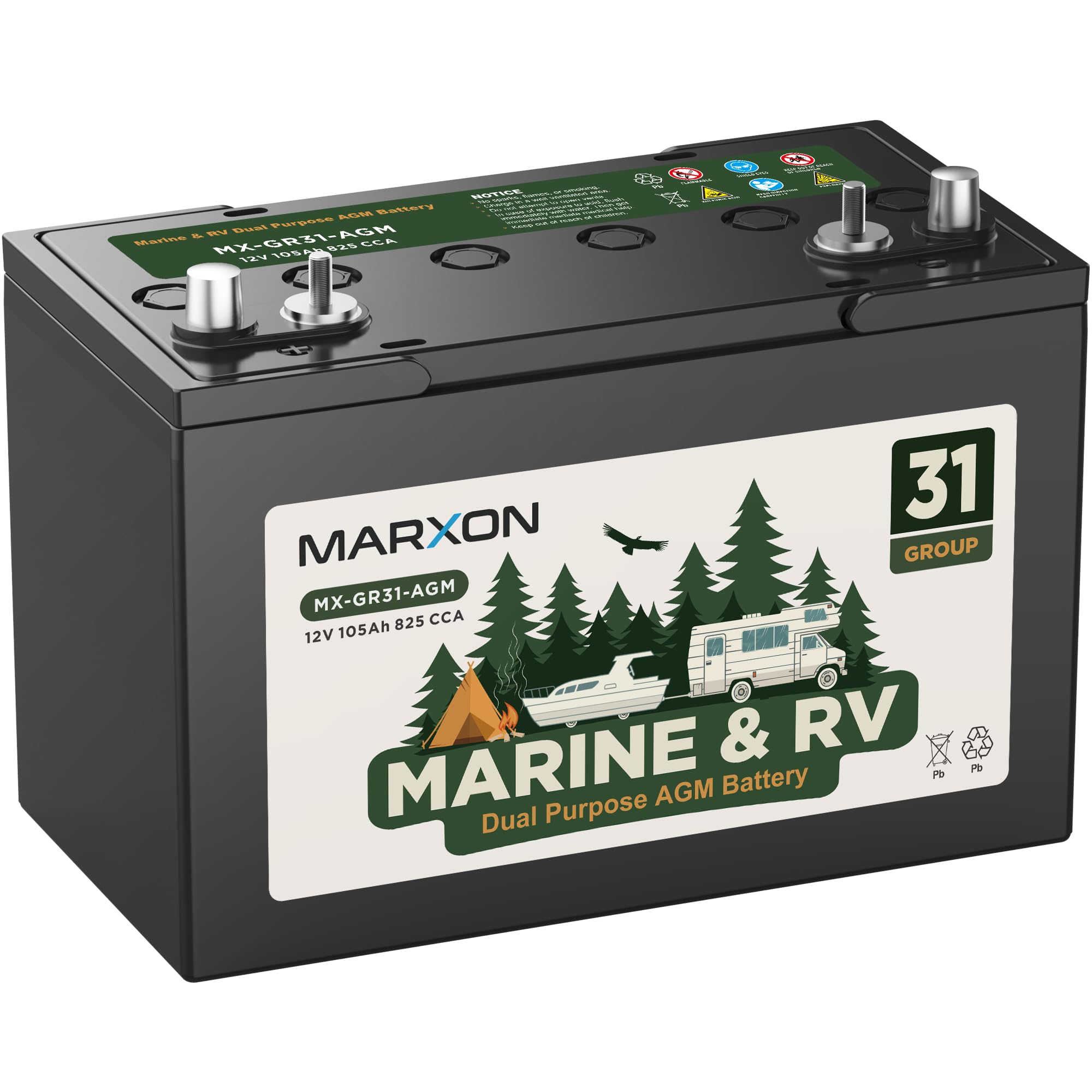
The Marxon Group 31M pushes 105 Ah and 825 CCA with a 200-minute reserve capacity, making it the highest total energy storage of any dual-purpose AGM on this list. The 200 RC means it can run a 25-amp DC load for over three hours, bridging the gap between starting duty and serious house power in a single battery. The sealed, maintenance-free AGM construction handles the constant motion and spray of the marine environment better than flooded batteries.
At 12.99 x 6.61 x 8.35 inches, this battery fits standard Group 31 trays, and the side-mounted marine terminals accept both SAE and M8 stud connections. The left-positive, right-negative orientation matches most US-made boats, reducing cable-stretching during installation. The local US warehouse and responsive support are practical advantages if a warranty issue arises.
Some users have noted that the heavy weight—similar to other Group 31 AGM batteries—makes placement and removal a two-person job. Additionally, if you’re installing this in a battery bank for a trolling motor, verify that the BMS (if used) is compatible with these high-capacity AGM cells. For large center consoles and dual-battery setups, the Marxon delivers premium specs at a mid-premium price.
Why it’s great
- Highest reserve capacity at 200 minutes
- 105 Ah capacity rivals dedicated house batteries
- US-based after-sales support within 12 hours
Good to know
- Heavy—install with a partner or bracket
- Return shipping is expensive due to weight
5. UPLUS Group 27M Dual Purpose AGM Battery

UPLUS designed the Group 27M to start engines ranging from 70 to 350 hp, covering the vast majority of recreational outboard and stern-drive boats. The 800 CCA rating ensures reliable turn-over even with a high-compression V6, while 92 Ah of capacity and a 175 RC give you enough reserve to run navigation lights, a fish finder, and a radio for hours. The AGM construction eliminates water refills and resists the vibrational fatigue that kills flooded batteries.
At 49 pounds and measuring 12.05 x 6.61 x 9.11 inches, the UPLUS fits standard Group 27 trays without modification—a real advantage over oversized Group 31 conversions. The fold-up carrying handle on the top is a practical touch for lifting into tight compartments. The 24-month warranty and 60-day refund window from a US-based warehouse provide solid consumer protection.
The main trade-off is that 92 Ah of capacity is adequate but not exceptional for heavy house loads. If you run multiple bilge pumps, a refrigerator, and a large stereo system, you’ll want to pair this with a dedicated deep-cycle battery. As a straightforward starting battery with moderate house capability, the UPLUS Group 27M offers an excellent balance of power, weight, and price.
Why it’s great
- 800 CCA at 49 lbs—strong power-to-weight ratio
- Easy-fit Group 27M dimensions for most boats
- Fold-up handle simplifies installation
Good to know
- Moderate 92 Ah limits prolonged house use
- Not suitable for engines over 350 hp
6. Mighty Max MM-G24M Group 24M AGM Battery
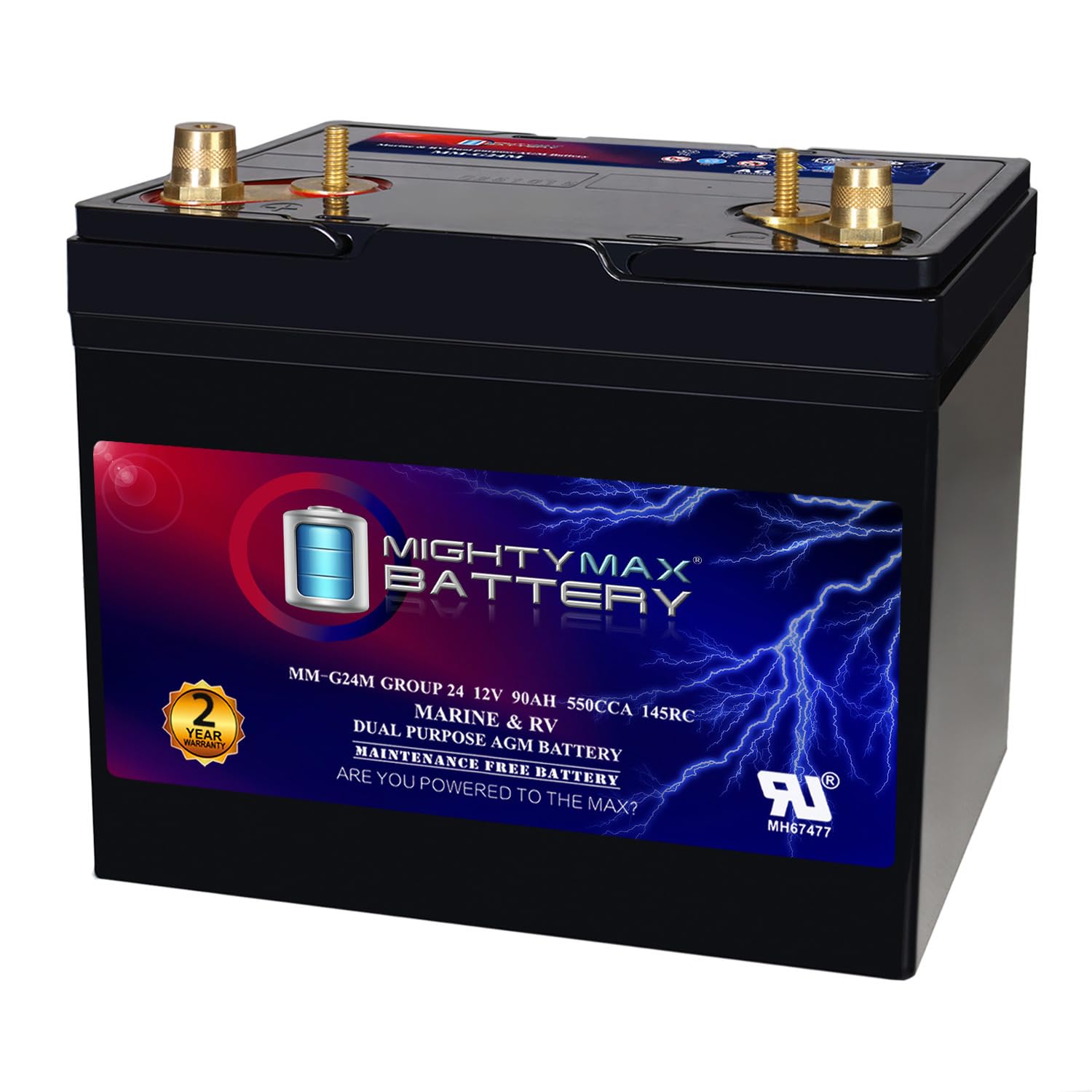
The Mighty Max MM-G24M provides 550 CCA and 700 MCA from a compact Group 24M form factor, making it one of the most affordable dual-purpose marine batteries for smaller boats. The 90 Ah capacity and 145 RC are sufficient for running a basic fish finder, bilge pump, and running lights during an afternoon on the water. The heavy-duty ABS case withstands impacts and heat better than many competitors in this price tier.
Measuring just 10.25 x 6.63 x 8.63 inches and weighing 52.2 pounds, the MM-G24M fits almost any standard 24M tray. The spill-proof AGM design allows safe mounting in non-ventilated compartments, and the 1-year warranty adds a modest safety net. Users report reliable starting for outboards up to 150 hp and solid performance for two seasons or more with proper charging.
Where it falls short is raw cranking power—550 CCA won’t reliably start a large V8 or a cold diesel during winter months. The 700 MCA rating is adequate for warmer-water operation, but northern boaters should step up to a Group 27 or 31 battery. For a small center console or aluminum fishing boat used in moderate climates, the Mighty Max MM-G24M is a budget-conscious choice that doesn’t compromise on basic marine reliability.
Why it’s great
- Compact Group 24M fits tight bilge spaces
- Spill-proof ABS case handles marine abuse
- Good value for 90 Ah dual-purpose duty
Good to know
- 550 CCA insufficient for large engines
- Lead-acid tech feels dated for the price
7. Weize Group 24M Dual Purpose AGM Battery
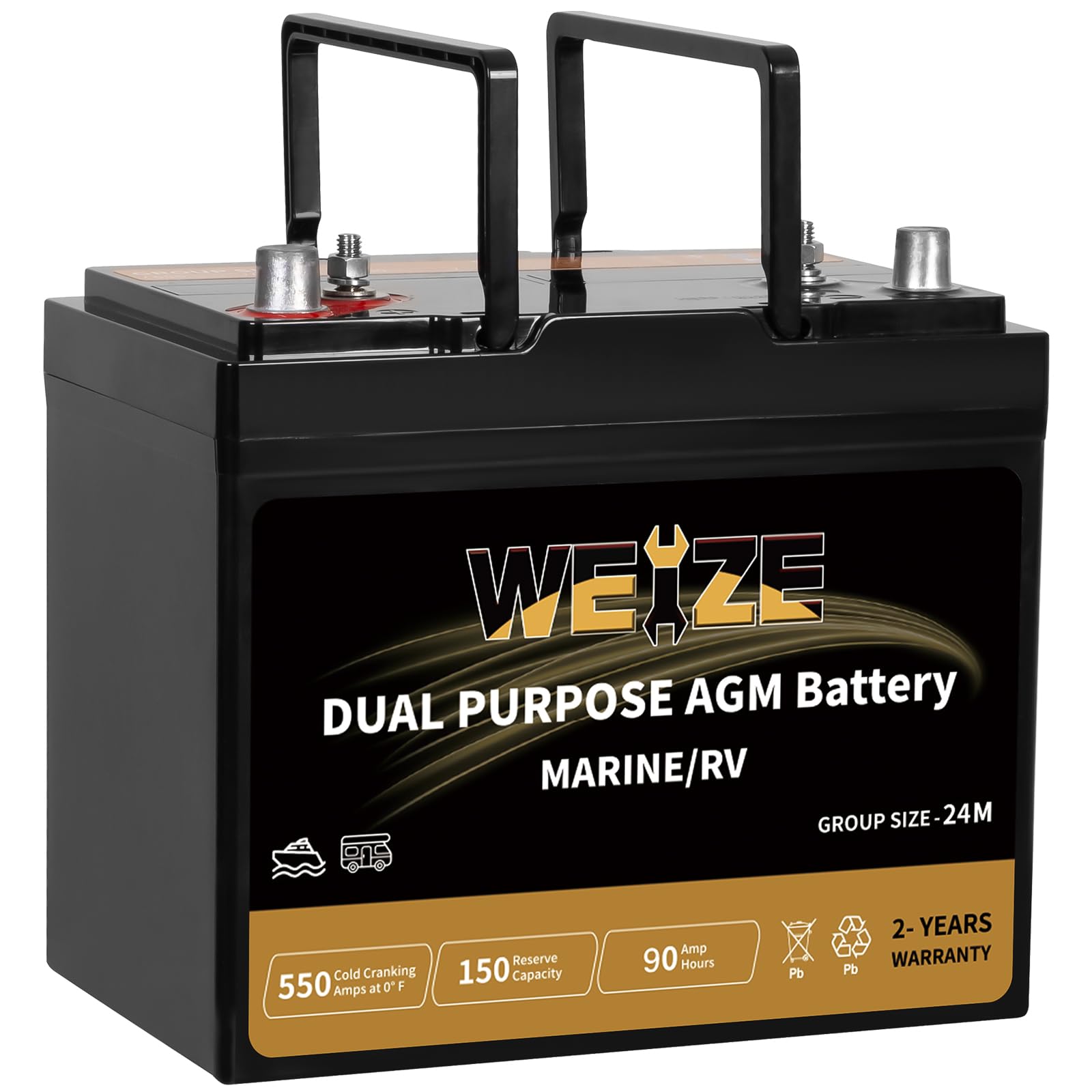
The Weize Group 24M dual-purpose battery offers the same 550 CCA and 90 Ah as the Mighty Max but at a slightly lower price point, making it a strong contender for budget-focused boaters. The AGM technology provides 2x the cycle life of traditional flooded marine batteries and charges up to five times faster when paired with a proper 14.4V charger. The 150 RC is marginally better than the Mighty Max, giving you a few extra minutes of reserve power for electronics.
At 50.72 pounds with dimensions of 10.24 x 6.61 x 8.19 inches, the Weize fits standard Group 24 trays and includes DT, SAE/M8 stud, and Wingnut terminal compatibility. The 2-year warranty is better than many in this tier, and the vibration resistance is rated 20 times higher than flooded batteries—a meaningful advantage for boats that pound through waves. Customer feedback highlights the well-packaged delivery and strong initial performance for small to mid-size outboards.
The limitations mirror those of the Mighty Max: 550 CCA is on the edge for cold weather starting of larger engines. Some users have reported early failure in high-draw applications, so this battery is best reserved for boats where the starting load is modest and a dedicated house battery handles the accessories. For a reliable, no-frills cranking battery on a bass boat or runabout, the Weize delivers dependable value.
Why it’s great
- 5x faster charging than flooded batteries
- 20x vibration resistance over flooded lead-acid
- Comprehensive terminal options (DT, SAE, M8)
Good to know
- 550 CCA not ideal for large engines
- Warranty process requires direct contact, not Amazon
8. Litime 12V 20Ah Marine Starting Lithium Battery

The Litime 20Ah lithium starting battery weighs just 9.68 pounds—roughly one-fifth the weight of an equivalent AGM—while delivering 650 to 800 CCA for reliable outboard starts. The LiFePO4 chemistry provides 5,000+ cycles, dwarfing the 300-500 cycles of a lead-acid battery. The upgraded BMS includes low-temperature charge protection (stops below 32°F), salt-spray resistance, and a 30-second overload recovery that prevents nuisance shutdowns during cranking.
At 7.76 x 5.2 x 6.69 inches, the U1 Group size is extremely compact, freeing up significant bilge space for tackle, batteries, or storage. Users report that it starts 60hp two-stroke outboards multiple times and still has enough reserve to power GPS and speakers for hours. The weight savings directly improve fuel efficiency and handling on small boats where every pound counts.
The major limitation is compatibility: this battery is explicitly not for Yamaha outboards, cars, motorcycles, or RV chassis starting—only for marine outboard and lawnmower engines. If your motor has a high inrush current spike (some Yamahas and large displacement engines), the BMS may cut power during the initial cranking pulse. Always verify your specific motor’s starting current before committing to a lithium starting battery.
Why it’s great
- Extreme weight savings—9.68 lbs vs. 50+ lbs AGM
- 5,000+ cycle lifespan
- Smart BMS protects against low-temperature and over-current
Good to know
- Not compatible with Yamaha outboards
- 20 Ah capacity means minimal house power
- App-based battery monitoring may feel gimmicky
9. Dumfume 12V 150Ah LiFePO4 Deep Cycle Battery
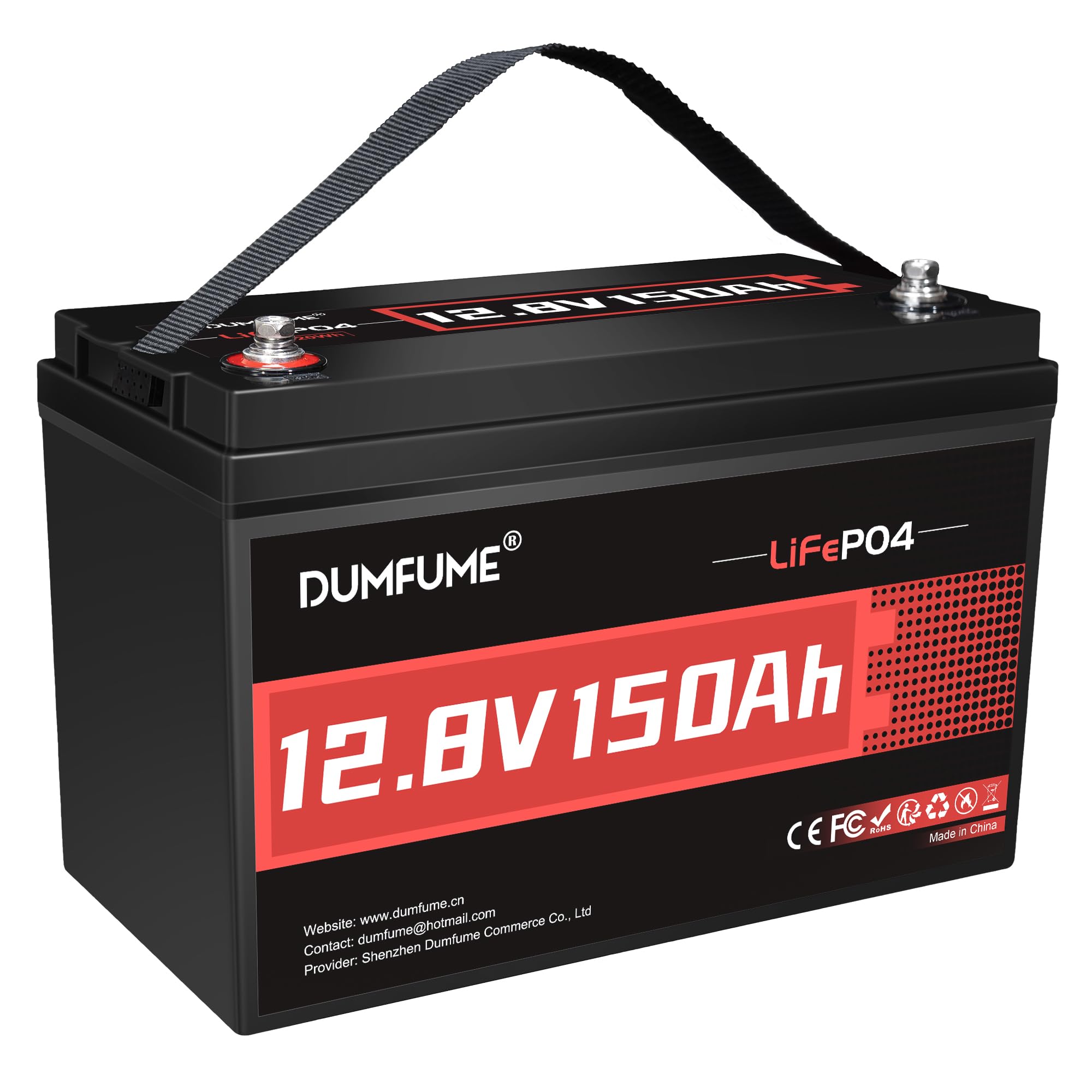
The Dumfume 150Ah LiFePO4 battery is a deep-cycle storage powerhouse, not a starter battery. With 1,920 Wh of energy and 4,000+ cycles to 80% capacity, it’s designed for solar storage, RV house loads, trolling motors, and off-grid backup—not for the high inrush current of an engine starter. The 100A BMS protects against overcharge, over-discharge, and short circuits, making it safe for long-term parallel setups up to 4S4P.
Weighing just 22.05 pounds, the Dumfume saves over 30 pounds compared to a 150Ah lead-acid equivalent, and its compact dimensions (13.05 × 6.78 × 8.66 inches) fit Group 31 trays with room to spare. Users have measured actual capacity exceeding the 150Ah rating by about 7 Ah, and the 5-year warranty adds confidence for permanent installations. The LiFePO4 chemistry operates well in temperatures above 41°F (5°C) and requires a full maintenance cycle every six months during storage.
The critical warning: this battery is explicitly labeled for energy storage only and is not designed for engine starting. Connecting it to a starter motor load can trigger the BMS low-voltage cutoff and permanently damage the cells. If you need a dedicated house battery to pair with a separate starting battery, the Dumfume 150Ah is an excellent choice. For a starting battery, look at the Litime or Optima options instead.
Why it’s great
- Massive 1,920 Wh storage for solar or house use
- Ultra-light at 22 lbs for 150 Ah
- 5-year warranty with reliable support
Good to know
- Not for engine starting—BMS will cut out
- Requires 5°C+ minimum charging temperature
- Warranty is direct purchase only, not via Amazon
FAQ
Can I use a deep-cycle battery as my main starting battery?
How many CCA do I need for a 150hp outboard?
What is the difference between AGM and flooded marine batteries?
Can a lithium LiFePO4 battery replace my AGM starting battery?
Final Thoughts: The Verdict
For most users, the best boat starting battery winner is the Optima 34 REDTOP because its SpiralCell AGM design delivers instant 800 CCA cranking and industry-leading vibration resistance in a lightweight, maintenance-free package that lasts for years on saltwater. If you need strong dual-purpose performance for both starting and powering electronics, grab the Interstate 8-31MAGMDC. And for the lightest possible starting battery that still cranks reliably, nothing beats the Litime 20Ah Lithium.