
The grain of sanded balsa, the crisp snap of a precisely laser-cut former sliding into place, and the first moment a structure you assembled from a pile of sticks actually holds weight — that tactile, deliberate process is the defining ritual of this hobby. It is a pursuit that demands patience, rewards precision, and delivers a flying experience unmatched by any injection-molded foam airframe.
I’m Min — the co-founder and writer behind Gadgets Feed. My analysis of these kits involves deep dives into customer build logs, critical assessments of laser-cutting tolerances, and direct comparisons of included hardware against the demands of electric or rubber-powered flight.
Whether you’re a returning builder after a long hiatus or a dedicated scale enthusiast, this guide breaks down the current market to help you select from the best balsa rc aircraft kits available today, matching each to your skill level and ambition.
How To Choose The Best Balsa RC Aircraft Kits
Selecting a balsa kit is a commitment of time and focus. Unlike almost every other RC product category, the purchase price is only a small fraction of the total investment — the dozens of hours of building time are the real cost. Choosing correctly means matching the kit’s complexity to your skill level.
Skill Rating and Build Complexity
Guillow’s kits use a 1-to-5 skill rating system that is a reliable benchmark. A level 1 or 2 kit is a simple stick-and-tissue build suitable for a first-timer, while a level 5 kit requires experience in carvel construction, silk or tissue covering, and painting. Most mid-range Viloga kits fall in the intermediate space, often lacking the detailed instructions a true beginner needs.
Wingspan and Wing Loading
Wingspan directly dictates how the plane flies. A 20-inch micro model is a nervous, fast-flying indoor ship that handles zero wind. A 46-inch kit like the Piper Cub is a much more docile flyer capable of handling a light breeze. Heavier models with higher wing loading require more speed to stay aloft and are less forgiving for landing in small fields.
Power System Compatibility
Many of these kits were originally designed for rubber-band power. Converting them to electric RC requires careful selection of a brushless outrunner motor, a 2S or 3S LiPo battery, and a compatible ESC. You need to verify that the firewall or motor mount included in the kit can support the weight and torque of a modern electric motor without modification.
Quick Comparison
On smaller screens, swipe sideways to see the full table.
| Model | Category | Best For | Key Spec | Amazon |
|---|---|---|---|---|
| Viloga Piper Cub J3 | Premium | Intermediate Builders | 46″ wingspan | Amazon |
| Viloga Extra330 | Premium | Aerobatic Flight | 39″ wingspan | Amazon |
| Viloga SE5A Biplane | Mid-Range | Indoor Flying | 14.8″ wingspan | Amazon |
| Guillow’s P-40 Warhawk | Mid-Range | Scale Display | 28″ wingspan | Amazon |
| Guillow’s Wright Flyer | Mid-Range | Challenging Build | 24.2″ wingspan | Amazon |
| Viloga R03 Stick-06 | Budget | Entry-Level Trainer | 580mm wingspan | Amazon |
| Guillow’s Aeronca Champion | Budget | Easy Assembly | 24″ wingspan | Amazon |
In‑Depth Reviews
1. Viloga Piper Cub J3

This 46-inch wingspan kit strikes the best balance between build satisfaction and flying performance. The high-emulation scale detail, including the molded plastic cowl and windscreen, is preserved without sacrificing the lightweight structure needed for stable flight. The tab-lock joints on the fuselage are a modern improvement that increases alignment accuracy during construction.
The balsa and plywood quality is consistently rated as top-tier by customers, with minimal warping across the laser-cut sheets. This is a kit designed for intermediate to experienced builders — the plans assume you have decent covering skills. The functional landing gear with real coil-over springs adds a layer of realism that shows on final approach.
Flying reports describe the J3 as docile and forgiving, with predictable stall characteristics. The kit does not include electronics, so you will need to source a motor, ESC, servos, and a 3S LiPo pack. The comprehensive hardware pack includes control horns, pushrods, and hinges, removing guesswork from the final assembly stage.
Why it’s great
- Large 46-inch wing provides excellent stability for relaxed flying in light wind.
- Tab-lock fuselage design improves build accuracy over traditional stick framing.
Good to know
- Instructions are vague; not suitable for a first-time builder.
- Paper hinges included in the hardware pack are inadequate — replace with standard CA hinges.
2. Viloga Extra330

This 39-inch aerobatic model is for the builder who flies 3D and wants a precise, lightweight airframe that responds instantly to control inputs. The mid-wing design is structurally efficient and allows for high-g maneuvers without flexing. The laser cutting is high-precision, and the included plastic cowl, windscreen, and full hardware pack accelerate the build.
Experienced builders note that the instructions lack detailed motor-mount geometry — the thrust angle diagrams are ambiguous, requiring you to double-check alignment with a protractor. The landing gear is a known weak point; replacing the stock wire with heavier-duty material is a common modification. Despite this, the balsa and plywood quality are rated as very good for this price tier.
Flight readiness requires a great deal of aftermarket components: a brushless outrunner, 40A ESC, four 9g micro servos, covering film, and a 4-channel receiver. The model is extremely stable once properly trimmed, but the first flight reveals a high wing loading, so keep the speed up on landing.
Why it’s great
- Designed for aerobatic precision — crisp snap rolls and smooth knife-edge flight.
- High-quality laser-cut balsa with excellent interlocking fit.
Good to know
- Not a complete kit — requires motor, ESC, servos, propeller, and covering material.
- Stock landing gear is flimsy and often requires replacement after a few landings.
3. Viloga SE5A Biplane

This micro WWI SE5A biplane is a delightful kit for the indoor and calm-day park flyer. At just 14.8 inches of wingspan, the finished model is tiny, but the pre-installed 1104 3700KV brushless motor and 1S 5A ESC dramatically reduce the barrier to entry for electric conversion. The biplane configuration provides a surprising amount of lift at low speeds.
The laser-cut balsa parts are clean and fit together with minimal sanding. The kit is rated as suitable for junior modelers, but the instructions are a significant weakness — several builders report missing steps and dark photos. You will need your own 1S LiPo battery, micro receiver, and a compatible transmitter to get airborne. The 1.7g servos are tiny and require steady hands to install.
Weight management is critical here. The finished model can balloon past 50 grams if you use too much glue. Customer reports indicate that the supplied motor provides roughly 20 grams of thrust, which is barely adequate. Many recommend swapping to the brushed gearbox version of the kit for more usable power.
Why it’s great
- Comes with brushless motor and ESC, saving a sourcing step for RC conversion.
- Biplane design produces excellent low-speed lift for indoor flying.
Good to know
- Instructions are poorly translated and missing critical assembly details.
- Stock motor is underpowered for the weight — consider upgrading the power system.
4. Guillow’s P-40 Warhawk

The “Flying Tiger” P-40 is one of Guillow’s most popular scale kits, and the 28-inch wingspan makes it a substantial display piece. The laser-cut balsa parts are near-perfection, with no splintering or burnt edges. The kit is designed for rubber power, free flight, or U-Control, but the structure is robust enough to handle a micro RC conversion with careful reinforcement.
Builders note the included decals are high quality and the vacuum-formed plastic parts are crisp. The instructions are typical of Guillow’s — adequate for an experienced builder but sparse on RC-specific guidance. A known detail issue is the inclusion of a two-blade propeller, whereas the real P-40 used a three-blade prop. Aftermarket scale props are easy to find.
This is widely considered one of the best kits in the Guillow’s line for a satisfying weekend build. The structure goes together straight and true, and the final model looks authentic on a shelf. If you follow a conversion guide found online, the plane becomes a lively, manageable RC flyer.
Why it’s great
- Laser-cut parts are exceptionally clean with near-zero flash or charring.
- Large wingspan creates a satisfying presence for static display or flight.
Good to know
- Supplied propeller is historically inaccurate — the real P-40 used a three-blade prop.
- RC conversion requires significant structural modification to the nose and firewall.
5. Guillow’s 1903 Wright Flyer
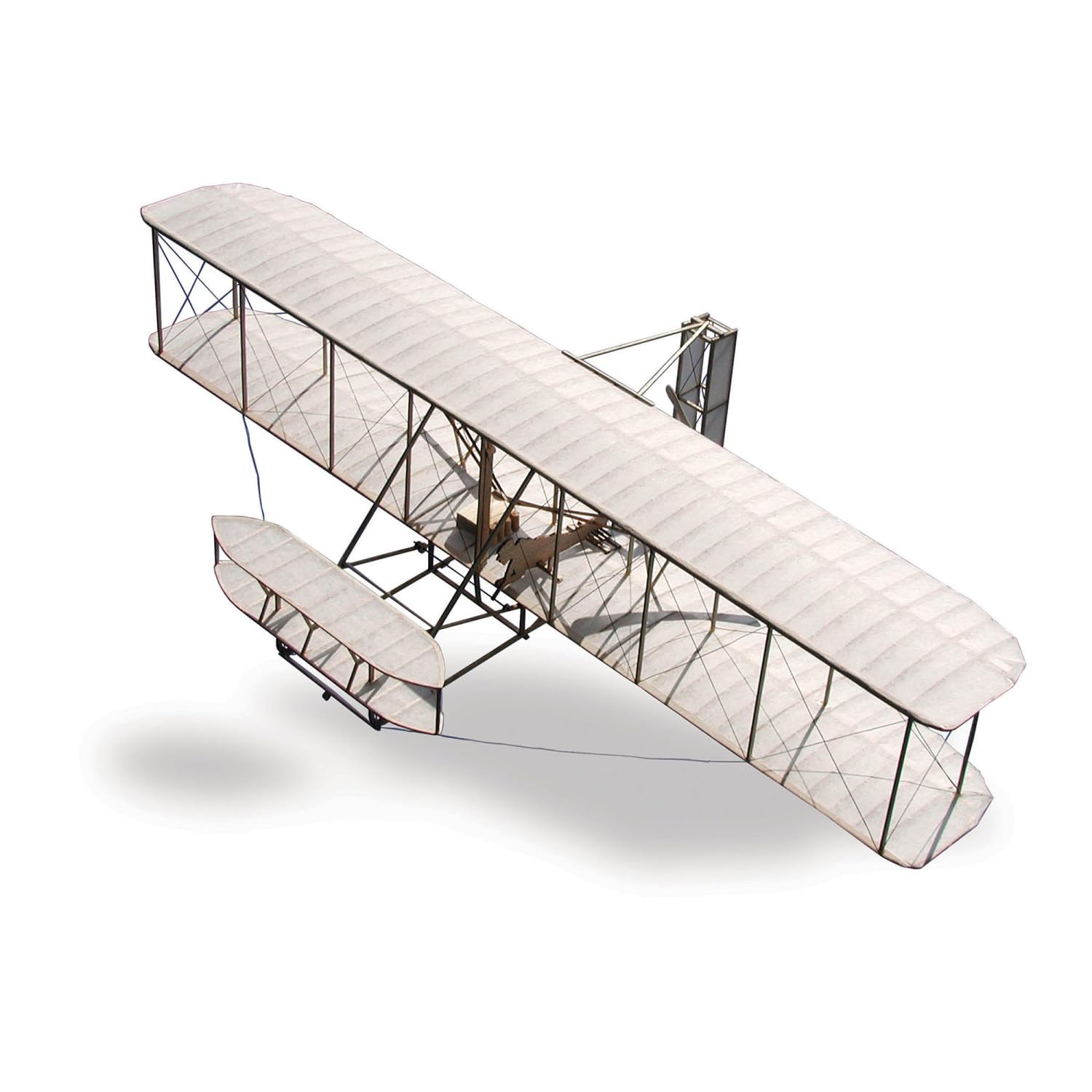
This is not a beginner’s kit, and Guillow’s makes no secret of that — it carries their highest skill rating. The 1:20 scale Wright Flyer is a faithful replica of the original, complete with simulated engine, moveable propellers, a laser-cut pilot profile, and a display stand. The wingspan at 24.2 inches is generous, but the construction is intricate.
The build requires a sewing needle for rigging, CA glue for the ribs, and careful study of the minimalist plans. The rib structure is particularly delicate. You will need to sand, carve, and fit parts. The tissue covering must be doped white for historical accuracy. This is a therapeutic project for the experienced builder that requires dozens of hours.
Reviewers unanimously agree that this is a display-only model. The structure is too fragile for RC conversion or rubber-powered flight. As a commemorative model of the first flight, it is stunning. You will need patience and a steady hand, but the final result is a conversation piece.
Why it’s great
- Highly accurate 1:20 scale replica with excellent historical detail.
- Laser-cut parts are clean, with extra material included for trial fitting.
Good to know
- Extremely challenging build — not for anyone under level 4 skill.
- Structure is too delicate for any form of powered flight.
6. Viloga R03 Stick-06

This entry-level trainer with a 580mm upper wingspan is marketed toward junior modelers, but the reality is mixed. The laser-cut balsa quality is decent for the price point, and the stick-and-tissue design is simple in theory. However, the instructions are the weakest point here — many builders report they are nearly unreadable, leading to frustration.
The wood warping is a recurring issue. Multiple customers report needing to add a carbon fiber wing spar just to keep the wing from folding during flight. The power system is not included, so you need to source your own motor, ESC, battery, and radio. The recommended specs call for a small brushless motor on a 2S LiPo, keeping the finished weight around 130 grams.
When assembled correctly, the model flies well at one-third throttle and can handle mild aerobatics. The basic design is sound, but the inconsistency of the kit — warped wood and poor documentation — makes it a project for someone who already knows how to build rather than a true beginner kit.
Why it’s great
- Very low entry cost for a balsa trainer airframe.
- Design is inherently stable and forgiving when built correctly.
Good to know
- Significant warping in balsa sheets reported frequently.
- Instructions are poor and missing critical assembly steps.
7. Guillow’s Aeronca Champion

The Aeronca Champion is a classic Guillow’s kit from their Series 300 line, featuring a 24-inch wingspan and precision laser-cut balsa that eliminates the frustration of old die-cut kits. The parts pop out cleanly, and the kit includes scale plastic wheels, a full decal sheet, and vacuum-formed plastic parts. It is designed for rubber power, free flight, or static display.
Builders consistently praise the ease of assembly. The instructions are clear, and the structure goes together in a weekend. Many customers are returning to the hobby after decades away and appreciate that the kit does not require extensive carving or sanding. The included rubber motor provides enough power for a short flight in calm conditions.
For those interested in RC conversion, the fuselage is spacious enough for micro electronics. A small brushless outrunner and a 2S 300mAh pack fit with minimal modification. The kit is made in the USA, a point of pride for many buyers. It is an ideal re-entry point for a builder who wants a satisfying, low-stress project.
Why it’s great
- Laser-cut parts are clean and require minimal clean-up before assembly.
- Straightforward build that is perfect for returning to the hobby.
Good to know
- Rubber motor provides limited flight time; RC conversion requires some modification.
- Small parts can be tricky for those with less dexterity.
FAQ
What is the difference between a die-cut and a laser-cut balsa kit?
Can I convert a rubber-powered kit to electric RC flight?
Which glue should I use for balsa aircraft construction?
Final Thoughts: The Verdict
For most users, the balsa rc aircraft kits winner is the Viloga Piper Cub J3 because its 46-inch wingspan delivers a stable, predictable flight experience and the tab-lock fuselage makes the build accessible to intermediate modelers. If you want a smaller, indoor-focused project that includes the motor and ESC, grab the Viloga SE5A Biplane. And for a pure, historical display model that sharpens your skin-and-tissue skills, nothing beats the Guillow’s 1903 Wright Flyer.