
Forget the compressed, hollow sound of a budget soundbar. A proper audio home theater system transforms your living room into a cinema, where every footstep creaks with intention, bass throbs in your chest, and dialogue cuts through the chaos with crystal clarity. The difference isn’t subtle — it’s the entire emotional weight of your favorite movie.
I’m Min — the co-founder and writer behind Gadgets Feed. I’ve spent hundreds of hours dissecting channel configurations, amplifier specs, driver materials, and real-world user feedback across hundreds of systems to separate truly immersive setups from marketing noise.
Whether you crave the raw authority of floorstanding towers or the sheer convenience of a giant soundbar that outperforms traditional separates, picking the wrong architecture wastes money and leaves your room sounding thin. This guide cuts through the confusion to deliver the definitive list of the best audio home theater system.
How To Choose The Best Audio Home Theater System
Navigating the world of channel counts, amplifier power, and driver materials can be dizzying. The perfect system depends on three core pillars: the physical acoustics of your room, your tolerance for cable management and physical speaker size, and your priority between movie immersion versus music fidelity.
Channel Configuration Decoded: 5.1 vs 7.1 vs 11.1.6
The first number is the ear-level channels (left, center, right, side/rear surrounds), the second is the dedicated subwoofer channels, and the third is the discrete height channels. For Dolby Atmos, a minimum of two discrete height channels from dedicated up-firing drivers (not simulated) is essential for convincing overhead effects like rain or helicopters. An 11.1.4 system offers four dedicated height drivers, creating a much more cohesive and seamless dome of sound compared to a passive 5.1 setup.
Subwoofer Strategy: Size, Power, and Driver Material
Bass is the foundation of any cinematic experience. The size of the driver (10-inch, 12-inch) dictates how much air it can move at a given excursion. A larger driver typically delivers deeper extension, but the cabinet design and amplifier wattage are equally critical. A 12-inch driven by a 400W all-digital amplifier will deliver tighter, more authoritative bass than an under-powered 10-inch. Dual subwoofers can smooth out room modes and provide a more even bass response across multiple seating positions.
Crossing the Chasm: Soundbar vs. Passive Speaker Systems
This is the single biggest decision. A flagship soundbar (like the top-tier Nakamichi or JBL models) offers unparalleled convenience with a single connection and wireless surrounds. They leverage advanced DSP to create a convincing sound bubble. On the other hand, a passive speaker system from Klipsch uses individual, dedicated speakers with larger drivers and horn-loaded tweeters. This architecture inherently offers higher sensitivity, lower distortion, and a physically wider, more effortless soundstage that fills even large rooms without strain. The trade-off is the need for a separate AV receiver and running speaker wire.
Quick Comparison
On smaller screens, swipe sideways to see the full table.
| Model | Category | Best For | Key Spec | Amazon |
|---|---|---|---|---|
| Klipsch Reference 5.2 Atmos System | Passive Tower System | Pure Cinema Power | Dual 12″ subs, 6.5″ IMG woofers | Amazon |
| Klipsch Reference Cinema 5.1.4 | Passive Satellite System | Entry-Level Atmos | 5.25″ dynamic drivers | Amazon |
| JBL Bar 1300XMK2 | Detachable Soundbar | Flexible Surrounds | 12″ wireless subwoofer | Amazon |
| Samsung Q990F | Wireless Soundbar | Samsung Ecosystem | 8″ wireless subwoofer | Amazon |
| Klipsch Bundle w/ Yamaha RX-A2AB | Complete Bundle | All-in-One Upgrade | 75W/ch, 7.2-ch receiver | Amazon |
| Nakamichi Shockwafe 11.2.6 | Flagship Soundbar | Ultimate Soundbar | Dual 10″ subs, 6 height ch | Amazon |
| Nakamichi Dragon 11.4.6 | Cinema Reference | AVR-Grade Performance | Dual-opposing 8″ subs, AMT tweeters | Amazon |
| Sony BRAVIA Theater Quad | Modular System | Spatial Audio Magic | 4 wireless speakers, 16 units | Amazon |
In‑Depth Reviews
1. Klipsch Reference 5.2 Dolby Atmos Home Theater System

This is the killer combo for anyone wanting true, no-compromise cinema sound without assembling a system piecemeal. The bundle pairs the R-625FA floorstanding towers (which integrate a dedicated up-firing 6.5-inch driver for overhead effects) with the R-52C center channel for crisp dialogue. The dual R-12SW 12-inch powered subwoofers are the star — each houses a 400W all-digital amplifier and a spun copper IMG woofer that delivers deep, room-shaking bass with surprising speed.
The Tractrix horn-loaded LTS aluminum tweeters provide the signature Klipsch high-end extension, which brings out detail in everything from footsteps to string instruments. At a sensitivity rating near 96dB for the towers, this system can fill a large room with dynamic range using a modest 75W receiver. The dual subs also help smooth out standing wave nulls, providing more even bass across a wider seating area than a single sub ever could.
One practical note: the supplied tower feet screws are reported as low quality by multiple owners, so plan to use your own hardware. The system demands a proper AV receiver with a 5.2-channel configuration. This is the benchmark for what a mid-premium passive system should sound like — authoritative, detailed, and effortlessly cinematic.
Why it’s great
- Dual 12-inch subs eliminate room mode nulls and deliver controlled, spine-tingling bass
- Dolby Atmos up-firing drivers in the towers eliminate the need for ceiling-mounted speakers
- High sensitivity (90-96dB) allows for dynamic peaks without amplifier strain
Good to know
- Requires a separate AV receiver and speaker wire — not a plug-and-play solution
- Supplied mounting screws for the towers are of poor quality and may strip
- The Tractrix horns produce a bright treble that may require EQ for some listeners
2. Nakamichi Dragon 11.4.6-Ch Surround System
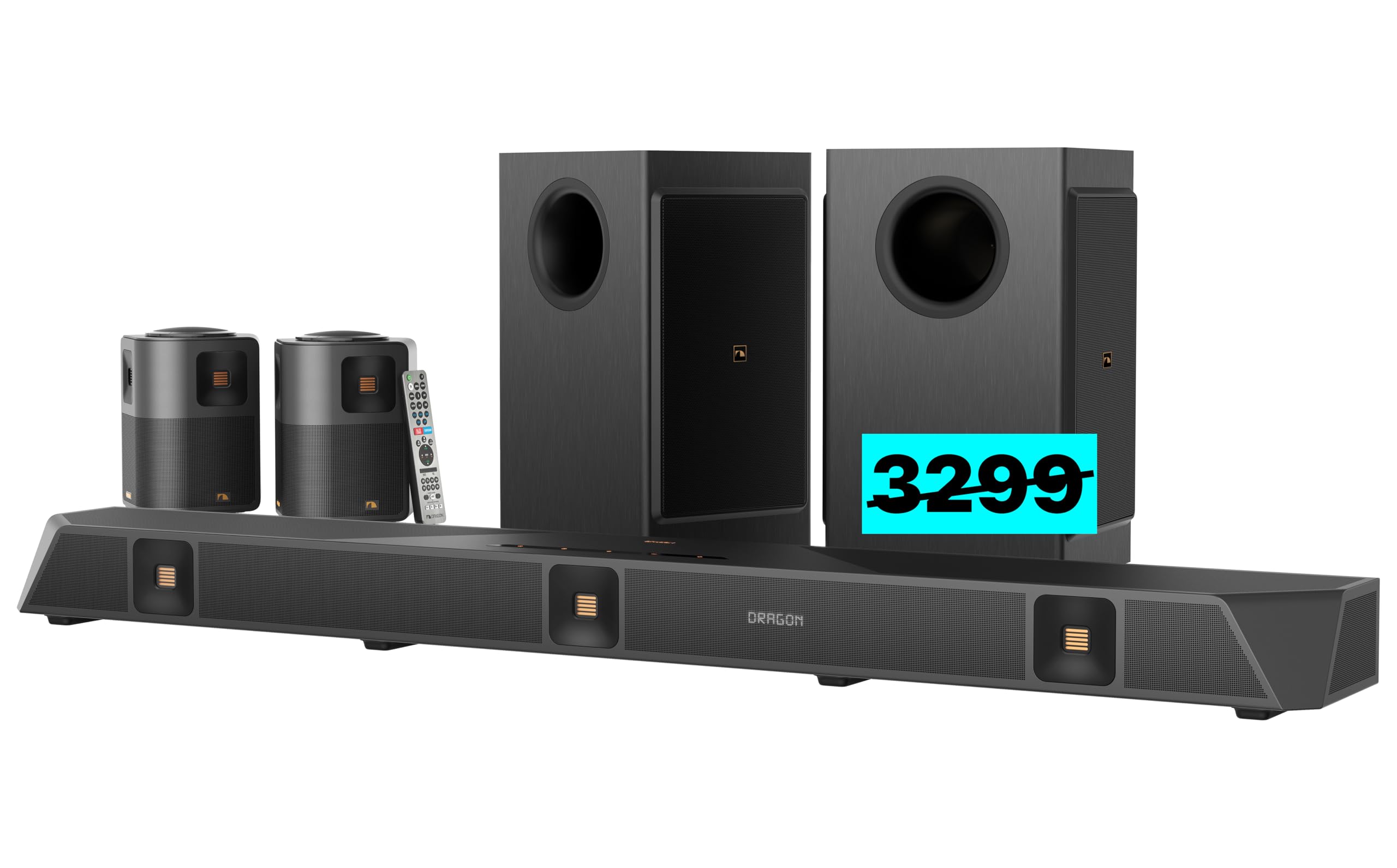
The Nakamichi Dragon is the most audacious soundbar ever built — it challenges the notion that a soundbar can’t match a high-end AVR-driven system. The 58-inch wide chassis houses HiFi Air Motion Transformers (AMTs) which offer radically lower distortion and faster transient response than traditional dome tweeters. This results in dialogue that sounds almost unnaturally clean and present, even at reference volume levels.
The 11.4.6 architecture is built around its exclusive Pro-Cinema Engine, which processes Dolby Atmos up to 24.1.10 and DTS:X Pro up to 30.2. The dual-opposing 8-inch subwoofers are a stroke of engineering genius — by firing two drivers against each other in each cabinet, they cancel out cabinet vibration, delivering deep, tight bass that is felt physically without audible distortion. The bipolar surround speakers with PerfectHeight Mechanism lock overhead effects to the acoustic sweet spot.
Setup is far simpler than a traditional system, but be prepared for the size — the main unit weighs 32 lbs and requires two people to mount. The lack of Wi-Fi for automatic firmware updates is a lingering annoyance, requiring a USB drive. For those seeking the pinnacle of soundbar performance that truly rivals dedicated separates, the Dragon is the clear choice.
Why it’s great
- AMT tweeters deliver ultrasonic clarity with zero breakup at high volumes
- Dual-opposing subwoofer design eliminates cabinet resonance for clean, room-pressurizing bass
- Pro-Cinema Engine processes higher-order Atmos with precision beyond typical soundbars
Good to know
- Massive footprint — requires a serious entertainment console or wall mounting
- Firmware updates require USB drive; no over-the-air Wi-Fi updates
- Premium price point places it above most standalone soundbars
3. Klipsch Reference Cinema Dolby Atmos 5.1.4 System

This kit is the most accessible entry point into a genuine Dolby Atmos system with discrete height channels. All four satellite speakers include dedicated up-firing drivers, creating a full 360-degree sound bubble with overhead effects from both the front and rear. The Tractrix 90° x 90° horn technology combined with aluminum tweeters delivers the legendary Klipsch high-end response, ensuring dialogue and high-frequency detail cut through the mix.
The built-in all-digital subwoofer amplifier is rated to deliver clean power, though the reviewer consensus notes that the subwoofer lacks the punch of a larger 12-inch model — it’s adequate for small to medium rooms (up to about 400 sq ft) but will struggle in open concept spaces. The 5.25-inch dynamic drivers in the satellites are surprisingly articulate for their size, offering a crisp, energetic sound signature that excels with action movies and gaming.
A critical practical detail: the system does not include speaker wire, and the push-locking connections require smaller banana plugs or bare wire. The crossover points (center at 90Hz, satellites at 100Hz) are slightly higher than audiophile-grade systems, meaning the sub handles more mid-bass. This is a fantastic starter system that allows a future upgrade path to larger Klipsch towers and a more powerful sub.
Why it’s great
- Four discrete up-firing satellite speakers provide front and rear height effects for true Atmos immersion
- Tractrix horn-loaded tweeters ensure crisp dialogue clarity even at moderate volumes
- Compact satellite footprint fits easily into smaller living rooms and apartments
Good to know
- The 8-inch subwoofer lacks low-end authority for larger rooms or bass-heavy content
- No speaker wire included; must purchase 14-16 gauge wire separately
- Plastic cabinet construction feels less premium than the Reference floorstander range
4. Nakamichi Shockwafe Wireless 11.2.6 Ch Soundbar System
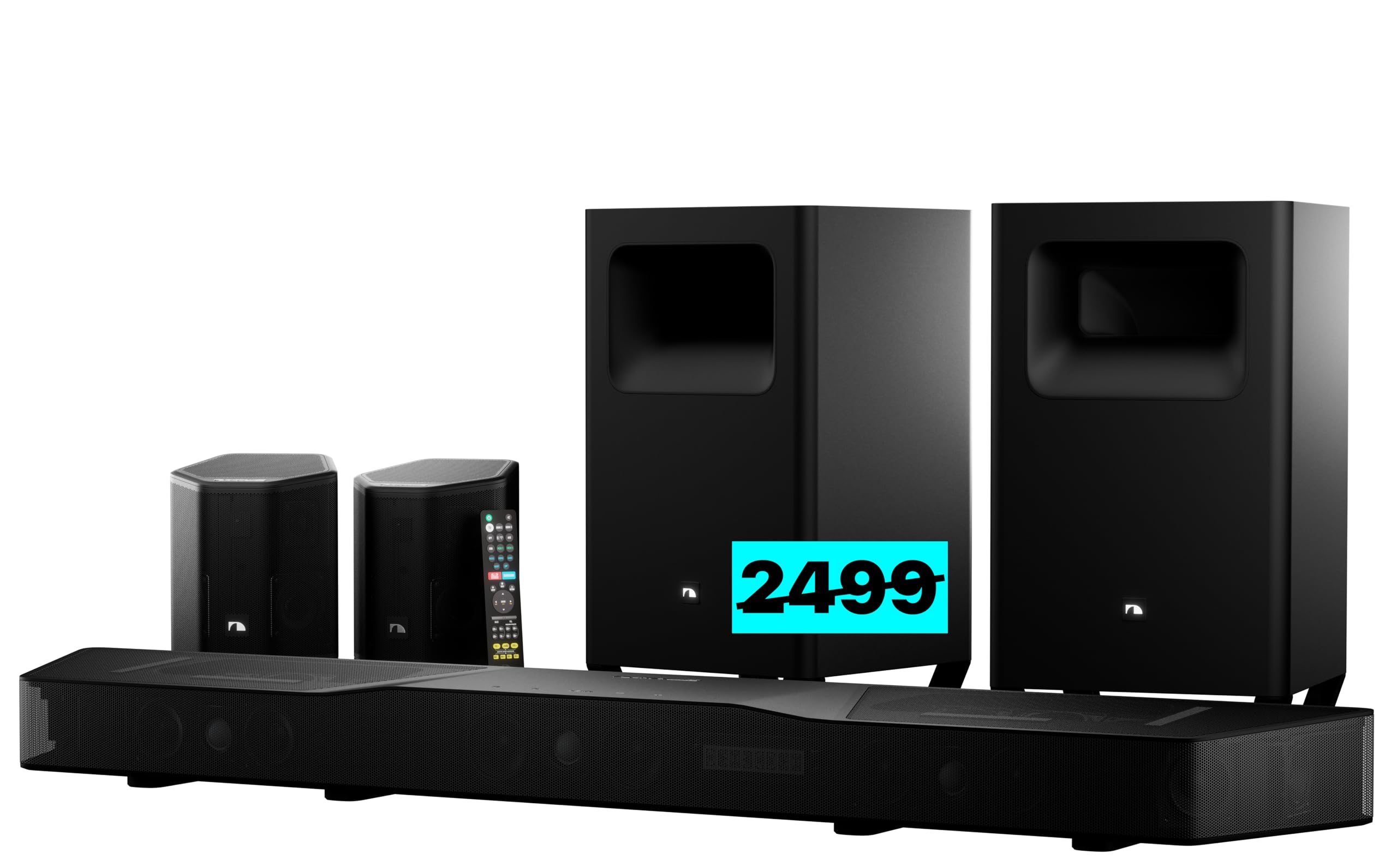
The Shockwafe 11.2.6 represents the sweet spot in Nakamichi’s lineup, offering the core architecture of the Dragon at a more accessible level. The 54-inch soundbar houses six discrete height channels — three up-firing drivers on each side of the bar — which create a massive, seamless overhead soundstage. The dual 10-inch wireless subwoofers use a flared port design to move air efficiently, producing deep, tactile bass that remains composed and clean even at high output levels.
The exclusive AHD Ultra engine drives the bipolar surround speakers, which project sound from both sides and above to create the presence of six distinct surround speakers. The result is a remarkably cohesive 360-degree sound bubble that makes sound effects seem to originate from specific locations in space. The HDMI eARC and two HDMI 2.1 inputs support 4K 120Hz Dolby Vision passthrough, making this system ideal for next-gen gaming.
Setup is genuinely plug-and-play — the wireless subs and surrounds pair automatically. The backlit remote and companion app allow for granular EQ control, including independent channel level adjustments. The system ships in three boxes (soundbar, two subs, two surrounds), so plan your delivery space accordingly. For its price, the Shockwafe delivers theater-scale sound that rivals many passive 7.1 systems.
Why it’s great
- Six discrete height drivers provide a genuinely immersive dome of overhead sound
- Dual 10-inch subs with flared ports deliver deep, room-pressurizing bass without distortion
- HDMI 2.1 inputs support 4K 120Hz with Dolby Vision for gaming
Good to know
- Massive 54-inch soundbar requires a wide console or dedicated mount
- Shipping in three boxes requires significant space for unboxing
- App calibration can be buggy; a firmware update via USB may be needed initially
5. Sony BRAVIA Theater Quad 16-Speaker Home Theater Audio System

The Sony BRAVIA Theater Quad is a radical departure from traditional home theater design. It consists of four wireless speaker modules (each housing four individual driver units for a total of 16) that you place around the room, with a central control box handling all processing. Sony’s 360 Spatial Sound Mapping technology uses the built-in microphones to automatically calibrate the system to your room’s specific acoustic characteristics, creating virtual speakers in space to fill the room with sound.
The spatial processing is genuinely remarkable — the system creates a convincing front soundstage without a physical center channel, which is a testament to Sony’s DSP prowess. For Dolby Atmos content, the overhead effects are localized with impressive precision, and the wide dispersion eliminates the “sweet spot” problem. The system supports all major immersive formats (Dolby Atmos, DTS:X, IMAX Enhanced) and passes through 4K 120Hz VRR/ALLM for gaming.
The notable downside is the subwoofer situation — the Quad system is sold without a subwoofer, and the only compatible options are Sony’s own wireless subs (SW5, SW3). Reviewers note that the system lacks low-end punch below around 30Hz even with the SW5. The software has been reported as buggy, with Wi-Fi congestion causing HDMI CEC issues. For those who prioritize spatial magic above raw bass output, the Quad is a stunning, innovative system.
Why it’s great
- 16-speaker array with 360 Spatial Sound Mapping creates a wide, convincing front soundstage without a center channel
- Wireless speaker modules allow flexible placement without running cables
- Auto-calibration adapts to room acoustics and seating positions for optimal imaging
Good to know
- Subwoofer is sold separately and has limited extension below 30Hz
- Buggy software can cause HDMI CEC interference and Wi-Fi pairing issues
- High price point for a system that still requires an additional subwoofer purchase
6. Klipsch Reference Dolby Atmos Bundle with Yamaha RX-A2AB AV Receiver
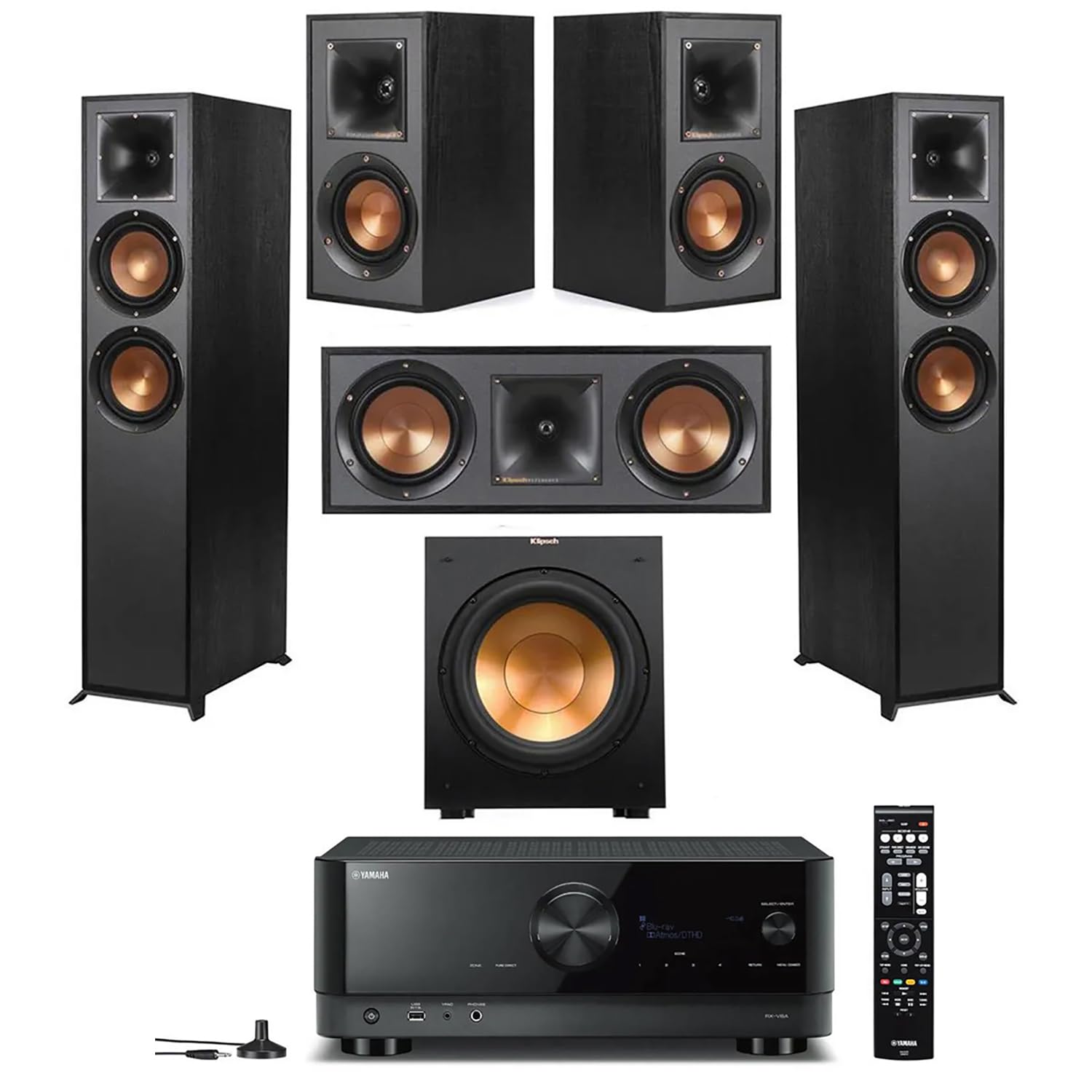
This bundle eliminates the most intimidating part of building a passive home theater: matching speakers to a receiver. It pairs the same Klipsch Reference 5.1.2 speaker array (R-625FA towers, R-52C center, R-41M surrounds, R-12SW sub) with a Yamaha RX-V6 (RX-A2AB) 7.2-channel AV receiver, which delivers 75 watts per channel with low distortion. The Yamaha adds HEOS wireless streaming, meaning you can play Spotify and Tidal directly without connecting a separate source.
The Yamaha receiver supports Dolby Atmos and DTS:X decoding, along with 8K video passthrough and automatic room calibration via YPAO. This is crucial for the Klipsch speakers — the YPAO system can EQ the bright Tractrix horn treble to better suit your room’s acoustics. The 7.2-channel receiver also leaves room for future expansion to a 7.1.2 or 5.2.2 configuration by adding rear surround speakers.
The speaker build quality is solid with scratch-resistant black wood-grain MDF cabinets and magnetic grilles. The 12-inch subwoofer provides the low-end thump that the smaller Cinema system lacks, making this bundle appropriate for medium to large rooms. The combination of an audited AVR and high-sensitivity speakers means this system can achieve reference-level playback in a standard living room without breaking a sweat.
Why it’s great
- Yamaha RX-V6 receiver with YPAO room calibration optimizes the Klipsch speakers for your room
- 12-inch subwoofer provides the deep bass foundation that smaller systems lack
- HEOS built-in allows direct streaming without an external source
Good to know
- The receiver is a previous generation model; YPAO is good but not as precise as Dirac Live
- Speaker wire and subwoofer cable not included in the bundle
- The 75W/ch amplifier is adequate but won’t drive ultra-efficient towers to their maximum dynamic potential
7. Samsung Q990F 11.1.4ch Soundbar System

The Samsung Q990F is the 2025 flagship soundbar that builds on the acclaimed Q990 series. Its 11.1.4 configuration features 11 front and surround channels, a single wireless subwoofer channel, and four up-firing channels. The standout feature is Q-Symphony, which synchronizes the soundbar’s speakers with the internal speakers of compatible Samsung TVs to create a wider, more detailed soundstage that surpasses what the soundbar alone can achieve.
The Adaptive Sound feature analyzes audio content in real-time and optimizes the EQ based on background noise and the type of content. Dialogue enhancement is excellent, with the center channel projecting clear vocals even during chaotic action sequences. The wireless subwoofer houses an 8-inch driver that, while smaller than the competition’s 10-inch and 12-inch units, uses a reflex port design to produce surprisingly deep bass that can fill a medium room with satisfying impact.
Setup is primarily done through the SmartThings app, which guides you through Wi-Fi and Bluetooth pairing. The soundbar includes two HDMI inputs, which is limited for those with multiple sources. The remote is reported as nearly useless by owners, with the SmartThings app being the primary control interface. The Q990F is a polished, well-integrated option for Samsung TV owners who want seamless connectivity and a clean, wireless aesthetic.
Why it’s great
- Q-Symphony leverages Samsung TV speakers for a wider, more immersive soundstage
- Adaptive Sound automatically adjusts EQ based on ambient noise and content type
- True wireless subwoofer and rear speakers for a clean, cable-free installation
Good to know
- Only two HDMI inputs limit connectivity for multiple source devices
- 8-inch subwoofer lacks the low-end authority of dual 10-inch or 12-inch alternatives
- SmartThings app is essential for control; the included remote is basic
8. JBL Bar 1300XMK2 11.1.4 Channel Soundbar
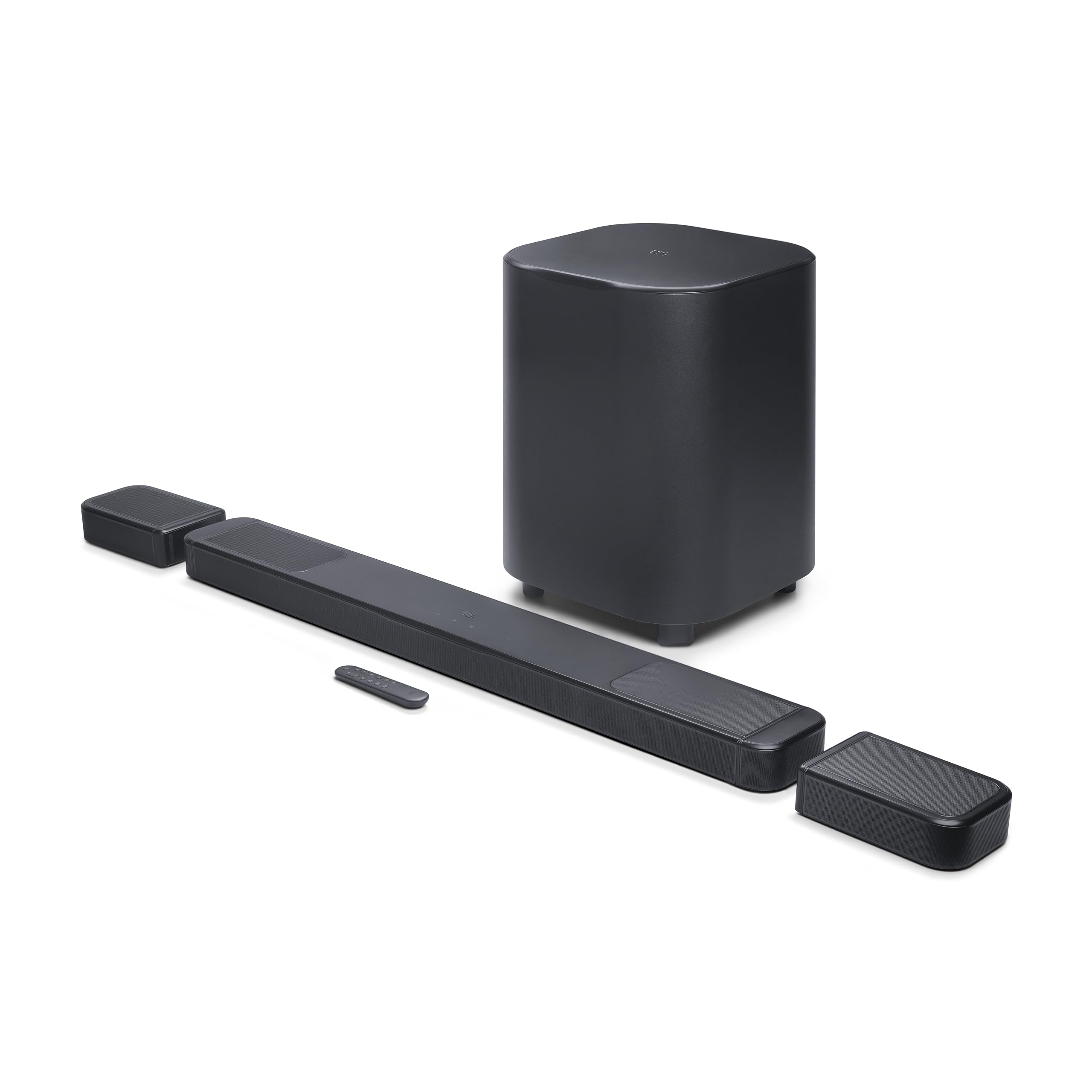
The JBL Bar 1300XMK2 is the most versatile soundbar on this list thanks to its detachable wireless surround speakers. The surrounds lift off the main bar with one hand and can be placed behind the seating area for true surround sound, or brought into another room for broadcast audio during parties. Each detachable speaker has built-in batteries rated for about 4-5 hours of playback, and they recharge when clicked back onto the bar. This is the only system that solves the “surround speakers when not in use” problem.
The 12-inch wireless subwoofer is the largest in this soundbar comparison and delivers the kind of deep, tactile bass that anchors explosions and musical bass lines. The 1,570W peak output rating translates to genuinely reference-level playback volume that can fill a large open-concept living space. The MultiBeam 3.0 technology uses an array of drivers and DSP to create a wide soundstage without a dedicated center channel, and PureVoice 2.0 ensures dialogue remains intelligible even during loud action scenes.
JBL also includes a Night Listening mode that routes all audio through the detachable speakers in front of you, muting the soundbar and subwoofer for late-night viewing. This is a genuinely thoughtful feature for apartment dwellers. The system supports AirPlay 2, Google Cast, and Spotify Connect, ensuring compatibility with any streaming ecosystem. The main trade-off is that the detachable speakers have limited battery life for extended movie sessions.
Why it’s great
- Detachable wireless surrounds offer unique flexibility for placement and broadcasting
- 12-inch subwoofer delivers deep, room-filling bass unmatched by most soundbar systems
- PureVoice 2.0 ensures dialogue clarity even at high volumes during loud scenes
Good to know
- Detachable surround batteries last only 4-5 hours; requires overnight charging
- The soundbar is large and heavy, requiring a sturdy console or dedicated wall mount
- At reference volume, the system can cause rattling in rooms with loose fixtures
FAQ
Can I use a soundbar system with an existing AV receiver?
How many height channels do I need for real Dolby Atmos?
Do I need to run speaker wire for an audio home theater system?
Is a 12-inch subwoofer better than a 10-inch subwoofer?
What is the difference between Dolby Atmos and DTS:X?
Final Thoughts: The Verdict
For most users, the best audio home theater system winner is the Klipsch Reference 5.2 Atmos System because its dual powered subwoofers and floorstanding towers deliver room-shaking bass and effortless dynamics that no soundbar can match. If you want the pinnacle of soundbar convenience with audiophile-grade drivers, grab the Nakamichi Dragon 11.4.6 for its AMT tweeters and room-pressurizing dual-opposing subs. And for a cinematic upgrade without running speaker wire, nothing beats the JBL Bar 1300XMK2.