
Running a wired connection across a house, through an attic, or out to a detached garage demands a cable that can handle the distance without signal loss or environmental damage. A flimsy patch cord designed for a desk setup will degrade your connection, introduce packet loss, and ultimately frustrate you more than Wi-Fi ever did.
I’m Min — the co-founder and writer behind Gadgets Feed. I’ve spent hundreds of hours analyzing the construction differences, shielding effectiveness, and real-world throughput of long-run Ethernet cables so you don’t have to guess which one will survive the installation and deliver full gigabit speeds.
This guide breaks down the top contenders for a 150 foot ethernet cable, comparing Cat5e, Cat6, and Cat8 options so you can match the right standard to your specific installation scenario and speed requirements.
How To Choose The Best 150 Foot Ethernet Cable
At 150 feet, you are past the point where a cheap, unshielded cable can be trusted. The key factors are the cable category’s maximum rated frequency, the type of shielding, the conductor material (pure copper vs. copper-clad aluminum), and whether the jacket is rated for direct burial or outdoor UV exposure.
Category and Speed Requirements
Cat5e supports 1 Gbps up to 328 feet and is perfectly fine for most home internet plans. Cat6 can push 10 Gbps up to about 180 feet, making it a smart choice if you have multi-gig service. Cat8 is overkill for 150 feet in a home—it is designed for 40 Gbps inside data centers—but offers the most robust shielding and future-proofing if you ever run server equipment.
Shielding and Jacket Type
For outdoor or in-wall runs, look for a cable with a UV-resistant PVC or LLDPE outer jacket. Direct burial cables add a water-blocking gel and tougher armor. For indoor runs near power lines, STP (shielded twisted pair) or S/FTP (shielded and foiled) construction dramatically reduces electromagnetic interference, which is critical at this length.
Quick Comparison
On smaller screens, swipe sideways to see the full table.
| Model | Category | Best For | Key Spec | Amazon |
|---|---|---|---|---|
| Smolink Cat8 | Cat 8 | Data center speeds | 40 Gbps / 2000 MHz | Amazon |
| AOPOCKAN Cat8 | Cat 8 | Outdoor UV exposure | 40 Gbps / 2000 MHz | Amazon |
| YSONG Cat8 | Cat 8 | Flat cable routing | 40 Gbps / 2000 MHz | Amazon |
| Jadaol Cat6 | Cat 6 | Value & 10 Gbps | 10 Gbps / 250 MHz | Amazon |
| Conable Cat5e | Cat 5e | Budget direct burial | 1 Gbps / 350 MHz | Amazon |
In‑Depth Reviews
1. Smolink Cat 8 Ethernet Cable 150 FT

The Smolink Cat8 cable is built around S/FTP construction — each twisted pair is individually foiled, and the bundle is wrapped in an overall braid. This quadruple-shielded design is the reason it can theoretically sustain 40 Gbps at 2000 MHz, though at 150 feet in a home environment you will most likely see flawless 10 Gbps performance with zero crosstalk, even when the cable runs parallel to electrical wiring.
Smolink uses 100% oxygen-free copper conductors and 24K gold-plated RJ45 connectors. The flat profile is genuinely useful for routing under carpets or through door seams without creating a trip hazard. The PVC jacket is rated UV-resistant and weatherproof, so it will survive a run along an exterior wall or inside a garage that sees temperature swings.
That said, customer feedback reveals a notable failure rate — several buyers report that this cable degrades to 100 Mbps after a few months or arrives with broken wire pairs. For a product at this premium tier, that level of inconsistency is a real drawback. If you get a good unit, it is excellent. But the gamble is real.
Why it’s great
- S/FTP shielding provides top-tier noise rejection for long runs
- Flat profile is easy to hide under carpets or baseboards
- 40 Gbps rating makes it theoretically future-proof
Good to know
- Inconsistent quality control with reported defect rates
- Some units drop from 1 Gbps to 100 Mbps after weeks of use
- Return window may expire before the defect appears
2. AOPOCKAN Cat 8 Ethernet Cable 150 FT
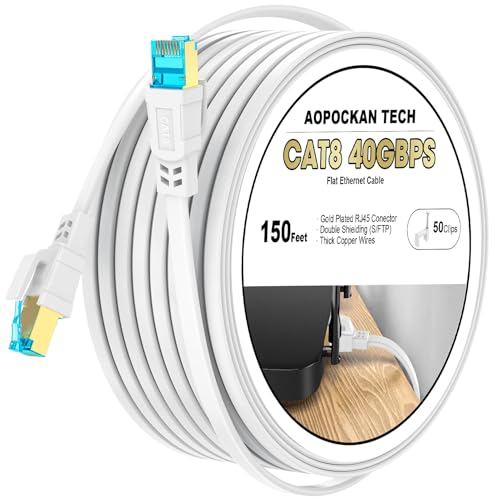
The AOPOCKAN Cat8 cable also uses a flat, flexible PVC jacket, but its emphasis is on the UV-resistant outer layer that actually holds up to prolonged sun exposure. The S/FTP shielding with 4 shielded foiled twisted pairs and a 50-micron gold-plated RJ45 connector is identical in structure to the Smolink, which is why both claim the same 40 Gbps / 2000 MHz ceiling.
Included cable clips are a nice touch for a clean wall-mount installation. Users consistently report that this cable resolves buffering and interference issues with smart TVs and gaming consoles when switching from Wi-Fi to a wired connection at this distance. The flat design makes coiling unused length easy without tangling.
Customer reviews are overwhelmingly positive, with none of the degradation complaints seen on the Smolink. The cable appears to deliver consistent 1 Gbps speeds without packet loss, which is exactly what you need for a 150-foot outdoor or indoor run. There are no mentions of it sustaining 10 Gbps in practice, so treat the Cat8 rating as a robust spec rather than a guarantee you will see 40 Gbps.
Why it’s great
- UV-resistant jacket is genuinely suited for outdoor installation
- Reliable performance at 1 Gbps with no reported degradation over time
- Comes with cable clips for tidy routing
Good to know
- Flat cable can be slightly stiff in cold temperatures
- Not rated for direct burial underground
- Cat8 rating is overkill for most home internet plans
3. YSONG Cat 8 Ethernet Cable 150 FT
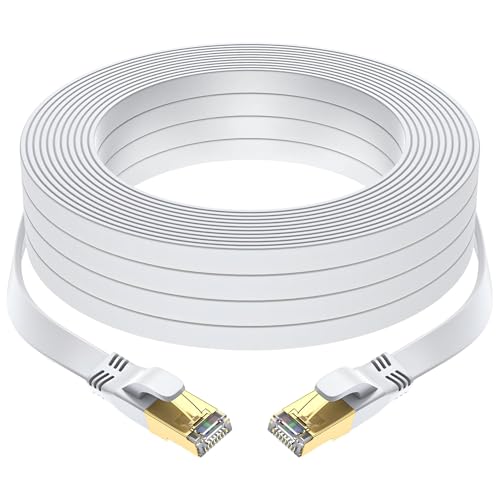
The YSONG Cat8 flat cable is the most affordable entry into the Cat8 tier at 150 feet. It maintains the same 40 Gbps and 2000 MHz rated specs, but uses 30 AWG conductors rather than the thicker 24 AWG found in premium round cables. Thinner wire means slightly higher resistance over the full 150 feet, but in practice this still delivers flawless gigabit speeds.
The multilayer shielding — copper core, ground wire, and aluminum foil — is a simplified S/FTP implementation that reduces interference without adding the bulk of a full braided shield. The flat profile makes it ideal for running under doors or along baseboard edges where a round cable would bulge. It is also the lightest cable in this comparison.
Buyers confirm it easily handles 1 Gbps with PoE for security cameras and provides a stable connection for 4K streaming. The main trade-off is that the thinner gauge makes it less physically robust for outdoor burial or areas where the cable might be stepped on or pinched. Keep this one indoors or in protected conduit.
Why it’s great
- Most affordable Cat8 option for a 150-foot run
- Flat and lightweight for easy indoor routing
- Multi-layer shielding keeps interference low
Good to know
- 30 AWG wire is thinner and less durable than 24 AWG
- Not suited for direct burial or high-traffic areas
- Does not include mounting clips in the package
4. Jadaol Cat 6 Ethernet Cable 150 ft
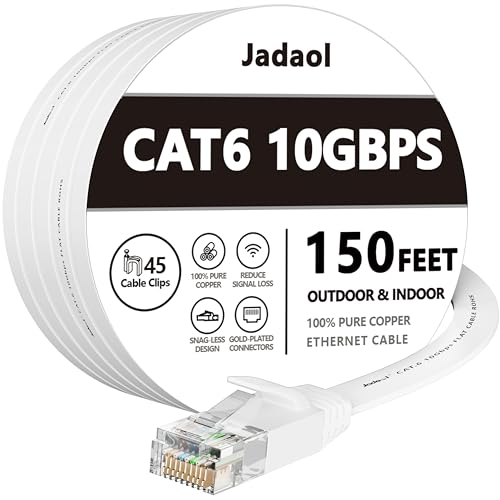
The Jadaol Cat6 is the smart middle-ground option. It is rated for 10 Gbps at 250 MHz, which is more than enough for any residential internet plan and for local network transfers between NAS devices or gaming PCs. At 150 feet, Cat6 can still sustain 10 Gbps (Cat6’s limit is about 180 feet for 10G), so you get full multi-gig capability without paying for Cat8’s overhead.
Jadaol uses UTP (unshielded twisted pair) construction with 100% bare copper wire and gold-plated RJ45 connectors. The flat design is 26 AWG, slightly thicker than the 30 AWG Cat8 flats, giving it a bit more durability. It comes with 45 cable clips, which is a generous inclusion for mounting the entire 150-foot run along a wall or ceiling.
Customers praise its reliability for connecting Deco mesh nodes, gaming consoles, and streaming devices. The only real limitation is the lack of any shielding beyond the twisted pair geometry — if you run this near fluorescent lights or heavy electrical equipment, you may see slight speed degradation. For typical home use, it works flawlessly.
Why it’s great
- 10 Gbps rating is perfect for multi-gig home networks
- Bare copper wire provides better conductivity than CCA
- 45 included cable clips make installation easy
Good to know
- UTP design offers no shielding against EMI
- Not rated for outdoor UV exposure or direct burial
- Flat cable may kink if bent too sharply
5. Conable Cat5e Outdoor Ethernet Cable 150 Feet

The Conable Cat5e is the only cable in this list designed specifically for direct burial. Its double jacket consists of a UV-resistant LLDPE outer layer over a PVC inner jacket, making it waterproof, cold-resistant, and tough enough to survive being buried underground. At 150 feet, Cat5e’s 1 Gbps / 350 MHz specification is perfectly adequate for standard internet plans and PoE security cameras.
The cable uses 24 AWG copper-clad aluminum (CCA) conductors rather than pure copper. CCA is less conductive than pure copper and more brittle, but at Cat5e speeds and 150 feet, the performance difference is negligible for most users. The snagless boot on the RJ45 connector and the included 25 cable ties show thoughtful design for outdoor installation.
Customers who have used this for running connectivity to a garage, shed, or backyard office report reliable signal with no weather-related issues. The main downside is the stiffness — this cable is thick and non-flexible, making it difficult to route around tight corners indoors. It is best used for long, straight outdoor runs where its ruggedness is an asset.
Why it’s great
- Double jacket design is purpose-built for direct burial
- UV-resistant LLDPE outer layer resists sun damage
- Includes cable ties for organization
Good to know
- CCA conductors are less efficient than pure copper
- Very stiff and hard to bend around corners
- Cat5e limits you to 1 Gbps maximum
FAQ
Can a 150 foot Ethernet cable maintain full gigabit speeds?
Should I use Cat8 or Cat6 for a 150 foot home run?
Is a flat Ethernet cable as reliable as a round one at 150 feet?
Final Thoughts: The Verdict
For most users, the 150 foot ethernet cable winner is the AOPOCKAN Cat8 because it combines genuine UV-resistant outdoor construction with reliable 1 Gbps performance and no reports of the quality control issues found on competing Cat8 flat cables. If you want the best mid-range value with 10 Gbps capability, grab the Jadaol Cat6. And for a direct burial application where weather toughness matters most, nothing beats the Conable Cat5e.