
That crisp, warm vinyl sound you love is trapped inside a digital optical cable spitting out 1s and 0s, and your classic amplifier speaks only in analog voltage waves. Bridging that gap without adding noise, distortion, or a brick of useless plastic is precisely what a dedicated converter does — and the difference between a clean stereo image and a hollow, echo-laden mess comes down to the chipset, power filtering, and input support hiding inside that little black box.
I’m Min — the co-founder and writer behind Gadgets Feed. I’ve spent countless hours analyzing the technical specifications, real-world compatibility reports, and signal-to-noise ratios across dozens of these converters to separate the units that deliver transparent PCM pass-through from the ones that introduce hum, latency, or format conflicts.
After digging through hundreds of verified owner experiences and comparing sampling rates, channel support, and connection flexibility, this guide cuts through the jargon to reveal the best analog to digital converter for your specific setup and budget.
How To Choose The Best Analog To Digital Converter
Picking the right converter isn’t about grabbing the cheapest box with an optical input. The real decision hinges on three things: the audio format your source outputs, the number and type of physical connections your gear requires, and whether you need extra features like Bluetooth or HDMI ARC integration. Ignoring the format mismatch between a TV that sends Dolby Digital 5.1 and a converter that only understands PCM 2.0 is the single most common way this purchase fails.
Match the Audio Format First
Most modern TVs default to outputting Dolby Digital or DTS surround sound over optical. If your converter cannot decode these formats, you will get silence or a loud static hiss. You must check the product specifications for “Dolby Digital” or “DTS” decoding. Converters that only support LPCM/PCM will require you to manually change your TV’s audio output setting to PCM, which disables surround sound but keeps stereo working.
Count Your Physical Ports
A surprising number of converters ship without the required cables or force you to choose between optical and coaxial without a simple switch. Look for units that include both input options plus a clear selector switch. If you need to connect a TV, a game console, and a DVD player, you will need a unit with multiple inputs or one that supports HDMI ARC, which carries both audio and control signals over a single cable.
Quick Comparison
On smaller screens, swipe sideways to see the full table.
| Model | Category | Best For | Key Spec | Amazon |
|---|---|---|---|---|
| PROZOR 192kHz DAC | Mid-Range | Old stereo revival | 192kHz / 24-bit | Amazon |
| PROZOR DAC + Bluetooth | Mid-Range | Wireless streaming | Bluetooth 5.0 | Amazon |
| avedio links HDMI ARC DAC | Mid-Range | ARC compatibility | ARC + PCM only | Amazon |
| XPTSFDU HDMI ARC Converter | Mid-Range | Learning & convenience | ARC + Optical + Coax | Amazon |
| Insignia NS-HZ313-C | Premium | Simple reliability | PCM stereo only | Amazon |
| OREI DA34 | Premium | Dolby decoding | Dolby DTS decode | Amazon |
| StarTech.com SPDIF2AA | Premium | Commercial grade | Metal chassis | Amazon |
In‑Depth Reviews
1. PROZOR 192Khz Digital to Analog Audio Converter
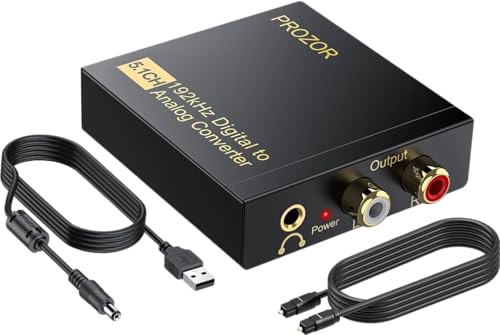
The PROZOR DAC hits the sweet spot between cost and performance with a genuine 192kHz / 24-bit sampling rate that captures the full frequency range of high-resolution audio sources. It supports both optical and coaxial inputs and outputs to RCA and 3.5mm, making it compatible with virtually any vintage amplifier or modern powered speaker. The magnetic ring on the power cord is a thoughtful addition that filters out electrical noise, resulting in a noticeably cleaner background.
Customer reports confirm it handles Dolby AC-3 and DTS 5.1 inputs by downmixing them to stereo 2.0CH analog output — a crucial feature when you hook it to a TV that defaults to surround sound. The metal housing provides decent RF shielding, and the unit stays cool even during extended listening sessions. The included USB power cable requires a 1A adapter, which is standard for most phone chargers.
One area where this converter excels is plug-and-play simplicity. Multiple owners mention connecting it to 15-year-old Bose or Sony systems with zero configuration beyond plugging in cables. The only minor complaint is that the 5.1 downmix to 2.0 can sound slightly quiet on the rear channel for ProLogic content, but that is a limitation of the format, not the hardware.
Why it’s great
- Genuine 192kHz/24-bit DAC chip for high-res audio
- Magnetic ring power cord reduces hum and noise
- Supports Dolby AC-3 / DTS 5.1 to stereo downmix
Good to know
- USB power adapter not included in the box
- Rear channel output is weak for ProLogic-encoded material
2. PROZOR 192kHz DAC with 5.0 Bluetooth Receiver

This PROZOR variant adds Bluetooth 5.0 reception to the standard optical and coaxial inputs, allowing you to stream music wirelessly from your phone or tablet directly to your legacy stereo system. The built-in DAC still supports 192kHz / 24-bit sampling for wired signals, so there is no downgrade in quality when you are connected via optical. The Bluetooth antenna is a separate external module that ensures stable signal transmission up to roughly 30 feet through walls.
Volume adjustment on the unit itself is a practical feature that owners of amplifiers without remote controls appreciate. The unit automatically switches to Bluetooth playback mode as soon as a paired device connects, which avoids the hassle of manual input toggling. Multiple reviewers successfully paired it with 80s Kyocera and 1990s B&W amplifiers, proving it works with gear spanning four decades.
The main trade-off is that this unit supports only PCM / LPCM audio formats via its digital inputs; it does not decode Dolby Digital or DTS. If your TV outputs Dolby Digital by default, you will need to switch the TV’s audio setting to PCM in the menu. The USB power cable is included, but the wall adapter is not, and some users note the bass is slightly less punchy compared to the non-Bluetooth version.
Why it’s great
- Integrated Bluetooth 5.0 for wireless streaming from any device
- Physical volume knob for direct level control
- Auto-switching between optical and Bluetooth inputs
Good to know
- No Dolby/DTS decoding — PCM input only
- Wall power adapter not included in the package
3. avedio links HDMI ARC Audio Extractor DAC
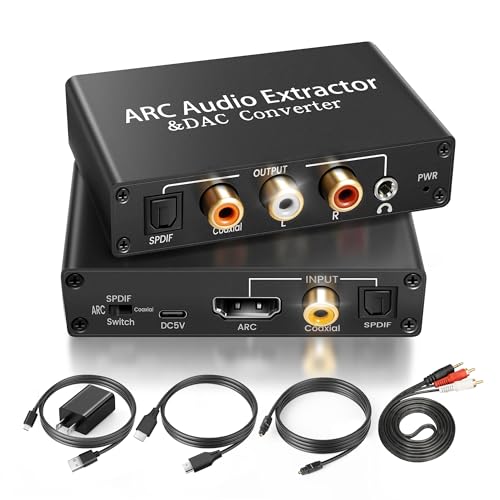
The avedio links converter stands out by including HDMI ARC input alongside the standard optical and coaxial ports, making it the ideal solution for modern TVs that have abandoned optical outputs entirely. It extracts the audio signal from the HDMI ARC channel and converts it to stereo analog RCA and 3.5mm outputs. The aluminum housing provides better heat dissipation and shielding than typical plastic enclosures.
This unit is explicitly designed for PCM / LPCM stereo signals only and does not decode Dolby or DTS surround formats. That means your TV must be set to output PCM stereo in the audio settings menu. The package is unusually complete, including the power adapter, HDMI cable, optical cable, and a 3.5mm to L/R cable — everything needed for immediate setup. The input selection switch on the panel makes toggling between ARC, optical, and coaxial straightforward.
Customer feedback highlights reliable ARC handshaking with TCL and Samsung TVs, and one reviewer successfully used it to integrate a non-Samsung subwoofer with a Samsung soundbar by feeding the subwoofer via the RCA outputs. The primary drawback is that the ARC implementation does not pass CEC volume control, so you must adjust volume on the connected amplifier or soundbar directly.
Why it’s great
- HDMI ARC input for TVs without optical ports
- Complete accessory kit including power adapter and all cables
- Aluminum chassis for durability and heat management
Good to know
- No Dolby or DTS decoding — PCM stereo only
- ARC mode does not support TV remote volume control
4. XPTSFDU HDMI ARC to RCA Audio Converter
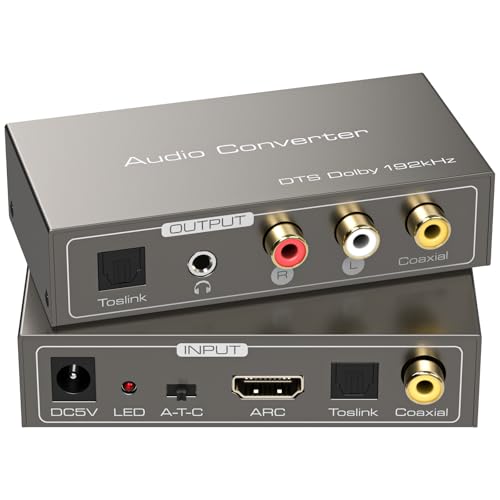
The XPTSFDU converter brings a practical convenience feature rarely seen at this price point: a power-off memory function that retains the last selected input mode. If you favor optical on Tuesday and switch to ARC on Wednesday, the unit remembers your preference after a power cycle, saving you from flipping the DIP switch every time. It supports 192kHz sampling and offers three input options (HDMI ARC, optical, coaxial) with corresponding outputs via RCA, optical, coaxial, and 3.5mm AUX.
Another engineering highlight is the built-in overvoltage protection, which safeguards the converter if you accidentally plug in an incompatible power supply — a real risk in cluttered entertainment setups. The unit also supports DTS, Dolby AC-3, DSD, and LPCM formats on its optical and coaxial outputs, though the analog RCA output is limited to LPCM 2.0 stereo. The DIP switch labeled ATC lets you toggle between ARC, Toslink, and Coaxial modes cleanly.
Owner experiences are mixed on long-term reliability. Several users report flawless operation with Panasonic TVs and Sennheiser headphones, praising the clear sound and easy setup. However, a notable number of reviews describe intermittent connection drops where the converter stops outputting audio and requires a power cycle to recover. A few also mention a loud pop through the speakers when the TV is turned on, which could be problematic for sensitive amplifiers.
Why it’s great
- Power-off memory remembers your last input selection
- Overvoltage protection prevents damage from wrong power adapters
- Supports Dolby, DTS, DSD, and LPCM input formats
Good to know
- Some units exhibit intermittent audio dropouts
- Potential loud pop noise when TV powers on
5. Insignia NS-HZ313-C Digital-to-Analog Converter

Insignia’s NS-HZ313-C is the no-frills, reliable workhorse of the category. It converts optical or coaxial PCM digital audio to analog RCA output with zero configuration beyond flipping the input selector switch. The plastic enclosure is lightweight, but the internal components are solid enough to survive years of daily use in a garage system or secondary TV setup. It supports sampling rates up to 48kHz, which covers standard TV broadcasts, DVD audio, and streaming content.
The unit’s biggest strength is its simplicity. Owners report it working instantly with Sennheiser wireless headphone bases, older Sony receivers, and garage TVs with optical outputs. The input selector switch on the side is clearly labeled and clicks into position with satisfying tactility. It draws power directly from the USB port on most TVs, eliminating the need for a separate wall adapter in many setups.
The limitations are notable. This converter supports only PCM stereo audio and will produce silence or static if fed a Dolby Digital or DTS signal. If your TV defaults to surround sound encoding, you must manually switch the TV’s audio output to PCM. A few owners also encountered an issue where the unit needs to be unplugged and reconnected if the TV has been off for an extended period, which is inconvenient in hard-to-reach setups.
Why it’s great
- Extremely simple plug-and-play operation
- Can be powered directly from TV USB port
- Reliable brand with consistent build quality
Good to know
- No Dolby or DTS decoding — PCM only
- Occasional need to power cycle after TV inactivity
6. OREI Digital to Analog Audio Decoder DA34

The OREI DA34 is one of the few converters in this price bracket that genuinely decodes Dolby Digital and DTS surround signals rather than simply passing them through as invalid data. It accepts SPDIF optical or coaxial 5.1-channel input and downmixes it to stereo 2.0CH analog output on both RCA L/R and 3.5mm headphone jacks simultaneously. This makes it the correct choice if your TV outputs Dolby Digital by default and you want to avoid changing settings every time you watch content.
The unit is compact enough to hide behind a TV, measuring just under three inches on each side. It includes the power adapter and an optical cable in the box, so you do not need to purchase additional accessories for a basic setup. The side-mounted input switch is small but clearly labeled, and the optical cable must be pushed in firmly until it clicks — a detail that a surprising number of first-time users miss, leading to no-sound complaints that are resolved by reseating the connector.
Reviewers consistently praise its compatibility with Sennheiser wireless headphone systems and Panasonic Viera TVs. The simultaneous RCA and headphone outputs allow you to connect both a stereo amplifier and powered headphones without a splitter. The main drawback is that the plastic casing feels less premium than metal alternatives, and there is no support for HDMI ARC, so you are limited to optical or coaxial sources only.
Why it’s great
- Active decoding of Dolby Digital and DTS 5.1 to stereo
- Simultaneous RCA and 3.5mm headphone outputs
- Includes power adapter and optical cable
Good to know
- Plastic casing not as durable as metal alternatives
- No HDMI ARC input — optical or coaxial only
7. StarTech.com SPDIF2AA Audio Converter

StarTech.com’s SPDIF2AA is built to a different standard than the consumer-focused alternatives on this list. The fully enclosed metal chassis provides superior electromagnetic interference shielding and feels reassuringly heavy in the hand at over 10 ounces. It accepts either digital coaxial or Toslink optical input and outputs to stereo RCA, with a simple input selector switch on the front. This is a converter designed for AV racks, commercial installations, and users who value build quality above all else.
The unit supports PCM stereo audio with sampling rates up to 48kHz, which covers standard television broadcasts, DVD playback, and most streaming services. The heavy-duty construction includes reinforced connector jacks that are less likely to crack or loosen over years of cable movement. StarTech’s reputation for enterprise-grade accessories means this unit is backed by reliable customer support and a longer warranty period than most budget converters.
Owner feedback is overwhelmingly positive for its primary use case: connecting a digital audio source to legacy analog equipment. One reviewer successfully integrated it with a projector and PS3 in a trailer audio system, while another paired it with a desk TV and vintage speakers. However, the PCM-only limitation means it cannot handle Dolby Digital or DTS signals from over-the-air broadcasts or streaming apps that default to surround sound. If your source outputs anything beyond stereo PCM, you will need to reconfigure the source device.
Why it’s great
- Fully metal chassis with excellent RF/EMI shielding
- Reinforced connector jacks for long-term durability
- Trusted brand with strong warranty and support
Good to know
- PCM stereo only — no Dolby or DTS decoding
- Heavier and larger than most plastic alternatives
FAQ
Why is there no sound after connecting my converter to the TV?
Do I need a converter with Bluetooth for streaming music?
Can I use an HDMI ARC converter with a TV that doesn’t have ARC?
Will a 192kHz converter make my TV sound better than a 48kHz converter?
Final Thoughts: The Verdict
For most users, the best analog to digital converter winner is the PROZOR 192kHz DAC because it balances a genuine high-res DAC chip, Dolby/DTS downmixing, and a noise-filtering power cable at a price that undercuts most competitors. If you want wireless Bluetooth streaming from your phone to vintage gear, grab the PROZOR DAC with Bluetooth. And for true Dolby Digital decoding without requiring any TV settings changes, nothing beats the OREI DA34.