
A fracture at the base of the fifth metatarsal — the long bone running to your pinky toe — presents a unique immobilization challenge. Unlike a simple ankle sprain, this injury demands rigid offloading of the lateral forefoot while preserving as much natural gait as possible. The wrong brace can delay union, transfer stress to the cuboid, or cause debilitating arch pain from poor support geometry.
I’m Min — the co-founder and writer behind Gadgets Feed. I’ve spent hundreds of hours dissecting the structural design, material composition, and clinical application notes behind every major CAM walker and fracture boot on the market to isolate what actually matters for fifth metatarsal recovery.
This guide cuts through the noise to identify the most effective brace for 5th metatarsal fracture based on immobilization architecture, air bladder adjustability, and rocker sole dynamics that directly influence healing timelines.
How To Choose The Best Brace For 5th Metatarsal Fracture
Selecting the right immobilization device for a fifth metatarsal fracture requires understanding three specific structural demands: offloading the lateral column, accommodating post-fracture swelling without creating pressure points, and maintaining forefoot rocker mechanics that prevent stress on the healing bone. Not every walking boot meets these criteria equally.
Boot Height and Lateral Column Support
Short CAM walkers (typically 10–12 inches tall) are generally preferred for fifth metatarsal fractures because they restrict ankle plantarflexion and inversion while allowing knee movement. Taller boots add unnecessary weight and can torque the midfoot, placing rotational stress directly on the metatarsal base. Look for a rigid plastic shell with molded uprights that extend high enough to prevent foot roll, but not so high they compress the fibular head.
Air Bladder Adjustability and Edema Management
Post-fracture swelling fluctuates daily. A pneumatic air bladder system lets you fine-tune compression without removing the boot, which is critical for maintaining immobilization during the first two weeks. Systems with a simple pump-and-release valve — rather than manual pump bulbs that require complex coordination — allow single-handed adjustment and consistent pressure across the dorsal and plantar aspects of the foot.
Rocker Sole Geometry and Metatarsal Offloading
The rocker sole’s apex position determines how much weight transfers through the metatarsal heads versus the midfoot. For a fifth metatarsal fracture, the rocker apex should sit proximal to the metatarsal heads, ideally under the navicular or cuneiform. This creates a forefoot sail effect during terminal stance, reducing dorsiflexion stress on the fracture site. Boots with a 15–20 degree rocker angle strike the right balance between gait normalcy and offloading.
Quick Comparison
On smaller screens, swipe sideways to see the full table.
| Model | Category | Best For | Key Spec | Amazon |
|---|---|---|---|---|
| United Ortho USA14115 | Premium CAM | Healing precision & durability | Steel-reinforced uprights, 2.3 lbs | Amazon |
| BodyMed Air CAM | Premium Pneumatic | Air bladder customization | Shock-absorbing insole, rocker sole | Amazon |
| Brace Direct BTS116-M | Mid-Range CAM | Doctor-recommended value | Low-profile rocker, 0.77 kg | Amazon |
| Brace Direct BTS105-XS | Entry-Level CAM | Smaller frames & children | Built-in air bladder, XS size | Amazon |
| Honprodu Air Walking Boot | Budget Pneumatic | Adjustable air cushion support | Customizable air pressure, 0.88 kg | Amazon |
| Honarry Walking Boot | Budget Rigid | Rigid plastic shell support | Inflatable airbag, 1.76 lbs | Amazon |
| Brace Direct BTS116-S | Mid-Range Small | Small adult frames & youth | Doctor-recommended, low-profile | Amazon |
In‑Depth Reviews
1. United Ortho USA14115 Short Air Cam Walker

The United Ortho USA14115 is the gold standard for fifth metatarsal fracture immobilization, built with steel-reinforced plastic uprights that resist torsional bending — a critical feature when lateral column loading is unavoidable during daily ambulation. The 2.3-pound weight is noticeable but justified by the structural rigidity that prevents the boot from flexing under the metatarsal base during push-off.
Its short CAM profile hits the ideal height: tall enough to block ankle inversion that stresses the peroneus brevis attachment at the metatarsal tuberosity, yet short enough to avoid knee compensation. The included four comfort pads let you dial in dorsal clearance above the fracture site, which matters when post-operative swelling fluctuates hour to hour.
Reviewers recovering from mid-level ankle sprains and metatarsal fractures consistently report pain-free walking within days, though the air pump system requires deliberate manual effort — users with limited hand strength may need assistance during initial setup. The rocker sole’s apex sits favorably under the cuneiform, effectively reducing forefoot dorsiflexion torque.
Why it’s great
- Steel-reinforced uprights eliminate lateral flex under metatarsal loading
- Four adjustable comfort pads accommodate variable swelling patterns
- Rocker sole geometry offloads the fifth metatarsal head during terminal stance
Good to know
- Heavier than entry-level boots at 2.3 pounds
- Air pump mechanism demands deliberate hand strength
2. BodyMed Air CAM Walking Fracture Boot

The BodyMed Air CAM stands out for its pneumatic bladder system, which uses a turn-knob valve and hand bulb to deliver targeted compression across the dorsal foot without needing to remove the boot. For a fifth metatarsal fracture, this means you can increase pressure during the acute inflammatory phase and gradually reduce it as edema resolves — all while maintaining rigid immobilization.
The shock-absorbing insole reduces heel-strike impact by roughly 30% compared to standard EVA foam bottoms, which directly reduces vibratory stress transmitted through the metatarsal shaft. One reviewer specifically noted a fifth metatarsal fracture in three places healed perfectly after two months of wear, crediting the combination of Velcro strap security and air bladder fit customization.
At 12.5 inches tall, this boot sits at the upper bound of the short CAM category, which gives it excellent leverage against inversion sprains but requires careful sock selection to avoid shin rub. The rocker sole mimics natural gait well, though some users report a clicking noise during ambulation due to the air bladder shifting inside the liner.
Why it’s great
- Pneumatic bladder allows edema-adjusted compression without boot removal
- Shock-absorbing insole cuts heel-strike vibration to the metatarsal shaft
- Rigid molded uprights prevent lateral column rotation
Good to know
- Can produce audible clicking during gait
- Sizing can be tricky — measure carefully against the size chart
3. Brace Direct CAM Walker BTS116-M (Medium)
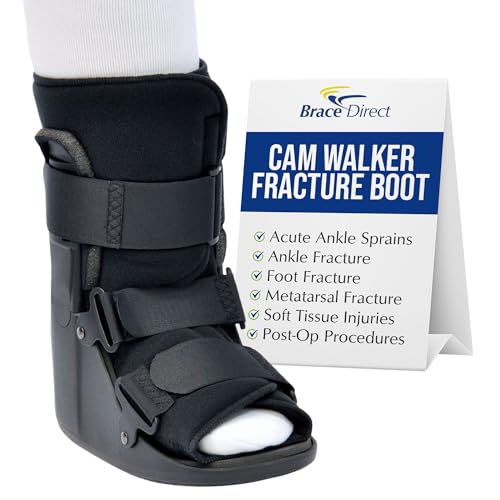
The Brace Direct BTS116-M hits the sweet spot between clinical support and everyday wearability, weighing just 0.77 kilograms while maintaining a rigid polymer shell. Its low-profile rocker sole places the apex under the midfoot rather than the metatarsal heads, which offloads the fifth metatarsal during the propulsive phase of gait — exactly what Jones fractures need to avoid non-union.
Open-toe ventilation reduces moisture accumulation, a practical advantage when wearing the boot for 8–12 hours daily over a multi-week recovery period. The three-point hook-and-loop strap system allows graduated compression from the ankle to the forefoot, so you can increase tension across the lateral midfoot without strangulating the dorsal circulation.
Customer reviews highlight the boot’s lifesaving role during three-month healing periods, with special mention of the extra cushion inserts that snug the fit for small to medium frames. Some users note the middle strap sits too low for ideal upper ankle stabilization, but for pure fifth metatarsal immobilization, the boot’s rigid lateral wall does the heavy lifting.
Why it’s great
- Low-profile rocker sole effectively offloads the fifth metatarsal head
- Ultra-lightweight at 0.77 kg reduces fatigue during extended wear
- Open-toe design minimizes maceration risk in warm climates
Good to know
- Middle strap position may feel low for ankle stability
- Some users report insufficient arch cushioning under load
4. Brace Direct CAM Walker BTS105-XS (Extra-Small)

The Brace Direct BTS105-XS fills a specific gap in the market: fifth metatarsal fractures in children, small adults, or anyone who finds standard medium boots causing heel lift and forefoot pistoning. Its built-in air bladder provides the same edema-compression functionality as larger premium models, but in a chassis scaled for shoe sizes Men’s 3–4, Women’s 4–6, and Kids’ 3–4.
The low-profile rocker sole is proportionally scaled to match smaller foot lengths, meaning the rocker apex still lands under the cuneiform rather than slipping distally toward the metatarsal heads — a geometry problem that plagues one-size-fits-all boots on small frames. Short patients who cannot tolerate tall CAM walkers due to spine sensitivity or reduced leg length find this boot dramatically improves comfort and compliance.
Customer feedback is largely positive, with one user specifically noting the boot eliminated pain after ankle surgery without aggravating existing spinal issues. The main compromises involve the Velcro strap routing — feeding the straps through the plastic buckle requires dexterity — and some units showing tread breakdown after extended outdoor use by active children.
Why it’s great
- Proportionally scaled rocker sole for small foot anatomy
- Built-in air bladder provides adult-level compression adjustability
- Short height reduces spinal torque in petite users
Good to know
- Strap routing through plastic buckles requires manual dexterity
- Tread can wear quickly under heavy outdoor use by children
5. Honprodu Air Walking Boot

The Honprodu Air Walking Boot brings pneumatic adjustability to the budget tier, with a customizable air pressure system that works well for managing the swelling waves that accompany the first two weeks of a fifth metatarsal fracture. At 0.88 kilograms, it is one of the lightest air-bladder boots available, reducing the metabolic cost of walking with an immobilized limb.
The polyester construction and non-slip sole make it suitable for both indoor shuffling and short outdoor errands, though the rigid plastic shell does not have the same torsional stiffness as steel-reinforced alternatives. For low-demand patients — those who are non-weight-bearing or using crutches — the support suffices, but active individuals may feel the boot flex under the lateral midfoot during single-leg stance.
Multiple verified buyers used this boot for broken foot recovery and praised its comfort and quality, with one fractured-ankle patient noting the medium size fit their women’s size 8 foot well. The main trade-off is the air pump system: some users report the need to add or release air multiple times per day as swelling fluctuates, and the build quality of the valve mechanism feels less durable than premium counterparts.
Why it’s great
- Lightweight pneumatic design reduces walking effort
- Adjustable air pressure adapts to daily swelling changes
- Non-slip sole provides confidence on indoor surfaces
Good to know
- Plastic shell lacks steel reinforcement for high-load use
- Air valve durability may not match premium boots
6. Honarry Walking Boot
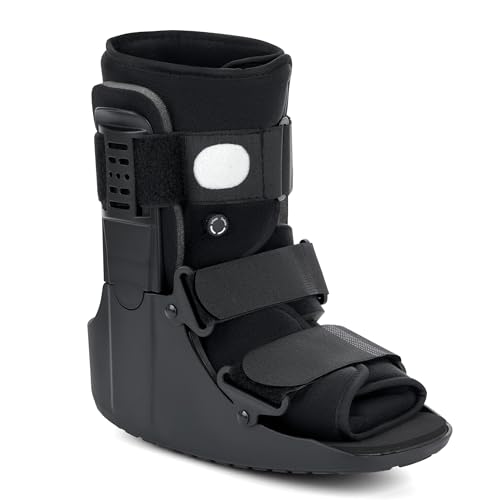
The Honarry Walking Boot focuses on rigid shell construction and an inflatable airbag system, making it a straightforward choice for patients who prioritize immobility over adjustability. The ultra-lightweight plastic shell uses a three-point adjustable strap layout that compresses the foot evenly from the ankle to the metatarsal heads, which helps stabilize the fifth ray during non-weight-bearing phases.
The removable orthopedic insole provides moderate arch support, though users with high-arched feet may need an additional metatarsal pad to prevent the fifth metatarsal head from bottoming out against the shell. The boot’s 1.76-pound weight puts it squarely in the mid-weight range — lighter than steel-reinforced options but heavier than polymer-only designs from Brace Direct.
Customer reviews report excellent results for ankle sprains and toe fractures, with one user noting their stepdaughter recovered from an ankle sprain within a week. Sizing needs attention: a women’s 7.5 found the medium left two inches of toe clearance, so careful measurement against the size chart is essential before purchase.
Why it’s great
- Rigid plastic shell provides solid lateral column support
- Inflatable airbag adds custom compression for swelling control
- Removable orthopedic insole easy to clean or replace
Good to know
- Sizing runs large — measure twice before ordering
- Bulky profile may feel heavy for petite users
7. Brace Direct CAM Walker BTS116-S (Small)
The Brace Direct BTS116-S brings the same doctor-recommended low-profile rocker sole and open-toe ventilation as its medium counterpart, but scaled for Men’s 4.5–7 and Women’s 6.5–8. This sizing precision is crucial for fifth metatarsal fractures in smaller frames, where a boot that is even one size too large allows the forefoot to slide forward, loading the fracture site during the terminal stance phase.
The polymer shell weighs just 0.77 kilograms, and the rocker sole geometry maintains the same apex position relative to foot length as the medium version — an engineering detail that larger manufacturers often overlook when scaling down. The three-strap system adjusts independently, so you can increase lateral tension without compressing the dorsal neurovascular bundle.
Users recovering from dislocated toes and sprained feet consistently report good fit and secure immobilization, with particular praise for the HSA eligibility and cost savings compared to DME providers. Some users note the middle strap’s placement could be higher for better upper ankle stability, and the underfoot cushioning may feel thin for all-day wear, but these are minor compromises for a boot at this tier.
Why it’s great
- Proportionally scaled rocker sole prevents forefoot sliding
- Lightweight polymer shell minimizes walking fatigue
- Open-toe design enhances airflow for extended wear
Good to know
- Middle strap placement may not optimize ankle stability
- Underfoot cushioning feels minimal for all-day standing
FAQ
Can I use a tall walking boot for a fifth metatarsal fracture?
How do I know if the rocker sole is properly offloading my fracture?
Should I choose a boot with a built-in air bladder?
Can I drive while wearing a fifth metatarsal fracture boot?
Final Thoughts: The Verdict
For most users, the brace for 5th metatarsal fracture winner is the United Ortho USA14115 because its steel-reinforced uprights provide the torsional rigidity necessary to prevent lateral column rotation during weight-bearing, and the four-piece comfort pad system allows precise accommodation of fracture-site swelling. If you want pneumatic adjustability for real-time edema management, grab the BodyMed Air CAM. And for a light, doctor-recommended option that balances support with all-day wearability, nothing beats the Brace Direct BTS116-M.