
Bringing heat deep into the backcountry without a shore power hookup or a roaring campfire is the single biggest thermal challenge for any cold-weather camper. Battery-operated heaters promise a warm tent or sleeping bag without the carbon monoxide risk of combustion, but the reality is a tight trade-off between battery capacity, heat output, and run time. You need to match the right thermal device to your shelter size, activity level, and power source — and a poorly matched unit can leave you shivering through the night.
I’m Min — the co-founder and writer behind Gadgets Feed. I’ve spent hundreds of hours analyzing technical specifications, battery chemistries, and thermal output metrics across dozens of portable heat sources to separate marketing claims from real-world warmth.
This guide cuts through the noise to help you find the best battery operated heater for camping that delivers genuine comfort in the cold without soaking your entire power budget.
How To Choose The Best Battery Operated Heater For Camping
Unlike a simple propane buddy heater, a battery-operated heater forces you to consider watt-hours, recharge cycles, and the thermal envelope of your shelter. Making the right choice means understanding three key variables that govern every portable electric heat source.
Battery Capacity & Power Draw
The single most important spec is the heater’s power draw in watts, matched against your battery’s capacity in watt-hours (Wh). A typical 12V car blanket draws about 50W, meaning a 500Wh power station would run it for roughly 10 hours. A smaller 20,000mAh lithium pack at 7.4V holds about 148Wh — enough for roughly 3 hours on high for a blanket that draws 40-50W. Always calculate run time as (battery Wh ÷ heater watts) × 0.85 for real-world efficiency.
Heat Output vs. Shelter Size
Electric heating elements are limited by the laws of physics: one watt produces roughly 3.41 BTU. A 50W blanket delivers about 170 BTU — enough to warm a sleeping bag microclimate but not a 100 sq ft tent interior. For larger spaces, consider a radiant propane heater in the 3,800-4,000 BTU range, which doesn’t rely on battery power at all but requires ventilation for safe indoor use.
Safety Features
Any electric heater used inside a tent or shelter should include overheat protection, a tip-over shutoff, and a low-voltage cutoff to prevent battery damage. Combustion-based heaters need an oxygen depletion sensor (ODS) and a carbon monoxide alarm to be used safely in enclosed spaces. Never compromise on safety shutoffs — a warm night isn’t worth the risk of fire or silent poisoning.
Quick Comparison
On smaller screens, swipe sideways to see the full table.
| Model | Category | Best For | Key Spec | Amazon |
|---|---|---|---|---|
| MIMYTH Cordless Heated Blanket with Hood | Electric Blanket | Personal warmth anywhere | 20,000mAh / 7.4V built-in battery | Amazon |
| CYCYHEAT 20000mAh Heated Blanket | Electric Blanket | Long run times on low | Up to 11.5 hrs on low setting | Amazon |
| Mr. Heater Little Buddy | Propane Radiant | Small tents & ice fishing | 3,800 BTU / 95 sq ft coverage | Amazon |
| Naturehike Camp Heater | Butane Radiant | Cooking + heating combo | 3,750 BTU / 240 min at low | Amazon |
| Heat Hog 4,000 BTU | Propane Radiant | Directable heat beam | 4,000 BTU / 100 sq ft coverage | Amazon |
| Sealy 12V Heated Car Blanket | 12V Blanket | Power station paired warmth | ~50W draw / 85-inch power cord | Amazon |
| VANZACK 2Pcs Kerosene Stoves | Kerosene Stove | Budget dual-purpose heat | 8-wick / non-electric operation | Amazon |
In‑Depth Reviews
1. MIMYTH Cordless Heated Blanket with Hood
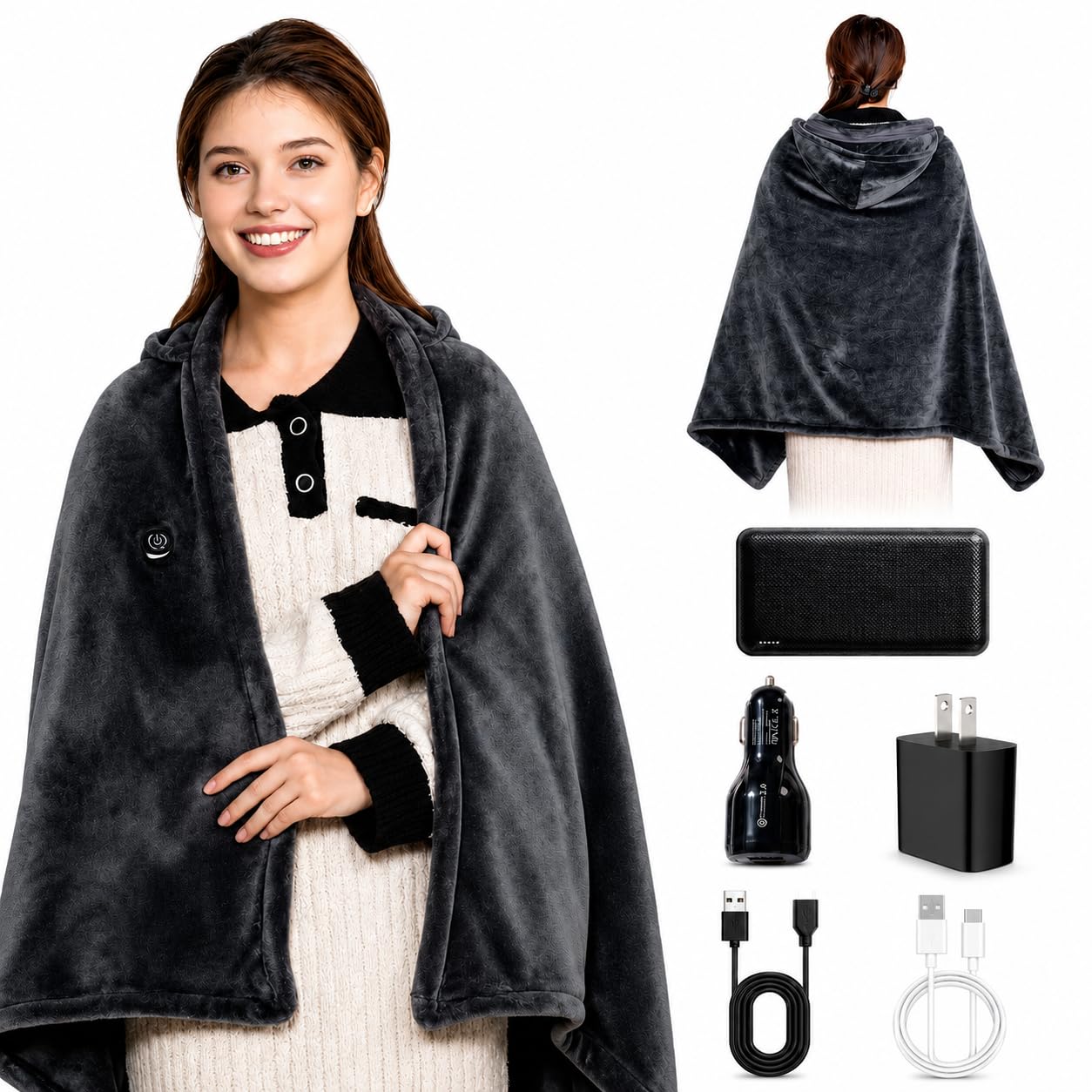
The MIMYTH brings true cordless freedom to camp warmth by integrating a 20,000mAh/7.4V battery into a wearable hooded blanket. Nine intelligently controlled heating zones distribute warmth across the chest, shoulders, and back, with three temperature levels reaching up to 149°F on high for about 8 hours of run time. On low, that run time extends to a claimed 16 hours — enough to span a full winter night plus morning coffee.
The ultra-soft flannel exterior feels far more premium than typical polyester camping throws, and the hooded design traps heat around the head and neck, which dramatically improves personal thermal efficiency. It even includes a 40-inch USB extension cable plus wall and car chargers, so you can top up the battery from a power station or vehicle during the day. The weight sits at about 2 lbs, making it genuinely packable for backpacking or car camping.
Safety is handled by per-zone temperature sensors that prevent overheating and an automatic cool-down feature that gradually drops heat after five minutes on high. While the 16-hour low claim depends on ambient temperature and battery condition, real-world testing from multiple user reports confirms at least 11+ hours on low, which is outstanding for a battery-powered wearable heater. If you want one device that keeps you warm from tent to camp chair to sleeping bag, this is it.
Why it’s great
- Built-in 20,000mAh battery with no dangling wires
- Nine heating zones with even warmth distribution
- Up to 16 hours run time on low setting
Good to know
- Battery adds noticeable weight to the blanket
- Heating zones don’t cover the lower half
2. CYCYHEAT 20000mAh Large Heated Blanket
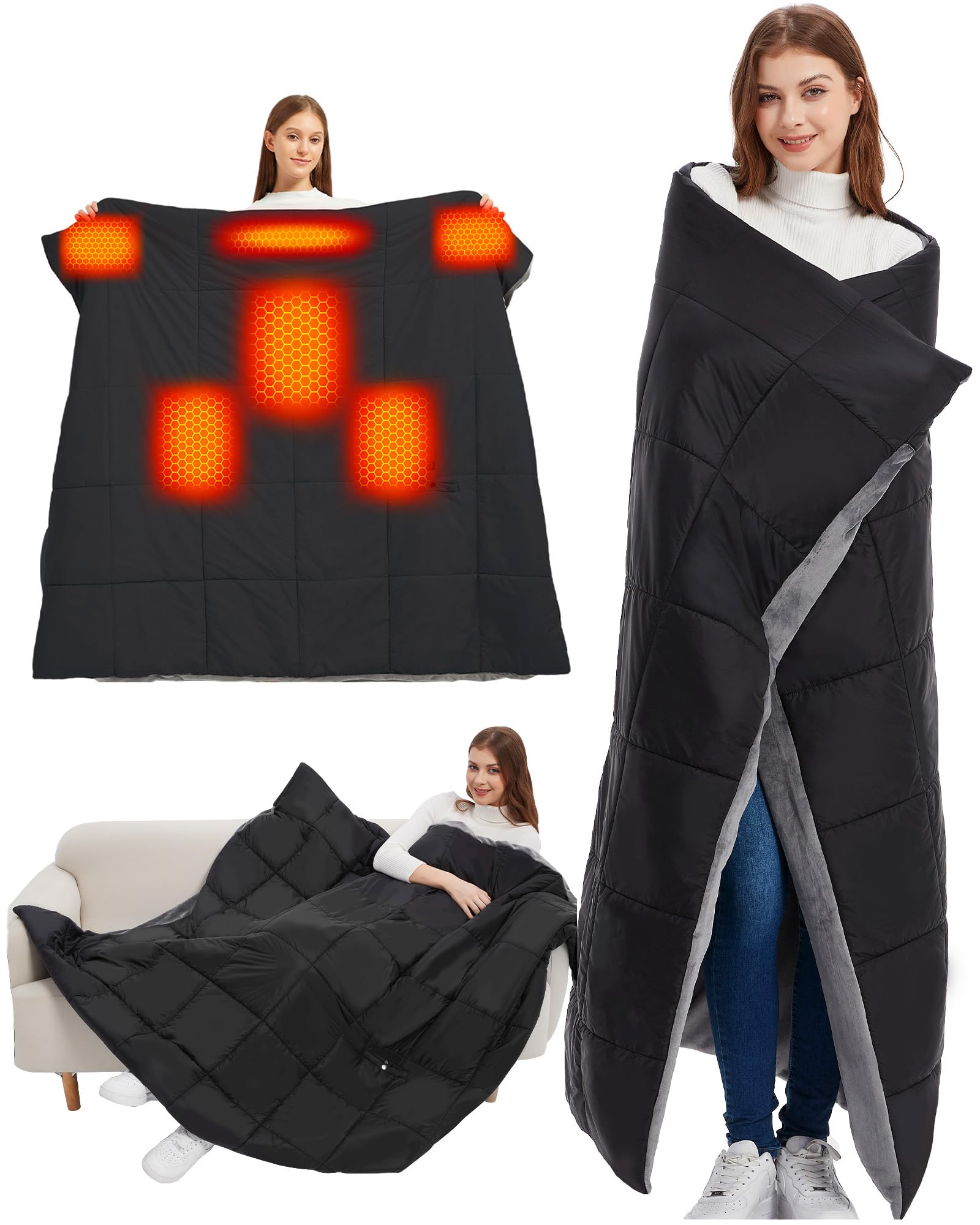
The CYCYHEAT blanket focuses on maximum battery endurance, packing a 20,000mAh/7.4V pack that delivers a confirmed 11+ hours on the low (113°F) setting. Real user reports confirm it held the low setting for roughly 11 hours straight, making it one of the longest-running cordless electric blankets available for camping. The 20W fast charging refills the battery in 5-6 hours, so a midday charge from a solar panel or power station gets you ready for the next night.
The carbon fiber heating elements are concentrated in the upper half — neck, back, waist, and hand areas — which matches how most people use a throw blanket while sitting or lounging. The 63×55 inch size offers generous coverage for an adult, and the 100% polyester fabric is lightweight enough to toss in a duffel. A built-in LED power display on the battery lets you monitor remaining charge at a glance.
It’s worth noting that the heating is intentionally localized — the lower half of the blanket has no elements, so this works best as a shoulder wrap or lap blanket inside the tent rather than a full-body bed cover. The battery itself is a separate 0.74 lb pack that clips to the blanket, so you need to keep it oriented correctly. For campers who prioritize battery endurance over full-body heat, this delivers serious runtime value.
Why it’s great
- 11+ hours of confirmed runtime on low setting
- 20W fast charging refills battery quickly
- LED power display for remaining charge
Good to know
- Heating elements only in upper half of blanket
- Battery pack adds weight and requires careful placement
3. Mr. Heater Little Buddy
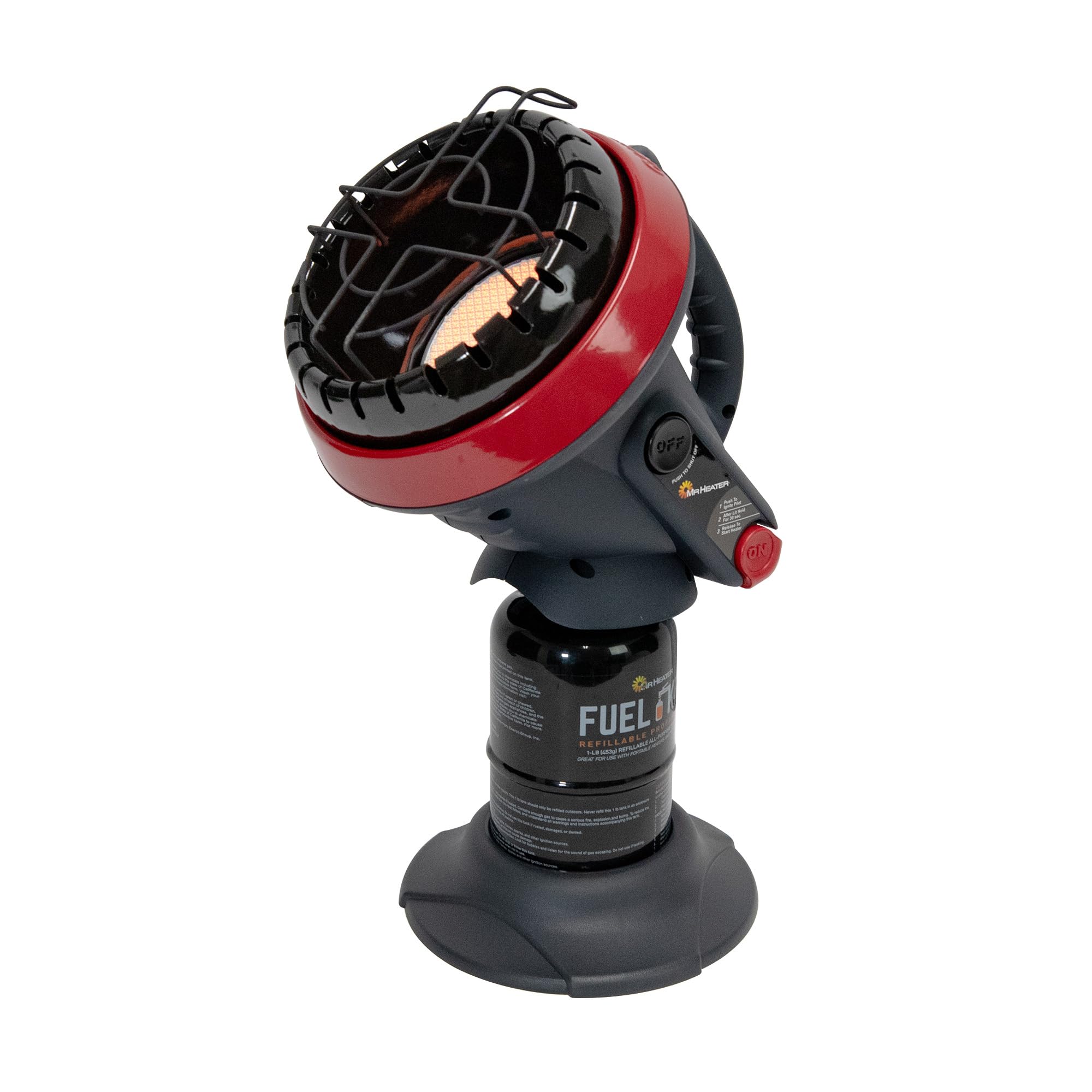
The Mr. Heater Little Buddy is the gold standard for propane-powered radiant heat in small enclosed spaces. At 3,800 BTU and covering up to 95 square feet, it’s specifically engineered for ice shanties, deer blinds, truck bed caps, and small tents under 100 sq ft. The radiant heating element produces clean, near-silent, odor-free heat that warms objects and people directly rather than just the air volume.
Safety is built around an Oxygen Depletion Sensor (ODS) and a tip-over shutoff switch — both of which have been tested extensively in the field. The one-button piezo ignition fires up reliably in most conditions, though some users report needing to hold the red safety button longer in very cold temperatures to allow the thermocouple to engage. It runs on standard 1 lb propane cylinders, with real-world consumption delivering roughly 5.5-6 hours of heat per canister at max output.
The small footprint — 8.35 x 10.31 x 10.04 inches — means it takes up minimal floor space inside a packed tent. It requires ventilation (a cracked tent door or roof vent) to safely replenish oxygen, but many users run it all night at lower settings without issue. If you want to heat the entire tent interior rather than just your sleeping bag microclimate, this is the most proven, rugged solution in the category.
Why it’s great
- Proven ODS and tip-over safety shutoffs
- 3,800 BTU heats up to 95 sq ft effectively
- Near-silent, odor-free radiant heat operation
Good to know
- Requires ventilation in enclosed tents
- Ignition can be finicky in extreme cold
4. Naturehike Camp Heater with Warming Shelf
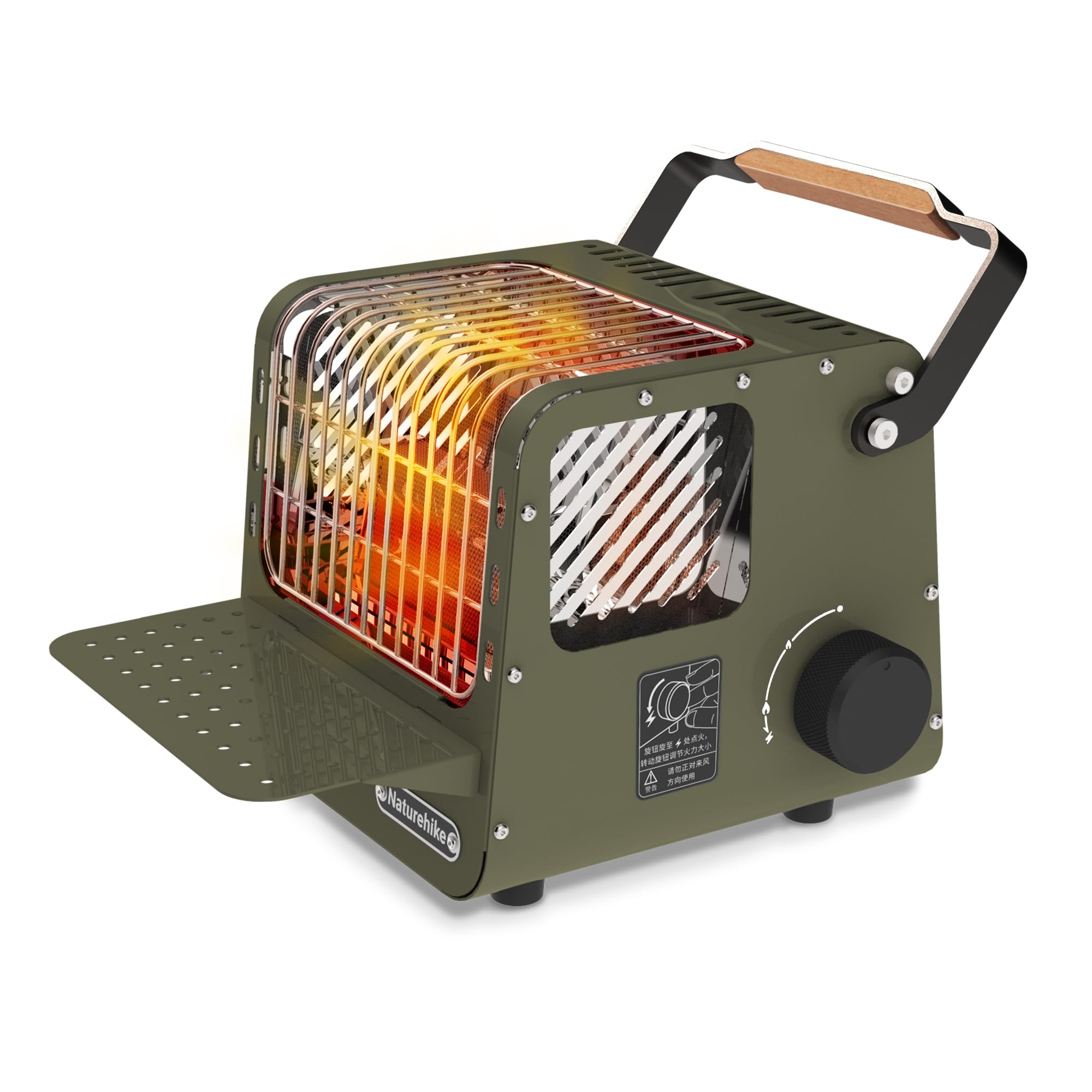
The Naturehike Camp Heater breaks the mold by combining a 3,750 BTU butane radiant heater with a detachable insulated warming shelf. This means you can simultaneously warm a 54-108 sq ft tent space and keep a coffee mug or small meal hot on the shelf — a genuinely useful dual-purpose design that reduces the number of gear items you need to carry. The magnetic butane connection makes canister swapping fast and tool-free.
On a single 8 oz butane canister, you get up to 240 minutes of runtime at the low setting or about 180 minutes at max output. The radiant heating element warms objects directly, which feels more natural in a camping shelter than forced-air heat. The moss green finish and compact freestanding form factor look great, and the carry handle makes transport simple despite the 5-ish pound weight.
Butane has a higher boiling point than propane (about 31°F vs -44°F), so this heater is best suited for moderate cold conditions above freezing — in deep winter, the vapor pressure drops and performance suffers. The ODS safety shutoff is present, but users report the handle design can be awkward for one-handed carrying. If you camp above freezing and want a heater that also serves as a cooktop, this is a category-unique option.
Why it’s great
- Integrated warming shelf for food and drinks
- Magnetic butane connection for easy swaps
- Radiant heat is quiet and direct
Good to know
- Butane struggles below freezing temperatures
- Carry handle design is not ergonomic
5. Heat Hog 4,000 BTU Portable Propane Radiant Heater
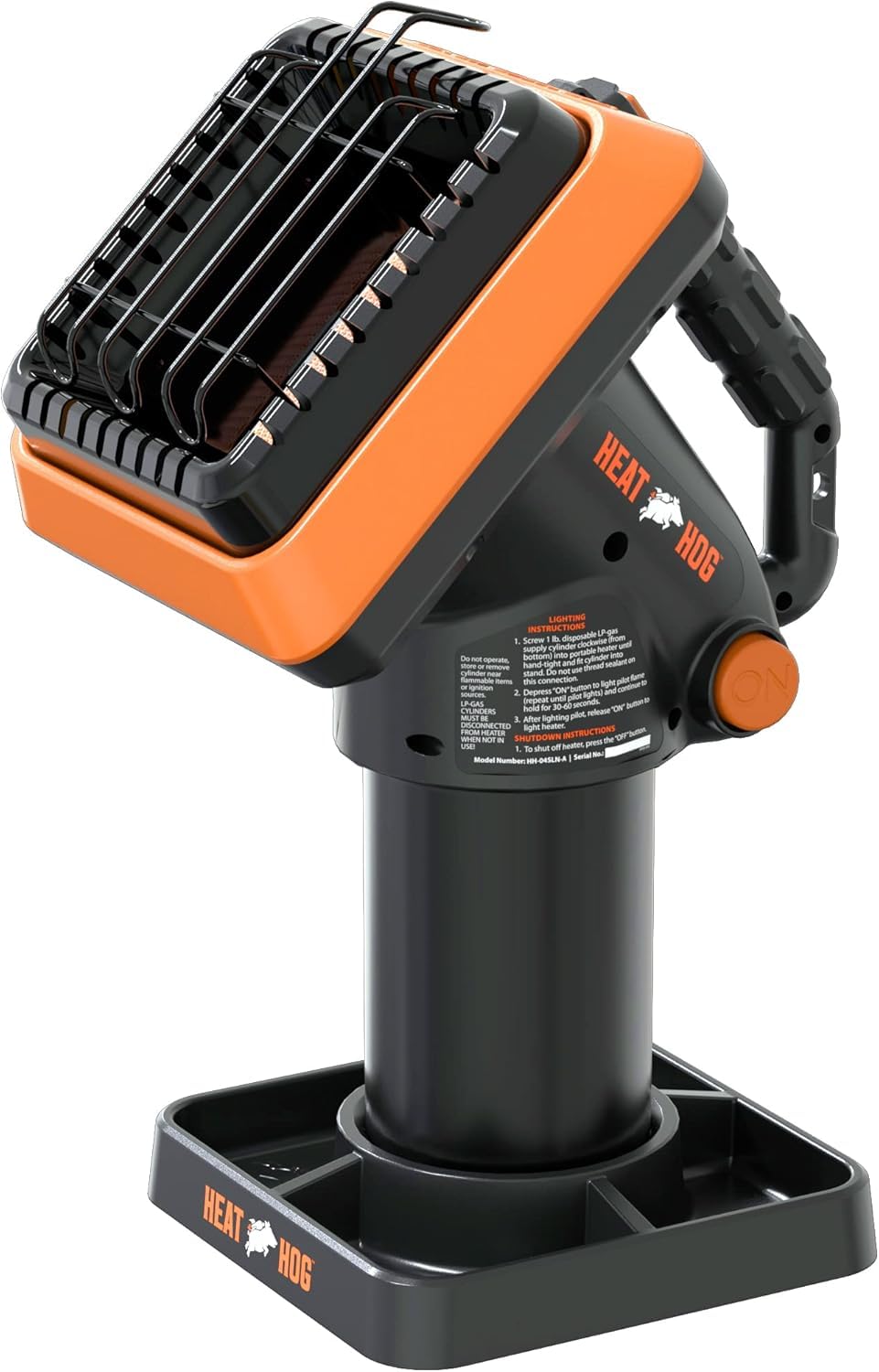
The Heat Hog delivers the highest BTU output in this roundup at 4,000 BTU, covering up to 100 square feet with radiant heat. Its defining feature is the angled head design with curved plaque technology that projects heat 33 degrees wider than a standard flat-panel heater — ideal for aiming warmth directly into a tent from the vestibule or positioning it to warm a specific camp chair zone. It runs on standard 1 lb propane cylinders and requires no electricity.
Safety coverage includes a rugged metal guard, a tip-over shutoff switch, and an Oxygen Depletion Sensor (ODS) that automatically cuts gas flow if oxygen levels drop or if the unit is knocked over. Real-world user feedback confirms it works well for warming bedding by aiming it into a tent from outside, or for taking the chill off an ice fishing shanty or tailgate setup. The 5 lb weight and 10x10x12.75 inch dimensions make it easy to stow.
Some units have arrived with signs of prior return (scratched boxes, missing accessories), and a small number of customers report that the unit won’t stay lit — likely a quality control issue at the valve assembly. However, Heat Hog’s customer service team appears responsive, sending replacement units quickly. If you need a concentrated 4,000 BTU beam that you can direct precisely, this is the most powerful option here.
Why it’s great
- Highest BTU output at 4,000 BTU
- Angled head with 33° wider heat spread
- Rugged safety guard and ODS system
Good to know
- Occasional quality control issues on delivery
- Requires 1 lb propane cylinders (not included)
6. Sealy 12-Volt Heated Car Blanket

The Sealy 12V blanket isn’t a standalone battery device — it requires a 12V DC source like a portable power station (Jackery, EcoFlow, etc.) or a vehicle cigarette lighter port. But its low power draw of roughly 50W makes it extremely efficient when paired with a mid-range power station. Real users have confirmed running it overnight for 8+ hours on a Jackery 240 with minimal battery drain, making it one of the most power-efficient heated options for campers who already carry a power station.
The blanket measures 59×43 inches, is machine washable (remove the controller first), and has three heating levels with a 4-hour auto-off safety timer. The 85-inch heavy-duty power cord provides good reach, and the polyester fabric is breathable, lightweight, and plush enough for direct skin contact. It works best as a thermal layer under a sleeping bag rather than the primary heat source for the whole tent.
At roughly a 50W draw, the math favors long nights: a 240Wh power station gives you about 4 hours on high, while the medium setting roughly doubles that. The real limitation is the cord — you’re tethered to your power station, which must stay dry and protected. For truck bed camping, RV use, or anyone with a small power station who wants personal warmth without buying a separate battery pack, this is the most efficient electric option.
Why it’s great
- Only 50W draw works well with portable power stations
- Machine washable with removable controller
- Three heat levels with 4-hour auto-off timer
Good to know
- Requires external 12V DC power source
- Heat output is subtle — best as sleeping bag layer
7. VANZACK 2Pcs Portable Kerosene Stoves

The VANZACK twin kerosene stoves are the most budget-friendly entry here, offering two non-electric heat sources that can also cook. Each stove uses an 8-wick kerosene burner that produces both radiant heat and a cooking flame — perfect for boiling water, frying eggs, or simmering coffee while warming a small shelter. The 6.89×13.39×6.69 inch iron body is compact and surprisingly durable for the price.
Users report that these stoves heat up quickly, produce a stable flame, and are reliable for camping, BBQ, or home backup. The 2-pack configuration gives you redundancy and the ability to use one for cooking and one for heating simultaneously. Operation is simple — fill with kerosene, light the wicks, and adjust the flame with the control knob. No batteries, no electronics, no moving parts to fail.
The quality control is inconsistent. Several buyers report missing fuel compartment caps, bent metal from poor packaging, and wick mechanisms that stick internally. The wicks are also non-replaceable, so when they burn out, the stove is effectively disposable. Kerosene also produces a distinct smell and requires careful ventilation similar to propane. For the price-conscious camper who wants a functional heat source that doubles as a stove and doesn’t mind occasional QC issues, this is a viable ultra-budget option.
Why it’s great
- Two stoves for under the price of one competitor unit
- Works as both heater and cooking surface
- No electronics or batteries needed
Good to know
- Quality control issues reported (missing parts, bent metal)
- Non-replaceable wicks limit lifespan
FAQ
Can I run an electric camping heater off a power station all night?
Is it safe to use a propane heater inside a tent?
Final Thoughts: The Verdict
For most users, the best battery operated heater for camping winner is the MIMYTH Cordless Heated Blanket with Hood because it combines a high-capacity built-in battery, nine independent heating zones, and up to 16 hours of runtime in a wearable, packable form factor that works in any shelter type. If you want the absolute longest battery runtime, grab the CYCYHEAT 20000mAh Large Heated Blanket. And for heating a full tent interior without draining a power station, nothing beats the proven, silent power of the Mr. Heater Little Buddy.