
Choosing an APS-C DSLR means committing to a sensor that balances image quality and portability without the full-frame price tag — but the wrong body will leave you fighting slow autofocus and cramped buffer depths. The market is flooded with kits that promise professional results but deliver frustration when you need to track a moving subject or shoot in low light. A smart purchase hinges on understanding exactly how many cross-type AF points you actually need and whether the optical viewfinder matches your shooting style.
I’m Min — the co-founder and writer behind Gadgets Feed. I’ve spent hundreds of hours comparing sensor architectures, autofocus systems, and in-camera processing pipelines across generations of APS-C bodies to identify which models still hold up in today’s market.
This guide distills that research into a clear breakdown of the best aps-c dslr camera options you should consider right now — from high-speed sports bodies to compact daily shooters you can actually afford.
How To Choose The Best APS-C DSLR Camera
Selecting the right APS-C DSLR is a battle of trade-offs between autofocus complexity, continuous shooting speed, and buffer capacity. A camera that nails focus on a stationary portrait may fail completely on a running dog, and a body that shoots 10 fps will stutter into silence after a few seconds if the buffer is too shallow. Understanding the real-world performance of every spec is the only way to avoid buyer’s remorse.
Autofocus System Depth and Cross-Type Sensors
Total AF point count is a marketing number. What matters is how many of those points are cross-type — sensors that detect contrast in both horizontal and vertical planes. A 51-point system with only 15 cross-type sensors locks focus faster and more accurately on low-contrast subjects than a system with 65 total points but fewer cross-types. For action and wildlife, prioritize cross-type coverage over the raw number.
Buffer Depth and Card Write Speed
Continuous shooting is useless if the camera freezes after two seconds. Check the maximum number of RAW frames the buffer can hold before writing slows down. A body that shoots 8 fps but only holds 10 RAW frames is less practical than a body that shoots 6 fps with a 25-frame buffer. Pair any APS-C DSLR with UHS-I or UHS-II SD cards rated for sustained write speeds above 90 MB/s to keep the buffer clearing consistently.
Sensor Resolution vs. High-ISO Noise
More megapixels is not automatically better. A 24MP APS-C sensor with large individual pixels outperforms a crowded 32MP sensor at ISO 3200 and above. For general use and low-light indoor shooting, aim for sensors between 20MP and 24MP. Higher resolution sensors above 26MP demand perfect technique and fast shutter speeds to avoid motion blur revealing pixel-level softness.
Quick Comparison
On smaller screens, swipe sideways to see the full table.
| Model | Category | Best For | Key Spec | Amazon |
|---|---|---|---|---|
| Canon EOS 80D | Mid-Range | Hybrid photo/video with best-in-class AF | 45 cross-type AF points | Amazon |
| Nikon D7500 | Mid-Range | Versatile action/wildlife shooter | 51-point AF, 15 cross-type | Amazon |
| Nikon D7100 | Mid-Range | Weather-sealed durability on a budget | 51-point AF, 14-bit RAW | Amazon |
| Sony Alpha 6700 | Premium | AI-powered subject tracking for hybrid shooters | 759 phase-detection points | Amazon |
| Canon EOS 7D Mark II | Premium | Pro-level sports and fast action | 65 all cross-type AF points | Amazon |
| Sony Alpha a6100 | Mid-Range | Compact entry with 4K oversampled video | 425 phase-detection points | Amazon |
| Nikon D5100 | Budget | Articulating screen for creative composition | 11-point AF with 3D tracking | Amazon |
| Canon EOS Rebel T7 | Budget | Complete beginner kit with accessories | 9-point AF, 24.1MP sensor | Amazon |
| Fujifilm X100 | Premium | Street photography with hybrid viewfinder | 12.3MP APS-C CMOS EXR | Amazon |
| Sony a7 III (Full-Frame Reference) | Premium | Full-frame low-light upgrade path | 693 phase-detection points | Amazon |
| Nikon D850 (Full-Frame Reference) | Premium | High-resolution studio and landscape | 45.7MP BSI sensor | Amazon |
In‑Depth Reviews
1. Canon EOS 80D

The EOS 80D is the gold standard for a hybrid shooter who needs both solid stills and smooth video in one APS-C body. Its 45-point all cross-type AF system locks onto subjects in dim lighting down to EV -3, and the Dual Pixel CMOS AF makes video focus transitions look like they were pulled by a professional follow-focus operator. The 24.2MP sensor delivers clean files up to ISO 6400 with vibrant Canon color science straight out of camera.
At 7 fps continuous shooting, it won’t win any speed records against dedicated sports bodies, but the buffer comfortably handles 25+ RAW frames before slowing down — enough for most action sequences. The articulated 3-inch touchscreen is a genuine advantage for vloggers and waist-level compositions, and the intelligent viewfinder overlays AF point information, grid lines, and a horizontal electronic level without cluttering the optical path.
The main trade-off is the lack of 4K video recording, which is a notable omission for anyone who needs ultra-high-definition footage. The 1080p 60fps output with Dual Pixel AF is still gorgeous, but content creators targeting a 4K workflow should look at the Sony Alpha 6700 instead. For photographers prioritizing reliable autofocus and excellent image quality in a mature system, the 80D remains a powerhouse.
Why it’s great
- 45 all cross-type AF points provide fast, accurate focus even in low light
- Dual Pixel CMOS AF delivers smooth, reliable video autofocus transitions
- Articulated touchscreen adds flexibility for creative compositions and vlogging
Good to know
- No 4K video recording limits future-proofing for videographers
- Body is relatively large compared to mirrorless APS-C alternatives
2. Nikon D7500

The D7500 borrows heavily from Nikon’s pro-tier D500, giving it image processing and metering that outperform most cameras in its price bracket. The 20.9MP sensor strikes an excellent balance between resolution and high-ISO performance — you can comfortably shoot at ISO 6400 and still produce clean 16×24 inch prints. The 51-point AF system with 15 cross-type sensors and Group Area AF tracks erratic subjects like birds in flight better than many full-frame cameras from just a few years ago.
Continuous shooting at 8 fps with a 50-frame RAW buffer makes this the most capable action-oriented APS-C DSLR outside Canon’s 7D series. The 3.2-inch tilting touchscreen is bright and responsive, though it doesn’t articulate sideways for vlogging. Video recording reaches 4K UHD at 30 fps with power aperture control and clean HDMI output, plus a 4K time-lapse mode that’s genuinely useful for landscape work.
The D7500 has one controversial limitation: a single SD card slot, which eliminates the instant backup that dual-slot shooters rely on for paid work. The lack of a built-in focus motor also means older AF-D lenses won’t autofocus on this body. For anyone who can work with a single card slot, the D7500 delivers class-leading image quality and speed for the money.
Why it’s great
- 8 fps burst with deep RAW buffer handles fast action reliably
- 4K video with clean output and power aperture control
- Metering and processing inherited from the pro D500
Good to know
- Single SD card slot eliminates backup redundancy for pro work
- No built-in focus motor limits compatibility with older Nikkor lenses
3. Nikon D7100

The D7100 remains a favorite among second-hand buyers because of its rock-solid build quality and weather sealing that puts many modern entry-level bodies to shame. The 24.1MP DX sensor lacks an optical low-pass filter, which means it resolves noticeably more detail than filtered sensors — you’ll see the difference in fine textures like fabric weaves and foliage. The 51-point AF system is fast and accurate, and the 6 fps continuous shooting is modest but deep enough for occasional action.
The 1.3x crop mode is a hidden gem for wildlife shooters: it effectively extends lens reach while maintaining a 15.4MP file with full AF coverage across the cropped area. The magnesium-alloy top and rear covers provide genuine durability — multiple user reports of surviving drops onto concrete without functional damage confirm this is not a fragile body. The pentaprism viewfinder is large and bright, easily as good as many semi-pro full-frame finders.
The small buffer is the biggest practical drawback — you get about 6-7 RAW frames before the camera slows to a crawl, and at 14-bit RAW, each file clocks in around 30 MB, so you’ll chew through card space fast. Battery life is also below modern standards, with some users reporting only 200-300 shots per charge when chimping frequently. For deliberate landscape and portrait shooters who value durability and detail, the D7100 still holds its own.
Why it’s great
- No OLPF delivers sharper, more detailed images than filtered sensors
- Weather-sealed magnesium-alloy body is exceptionally durable
- 1.3x crop mode extends effective reach for wildlife without heavy quality loss
Good to know
- Small RAW buffer limits continuous shooting to only a few frames
- Battery life is short by modern standards, especially with heavy live view use
4. Sony Alpha 6700

The Alpha 6700 is Sony’s most advanced APS-C body, packing a 26MP back-illuminated sensor with an AI processing chip dedicated to real-time subject recognition. The autofocus system uses 759 phase-detection points covering almost the entire frame and can identify and track human eyes, animal eyes, bird eyes, insects, cars, and trains — all in real time without entering sub-menus. For hybrid shooters who switch between portraits, wildlife, and automotive work, this speed alone justifies the premium.
Video capability is exceptional for an APS-C camera: 4K 60p from a 6K oversampled readout delivers sharp, clean footage with moiré-free detail, and 4K 120p is available for slow-motion work. The 10-bit 4:2:2 internal recording supports Log gamma and LUT application in-camera. The BIONZ XR processor makes menu navigation feel instantaneous, though Sony’s menu structure still requires a learning curve to locate every setting.
The compact body is both a strength and a weakness — it’s small enough to carry all day, but the grip is cramped for larger hands, and the lack of a built-in flash means you’ll need an external unit for indoor events. In-body stabilization is decent for photos but falls short of what you need for smooth handheld walking video without a gimbal. For the best all-around APS-C hybrid experience in 2024, the 6700 is hard to beat.
Why it’s great
- 759-point AF with AI-based subject recognition locks onto anything
- 6K oversampled 4K 60p video with 10-bit internal recording
- Compact, lightweight body with excellent battery life
Good to know
- Small grip and tight button layout can be uncomfortable for larger hands
- Complex menu system requires time to master
5. Canon EOS 7D Mark II

The 7D Mark II is a purpose-built speed machine, designed for sports, wildlife, and any scenario where missing the decisive moment is not an option. Its 65-point all cross-type AF array is denser and more responsive than almost any other APS-C DSLR ever produced, with low-luminance sensitivity down to EV -3. The 10 fps continuous shooting with full AF tracking can sustain 30+ RAW frames before the buffer fills — enough to capture an entire sprint sequence.
The body is built to take abuse, with a magnesium-alloy frame and comprehensive weather sealing that rivals professional full-frame bodies. The optical viewfinder is massive and clear, and the 202,000-pixel RGB+IR metering sensor works with the AF system to anticipate focus needs based on scene analysis. Dual SD card slots provide the redundancy that wedding and event shooters demand.
The 20.2MP sensor is modest by modern resolution standards, and high-ISO performance tops out around ISO 6400 before noise becomes noticeable. There’s no Wi-Fi built in, no articulating screen, and no 4K video — this is a pure stills camera. Battery life is also poor for its class, often draining after roughly 350 shots with regular AF use. For photographers who prioritize speed and AF accuracy above all else, the 7D Mark II remains a legendary tool.
Why it’s great
- 65 all cross-type AF points provide exceptional tracking accuracy
- 10 fps burst with deep buffer captures fast action reliably
- Magnesium-alloy body with pro-grade weather sealing
Good to know
- No 4K video, no articulating screen, no Wi-Fi
- Battery life is short, requiring spares for a full day of shooting
6. Sony Alpha a6100

The a6100 packs Sony’s excellent 24.2MP APS-C sensor with 425 phase-detection AF points and Real-Time Eye Tracking into a body that weighs just 12.3 ounces with battery and memory card. The autofocus claims a 0.02-second acquisition speed, and in practice, it sticks to eyes and faces so reliably that you can almost ignore AF settings entirely. Continuous shooting at 11 fps keeps up with moderate action, though the buffer fills after about 20 RAW frames.
The dual-lens kit with the 16-50mm and 55-210mm OSS zooms gives you a 24-315mm equivalent range that covers everything from group portraits to compressed telephoto shots. Video features 4K recording from a 2.4x oversampled readout with full pixel readout and no pixel binning, producing noticeably sharper footage than the a6000 series. The 180-degree tiltable touchscreen is useful for self-recording, though it doesn’t articulate sideways for overhead or low-angle work.
The biggest limitation is the lack of in-body image stabilization, meaning smooth handheld video requires OSS lenses exclusively. The electronic viewfinder is small and low-resolution compared to the optical finders on higher-tier bodies. Build quality is largely polycarbonate and doesn’t inspire the same confidence as a magnesium-alloy chassis. For budget-conscious shooters who want modern AF and good video in a tiny package, the a6100 is a fantastic entry point.
Why it’s great
- Fast 0.02s autofocus with reliable Real-Time Eye Tracking
- Compact body weighs only 12.3 oz with battery
- 4K video from oversampled readout produces sharp footage
Good to know
- No in-body stabilization, requiring stabilized lenses for smooth video
- Small, low-res EVF and plastic build feel less premium
7. Nikon D5100

The D5100 is an older model that remains relevant primarily for its fully articulated side-hinged LCD — a rare feature on budget Nikon bodies that makes waist-level shooting, self-portraits, and video framing genuinely easier. The 16.2MP DX sensor still produces excellent JPEG colors and surprisingly good high-ISO files up to ISO 3200, with the EXPEED 2 processor keeping noise well-controlled for an entry-level sensor of its generation. The 11-point AF system is basic but reliable for stationary subjects in good light.
Video recording hits 1080p at 30 fps with full-time autofocus in live view, though the AF hunts slowly in dim conditions. In-camera HDR mode and special effects filters add creative options without needing post-processing. The D5100 uses the same F-mount as all Nikon DX lenses, so you have an enormous library of affordable glass including older AF-S and manual-focus Nikkors, though VR is recommended for sharp video.
The body is lightweight at 1.3 lbs with battery and lens, making it one of the most travel-friendly DSLRs ever made. The kit lens (AF-S DX 18-55mm f/3.5-5.6 VR) is optically decent but noticeably soft at the corners. The D5100 lacks an internal focus motor, so older AF-D lenses won’t autofocus. For a second-hand budget buy under serious budget constraints, this is a capable learning tool that won’t frustrate you with poor image quality.
Why it’s great
- Fully articulated LCD screen enables creative angles and vlogging
- Lightweight and compact body is ideal for travel
- Excellent JPEG color output with good noise control at lower ISOs
Good to know
- 11-point AF is basic and struggles with moving subjects
- No internal focus motor limits lens compatibility
8. Canon EOS Rebel T7
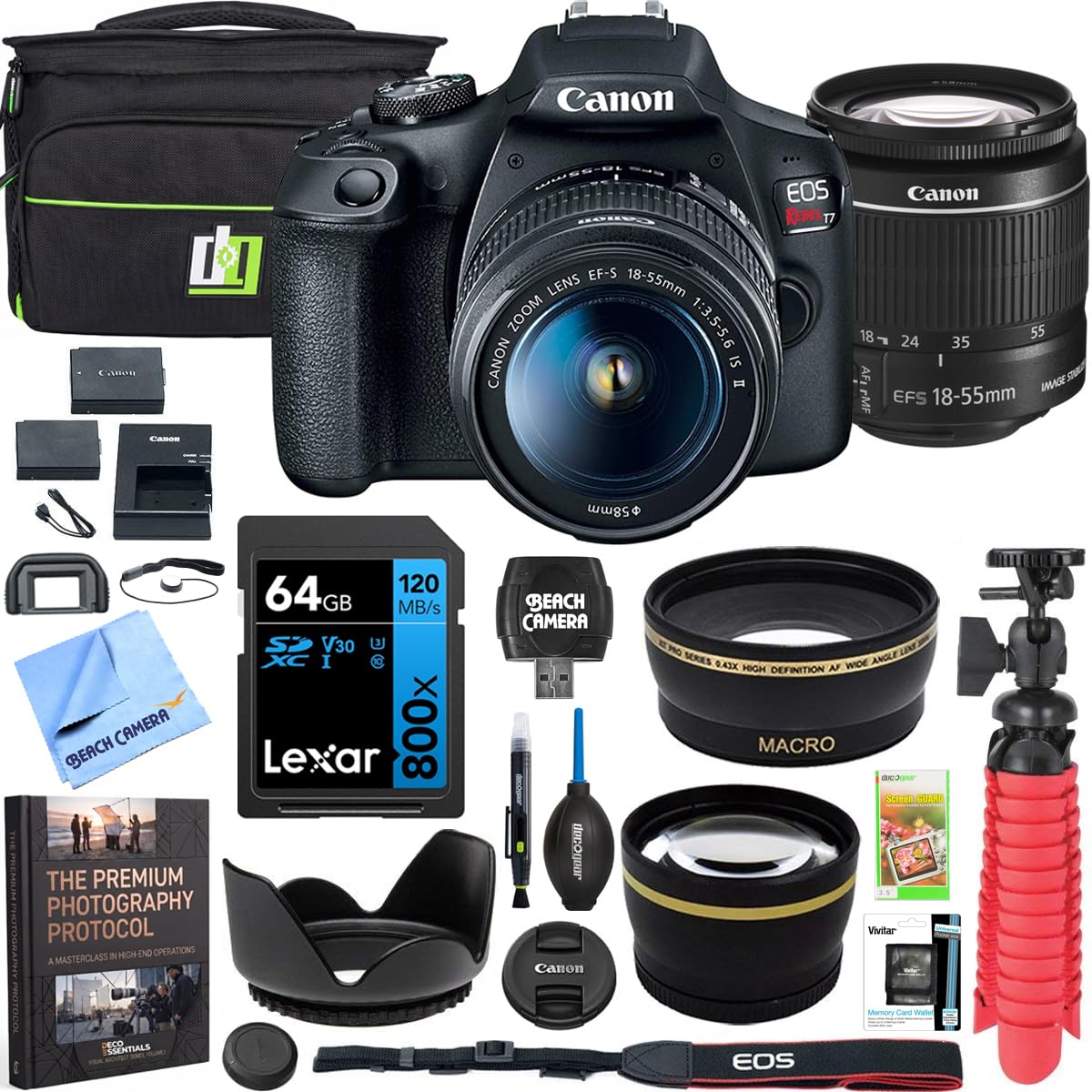
The Rebel T7 is Canon’s no-frills entry-level DSLR that gives first-time buyers a complete system without overwhelming them. The 24.1MP APS-C CMOS sensor outputs clean, well-exposed JPEGs with Canon’s appealing color science, and the included 18-55mm IS II lens provides image stabilization for steadier handheld shots. Wi-Fi and NFC connectivity let you transfer images to a smartphone for quick social media sharing without a card reader.
This bundle includes a massive accessory package: a Deco Gear camera bag, extra battery, pair of 16GB SD cards (effectively 32GB total), a 58mm wide-angle and telephoto lens set, a 60-inch tripod plus a 12-inch tabletop tripod, cleaning kit, tulip lens hood, memory card reader, and a digital photography guide. For someone starting from zero, this bundle eliminates the need to buy any additional gear for months of learning. The 9-point AF system is basic and will hunt in dim light, but it’s adequate for static subjects.
The built-in flash is useful for indoor fill light, and the Scene Intelligent Auto mode handles exposure decisions competently for beginners who aren’t ready for manual mode. The main downsides are the small, low-resolution optical viewfinder and the 3 fps continuous shooting that limits action photography. Crop in on fine details and you’ll see the kit lens softness at the edges. For the absolute lowest barrier to entry into the Canon ecosystem, the T7 bundle makes sense.
Why it’s great
- Comprehensive accessories bundle includes everything a beginner needs
- 24.1MP sensor produces pleasing color and solid image quality
- Built-in Wi-Fi for quick smartphone image transfer
Good to know
- 9-point AF is slow and struggles in low light or with moving subjects
- 3 fps burst rate is too slow for capturing action or sports
9. Fujifilm X100

The Fujifilm X100 is a unique fixed-lens APS-C camera that prioritizes the shooting experience above all raw specs. Its hybrid viewfinder lets you switch between a bright-frame optical viewfinder and an electronic viewfinder, giving you the instant clarity of a rangefinder with the exposure preview of a digital camera. The 12.3MP EXR CMOS sensor produces stunning color reproduction — Fujifilm’s Velvia and Astia film simulations deliver JPEGs that look ready for print without editing.
The 23mm f/2 Fujinon lens (35mm equivalent) is sharp wide open with beautiful bokeh rendering that many zoom lenses can’t match. The leaf shutter is nearly silent, allowing you to shoot in quiet environments without drawing attention. The built-in 3-stop ND filter lets you shoot wide open in bright sunlight to maintain shallow depth of field, and the EXR sensor’s dynamic range mode helps retain highlight and shadow detail in high-contrast scenes.
The autofocus is slow and hunts noticeably in low light, and the fly-by-wire manual focus is effectively unusable for precise focusing — you’ll rely entirely on AF. Some units develop a sticky aperture blade issue after light use, which requires expensive out-of-warranty repair. The fixed lens demands you “zoom with your feet,” which isn’t suitable for every situation. For deliberate street photographers who value image character and the unique OVF experience, the X100 is a cult classic.
Why it’s great
- Hybrid optical/electronic viewfinder offers a unique shooting experience
- Silent leaf shutter enables discreet street and event photography
- Fujifilm film simulations deliver beautiful color straight from camera
Good to know
- Autofocus is slow and unreliable in low-light situations
- Fixed 23mm lens limits compositional flexibility
10. Sony a7 III

The a7 III is the camera that redefined what a full-frame mirrorless body could cost. Its 24.2MP back-illuminated sensor delivers 15 stops of dynamic range and ISO performance that reaches up to 204,800 — you can shoot usable images in candlelight that no APS-C sensor can match. The 693-point phase-detection AF covers 93% of the frame, and real-time Eye AF for humans and animals locks onto subjects with near-zero hunting, even in near-darkness.
Continuous shooting at 10 fps with silent electronic shutter or mechanical shutter lets you capture action without mirror slap vibration. The 5-axis in-body stabilization provides 5 stops of compensation, making handheld 1/2-second exposures possible with steady technique. Battery life with the NP-FZ100 pack is exceptional: roughly 710 shots per charge with the LCD, which is double what most mirrorless cameras offer. The 4K video output is crisp, though the 8-bit internal recording limits color grading depth compared to the a7 IV.
The kit 28-70mm f/3.5-5.6 OSS lens is optically decent but built from plastic with a narrow aperture range — you’ll quickly outgrow it in low light. The menu system is famously convoluted, and the touchscreen is limited to focus point placement rather than full menu navigation. Weather sealing is present but not as robust as Canon or Nikon pro bodies. For APS-C users considering an upgrade path, the a7 III remains the benchmark for full-frame value.
Why it’s great
- 15 stops of dynamic range and exceptional high-ISO performance
- 693-point AF with reliable Eye Tracking for humans and animals
- 5-axis IBIS provides 5 stops of stabilization for handheld shooting
Good to know
- Kit lens is optically average and limits low-light performance
- Menu system is complex and touchscreen functionality is limited
11. Nikon D850

The D850 is the finest DSLR ever made for full-frame resolution, combining a 45.7MP back-illuminated sensor with no optical low-pass filter to produce files that rival medium format systems. The 153-point AF system with 99 cross-type sensors delivers stunningly fast and accurate subject acquisition, even in dim light. The 9 fps full-resolution burst with the optional grip makes it a viable sports and wildlife camera despite the high pixel count.
The tilting touchscreen is a significant improvement over fixed LCDs on older pro bodies, and the illuminated buttons make night shooting practical. 4K Ultra HD video from the full sensor width is sharp and detailed, with slow-motion 1080p up to 120 fps. The focus shift mode automatically captures a stack of images at different focal distances, ideal for macro and product photography. At ISO 64 base sensitivity, the D850 produces images with essentially no measurable noise and incredible dynamic range.
File sizes are enormous: a 14-bit uncompressed RAW file runs about 50-60 MB each, requiring large and fast memory cards — the single XQD slot is fast but limits compatibility. The Snapbridge Wi-Fi implementation is unreliable for quick transfers, and the camera is heavy at 2.08 lbs body-only. There’s no built-in flash, and the touchscreen depletes the battery noticeably faster than the optical viewfinder. For anyone who needs the absolute highest resolution and dynamic range in a DSLR body, the D850 remains unmatched.
Why it’s great
- 45.7MP BSI sensor delivers medium-format-level resolution and detail
- 153-point AF with 99 cross-type sensors tracks subjects precisely
- Focus shift mode for automated focus stacking is a game-changer for macro work
Good to know
- Huge RAW files require fast, high-capacity memory cards
- Heavy body and poor Snapbridge Wi-Fi implementation
FAQ
Is an APS-C DSLR still worth buying in the mirrorless era?
How many cross-type AF points do I actually need for portraits and travel?
Can I use full-frame lenses on an APS-C DSLR body?
Final Thoughts: The Verdict
For most users, the best aps-c dslr camera overall is the Canon EOS 80D because it combines a professional-level 45-point all-cross-type AF system with excellent video autofocus from Dual Pixel CMOS AF, all in a well-built body that handles most shooting scenarios. If you want faster action performance with a deeper buffer, grab the Nikon D7500 for its 8 fps burst and superior metering. And for the ultimate dedicated sports APS-C DSLR, nothing beats the Canon EOS 7D Mark II with its 10 fps speed and 65-point cross-type AF array.