
The leap from a cheap, finicky printer to a reliable workhorse that actually holds its level and prints clean first layers without constant intervention is the single biggest upgrade a maker can make. At this price threshold, the difference between a frustrating tinkerer’s project and a tool you trust to run overnight comes down to precision mechanics, smart auto-leveling, and extrusion that doesn’t slip or clog mid-print. You want speed without stringing, multicolor without waste, and a machine that understands the filament you feed it without manual profiles.
I’m Min — the co-founder and writer behind Gadgets Feed. I’ve spent hundreds of hours analyzing print speeds, extrusion consistency, auto-leveling reliability, and material compatibility across the current market to separate the true plug-and-play performers from the endless calibration traps. This guide cuts through the spec sheet noise and focuses on what actually matters for prints that succeed on the first try.
Whether you’re upgrading from a first-gen starter machine or buying your very first printer, these are the models that deliver genuine professional results without pushing past a reasonable budget, and they represent everything you need to know before picking the best 3d printer under $450.
How To Choose The Best 3D Printer Under $450
The sub-$450 segment has matured rapidly, with features that were once exclusive to + machines now appearing in affordable packages. The key is knowing which features genuinely improve reliability and which are just marketing numbers. Focus on the extrusion system, the motion platform, and the leveling mechanism.
Extruder Type: Bowden vs. Direct Drive
A direct-drive extruder mounts the motor directly above the hotend, giving you precise retraction control and the ability to print flexible filaments like TPU without jams. Bowden setups, where the motor is mounted on the frame and pushes filament through a long PTFE tube, are lighter but introduce more friction and stringing with flexible materials. Every printer on this list uses a direct-drive or geared direct-drive system, which is the baseline for reliable multi-material printing at this price.
Auto-Leveling: Strain Sensors vs. Inductive Probes
Strain sensors measure the actual pressure of the nozzle against the build plate, compensating for small bed warps without needing a separate probe. Inductive or capacitive probes (like CR Touch) physically map the bed surface before each print. The best systems combine both, but a single reliable auto-leveling implementation eliminates the most common beginner frustration: failed first layers from an unlevel bed. Look for 49-point or 121-point mesh leveling for the most consistent adhesion across the entire plate.
Build Volume and Enclosure
A cubic build volume of 220x220x220mm is standard at this price, but larger volumes like 260x260x260mm give you room for functional parts and batch printing. An enclosed chamber is critical for ABS, ASA, and polycarbonate filaments because it maintains a stable temperature and prevents warping. Open-frame printers work perfectly for PLA and PETG but struggle with materials that require a hot environment. If you plan to print advanced filaments, prioritize a fully enclosed model or one with an available enclosure kit.
Quick Comparison
On smaller screens, swipe sideways to see the full table.
| Model | Category | Best For | Key Spec | Amazon |
|---|---|---|---|---|
| Creality Ender 3 V3 SE | Bed Slinger | Budget reliability with auto-leveling | 250mm/s, direct drive, 220x220x250mm | Amazon |
| FLASHFORGE Adventurer 5M | CoreXY | Speed and simplicity for beginners | 600mm/s, CoreXY, 220x220x220mm | Amazon |
| Anycubic Kobra X Multicolor | Bed Slinger | Multicolor on a budget | 600mm/s, 4-color, 260x260x260mm | Amazon |
| Bambu Lab P1S | CoreXY | Enclosed workhorse for advanced materials | 500mm/s, enclosed, 256x256x256mm | Amazon |
| Anycubic Kobra S1C | CoreXY | Enclosed multicolor with active drying | 600mm/s, CoreXY, 4-color, enclosed | Amazon |
| Creality K2 Pro Combo | CoreXY | Large format multicolor with heated chamber | 600mm/s, 16-color, 300x300x300mm | Amazon |
In‑Depth Reviews
1. Bambu Lab P1S

The Bambu Lab P1S represents the most refined out-of-box experience in this price bracket. Its fully enclosed CoreXY design reaches 500mm/s with 20,000mm/s² acceleration, and it auto-levels before every single print using a robust inductive probe system. Users report setting it up in under 30 minutes and producing high-quality prints immediately, with no manual bed leveling or Z-offset calibration. The enclosed chamber allows reliable printing of ABS and ASA without an additional enclosure kit, and the 256x256x256mm build volume is generous for a machine in this class.
Bambu Studio slicer software streamlines the workflow from design to print, and the P1S supports up to 16 colors when paired with the optional AMS unit. Real-world feedback highlights its reliability as a daily workhorse — one reviewer noted it “buries my previous printer” and praised its consistent auto-leveling that eliminates first-layer failures. The all-metal frame and linear rail system provide the rigidity needed for high-speed printing without ghosting, and the filament runout sensor with power-loss recovery ensures long prints don’t fail silently.
The P1S is not the absolute cheapest CoreXY on the market, but it delivers industrial-grade consistency that justifies its position near the top of the budget. The automatic bed leveling is slower than some competitors, taking about 90 seconds per cycle, but the accuracy is superior. For makers who want to print advanced materials without manual tuning, this is the clear choice.
Why it’s great
- Fully enclosed for ABS/ASA printing with zero add-ons
- Auto-levels before every print, eliminating first-layer guesswork
- Multicolor expansion ready with optional AMS unit
Good to know
- Automated leveling cycle takes about 90 seconds
- TPU flexible printing requires careful tuning
2. Anycubic Kobra X Multicolor
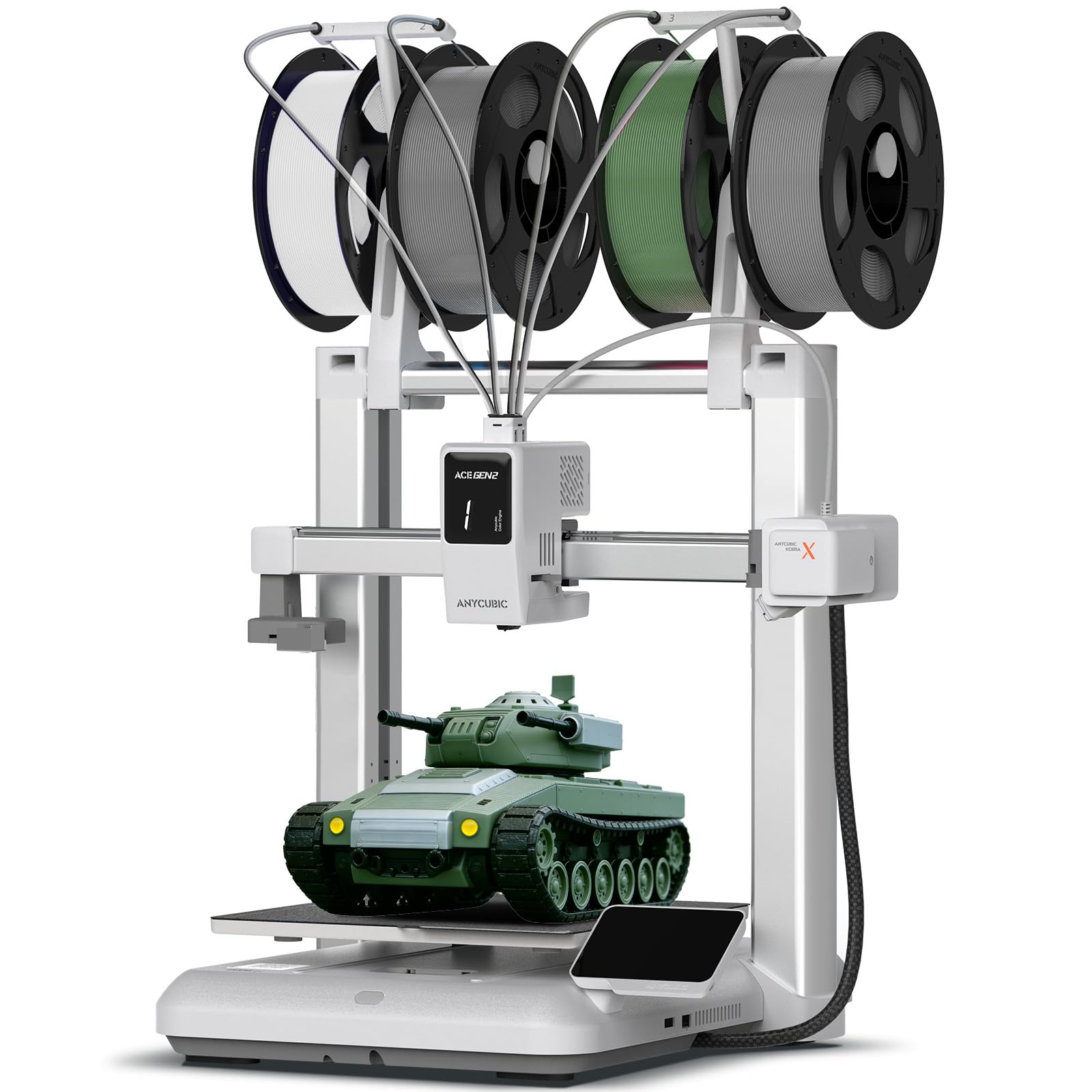
The Anycubic Kobra X Multicolor brings genuine built-in 4-color printing to the sub-$450 segment without sacrificing speed or build volume. It reaches 600mm/s using a balanced bed-slinger motion system and features LeviQ 3.0, a 49-point full-auto leveling system that compensates for bed warp more accurately than most competitors at this price. The 260x260x260mm build volume is among the largest in this class, giving you room for helmets, vases, and functional prototypes that won’t fit on smaller 220mm machines.
Active vibration compensation keeps prints clean at high speeds, and the hardened steel nozzle supports temperatures up to 300°C, enabling PLA, PETG, TPU, PVA, and ASA. The integrated 720P camera with AI spaghetti detection adds a layer of protection for unattended long prints. One reviewer described it as “the best purchase I have ever made on Amazon,” citing easy setup and excellent print quality out of the box. The 4-color system uses a built-in filament buffer that reduces waste compared to external multi-material units.
Some users note that nozzle clogs can occur if the retraction settings aren’t dialed in for flexible filaments, and the nozzle change procedure is not as quick as the tool-free designs on higher-end machines. The open-frame design means ABS and ASA will warp without an enclosure, but for PLA and PETG multicolor projects, the value proposition is unmatched at this price point.
Why it’s great
- Built-in 4-color printing without an expensive add-on unit
- Large 260mm³ build volume and 600mm/s top speed
- AI monitoring with spaghetti detection for worry-free overnight prints
Good to know
- Nozzle changes require tools and can be tricky
- Open frame limits advanced material use without enclosure
3. FLASHFORGE Adventurer 5M

The FLASHFORGE Adventurer 5M is a genuinely beginner-friendly CoreXY machine that prioritizes simplicity without cutting speed. It accelerates from 0 to 600mm/s in 0.025 seconds using 20,000mm/s² acceleration, and its one-click full-auto leveling system eliminates the manual bed-leveling ritual entirely. The 220x220x220mm build volume is standard for this class, but the all-metal chassis and linear rail motion system provide the rigidity needed to maintain precision at those high speeds.
A 50W heater brings the nozzle to 200°C in 35 seconds, and the 32mm³/s flow rate allows rapid extrusion without underextrusion artifacts. The dual-sided PEI steel plate offers flexible removal of prints — just bend the plate and parts pop off. User reviews consistently praise its reliability: one reviewer with over 40 prints reported zero issues after six months, calling it a “single color workhorse.” The built-in WiFi enables direct slicing and file transfer from the FLASHFORGE slicer or Orca Slicer, though some users note that 5GHz mesh networks can cause connectivity drops.
The Adventurer 5M lacks a heated chamber, so ABS and ASA require an optional enclosure kit that may not be widely available. The touchscreen interface is intuitive, though some users find the manual jogging controls confusing at first. For single-material PLA and PETG projects, this machine delivers a near-appliance-like experience that gets you printing within 10 minutes of unboxing.
Why it’s great
- One-click leveling with zero manual bed adjustment
- Ultra-fast 35-second hotend heat-up time
- Dual-sided PEI flexible plate for easy print removal
Good to know
- Smaller build volume limits large-part printing
- No built-in enclosure for advanced materials
4. Creality Ender 3 V3 SE

The Creality Ender 3 V3 SE is a direct evolution of the legendary Ender 3 platform, addressing the two biggest pain points of its predecessors: manual bed leveling and Bowden extrusion. It ships with a full-metal Sprite direct-drive extruder that handles PLA, TPU, and PETG without slipping, and the CR Touch auto-leveling sensor combined with a strain sensor for automatic Z-offset means you can genuinely skip the leveling ritual. The 250mm/s top speed is slower than the CoreXY machines on this list, but the dual Z-axis lead screws and 8mm Y-axis linear shafts provide exceptional stability for consistent layer adhesion.
Assembly requires about 20 minutes and three major steps — a dramatic improvement over the original Ender 3’s multi-hour build. The auto filament loading and unloading function simplifies material swaps, and the included SD card slot lets you print without tethering to a computer. One one-month review highlighted “quieter operation than older Enders” and “improved print quality,” though the firmware update process can be confusing due to a hidden USB-C connector. The stock cooling fans are adequate for PLA but may struggle with overhangs on high-speed PETG prints.
The V3 SE is the most affordable fully featured printer on this list, making it the ideal entry point for makers who want a reliable machine without spending premium-tier money. The 250mm/s speed won’t beat CoreXY machines, but the print quality per dollar ratio is outstanding. Some users report the Creality app and cloud connectivity are unreliable, so treat the printer as a standalone device and use the SD card or USB for best results.
Why it’s great
- Sprite direct drive handles flexible filaments without jams
- 20-minute assembly with auto Z-offset calibration
- Excellent print quality at the lowest price point
Good to know
- Stock cooling fans are slightly underpowered for overhangs
- Cloud/app connectivity has known reliability issues
5. Creality K2 Pro Combo
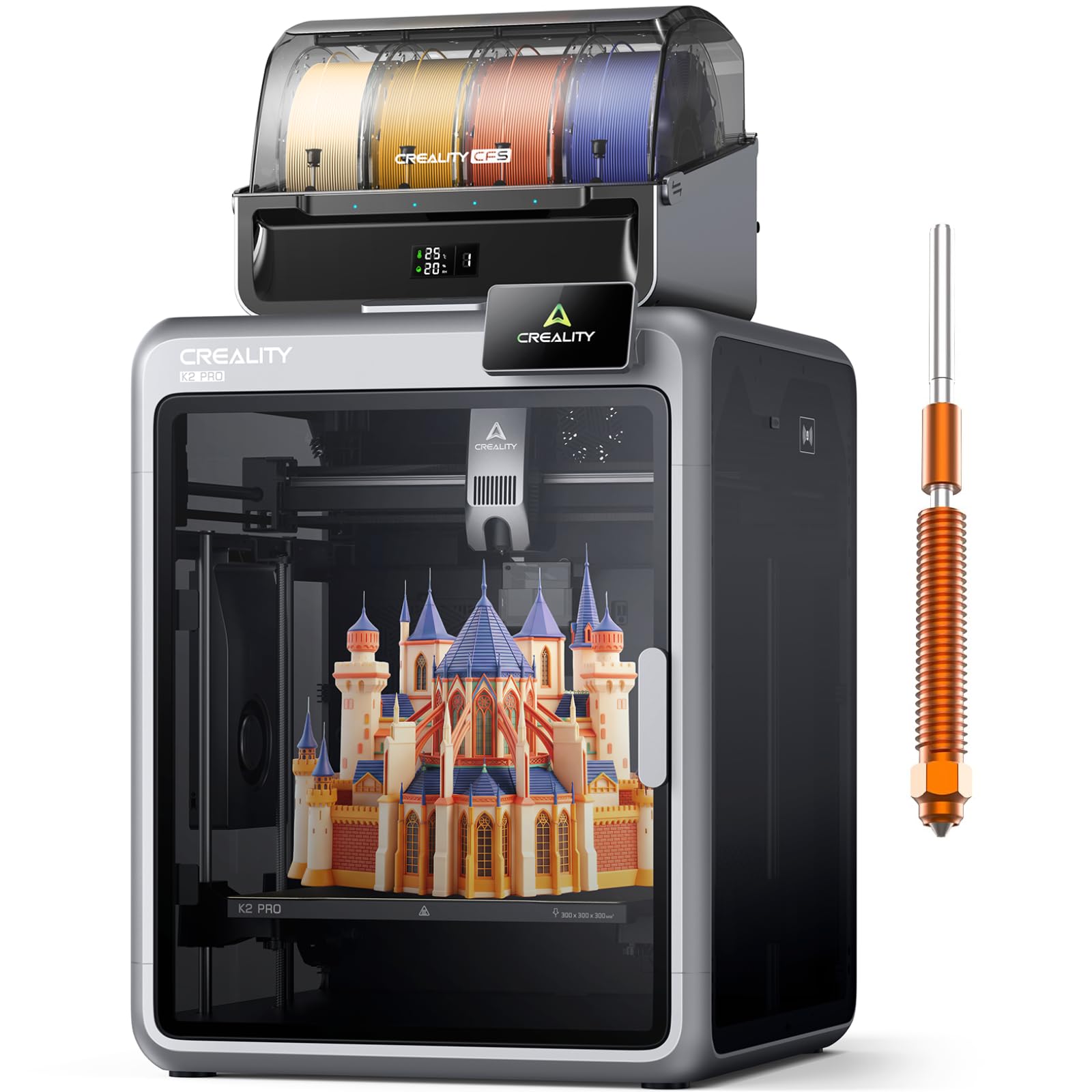
The Creality K2 Pro Combo pushes the sub-$450 envelope with a massive 300x300x300mm build volume and a fully enclosed chamber that maintains temperatures up to 60°C for warping-prone materials like ASA and PPA-CF. Powered by FOC step-servo motors and linear rails, it reaches 600mm/s with 20,000mm/s² acceleration, and its dual AI cameras — one chamber camera for print failure detection and one nozzle camera for real-time flow rate tuning — provide a level of automation usually reserved for + machines. The included CFS smart filament system handles up to 16 colors with auto filament identification via RFID tags.
The direct-drive extruder pushes 40mm³/s flow rate with hardened steel gears that handle abrasive carbon fiber filaments without wear. The active chamber heating prevents corner warping on large ABS prints, and the automatic intelligent leveling probes only the areas where the model will be printed, cutting setup time significantly. User reviews praise its speed and print quality, with one noting it “prints so fast, you can’t even tell it’s printing anything.” The K2 Pro supports remote monitoring via WiFi/LAN and OTA firmware updates, and it’s compatible with Creality Print, Cura, and Orca Slicer.
The CFS multicolor software is still maturing — some users report sync issues between the printer and slicer that require full power cycles to resolve. The initial setup is more involved than simpler machines due to the CFS integration and active chamber heating configuration. For makers who need large-format multicolor printing and advanced material support, the K2 Pro delivers premium features at a mid-range price, but it rewards users who are comfortable troubleshooting software quirks.
Why it’s great
- 300mm³ build volume for large functional parts and batch prints
- Active chamber heating eliminates corner warping on ABS/ASA
- Dual AI cameras with real-time flow rate optimization
Good to know
- CFS multicolor software has documented sync and error issues
- Setup is more complex due to CFS integration and heated chamber
6. Anycubic Kobra S1C

The Anycubic Kobra S1C stands out with its built-in active filament drying system, which maintains optimal humidity levels inside the enclosed chamber to prevent bubbles and clogs from moisture absorption — a critical feature for long multi-day prints. Using a stable CoreXY structure, it reaches 600mm/s with vibration compensation that keeps detail crisp at high speeds. The enclosed chamber allows reliable ABS and ASA printing, and the full-auto calibration handles leveling, vibration compensation, and flow rate tuning in a single automated sequence, making it genuinely beginner-friendly despite its advanced features.
The S1C supports 4-color printing out of the box with the ability to expand to 8 colors using two ACE Pro units. The quick-swap nozzle design allows hotend changes in seconds without tools, reducing downtime when switching between materials. Anycubic’s App and LAN control let you manage prints remotely, and the camera (though lower resolution) provides visual monitoring and time-lapse recording.
The ACE Pro multi-material unit can be finicky with matte PLA and some generic brands, occasionally causing loading errors that require manual intervention. The camera resolution is adequate for checking print progress but not for detailed inspection. At 56 pounds, the S1C is heavy and needs a dedicated sturdy table, but the build quality and material drying feature make it a compelling choice for makers who print with moisture-sensitive filaments.
Why it’s great
- Active filament drying prevents moisture-related print failures
- Quick-swap nozzle for effortless material changes
- Full-auto calibration handles leveling and flow rate tuning
Good to know
- ACE Pro unit has compatibility issues with some matte filaments
- Camera resolution is adequate for monitoring only, not inspection
FAQ
Can I print ABS with an open-frame printer under $450?
What does a direct drive extruder do for print quality?
How much real-world speed difference does 600mm/s make versus 250mm/s?
Final Thoughts: The Verdict
For most users, the best 3d printer under $450 winner is the Bambu Lab P1S because it delivers enclosed CoreXY performance, reliable auto-leveling, and multicolor expansion in a package that works right out of the box with minimal tuning. If you want built-in 4-color printing without an expensive add-on unit, grab the Anycubic Kobra X Multicolor. And for the most affordable reliable path into FDM printing, nothing beats the Creality Ender 3 V3 SE at its price point.