
An overlocker (or serger) is the single fastest way to give your sewing projects that clean, professional, store-bought finish. But if you are new to the category, the threading paths, tension dials, and differential feed can feel intimidating. The right beginner model removes that fear with clear color coding, a sturdy metal frame, and a simplified setup process that lets you focus on sewing, not fighting the machine.
I’m Min — the co-founder and writer behind Gadgets Feed. I’ve spent hundreds of hours analyzing technical specifications, customer feedback, and long-term reliability data across dozens of overlocker models to pinpoint the machines that genuinely serve a first-time buyer without demanding a steep learning curve.
My research has narrowed the field to the nine most capable machines. This guide breaks down every critical decision so you can confidently choose the best beginner overlocker for your sewing room.
How To Choose The Best Beginner Overlocker
Picking your first overlocker is more about avoiding frustration than getting the highest stitch count. A beginner-friendly machine must have three things: a clear threading system, a frame that doesn’t vibrate at speed, and a differential feed that handles both stretchy and woven fabrics. Machines that skip any of these three produce tangled thread, uneven seams, and a desk full of frustrations.
Threading System: Color-Coded vs. Lay-In
The single biggest pain point for a new overlocker user is threading the lower looper. Color-coded guides with numbered paths reduce the chance of a missed loop. The Janome MOD-8933’s lay-in threading system goes further—you drop the thread into a slot instead of fishing it through tiny holes. For a beginner, this alone can save twenty minutes per rethread. If you plan to switch thread colors often, prioritize a machine with a true lay-in system over a standard color-coded path.
Metal Frame vs. Plastic Frame
A heavy-duty metal frame absorbs vibration at speeds above 1,200 stitches per minute. Plastic-framed machines often walk across a table or produce wavy stitches when sewing multiple layers of denim or canvas. This does not mean every plastic component is bad — the Brother 1034D uses a metal chassis with plastic outer panels, striking a good balance between stability and portability at 17.7 pounds. If your sewing table is lightweight, the extra heft of a metal frame is worth every gram.
Differential Feed Ratio Range
Differential feed controls how fast the front feed dogs move compared to the back ones. A ratio of 0.7 to 2.0 is the standard range for beginner machines. The VEVOR and Lumina Moda models offer exactly this span, letting you stretch lightweight fabric slightly (ratio above 1.0) or gather stretchy knits (ratio below 1.0). A machine without differential feed will pucker jersey fabric and stretch out silk — avoid any model that omits this feature entirely.
Stitch Capability: 2, 3, and 4-Thread
A true beginner overlocker must support 2, 3, and 4-thread stitches. The 4-thread overlock is the workhorse for garment seams, the 3-thread stitch is ideal for rolled hems and decorative edging, and the 2-thread is useful for lightweight fabric finishing. All nine machines in this guide offer this three-way capability. If you find a machine that only does 3 and 4-thread, you will be locked out of the rolled hem function that is essential for scarves, napkins, and chiffon projects.
Quick Comparison
On smaller screens, swipe sideways to see the full table.
| Model | Category | Best For | Key Spec | Amazon |
|---|---|---|---|---|
| Brother 1034D | Premium | Reliability for beginners | 1,300 stitches/min, metal frame, 3 included feet | Amazon |
| Janome MOD-8933 | Premium | Easiest threading | Lay-in threading, 3/4 thread convertible | Amazon |
| Brother ST4031HD | Premium | Heavy-duty projects | 1,300 stitches/min, large extension table, hard carbon steel blade | Amazon |
| Janome 8002D | Premium | Color-coded simplicity | 1,300 stitches/min, 19 lbs, 3/4 thread differential feed | Amazon |
| SINGER S0100 | Mid-Range | Speed with metal frame | 1,300 stitches/min, 6 built-in stitches, color-coded guides | Amazon |
| SINGER S14-78 | Mid-Range | Brand trust and support | 1,200 stitches/min, free arm, rolled hem convertible | Amazon |
| Lumina Moda | Mid-Range | Feature-rich for the price | 1,250 stitches/min, free arm, LED light, built-in trim trap | Amazon |
| VEVOR Serger | Budget-Friendly | Cast-iron stability | 1,250 stitches/min, 0.7–2.0 differential feed, free arm, LED | Amazon |
| FEIYUE FY505 | Budget-Friendly | Rock-bottom entry point | 1,100 stitches/min, carbon steel blade, color-coded guides | Amazon |
In‑Depth Reviews
1. Brother 1034D Heavy-Duty Metal Frame Overlock Machine

The Brother 1034D is widely considered the gold standard for first-time overlocker buyers. Its durable metal frame and internal components weigh 17.7 pounds, providing the stability needed to handle multiple layers of denim without walking across your table. The machine sews at up to 1,300 stitches per minute and includes a removable trim trap that collects fabric scraps, keeping your workspace clean during long sessions.
Threading is simplified with a color-coded upper thread guide and lower looper system. The machine comes pre-threaded out of the box with a practice piece of fabric, so you can start serging immediately. It supports 3 and 4-thread overlock stitches, plus rolled hem, flatlock, and blind hem — covering every stitch a beginner needs without overwhelming options. Three snap-on accessory feet (standard, gathering, and blind stitch) are included.
Users consistently report the 1034D is reliable after years of use, with an responsive foot pedal and an easy-access lever to disengage the cutting knife. The manual is clear, and free instructional videos on YouTube address common tension questions. The one trade-off: no coverlock or chain stitch capability, but neither is essential for a beginner focused on seam finishing and edge neatening.
Why it’s great
- Proven long-term reliability reported over multiple years of ownership
- Easy color-coded threading with a clear manual and online video support
- Three included accessory feet expand your stitch options immediately
Good to know
- Does not produce a coverlock or true chain stitch
- Some users found the oiling diagram confusing and needed online guidance
2. Janome MOD-8933 Serger with Lay-In Threading

The Janome MOD-8933 is built around the single feature that frustrates beginners the most: threading the lower looper. Its lay-in threading system lets you drop the thread into a slot rather than pushing it through a narrow eyelet. Color-coded thread guides and a pretension setting slider further reduce the guesswork, making this the most approachable machine in the list for someone who dreads rethreading after every color change.
This serger operates as a 3 or 4-thread convertible machine with an adjustable differential feed that prevents stretching and puckering on a wide range of fabrics. The quick-change rolled hem feature is accessible without swapping needle plates, which saves time when switching between a standard overlock edge and a narrow hem. The machine weighs 14.3 pounds and has a compact 11 x 12 x 10.7-inch footprint.
Customer feedback highlights the durable construction and the fact that the factory tension settings work well out of the box, rarely requiring adjustment. The 25-year limited warranty on mechanical parts adds a layer of confidence that budget machines cannot match. The lack of a free arm for cuffs and sleeves is a genuine limitation, and the included dust cover is thin. If easy threading is your top priority, this machine justifies its premium price.
Why it’s great
- Lay-in threading system dramatically reduces lower looper frustration
- Quick-change rolled hem without plate swapping for seamless transitions
- Factory tension settings work well for most fabrics right away
Good to know
- No free arm for sewing cuffs, sleeves, or pant legs
- Included dust cover is thin and offers minimal protection
3. Brother ST4031HD Strong & Tough Serger

The Brother ST4031HD is the premium choice from the Strong & Tough series, designed for sewists who work with multiple layers of canvas, denim, or toweling. Its hard carbon steel cutting blade stays sharper longer than standard blades, producing a smoother cut edge. The large extension table provides extra fabric support for big projects like duvet covers or curtains, and the removable deck gives access to the free arm for smaller items like cuffs.
This machine reaches 1,300 stitches per minute and features color-coded thread guides with numbered upper and lower thread loopers for straightforward setup. Three accessory feet (standard, blind stitch, and gathering) are included along with a trim trap and a comprehensive accessory kit. The metal frame weighs 17.6 pounds, keeping vibrations minimal even during high-speed serging.
Users consistently praise the ST4031HD for handling thick two-ply towels without tension adjustment and for being quiet during operation. The Brother app provides threading and troubleshooting videos, reducing the learning curve. Some beginners may find the front-facing tension dials intimidating at first, but once set for a specific fabric, the machine holds those settings reliably. It is the most expensive option on this list, but for anyone planning heavy-volume garment sewing, it is a true workhorse.
Why it’s great
- Hard carbon steel blade delivers precise, long-lasting cuts on heavy materials
- Large extension table and free arm accommodate both big and small projects
- Runs quietly and holds tension settings across fabric changes
Good to know
- Front-facing tension dials can feel complex for absolute beginners
- Missing accessories from the box — confirm contents with seller
4. Janome 8002D Overlock Machine

The Janome 8002D is a straightforward 3/4-thread overlocker that emphasizes reliable mechanical simplicity over flashy extra features. At 19 pounds, it is the heaviest machine in this roundup, and that weight translates directly to stability: there is negligible vibration even at the maximum 1,300 stitches per minute. The adjustable differential feed system prevents puckering on lightweight cotton and stretching on jersey, making it equally capable for garment construction and home decor.
Color-coded threading paths and clearly marked tension dials make setup manageable. The machine comes pre-threaded with four white cone threads, and the included DVD provides step-by-step visual guidance. The 8002D features a quick-change rolled hem, a disengageable upper knife, and a built-in accessory storage compartment. The warranty structure is generous: 5 years on mechanical parts, 2 years on electrical parts, and 1 year on labor.
Experienced sewers upgrading from a more expensive machine have reported that the Janome 8002D is easier on arthritic hands and produces perfect seams out of the box. The only consistent criticism is noise at high speed — it is louder than some competing models. If you prioritize a rock-solid frame, clear threading, and a proven track record, this machine justifies its premium price through sheer dependability.
Why it’s great
- Very heavy 19-pound metal frame provides exceptional vibration dampening
- Color-coded guides and a detailed DVD make learning straightforward
- Strong warranty coverage with 5 years on mechanical parts
Good to know
- Operates louder than some competitors at maximum speed
- Included thread cones run out after a few projects and require replacement
5. SINGER S0100 Metal Frame Serger

The SINGER S0100 brings a metal frame and 1,300 stitches per minute to the mid-range category. Its six built-in stitches cover the essential 2, 3, and 4-thread overlock options plus a rolled hem, providing flexibility without overwhelming a new user. The color-coded threading system includes diagrams printed on the machine, and the differential feed is adjustable to handle a range of fabrics from sheer to medium-weight denim.
This machine arrives pre-threaded (though some customers reported otherwise) and includes a general-purpose foot, tweezers, extra needles, cone adapters, a screwdriver, and a foot controller. The front compartment stores all accessories for easy access. The machine weighs 13.5 pounds, and the metal frame keeps vibration moderate even when sewing at speed. The SINGER brand name also means replacement parts and service centers are widely available.
Customers note that the S0100 is lightweight compared to other metal-frame sergers, making it easier to move between storage and the sewing table. The tension settings hold well through medium-weight woven fabrics. The main drawbacks are the lack of a free arm for cuffs and sleeves and reports that the color-coded guides are faded and hard to read in low light. For a mid-range price, you get solid metal construction and a recognizable brand warranty.
Why it’s great
- Metal frame construction at a mid-range price point offers good stability
- Six built-in stitches cover all essential beginner applications
- Pre-threaded setup and included accessory kit reduce initial friction
Good to know
- No free arm for tubular sewing on sleeves or pant legs
- Color-coded threading guides can be difficult to read in dim lighting
6. SINGER S14-78 Serger with Accessory Kit

The SINGER S14-78 is a well-rounded beginner overlocker that includes a free arm — a feature often missing in this price bracket. The extension table slides off easily to expose the free arm, giving you direct access to cuffs, sleeves, and pant legs. This machine offers 2, 3, and 4-thread stitch capability and can convert to rolled and narrow hemming modes with simple adjustments, making it suitable for both garment construction and home decor finishing.
The S14-78 runs at up to 1,200 stitches per minute with a differential feed that prevents puckering on lightweight fabrics and stretching on knits. Color-coded threading guides and numbered tension dials simplify the setup process. The included accessory kit contains a universal sewing foot, tweezers, an Allen key, a two-thread overlock converter, a screwdriver, and a dust cover. The machine weighs 13.89 pounds and has suction cups on the bottom to reduce vibration on smooth surfaces.
Owners describe the S14-78 as an easy-to-use serger that produces good stitch quality for occasional hobby sewing. The free arm is particularly valued by quilters and garment makers who frequently sew tubular sections. The manual is not included in the box — it must be downloaded as a free PDF — and the lack of on-deck tension guides for the lower looper can complicate rethreading. For the brand trust and the free arm utility, it is a strong mid-range contender.
Why it’s great
- Free arm is essential for sewing cuffs, sleeves, and other tubular areas
- Suction cup feet on the base reduce vibration and machine walk
- Simple adjustments convert the machine to rolled or narrow hems
Good to know
- Manual is not printed — must be downloaded from the SINGER website
- No dust cover included despite the machine being sold with an accessory kit
7. Lumina Moda Serger Overlock Machine

The Lumina Moda packs an impressive set of features into a mid-range price. It delivers 1,250 stitches per minute from a 90-watt motor, has a free arm for tubular sewing, an adjustable LED light for visibility, and a built-in trim trap for a clean workspace. The metal frame provides stability, and the machine includes a carrying handle that makes it genuinely portable for a 16.5-pound unit.
The 2/3/4-thread stitch capability covers all standard overlock applications, including rolled hems and lettuce edging. The differential feed is adjustable from 0.7 to 2.0, giving you the range needed to handle both delicate sheers and stretchy knits. The color-coded threading guide is clearly marked, and the disengageable upper knife offers added flexibility when you want to sew without trimming. The machine comes with extra serger needles, tweezers, and a trim trap.
Customer feedback highlights the excellent stitch quality for the price and the convenient free arm that is rare at this level. The main concern is durability: one buyer reported a motor failure after three months, and the instruction manual lacks specific guidance for the narrow rolled hem configuration. For beginners on a tighter budget who want both a free arm and LED lighting, the Lumina Moda is a compelling value proposition — just factor in the potential need for online troubleshooting.
Why it’s great
- Free arm and LED light are a rare combination at this price level
- 90-watt motor provides ample power for handling multiple fabric layers
- Carrying handle and compact design make it easy to move and store
Good to know
- Motor reliability has been questioned in a small number of user reports
- Manual lacks detailed steps for configuring the narrow rolled hem
8. VEVOR Serger Overlock Sewing Machine
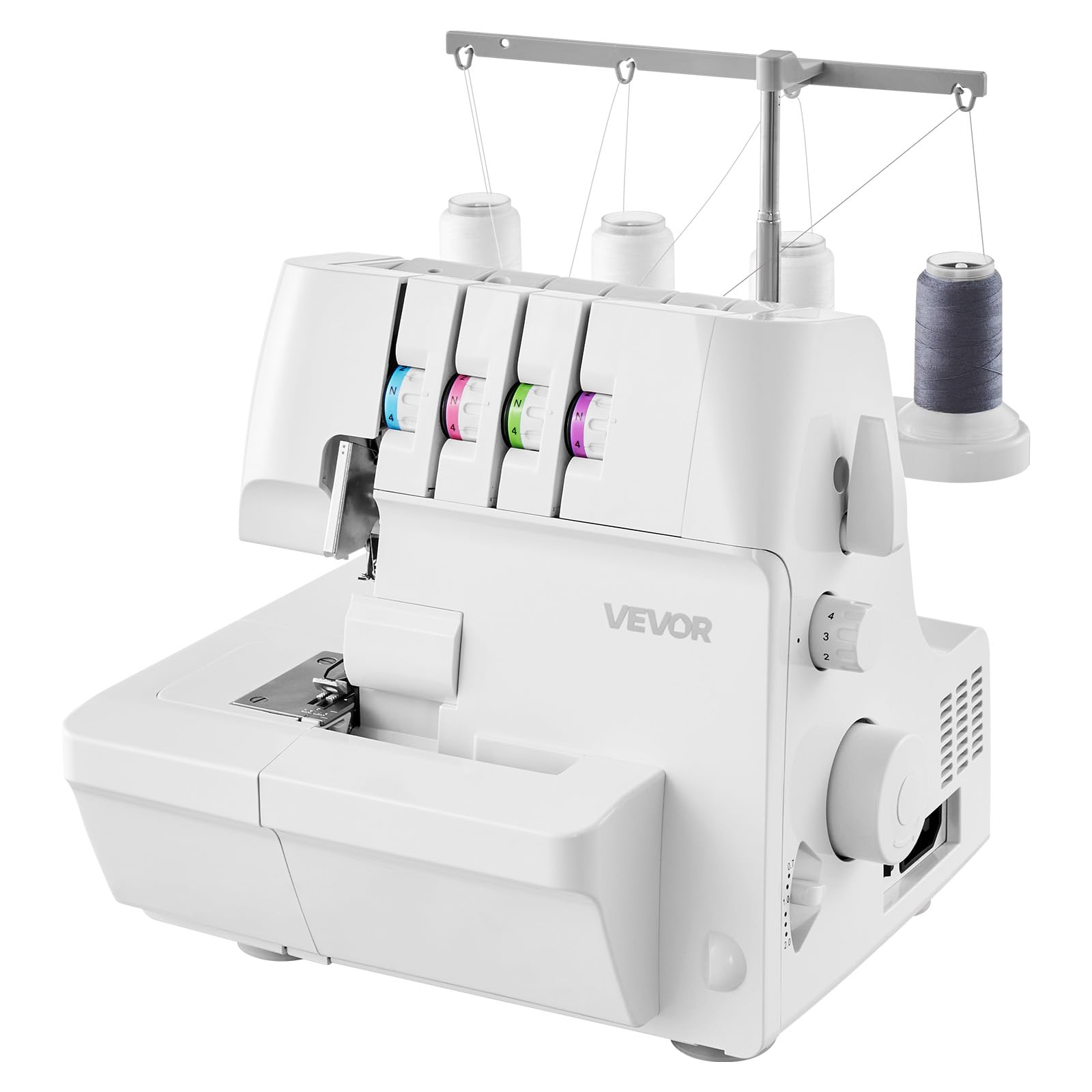
The VEVOR serger is built with a cast-iron frame that punches well above its budget-friendly price. The machine weighs 16.5 pounds and delivers 1,250 stitches per minute with a 2/3/4-thread capability that covers every essential beginner stitch. The differential feed operates from 0.7 to 2.0, allowing you to gather stretchy knits or stretch lightweight fabrics for a smooth finish. A free arm, LED light, and built-in waste bin round out the feature set.
Color-coded threading paths make setup straightforward, and the machine handles up to six layers of denim without strain. The included accessories are generous: a dust cover, foot pedal, test fabric, user manual, and a standard presser foot. Users report that the machine needs to be oiled before first use, as it arrives bone dry. The tension dials lack numeric markings, so finding the right setting requires manual trial and adjustment.
The VEVOR produces good stitch quality after the initial oiling and tuning. The cast-iron frame keeps vibration low even at high speed. A small number of users experienced intermittent stopping, possibly due to overheating, but the majority report a positive experience. If you are willing to invest twenty minutes of setup time — oiling, adjusting the cutting blade screw, and watching a YouTube threading tutorial — you get a metal-framed serger at a raw-material price.
Why it’s great
- Cast-iron frame provides heavy-duty stability at a budget-friendly cost
- Handles multiple layers of denim with consistent stitch quality after setup
- Differential feed range covers both gathered and stretched fabric effects
Good to know
- Arrives bone dry — requires manual oiling of metal parts before first use
- Tension dials lack numeric markings, making precise adjustments trial-based
9. FEIYUE FY505 Serger Overlock Machine

The FEIYUE FY505 is the most affordable fully featured overlocker in this guide, designed specifically to reduce the financial barrier to entry. It operates at 1,100 stitches per minute with 2/3/4-thread capability and includes a durable metal frame for stability. The cutting blade is extra-hard carbon steel, designed to maintain a clean edge through repeated heavy-duty projects.
Color-coded thread guides and numbered upper and lower loopers help new users manage the threading process. The machine weighs 13.6 pounds and measures 13.89 x 11.92 x 10.62 inches, making it one of the more compact and portable options. The included embroiderer plate adds versatility for free-motion work. The FEIYUE arrives pre-threaded, and customers have described the setup as straightforward with clear instructions.
While many users are delighted with the FY505’s performance and consider it life-changing for the price, the reviews also reveal notable quality control issues. Pedal defects and difficulty threading the lower looper are recurring themes. The printed manual is small and lacks depth, forcing users to rely on YouTube videos. For the budget-conscious beginner willing to troubleshoot, the FY505 represents the cheapest path to an overlocker. Those who want a smoother experience should consider saving for the VEVOR or a mid-range model.
Why it’s great
- Most accessible entry point for a machine with a metal frame and full stitch capability
- Carbon steel cutting blade provides sharp edges for professional-quality finishes
- Color-coded guides and pre-threaded setup reduce initial learning curve
Good to know
- Quality control inconsistencies — pedal defects reported out of the box
- Printed manual is small and lacks detailed threading steps for the lower looper
FAQ
Why do all overlockers have a metal frame if the price difference is huge?
Can a beginner overlocker sew through denim or multiple fabric layers?
What is the difference between a rolled hem and a narrow hem on an overlocker?
How often do I need to oil my beginner overlocker?
Final Thoughts: The Verdict
For most users, the best beginner overlocker overall is the Brother 1034D because it combines the most reliable metal frame construction in its class with demonstrably easy color-coded threading and a massive library of free instructional videos. If you want the absolute easiest threading experience with a lay-in system that eliminates lower-looper frustration, grab the Janome MOD-8933. And for those planning to sew heavy canvas, denim, or multiple layers regularly, nothing beats the Brother ST4031HD for its hard carbon steel blade and large extension table. Choose the machine that matches your fabric volume and your tolerance for initial setup — and enjoy the clean seams that follow.