
Handing a 10-year-old a tool that extrudes hot melted plastic requires serious trust. The right 3D pen for this age group balances creative freedom with safety features that let parents breathe easy — low-temperature nozzles, no exposed hot parts, and filaments that cool fast enough to prevent burns during enthusiastic doodling sessions.
I’m Min — the co-founder and writer behind Gadgets Feed. I’ve spent countless hours analyzing temperature specs, nozzle materials, and real-world feedback to identify which 3D pens genuinely deliver a safe and frustration-free experience for young creators.
Whether you need an entry-level tool for birthday gifts or a more advanced option for a budding engineer, this guide breaks down the best 3d pen for 10 year olds across safety, ease of use, and creative output.
How To Choose The Best 3D Pen For 10 Year Olds
Choosing a 3D pen for a child is different from buying one for an adult. Safety, simplicity, and the learning curve matter more than raw speed or material versatility. The wrong pick can lead to frustration, wasted filament, or even minor burns.
Safety First: Nozzle Temperature & Filament Type
The nozzle temperature is the defining safety factor. Pens with low-temperature PCL filament nozzles operate around 70-90°C, while standard PLA/ABS pens run at 180-230°C. For a 10-year-old, low-temperature options drastically reduce burn risk. Look for models that explicitly advertise “no hot parts” or “child-safe” nozzles.
Ease of Use: Controls and Ergonomics
Young hands need a lightweight pen with simple controls. Stepless speed sliders are better than tiny buttons that confuse kids. A comfortable grip reduces hand fatigue during long projects. Parent reviews consistently highlight pens that “just work” out of the box versus those that require constant tinkering to unclog or adjust temperature.
Filament Quantity and Variety
Filament runs out faster than most parents expect. Kits that include at least 60-100 feet of assorted colors give a child room to experiment without needing an immediate refill purchase. Transparent silicone mats and stencil books are bonus features that help kids trace designs accurately from day one.
Quick Comparison
On smaller screens, swipe sideways to see the full table.
| Model | Category | Best For | Key Spec | Amazon |
|---|---|---|---|---|
| 3Doodler Start+ Essentials | Premium | Child-safe creativity | No hot parts, 72 strands | Amazon |
| MYNT3D Pro + DesignPad Kit | Premium | Advanced young creators | Stepless speed, replaceable nozzle | Amazon |
| SCRIB3D P1 Bundle | Mid-Range | All-in-one starter bundle | 328 feet filament, ceramic nozzle | Amazon |
| MYNT3D Junior | Mid-Range | Safe low-temp experience | Low-temp PCL, ergonomic grip | Amazon |
| LinkSpoX 3D Printing Pen Kit | Mid-Range | Adjustable speed & temperature | LCD display, ceramic nozzle | Amazon |
| 3Dmate Filament Kit | Accessory | Filament & mat supplement | 360 feet, silicone mat, stencils | Amazon |
| 3Doodler Create+ Juku | Premium | Older kids with precision needs | Dual-drive, 15-color refills | Amazon |
In‑Depth Reviews
1. 3Doodler Start+ Essentials 3D Pen Set for Kids
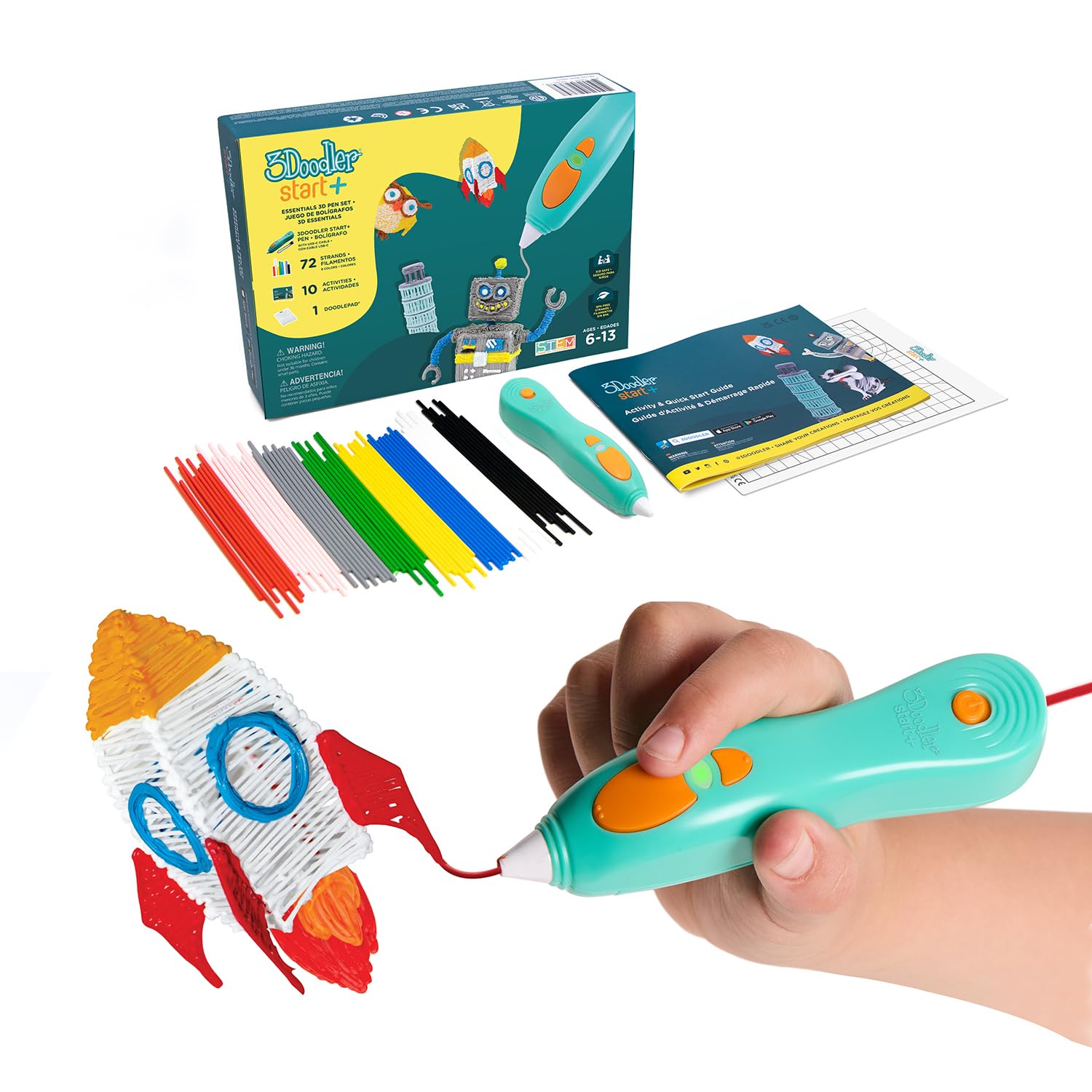
The 3Doodler Start+ is the most child-safe 3D pen on the market because its nozzle and plastic remain cool to the touch even during operation — no burn risk whatsoever. This pen uses proprietary low-temperature PCL plastic that extrudes at roughly 70°C, a fraction of the heat required for standard PLA or ABS pens. For a 10-year-old, this safety margin transforms 3D drawing from a supervised activity into one they can explore independently.
The kit includes 72 strands of mixed-color Start+ plastic, a DoodlePad for tracing, and a USB-C cable for charging. Parents report the pen holds a charge for several sessions and enters a safety standby mode when idle. The ergonomic grip is noticeably slimmer than earlier versions, making it easier for smaller hands to control the extrusion path without fatigue.
Customer reviews highlight the company’s responsive warranty service as a major plus — several users received replacements when pens stopped working after weeks of non-use. The main tradeoff is that filament consumption runs high during freehand projects, so buying additional plastic packs early is advisable.
Why it’s great
- No hot parts makes it genuinely safe for independent play
- Fast-charging USB-C and improved standby mode
- Generous 72-strand filament starter pack
Good to know
- Filament runs out quickly during ambitious projects
- Not compatible with standard PLA or ABS filaments
2. MYNT3D Pro 3D Pen + 10 Color PLA + DesignPad Mat Kit
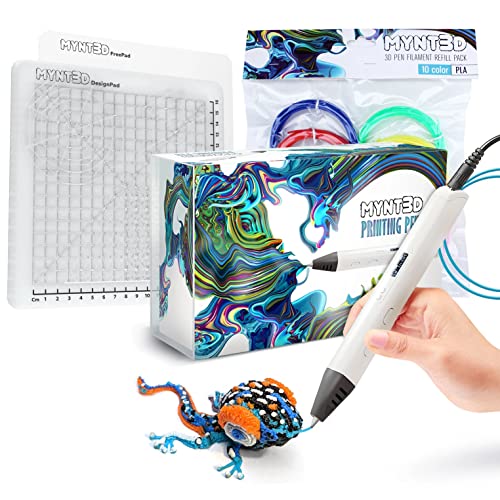
The MYNT3D Pro bundle targets the 10-year-old who has outgrown basic tracing and wants to create detailed, multi-layer sculptures. Its stepless speed control lets a child slow the extrusion rate for fine details or ramp it up to fill larger areas quickly. The replaceable sealed nozzle design is a standout feature — if it clogs, you swap it rather than tossing the pen.
This kit ships with ten colors of vacuum-sealed PLA filament, a double-sided DesignPad with channels for creating geometric shapes, and a FreePad transparent surface for tracing patterns. The pen’s temperature is discretely adjustable, meaning an adult can set it to the optimal range for PLA before handing it to the child. One caveat: the USB power draw is substantial, so plugging it into a powered hub or dedicated adapter is recommended over a computer port.
Parent reviews consistently praise its reliability — the pen rarely clogs and the adjustable controls give kids room to grow their skills. The 1-year limited warranty and accessible customer support add confidence for a purchase at this level.
Why it’s great
- Replaceable nozzle prevents permanent clogs
- Stepless speed and temperature controls offer real precision
- Includes two mats and 10 filament colors
Good to know
- High power draw can damage standard USB ports
- Requires adult guidance for temperature setup
3. SCRIB3D P1 3D Printing Pen with 3 Starter Colors and PLA Refill Pack

The SCRIB3D P1 Bundle delivers the best filament-to-dollar ratio in this guide, packing over 350 feet of PLA into a single purchase. The pen itself uses a ceramic nozzle that resists clogging and a stepless speed slider that lets young users control the flow rate intuitively. Rounding out the package, the soft grip body and 3mm line size are well-suited for children transitioning from basic doodling to structured projects.
The bundle includes the P1 pen, 3 starter colors (30 feet), plus a separate 20-color refill pack with 328 feet of assorted filaments. Parents note that the instruction manual is essential — the pen requires a quick calibration of feed speed and temperature to avoid jams, but once set, it runs smoothly. The anti-clogging design is a practical advantage for kids who forget to pause or retract the filament between uses.
Reviewers mention that the pen produces sturdy, cute items once the user adjusts to the controls. An 11-year-old tester found it fun but not intuitive without the directions nearby, making it a good option for patient learners or parent-child collaborative sessions.
Why it’s great
- Massive filament quantity — over 350 feet total
- Ceramic nozzle minimizes clogging frustration
- Soft grip and stepless speed for young hands
Good to know
- Initial setup requires reading the manual carefully
- Temperature adjustments are needed for different filament colors
4. MYNT3D Junior 3D Pen for Kids

MYNT3D Junior is explicitly designed for young children, with a low-temperature nozzle that works exclusively with 1.75mm PCL plastic — it will not accept standard PLA or ABS. The nozzle runs cool enough that accidental skin contact won’t cause burns, which is the single most important consideration for 10-year-old users. The pen is battery-powered and charges via Micro USB, giving kids wireless freedom to move around while drawing.
The kit includes three starter rolls of PCL filament in assorted colors, a set of stencils, and the USB charging cable. The ergonomic grip is designed for small hands, with easy-to-press buttons that control filament advance and retraction. Parents of children as young as four have reported successful use, though some note that the extrusion is not precise enough for detailed work — this is a creative toy, not a modeling tool.
A minority of reviews mention clogging issues after several days of use, with the nozzle being a solid piece that cannot be cleared manually. Turning the unit on and off repeatedly to melt blockages is the recommended workaround. For the asking price, the safety and simplicity make it a solid entry-level pick despite these occasional reliability concerns.
Why it’s great
- Low-temperature nozzle eliminates burn risk
- Wireless battery-powered operation
- Ergonomic grip fits small hands well
Good to know
- Not compatible with PLA or ABS filaments
- Some units clog after short use; nozzle can’t be cleaned
5. LinkSpoX 3D Printing Pen Kit
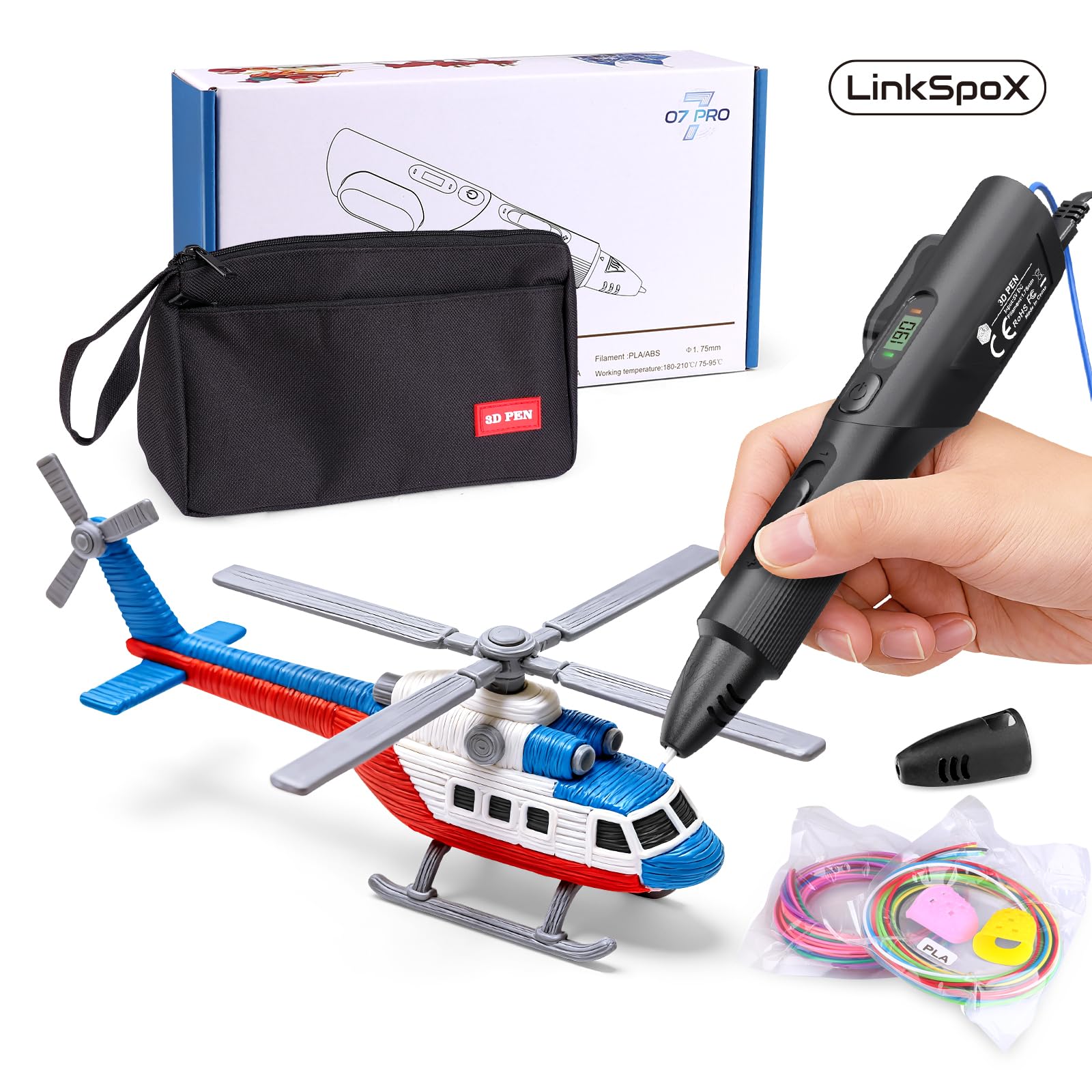
The LinkSpoX kit offers a balance of safety and versatility that suits 10-year-olds who want to explore both PLA and ABS filaments. Its LCD display shows real-time temperature and filament data, while dual preset heat levels let users switch between PLA and ABS with a single button press. The ceramic nozzle resists clogging, and the automatic standby and filament retraction features prevent common messes.
This set includes 12-color PLA filament refills totaling 80 feet, reusable stencils, a pen stand, heat-resistant sleeves, and a storage bag. The plant-based PLA material is derived from corn stover rather than petroleum, which adds an eco-friendly angle. The adjustable speed control lets a child draw slowly for precision or faster for filling shapes.
Customer feedback is mixed on durability — some units arrived damaged or stopped extruding randomly, though the company’s customer support was responsive in replacing faulty pens. A 9-year-old user successfully created multiple designs, and parents appreciate the included accessories that make setup straightforward. The learning curve for speed control is mild, making it a decent middle-ground option between basic and advanced pens.
Why it’s great
- LCD screen provides clear temperature feedback
- Dual PLA/ABS presets expand creative options
- Plant-based filament is an eco-friendly choice
Good to know
- Build quality inconsistency reported in some units
- Speed control variation is subtle, not dramatic
6. 3Dmate Filament Kit with Silicone Mat and Stencils

This 3Dmate kit is a filament and accessory bundle designed to supplement an existing 3D pen — it does not include the pen itself. For parents who already own a compatible pen, this provides excellent value with 36 vibrant PLA colors totaling 360 feet, a heat-resistant silicone starter mat, and a stencil book with 11 creative templates. The mat’s transparent design allows kids to place templates underneath for accurate tracing.
The 1.75mm PLA filament is vacuum-sealed per color to prevent moisture damage, and the individual packaging doubles as organized storage. Customer reviews confirm the filament feeds smoothly and adheres well to the silicone mat without excessive curling or bubbling. The included finger protectors are a thoughtful addition for younger users learning to handle freshly extruded plastic.
Parents of 10-year-olds appreciate the massive color variety — 36 colors means kids can create detailed, multi-colored projects without running out of any single shade. The only downside is the need for a separate pen purchase, but for households upgrading their filament supply, this kit is the most cost-effective way to stock up on quality PLA.
Why it’s great
- 36 colors offer unmatched variety for kids
- Silicone mat with grooved guidance enhances precision
- Vacuum-sealed packaging keeps filament fresh
Good to know
- 3D pen not included — requires a separate purchase
- Finger protectors are basic; supervision still recommended
7. 3Doodler Create+ Juku 3D Printing Pen

The 3Doodler Create+ Juku is a step up in capability, designed for the 10-year-old who wants to move beyond simple shapes into detailed models, repairs, or jewelry. Its dual-drive technology provides two flow modes — fast for covering large areas and slow for intricate details. This pen works with 3Doodler PLA, ABS, and FLEXY plastics, giving it more material flexibility than the child-specific Start+ model.
The kit includes two packs of ABS and PLA 3mm plastic refills in 15 colors, a power adapter, and a set of tools. The optimized speed control helps ensure finished projects match the intended design, reducing the frustration of inconsistent extrusion. The ergonomic body is comfortable for longer sessions, though the 1.3-pound weight is noticeable compared to lighter junior models.
Reviews are polarized: many grandparents and parents report easy setup and fun shared experiences, while some users received units with rust on metal parts or that were broken on arrival. The Create+ is best suited for a child who already has some 3D pen experience and is ready for more precise control. The higher price reflects the expanded material compatibility and dual-drive mechanism, but quality control issues mean it’s worth purchasing from a retailer with a good return policy.
Why it’s great
- Dual-drive technology enables fast fills and fine details
- Compatible with PLA, ABS, and FLEXY filaments
- 15-color starter pack encourages creative variety
Good to know
- Quality control issues reported — check packaging carefully
- Heavier than most kid-specific models at 1.3 pounds
FAQ
Is low-temperature PCL filament safe if my child touches the nozzle?
How much filament should I buy for a 10-year-old beginner?
Final Thoughts: The Verdict
For most users, the 3d pen for 10 year olds winner is the 3Doodler Start+ Essentials because its no-hot-parts design and generous 72-strand starter pack make it the safest and most complete package for independent creative play. If you want stepless speed control and a replaceable nozzle for growing skills, grab the MYNT3D Pro + DesignPad Kit. And for unbeatable filament volume per dollar, nothing beats the SCRIB3D P1 Bundle.