
The silence of a boondocking campsite is only peaceful when you’re not worrying if your motorhome’s appliances will drain the house battery before sunrise. Choosing the wrong power source leaves you guessing how long your fridge, furnace, or water pump will run — and that guesswork ruins a trip. This guide cuts through the amp-hour math and chemistry debates to find the storage solution that keeps your rig’s 12V system stable through the night.
I’m Min — the co-founder and writer behind Gadgets Feed. I’ve spent hundreds of hours comparing battery chemistries, discharge curves, BMS configurations, and real-world capacity tests so you don’t have to cross-reference conflicting spec sheets yourself.
Whether you need a drop-in replacement for your existing bank or a complete upgrade, this analysis of the top batteries for motorhome covers every chemistry and capacity tier you’ll actually find in an RV electrical compartment.
How To Choose The Best Batteries For Motorhome
Selecting the right battery for your motorhome means balancing usable energy, physical footprint, and charging compatibility. The wrong choice leads to premature failure, insufficient runtime, or expensive electrical rewiring. Focus on these four criteria to narrow the field.
Chemistry: LiFePO4 vs. AGM vs. Flooded Lead-Acid
Lithium iron phosphate (LiFePO4) batteries deliver nearly 100% of their rated capacity, weigh about 60% less than equivalent lead-acid, and survive 3,000 to 15,000 cycles. AGM batteries offer spill-proof operation and decent deep-cycle performance, but you can only safely use 50% of their rated amp-hours — a 100Ah AGM gives you just 50Ah of usable energy. Flooded lead-acid is the cheapest upfront but requires regular watering, produces hydrogen gas, and degrades quickly if discharged below 50%.
Capacity Planning: Amp-Hours (Ah) and Usable Energy
Calculate your daily power draw by adding the wattage of your fridge, furnace fan, lights, water pump, and any inverter loads. Divide that total watt-hours by 12 to get the amp-hours you need. For example, a rig pulling 60Ah per day needs at least 120Ah of lead-acid (to stay above 50% discharge) or 80Ah of LiFePO4. Oversizing by 20-30% provides a buffer for cloudy days or unexpected loads.
BMS and Low-Temperature Protection
A quality Battery Management System prevents overcharge, over-discharge, short circuits, and thermal runaway. For LiFePO4 batteries installed in unheated compartments, low-temperature charge protection is non-negotiable — charging lithium cells below freezing (32°F) causes permanent damage. Look for a BMS that automatically disables charging below 0°C (32°F) and resumes when the temperature rises.
Physical Fit and Terminal Configuration
Motorhome battery compartments follow standard group sizes (Group 24, Group 27, Group 31, Group 4D). Measure your tray dimensions before buying. Terminal placement matters too — front-facing terminals simplify cable access in tight compartments, while side-post designs require adapters. Some lithium batteries also include a physical on/off switch for safer maintenance.
Quick Comparison
On smaller screens, swipe sideways to see the full table.
| Model | Category | Best For | Key Spec | Amazon |
|---|---|---|---|---|
| ECO-WORTHY 280Ah Metal Case | LiFePO4 | Off-grid boondocking with high daily draw | 280Ah / 3584Wh / 200A BMS | Amazon |
| Litime 12V 320Ah Mini | LiFePO4 | Compact installs needing high capacity | 320Ah / 4096Wh / Bluetooth 5.0 | Amazon |
| GOLDENMATE 12V 400Ah | LiFePO4 | Maximum single-battery capacity | 400Ah / 5120Wh / 250A continuous | Amazon |
| Battle Born 100Ah | LiFePO4 | Premium drop-in replacement reliability | 100Ah / 1280Wh / 10-year warranty | Amazon |
| Power Queen 12V 100Ah | LiFePO4 | Budget lithium upgrade with proven support | 100Ah / 1280Wh / Group 24 fit | Amazon |
| Litime 12V 165Ah Bluetooth | LiFePO4 | Mid-capacity with app monitoring | 165Ah / 2112Wh / 165A BMS | Amazon |
| DUMFUME 12V 150Ah | LiFePO4 | High-capacity value without smart features | 150Ah / 1920Wh / 100A BMS | Amazon |
| HumsiENK 12V 100Ah LiFePO4 | LiFePO4 | Lightweight entry-level lithium upgrade | 100Ah / 1280Wh / IP67 / 19.73 lbs | Amazon |
| WEIZE 12V 100Ah Deep Cycle | AGM | Budget-friendly lead-acid replacement | 100Ah / 1150A max / 63 lbs | Amazon |
In‑Depth Reviews
1. ECO-WORTHY 12V 280Ah Metal Case LiFePO4
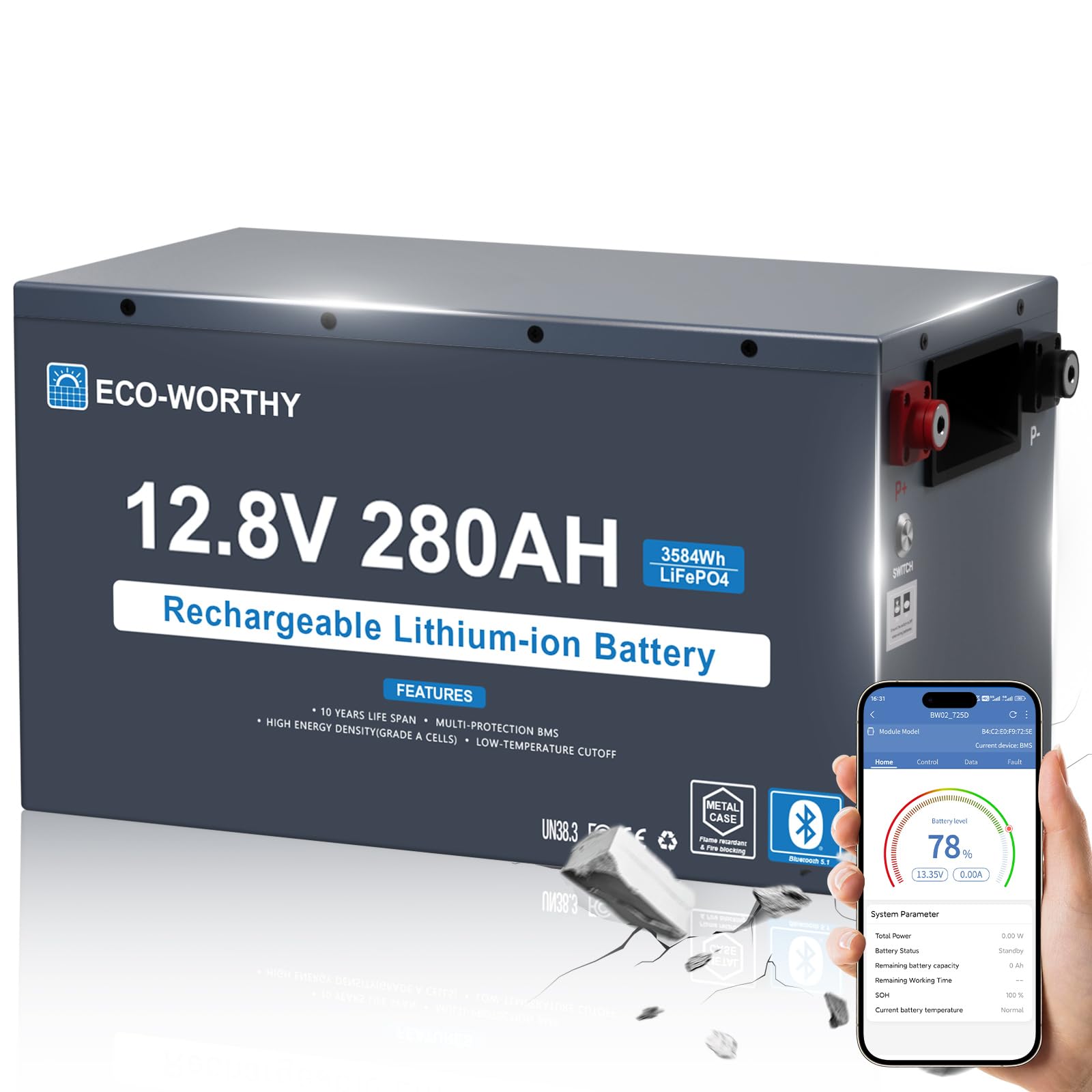
This 280Ah battery delivers 3584Wh of usable energy in a rugged metal case with integrated mounting feet, so you can screw it directly to the floor of your motorhome without an external battery box. The built-in 200A BMS handles heavy loads like a 2000W inverter running a microwave or induction cooktop, and the low-temperature protection automatically cuts off charging at 20°F to prevent cell damage during winter storage.
Bluetooth monitoring via the JBD-compatible app gives real-time voltage, state of charge, and individual cell balance data — a feature usually reserved for batteries costing twice as much. Users report that the battery actually exceeds its rated capacity during initial testing, and the integrated on/off switch simplifies maintenance and emergency shutdown.
At 68.5 pounds, the weight is similar to a 100Ah AGM bank, yet you get nearly three times the usable amp-hours. The metal case provides superior heat dissipation and fire resistance compared to plastic-shelled alternatives, making this a solid choice for motorhomes that see both hot desert climates and cold mountain nights.
Why it’s great
- Metal enclosure with mounting feet — no battery box required
- Bluetooth app shows cell balance and real-time SOC
- 200A BMS handles heavy inverter loads safely
Good to know
- May arrive in multiple packages for safety compliance
- Two exterior label styles shipped randomly (internal specs identical)
2. Litime 12V 320Ah Mini Lithium LiFePO4
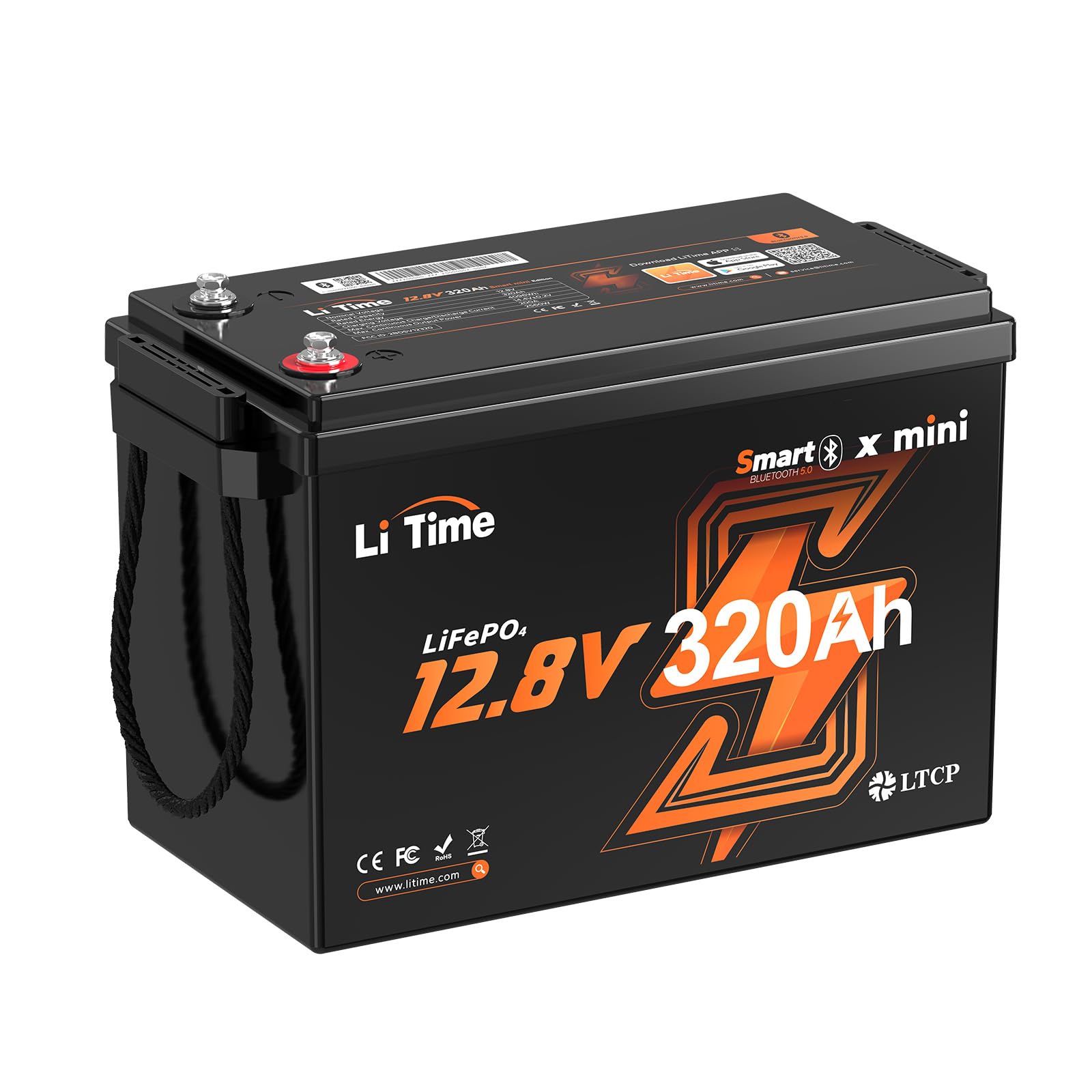
The 320Ah Mini packs 4096Wh of energy into a footprint that is physically one-third smaller than a standard 300Ah lead-acid bank and weighs only 57.3 pounds. That weight savings — about 110 pounds less than three Group 31 AGMs — directly improves your motorhome’s payload capacity and fuel economy without sacrificing overnight runtime for your fridge, furnace, and lights.
Built-in Bluetooth 5.0 connects to LiTime’s free app for real-time voltage, state of charge, and charge/discharge current monitoring with no external shunt required. The 20+ BMS protections include low-temperature charge cutoff, over-current protection, and short-circuit prevention — all critical for a battery living in an unheated compartment during shoulder-season camping.
Peak power output hits 2560W, enough to start a residential-style fridge compressor or run a 2000W inverter for microwave and coffee maker loads. The compact form factor opens up flexible installation options, including vertical mounting or tucking into compartments that previously could not fit a high-capacity battery.
Why it’s great
- One-third smaller footprint than comparable 300Ah units
- Bluetooth 5.0 with app — no separate monitor needed
- 2560W peak handles fridge and inverter simultaneously
Good to know
- Heavy — requires two people for safe lifting during install
- BMS may need jump-start if battery enters deep sleep
3. GOLDENMATE 12V 400Ah LiFePO4
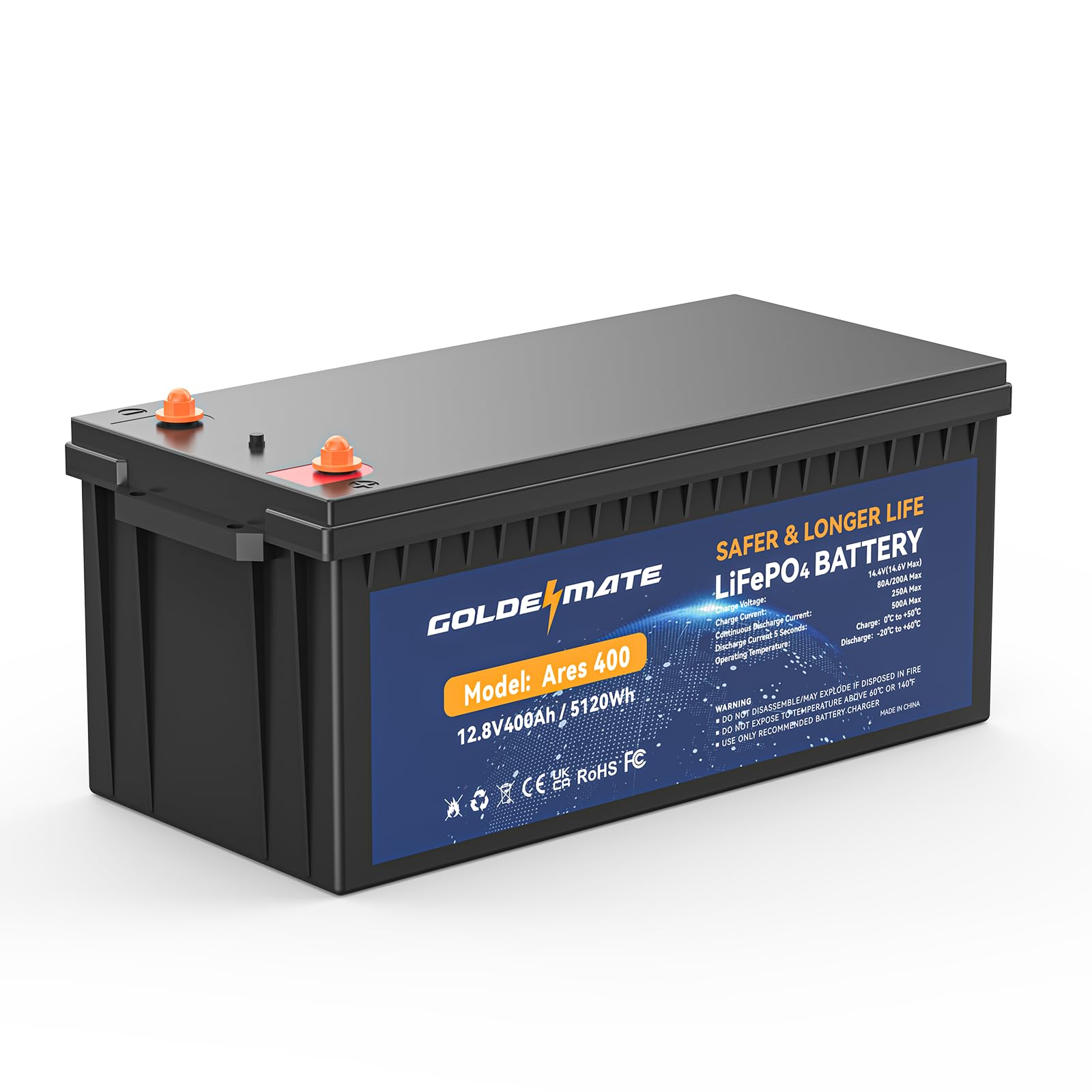
At 400Ah and 5120Wh, this single-unit GOLDENMATE battery replaces a multi-bank lead-acid setup while taking up less total space in your motorhome’s electrical bay. The BMS supports 250A continuous discharge and up to 500A for 5-second bursts, so it can comfortably power a 3000W inverter running a rooftop air conditioner or electric cooktop without tripping protection.
Expandability is straightforward: connect up to four in series for a 48V system or four in parallel for 1600Ah total capacity. The self-discharge rate is exceptionally low — the battery can sit for a full year at full charge without needing a top-up, making it suitable for motorhomes stored between seasons. The M8 terminal bolts accommodate standard 4/0 or 2/0 battery cables cleanly.
The included Bluetooth app (GOLDENMATE) displays runtime estimates and charge time projections, though some users note the charge percentage display is oversized on smaller phone screens. At 88.2 pounds, this is a heavy unit to maneuver into place, but the single-battery approach eliminates the cable complexity and balancing issues of a parallel bank.
Why it’s great
- Massive 5120Wh in a single drop-in package
- 250A continuous discharge handles high-power inverters
- Stores up to 1 year without maintenance charging
Good to know
- Heavy at 88.2 lbs — difficult to handle alone
- 1-year warranty is shorter than many competitors
4. Battle Born 12V 100Ah LiFePO4
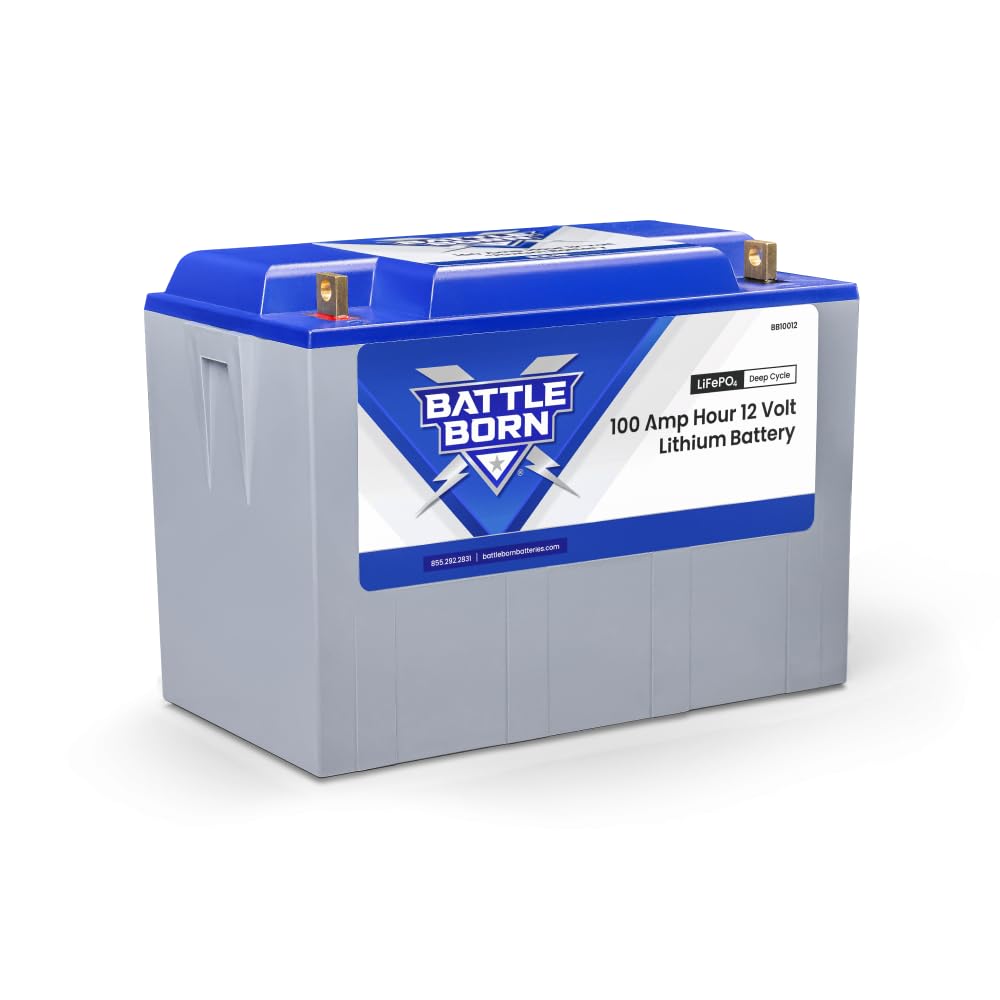
The internal BMS provides low-temperature charge protection, high and low voltage cutoffs, and short-circuit prevention across 3,000 to 5,000 deep cycles.
The 10-year warranty is the best in the industry and the company is known for responsive US-based support — multiple owners report free replacements for units that developed BMS issues years into ownership. Each battery delivers 1280Wh of usable energy, and users regularly report powering a 12V fridge, furnace fan, LED lights, and phone charging for 24+ hours before dropping below 50% state of charge.
Wiring flexibility is excellent: batteries can be mounted in any orientation and connected in series or parallel up to a 48V bank. The premium price reflects the build quality, UL-compliant manufacturing, and the peace of mind that comes with a company that stands behind its product for a decade.
Why it’s great
- 10-year warranty with proven US-based customer support
- 31 lbs — saves ~70 lbs vs. lead-acid equivalent
- Side-post connectors fit OEM RV cables without adapters
Good to know
- Premium price compared to newer LiFePO4 brands
- No Bluetooth monitoring built into the battery
5. Power Queen 12V 100Ah LiFePO4
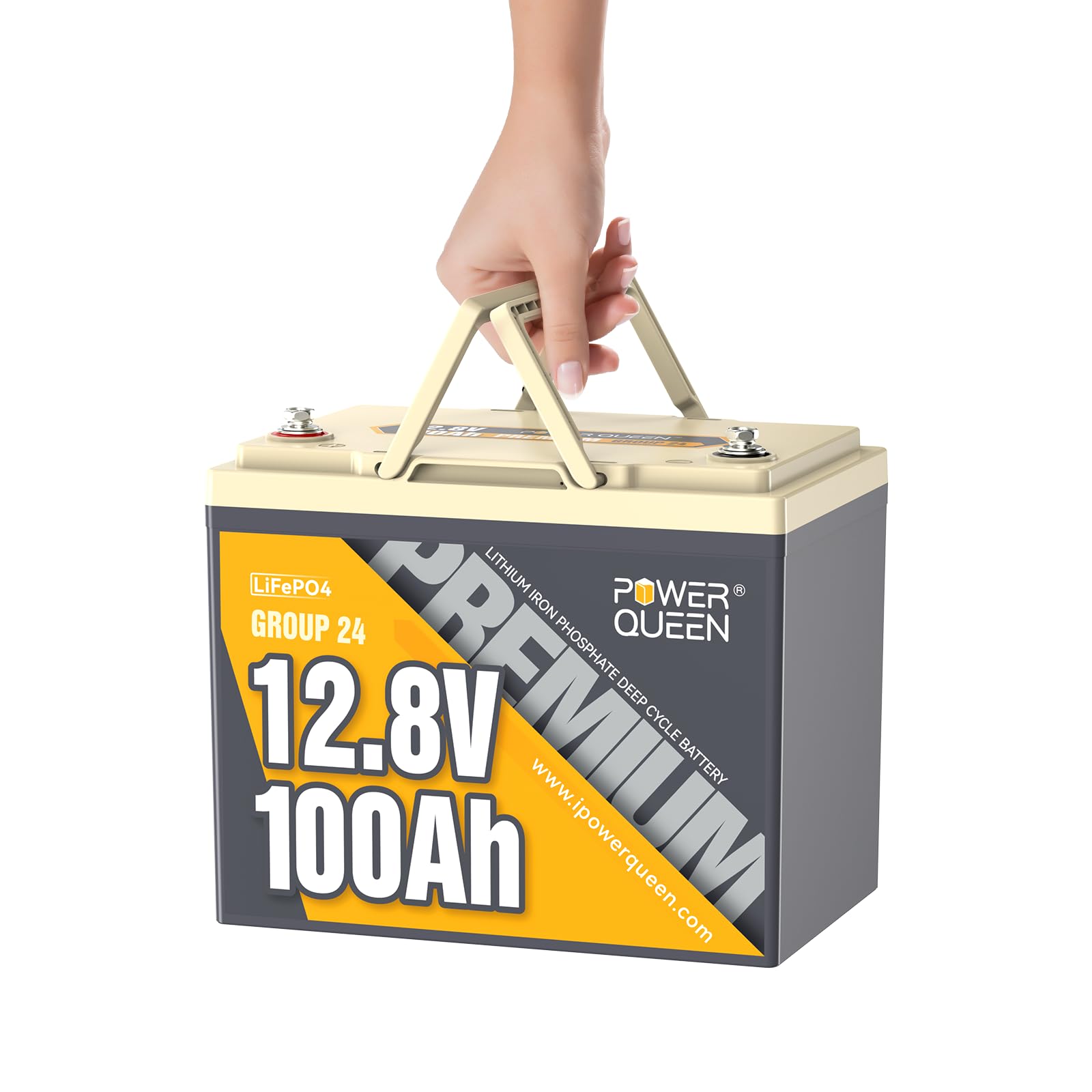
Power Queen’s 12V 100Ah LiFePO4 fits standard Group 24 battery boxes, making it a true five-minute swap for older motorhomes with limited tray space. The EV-grade LiFePO4 cells are paired with a 20+ protection BMS that covers overcharge, over-discharge, overheat, and short circuits — and the battery delivers 1280Wh of 100% usable energy versus the ~500Wh you get from a 70Ah AGM at 50% depth of discharge.
The expandability ceiling is impressive: you can connect up to 16 units in a 4P4S configuration to build a 51.2V 400Ah bank (20.48kWh total), which is enough to run a motorhome’s full electrical system including a rooftop AC unit for hours. Carry handles on the 21-pound casing make positioning in tight compartments much easier than with heavier AGM replacements.
Customer support is a standout — multiple reports of warranty replacements being shipped within days for batteries that developed BMS faults. The 5-year warranty and estimated 10-year lifespan at 4000 cycles (100% DOD) make this one of the best cost-per-cycle values in the lithium category for motorhome owners.
Why it’s great
- True Group 24 drop-in — no wiring modifications needed
- Carry handles simplify installation in tight compartments
- Proven warranty support with fast replacement shipping
Good to know
- Not for engine starting or golf cart applications
- No Bluetooth monitoring on standard model
6. Litime 12V 165Ah Bluetooth LiFePO4
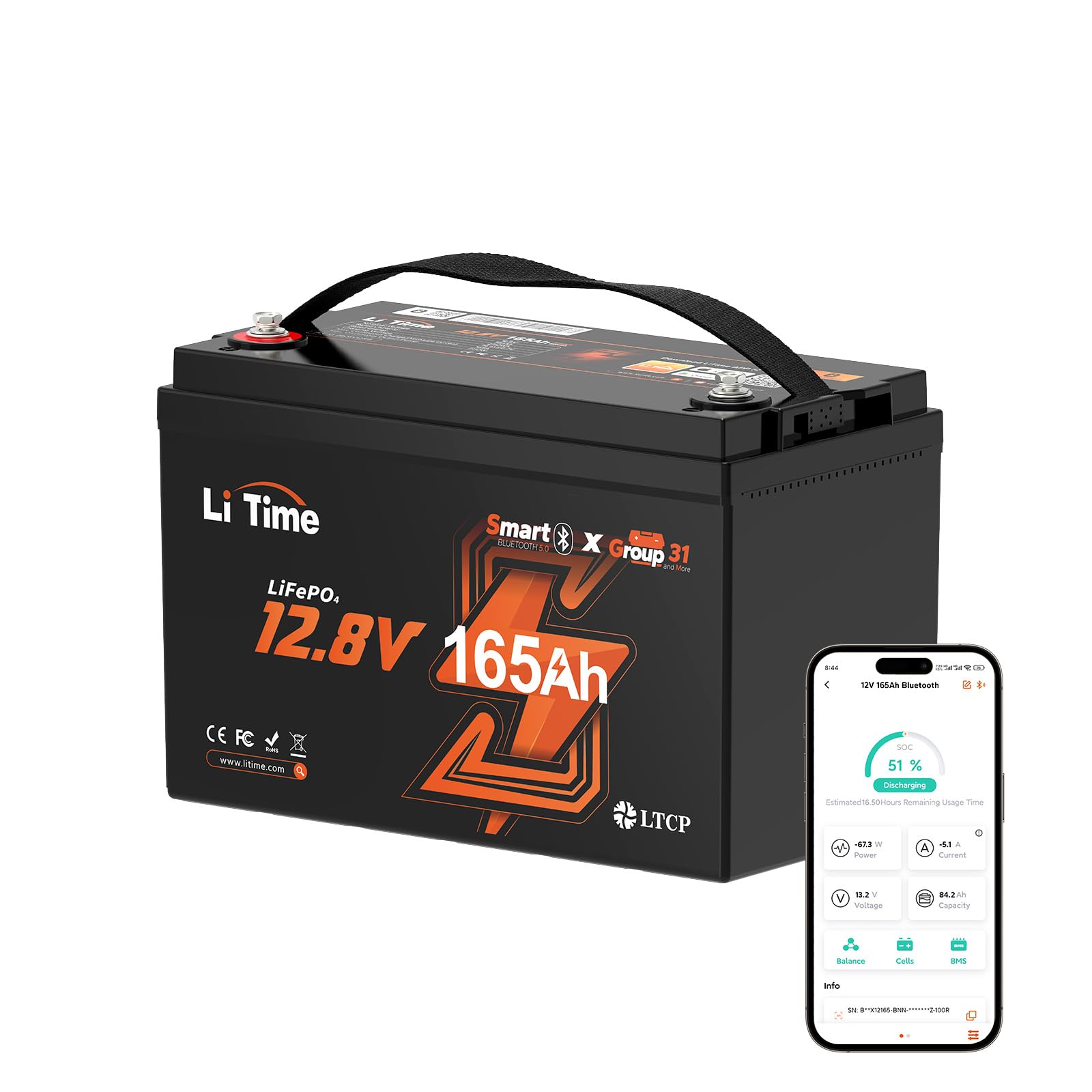
This Litime 165Ah battery hits a sweet spot between capacity and cost, delivering 2112Wh of energy while including Bluetooth 5.0 for real-time monitoring without an external shunt. The 165A BMS supports heavy discharge loads — users report running an 8000 BTU air conditioner for 11 hours on eco mode using only 50% of the battery’s capacity, which translates to about 22 hours of AC runtime on a full charge.
Low-temperature protection cuts off charging below 0°F and discharging below -4°F, making this battery safe for motorhomes stored in cold climates. The IP65 waterproof rating and salt-fog resistance add durability for marine-adjacent installations or compartments exposed to road spray. At 32.2 pounds, it is manageable to lift and position compared to larger 300Ah+ units.
The 20+ BMS safeguards include overcurrent and high-temperature protection, and the battery is certified to UL 1973, FCC, CE, and UN38.3 standards. Expandability to 33.79kWh via 4P4S configuration means this single battery can serve as the foundation for a much larger system later.
Why it’s great
- Bluetooth 5.0 auto-connects for real-time SOC tracking
- 165A BMS handles inverter loads up to 2000W
- IP65 waterproof with salt-fog resistance
Good to know
- BMS may arrive in sleep mode requiring charger activation
- Not suitable for use as a starter battery
7. DUMFUME 12V 150Ah LiFePO4
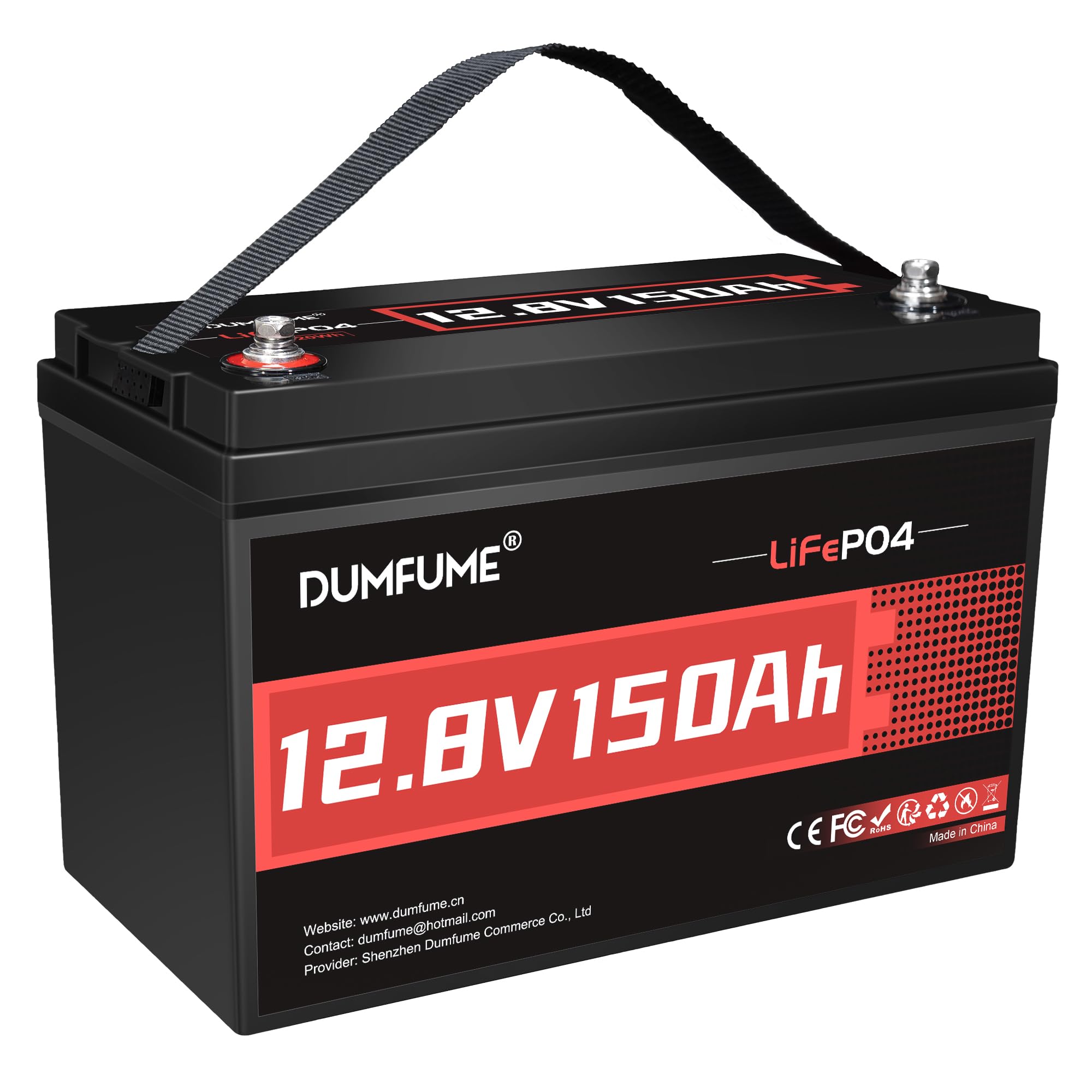
The DUMFUME 150Ah battery delivers 1920Wh of usable energy at a price point well below many 100Ah competitors, making it one of the best cost-per-watt options for motorhome owners on a tighter budget. The 100A BMS provides standard protection against overcharge, over-discharge, and short circuits, and the battery weighs only 22.05 pounds — nearly three times lighter than a lead-acid battery of similar amp-hour rating.
The Group 31 form factor (13.05 x 6.78 x 8.66 inches) fits most standard battery trays, and the battery supports both series and parallel connections up to 4S4P for future expansion. Users who tested the capacity found the units consistently exceeded their rated 150Ah by about 7Ah, and the lithium cells maintain stable voltage output until they are nearly fully discharged.
One important caveat: the battery lacks Bluetooth monitoring or a smart BMS, so you will need an external shunt or voltage meter to track state of charge. The 5-year warranty applies to units purchased direct from DUMFUME, not Amazon, so register your purchase after delivery to maintain coverage.
Why it’s great
- 150Ah capacity at a price often below 100Ah competitors
- 22.05 lbs — extremely lightweight for its capacity class
- Consistently exceeds rated capacity on initial testing
Good to know
- No Bluetooth or smart BMS — need external monitor
- 5-year warranty only valid for direct purchases, not Amazon
8. HumsiENK 12V 100Ah LiFePO4

Weighing just 19.73 pounds, the HumsiENK 100Ah LiFePO4 is one of the lightest 12V 100Ah batteries on the market — a full 11 pounds lighter than many competitors in the same capacity class. The IP67 waterproof rating means it can handle direct rain exposure, pressure washing, or even temporary submersion without damage, making it ideal for motorhomes with external battery compartments that are not fully sealed.
The built-in 100A BMS provides multi-layer protection including low-temperature charge cutoff at -4°F, overcurrent shutdown at 300±50A, and automatic reset after fault conditions. The battery supports fast charging — a full 100Ah recharge in about 2 hours with the right LiFePO4 charger — and can be expanded with up to 4 batteries in series or parallel for a 48V or 400Ah bank.
The BCI Group 24 box size (8.4 x 6.6 x 10.2 inches) fits most standard trays, and the nylon carry handle makes transport easy. Some users note that batteries shipped to certain regions may require a low-current activator charger to wake the BMS from deep sleep, so keep a 12V 1A lead-acid charger on hand for initial setup.
Why it’s great
- 19.73 lbs — extremely lightweight for easy handling
- IP67 waterproof rating for exposed compartments
- Fast 2-hour charge time with compatible LiFePO4 charger
Good to know
- BMS may require low-current charger to wake from sleep
- Low-temperature protection disables charging below -4°F
9. WEIZE 12V 100Ah Deep Cycle AGM

If your motorhome budget does not stretch to lithium yet, the WEIZE 100Ah AGM battery provides a reliable maintenance-free upgrade over flooded lead-acid at a low upfront cost. The sealed, spill-proof design means no watering and no off-gassing, and it delivers a respectable 1150A maximum discharge current for powering inverter loads up to about 1800W.
The Group 31 dimensions (12.99 x 6.73 x 8.34 inches) and standard terminal layout make this a direct replacement for OEM RV house batteries. Users report running two in parallel for a 200Ah bank (100Ah usable) that handles a 2000W inverter, fans, and garage door openers for emergency backup — though at 63 pounds each, handling two units is a heavy task.
Battery hold-down brackets and screws are included, but you will need to supply your own cables and wire harness. The 3% self-discharge rate is excellent for storage between trips, and the AGM construction tolerates vibration and road shock better than flooded batteries. Just remember you can only safely use half the rated capacity to avoid premature wear.
Why it’s great
- Low upfront cost — best entry point for budget builds
- Maintenance-free and spill-proof AGM construction
- 1150A max discharge handles heavy inverter loads
Good to know
- Only 50Ah usable out of the rated 100Ah
- 63 lbs per battery — installation is a two-person job
FAQ
Can I replace my motorhome’s lead-acid battery with LiFePO4 without rewiring?
How many amp-hours do I actually need for a standard motorhome?
Will my motorhome alternator properly charge lithium batteries?
Is it safe to mount LiFePO4 batteries on their side or upside down?
Final Thoughts: The Verdict
For most motorhome owners making the switch from lead-acid, the batteries for motorhome winner is the ECO-WORTHY 280Ah Metal Case LiFePO4 because it combines massive usable capacity, a rugged metal enclosure that eliminates the need for a battery box, and Bluetooth monitoring at a price well below premium brands. If you need a compact high-capacity solution for a tight compartment, grab the Litime 12V 320Ah Mini for its one-third smaller footprint and 2560W peak power. And for budget-conscious builds, the Power Queen 12V 100Ah delivers true Group 24 drop-in lithium performance with a 5-year warranty and excellent customer support.