
Adding an aftermarket amplifier to your factory car stereo requires bridging the gap between high-level speaker signals and low-level RCA inputs. A passive resistor-based converter often introduces noise, distortion, or a frustrating loss of low-end frequency response. The right unit maintains signal integrity, matches impedance correctly, and preserves the factory head unit’s core features like chimes and Bluetooth without compromise.
I’m Min — the co-founder and writer behind Gadgets Feed. I’ve spent many hours analyzing specifications, reading hundreds of verified owner reports, and comparing signal-to-noise ratios across dozens of units to separate the converters that deliver clean audio from those that color the sound.
Factory systems rarely output a clean, distortion-free signal for an aftermarket amplifier, which is why choosing the right 2-channel line output converter directly determines whether your subwoofer sounds punchy and tight or muddy and strained.
How To Choose The Best 2-Channel Line Output Converter
Not all line output converters are built equal. A budget-friendly passive unit uses resistors to drop voltage, which works in simple setups but often introduces distortion and hum. Premium units add transformers, active circuitry, or DSP processing to maintain signal purity. Understanding a few key distinctions helps you match the right converter to your factory system and aftermarket amplifier requirements.
Transformer-Coupled vs. Resistor-Based Design
Transformer-coupled converters use physical windings to isolate the signal and eliminate ground loops, making them ideal for vehicles with non-common ground factory amplifiers. Resistor-based converters are simpler and cheaper but prone to introducing alternator whine and noise bleed, especially in modern cars with sensitive CAN-bus electrical systems. If your vehicle has a factory amplified system, a transformer-coupled unit is the safer choice.
Remote Turn-On Integration
Many aftermarket amplifiers require a 12-volt trigger signal to power on. Some line output converters include a built-in remote turn-on circuit that detects the speaker signal and generates that trigger automatically. This eliminates the need to run a wire from the fuse box or head unit, saving significant installation time. For vehicles with factory radios that lack a dedicated remote output, this feature is essential.
Active Line Drivers and Bass Restoration
Factory head units often roll off bass frequencies as volume increases to protect stock speakers. An active line output converter with a built-in line driver boosts the signal voltage to a level that aftermarket amplifiers expect, restoring lost low-end response. Units with dedicated bass restoration circuits compensate for this roll-off and deliver cleaner, more powerful subwoofer output without clipping.
Quick Comparison
On smaller screens, swipe sideways to see the full table.
| Model | Category | Best For | Key Spec | Amazon |
|---|---|---|---|---|
| AudioControl LC1i | Active Line Driver | Signal boost & noise elimination | 400W / 40V input capability | Amazon |
| NVX XLCA2 | Active with xBOOST | Bass enhancement & remote control | 400W RMS / 9.5V pre-out | Amazon |
| CT Sounds CT-LC2 | Active with BassLift | Factory bass roll-off compensation | Dedicated subwoofer output | Amazon |
| Taramp’s Pro 2.4S | Full DSP Unit | Advanced tuning & crossover control | 15-band EQ / 4-channel output | Amazon |
| PAC LP7-2R | Active with Remote Turn-On | Clean integration & easy install | 55W per channel / remote trigger | Amazon |
| DS18 V2HL.V2 | Speaker Emulator | OEM amplifier retention | Built-in speaker load emulation | Amazon |
| PAC LP3-2 | Passive Transformer | Budget-friendly clean conversion | Transformer-coupled / single dial | Amazon |
In‑Depth Reviews
1. AudioControl LC1i Active 2-Channel Line Driver & Line Output Converter
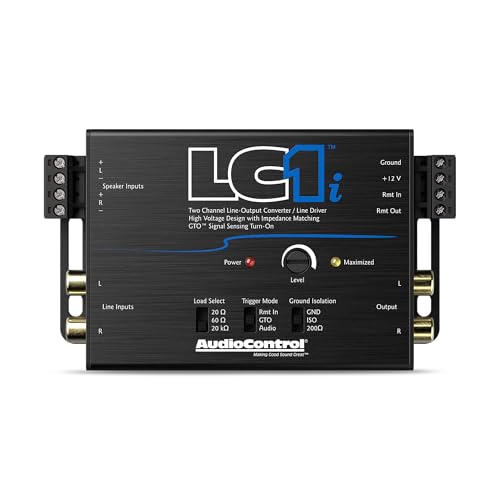
The AudioControl LC1i is an active line driver that solves two common problems simultaneously: weak factory signal voltage and ground-loop noise. It accepts up to 400W (40V) per channel from your OEM radio and converts it to a clean, high-quality pre-amp output. The onboard GTO signal sense automatically powers the unit when it detects an audio signal, eliminating the need to find a switched 12V source behind the dash.
What sets the LC1i apart is its ground isolation switch and selectable load impedance settings (20 ohms, 60 ohms, or 20k ohms). These features let you match the converter to late-model vehicles whose factory amplifiers require a specific load to remain active. The compact chassis measures just 4.8 x 3 x 1 inches, making it easy to hide behind the radio or under a seat.
Users consistently report that the LC1i eliminates alternator whine that plagued their previous passive converters, and the built-in line driver restores bass output that factory radios intentionally cut. The remote output can trigger downstream amplifiers, and the optional ACR-1 dash knob gives you subwoofer level control from the driver’s seat. For a clean, distortion-free installation, this is the benchmark.
Why it’s great
- Built-in ground isolation eliminates alternator whine
- Selectable load impedance works with modern factory systems
- GTO signal sense provides automatic remote turn-on
Good to know
- Remote level knob sold separately
- Requires a 1-amp fuse on the power lead
2. NVX XLCA2 X-Series 2-Channel Line Out Converter with xBOOST

The NVX XLCA2 packs an impressive feature set into a mid-range price point. It handles speaker-level inputs up to 400 watts RMS and outputs a high 9.5V pre-out signal, which is significantly higher than typical passive converters. The included remote bass knob mounts to the dashboard for real-time subwoofer level adjustment without reaching behind the radio.
The standout feature is xBOOST technology, which enhances low-end response to compensate for factory bass roll-off. A selectable auto-on mode detects the input signal and activates the unit automatically, simplifying installation. The XLCA2 also includes a 12V trigger out that can turn on your amplifier, acting as a remote turn-on relay for systems that lack one.
Real-world reports confirm that the XLCA2 far outperforms entry-level converters in terms of signal clarity and bass recovery. Some users note that the xBOOST circuit can induce clipping at maximum gain if not carefully tuned, but with proper setup it delivers deep, punchy bass. The dual amplifier outputs allow daisy-chaining multiple amps without a splitter.
Why it’s great
- xBOOST restores factory bass roll-off effectively
- Remote bass knob included for dash mounting
- 9.5V pre-out voltage feeds amplifiers confidently
Good to know
- xBOOST can clip at extreme gain settings
- Some low-frequency distortion reported on sub-60Hz content
3. CT Sounds CT-LC2 2-Channel Premium Line-Out Converter with BassLift
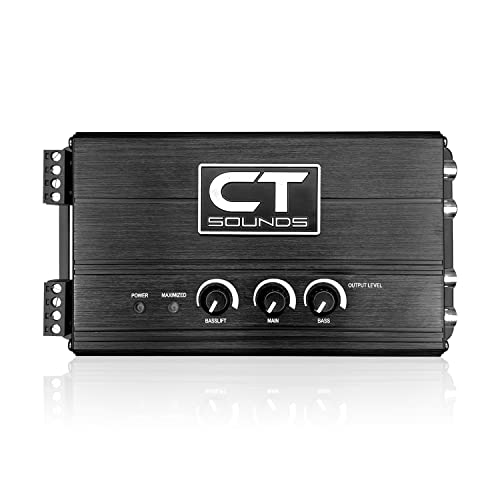
The CT Sounds CT-LC2 is engineered specifically to combat factory bass roll-off with its BassLift technology. It provides both a full-range main output for speakers and a dedicated low-pass bass output for subwoofers, giving you configuration flexibility in a single unit. The converter accepts high-level speaker inputs and converts them into low-level RCA signals for your aftermarket amplifier.
What makes the CT-LC2 unique is the comprehensive 34-page installation manual included in the box. This step-by-step guide covers wiring diagrams, gain-setting procedures, and troubleshooting, making it the best option for first-time installers. The BassLift circuit automatically compensates for bass reduction as volume increases, restoring low-end punch without manual adjustment.
Customer feedback highlights the CT-LC2’s ability to correct bass roll-off in factory infotainment systems that previous converters failed to fix. The remote wire hookup eliminates the need to run a separate turn-on wire through the firewall. Some users note that the built-in low-pass filter may cut frequencies above 200Hz, so it works best when paired with a dedicated subwoofer amplifier that handles its own crossover.
Why it’s great
- BassLift restores factory bass roll-off automatically
- Dedicated subwoofer output simplifies setup
- Detailed manual guides first-time installers
Good to know
- Low-pass filter may restrict subwoofer range above 200Hz
- Needs gain reduction with high-power amplifiers over 1500W
4. Taramp’s Pro 2.4S DSP Crossover

The Taramp’s Pro 2.4S blurs the line between a simple line output converter and a full digital signal processor. It accepts two high-level inputs and provides four channels of RCA output with a complete DSP toolset: 15-band graphic equalization, parametric EQ, fully adjustable crossover filters (Butterworth, Bessel, Linkwitz-Riley), and 12 preset EQ curves for different music genres.
This unit is for the enthusiast who wants surgical control over their system. You can set high-pass and low-pass filters for each output channel independently with slopes up to -48dB per octave. The built-in sequencer and input parametric EQ allow fine-tuning of frequency response to compensate for vehicle acoustics. The gain adjustment provides up to +15dB boost or -45dB attenuation per channel.
Owners report exceptional clarity and precise tuning capabilities that transform factory systems into competition-grade setups. The 12 presets — including FLAT, BASS BOOST, ROCK STYLE, and COMPETITION — let you switch between profiles on the fly. The learning curve is steeper than a standard converter, but for users who want active crossover control and room correction, the Pro 2.4S offers capabilities normally found in much more expensive processors.
Why it’s great
- Full DSP with 15-band graphic EQ and parametric EQ
- Adjustable crossover filters with multiple slope options
- 12 preset EQ curves for instant tuning
Good to know
- Requires learning DSP setup; not plug-and-play
- Larger chassis takes more installation space
5. PAC LP7-2R L.O.C. PRO Series 2-Channel with Remote Turn On

The PAC LP7-2R is a high-power 2-channel line output converter rated at 55 watts per channel, designed to optimize audio levels between factory radios and aftermarket amplifiers. Its defining feature is the built-in remote turn-on circuit that generates a 12-volt trigger signal from the speaker-level input, eliminating the need to run a separate remote wire from the head unit or fuse box.
This unit accepts both high-level speaker inputs and low-level RCA inputs, making it versatile for systems where the factory amplifier is being bypassed or replaced. The compact housing recesses the transformers into the circuit board, keeping the overall footprint small for tight installations behind the radio. Single stereo gain controls simplify level matching.
Users specifically recommend the LP7-2R for late-model vehicles like the Dodge Journey with Uconnect, where finding a remote turn-on lead is difficult. The ultra-compact size fits behind factory radios that have very little clearance. Some users note that the remote turn-on may not trigger at very low input voltages, but for most factory systems it works reliably. The LP7-2R delivers clean, undistorted output and has proven a popular upgrade over the older PAC LP5-2.
Why it’s great
- Built-in remote turn-on circuit saves installation time
- Accepts both high-level and low-level inputs
- Ultra-compact design fits tight spaces
Good to know
- Remote trigger may not activate at very low signal voltages
- Input RCAs are male, requiring female-to-female adapters in some setups
6. DS18 V2HL.V2 Hi/Lo Converter with Speaker Emulator

The DS18 V2HL.V2 solves a specific problem that many other converters cannot: it integrates with factory amplified systems that require a speaker load to remain active. The built-in speaker emulator presents the correct impedance to the OEM amplifier, preventing it from shutting down or entering protection mode while you tap its output for your aftermarket amplifier.
The converter features signal-sensing technology that activates instantly when it detects an audio signal, so there is no delay or click when music starts playing. The FR4 double-sided PCB construction adds durability, and the compact surface-mount design fits easily into crowded dashboards. It provides 2-channel high-level input and 2-channel RCA output.
Customer feedback confirms that the V2HL.V2 works flawlessly for integrating amplifiers into factory Bose, JBL, and premium audio systems that other converters fail with. One user reported that the remote wire output kept a constant 12V signal even after the radio shut off, which could keep the amplifier running. This appears to be an isolated issue, but verifying the remote output behavior after installation is recommended.
Why it’s great
- Speaker emulator prevents OEM amp shutdown
- Signal-sense activation for automatic power
- Durable FR4 PCB construction
Good to know
- Some units may hold remote output active after shutdown
- Not suitable for passive-only systems without OEM amplifier
7. PAC LP3-2 L.O.C. PRO Series 2-Channel Line Output Converter

The PAC LP3-2 is a transformer-coupled passive line output converter that provides clean signal conversion at a budget-friendly price point. Unlike resistor-based converters at similar price levels, the LP3-2 uses a transformer to isolate the signal, which significantly reduces the risk of ground-loop noise and alternator whine in non-common ground systems.
The single-dial precision-matched stereo gain adjustment lets you balance the input sensitivity with one control. The universal fit type means it works with virtually any factory radio or amplifier. The compact plastic housing measures 7.75 x 4 inches and supports wire-tie or screw mounting for flexible placement under the dash or behind the radio.
Users have successfully used the LP3-2 in home theater applications, running from speaker B outputs to provide a pure analog path for subwoofers. Verified buyers note that adding a ground wire to the receiver’s chassis or FM ground connection can eliminate any residual hum. While it lacks the features of active converters, the LP3-2 delivers reliable, noise-free conversion for simple subwoofer additions without breaking the budget.
Why it’s great
- Transformer-coupled design reduces ground-loop noise
- Single dial simplifies gain matching
- Universal fit works with most factory systems
Good to know
- May introduce hum in systems without proper grounding
- No remote turn-on or bass enhancement features
FAQ
Can I use a 2-channel line output converter with a mono subwoofer amplifier?
Why does my factory radio need a load on the speaker outputs?
Will a line output converter fix alternator whine from my factory system?
Final Thoughts: The Verdict
For most users, the 2-channel line output converter winner is the AudioControl LC1i because it combines active signal boosting, ground isolation, and load impedance matching in a compact chassis that works reliably with modern factory systems. If you want bass restoration and a remote control knob, grab the NVX XLCA2. And for a budget-friendly transformer-coupled option that keeps noise out of your signal, nothing beats the PAC LP3-2.