
A 61-key piano keyboard occupies a specific middle ground—it offers more range than a mini 49-key controller for two-handed playing, yet it remains compact enough for a small apartment or a desk corner. The key decision isn’t brand loyalty; it’s whether you need a self-contained instrument with built-in speakers for immediate practice or a MIDI controller optimized for software-based production. The wrong choice here means either missing essential voices for learning or struggling with latency when you want to record.
I’m Min — the co-founder and writer behind Gadgets Feed. I’ve spent hundreds of hours analyzing technical specifications, reading customer reviews, and cross-referencing features across dozens of models to help you find the best 61-key piano keyboard for your needs and budget.
Whether you are a beginner taking your first lesson or an intermediate player looking for better portability, this guide breaks down the nine best options available so you can choose the right 61 key piano keyboard for your home, studio, or travel routine.
How To Choose The Best 61 Key Piano Keyboard
Selecting a 61-key keyboard means balancing your need for realistic feel against your need for portability and features. A beginner focused on lessons will prioritize different specs than a producer needing a MIDI controller. Focus on the core elements that define playability and long-term value.
Weighted vs. Touch-Sensitive Keys
Touch-sensitive keys respond to how hard you press, producing louder or softer notes. This is the minimum acceptable standard for learning proper dynamics. Semi-weighted keys add resistance that mimics an acoustic piano’s mechanical action, which helps develop finger strength. Fully weighted or hammer action keys are heavier but rare in 61-key models due to size constraints. Beginners should prioritize touch sensitivity at a minimum; intermediate players upgrading from a toy keyboard will benefit from semi-weighted action.
Sound Engine and Polyphony
The sound engine determines the realism of the piano tones. Look for models that use stereo sampling—Yamaha’s AWM and Casio’s AiX are good examples. Polyphony refers to how many notes can sound simultaneously without dropping voices. A 32-note polyphony limit can cut off sustained notes during fast playing with the sustain pedal. For serious practice, 64-note polyphony is the safer target; 128-note polyphony is ideal for advanced pieces.
Connectivity and Learning Features
USB-MIDI is essential for connecting to learning apps like Simply Piano or GarageBand. Bluetooth MIDI adds wireless convenience. Built-in lesson modes and lighted keys can accelerate learning for absolute beginners. If you plan to record, check for a USB audio interface or a direct WAV recording function to an SD card.
Quick Comparison
On smaller screens, swipe sideways to see the full table.
| Model | Category | Best For | Key Spec | Amazon |
|---|---|---|---|---|
| Casio Casiotone CT-S400 | Premium | Best all-around sound engine | 600 tones, 200 rhythms, AiX sound source | Amazon |
| Yamaha Piaggero NP15B | Premium | Most piano-like feel in 61 keys | 11.46 lbs, AWM stereo sampling | Amazon |
| Novation Launchkey 61 MK4 | Premium | Best MIDI controller for producers | 61 semi-weighted keys, 16 FSR pads | Amazon |
| Casio Casiotone LK-S250 | Premium | Best lighted keys for self-teaching | 400 tones, 77 rhythms, key lighting system | Amazon |
| Yamaha PSR-E383 | Mid-Range | Best entry-level Yamaha learning keyboard | 61 touch-sensitive keys, Smart Chord | Amazon |
| Alesis Harmony 61 Pro | Mid-Range | Best value with 580 sounds and FX | 64-note polyphony, 30W speakers | Amazon |
| Amazon Basics Portable Keyboard | Mid-Range | Best budget-friendly starter bundle | 255 timbres, 255 rhythms, includes headphones | Amazon |
| Finger Dance Folding Piano | Budget | Best ultra-portable folding design | Bluetooth MIDI, 8-10h battery life | Amazon |
| FingerBallet BX20 | Budget | Best folding option for 88 keys on a budget | 88 semi-weighted keys, foldable design | Amazon |
In‑Depth Reviews
1. Casio Casiotone CT-S400

The Casio Casiotone CT-S400 is the standout all-rounder in the 61-key category, thanks to its AiX sound source that delivers a genuinely rich German concert grand piano tone. With 600 dynamic tones and 200 accompaniment rhythms, this keyboard gives you an enormous sonic palette without requiring menu-diving—the front panel layout keeps controls immediate. The bass-reflex stereo speaker system with SURROUND mode produces surprisingly full sound for an instrument weighing under 10 pounds.
Touch-responsive keys feel responsive and consistent across the range, which matters for developing proper dynamics. The 6-track MIDI recorder is a rare find at this level, letting you layer parts without external software. Connectivity options include USB-MIDI for DAW integration, and the Casio Music Space app adds wireless control when paired with the optional WU-BT10 Bluetooth adapter. Pitch bend and strap pins make it genuinely stage-ready.
The only tradeoff is the lack of a 1/4-inch output jack—you will need an 1/8-inch to 1/4-inch adapter to connect to a PA system. Players who need traditional weighted action may find the keys too light. But for anyone seeking the deepest sound engine and most versatile feature set in a portable 61-key package, the CT-S400 is the clear choice.
Why it’s great
- AiX sound source delivers premium grand piano realism.
- 200 rhythms with full accompaniment for instant band-like backing.
- Under 10 pounds with powerful bass-reflex speakers.
Good to know
- No 1/4-inch output jack; requires adapter for PA systems.
- Keys are touch-responsive, not fully weighted.
2. Yamaha Piaggero NP15B

The Yamaha Piaggero NP15B prioritizes one thing above all else: the closest possible piano feel in a 61-key portable form. Its Advanced Wave Memory (AWM) stereo sampling captures every nuance of a real acoustic piano, from the attack of the hammer to the resonance of the soundboard. The touch-sensitive keys offer a noticeably heavier resistance than budget keyboards, which helps build proper finger muscle memory for students transitioning to an acoustic instrument later.
Weighing only 11.46 pounds and capable of running on six AA batteries for up to five hours, the NP15B is built for spontaneous practice anywhere. The Smart Pianist app integration unlocks additional functionality like voice control and rhythm patterns. The design is sleek and minimalist—no flashing lights or toy-like interfaces—making it suitable for adult learners who want a dignified instrument.
The narrower keys (slightly reduced width compared to a full-size 88-key piano) may require a brief adjustment period for players with larger hands. The built-in speaker system, while clean, lacks the bass punch of the Casio CT-S400. For learners and casual players whose top priority is authentic Yamaha piano sound and realistic touch, the Piaggero NP15B delivers where it counts.
Why it’s great
- AWM stereo sampling provides authentic, warm acoustic piano tone.
- Ultra-portable at 11.46 lbs with battery power option.
- Smart Pianist app adds rhythm tracks and voice control.
Good to know
- Keys are slightly narrower than standard acoustic piano width.
- Built-in speakers are clean but lack bass extension.
3. Novation Launchkey 61 MK4
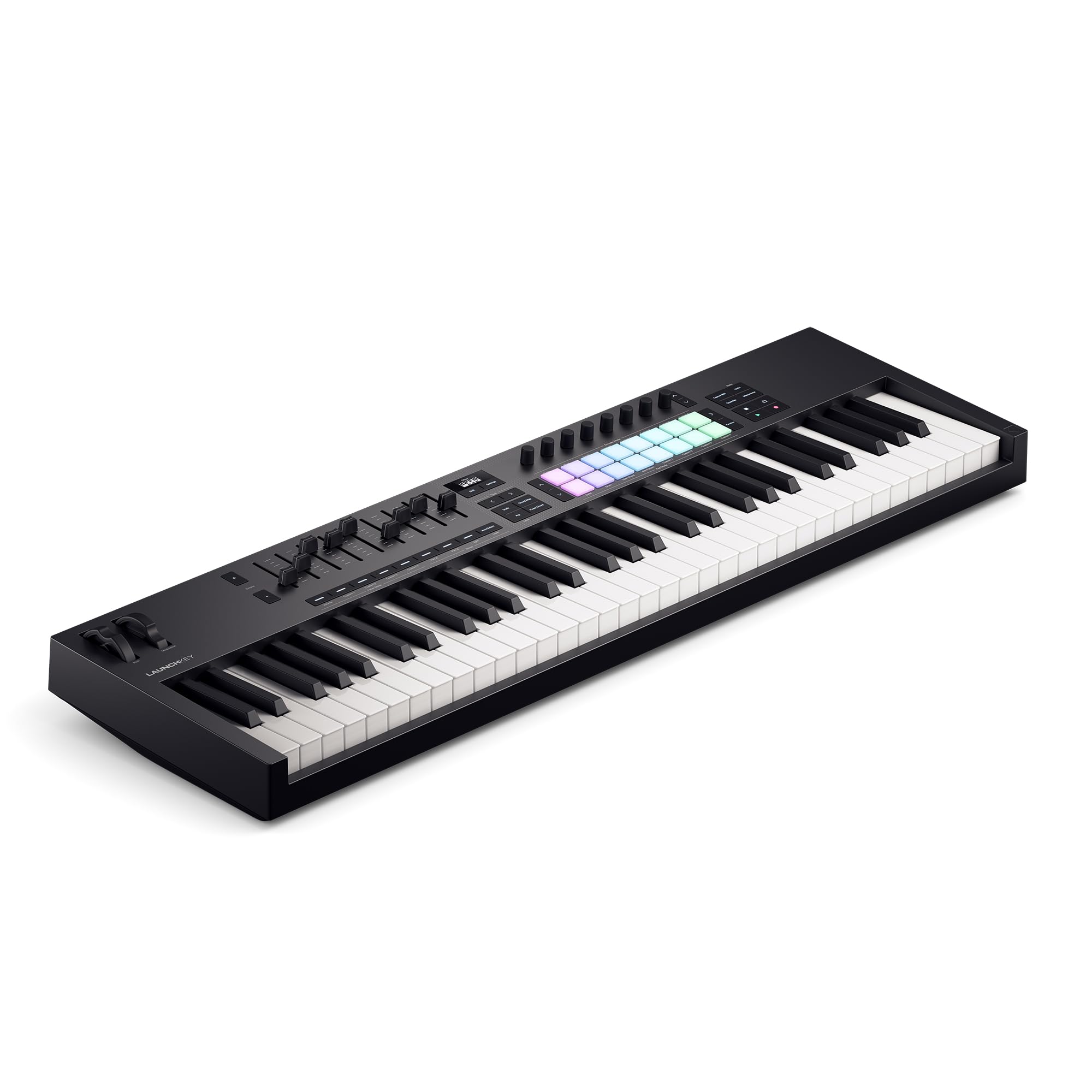
The Novation Launchkey 61 MK4 is not a self-contained instrument—it is a MIDI controller designed to be the command center of your DAW-based studio. The 61 semi-weighted keys offer a satisfying resistance that sits between budget touch-sensitive keyboards and heavy hammer-action digital pianos. What sets this MK4 apart is the deep integration with Ableton Live: the 16 FSR drum pads automatically map to clip launching, step sequencing, and chord triggering without manual configuration.
Scale Mode eliminates wrong notes by restricting the keyboard to a selected scale, and the Arpeggiator can create and mutate patterns in real time. Polyphonic aftertouch on the drum pads adds expressive control over software instruments. The included software bundle—Ableton Live Lite, Cubase LE, Novation Play, and sounds from Native Instruments—represents hundreds of dollars in value. The USB-MIDI connection is class-compliant across Windows, Mac, and iOS.
The Launchkey is not designed for standalone practice or performance—it produces no sound on its own without a computer or tablet. FL Studio users may find the Reason integration requires manual mapping for some controls. For music producers who want a streamlined, deeply integrated DAW controller with premium build quality, the Launchkey 61 MK4 is the definitive choice in this form factor.
Why it’s great
- Seamless Ableton Live integration with automatic mapping.
- Scale Mode and Arpeggiator for creative music production.
- Generous software bundle with DAWs and virtual instruments.
Good to know
- No built-in speakers or sounds—requires computer/tablet.
- Reason DAW integration requires manual knob mapping.
4. Casio Casiotone LK-S250

The Casio Casiotone LK-S250 is purpose-built for self-directed learning, with a Key Lighting System that illuminates the correct keys to press during built-in songs. This visual feedback, combined with a 4-Stage Lesson System that gradually removes assistance, allows beginners to progress from following lights to playing independently. With 400 tones and 77 rhythms, there is enough variety to keep practice engaging without overwhelming a new player.
Dance Music Mode is a clever addition—it lets users remix EDM tracks live using the keyboard, which makes practice feel more like creative play. The integrated handle and lightweight design (4.98 kg) make it easy to move around the house or bring to a friend’s house. USB-MIDI and audio input allow connection to tablets and phones for use with learning apps like Simply Piano or for playing along to your own tracks.
The lighted keys can only display four notes simultaneously, which limits its usefulness for complex chords. The built-in speakers are adequate for personal practice but lack the power for room-filling sound. For absolute beginners—especially children or adults who struggle with traditional sheet music—the LK-S250’s lighted approach can accelerate the early learning curve dramatically.
Why it’s great
- Lighted keys with 4-Stage Lesson System for self-teaching.
- Dance Music Mode makes practice fun and creative.
- Integrated handle and lightweight for easy portability.
Good to know
- Lighted keys limited to 4 simultaneous notes.
- Speakers are adequate for practice only, not performance.
5. Yamaha PSR-E383

The Yamaha PSR-E383 is the entry-level gateway into Yamaha’s trusted sound quality without breaking the budget. The 61 touch-sensitive keys respond to playing dynamics, which is critical for beginners learning to control volume through finger pressure rather than a volume knob. The Smart Chord function is a standout learning tool—it lets you play complex chords with a single finger, making early song practice more rewarding.
Yamaha’s Keys to Success lesson system guides you through songs step by step, allowing you to practice each hand separately before combining them. The Touch Tutor feature teaches you to vary your touch for expressive playing. With hundreds of built-in songs spanning genres from pop to classical, there is always fresh material to work on. The sound quality is unmistakably Yamaha—clean, realistic piano tones that put cheaper keyboards to shame.
The keys are touch-sensitive rather than weighted, which is typical at this price point. The PSR-E383 lacks Bluetooth connectivity, so connecting to apps requires a USB cable. For beginners who want a reliable, great-sounding instrument from a brand with a proven track record for learning, the PSR-E383 is the safe, smart investment.
Why it’s great
- Yamaha AWM sound engine delivers premium piano tones.
- Smart Chord lets beginners play complex chords with one finger.
- Keys to Success lesson system with step-by-step learning.
Good to know
- Keys are touch-sensitive, not weighted.
- No Bluetooth—requires USB cable for app connectivity.
6. Alesis Harmony 61 Pro

The Alesis Harmony 61 Pro packs an astonishing 580 premium sounds into a sub- keyboard, making it the sound-design champion of the 61-key category. The X/Y performance touchpad lets you apply DJ-style effects like slicer and filter sweeps in real time, which is a feature usually found on much more expensive gear. With 64-note polyphony, complex passages with sustain pedal use won’t cut off notes prematurely.
The 30W (15W x 2) stereo speaker system is the most powerful in this guide—loud enough for small room jams without external amplification. You can record your performances directly as 16-bit, 44.1kHz WAV files to an SD card, bypassing the need for a computer. USB-MIDI connectivity works with all major DAWs for recording software instruments. The backlit LCD screen shows notation and chord diagrams, aiding learning.
The spring-loaded velocity-sensitive keys are not weighted, and some users report cabinet vibration on bass-heavy notes at high volume. The 177 built-in songs and lesson functionality are helpful but less structured than Yamaha’s Keys to Success system. For learners and performers who want the widest sound palette and DJ-style creative controls at a mid-range price, the Harmony 61 Pro is an unbeatable value proposition.
Why it’s great
- 580 premium sounds with Layer and Split modes.
- X/Y touchpad for live DJ-style FX manipulation.
- 30W speaker system loud enough for small performances.
Good to know
- Keys are spring-loaded velocity-sensitive, not weighted.
- Cabinet vibration can occur on bass-heavy notes at high volume.
7. Amazon Basics Portable Keyboard

The Amazon Basics Portable Electronic Keyboard is the most complete bundle in the budget-friendly tier. It includes the keyboard, headphones for silent practice, a sheet music stand, a power adapter, and note stickers to help beginners learn key names. With 255 timbres, 255 rhythms, and 50 demo songs, it offers more sonic variety than many keyboards costing twice as much.
The 61 full-size keys provide solid resistance—better than expected at this level—and the upward-facing speakers produce clear, balanced sound. The LCD display shows current settings clearly. The semi-weighted feel is a pleasant surprise; it is not a toy action. The unit is lightweight enough at 5.7 kg to move between rooms easily. The transposition feature is useful for playing songs in different keys.
The sustain pedal port uses a proprietary 6-pin PS/2 connection, meaning only the included pedal works, and you must power off to connect it. The power cord length is awkward—too short for some setups and too long for others. For anyone on a tight budget who wants a functional, full-featured 61-key keyboard to start lessons, the Amazon Basics bundle removes the need for separate accessory purchases.
Why it’s great
- Includes headphones, stand, adapter, and note stickers out of box.
- 255 timbres and 255 rhythms provide huge variety for exploration.
- Solid key feel with semi-weighted resistance.
Good to know
- Proprietary PS/2 sustain pedal port limits pedal options.
- Power cord length is awkwardly balanced.
8. Finger Dance Folding Piano

The Finger Dance 61 Key Folding Piano redefines portability by folding 180 degrees into a compact package small enough to fit in a travel tote bag. The imitation wood texture finish gives it a surprisingly premium aesthetic that belies its budget-friendly price. With a rechargeable lithium battery providing 8-10 hours of playtime on a full charge, this keyboard is truly designed for playing anywhere—park, classroom, or living room.
Bluetooth MIDI connectivity allows wireless connection to teaching apps like Perfect Piano and Garage Band, making it easy to follow along with interactive lessons. The built-in speakers deliver three-dimensional surround sound with warm tone, though the rear-facing design means the sound is thinner than front-firing alternatives. The light-up keys can be activated independently for guided learning, though they do not trigger from external apps.
The keys remain exposed when the keyboard is folded, making them vulnerable to damage during travel without a hard case. The volume resets to a default level each time you power on. For travelers, RV dwellers, or anyone who needs to practice in tight spaces where a traditional keyboard cannot fit, the Finger Dance folding design is a clever space-saving solution.
Why it’s great
- Folds 180 degrees for maximum portability and storage.
- 8-10 hour battery life with USB-C charging.
- Bluetooth MIDI connects to learning apps wirelessly.
Good to know
- Keys exposed when folded—vulnerable without hard case.
- Volume resets to default on power cycle.
9. FingerBallet BX20

The FingerBallet BX20 is an 88-key folding digital piano that brings a full keyboard range to a foldable form factor typically reserved for 61-key models. This matters for pianists who need the full octave range for two-handed repertoire but cannot accommodate a full-sized instrument. The semi-weighted keys provide more resistance than standard touch-sensitive keys, offering a more realistic piano feel for its class.
With 128 tones, 128 rhythms, and 20 demo songs, the BX20 covers the essentials for exploration. Bluetooth MIDI connectivity allows wireless connection to DAW apps on mobile devices for recording and editing. The included bundle—carrying bag, sustain pedal, USB cable, charger, and music holder—makes this a turnkey travel solution. At 5.64 kg, it is light enough to be carry-on luggage on most airlines.
The built-in speakers are notably thin, and many users prefer using headphones or an external amplifier for acceptable sound quality. The key action uses spring-loaded, not fully weighted, mechanics, which can feel unsettling to players accustomed to acoustic pianos. For traveling musicians or space-constrained players who refuse to compromise on full 88-key range, the FingerBallet BX20 is the only portable folder that delivers the full octave span.
Why it’s great
- 88-key full range in a foldable, travel-friendly design.
- Semi-weighted keys offer better resistance than budget options.
- Complete bundle with bag, pedal, and USB cable included.
Good to know
- Built-in speakers are thin—headphones or amp recommended.
- Spring-loaded key action does not feel like weighted piano.
FAQ
Why would I choose a 61-key keyboard over an 88-key model?
What is the difference between a portable keyboard and a digital piano?
Can I use a 61-key keyboard with learning apps like Simply Piano?
Final Thoughts: The Verdict
For most users, the 61 key piano keyboard winner is the Casio Casiotone CT-S400 because it combines the richest AiX sound engine with 600 tones, 200 rhythms, and powerful built-in speakers in a sub-10-pound package. If you want the most realistic piano feel in a portable design, grab the Yamaha Piaggero NP15B. And for music producers who need deep DAW integration with semi-weighted keys, nothing beats the Novation Launchkey 61 MK4.