
An AV receiver is the neural center of any serious home cinema, decoding the latest object-based audio formats while routing pristine video signals to your display. Choosing the right one separates a room-filling, immersive experience from a flat, muddy soundstage that leaves action scenes feeling hollow.
I’m Min — the co-founder and writer behind Gadgets Feed. I’ve spent hundreds of hours combing through spec sheets, user reports, and component datasheets across the to receiver tier to find the models that actually deliver on their power and channel claims.
Whether you are upgrading from a soundbar or building a drop-ceiling Atmos setup from scratch, this guide to the best av receiver home cinema buyers should consider breaks down every key spec, real-world trade-off, and hidden dealbreaker.
How To Choose The Best AV Receiver Home Cinema
Picking the wrong receiver usually comes down to misjudging how many channels you need, ignoring which HDMI version is on the rear panel, or underestimating how much a proper room calibration system matters for dialogue intelligibility.
Channel Count and Atmos Configuration
A 5.1 receiver handles the traditional surround layout: front left, center, front right, two surrounds, and a subwoofer. Going to 5.1.2 adds two overhead or up-firing speakers for Dolby Atmos height effects, while 7.1 drops those overheads for rear surrounds. For a convincing Atmos bubble in a dedicated room, 5.1.2 is the baseline — anything less and the vertical layer is simulated, not discrete.
HDMI 2.1 and Video Bandwidth
HDMI 2.1 with 40Gbps throughput is mandatory if you own a PlayStation 5, Xbox Series X, or an 8K television. Without it, 4K/120Hz HDR gaming falls back to 4K/60Hz, and Variable Refresh Rate (VRR) glitches. Every receiver in this guide that claims 8K support also passes 4K/120Hz, but double-check the number of 40Gbps ports — some budget models only offer one.
Room Correction Software
Raw wattage means little if your room has standing waves and reflective surfaces that smear the soundstage. Basic receivers ship with Yamaha’s YPAO or Denon’s Audyssey MultEQ, which fix timing and level mismatches. Stepping up to Dirac Live on Onkyo’s TX-NR7100 gives you a parametric EQ that can smooth out bass nodes — a genuine advantage for challenging rectangular rooms.
Quick Comparison
On smaller screens, swipe sideways to see the full table.
| Model | Category | Best For | Key Spec | Amazon |
|---|---|---|---|---|
| Onkyo TX-NR7100 | Premium | Best Overall — Dirac Live room correction | 100W x 9 channels, Dirac Live, HDMI 2.1 | Amazon |
| Denon AVR-S970H | Premium | Phono input and stable 7.2 performance | 90W x 7 channels, HEOS, 8K HDMI | Amazon |
| Sony STR-AN1000 | Premium | 360 Spatial Sound Mapping, easy GUI setup | 7.2 channels, 165W/ch (6 ohms), DCS IX | Amazon |
| Sony STRAZ1000ES | Premium | High-end build, custom integration ready | 100W x 7 (8 ohms), 360 Reality Audio | Amazon |
| Yamaha RX-V6A | Mid-Range | Dependable 7.2 with MusicCast multi-room | 7.2 channels, 8K HDMI, YPAO R.S.C. | Amazon |
| Onkyo TX-NR6100 | Mid-Range | THX Certified, great for gaming | 7.2 channels, THX Select, 8K HDMI | Amazon |
| JBL MA710 | Mid-Range | Shallow chassis, phono input, 7.2 power | 110W x 7 channels, 8K, Chromecast | Amazon |
| Denon AVR-S670H | Mid-Range | Entry-level 5.2 with easy setup | 75W x 5 channels, 8K, HEOS | Amazon |
| Yamaha RX-V4A | Budget | Reliable 5.2 with MusicCast streaming | 5.2 channels, 8K HDMI, YPAO | Amazon |
| JBL MA310 | Budget | Clean 5.2 sound at the lowest entry cost | 60W x 5 channels, Bluetooth 5.1 | Amazon |
In‑Depth Reviews
1. Onkyo TX-NR7100 9.2-Channel AV Receiver
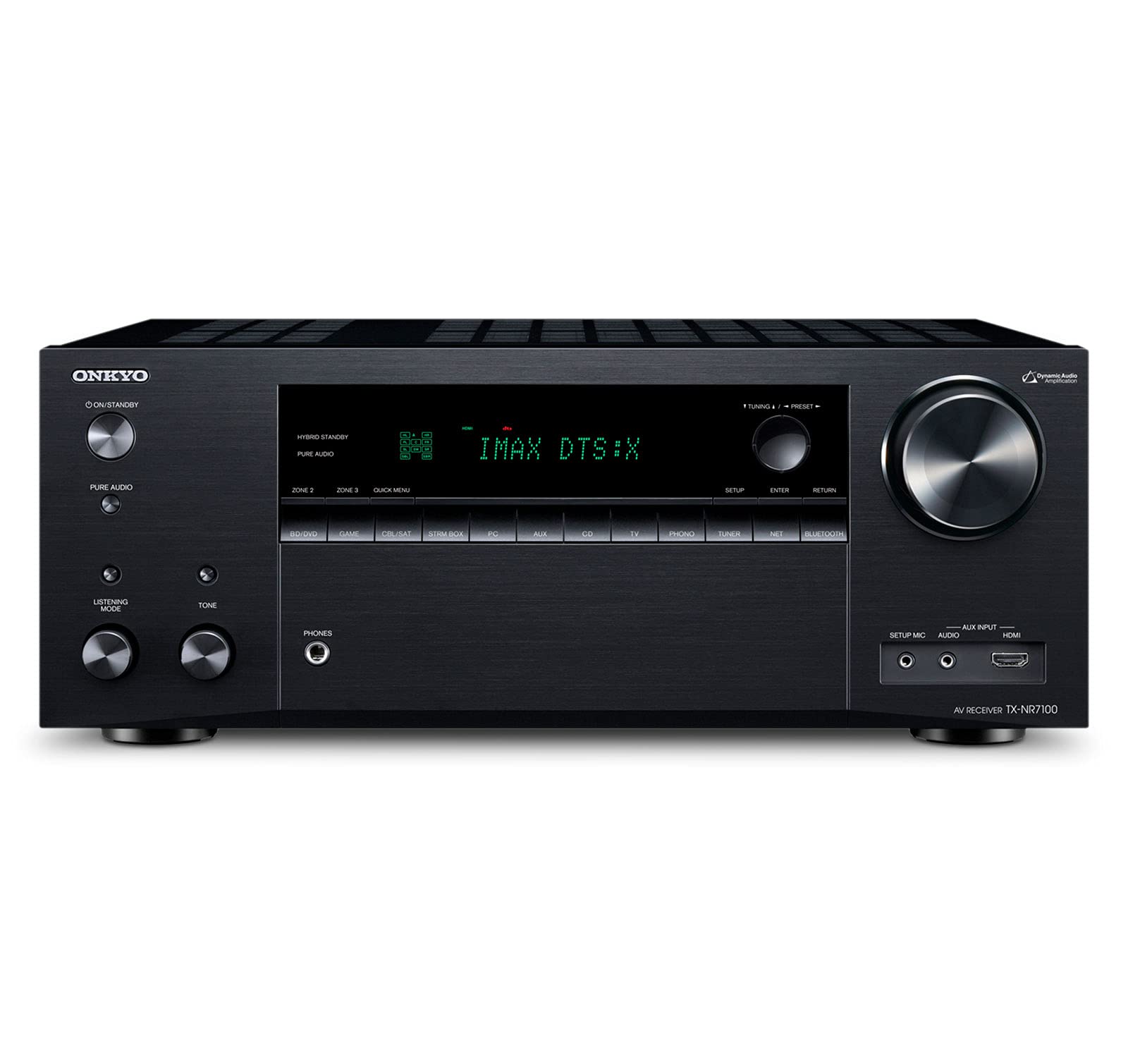
The TX-NR7100 is the only receiver in this lineup that ships with Dirac Live room correction out of the box — a parametric EQ system that measures your speakers at multiple positions and flattens frequency response far more precisely than the basic Audyssey or YPAO on competitors. Its 9-channel amplification (100W per channel) supports a full 5.1.4 Atmos layout, meaning four ceiling speakers for overhead object panning instead of just two.
HDMI 2.1 with 40Gbps bandwidth covers three inputs, so you can run a PS5, Xbox Series X, and a streaming box all at 4K/120Hz simultaneously. Bi-directional Bluetooth using aptX HD lets you send audio to wireless headphones while also receiving from your phone — a rare dual-role feature. Owners consistently praise its clean, dynamic power delivery with large Klipsch or Bowers & Wilkins systems.
The remote lacks backlighting, and the initial Dirac calibration takes longer than automated setups, but the acoustic payoff is immediate for anyone fighting a reflective or asymmetrical room. For buyers who prioritize precise sound over plug-and-play simplicity, this is the most capable receiver under the premium ceiling.
Why it’s great
- Dirac Live room correction fixes bass nodes and timing
- 9-channel amplification for true 5.1.4 Atmos
- Bi-directional Bluetooth with aptX HD
Good to know
- Remote is not backlit
- Dirac setup is time-consuming for beginners
- Runs warm — good ventilation required
2. Denon AVR-S970H 7.2 Channel 8K Receiver

The AVR-S970H delivers 90 watts per channel across seven channels, enough to drive a 5.2.2 Atmos configuration with authority in medium-sized rooms. Its eight HDMI ports include three that handle 8K/60Hz and 4K/120Hz pass-through with VRR, ALLM, and QFT — meeting the current gaming console standard without compromise. The built-in phono stage means you can connect a turntable directly without an external preamp.
HEOS multi-room streaming works with Spotify, TIDAL, and Amazon Music HD, though Bluetooth is restricted to input only — you cannot stream HEOS sources to Bluetooth headphones. Owners report that eARC integration with modern TVs is flawless, and the on-screen setup menus are among the most user-friendly in this class. The unit runs cooler than the Onkyo TX-NR7100, typically hovering around 80°F under load.
The remote lacks a dedicated TV power button, and engaging Zone 2 drops the main room to 5.2 channels. But for a balanced mix of gaming features, vinyl playback, and solid 7.2 power, the S970H justifies its premium positioning with reliable daily performance.
Why it’s great
- Built-in phono input for turntables
- Three 8K/4K120 HDMI 2.1 inputs with VRR
- Simple, intuitive on-screen setup
Good to know
- Zone 2 reduces main room to 5.2 channels
- No Bluetooth output from HEOS sources
- Remote missing dedicated TV power button
3. Sony STR-AN1000 7.2 CH A/V Receiver

Sony’s Digital Cinema Auto Calibration IX uses a supplied microphone to measure speaker distances, levels, and frequency response across nine points, then applies 360 Spatial Sound Mapping to create phantom height and surround speakers from a physical 5.1.2 layout. The result is a remarkably broad soundstage that tricks the ear into hearing more speakers than are physically present — useful for rooms that cannot accommodate rear surrounds or four ceiling channels.
With six HDMI inputs (two output), it supports 8K/60Hz and 4K/120Hz pass-through plus Dolby Vision and HDR10. The “Works with Sonos” certification lets it integrate into an existing Sonos system as a wired zone. Owners upgrading from older Sony receivers report noticeably clearer dialogue and more precise object panning in Atmos films like Blade Runner 2049.
The front display is nearly unreadable from a distance, and there is no phono input for turntables. An Apple TV 4K pass-through glitch that drops Dolby Vision requires connecting the Apple TV directly to the TV. Still, for immersive virtual surround without cutting ceiling holes, the AN1000 leads the pack.
Why it’s great
- 360 Spatial Sound Mapping creates convincing virtual height channels
- Easy guided setup via graphical interface
- Works with Sonos for multi-room integration
Good to know
- No phono input for turntables
- Front display hard to read from seating distance
- Apple TV 4K Dolby Vision requires direct TV connection
4. Sony STRAZ1000ES 7.2 CH 8K A/V Receiver

The STRAZ1000ES sits at the top of Sony’s consumer AV receiver hierarchy, delivering 100 watts per channel into 8 ohms with notably low distortion. It supports 8K/60Hz and 4K/120Hz across six HDMI 2.1 inputs, passes Dolby Vision and HDR10, and includes Sony’s 360 Reality Audio upmixing that converts stereo music into a spherical sound field — a feature unique to Sony’s ES line.
Digital Cinema Auto Calibration IX handles room correction, and the unit includes a backlit remote, a rarity at any price point. The chassis is optimized for custom integration with IP control for Crestron and Control4 systems, making it popular among homeowners who want whole-house coordination. Owners describe the DAC as revealing — good recordings shine, while poorly mastered tracks become more obvious.
The receiver runs very hot and benefits from external cooling in confined cabinets. It lacks HDR10+ support, and QMS (Quick Media Switching) is absent. For a no-compromise 7.2 setup with premium build quality and professional-grade control, the ES line delivers exactly what the badge promises.
Why it’s great
- Backlit remote included
- IP control for custom home integration
- 360 Reality Audio upmixing for music
Good to know
- Runs very hot — external cooling recommended
- No HDR10+ support
- QMS (Quick Media Switching) not available
5. Yamaha RX-V6A 7.2-Channel AV Receiver

The RX-V6A bridges the gap between entry-level 5.2 receivers and full-featured 9-channel units. It offers a 7.2 channel layout (supports 5.1.2 Atmos and DTS:X), three 8K/60Hz HDMI 2.1 inputs, and YPAO R.S.C. with multipoint measurement for more accurate calibration than the basic YPAO found on the V4A. MusicCast multi-room lets you group the receiver with Yamaha wireless speakers throughout the house.
Owners moving from older Yamaha units report a noticeable jump in clarity and a wider soundstage, especially with Klipsch or JBL speaker systems. The setup menu is straightforward, and the unit works reliably with PS5 for 4K/120Hz VRR gaming. The remote remains button-dense and uncomfortable, but the MusicCast app provides an alternative control path that many users prefer.
Zone 2 is pre-out only, meaning you need a separate amplifier for a second room, and the receiver sometimes fails to auto-switch to TV eARC on power-up. For a mid-range 7.2 receiver with solid streaming support and Yamaha’s proven reliability, the V6A delivers exceptional value per channel.
Why it’s great
- Three 8K HDMI 2.1 inputs for gaming
- YPAO R.S.C. multipoint room calibration
- MusicCast multi-room streaming ecosystem
Good to know
- Remote has small, uncomfortable buttons
- Zone 2 requires external amp
- eARC auto-switching inconsistent on power-up
6. Onkyo TX-NR6100 7.2 Channel THX Certified Receiver
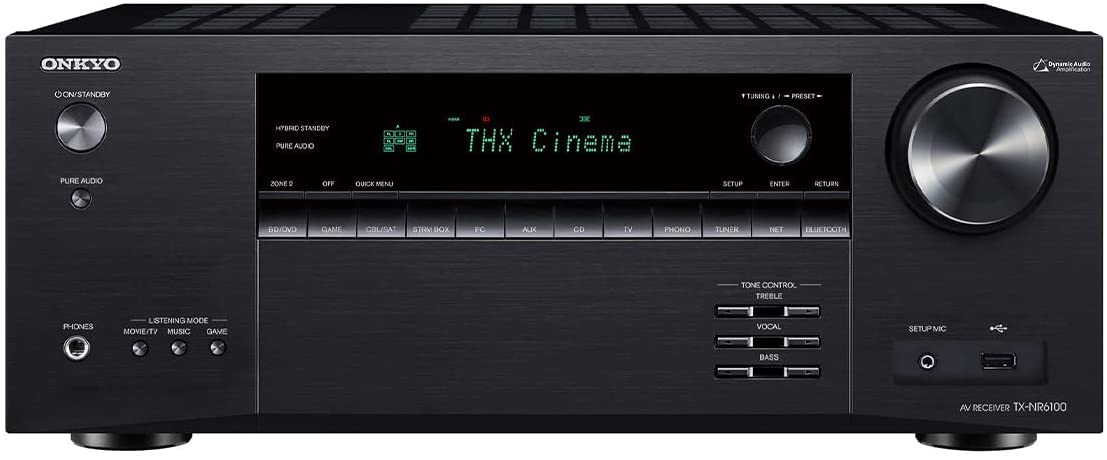
THX Select certification means the TX-NR6100 guarantees a specific level of playback quality — reference-level volume with minimal distortion — in rooms up to roughly 2,000 cubic feet. Its 210W per channel dynamic amplification (rated at 6 ohms, 1 kHz, 10% THD) provides headroom that makes action sequences feel explosive without compression artifacts. Three HDMI 2.1 inputs handle 8K/60Hz and 4K/120Hz with full gaming features.
Dolby Atmos and DTS:X decoding support a 5.2.2 layout, and IMAX Enhanced certification ensures compatibility with IMAX-remastered films on Blu-ray and streaming. Owners consistently note the auto-calibration using AccuEQ does an excellent job matching the receiver to Klipsch speakers, delivering clear channel separation and a wide, enveloping soundstage.
A vocal minority report HDMI 2.1 failures after a couple of years — the 40Gbps ports stop accepting 4K/120Hz signals — and the fan is audible in quiet passages. Bi-amping the front channels reduces the system to 5.1. For gamers wanting THX assurance today, the sound is superb, but long-term reliability is a watch item.
Why it’s great
- THX Select certification for guaranteed reference playback
- IMAX Enhanced for remastered titles
- Excellent auto-calibration with Klipsch speakers
Good to know
- HDMI 2.1 reliability issues reported after 1-2 years
- Fan noise audible during quiet scenes
- Bi-amping drops configuration to 5.1
7. JBL MA710 7.2 Channel 8K AV Receiver

JBL’s MA710 packs 110 watts into each of its seven channels, giving it more per-channel power than many similarly priced 7.2 receivers. That extra headroom translates to cleaner peaks during action sequences, especially when driving lower-sensitivity tower speakers like the Polk ES60. The chassis is surprisingly shallow for a 7-channel unit, fitting media consoles where deeper Yamaha or Onkyo boxes would not.
It supports 8K/60Hz and 4K/120Hz pass-through via six HDMI inputs (one output with eARC), Dolby Atmos and DTS:X decoding for 5.1.2 or 7.1 configurations, and includes both Apple AirPlay 2 and Google Chromecast built-in — a dual-streaming advantage over receivers that only support one. A moving magnet phono input accommodates turntables without an external preamp.
The remote is not backlit — a recurring complaint in dark home theater rooms — and the auto shut-off defaults to 20 minutes (adjustable in the menu). A missing firmware update means the MA710 does not downmix DTS-HD Master Audio to 2.1 for stereo-only setups. For buyers who need a powerful, shallow 7.2 receiver with native turntable support, the MA710 is a strong contender.
Why it’s great
- 110W per channel — high headroom for tower speakers
- Shallow chassis fits tight media consoles
- Phono input and dual AirPlay 2 / Chromecast streaming
Good to know
- Remote is not backlit
- No DTS-HD downmix for 2.1 setups
- Default auto shut-off needs manual adjustment
8. Denon AVR-S670H 5.2 Ch 8K Receiver

The AVR-S670H is a 5.2-channel receiver that punches above its spec sheet with 8K/60Hz and 4K/120Hz pass-through, making it the cheapest way to get next-gen console features into a 5.1 system. Its 75 watts per channel (two channels driven) is enough to fill a living room with KEF Q150s or similar bookshelf speakers, and the Audyssey MultEQ calibration helps tame standing waves that plague odd-shaped rooms.
HEOS built-in streams Spotify, TIDAL, and Amazon Music HD, and the receiver integrates with Amazon Alexa for hands-free volume and input control. Owners consistently describe the setup as refreshingly simple — the on-screen assistant walks through speaker detection, distance measurement, and level setting in under ten minutes. The single remote handles TV and receiver functions after HDMI-CEC pairing.
Power drops when driving all five channels simultaneously, and HEOS wireless stability can be inconsistent — some users report lag or dropouts with AirPlay. The plastic binding posts feel less substantial than the metal ones on step-up models. For a budget 5.2 receiver with genuine 8K HDMI 2.1 and excellent ease of use, the S670H is the right starting point.
Why it’s great
- 8K/4K120 HDMI 2.1 at an entry-level price
- Audyssey MultEQ room calibration included
- Fast, intuitive on-screen setup assistant
Good to know
- Power drops when driving all five channels
- HEOS wireless streaming can be unreliable
- Plastic binding posts feel less durable
9. Yamaha RX-V4A 5.2-Channel AV Receiver

The RX-V4A is the most affordable 5.2-channel receiver in Yamaha’s lineup that still supports 8K/60Hz and 4K/120Hz pass-through via HDMI 2.1, making it a viable choice for gamers on a strict budget. Its 70 watts per channel (two channels driven, 8 ohms) is modest, but YPAO automatic room calibration helps squeeze the best performance from budget bookshelf speakers like the Micca RB42 or Polk T15.
Wireless streaming covers AirPlay 2, Spotify Connect, and MusicCast, giving you multi-room grouping with Yamaha MusicCast speakers. Voice control via Alexa or Google Assistant works well for basic commands like volume and input switching. Owners driving tower speakers like Bowers & Wilkins CDM 7s report surprisingly clean stereo separation and clarity that beats dedicated stereo amps in the same price band.
The menu system is dated and the remote buttons are tiny and painful to use — the MusicCast app becomes almost mandatory. Some units exhibit HDMI switching problems that require a hard reset. For a no-frills 5.2 receiver that brings 8K gaming support and Yamaha reliability, the V4A is the budget champion.
Why it’s great
- 8K/4K120 HDMI 2.1 at lowest price in the guide
- YPAO room calibration improves budget speaker sound
- MusicCast multi-room and voice control
Good to know
- Menu system looks dated and slow
- Remote buttons are small and uncomfortable
- Occasional HDMI switching glitches reported
10. JBL MA310 5.2 Channel 4K AV Receiver

JBL’s MA310 is a 5.2-channel receiver that strips away 8K support and network streaming to hit the lowest price in this guide, covering only 4K/60Hz pass-through via five HDMI inputs (one with ARC). Its 60 watts per channel is adequate for small satellite speakers or a dedicated front-left/center/right setup in a modest living room, but the amp runs out of headroom quickly if driven hard with large towers.
Bluetooth 5.1 with Low Energy provides wireless input from a phone or tablet, though there is no Wi-Fi streaming, AirPlay, or Chromecast — you are limited to local Bluetooth audio and physical HDMI sources. Owners pair it with affordable Polk or Athena towers for a surprisingly clear and balanced soundstage that far exceeds TV speakers or budget soundbars.
The remote is not backlit, and the on-screen menus only appear over HDMI ARC — not through standalone displays. Auto shut-off defaults to 20 minutes and requires manual adjustment. For the absolute lowest entry cost into a true 5.2 AV receiver experience, the MA310 works, but you give up streaming and future-proofing.
Why it’s great
- Lowest entry point for real 5.2 surround sound
- Bluetooth 5.1 wireless streaming from any device
- Shallow chassis fits small media consoles
Good to know
- No Wi-Fi, AirPlay, or network streaming
- 60W/channel — limited headroom for large speakers
- 4K only — no 8K pass-through support
FAQ
Do I need a 7.2 receiver or will 5.2 suffice?
What HDMI version matters most for 4K gaming?
Does Dirac Live really make a noticeable difference?
Can I connect a turntable without a phono preamp?
Final Thoughts: The Verdict
For most users, the best av receiver home cinema winner is the Onkyo TX-NR7100 because it combines Dirac Live room correction, nine-channel amplification for 5.1.4 Atmos, and three 40Gbps HDMI 2.1 inputs at a price that undercuts similarly equipped competitors. If you want a phono input and cooler running temperatures with reliable 7.2 performance, grab the Denon AVR-S970H. And for immersive virtual surround without cutting ceiling holes, nothing beats the Sony STR-AN1000.