
The difference between hearing garbled static on approach and catching every single tower instruction is the radio in your hand. Aviation band radios are precision tools built for one real purpose: clear, reliable communication on the 118–137 MHz VHF airband, whether you’re in the cockpit, on the ramp, or scanning the skies from the ground.
I’m Min — the co-founder and writer behind Gadgets Feed. I’ve spent hundreds of hours cross-referencing technical specifications, decoding the differences in receiver sensitivity, squelch behavior, and channel spacing across the most popular airband radios to build this authoritative guide.
After analyzing nine of the most capable models on the market, I’ve separated the pilots’ tools from the listeners’ toys to help you find the best aviation band radio for your specific flying or monitoring needs.
How To Choose The Best Aviation Band Radio
An aviation band radio is a safety-critical tool, not a casual gadget. The wrong choice here means missed ATIS updates, garbled tower instructions, or a dead battery when you need it most. Focus on four key factors that separate a reliable airband performer from a frustrating lifeless brick.
Transmit or Receive-Only?
This is the single biggest fork in the road. If you’re a pilot needing backup comms or a ground crew member coordinating aircraft movements, you need a transceiver that transmits on airband frequencies at 5-6 watts PEP. If you’re an aviation enthusiast, a spotter, or a student pilot learning ATC phraseology, a high-quality receiver with airband scanning — like the XHDATA D808 or C. Crane CC Skywave — will serve you perfectly at a fraction of the cost.
Channel Spacing: 8.33 kHz vs. 25 kHz
European and modern airspaces have migrated to 8.33 kHz narrowband channel spacing to fit more traffic into the same spectrum. Radios like the Yaesu FTA-250L and Icom IC-A16B support both 8.33 and 25 kHz spacing, giving you full compliance anywhere in the world. Older radios stuck at 25 kHz only will miss narrowband transmissions entirely, which sounds like silence where there should be a tower.
Receiver Sensitivity and Squelch Type
A sensitive receiver (typically rated in microvolts for 12 dB SINAD) is what lets you pick up a low-power tower from 40 miles away rather than 10. The C. Crane CC Skywave and the Yaesu FTA-550 are known for exceptional AM sensitivity. Equally important is the squelch — analog squelch can be noisy at the threshold, while digital (carrier-operated) squelch on the Yaesu FTA-250L cuts out the hiss and only opens when a valid carrier is detected, making extended monitoring far less fatiguing.
Battery Strategy: Lithium-Ion vs. AA
Built-in Li-ion packs (1950–2600 mAh) are convenient and rechargeable, but when they die on a cross-country flight, you’re dead in the water until you find AC power. The Sporty’s PJ2+ runs on six AA batteries, which can be swapped anywhere in seconds from a gas station. The Yaesu FTA-750L comes with both a Li-ion battery and an alkaline battery tray, giving you the best of both worlds: daily recharging plus a failsafe backup plan.
Quick Comparison
On smaller screens, swipe sideways to see the full table.
| Model | Category | Best For | Key Spec | Amazon |
|---|---|---|---|---|
| Yaesu FTA-250L | Transceiver | Pilot backup comms | 5W TX, 8.33/25 kHz | Amazon |
| Icom IC-A16B | Transceiver | Bluetooth cockpit comms | 6W PEP, 1500 mW audio | Amazon |
| Sporty’s PJ2+ | Transceiver | Emergency simplicity | 6W PEP, 6x AA | Amazon |
| Yaesu FTA550 | NAV/COM | ILS/VOR navigation backup | 108-137 MHz, ILS | Amazon |
| Yaesu FTA750L | NAV/COM/GPS | IFR emergency backup | GPS, ILS, VOR, WX | Amazon |
| C. Crane CC Skywave SSB 2 | Receiver | Portable airband scanning | SSB, 400 memories | Amazon |
| Raddy RF919 | Receiver | Multi-band monitoring | 5000 mAh, 9-band | Amazon |
| XHDATA D808 | Receiver | Budget airband & SWL | Air band + SSB | Amazon |
| BTECH UV-PRO | Dual-Band HT | Ham + airband scanning | APRS, GPS, IP67 | Amazon |
In‑Depth Reviews
1. Yaesu FTA-250L Handheld VHF Airband Transceiver
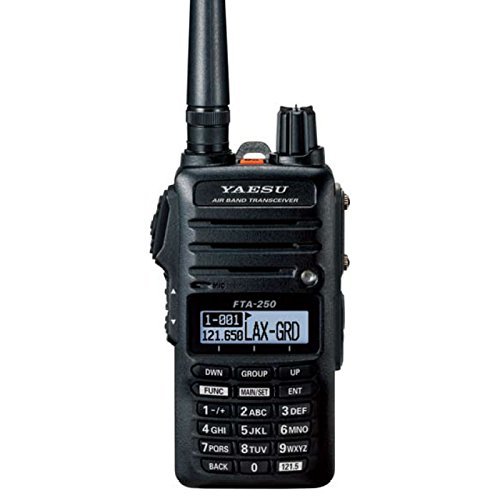
The Yaesu FTA-250L strikes the ideal balance for pilots needing a dedicated backup transceiver without breaking into premium pricing. It delivers 5 watts of transmit power across the full 118–136.975 MHz airband, supports both 8.33 kHz and 25 kHz channel spacing for international compliance, and packs 250 memory channels — enough to store every tower, ground, ATIS, and approach frequency you’ll ever need.
What sets this radio apart is its digital squelch, which eliminates the constant background hiss of analog squelch and only opens when a valid carrier is detected. The 1950 mAh Li-ion battery provides solid endurance for a full flying day, and the IPX5 waterproof rating means it survives rain on the ramp. Reviewers consistently praise its crystal-clear receive audio and the intelligent squelch that makes extended monitoring sessions much less fatiguing than competitors.
It comes complete with a drop-in charging cradle, headset adapter, belt clip, and both AC and 12V DC chargers — everything a pilot needs to throw it in a flight bag and forget about it until an emergency demands it. The only compromise is the proprietary cradle charging, which means you can’t top up with a standard USB cable mid-flight.
Why it’s great
- 5W transmit is powerful enough for reliable air-to-ground comms out to 5+ miles
- Digital squelch eliminates constant hiss for fatigue-free listening
- Supports 8.33 kHz narrowband spacing for full European compliance
Good to know
- Charging requires the included cradle; no USB-C charge port
- The included speaker earpiece is basic — upgrade to a proper headset adapter for cockpit use
2. Icom IC-A16B 51 USA Aviation Bluetooth Handheld
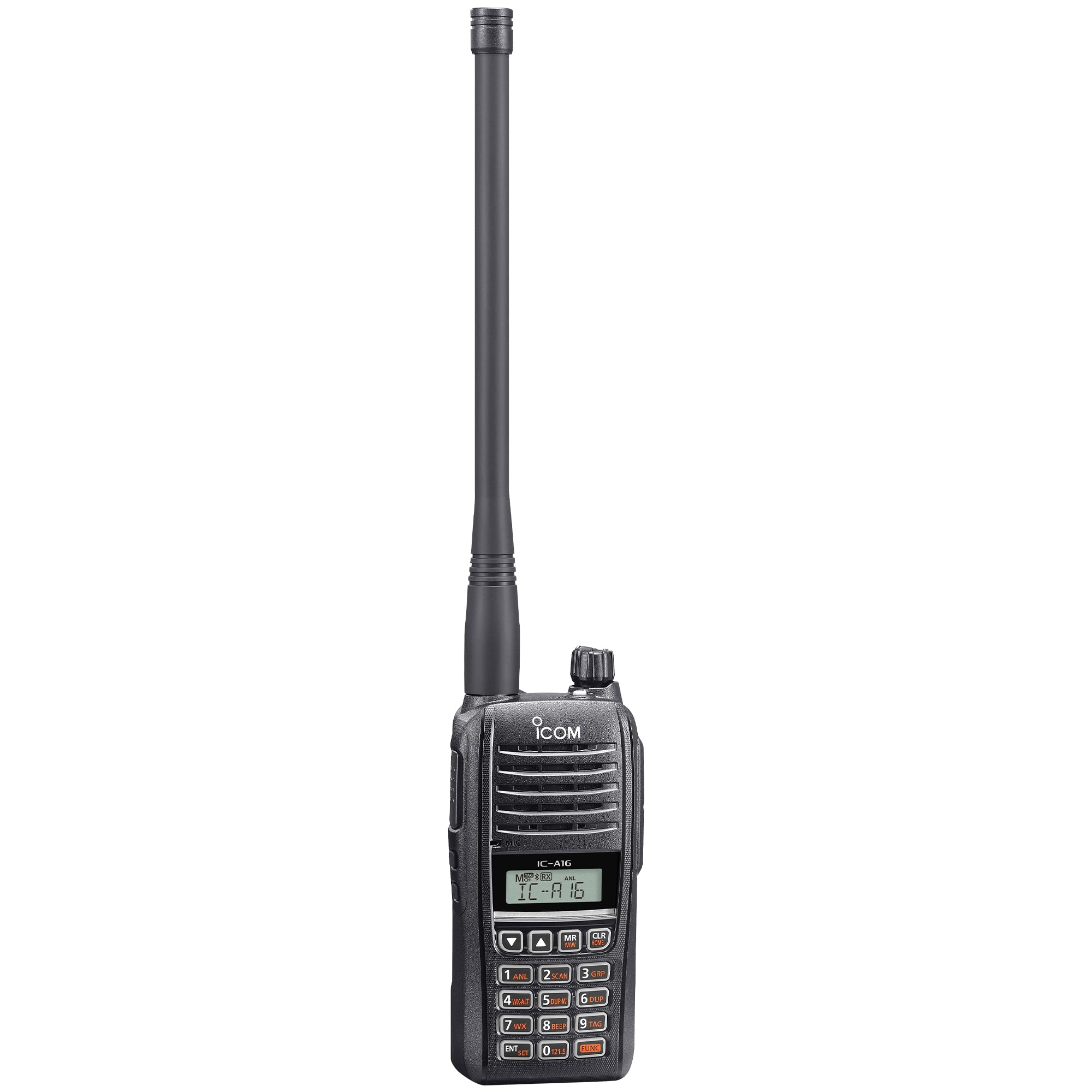
The Icom IC-A16B is the most technologically advanced handheld on this list, bringing Bluetooth wireless connectivity directly into the cockpit communication chain. Its 6-watt PEP transmit output is the strongest available, and the 1500 mW loudspeaker means you’ll hear tower calls clearly even with cockpit noise levels that overwhelm lesser radios. It supports both 8.33 kHz and 25 kHz channel spacing across 100 memory channels covering 108–137 MHz.
The built-in Bluetooth pairs directly with wireless headsets like the Bose A20, eliminating the cable tangle that plagues traditional setups — a genuine safety advantage during critical phases of flight. The IP67 waterproof housing (submersible to 1 meter for 30 minutes) and MIL-STD-810-G ruggedization make it the most durable aviation handheld available. The 2400 mAh battery delivers up to 17 hours of operation, easily covering long cross-country days.
Where the IC-A16B truly shines is audio clarity: reviewers consistently note it’s louder and clearer than the Sporty’s PJ2+ and the older Icom A-14, with text labels for saved channels that make frequency identification instant. The downsides are real — no USB charging, requiring the proprietary cradle and power supply — and the Bluetooth pairing process is less intuitive than modern consumer electronics. But for pilots who demand the best, this is it.
Why it’s great
- 6W PEP transmit and 1500 mW audio — the loudest and most powerful combo here
- Bluetooth wireless headset connection removes cockpit cable clutter
- IP67 waterproof and MIL-STD-810 rugged for harsh environments
Good to know
- Proprietary cradle charging only — no USB-C or direct power option
- Complex menu system and a poor manual make initial setup difficult
3. Sporty’s PJ2+ COM Aviation Handheld Radio

The Sporty’s PJ2+ is built on a single design philosophy: when an emergency happens, you don’t have time to navigate menus. It has the simplest user interface of any transmitting airband radio — power it on, punch in the frequency, and talk. No sub-menus, no memory-mode confusion, no complex programming required. That simplicity is its superpower.
At 6 watts PEP, it matches the Icom for transmit power, but it uses six standard AA batteries instead of a proprietary Li-ion pack. This is a deliberate safety choice: you can buy fresh AAs at any gas station in the world mid-trip, while a dead Li-ion leaves you grounded until you find AC power. The PJ2+ also includes a USB-A to USB-C cable for direct aircraft power, so you can run it indefinitely off your panel. Standard PJ headset jacks are built in — no adapters needed — and the dedicated flip-flop button instantly recalls the last-used frequency.
Reviewers highlight the PJ2+ as the perfect backup for aircraft like the C172, where it reliably pulls ATIS and AWOS during pre-flight and provides clear, powerful transmissions during flight training or solo student monitoring. The 10 memory channels are limited compared to the Yaesu and Icom, but for a backup radio that never needs charging and always just works, that’s an acceptable trade.
Why it’s great
- Zero-menu operation — power on, dial frequency, transmit instantly
- 6x AA battery flexibility means you can buy replacements anywhere
- Built-in PJ headset jacks require zero adapters for standard aviation headsets
Good to know
- Only 10 memory channels — limited compared to 200-250 on other transceivers
- AA batteries must be removed when stored to prevent leak damage
4. Yaesu FTA750L Handheld VHF Transceiver with GPS

The Yaesu FTA750L is the most feature-packed handheld NAV/COM transceiver available, combining a full VHF airband transceiver (118–137 MHz) with VOR and ILS navigation receivers and a built-in GPS receiver. For an IFR pilot, this means you can shoot an ILS approach with glideslope guidance using a handheld device that fits in your flight bag — a genuine emergency redundancy tool that can back up a failed panel-nav system.
The built-in GPS provides position awareness, distance and bearing to waypoints, and logging capability for ground-based frequency mapping. It also includes NOAA weather band monitoring, which is critical for assessing en route weather changes.
Reviewers caution that the VOR and GPS functions are functional but not Garmin-level — there’s a slight lag, and the display is best suited for occasional situational reference rather than primary navigation. Programming advanced functions like memory groups requires the Windows-based PC software (YCE01), which is not the most intuitive tool. But for a pilot who wants one device that can communicate, navigate, and provide weather information, the FTA750L packs capabilities that nothing else at this size and price can match.
Why it’s great
- VOR/ILS navigation receivers provide IFR emergency redundancy
- Built-in GPS for position awareness and waypoint logging
- Dual power: Li-ion rechargeable plus AA alkaline battery tray included
Good to know
- Advanced functions like memory groups require Windows-only PC software
- Lowest volume setting is still loud — no fine volume control for quiet environments
5. Yaesu FTA550 Handheld VHF Transceiver

The Yaesu FTA550 brings the same NAV/COM capability as the FTA750L — with ILS and VOR navigation receivers — at a lower price point by stripping out the GPS and using a simpler power system. It covers the full 108–136.975 MHz range, giving you both the navigation band (108–118 MHz for VOR/ILS) and the communications band (118–137 MHz) in one package.
It runs on two AA batteries, which is both a strength and a limitation. The strength is universal battery availability — you can use Ni-MH rechargeables or standard alkaline cells anywhere in the world. The limitation is that the AA battery tray is notoriously tight; reviewers note you often need a screwdriver to wedge the cells out. Ni-MH batteries trigger an early low-battery warning but still run for over 8 hours of active use, which is serviceable for a backup unit.
Where this radio excels is as a dedicated emergency backup in a flight bag. Reviewers who have owned it for 15+ years report it still works like new. The receive audio is strong — comparable to panel-mounted Garmin and King radios — and the transmissions are clear out to 5 miles with the included antenna. The menu system feels dated, and there’s a known USB connection timeout bug with the programming software, but for the price of a NAV/COM handheld with ILS capability, the FTA550 remains a remarkable value.
Why it’s great
- ILS/VOR receivers provide navigation backup at budget-tier pricing
- 2x AA battery operation means universal power availability
- Proven durability — many units still working flawlessly after 15+ years
Good to know
- AA battery tray is very tight — removing cells without tools is difficult
- Antenna lacks a positive locking mechanism and loosens easily
6. C. Crane CC Skywave SSB 2
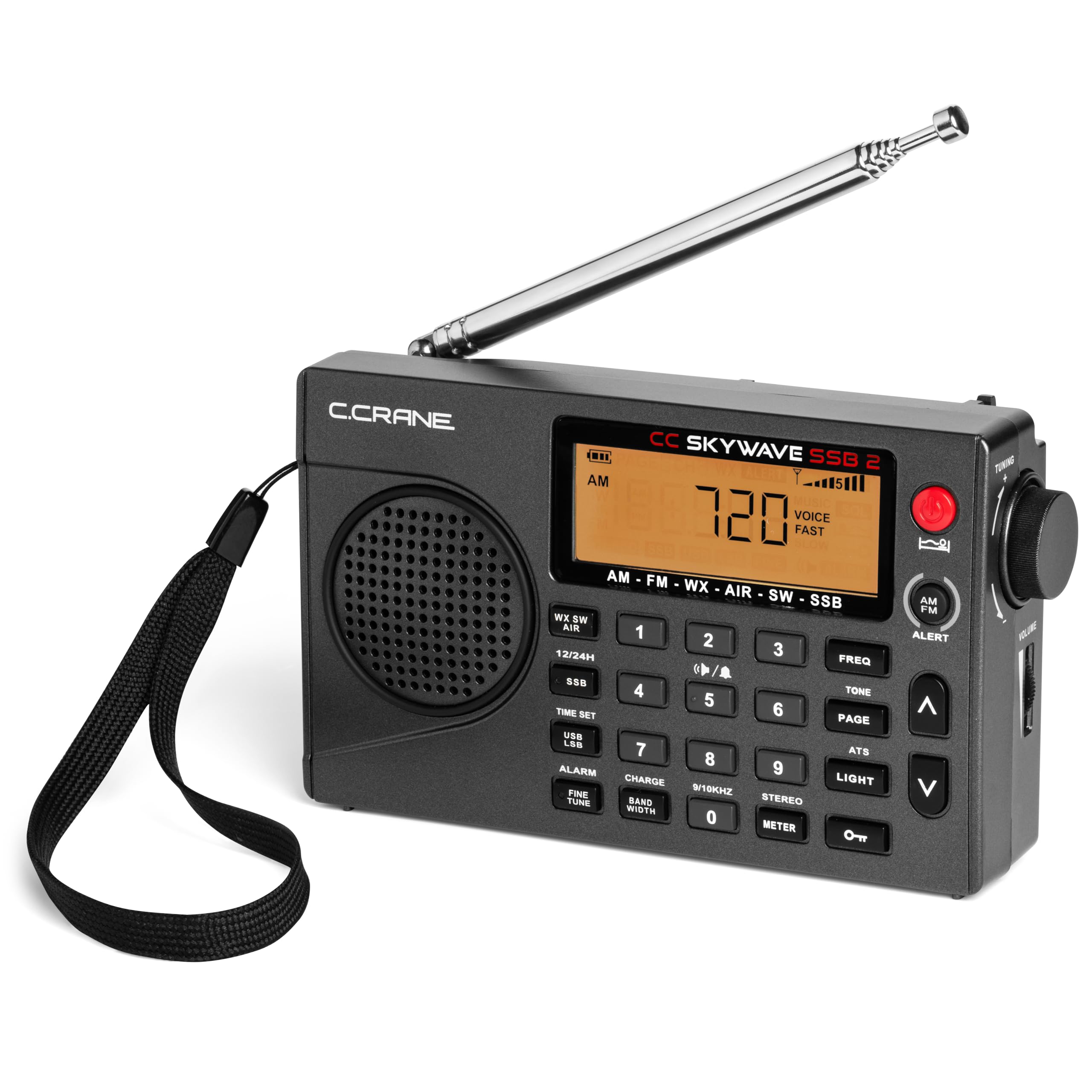
The C. Crane CC Skywave SSB 2 is a marvel of miniaturization, packing AM, FM, Shortwave (1711–29999 kHz), NOAA Weather + Alert, VHF Aviation (airband), and Single Side Band reception into a package that measures just 4.75 x 3 x 1.1 inches and weighs 6 ounces without batteries. It runs on 2 AA batteries for approximately 70 hours with earbuds or 60 hours through the built-in speaker — extraordinary endurance for a radio this small.
The airband performance is excellent for a receive-only radio, with multiple bandwidth settings and selectable fast or fine tuning. The 10 aviation memories can be scanned specifically for activity, letting you quickly check which frequencies are active at your local airport. The inclusion of SSB is a bonus for radio enthusiasts who want to listen to long-range emergency communications that normal AM/FM radios cannot decode — useful for off-grid backup situations.
Reviewers consistently praise the reception quality, noting that the CC Skywave performs far better than its size suggests, especially when paired with the included 23-foot shortwave reel antenna. The downsides are the small buttons with multiple functions mapped to each one — the learning curve is steep, and the manual is small but dense. For the aviation listener who travels light and wants a radio that fits in a jacket pocket, the CC Skywave is the ultimate portable companion.
Why it’s great
- Pocket-sized at only 6 oz with excellent sensitivity on all bands
- 10 dedicated aviation memories with band scanning for active frequencies
- SSB capability adds emergency backup communications tool
Good to know
- Small buttons with multi-function assignments require a steep learning curve
- Limited fine-tuning control makes finding very weak airband signals challenging
7. XHDATA D808 Portable Multi-Band Radio

The XHDATA D808 proves that you don’t need to spend hundreds to get solid airband reception with excellent sensitivity. It covers FM (64–108 MHz), AM (520–1710 KHz), LW, SW (1711–29999 KHz), and the aviation band (118–137 MHz) with Single Side Band decoding — a feature typically reserved for radios costing three times as much. The DSP chip provides impressive selectivity, and the 360-degree antenna picks up stations across a wide arc.
What makes the D808 stand out in the budget tier is its 500 station memories with frequency display, meaning you can save every local tower, ground, ATIS, and approach frequency plus hundreds of shortwave stations without forgetting a single one. The 18650 battery is user-replaceable — you can swap in a high-capacity 3000 mAh cell for extended monitoring sessions. The Type-C USB charging is a welcome modern convenience that most dedicated airband transceivers lack.
Reviewers who upgraded from the Sihuadon R-108 note the D808 has a larger, better speaker and more robust SSB performance. The aviation band reception is rated as “fantastic” by one user pulling a tower 45 miles away. The main deficiency is the clunky memory recall system — you can’t scroll through memories, you must page-select double-digit slots, and there is no dedicated airband scan function. For pure airband monitoring value, though, the D808 is unmatched.
Why it’s great
- Excellent airband sensitivity that rivals radios costing three times as much
- 500 station memories and removable 18650 battery with Type-C charging
- SSB decoding adds emergency communications and shortwave utility
Good to know
- No dedicated airband scan mode — memory recall is a multi-step process
- Poor ergonomics with flushed buttons and no VFO/memory mode switch
8. Raddy RF919 SSB Shortwave Radio
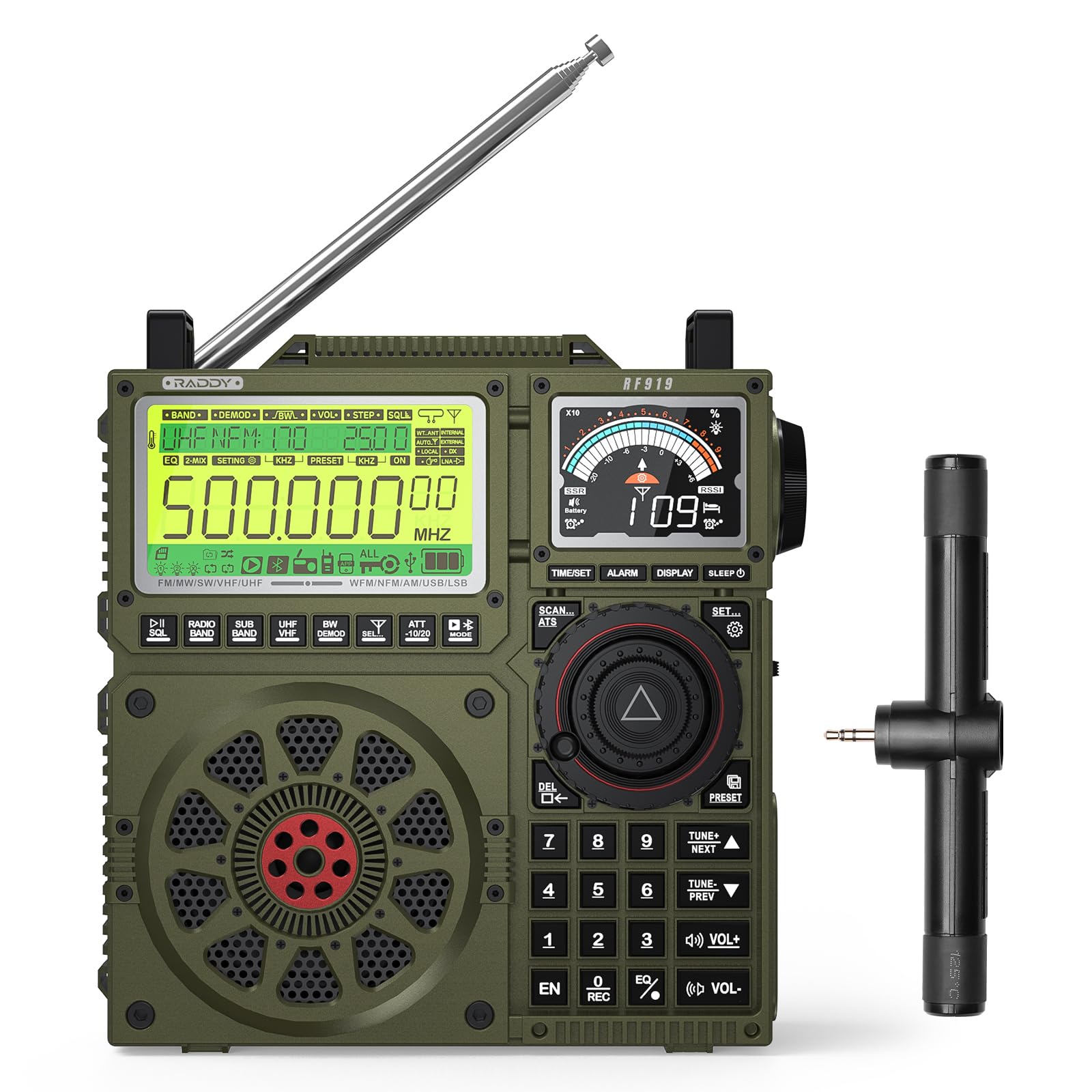
The Raddy RF919 is a multi-band monitoring powerhouse that covers FM, AM, SW, SSB, VHF, UHF, AIR (aviation), CB, and WB (weather) bands in a single retro-styled chassis. Its dual-screen design is unique — a 3.54-inch main display shows reception status, while a secondary screen adds signal strength, time, and a customizable music spectrum light. The 5000 mAh battery (dual 18650 cells) provides exceptional run time for extended airshow or airport monitoring sessions.
The aviation band performance is solid, picking up tower and ground frequencies clearly with the included antennas. The RF919 offers three external antenna ports (VHF/UHF SMA, AM antenna, and 3.5mm SW), giving you the flexibility to optimize reception for each band using dedicated external antennas. The 20W speaker and built-in subwoofer deliver audio quality that far exceeds typical airband receivers — useful when you want to hear ATC instructions clearly across a noisy room.
The Bluetooth input and micro SD card playback add entertainment utility, and the Radio-CT app allows single-handed control from your phone — freeing you to scan frequencies on the radio while managing your playlist or antenna adjustments. Reviewers note that the airband reception is “good” rather than “great,” and the tuning knobs feel less robust than the overall build quality suggests. The RF919 is best suited for the aviation enthusiast who wants one radio to monitor everything — airband plus CB, shortwave, weather, and FM music — rather than the dedicated pilot looking for a flight bag transceiver.
Why it’s great
- 5000 mAh battery provides days of continuous monitoring on a single charge
- Dual screens with signal strength and time display for at-a-glance situational awareness
- Three external antenna ports allow band-specific optimization
Good to know
- Tuning knobs feel flimsy and wobbly compared to the solid chassis
- Batteries drain slowly even when the radio is switched off
9. BTECH UV-PRO IP67 Dual Band HT with Airband Scan
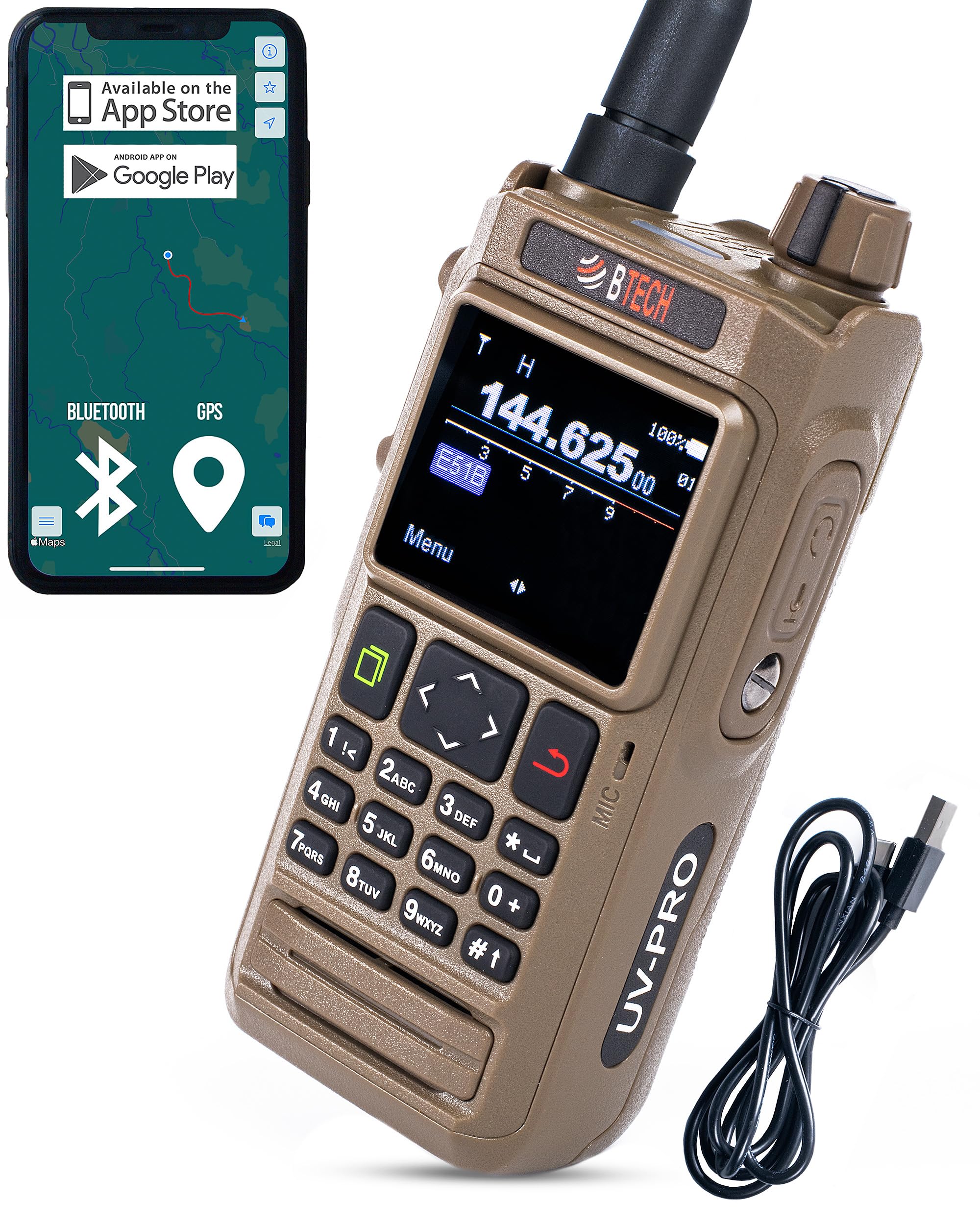
The BTECH UV-PRO is primarily a dual-band VHF/UHF amateur radio transceiver (2m/70cm) with a bonus: it receives the aviation band (118–137 MHz) with Frequency Sync Rapid Scanning to quickly locate active air traffic frequencies. For a licensed ham radio operator who also monitors airport traffic, this is arguably the best value proposition on the market — APRS, Bluetooth, GPS, text messaging, and NOAA alerts all packed into an IP67-rated waterproof housing.
The smartphone app programming via CSV files is a game-changer for speed: you can build an entire channel list on your phone in minutes and push it to the radio without touching a single menu button. The built-in GPS enables APRS position reporting and location sharing between the radio and the app, making it a powerful tool for SAR teams, event coordination, or off-grid field work. The Frequency Sync Rapid Scan automatically finds the strongest nearby active frequencies, which is excellent for quickly tuning into local airport traffic without knowing the specific ground or tower frequencies.
Reviewers praise the clean transmit audio that rivals much higher-end ham HTs, and the Bluetooth integration with the BS-22 BT speaker/mic provides zero-delay wireless operation. The downsides: no CHIRP support (proprietary app only), and the aviation band is receive-only — you cannot transmit on airband frequencies. The BTECH UV-PRO is the ultimate Swiss Army knife for the radio enthusiast who wants airband monitoring plus full amateur radio capabilities in a single rugged package.
Why it’s great
- Full dual-band ham transceiver + airband scanning in one IP67 waterproof unit
- Frequency Sync Rapid Scan auto-finds active air traffic frequencies on-site
- Smartphone app programming via CSV is faster and easier than any menu-based system
Good to know
- Airband is receive-only — no transmit capability on aviation frequencies
- No CHIRP programming support; proprietary phone app required for batch programming
FAQ
Can I listen to aviation frequencies without a license?
What is the difference between a transceiver and a receiver for airband use?
Do airband radios work through aircraft cockpit noise?
Final Thoughts: The Verdict
For most pilots needing a reliable backup transceiver, the best aviation band radio winner is the Yaesu FTA-250L because it combines 5W transmit power, 8.33/25 kHz channel spacing, digital squelch, and 250 memory channels at a price point that makes it accessible for every flight bag. If you want Bluetooth wireless headset connectivity and the loudest audio output for noisy cockpits, grab the Icom IC-A16B. And for the aviation enthusiast who just wants to listen to tower traffic without spending on transmit capability, nothing beats the pocket-friendly portability of the C. Crane CC Skywave SSB 2.