
A stretch of remote land, a construction site miles from the nearest router, or a seasonal cabin where the internet was never installed — these are the places where a standard security camera becomes a useless plastic brick. The core difference in this category isn’t resolution or field of view; it’s connectivity independence. A 4G security camera replaces your home Wi-Fi network with a cellular data connection, making it the only real option for off-grid monitoring where the network map shows a dead zone.
I’m Min — the co-founder and writer behind Gadgets Feed. I’ve logged hundreds of hours analyzing cellular camera specs, data plan structures, solar charging efficiency, and real-user deployment scenarios across farms, job sites, and vacation properties to separate the cameras that truly deliver off-grid reliability from those that frustrate with hidden subscription traps and flaky motion detection.
Whether you need to keep an eye on livestock, secure equipment, or monitor a remote entry point, choosing the right 4g security camera means weighing battery capacity against solar panel wattage, understanding data plan commitments, and knowing which features actually work over a cellular connection rather than just sounding good on paper.
How To Choose The Best 4G Security Camera
Buying a 4G security camera means deliberately stepping away from the convenience of unlimited home Wi-Fi and grid power. The trade-off is freedom of placement, but the selection criteria shift entirely toward cellular reliability, power autonomy, and data cost predictability. Ignoring these three pillars leads to a camera that either burns through your data cap, dies in the shade, or connects to the wrong carrier’s weak tower.
Network Compatibility and Data Plan Structure
Not all 4G cameras connect to all carriers. Many units use a built-in eSIM that auto-selects between Verizon, AT&T, and T-Mobile, but some are locked to a single network or require a specific carrier’s SIM. Check which towers have coverage at your exact coordinates before buying. Data plan costs vary wildly — some cameras require monthly subscriptions (–/month) while a few offer lifetime free unlimited data, dramatically changing the total cost of ownership over two or three years.
Solar Panel Wattage and Battery Chemistry
Solar-powered 4G cameras must generate enough energy to run the cellular modem, which draws more power than a Wi-Fi camera. A 6W solar panel paired with a 2000mAh battery might sustain a camera in Arizona summer but fail completely during a Pacific Northwest winter with short, overcast days. Look for at least a 6W panel (12W is better for continuous use) and a battery capacity above 5000mAh if the camera supports 360° pan-tilt or live-view streaming, both of which are power-intensive.
PTZ and Auto-Tracking Over Cellular Latency
Pan-tilt-zoom is a powerful feature, but controlling it over a 4G connection introduces noticeable lag. Budget-friendly cameras often rely on the UBox or similar apps where PTZ commands feel sluggish. Premium options like Reolink’s TrackMix implement auto-tracking that runs locally on the camera rather than requiring smooth app control, making the feature genuinely useful. If you need real-time, responsive panning, latency matters more than the motor speed spec.
Storage Path: Cloud vs. Local SD Card
Every 4G camera, by nature of operating off-grid, must handle recording without a home server or NVR. Most offer both cloud storage (subscription required after a free trial, typically 7–30 days) and local SD card support up to 128GB or 512GB on premium models. The SD card is the cheaper long-term option, but you must physically retrieve it to access footage — cloud playback offers remote convenience at a monthly cost. Dual storage, available on several models, gives you the best of both worlds.
Quick Comparison
On smaller screens, swipe sideways to see the full table.
| Model | Category | Best For | Key Spec | Amazon |
|---|---|---|---|---|
| Reolink TrackMix LTE+SP | Premium | Highest detail with dual-lens zoom | 4K 8MP dual lens, 6x hybrid zoom | Amazon |
| Reolink Atlas Go PT | Premium | Longest battery life with 12W solar | 2000mAh battery, 6-month endurance | Amazon |
| Tactacam Defend Bundle | Mid-Range | Complete kit out of the box | 4K photo, 1080p video, 0.4s trigger | Amazon |
| Sansco S52-4G-3MP | Mid-Range | Zero monthly data fees | Lifetime free unlimited data | Amazon |
| Tactacam Defend | Mid-Range | Entry-level cellular with low plan cost | 4K photo, 1080p video, plans from /mo | Amazon |
| GLEEMALL 4G LTE 2-Pack | Budget | Two-camera coverage on a budget | 360° PTZ, 2K color night vision | Amazon |
| ELYSOO 4G LTE 2-Pack | Budget | Most affordable 2-pack for farm use | 2K resolution, 360° pan & tilt | Amazon |
In-Depth Reviews
1. Reolink TrackMix LTE+SP
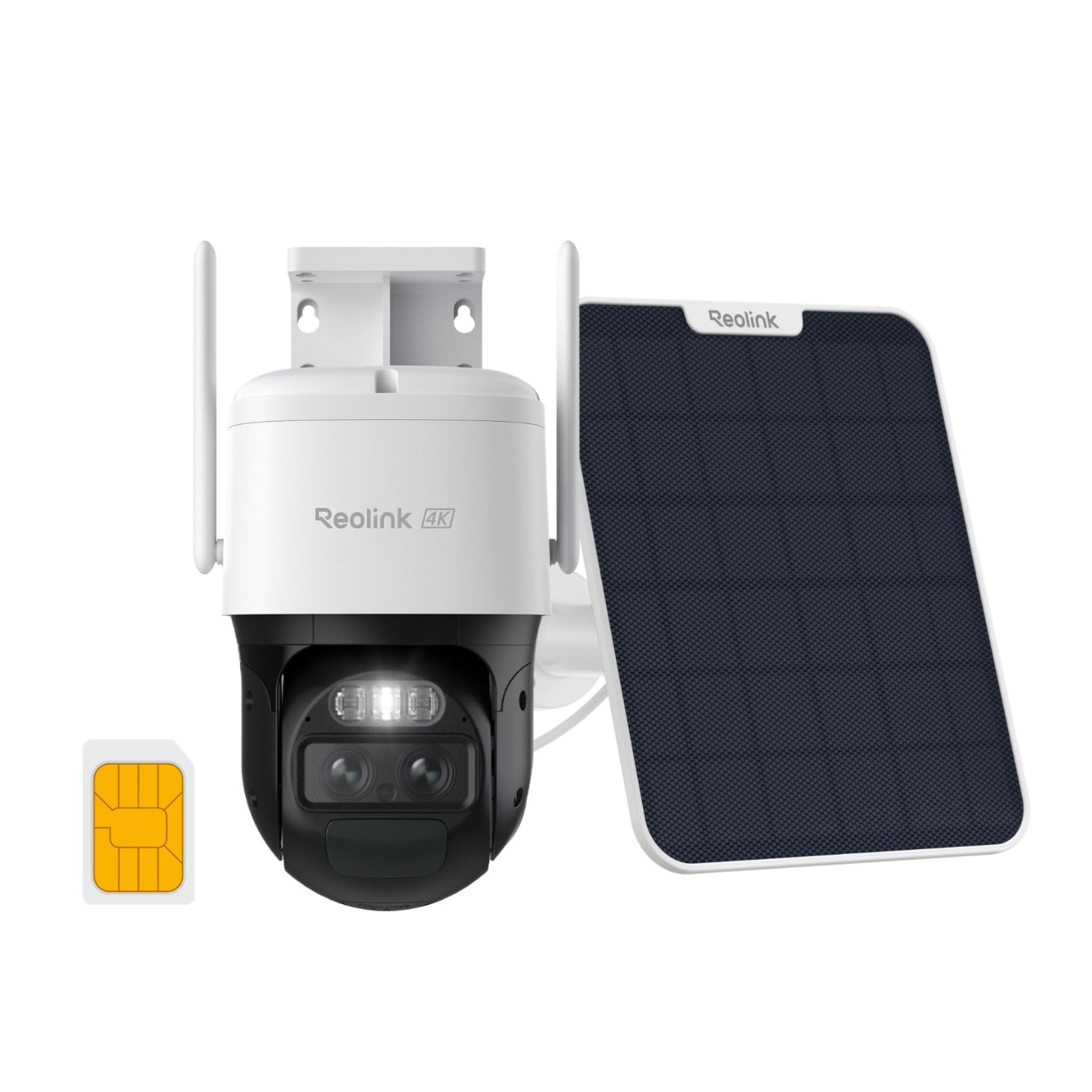
The TrackMix LTE+SP redefines what a 4G security camera can deliver by packing two independently functioning lenses — a wide-angle overview and a telephoto zoom — into a single PTZ housing. The 4K 8MP sensor pair, combined with 6x hybrid zoom, lets you read a license plate at the far end of a pasture while still seeing the entire gate on the same screen. Auto-tracking runs on the camera itself rather than relying on cloud processing, so the zoom follows a moving vehicle or person even when the cellular signal introduces a few seconds of latency.
Reolink’s smart detection correctly distinguishes people, vehicles, and pets, pushing relevant alerts via email or the app. The PTZ range covers 355° pan and 90° tilt, leaving virtually no blind spot, and the solar panel keeps the camera charged continuously even on overcast days based on field reports. The included SIM card supports 3G/4G LTE fallback on AT&T and T-Mobile, and you can insert a microSD up to 512GB for local recording without any cloud subscription.
The main drawback is the setup process, which some users report as fiddly — particularly the small, non-captive screws for the SD card and SIM covers, and the initial app pairing that requires patience. Data plan activation through the Reolink app is straightforward, but the cluttered app interface takes some learning. For buyers who prioritize image detail and intelligent tracking over simplicity, this is the most capable 4G camera available at this tier.
Why it’s great
- Dual-lens system provides simultaneous wide view and 6x zoom detail on one screen
- Local auto-tracking works reliably even with cellular latency
- 512GB local microSD support eliminates cloud subscription needs
Good to know
- Setup requires patience with small hardware and app navigation
- Customer support response can take 1-3 days; live chat is limited
2. Reolink Atlas Go PT
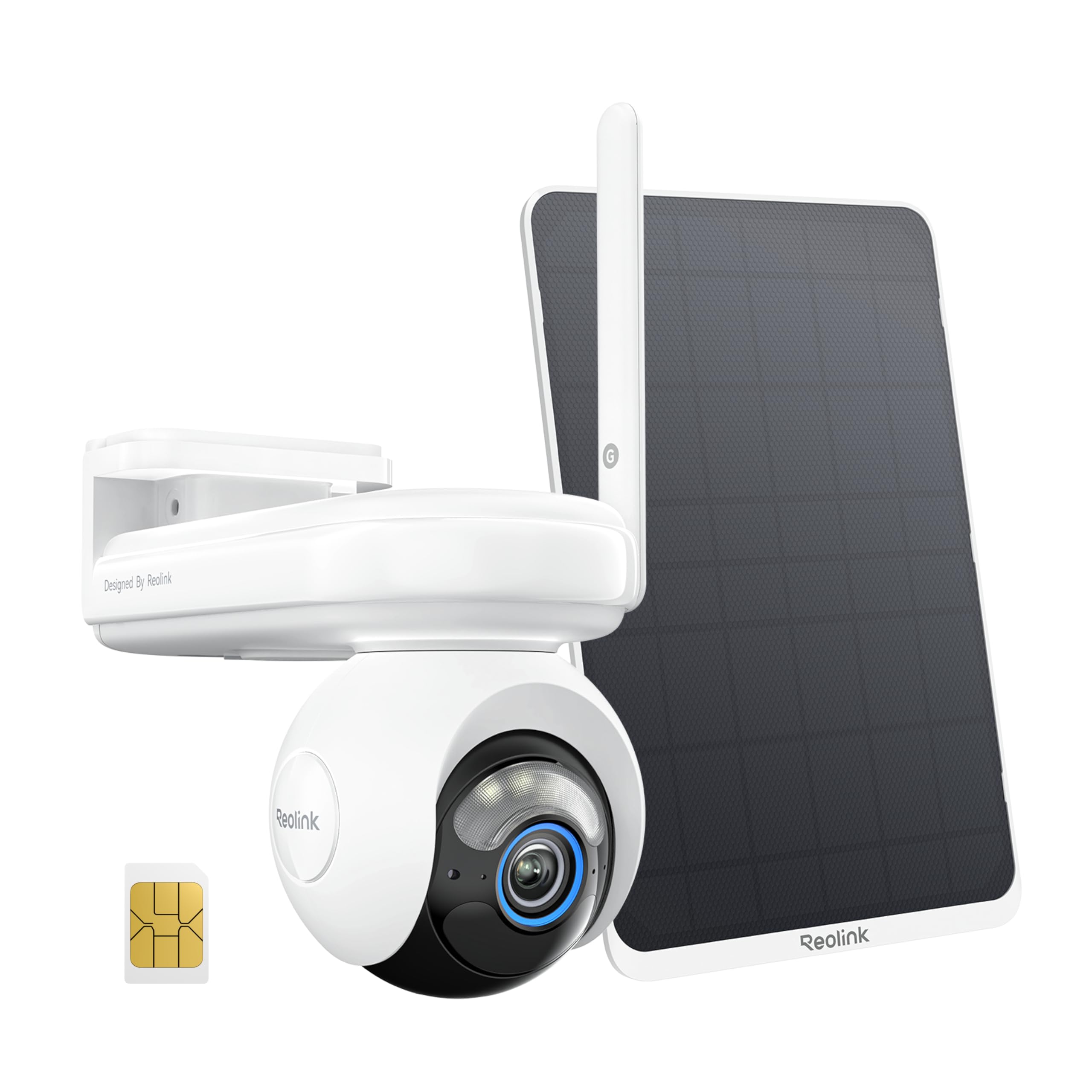
Reolink claims a 6-month battery life on the Atlas Go PT in standard mode, and real-world deployments — including one unit installed at a high-traffic gate during a short-winter-day region — reported the battery still at 100% after two weeks with the 12W solar panel attached. This endurance is made possible by the large 2000mAh internal battery and a power management system that prioritizes motion-activated recording over constant streaming. The 12W panel is significantly larger than the 6W panels found on most competitors, which makes the difference when sunlight hours drop below six per day.
The ColorX night vision technology captures full-color footage in low light without needing a blinding white spotlight. Combined with 2K resolution and 355° pan / 90° tilt rotation, the camera covers a large yard, stable, or construction site while intelligently auto-tracking moving subjects. The 10-second pre-recording feature buffers footage before a motion event triggers, ensuring you do not miss the critical first moments of an intrusion or animal crossing.
The cellular connectivity is flexible: the Atlas Go PT includes a SIM card with 100MB of free trial data, and you can refill through the Reolink app with no contract. SmartThings compatibility allows integration with smart home routines. The primary limitation is the 4MP effective still resolution, which is lower than the 8MP TrackMix — fine for general monitoring but not ideal for identifying faces at distance. Also, users on slower rural data plans note that live-view streaming can lag, though recorded clips play back smoothly from the microSD card (up to 512GB, sold separately).
Why it’s great
- Massive 2000mAh battery with 12W solar panel delivers true 6-month autonomy
- ColorX full-color night vision without intrusive spotlights
- 10-second pre-recording buffer catches events before motion triggers
Good to know
- Effective 4MP resolution is lower than dual-lens competitors
- Live-view streaming can experience lag over slow cellular connections
3. Tactacam Defend Cellular Security Camera Bundle

Tactacam’s Defend Bundle is the rare 4G camera kit where you genuinely need nothing else to get started — the box contains the camera body, a dedicated solar panel, a rechargeable lithium battery pack, a Lexar 32GB microSD card, and a microfiber cloth. This eliminates the typical frustration of buying a camera, then discovering you need to separately source a compatible solar panel and SD card. The camera itself delivers 4K UHD stills and 1080p HD video with a 0.4-second trigger speed that captures fast-moving vehicles and wildlife reliably.
The built-in eSIM automatically selects the strongest available carrier (Verizon, AT&T, or T-Mobile) with no manual SIM swap or carrier activation. Tactacam’s data plans start at per month, which is among the most affordable in the category, and you can share camera access with multiple users at no extra cost. Users report the solar panel and battery combination keeping the camera running for months without a ladder climb for recharging, though in winter with very limited sun, the battery may need a top-up every 6–9 months.
The trade-off is that on-demand live video is not available — this is primarily a motion-activated capture camera with scheduled check-in capabilities. The motion-to-notification delay, while better than many trail cameras, still lags 3–8 minutes depending on cellular signal strength. Night vision IR is effective up to roughly 65 feet, but background detail drops off beyond that range. For users who need reliable intrusion detection and periodic photo/video updates rather than continuous live monitoring, the Defend Bundle offers the best value-per-dollar in this lineup.
Why it’s great
- Complete out-of-box kit with solar panel, battery, and SD card included
- 0.4-second fast trigger captures fast-moving subjects cleanly
- Flexible data plans start at /month with no contract
Good to know
- No live-view streaming — motion capture only
- Battery may need manual charge every 6–9 months in low-sun climates
4. Sansco S52-4G-3MP
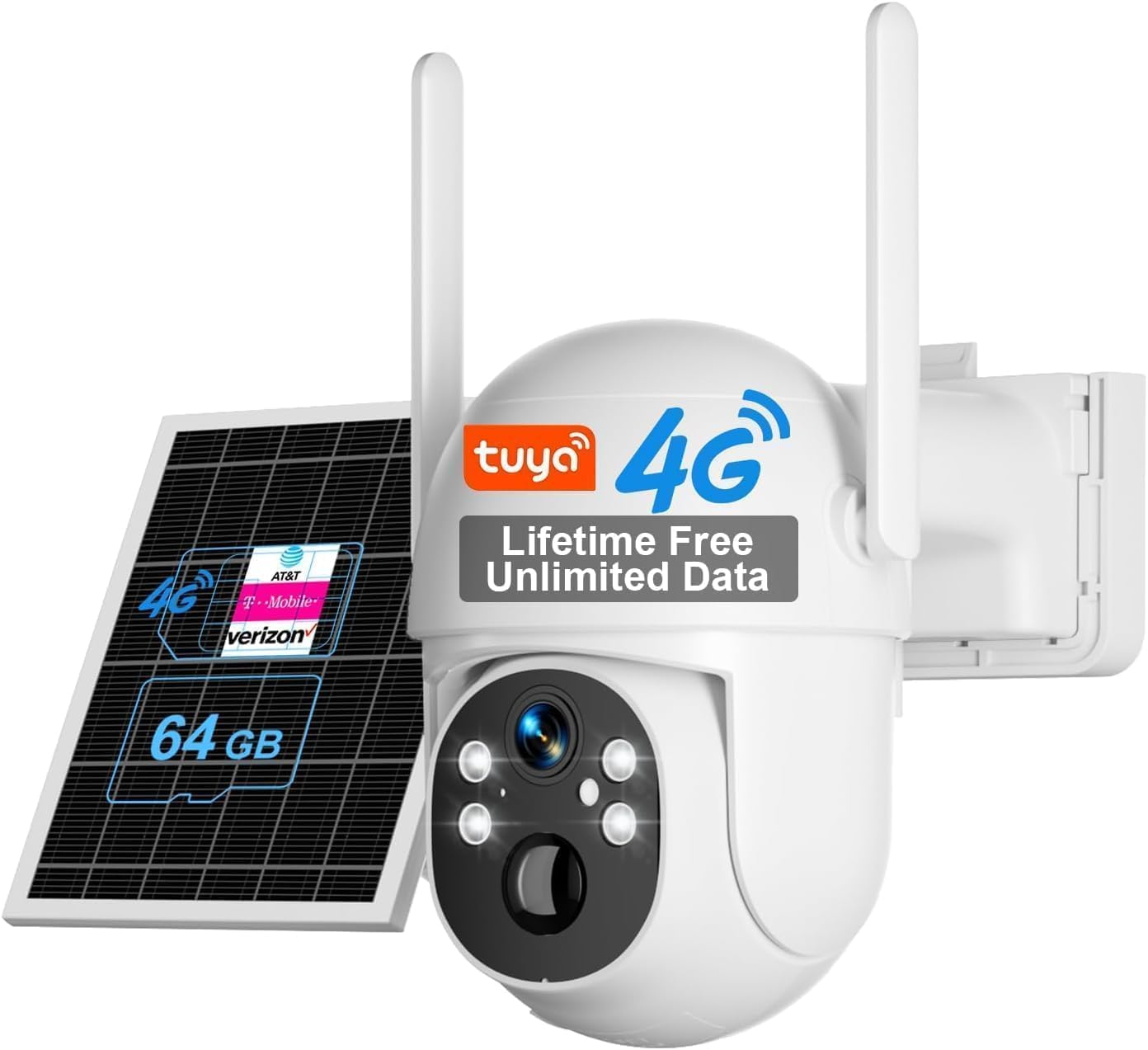
The Sansco S52-4G-3MP is the strongest argument against recurring subscription costs in the 4G security camera space. Its built-in SIM card offers lifetime free unlimited data — no monthly fee, no trial period that expires, no surprise billing after a year. For properties where a single camera will run for years, this eliminates the – in subscription costs that other cameras would accumulate over the same period. The camera also ships with a 64GB TF card included, further reducing upfront accessory spending.
Video quality hits 2K (3MP) with color night vision that can identify a license plate up to 49 feet away. The 355° horizontal and 90° vertical PTZ range covers large open areas, and the 7800mAh battery paired with the included solar panel maintains continuous 24/7 operation without wiring. The Tuya/Smart Life app provides AI-based motion detection that distinguishes people from animals, two-way audio, and customizable detection zones. The IP66 weatherproof rating is one notch above the more common IP65, offering better dust protection for dry, dusty environments like barns or construction sites.
The primary compromise is motion detection reliability. Several users report that the PIR sensor is offset to one side, causing it to miss movement entering from the camera’s right field while generating false positives on the left side. The motion detection settings in the app offer sensitivity tuning, but the sensor’s physical placement means it doesn’t cover a perfectly symmetrical field. For static monitoring where 100% motion capture isn’t critical — like watching a gate or a feed area — the Sansco’s zero-cost data plan makes it the most economical long-term option.
Why it’s great
- Lifetime free unlimited data with no hidden fees or expiring trials
- 64GB microSD card and solar panel included in the box
- IP66 weather resistance handles dust and heavy rain
Good to know
- PIR motion sensor has an asymmetrical blind spot on the right side
- Subject to false positives even after sensitivity adjustment
5. Tactacam Defend

The standard Tactacam Defend strips the bundle down to the camera body and operates on either AA batteries or an optional rechargeable lithium pack (sold separately). This makes it the lightest and most compact cellular camera in the lineup, weighing approximately 2.4 pounds and measuring just 5.9 x 4.8 x 3.5 inches. The size advantage is meaningful when mounting on a fence post, tree branch, or gate where a larger solar-paneled unit would be cumbersome or conspicuous. The 4K photo and 1080p video quality matches the bundle version, with the same 0.4-second trigger and 100-foot infrared night vision range.
The auto-carrier eSIM works identically to the bundle version, requiring zero carrier setup and supporting data plans starting at per month. Users report that image quality is genuinely excellent, with license plates legible at slow speeds and motion alerts arriving within roughly a minute of detection. The app is straightforward and allows multi-user sharing at no extra cost, making it simple for multiple family members or crew members to receive alerts simultaneously.
Missing from this base unit are the solar panel and rechargeable battery, so you must supply your own power. AA batteries will drain relatively quickly — expect to replace them every few weeks depending on motion activity — making the Defend better suited for temporary deployments or locations where you can easily access and replace batteries. Additionally, like the bundle version, there is no live-view streaming; the camera captures and sends photos and video clips on demand, but you cannot watch a continuous feed. For seasonal cabin monitoring or short-term construction site security, the compact Defend is a capable, low-cost entry point into 4G camera ownership.
Why it’s great
- Most compact and lightweight body, easy to mount in tight spots
- Excellent 4K photo quality with fast 0.4-second trigger
- Lowest data plan entry cost at /month with no contract
Good to know
- No solar panel or rechargeable battery included — runs on AA batteries
- No live-video streaming; motion-capture only
6. GLEEMALL 4G LTE 2-Pack
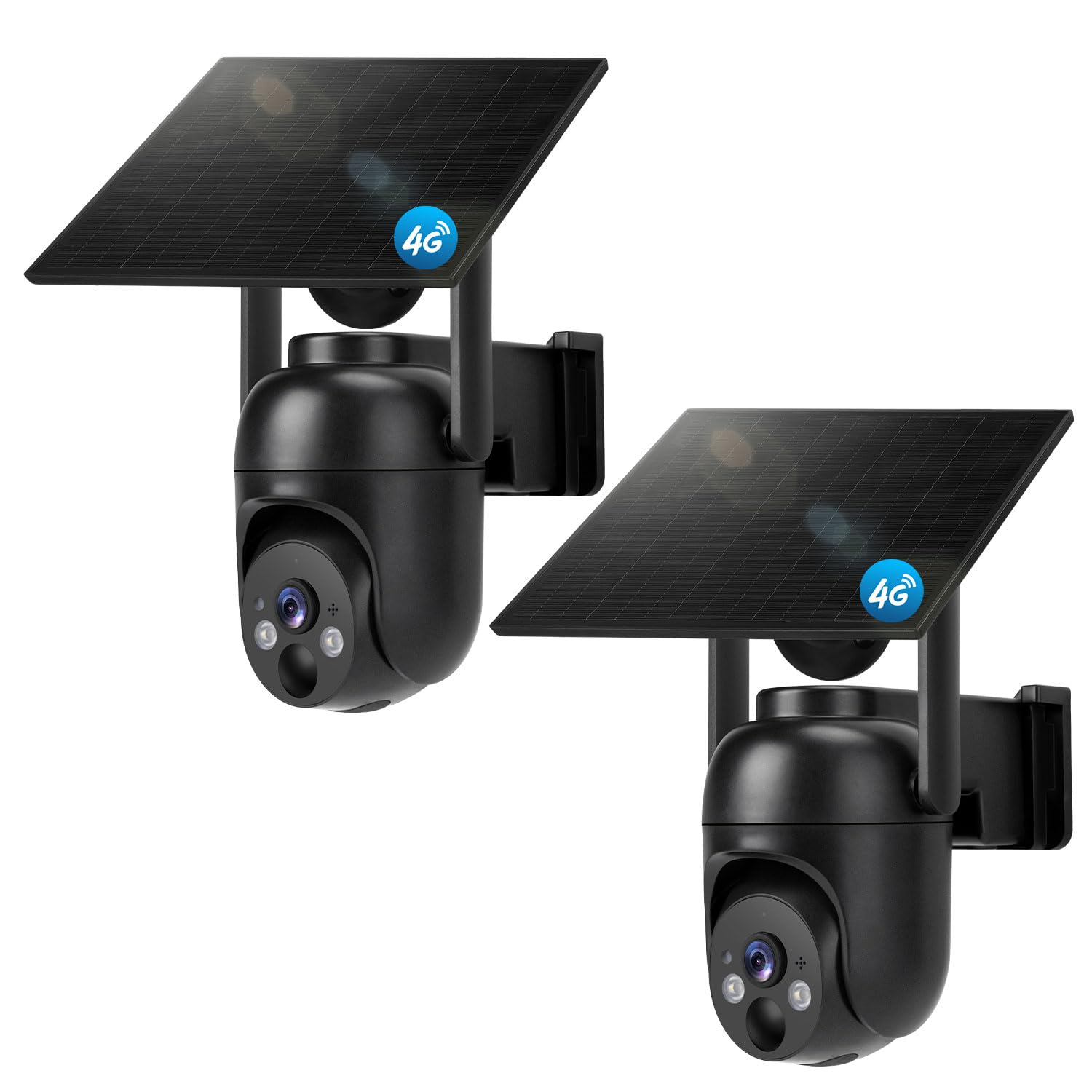
Delivering two solar-powered 4G cameras with 360° PTZ, 2K color night vision, and a 6W solar panel per camera for a combined price that barely exceeds a single premium unit, the GLEEMALL 2-pack is the strongest budget play in the category. Each camera includes a built-in SIM card with a 7-day unlimited data trial, after which a subscription through the UBox app costs per month or per year per camera. The combination of two cameras with solar autonomy makes this kit ideal for covering a barn and a gate, or two sides of a cabin, on a tight budget.
The UBox app provides customizable motion detection zones, two-way audio, white light and siren alarm deterrents, and event recording to a microSD card (up to 128GB, not included). The 355° pan and 100° tilt range offers near-complete coverage without blind spots. Users consistently praise the image quality, ease of setup (under an hour for both cameras), and the solar panel’s ability to keep the battery topped up in direct sun. The IP65 weatherproof rating handles rain and dust adequately for outdoor deployment.
The most significant risk is the subscription model. If you need continuous recording or cloud storage, the per-camera monthly fee doubles the ongoing cost for the 2-pack, bringing it to nearly /month. Some users reported losing access to the camera after the trial if the subscription was not activated correctly, with poor customer support response when account issues arose. Also, the cameras do not support WiFi at all, so they must rely entirely on the built-in SIM — if the cellular signal at your location is weak, there is no fallback option. For short-term monitoring or users comfortable with the subscription structure, the GLEEMALL 2-pack offers impressive hardware for the price.
Why it’s great
- Two full-featured 4G solar cameras for a very low combined price
- 2K color night vision and 360° PTZ on both units
- Solar panels keep batteries charged with minimal intervention
Good to know
- Subscription required after 7-day trial at /month per camera
- Customer support can be unresponsive for account or subscription issues
7. ELYSOO 4G LTE 2-Pack
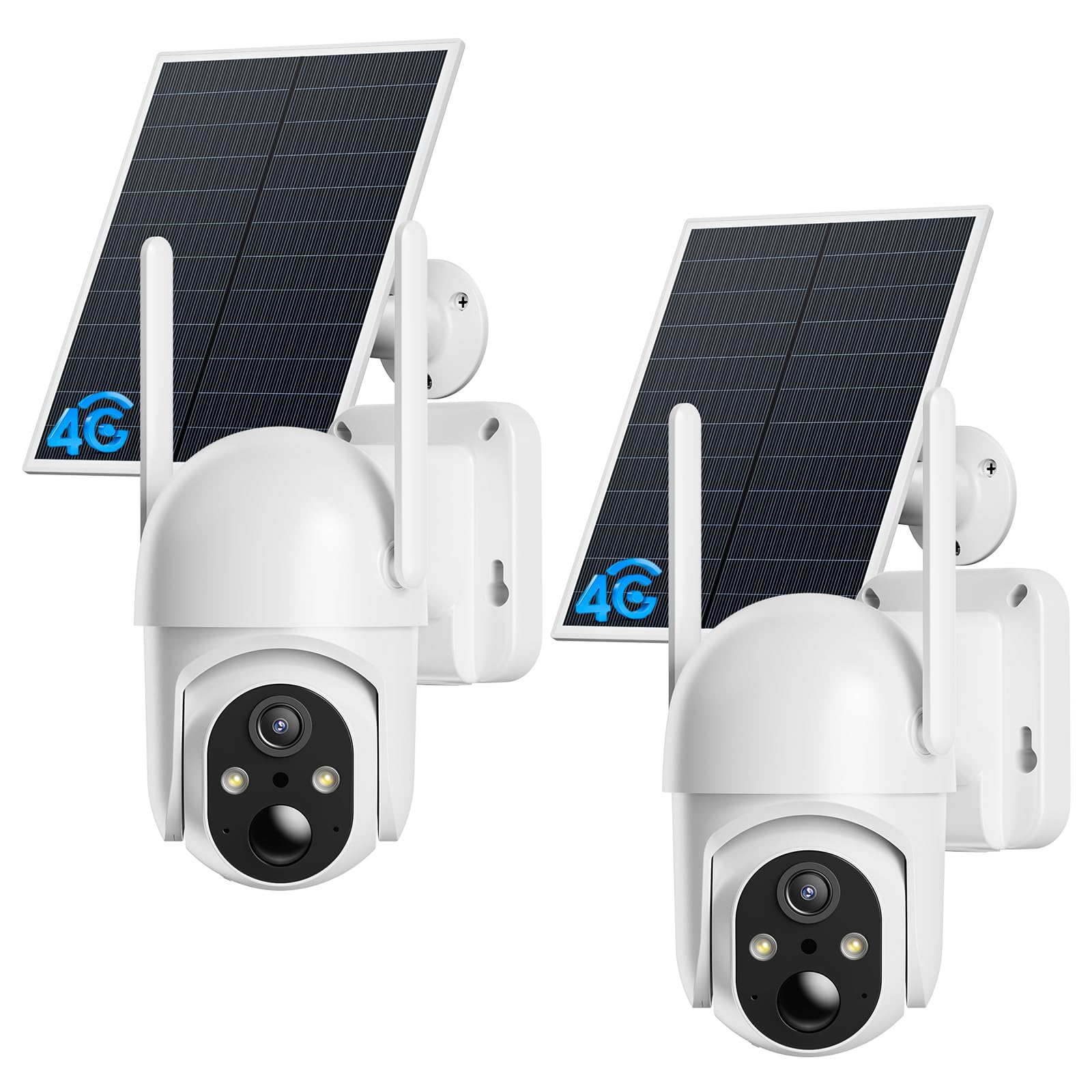
The ELYSOO 4G LTE 2-pack targets the absolute entry-level price point for two-camera cellular security without WiFi. Each camera features 2K HD resolution, 360° pan and tilt, enhanced infrared night vision, and a solar panel for off-grid power. The built-in SIM card supports Verizon, AT&T, and T-Mobile networks, and comes with a 7-day free data trial. After the trial, the UBox subscription costs per month or per year per camera. The IP65 weatherproof housing is rated for rain, snow, dust, and temperature extremes, making it viable for barns, pastures, and outbuildings.
Early adopters and verified purchasers report surprisingly solid performance for the price point — clear day and night footage, reliable motion alerts through the UBox app, and solar panels that keep the cameras running without manual charging in moderate sunlight. The 2-pack structure means you can monitor two separate zones immediately. Several users on horse farms and chicken coops found the cameras adequate for watching animals and detecting predators, with the caveat that they do not need continuous recording and therefore avoid the ongoing subscription for cloud storage.
The trade-offs are visible at this entry tier. The camera construction feels less premium than mid-range competitors, with lighter plastic housing and less robust mounting hardware. Subscription confusion is the most common complaint — multiple users reported difficulty understanding that each camera requires its own separate data plan, effectively doubling the monthly cost for the 2-pack. Some users felt misled by the “free service” messaging in marketing materials, discovering post-purchase that the free tier only provides live viewing without recording. For buyers who understand the subscription structure and need a cheap two-camera solution for casual monitoring, the ELYSOO works. For anyone wanting a single premium camera with lifetime free data, the SANSCO is a better long-term investment.
Why it’s great
- Lowest entry price for a 2-pack of 4G solar cameras
- Decent 2K image quality and effective night vision for the cost
- Solar panels reduce maintenance frequency
Good to know
- Each camera requires its own data subscription — cost doubles for the pack
- Build quality is lightweight plastic; mounting hardware feels less durable
- Free trial only provides live view, not recording; subscription needed for full function
FAQ
Can I use a 4G security camera with any cellular carrier?
How much data does a 4G security camera use per month?
Do I need to pay a monthly subscription for a 4G security camera?
Can a 4G security camera work in an area with weak cellular signal?
What is the difference between motion-activated capture and continuous recording on a 4G camera?
Final Thoughts: The Verdict
For most users, the 4g security camera winner is the Reolink TrackMix LTE+SP because its dual-lens 4K system provides both wide-area coverage and detailed zoom on a single screen, making it the most capable camera for identifying threats without guesswork. If you want zero monthly data fees and a complete solar kit out of the box, grab the Sansco S52-4G-3MP. And for the best value-to-endurance proposition with a large solar panel and long battery life, nothing beats the Reolink Atlas Go PT.