
Our readers keep the lights on and my morning glass full of iced black tea. As an Amazon Associate, I earn from qualifying purchases.
A hurricane knocks out your grid for three days. Your refrigerator is warming up, the sump pump is silent, and the AC is just a memory. In that moment, a portable backup gas generator isn’t a luxury — it’s the difference between a manageable outage and a full-blown emergency. The market is crowded with options ranging from 4,500-watt inverter models to 15,000-watt tri-fuel beasts, and the wrong choice can leave you with a unit that’s either too weak for your well pump or too loud to sleep next to.
I’m Min — the co-founder and writer behind Gadgets Feed. My research for this guide involved analyzing over 350 customer reviews, cross-referencing surge and running wattage claims against real-world appliance loads, and evaluating runtime, noise levels, and safety features like CO sensors across 11 distinct models from brands like Westinghouse, Champion, Honda, and DuroMax.
Whether you need to keep a few lights on or power your entire home with a transfer switch, this deep-dive will help you identify the best backup gas generator for your specific situation and budget.
How To Choose The Best Backup Gas Generator
The first mistake most buyers make is grabbing the highest wattage number they see. But raw power without understanding starting vs. running watts, fuel flexibility, and noise tolerances will leave you with a machine that doesn’t fit your real-world needs. Focus on these four pillars to narrow the field.
Wattage: Surge vs. Running Capacity
Every motor in your home — your well pump, refrigerator compressor, AC unit — draws a massive burst of power when it kicks on, often 2 to 3 times its running wattage. A generator’s “surge” or “starting” wattage must handle that initial spike. If your fridge pulls 700 watts running but needs 2,100 watts to start, a 2,000-watt unit will trip its breaker the moment the compressor engages. Always size your generator so the surge wattage covers the largest motor plus the running load of everything else.
Fuel Type: Gasoline, Propane, or Natural Gas
Gasoline is the most energy-dense and widely available, but it degrades over months and must be treated with stabilizers. Propane and natural gas burn cleaner, extend engine life, and never go stale — but they deliver about 10-15% less peak wattage than gasoline. Dual-fuel generators let you switch between gas and propane on the fly. Tri-fuel adds natural gas, giving you a permanent line to your home’s gas supply for indefinite runtime during a grid outage.
Noise Levels and Inverter Technology
Conventional open-frame generators often hit 75-85 dB — loud enough to disturb neighbors and drown out conversation. Inverter generators enclose the engine and use advanced electronics to produce cleaner power (under 3% Total Harmonic Distortion) at quieter volumes, often in the 52-64 dB range. If you’re camping or have close neighbors, the premium for an inverter model is worth every extra dollar.
Safety Features: CO Shutdown and Low-Oil Protection
Carbon monoxide poisoning from generators kills hundreds of people annually in the US alone. A built-in CO sensor that automatically shuts down the engine when dangerous fumes accumulate is a non-negotiable feature for any unit placed near living spaces. Low-oil shutdown prevents catastrophic engine damage when the crankcase runs dry — a common failure point for generators running unattended through the night.
Quick Comparison
On smaller screens, swipe sideways to see the full table.
| Model | Category | Best For | Key Spec | Amazon |
|---|---|---|---|---|
| Westinghouse 12500 | Dual Fuel | Whole-Home Backup | 12,500 Peak / 9,500 Running Watts | Amazon |
| Champion 11000 Inverter | Inverter | Quiet Whole-Home | 64 dBA at 23 ft | Amazon |
| DuroStar DS13000MX | Dual Fuel | Heavy-Duty Jobs | 13,000 Surge Watts / 500cc Engine | Amazon |
| DuroMax XP15000HXT | Tri Fuel | Maximum Power Output | 15,000 Surge Watts / 670cc Engine | Amazon |
| GENMAX GM10500iETC | Tri Fuel Inverter | Quiet Tri-Fuel | 10,500 Starting / 8,500 Running Watts | Amazon |
| Honda EU7000iS | Inverter | Premium Reliability | 52-58 dBA / 389cc Engine | Amazon |
| AIVOLT 8000W Inverter | Dual Fuel Inverter | RV & Camping | 62 dBA / 131 lbs | Amazon |
| WEN DF5600X | Dual Fuel | Best Value Dual Fuel | 5,600 Surge / 4,500 Running Watts | Amazon |
| A-iPower GXS5000D | Dual Fuel | Budget Whole-Home | 5,000 Surge / 4,000 Running Watts | Amazon |
| maXpeedingrods 4800W Inverter | Inverter | Quiet & Portable | 58 dBA / 63 lbs | Amazon |
| WEN 56432i Inverter | Inverter | Budget Inverter | 4,500 Surge / 53 lbs | Amazon |
In‑Depth Reviews
1. Westinghouse 12500 Peak Watt Dual Fuel Home Backup Portable Generator

The Westinghouse 12500 sits in the sweet spot of the mid-premium tier, delivering 12,500 peak watts and 9,500 running watts from a 457cc cast-iron-sleeve engine — enough to power a 3-ton AC, a well pump, a refrigerator, and lights simultaneously. Its dual-fuel capability lets you run on gasoline or propane, and the remote start key fob is a genuine convenience when you’re huddled indoors during a storm.
The control panel is loaded with rubber-covered outlets, including a 50A 14-50R RV outlet and a transfer-switch-ready L14-30R, so you can plug directly into your home’s interlock kit without adapters. The included 12V battery charger, oil funnel, and tool kit mean minimal assembly straight out of the box. Customer feedback consistently praises its quick startup and stable voltage output even under heavy mixed loads like a well pump and water heater running simultaneously.
It’s not silent — expect a deep hum around 70-75 dB under load — but the trade-off for this much reliable power at this tier is reasonable. The automatic CO shutdown and low-oil alert provide essential safety margins, and the 3-year warranty backs up a brand that Consumer Reports and Popular Mechanics have both rated highly.
Why it’s great
- Remote start key fob works up to 80 feet, letting you start the generator from inside your home.
- Dual-fuel flexibility means you can switch to propane for indefinite storage and cleaner emissions.
- 50A RV and transfer-switch-ready outlets eliminate the need for bulky adapters.
Good to know
- Weighs 212 pounds — the wheel kit is essential for moving it around a garage or driveway.
- Loses some efficiency above 2,000 feet elevation; a high-altitude kit is recommended for mountain homes.
2. Champion Power Equipment 11,000-Watt Wireless Remote Start Portable Inverter Generator

At 64 dBA from 23 feet, the Champion 11000 Inverter is roughly half as loud as typical open-frame units of similar wattage, making it the quietest high-output inverter we tested. Its 459cc engine delivers 11,000 starting watts and 9,000 running watts — enough for an entire 2,500 sq ft home including a 3-ton AC when managed via a transfer switch.
The wireless remote key fob starts and stops the generator from up to 80 feet away, and the built-in Cold Start Technology ensures reliable ignition in freezing temperatures. Inverter technology keeps Total Harmonic Distortion below 3%, so you can safely plug in laptops, mini-splits, and smart TVs without voltage spikes. Customer reviews highlight its ability to power a whole house drawing less than 30% load, with a 5.5-gallon tank delivering 10-12 hours of runtime on gasoline.
Some users report that the CO sensor can be overly sensitive, shutting down in outdoor locations with poor ventilation. The fuel gauge is also notoriously hard to read in low light. But for a generator that runs a 3/4 HP well pump (50-amp startup surge) with less than 3% THD, the trade-offs are minimal for anyone prioritizing noise comfort and clean power.
Why it’s great
- Inverter technology produces clean power under 3% THD, safe for sensitive electronics right out of the box.
- Remote start with Cold Start Technology makes winter outages stress-free.
- Extremely quiet operation at 64 dBA for a generator in this power class.
Good to know
- CO sensor may false-shutdown in breezeless outdoor areas — consider placement carefully.
- Floating neutral from the factory requires a bonding plug for home backup setups.
3. DuroStar DS13000MX 13,000-Watt Dual Fuel Portable Generator

The DuroStar DS13000MX is a conventional dual-fuel generator built around a massive 500cc engine that delivers 13,000 surge watts and 9,500 running watts on gasoline. This is a machine aimed at users who need raw torque — it drove a reviewer’s Titanium 225 stick welder on the 240V setting without hesitation, and it powered an entire home including a 1.5-ton split AC unit.
The all-metal construction with a reinforced steel power panel is noticeably more rugged than the plastic-clad competition. Push-button electric start is standard, and the front-facing fuel selector lets you switch between gasoline and propane in seconds. The included remote control, wheel kit, and propane regulator mean you’re ready to run within 20 minutes of opening the box. The CO Alert system provides automatic shutdown when dangerous fumes are detected.
It’s not light at 220 pounds, and it lacks inverter-level quietness — expect 75-80 dB under moderate load. But for job sites, welding, or powering a home with heavy simultaneous loads, the DS13000MX’s combination of metal durability, dual-fuel flexibility, and raw starting power justifies its mid-premium tier position.
Why it’s great
- All-metal construction outlasts plastic-frame competitors in harsh weather and heavy use.
- 500cc engine provides massive surge capacity for starting large motors and welders.
- Dual-fuel with included propane regulator and remote start key fob.
Good to know
- Weighs 220 pounds — a hand truck or strong helper is needed for transport.
- No inverter technology means THD above 5% — not ideal for sensitive electronics without a surge protector.
4. DuroMax XP15000HXT 15,000 Watt Tri Fuel Portable Generator with CO Alert
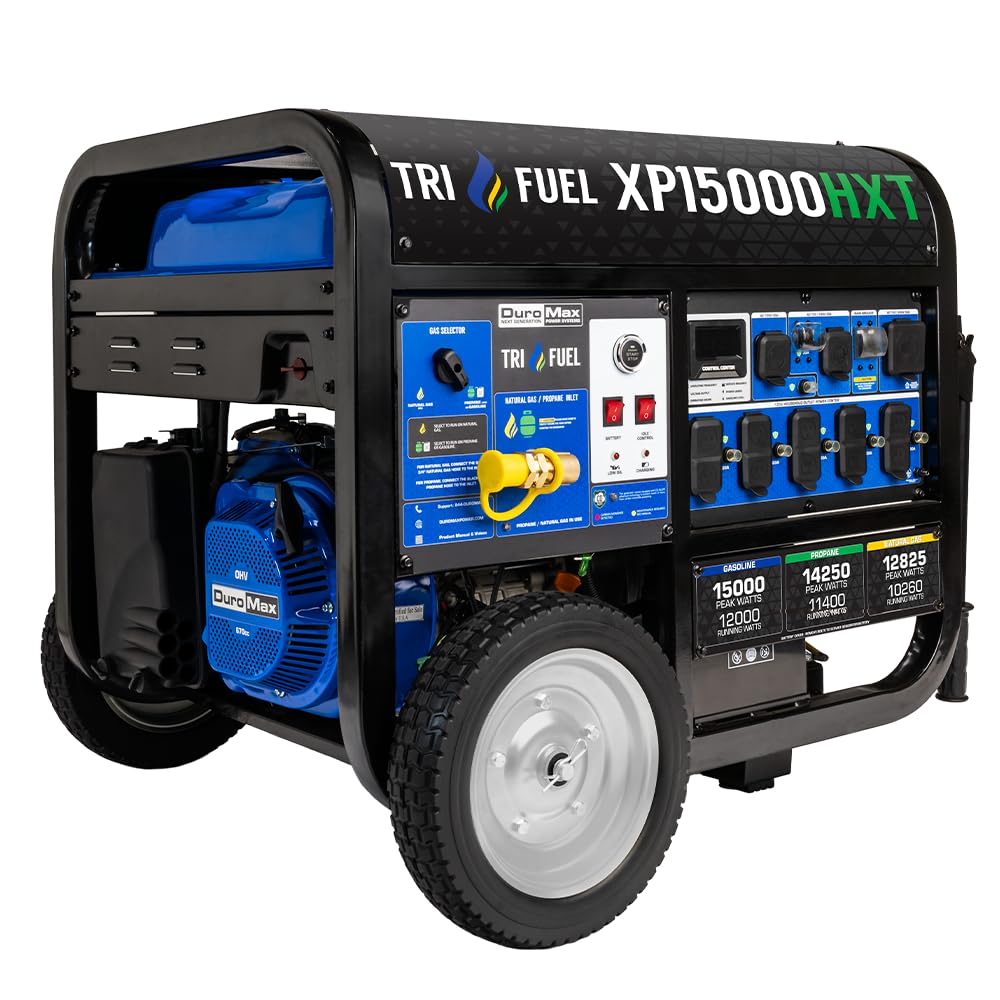
The DuroMax XP15000HXT is the most powerful unit in this lineup, with a 670cc engine generating 15,000 surge watts and 12,000 running watts on gasoline. Tri-fuel capability (gasoline, propane, natural gas) gives you maximum fuel flexibility, and the push-button start with remote key fob adds convenience. The large LED display shows gas gauge, load gauge, voltage, frequency, and runtime at a glance.
It’s designed for whole-home backup with a 50-amp outlet that connects directly to a transfer switch. The advanced computer interface includes an interactive display that tracks load in real-time, helping you avoid overloading. Customer reviews from Hurricane Helene confirm it ran full HVAC load for 3.5 hours without issue, using only natural gas. The CO Alert system adds a critical safety layer for placement near living spaces.
Be warned: this generator is enormous at 36 inches long and weighs approximately 280 pounds — you’ll need a permanent spot or a strong dolly. Some customers reported breakers tripping under heavy loads, and the control board layout changed from earlier DuroMax models, so check dimensions if you’re replacing an older unit. It’s loud, heavy, and expensive — but if raw power output is your priority, nothing else here matches it.
Why it’s great
- Tri-fuel support for gasoline, propane, or natural gas — never worry about stale fuel again.
- 670cc engine delivers industry-leading 15,000 surge watts for heavy industrial and whole-home loads.
- Large LED display with real-time load, voltage, and frequency monitoring.
Good to know
- Extremely heavy at ~280 pounds — requires a permanent location or heavy-duty wheel kit.
- Loud under load — expect 80+ dB; neighbors will definitely hear it.
5. GENMAX Tri Fuel Generator GM10500iETC

The GENMAX GM10500iETC is a rarity in this power class: a tri-fuel inverter generator. Most inverters top out at 8,000 watts, but this unit delivers 10,500 starting and 8,500 running watts on gasoline, with clean power under 3% THD — safe for computers, phones, and sensitive medical equipment. It runs on gasoline, propane, or natural gas, giving you unmatched fuel flexibility.
The control panel is exceptionally well-equipped: a 50A 14-50R outlet for transfer switch connection, an L14-30R twist-lock, four 5-20R GFCI household outlets, and a 12V DC cigarette port with USB adapter. Remote start, electric start, and ATS-ready connection make it suitable for permanent standby installation. The magnetic dipstick and oil filter are thoughtful touches that simplify maintenance. Customer reviews highlight its very quiet operation on natural gas — barely louder than a conversation.
It’s heavy at approximately 200 pounds, and some users reported that the startup procedure can require multiple presses on natural gas. The included documentation is sparse — you’ll likely need to email GENMAX directly for a full manual. But for a single-cylinder inverter that runs a 3-ton AC and well pump simultaneously while staying quiet, this is a strong contender for the premium-tier spot.
Why it’s great
- Tri-fuel inverter with under 3% THD — rare at this wattage class.
- Full suite of outlets including 50A RV-ready and 30A twist-lock for transfer switches.
- Quiet operation, especially on natural gas — suitable for noise-sensitive neighborhoods.
Good to know
- Heavy at ~200 pounds — wheel kit is essential for moving.
- No printed user manual included; digital version requires contacting customer service.
6. Honda EU7000iS 7000 Watt Inverter Generator
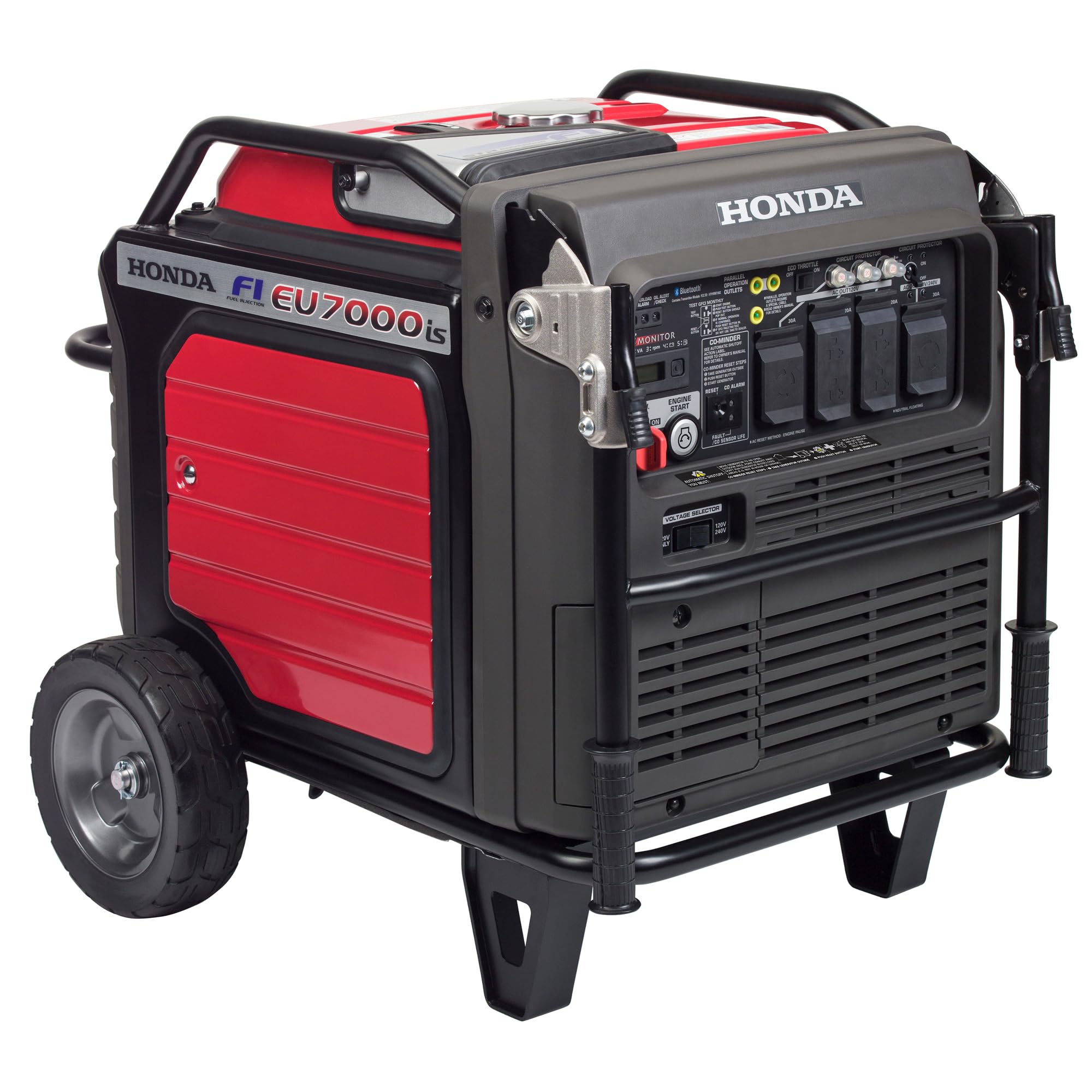
The Honda EU7000iS is the gold standard for portable inverter generators. Its 389cc engine generates 7,000 starting and 5,500 running watts, but the real story is the noise: 52-58 dBA is quieter than a normal conversation. Combined with Honda’s Eco Throttle system that adjusts engine speed to match the load, you get up to 16 hours of runtime on a single 5.1-gallon tank — the best fuel efficiency in this class.
Bluetooth connectivity through the My Generator app allows remote monitoring and push-button stop from your smartphone. The CO-MINDER system constantly monitors carbon monoxide levels and shuts down the generator before they become dangerous. The companion app also tracks service intervals, taking the guesswork out of maintenance. Customer feedback is overwhelmingly positive: reliable startup, stable 122V/244VAC output, and far quieter than any conventional Generac or DuroMax unit.
The obvious drawback is the price — the EU7000iS costs more than twice as much as comparably-powered generators. It also lacks dual-fuel capability and produces lower total wattage than the Champions and Westinghouses of the world. But if your priority is whisper-quiet operation, bulletproof reliability for decades, and clean power for a home full of sensitive electronics, the Honda justifies its premium with engineering that simply doesn’t quit.
Why it’s great
- Bluetooth app control for remote monitoring, shutdown, and service reminders.
- Ultra-quiet 52-58 dBA operation — less noise than a normal conversation.
- Eco Throttle delivers up to 16 hours of runtime on a single tank.
Good to know
- Highest price per watt in this lineup — a serious investment.
- Gasoline-only — no dual-fuel or tri-fuel option for fuel flexibility.
7. AIVOLT 8000W Dual Fuel Inverter Generator

The AIVOLT 8000W inverter combines dual-fuel capability with inverter-clean power in a package that weighs just 131 pounds — light enough to load into an SUV for camping. The 322cc engine delivers 8,000 starting and 6,100 running watts on gasoline, with automatic fuel-switching technology that lets you swap between propane and gas without manual adjustments.
The 5-in-1 LCD display is genuinely useful, showing fuel consumption, output, voltage, frequency, and cumulative runtime all on one screen. The CO Alert system provides automatic shutdown for safety, while the telescopic rod and 7-inch never-flat wheels make rolling across grass and gravel effortless. Customer reviews note it ran a 400W portable AC (1,500W startup) without breaking a sweat, and noise levels sit around 72-73 dB at 5 feet — slightly louder than the 62 dBA claim but still quiet for its class.
Some units shipped with rough idle issues or failed after limited run time, and the support team is based in China, which can lead to slow warranty resolutions. The need to let the generator cool completely before restarting (up to an hour) is an annoyance during back-to-back outages. Still, for the price and weight savings versus competitors, this is a compelling mid-premium inverter.
Why it’s great
- Automatic fuel-switching between propane and gasoline without manual valves.
- Compact and light at 131 lbs — one of the lightest dual-fuel inverters at this wattage.
- 5-in-1 LCD display tracks fuel consumption, output, voltage, frequency, and runtime.
Good to know
- Cool-down requirement before restart can take up to an hour — inconvenient for intermittent outages.
- Customer support based in China with slower response times than US-based brands.
8. WEN 5,600-Watt Dual Fuel Portable Generator (DF5600X)

The WEN DF5600X is the entry point for dual-fuel backup without sacrificing reliability. Its 224cc engine generates 5,600 surge and 4,500 running watts on gasoline, with a 4.3-gallon tank providing up to 12.5 hours of half-load runtime. The electric start works via a push button, and the CO Watchdog sensor automatically kills the engine if carbon monoxide builds up.
The control panel includes an RV-ready TT-30R 30-amp outlet and a transfer-switch-ready NEMA L5-30R twist-lock, plus two standard 20-amp household outlets. The wheel kit is included, making it easy to roll into position. Customer reviews highlight exceptional value: one user ran it 24/7 for eight months in Arizona heat, and when the engine finally failed at 6,000 hours, WEN replaced the entire unit free of charge.
It’s an open-frame conventional generator, so expect noise around 75-80 dB — comparable to a push mower. The rocker switch doesn’t kill the engine; you must use the fuel valve or RPM control for shutdown. The oil dipstick threads are fine and prone to cross-threading if you’re not careful. But for a budget-friendly dual-fuel unit that starts every time and has a three-year warranty, the DF5600X is tough to beat.
Why it’s great
- Electric start with push-button convenience — no pull-cord struggle.
- CO Watchdog sensor provides automatic shutdown for carbon monoxide safety.
- Three-year warranty with WEN’s reputation for honoring replacements.
Good to know
- Open-frame design means 75-80 dB noise — plan for ear protection and neighbor distance.
- Rocker switch does not shut off the engine; you must use the fuel valve to stop it.
9. A-iPower 5000-Watt Dual Fuel Portable Generator (GXS5000D)
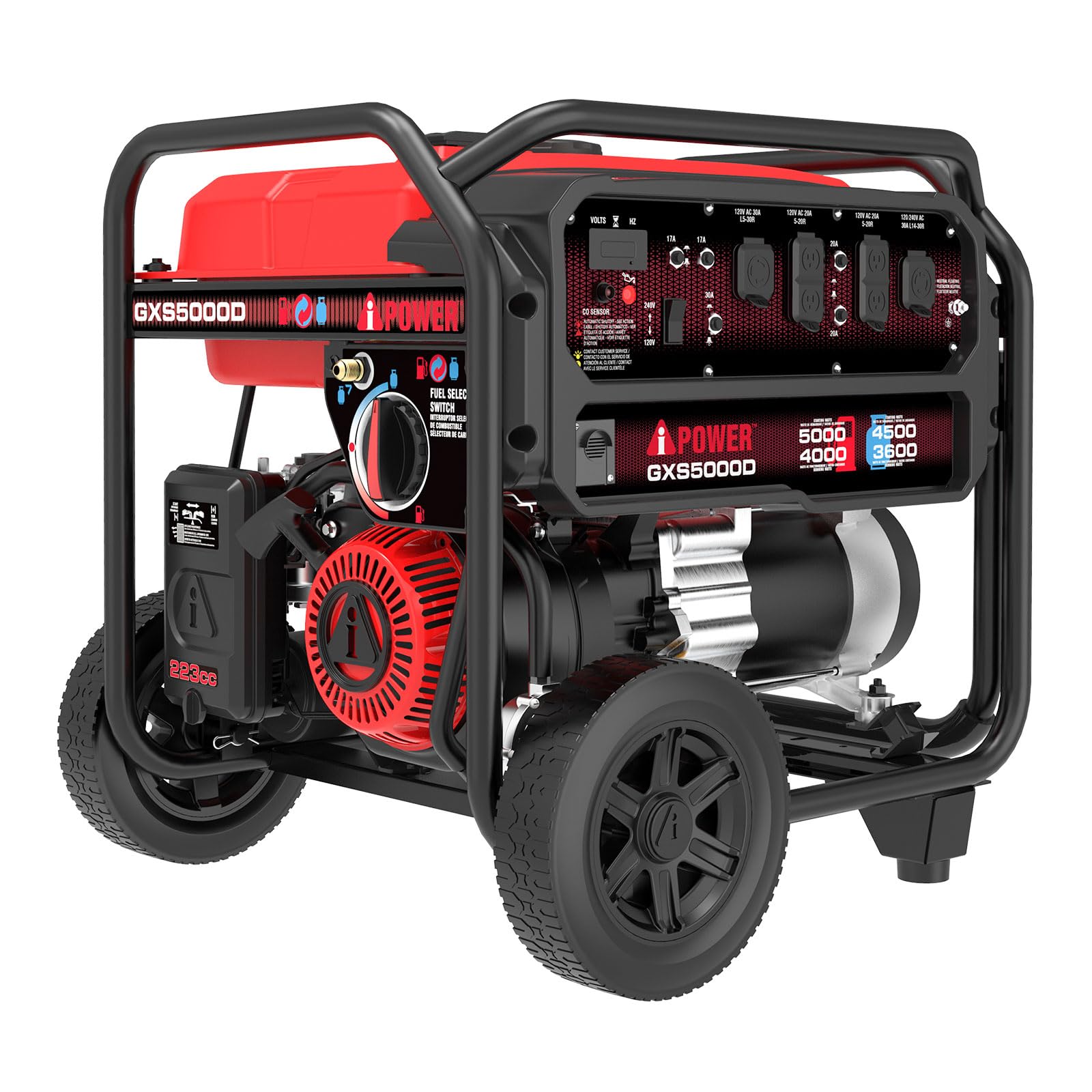
The A-iPower GXS5000D delivers 5,000 starting and 4,000 running watts on gasoline from its 223cc cast-iron-sleeve engine, with dual-fuel capability that also runs on propane. The 6.3-gallon fuel tank delivers up to 20 hours of runtime at 25% load — excellent endurance for a budget-tier generator. At 68 dB, it’s notably quieter than many conventional open-frame units in this price range.
The control panel is a standout: dual 20-amp GFCI household outlets, an L5-30R 30-amp twist-lock, and an L14-30R 120/240V 30-amp twist-lock for transfer switch connection. The CO sensor indicator light and data center display add safety and convenience. Customer reviews confirm it handled a 6kW load including a 3.5-ton AC and 2HP well pump without voltage droop, and it ran 80 hours straight after Hurricane Irma powering a fridge, 12k BTU AC, TVs, and lights.
It lacks load metering, so you can’t see exactly how many watts you’re drawing. Some users reported frequency drift up to 62.5 Hz under heavy load, which caused an APC UPS to cycle (though Tripp Lite units handled it fine). The recoil start is the primary ignition — electric start is not included on this model. For the price, it’s a solid performer with great runtime but lacks the refinement of premium options.
Why it’s great
- Up to 20 hours of runtime on a 6.3-gallon tank at 25% load — best-in-class endurance.
- Cast-iron-sleeve engine provides longer life and better heat dissipation than aluminum-sleeve competitors.
- Includes both L5-30R and L14-30R outlets for transfer switch compatibility.
Good to know
- No electric start — recoil pull-start only, which can be challenging in cold weather.
- Frequency drift under heavy load may cause issues with sensitive UPS units.
10. maXpeedingrods 4800W Gasoline Inverter Generator
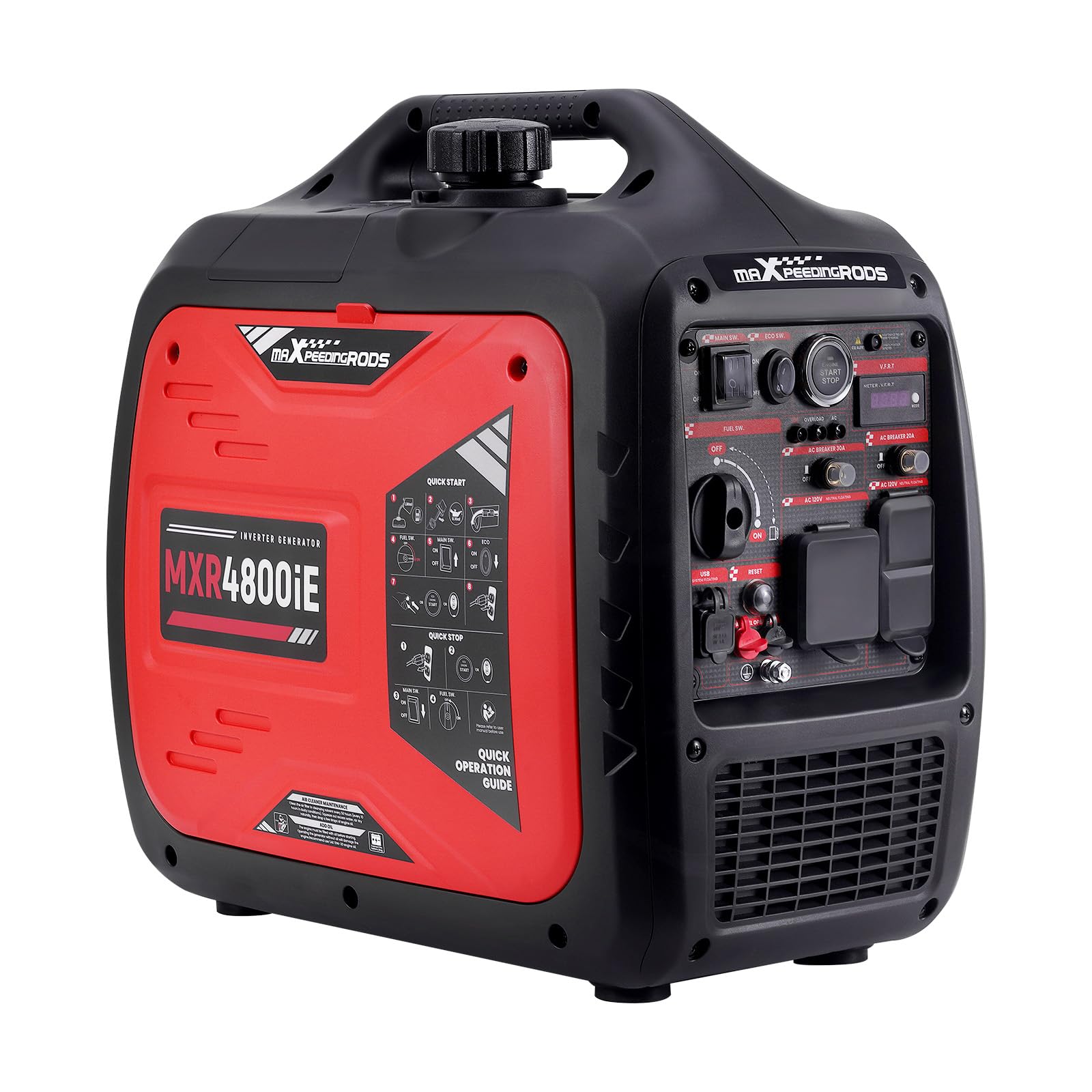
The maXpeedingrods 4800W inverter is the quietest generator at its wattage in this guide, operating at just 58 dBA from 23 feet — barely louder than a library. It produces 4,800 peak and 3,800 running watts from its gasoline engine, with three start methods: remote key fob, push-button electric, and recoil backup. The digital display shows voltage, frequency, single run time, and accumulated run time, providing excellent situational awareness.
It’s surprisingly portable at 63 pounds, and the parallel capability lets you link two units for double the output. The included parallel cables, RV30 plug, and 20A plugs mean you can start using it immediately. Customer reviews report 9-10 hours of eco-mode runtime on less than 2 gallons of gas when powering lights, TV, and battery chargers — remarkable fuel efficiency for an inverter at this price point.
Quality control is inconsistent — some units arrived with no spark or non-functional remote start. The RV outlet design has a lip that prevents flat plugs from fully seating, and the digital display isn’t fully documented (only voltage and hours are explained in the manual). For the price, it’s a gamble, but if you get a good unit, the quiet operation and remote start make it a fantastic portable companion.
Why it’s great
- Extremely quiet 58 dBA operation — ideal for camping and noise-sensitive areas.
- Three start methods (remote, electric, recoil) ensure you can always get it running.
- Lightweight at 63 lbs with parallel capability for daisy-chaining.
Good to know
- Quality control varies — some units arrive with no spark or dead remote start.
- RV outlet design prevents some flat plugs from seating properly.
11. WEN 4500-Watt Inverter Generator (56432i)
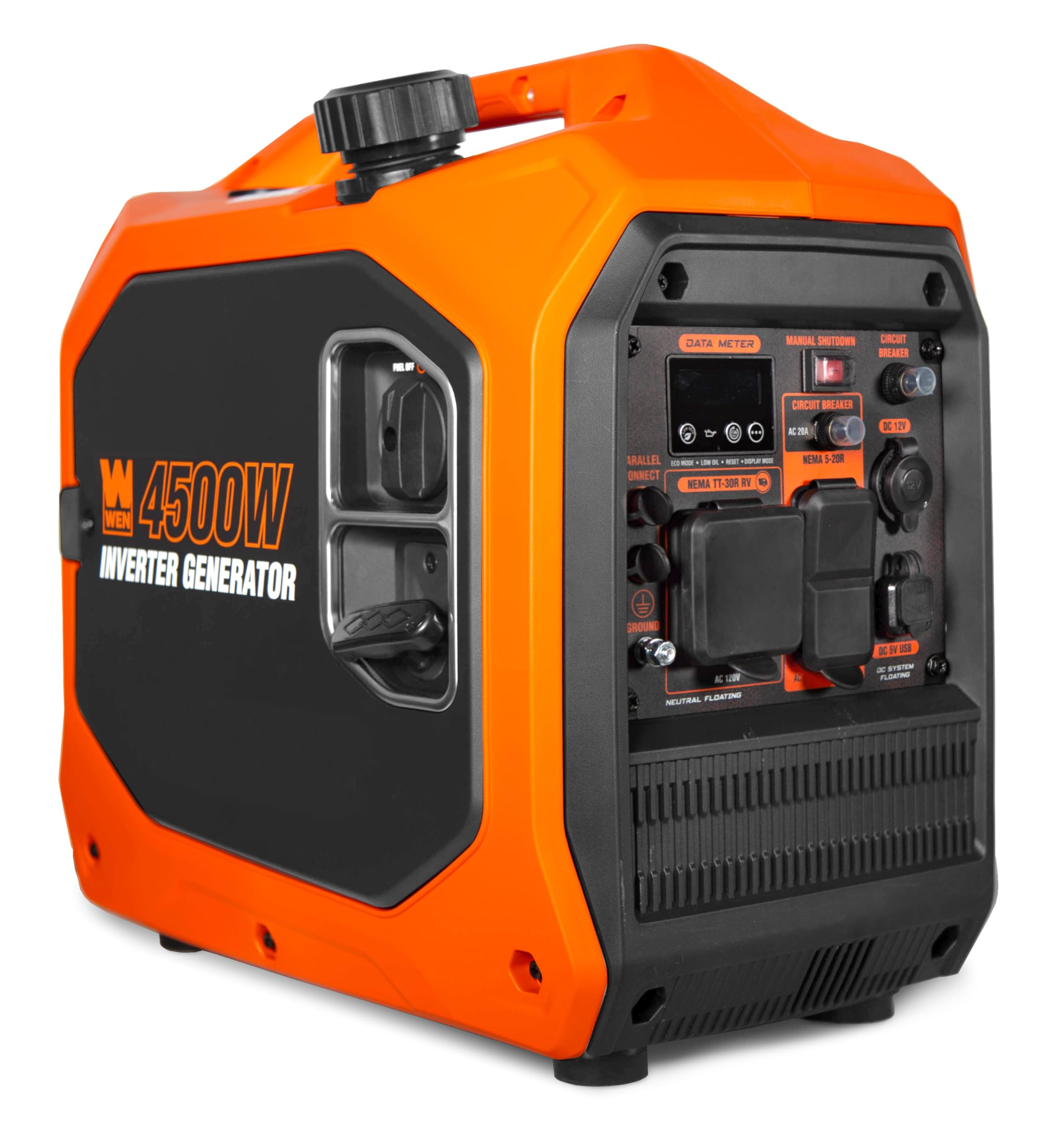
The WEN 56432i is the lightest inverter in this lineup at just 53 pounds, making it the easiest to lift into a truck bed or carry up stairs. Its 181cc engine produces 4,500 surge and 3,600 running watts — enough to run a fridge, boiler, lights, and TV during an outage. The fuel shutoff valve maximizes engine lifespan by emptying the carburetor before shutdown, preventing gummed-up fuel passages during storage.
The control panel includes two three-prong 120V household receptacles, a TT-30R RV outlet, a 12V DC receptacle, and dual 5V USB ports for charging phones and tablets directly. The intelligent data meter shows voltage and run time. Cleaning power from the inverter technology ensures safe operation for laptops and sensitive electronics. Customer reviews note it’s noticeably quieter than comparable Champion units, with reliable start-up and stable voltage for 120V appliances.
The floating neutral from the factory prevents double bonding, but this means you can’t use it with a bonded transfer switch without modification. Some users reported engine lockup after a month due to the air intake on the bottom pulling in dirt past the filter — mounting it on a platform or clean surface is recommended. It’s not a powerhouse, but for the price, it’s the best ultra-portable inverter for light home backup and camping.
Why it’s great
- Only 53 pounds — the lightest generator here, easy to carry and store.
- Fuel shutoff valve prolongs engine life by draining the carburetor before storage.
- Dual USB ports for direct device charging without an adapter.
Good to know
- Bottom-mounted air intake is prone to debris ingestion — keep it on a clean, raised surface.
- Floating neutral requires a bonding plug for transfer switch connections.
FAQ
How do I calculate the right wattage for my home?
Can I run a generator in the rain?
What is the difference between a floating and bonded neutral?
How often should I change the oil in my generator?
Is it safe to plug a generator into a wall outlet?
Final Thoughts: The Verdict
For most users, the best backup gas generator winner is the Westinghouse 12500 Dual Fuel because it balances raw power output with remote start convenience, dual-fuel flexibility, and rock-solid reliability at a mid-premium price that doesn’t require a second mortgage. If you prioritize whisper-quiet operation and clean power for sensitive electronics, grab the Champion 11000 Inverter — it delivers whole-home power at half the noise of conventional units. And for maximum raw output regardless of noise or weight, nothing beats the DuroMax XP15000HXT with its 15,000 surge watts and tri-fuel capability for indefinite runtime.