
A 4K HEVC HDMI encoder card with hot-swappable capability is the backbone of any serious multi-camera production, live-streaming pipeline, or surveillance system that demands zero downtime. Unlike consumer-grade USB capture sticks, these cards decode H.265 streams on the fly, pushing pristine 4K video over IP with sub-second latency, and their hot-swappable PCIe or standalone chassis design means you can replace a failed unit without pulling the plug on a live broadcast.
I’m Min — the co-founder and writer behind Gadgets Feed. I’ve spent hundreds of hours combing through encoder datasheets, decoding firmware changelogs, and analyzing real-world user benchmarks across SDI, HDMI, and IP-based streaming hardware to separate the cards that truly survive a 24/7 production environment from those that choke under load.
From a budget-friendly single-channel SDI encoder that punches above its weight to a Thunderbolt 3 powerhouse capable of ingesting 12G-SDI and HDMI 2.0 simultaneously, this guide cuts through the noise to deliver the definitive shortlist of the best 4k hevc hdmi encoder card hot swappable solutions that professional streamers, broadcast engineers, and AV integrators can actually trust.
How To Choose The Best 4K HEVC HDMI Encoder Card Hot Swappable
Selecting the right encoder card is less about brand loyalty and more about matching the hardware’s stream-count ceiling, protocol support, and chassis form factor to your specific production flow. Overlooking HDCP compliance or assuming all H.265 implementations handle 4:4:4 chroma equally will cost you in post-production.
Stream Count and Protocol Support
Not all encoders can push four simultaneous streams to separate platforms. A card that only outputs one RTMP stream forces you to buy secondary equipment for multi-destination broadcasting. Look for a minimum of two concurrent stream outputs and support for SRT alongside RTMP, HLS, and UDP if you need reliable delivery over unpredictable networks.
Hot-Swappable and Redundant Design
In a live environment, swapping a failed encoder without powering down the entire rack is non-negotiable. True hot-swappable cards use a chassis with independent power regulators per slot, allowing you to pull and replace a module while the other channels keep streaming. Standalone units with dual power inputs or PoE failover offer similar redundancy at a lower entry point.
HEVC Encoding Depth and Bitrate Control
A card that advertises “4K HEVC” but caps its encode at 20 Mbps will produce visible macro-blocking in fast-moving sports or high-detail presentations. Professional-grade encoders let you dial in a variable bitrate from 500 Kbps to 50 Mbps, and they support 10-bit HDR color space for Rec. 2020 gamut. Confirm the encoder chip (HiSilicon, Ambarella, or FPGA-based) supports Main10 profile before buying.
Quick Comparison
On smaller screens, swipe sideways to see the full table.
| Model | Category | Best For | Key Spec | Amazon |
|---|---|---|---|---|
| URayCoder UHE265-4-4K | Multichannel Encoder | Multi-platform live streaming | 4 concurrent streams, 4K@30fps H.265 | Amazon |
| Blackmagic DeckLink Quad HDMI | PCIe Capture Card | Multi-camera PC workstation | 4x HDMI 2.0b input, PCIe 3.0 x8 | Amazon |
| Elgato 4K Pro | Internal Capture Card | Gaming and dual-PC streaming | 8K60 passthrough, 4K60 HDR10 capture | Amazon |
| Magewell USB Capture HDMI 4K Plus | USB 3.1 Capture | Plug-and-play laptop streaming | Up to 4K30 capture, HDMI loop-through | Amazon |
| ClonerAlliance UHD Pro Max | Standalone Recorder | Cinematic 24fps 4K recording | H.265/H.264, 4K@30fps, 50 Mbps bitrate | Amazon |
| URayCoder USE265-1L | Single SDI Encoder | Budget SDI-to-IP streaming | 1x SDI input, 4 stream outputs | Amazon |
| URayCoder UHSCVD265-1-4K | Decoder | Multi-format IP decode to SDI/HDMI | 4K30 decode, SDI+HDMI+VGA+CVBS out | Amazon |
| URayCoder UHE265-8 | 8-Channel Encoder | Large-scale multi-camera installations | 8 HDMI inputs, 2 streams per channel | Amazon |
| Blackmagic UltraStudio 4K Mini | Thunderbolt 3 Capture | Mac/Linux uncompressed capture | Thunderbolt 3, 12G-SDI, HDMI 2.0 | Amazon |
In‑Depth Reviews
1. URayCoder UHE265-4-4K
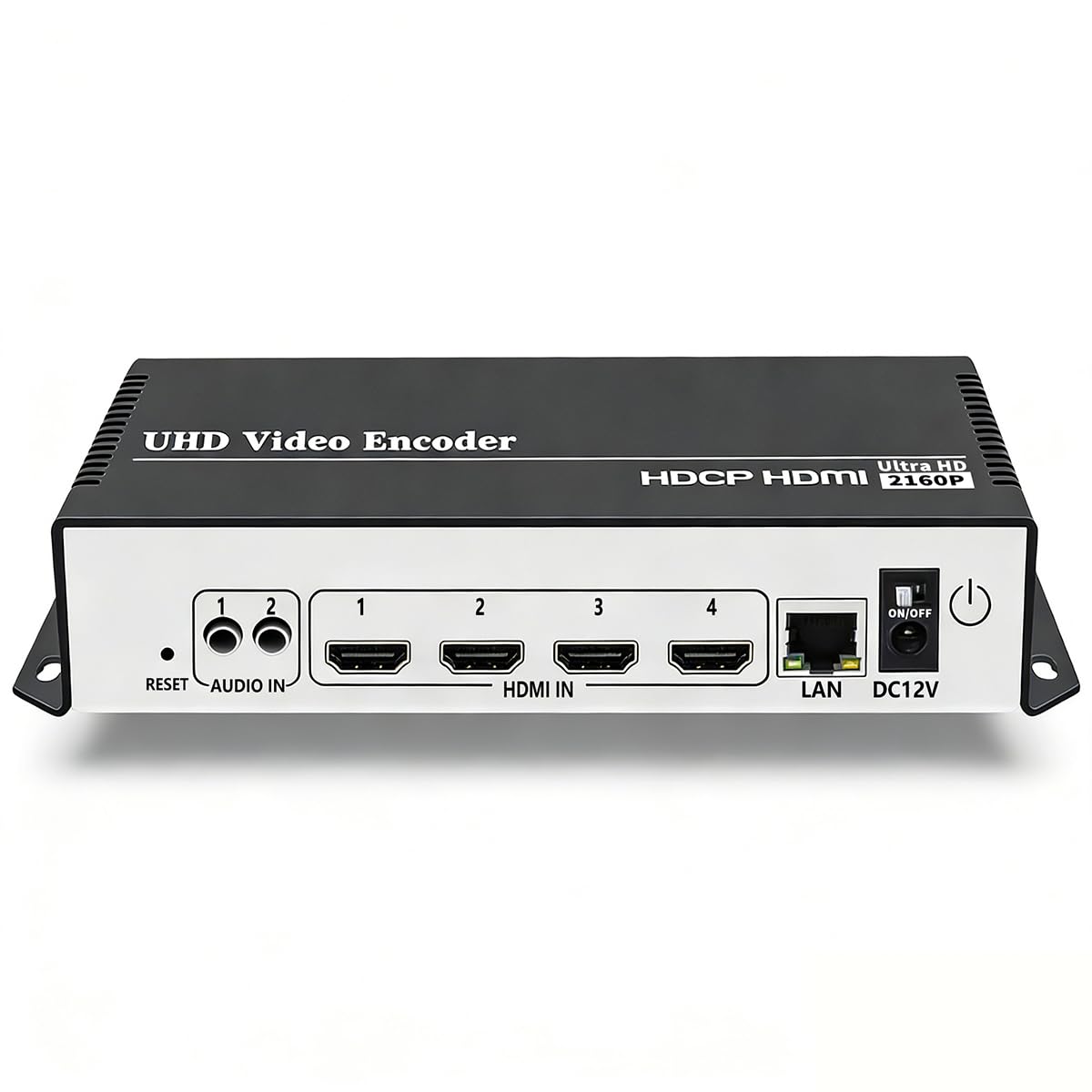
The URayCoder UHE265-4-4K is the sweet spot for professional streamers who need to push a single 4K source to Facebook, YouTube, Twitch, and a private RTMP server simultaneously. Its four independent stream engines each support different protocols — RTMP, SRT, HLS, UDP — so you can tailor delivery for every platform without buying additional encoding hardware. The 4K UHD input at 30 fps with H.265 encoding delivers crisp detail at roughly half the bitrate of H.264, saving bandwidth when streaming over constrained corporate networks.
Setup is surprisingly straightforward for a device this capable: plug an HDMI source into the input, connect Ethernet, and configure the web GUI to assign stream destinations. The LCD front panel provides quick status checks on encoding bitrate, connection health, and stream uptime. Multiple reviewers report reliable 24/7 operation for church services and corporate surveillance, with one noting it replaced a TeraDek at a fraction of the cost and comparable stability.
The only real friction point is the initial DHCP configuration — the unit ships with DHCP disabled by default, so you must manually assign an IP via the front panel before the web interface becomes accessible. Once passed that hurdle, the encoder handles HDCP 1.4 sources gracefully and allows granular bitrate control down to 500 Kbps for low-bandwidth scenarios. Lifetime technical support from URayCoder (Linda and Allen are frequently praised) adds peace of mind for mission-critical deployments.
Why it’s great
- Four concurrent streams with independent protocols per output
- Robust H.265 encode at up to 50 Mbps for high-fidelity 4K
- Free lifetime technical support and firmware updates
Good to know
- DHCP is off by default, requiring manual IP assignment on first boot
- No way to stop a stream remotely without unplugging the unit
2. Blackmagic DeckLink Quad HDMI

The DeckLink Quad HDMI is the PCIe card for anyone running a multi-camera vMix or OBS workstation that needs to ingest four independent 4K60 signals simultaneously. Each of its four HDMI 2.0b ports supports up to 4Kp30 DCI with 12-bit RGB 4:4:4 or 4Kp60 with 10-bit YUV 4:2:2, giving you broadcast-grade color fidelity for live switching. The PCI Express 3.0 x8 interface ensures enough bandwidth to capture all four channels at full resolution without dropping frames.
Blackmagic’s Desktop Video software suite provides a stable SDK that integrates with virtually every major production app — Wirecast, vMix, OBS, and Resolume all recognize the card immediately. Reviewers highlight its “beautiful picture” and rock-solid performance in live production environments where three cameras run for hours without sync drift. The card also supports HDR and Deep Color metadata passthrough, which is critical for modern HDR workflows.
Driver installation can be frustrating — finding the correct “Desktop Video” installer on Blackmagic’s website requires navigating a maze of product pages, and the internal USB header (used for some firmware features) is completely undocumented in the quick-start guide. The HDMI inputs are also HDCP-sensitive, meaning any copy-protected source will output a black screen. If you can tolerate the initial setup friction, this card delivers unmatched multi-channel value for its price bracket.
Why it’s great
- Four independent HDMI 2.0b inputs with full 4K60 support per channel
- PCIe 3.0 x8 lane width prevents bandwidth bottlenecks
- Wide software compatibility with OBS, vMix, and Resolume
Good to know
- Driver discovery on the Blackmagic website is intentionally obscure
- HDCP-protected sources will not display
3. Elgato 4K Pro

The Elgato 4K Pro is the top choice for gamers and streamers who demand zero-lag passthrough on next-gen consoles. With HDMI 2.1 in/out it supports 8K60 passthrough and captures 4K60 HDR10 footage simultaneously, while VRR passthrough eliminates screen tearing on the local monitor. Capture resolutions scale all the way down to 1080p240 for esports players who need high frame-rate recordings of competitive gameplay.
Installation is straightforward — the PCIe x4 card slides into any full-size slot, and the 4K Capture Utility recognizes it immediately on Windows. Reviewers report sub-30ms latency in the preview window, and OBS integration works flawlessly for dual-PC setups. One competitive Splatoon player confirmed that the card captures Switch gameplay at full quality with zero visible lag on the passthrough display, even during intense ranked matches.
The card is notoriously picky about HDMI cables. Several reviewers experienced screen splitting or signal dropouts when using cables that didn’t meet HDMI 2.1 bandwidth specifications. After a few hours of gaming, some users had to restart Windows Explorer to prevent the video preview from freezing, particularly when streaming DRM-protected content like Paramount+. It’s a premium internal card with no hot-swappable capability — if it fails, you have to power down the entire PC to replace it.
Why it’s great
- 8K60 passthrough with VRR for tear-free local gaming
- Captures 4K60 HDR10 at 240 fps in 1080p mode
- Ultra-low latency preview for real-time monitoring
Good to know
- Extremely sensitive to HDMI cable quality and length
- Requires Windows Explorer restart after extended gaming sessions
4. Magewell USB Capture HDMI 4K Plus

The Magewell USB Capture HDMI 4K Plus is the gold standard for laptop-based field production where driverless operation is a requirement. It accepts HDMI input up to 4096×2160 and captures up to 4K30 via USB 3.1 Gen 1 on Windows, macOS, Linux, and Chrome OS without installing a single driver. The built-in HDMI loop-through port lets you monitor the source on a local display with zero additional latency, which is invaluable for on-location recording where you need instant visual confirmation.
Inside the compact metal housing is an FPGA-based processing pipeline that handles scaling, cropping, de-interlacing, and color conversion on the card — offloading all frame processing from your host CPU. This means a modest laptop can capture 4K30 without stuttering. Reviewers on Linux praise its flawless V4L2 compliance, noting it works out of the box with OBS and FFmpeg on Fedora and Ubuntu. The 3-year limited warranty and thermal protection make it suitable for 24/7 deployment in digital signage or lecture capture.
The USB 3.1 interface is the bottleneck — attempting 4K60 input results in choppy, frame-skipping video because the interface cannot sustain the full bandwidth required for uncompressed 4K60. This is a design limitation of the USB capture format, not a defect. The noisy internal fan is another complaint, though it only spins under heavy load. For pure 4K60 capture, you’ll need an internal PCIe card or a Thunderbolt solution. But for zero-fuss 4K30 capture on any OS, this unit is unmatched.
Why it’s great
- Truly driverless plug-and-play on Windows, macOS, Linux, and Chrome OS
- FPGA-based processing offloads scaling and de-interlacing from the host
- Built-in HDMI loop-through for zero-latency local monitoring
Good to know
- Limited to 4K30 capture; 4K60 input produces frame-skipping artifacts
- Noisy internal fan under sustained 4K load
5. ClonerAlliance UHD Pro Max
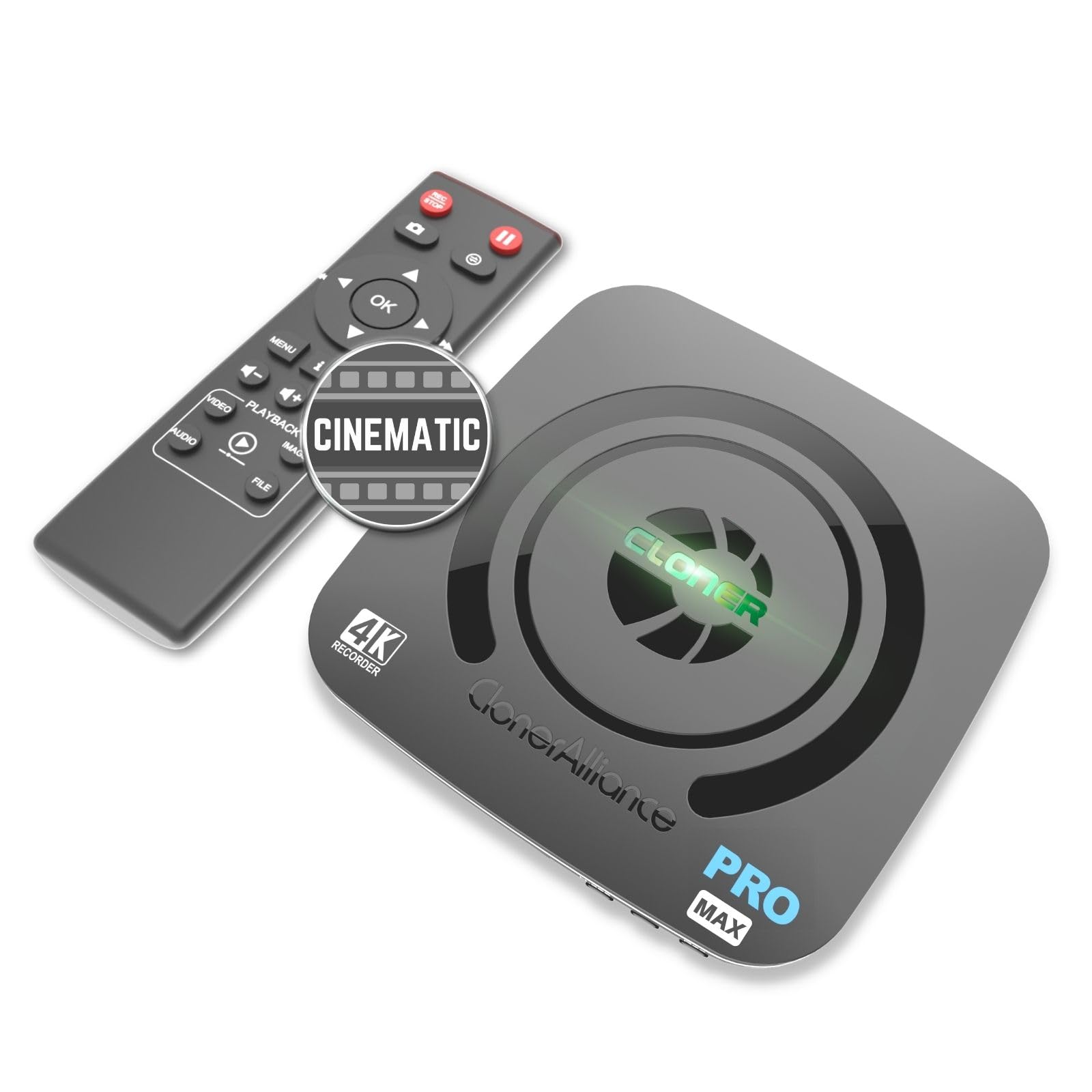
The ClonerAlliance UHD Pro Max is a standalone 4K recorder that captures cinema-quality footage at 24fps with up to 50 Mbps bitrate, making it ideal for filmmakers who want to record HDMI camera output directly to a portable SSD or MicroSD card without a computer. It supports both H.264 and H.265 encoding, and its unique pause/resume functionality allows you to split long recordings into manageable files without stopping the feed. The 4K60 HDMI passthrough ensures the downstream monitor or switcher sees full-resolution video while the recorder captures independently.
Compatibility is broad — the unit works with DSLRs, game consoles, cable boxes, and even older MiniDV cameras via HDMI. It strips HDCP from streaming services like Netflix and Disney+ without throwing an error, a rare capability that reviewers note with caution (and appreciation). The file management system supports renaming, playback, and scheduled recordings, and external storage can reach up to 8 TB via USB 3.0 for extended sessions.
Recording at 4K is limited to 30 fps or 24 fps (Cinematic-FPS), and there is no 1440p/2K resolution option — you jump straight from 1080p60 to 4K30. Several reviewers report micro-stuttering in MP4 files at 4K, which is resolved by switching to the TS container format at the cost of larger file sizes. The remote must be pointed directly at the unit’s IR receiver for reliable control, and the unit runs warm even when idle. Frame skipping can occur with slower memory cards, so a fast U3 or V30 card is mandatory for 4K recording.
Why it’s great
- Unique Cinema-FPS 4K24 recording for film-accurate capture
- Pause/resume recording without stopping the HDMI signal flow
- HDCP stripping enables recording from most streaming platforms
Good to know
- No 1440p/2K resolution support
- Micro-stuttering in 4K MP4; TS format recommended
6. URayCoder USE265-1L
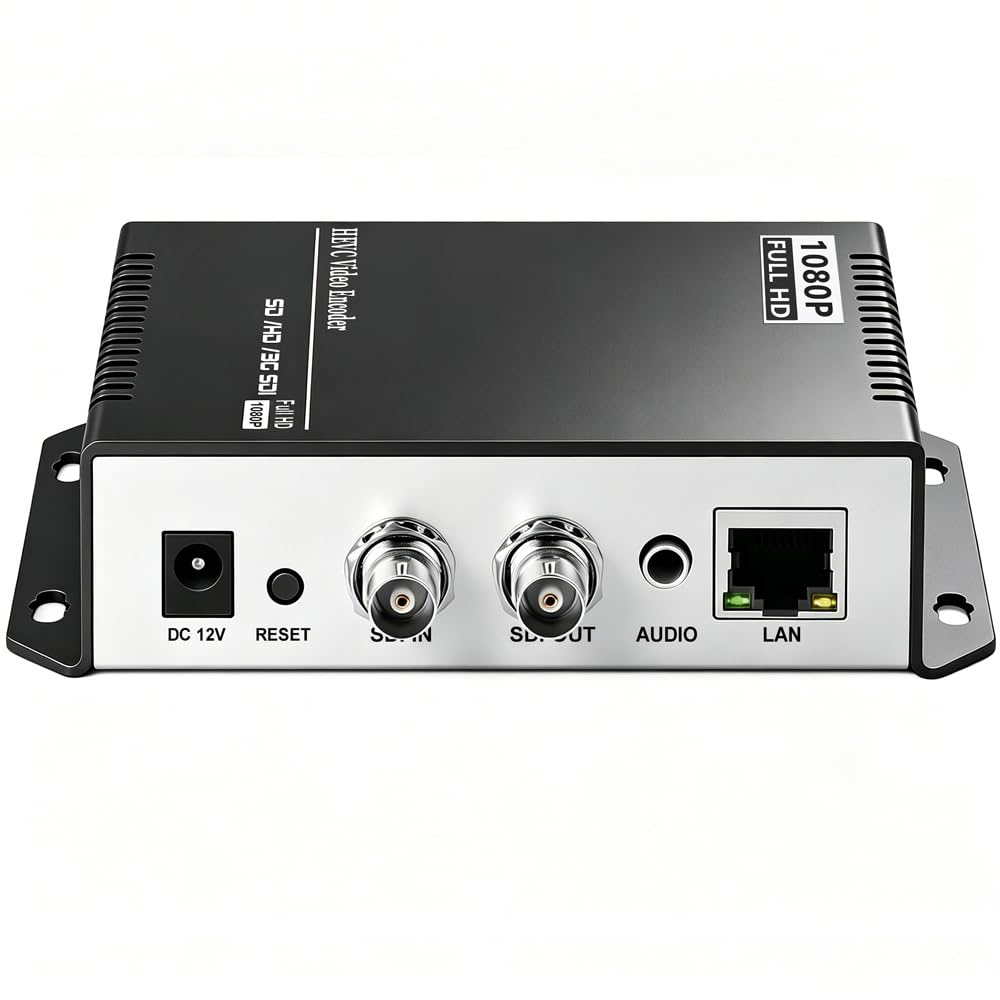
The URayCoder USE265-1L is the entry-level SDI-to-IP encoder that punches far above its price point. It accepts 3G-SDI input and can output four simultaneous video streams using different protocols — RTMP, SRT, HLS, and UDP — making it a viable bridge for converting legacy SDI camera feeds into modern IP streaming workflows. The matte aluminum shell dissipates heat effectively, and reviewers report reliable 24/7 operation in remote monitoring setups for lobbies and parking lots.
Setup is straightforward: connect an SDI source, assign a static IP, and configure the web interface to point at your streaming server. The unit supports adding static text, scrolling captions, and logo overlays, which is rare at this price level. Build quality is solid with a reassuring weight, and the loop-out SDI port allows daisy-chaining to a local monitor without a separate splitter.
The web GUI is utilitarian — functional but dated, with no mobile-optimized view. Audio configuration can be tricky if the SDI source doesn’t embed audio properly; you may need to adjust the audio routing manually in the settings. The power plug uses a Type I (Australian/Chinese) connector, so international buyers will need an adapter or a replacement power cord. Despite these quirks, the consistent 5-star reviews from church production teams and surveillance installers confirm it as a cost-effective encoder that simply works.
Why it’s great
- Four simultaneous stream outputs from a single 3G-SDI input
- Rugged aluminum chassis with excellent heat dissipation
- Supports text, scrolling captions, and logo overlay
Good to know
- Power plug is Type I (Australian/Chinese) — adapter may be required
- Web GUI is basic and not mobile-friendly
7. URayCoder UHSCVD265-1-4K

The URayCoder UHSCVD265-1-4K is a versatile decoder that converts IP video streams (RTMP, SRT, HLS, UDP, RTSP) back into SDI, HDMI, VGA, and CVBS outputs simultaneously. This makes it essential for broadcast environments where you need to receive a remote 4K stream and distribute it to legacy analog monitors, digital projectors, and professional SDI gear all at once. It decodes streams up to 3840×2160 at 30 fps and can handle up to 4 channels of independent video decoding at lower resolutions.
Setup is simpler than the encoder equivalent: enter the stream URL into the web GUI, and the decoder automatically routes the video to all active output ports. The ability to decode to VGA is particularly useful for conference rooms and educational settings where aging projectors lack HDMI ports. Reviewers note that the unit works well with Blue Iris surveillance software and multi-brand encoders, confirming broad compatibility across different ecosystems.
The decoder does not come with a power plug in the box — it ships without any power connector, so you must source a compatible 12V adapter separately. The web interface, like other URayCoder products, feels dated and can be slow to load on first connection. While 4K30 is sufficient for most streaming sources, event producers requiring 4K60 decoding will need to look at higher-end solutions. For a multi-format decoder that bridges old and new display standards, this unit is cost-effective and reliable.
Why it’s great
- Outputs to SDI, HDMI, VGA, and CVBS simultaneously
- Decodes up to 4K30 from multiple IP streaming protocols
- Works with Blue Iris and third-party encoders without compatibility issues
Good to know
- No power plug included — requires separate 12V adapter
- Interface can feel sluggish on initial load
8. URayCoder UHE265-8

The URayCoder UHE265-8 is the heavy lifter for large-scale productions that need to ingest eight separate HDMI sources and encode each one into dual independent streams. With 8 HDMI inputs and the ability to output 2 streams per channel (16 total), this unit can send every camera feed to a private SRT server and a public RTMP platform simultaneously. The H.265 encoding at up to 4K30 keeps bandwidth manageable even when all 8 channels are active, and the separate Ethernet ports for admin and streaming networks prevent management traffic from interfering with video delivery.
Corporate streamers and sports production teams praise this encoder for its reliability in multi-camera setups. One reviewer uses it for live sports streaming at 1080p60 with a simple UI that requires no laptop on site — just connect cameras, configure the streams, and let it run. Another replaced a Slingbox setup entirely, using the encoder to deliver a full-home TV feed to a remote URL viewable in VLC. Tech support from Linda at URayCoder is frequently highlighted for providing firmware updates within 24 hours of a support ticket.
The major caveat is a known hardware revision issue: units purchased later may ship with an older chipset that locks output at 720x480i@60 until the “field to frame” de-interlacing option is enabled in the settings. This is a firmware fix, not a hardware defect, but it requires digging into the advanced configuration menu. Some users also report that the unit’s default streaming state (always on) makes it difficult to stop a stream gracefully during live events — unplugging is the only sure way to halt transmission.
Why it’s great
- Eight HDMI inputs with dual independent stream outputs per channel
- Separate admin and streaming Ethernet ports for traffic isolation
- Excellent responsiveness from technical support for firmware updates
Good to know
- Some units shipped with older chipset needing “field to frame” fix
- No remote stream stop without physically unplugging the device
9. Blackmagic UltraStudio 4K Mini

The Blackmagic UltraStudio 4K Mini is the premier Thunderbolt 3 capture solution for Mac and Linux users who need uncompressed DCI 4K capture from professional SDI and HDMI sources. With 12G-SDI and HDMI 2.0 inputs, it handles up to 4Kp60 in 10-bit YUV 4:2:2 with full Rec. 2020 color space support, delivering frame-accurate, visually lossless capture directly into DaVinci Resolve, Adobe Premiere, or OBS. The Thunderbolt 3 interface provides 40 Gb/s bandwidth, enough for multiple uncompressed streams without compression artifacts.
The chassis is a sturdy desktop unit with a clean front-panel LCD and physical buttons for input selection, a welcome tactile alternative to software-only switching. Reviewers praise its simple connectivity to MacBook Pros and the ability to capture uncompressed HD to 4K footage that survives heavy grading in post-production. The included Thunderbolt 3 cable is a high-quality passive 0.7m cable, but you’ll need an active cable for longer runs.
Reliability is a mixed bag. Several reviewers report dead-on-arrival units — two different users received completely unresponsive hardware. The audio subsystem has known issues: the analog audio input is weak and prone to distortion, and the mic input introduces an unadjustable delay that makes it unusable for live commentary without external mixing. The front-panel LCD, while useful for status checks, confuses some users with its button layout and menu logic. For uncompressed 4K capture on a Mac, this unit is unrivaled in quality when it works, but the QC lottery is real.
Why it’s great
- Uncompressed DCI 4K capture via Thunderbolt 3 with full Rec. 2020 support
- Accepts both 12G-SDI and HDMI 2.0 input for professional workflows
- Front-panel LCD with physical input selection buttons
Good to know
- Inconsistent QC — multiple reports of dead-on-arrival units
- Analog audio input is weak with noticeable distortion
FAQ
What does “hot-swappable” mean for a 4K encoder card?
Can I use a 4K HEVC encoder with a USB capture card instead of PCIe?
Why does my encoder need HDCP stripping for streaming devices?
Final Thoughts: The Verdict
For most users, the best 4k hevc hdmi encoder card hot swappable winner is the URayCoder UHE265-4-4K because it balances four concurrent stream outputs, robust H.265 encoding, and lifetime technical support at a price that undercuts competing multi-stream encoders by hundreds. If you need to ingest four separate HDMI sources into a PC workstation, grab the Blackmagic DeckLink Quad HDMI. And for uncompressed 4K capture on a Mac or Linux workstation, nothing beats the Blackmagic UltraStudio 4K Mini — provided you get a unit that powers on.