
When a family member collapses from sudden cardiac arrest, every second until paramedics arrive feels like an eternity. An automated external defibrillator (AED) at home bridges that critical gap, turning a bystander into a potential lifesaver with step-by-step voice prompts that guide even an untrained user through the process of delivering a controlled shock to restart a heart.
I’m Min — the co-founder and writer behind Gadgets Feed. I’ve spent hundreds of hours dissecting AED specifications, comparing pad cartridge lifespans, battery chemistry types, voice prompt clarity, and self-testing algorithms to build a guide that cuts through the marketing noise.
Whether you are a caregiver for a cardiac patient or simply preparing your household for the unexpected, finding the right best aed for home use means balancing automated safety features, pad longevity, and a device that anyone in the house can operate under pressure.
How To Choose The Best AED For Home Use
Selecting a home AED is fundamentally different from choosing one for an office gym or a school hallway. At home, you cannot rely on a designated safety officer checking expiration dates. The device must be virtually maintenance-free, intuitive enough for a child or visiting grandparent to operate, and compact enough to store in a closet or under a bed without feeling like a piece of hospital equipment.
Voice Prompts and Ease of Use
The single most important differentiator for home use is the quality and clarity of the voice guidance system. Look for an AED that provides unambiguous, step-by-step instructions — from calling 911 to placing pads correctly to delivering CPR compressions at the right depth and rate. The best models automatically adjust shock energy and won’t deliver a shock unless SMART Analysis detects a shockable rhythm, removing the potential for user error.
Pad Cartridge Life and Battery Longevity
Home AEDs sit unused for years. The pads, which contain conductive gel, have a finite shelf life typically between two and four years. Similarly, the battery must hold charge through daily, weekly, and monthly self-tests. Prioritize units that run these tests automatically and signal readiness with a simple green indicator light. Models with long-lasting lithium battery packs reduce the frequency and cost of replacement.
Size and Portability
A home AED should be small and light enough to grab quickly and carry to any room. Units weighing around five pounds or less with a slim carry case are ideal. If you travel frequently, consider a model that fits in a suitcase or carry-on without dominating the bag. Some high-capacity training kits exist, but for a primary home response device, compact size wins.
Quick Comparison
On smaller screens, swipe sideways to see the full table.
| Model | Category | Best For | Key Spec | Amazon |
|---|---|---|---|---|
| Philips HeartStart Home M5068A | Premium | Pure home protection | Quick Shock < 8 seconds | Amazon |
| Philips HeartStart OnSite M5066A | Premium | Versatile home + public | SMART Biphasic waveform | Amazon |
| Prestan Take2 Kit w/ Feedback | Mid-Range | Training + home readiness | 2 Adult + 2 Infant manikins | Amazon |
| MCR Medical Prestan Take2 Kit | Mid-Range | Training with accessories | Includes kneeling mats | Amazon |
| MCR Medical Diversity Adult Kit | Premium | Multi-tone training sets | 4 Adult + 4 AED trainers | Amazon |
| Prestan 4-Adult 4-Infant Kit | Premium | Full classroom training | 8 manikins + 4 AED trainers | Amazon |
| MCR Medical Wheeled Diversity Kit | Premium | Mobile training pro | Wheeled carryall included | Amazon |
In‑Depth Reviews
1. Philips HeartStart Home AED Defibrillator M5068A

The Philips HeartStart Home M5068A is purpose-built for residential use, shipping with a slim carry case and a pre-installed battery plus SMART Pads Cartridge so it is virtually ready to deploy from the box. Its voice coaching delivers clear instructions for pad placement, CPR timing, and shock delivery, and the Quick Shock feature can deliver a shock within eight seconds of the device detecting a shockable rhythm — a critical speed advantage in a home emergency.
The unit performs daily, weekly, and monthly self-tests with a simple green readiness light, removing any guesswork about maintenance. At just 5.5 pounds and with compact dimensions, it stores easily in a bedroom closet or under a bed. Real-world accounts from users who survived sudden cardiac arrest at home confirm that the voice-guided process, including 45 seconds of CPR coaching, is effective for bystanders with zero prior training.
The 8-year warranty on the AED itself and 4-year warranty on the battery provide long-term peace of mind, though the SMART Pads Cartridge will eventually need replacement before its printed expiration date. The device outputs a biphasic truncated exponential waveform, automatically adjusting energy based on the patient’s impedance, which minimizes the risk of delivering too high a shock to a child or frail adult.
Why it’s great
- Quick Shock delivers within 8 seconds of rhythm detection
- Automated daily/weekly/monthly self-tests with green light
- 8-year device warranty and 4-year battery warranty
- Voice guidance for CPR compressions and pad placement
Good to know
- Pads cartridge must be replaced before expiration date
- Voice prompts are only available in English
- Infant/child training pads cartridge sold separately
2. Philips HeartStart OnSite AED Defibrillator M5066A
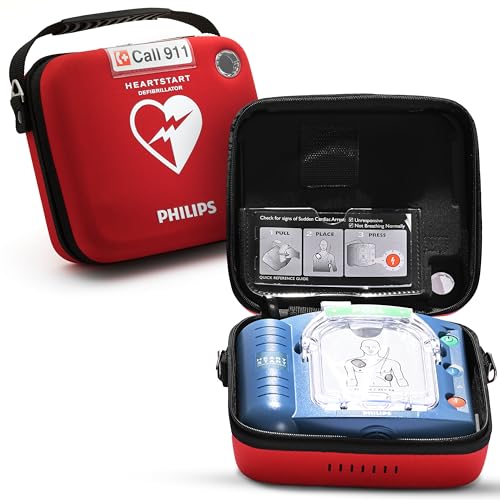
The Philips HeartStart OnSite M5066A shares nearly identical core technology with the Home model but is marketed for public environments like offices, gyms, and airports — making it equally suited for a home where multiple people, including guests or caregivers, may need to operate it under stress. It uses the same SMART Analysis algorithm to assess the heart’s rhythm and only permits a shock when a shockable arrhythmia is detected.
The device is slightly larger than the Home variant but remains under 5.5 pounds and fits in a convenient carry case. It runs automated self-tests without manual calibration, and the pre-installed battery and SMART Pads Cartridge mean no setup steps beyond unpacking. Users consistently praise the clear, step-by-step voice prompts that guide pad placement and CPR rhythm.
One trade-off is that the OnSite model does not include a dedicated infant/child key by default; a separate Infant/Child Pads Cartridge is required for pediatric use. The 8-year warranty on the device is a strong assurance, and the battery carries a 4-year warranty. For a household that might double as a gathering space for elderly relatives, this unit’s public-grade ruggedness is a worthwhile advantage.
Why it’s great
- Same SMART Analysis and Quick Shock as Home model
- Automated self-tests with no manual calibration needed
- 8-year device warranty for long-term reliability
- Rugged enough for public spaces, reliable at home
Good to know
- Infant/child pad cartridge sold separately
- Voice prompts are English-only
- Marginal price jump over Home model for similar core features
3. Prestan Take2 CPR Manikin Trainer Kit w/ Feedback

The Prestan Take2 kit is a powerful training companion that prepares your household for using a real AED. It includes two adult manikins and two infant manikins with feedback indicator lights that illuminate when compressions reach the correct depth, plus two AED UltraTrainers pre-programmed with five bilingual English/Spanish scenarios. This allows a family to practice pad placement, shock sequencing, and CPR timing in a low-stakes environment.
The kit is fully compliant with current AHA guidelines and comes with a three-year warranty. At roughly 23 x 26 x 23 inches in its carry bag, it is bulky but designed for portability to training sessions. Users consistently report that the Prestan brand is the preferred choice among CPR instructors for its durability and realistic feel — the manikins hold up well to repeated compression cycles without cracking.
While this is not a real defibrillator for emergency use, pairing it with a live Philips device creates a comprehensive home response system. The bag lacks wheels, which some users note makes it less convenient to haul. Batteries for the UltraTrainers are not included, so factor that into initial setup cost. For families wanting hands-on practice, this kit delivers unmatched training value.
Why it’s great
- Feedback lights confirm proper compression depth
- Two AED trainers with 5 pre-programmed scenarios
- Includes both adult and infant manikins
- AHA compliant with 3-year warranty
Good to know
- Batteries for trainers not included
- Carry bag lacks wheels for easy rolling
- Intended for training, not emergency defibrillation
4. MCR Medical Prestan Take2 CPR Manikin & UltraTrainer Kit
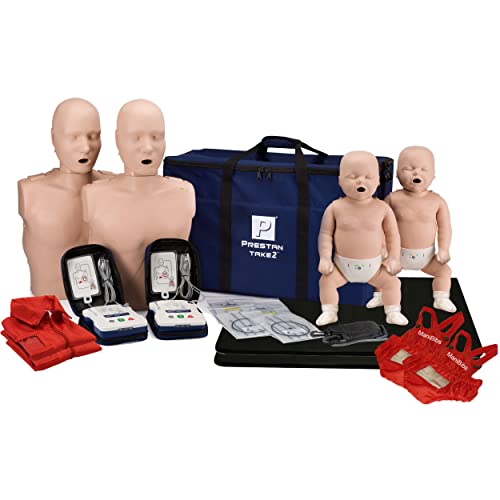
MCR Medical packages the same popular Prestan Take2 manikins and UltraTrainers with additional accessories including kneeling mats, ManiVests, and ManiBibs, making this kit more comfortable for extended training sessions at home or in a classroom. The two adult and two infant manikins provide feedback on compression depth and rate, and the Prestan AED trainers are widely considered more realistic than the Red Cross equivalents for simulating the shock sequence.
The kit’s foam construction gives the manikins a realistic torso weight, and the included carry bag helps keep everything organized between practice drills. Users note that the setup is straightforward and the manikins have proven durable over multiple training cycles. The three-year warranty covers defects, and the kit is AHA compliant for current protocols.
Where this kit shines is the density of accessories relative to the base Prestan offering — the kneeling mats especially reduce fatigue during longer CPR practice. However, the additional items add to the bulk, and the overall dimensions remain similar to the standalone Prestan kit. For a family serious about regular skills refreshers, the extra comfort items justify the step up over the basic Take2 kit.
Why it’s great
- Includes kneeling mats and vests for comfort
- Realistic AED trainers with multiple scenarios
- Feedback manikins with compression indicators
- AHA compliant with 3-year warranty
Good to know
- Bulky for home storage
- Batteries for trainers not included
- Duplicates many items from base Prestan kit
5. MCR Medical Prestan CPR Adult Manikin Diversity Kit 4-Pack
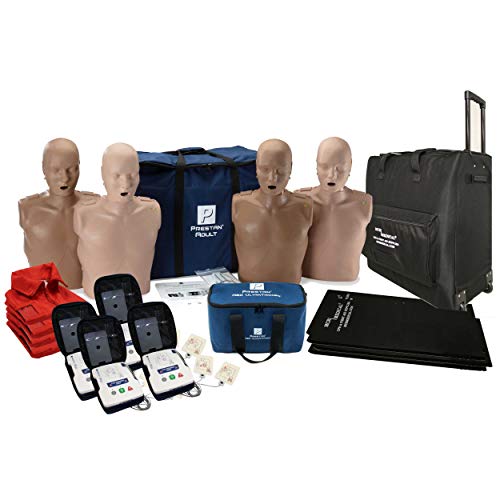
This kit swaps the mixed adult/infant configuration for four adult manikins in two medium and two dark skin tones, paired with four AED UltraTrainers. The diversity focus allows a training group to practice realistic scenarios with manikins that represent a broader population, which is particularly relevant for teaching proper pad placement across different skin pigmentation and chest anatomies.
Each adult manikin includes feedback technology that lights up when compressions hit the correct depth and rate, and the AED trainers replicate the shock-and-analyze cycle. The kit weighs 39.3 pounds and comes in a carry bag — substantial, but still portable for training sessions. Users report that the manikins are well-made and that the feedback mechanism helps trainees self-correct in real time.
A limitation is the lack of infant manikins, so this kit is best suited for households or instructors who focus exclusively on adult resuscitation training. The 3-year warranty is reassuring, but a single user reported a missing face mask issue that was resolved upon inspection — the masks are integrated with the lung bags. This kit is a powerful dedicated adult training tool.
Why it’s great
- Diverse skin tones for realistic training
- Four AED UltraTrainers included
- Feedback lights for compression accuracy
- 3-year warranty for training equipment
Good to know
- No infant manikins in this pack
- Heavy at 39.3 pounds
- Batteries not included
6. Prestan CPR Manikin Diversity Kit 4-Adult & 4-Infant
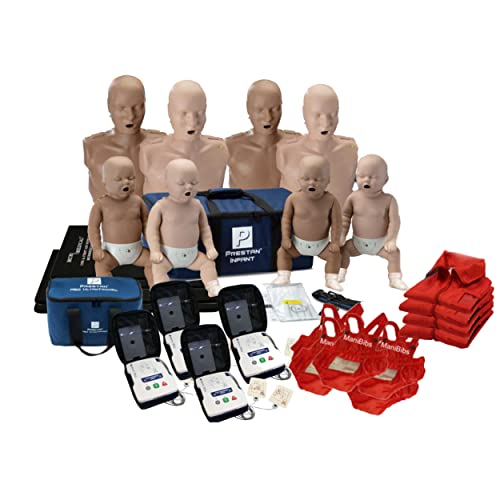
This large-scale training kit packs four adult and four infant Prestan manikins with feedback, plus four AED UltraTrainers, making it the most comprehensive training station for a home-based classroom or a multi-generational family practice group. The manikins come in a mix of medium and dark skin tones, and the feedback lights on both adult and infant models ensure trainees learn proper compression technique for different body sizes.
Users praise the overall value — this kit provides everything needed for a full CPR and AED course without purchasing separate components. The AED trainers simulate shock delivery and include multiple scenarios, and the included carry bag helps with storage. The warranty covers three years on the manikins and trainers.
Quality control has been a minor concern: one user reported a broken infant manikin leg, and another noted that the shoulder pins on two adult manikins could pop open during rescue breaths, reducing chest seal integrity. The AED trainer pads and cables were also noted to feel lower quality in one unit. These are not deal-breakers for the overall price-to-quantity ratio, but they suggest batch-to-batch variability.
Why it’s great
- Eight manikins cover adult and infant training
- Diverse skin tones in 2-count each
- Four AED trainers for group scenarios
- Comprehensive training value for the cost
Good to know
- Occasional quality issues with shoulder pins
- Infant manikins may have loose parts
- Batteries not included for trainers
7. MCR Medical Prestan Diversity Adult & Infant Kit w/ Wheeled Carryall
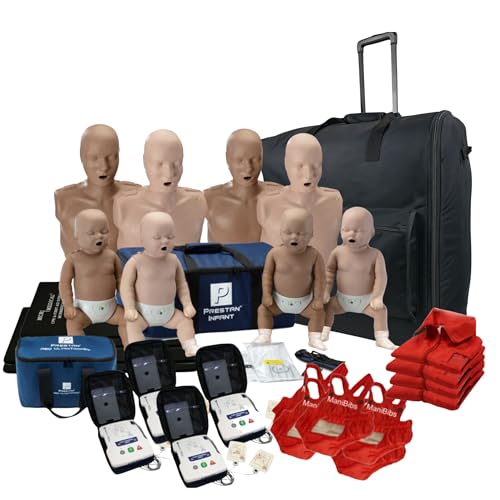
This top-tier training bundle from MCR Medical combines four adult and four infant Prestan manikins with four AED UltraTrainers, but its defining feature is the wheeled carryall that makes transporting the 42.5-pound kit from room to room or to remote training locations significantly easier. The adult and infant manikins include feedback technology for compression depth and rate, and the four AED trainers support group practice.
The kit is designed for instructors who need to bring the full training suite to students, but it also works well for a large family or community group that wants dedicated equipment for regular drills. Users consistently rate the product as high quality and a great value, noting that the wheeled case protects the manikins during transport and storage. The diversity skin tones add realism.
One user did report a faulty AED trainer that failed on first use, though the manufacturer quickly sent a replacement. This highlights the importance of testing all units upon delivery. The bulk and weight of this kit make it unsuitable for casual home storage, but if you have a dedicated training space and plan to use it frequently, the wheeled mobility is a game-changer over bag-only alternatives.
Why it’s great
- Wheeled carryall simplifies moving 42.5 lbs of gear
- Eight-manikin diversity set with feedback
- Four AED trainers enable group practice
- Quick replacement support reported by users
Good to know
- Very heavy and large for home closets
- One unit reported faulty on arrival
- Batteries not included
FAQ
Are home AEDs safe to use on someone with a pacemaker?
Can I use a home AED on an infant or child?
How often do the pads and battery need to be replaced?
Final Thoughts: The Verdict
For most users, the best aed for home use winner is the Philips HeartStart Home M5068A because it combines the fastest shock delivery time with a compact form factor, automated self-tests, and a generous warranty that reduces long-term ownership anxiety. If you want a device that doubles for public spaces without sacrificing home-readiness, grab the Philips HeartStart OnSite M5066A. And for a family that wants to pair emergency gear with realistic practice, nothing beats the Prestan Take2 Training Kit for building the muscle memory that matters most when every second counts.