
Scrolling through solar panel listings can feel like a minefield of inflated wattage claims and confusing connector standards. The real challenge isn’t finding a panel—it’s finding one that actually delivers usable power to your portable power station without emptying your wallet in the process. Whether you’re tricking out a camper van, building an off-grid cabin setup, or just keeping your devices alive during a weekend campout, the right panel makes all the difference between a sunny day of free energy and a cloudy disappointment.
I’m Min — the co-founder and writer behind Gadgets Feed. I spend hours cross-referencing efficiency ratings, connector compatibility, and real-world user benchmarks to separate marketing hype from genuine performance in the affordable solar space.
This guide walks through the most capable options that balance cost with real-world output, so you can confidently pick the right cheap solar panels for your off-grid needs without second-guessing the specs.
How To Choose The Best Cheap Solar Panels
Buying on a budget doesn’t mean buying blind. The affordable solar market has matured to the point where entry-level panels now incorporate technologies once reserved for premium units—like N-type cells and multi-busbar designs. The key is knowing which specs actually translate to real-world wattage and which are just marketing numbers.
Cell Efficiency and Busbar Count
Efficiency ratings in the 23-25% range are now common even in mid-range panels. Higher efficiency means more power per square foot, which matters when you’re limited on roof space or carrying a portable panel. The number of busbars (BB) also matters—16BB designs reduce internal resistance, improve current collection, and make cells less prone to micro-cracks from handling.
Connector Compatibility is Everything
Nothing is more frustrating than buying a panel that doesn’t physically connect to your power station. Budget panels often solve this with multi-connector cables (5-in-1 or 3-in-1) that include XT60, Anderson, DC7909 (8mm), DC5521, and DC8020 ports. Always check what your specific generator or battery needs before purchasing.
Portable vs. Rigid: Form Factor Trade-offs
Foldable portable panels offer convenience and easy storage, but rigid glass-and-aluminum panels typically produce higher sustained wattage due to better heat dissipation and optimal cell spacing. Portable panels sacrifice some peak output for packability, while rigid panels demand permanent or semi-permanent mounting.
Quick Comparison
On smaller screens, swipe sideways to see the full table.
| Model | Category | Best For | Key Spec | Amazon |
|---|---|---|---|---|
| Renogy 100W N-Type | Rigid Panel | Off-grid cabin & RV roof | 25% N-Type 16BB efficiency | Amazon |
| HQST 200W Portable | Foldable Panel | High-wattage camping & backup | 200W output at 11 lbs | Amazon |
| ZOUPW 100W Portable | Foldable Panel | Multi-brand power station charging | 23.5% eff. 5-in-1 cable | Amazon |
| ECO-WORTHY 2x100W | Rigid 2-Pack | Budget 200W system building | 25% PERC, IP68 junction | Amazon |
| EBL 100W Portable | Foldable Panel | Jackery & EcoFlow compatibility | 23% eff. magnetic handle | Amazon |
| NESTOUT 14W Portable | Ultra-Portable | Backpacking phone charging | 24% eff. built-in ammeter | Amazon |
| ELECOM NESTOUT 28W | Ultra-Portable | Modular outdoor gear system | SunPower cells, dual USB | Amazon |
In‑Depth Reviews
1. Renogy 100W Solar Panel N-Type

The Renogy N-Type panel hits the sweet spot where premium cell technology meets an accessible price point. Its 16BB configuration reduces internal resistance and improves current collection, delivering up to 20W more power than conventional PERC panels of the same physical footprint. The 25% efficiency rating means you extract more wattage from limited roof or ground space, and the 22.79V maximum voltage pairs cleanly with most MPPT charge controllers.
Build quality is a clear step above entry-level competition: IP65-rated junction box, low-iron tempered glass, and corrosion-resistant aluminum frame that withstands snow loads and sustained heat. The low temperature coefficient (≤0.4% annual degradation after year one) makes this a compelling choice for hot climates where other panels suffer greater power loss during summer months. Real-world owners report sustained output around 93W in peak conditions, which is excellent for a 100W-rated panel.
The trade-off is that this is a rigid panel—you’ll need mounting hardware and a semi-permanent installation. It’s not something you toss in a backpack for a hike. But for an RV roof, cabin wall, or ground-mounted array, the N-Type delivers the best long-term value among affordable rigid options. The 10-year material warranty and 25-year performance guarantee at 80% output provide meaningful long-term reassurance.
Why it’s great
- 25% N-Type efficiency delivers more real-world power than standard PERC panels
- 16BB design reduces hot spots and micro-crack risk for longer service life
- Low degradation profile ensures reliable output beyond a decade of use
Good to know
- Rigid frame requires permanent or semi-permanent mounting
- No built-in USB ports for direct device charging
2. HQST 200W Ultra-Light Portable Solar Panel
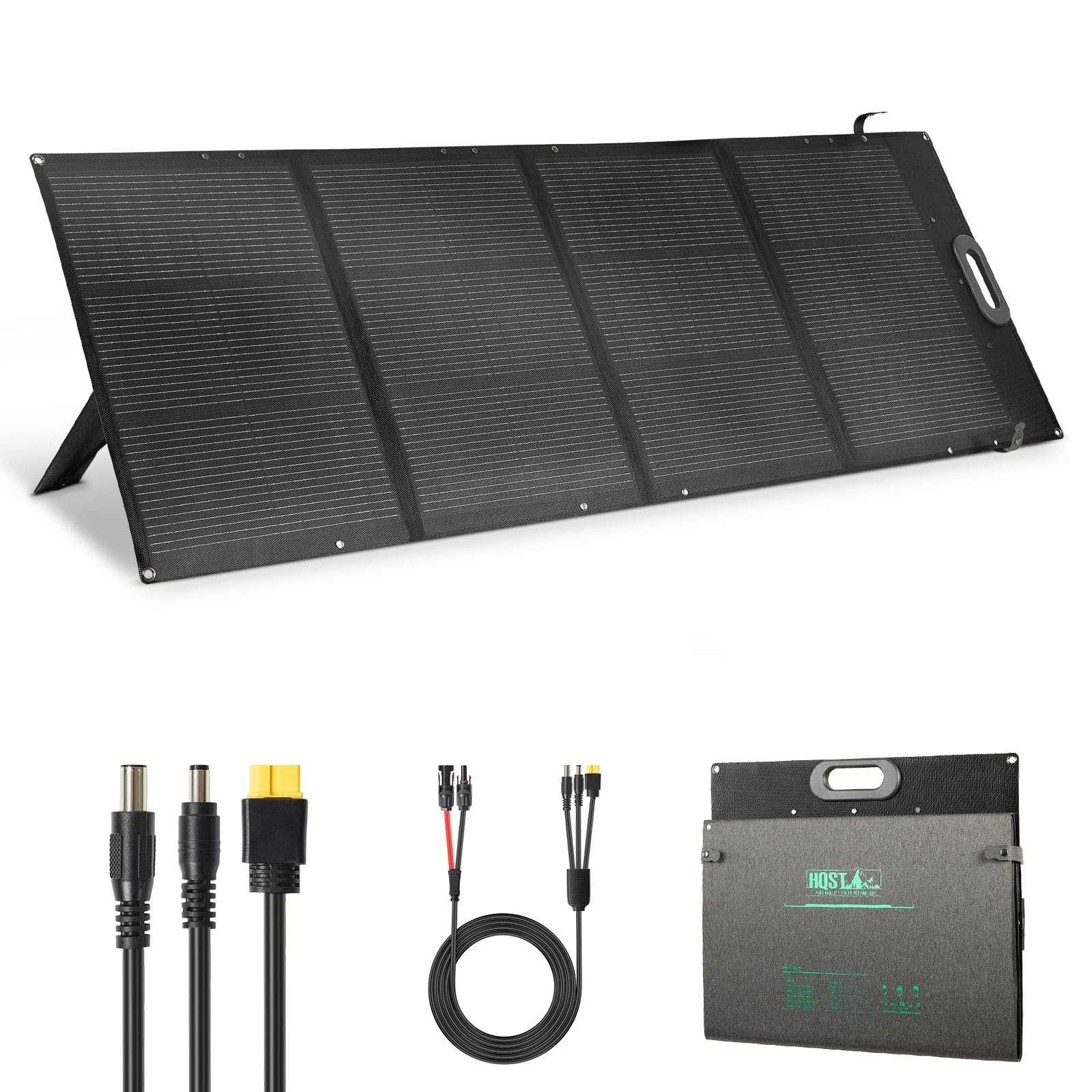
HQST’s 200W portable panel uses next-gen 16BB N-Type cells to hit 25% efficiency while staying remarkably lightweight at just 11 pounds—up to 37% lighter than comparable 200W portable panels. This weight savings is tangible when you’re carrying it from the car to a campsite or hauling it up to a remote cabin. The foldable design collapses to just 1.97 inches thick with built-in buckles for storage.
Connectivity is handled by a 4.9-foot 3-in-1 adapter cable supporting XT60, DC7909 (8mm), and DC5521 ports, covering most major power stations from Jackery and EcoFlow to BLUETTI and Goal Zero. The two adjustable kickstands offer a 40-60 degree angle range, positioning for optimal sun capture even on uneven ground. The rigid design avoids the floppy instability common with soft folding panels, and the IP67 waterproof rating means rain and splashes won’t ruin your charging session.
Owners report sustained output around 170-180W in good sun, occasionally hitting 190W peaks—impressive for a portable unit. The fully laminated construction eliminates stitched seams where water typically seeps into cheaper panels, and the PVDF coating adds scratch resistance. If you need serious wattage on the go without paying premium-brand pricing, this is the portable panel to beat at this price tier.
Why it’s great
- 37% lighter than comparable 200W panels, easy to transport
- 16BB N-Type cells achieve genuine 25% efficiency in a portable format
- IP67 waterproof with fully laminated construction—no stitched seams
Good to know
- 3-in-1 adapter cable is relatively short at 4.9 feet
- Kickstand angle range is adjustable but not infinitely variable
3. ZOUPW 100W Portable Solar Panel

ZOUPW’s panel is built around a 5-in-1 connector cable that supports DC8020, XT60, Anderson, DC7909, and DC5521—making it arguably the most universally compatible foldable panel in this price bracket. The 23.5% Grade A+ monocrystalline cells deliver strong real-world output, with owners reporting consistent 60W+ charges into their power stations even under partially cloudy conditions. The 10-foot extension cable provides meaningful flexibility for positioning the panel in sunlight while keeping your generator shaded.
The IP67 ETFE coating is a notable upgrade over the PET coating found on cheaper competitors—better light transmittance, higher heat resistance, and genuine protection against rain and splashes. The built-in controller includes a USB-C PD port (15V/3A) and two USB-A ports (one with QC3.0), allowing direct device charging without needing a separate power station. The magnetic carry handle and Velcro leg attachments make setup intuitive, and the folded footprint of 24 by 21 inches is manageable for trunk storage.
The downsides are minor but worth noting: the kickstands lack angle adjustability (fixed at roughly 45 degrees), and some users have found the USB-C PD output peaks at 45W rather than the suggested 60W in certain conditions.
Why it’s great
- 5-in-1 cable works with 99% of power stations out of the box
- IP67 ETFE coating resists heat, scratches, and water better than PET panels
- Built-in USB-C PD and QC3.0 ports for direct device charging
Good to know
- Kickstands have no adjustable angle—fixed at roughly 45 degrees
- Weighs 9.48 lbs, heavier than some 100W foldable competitors
4. ECO-WORTHY 2-Pack 100W Monocrystalline Panels
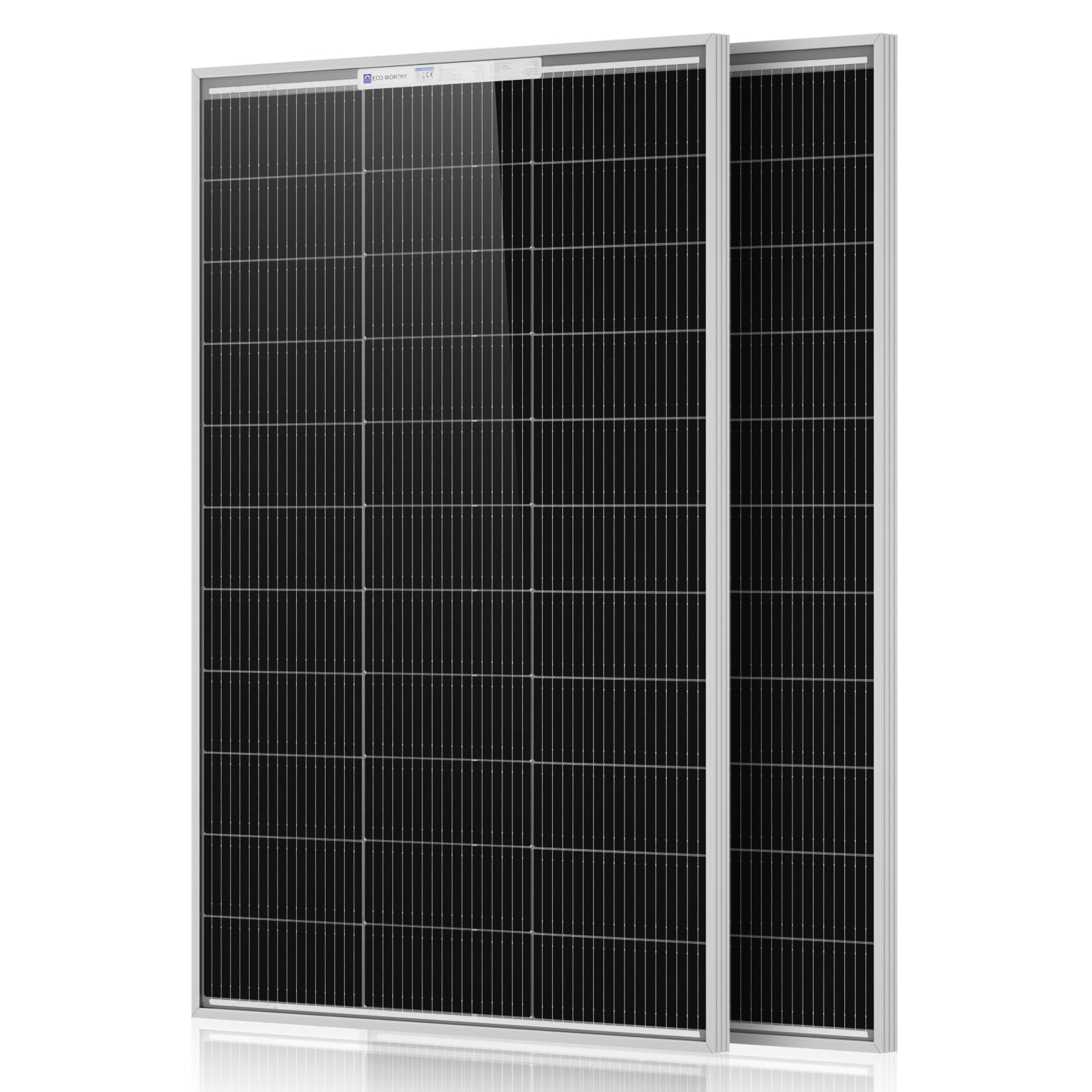
The ECO-WORTHY 2-pack is the budget way to build a 200W ground array or supplement an existing rooftop system. Each panel uses PERC technology to push efficiency to 25%, and real-world owners confirm output exceeding 100W per panel at optimal angles. The IP68-rated junction box is genuinely waterproof, and the bypass diodes minimize power loss from partial shading—critical when panels are mounted in less-than-ideal locations.
Build quality includes a 1.18-inch thick edge for better heat dissipation and 5400Pa snow load capacity with 2400Pa wind resistance. The pre-drilled holes on the back frame simplify installation on Z-brackets or roof rails. Each panel weighs 11.46 pounds and includes 35-inch cables with MC4 connectors for daisy-chaining in series or parallel. Two panels wired in series deliver roughly 50.4V nominal, which pairs efficiently with 24V MPPT controllers.
The main caveat is that this is a rigid panel—not portable. It’s meant for permanent or semi-permanent mounting, and the glass surface requires careful handling during installation. Some owners have noted that shipping packaging could be more protective, with occasional frame dents from rough handling. But as a value proposition for building a stationary 200W system, the per-panel cost is hard to beat in this segment.
Why it’s great
- Two panels provide 200W total output at an excellent per-watt cost
- 25% PERC efficiency with IP68 junction box for long-term outdoor use
- High wind and snow load ratings suit permanent rooftop installations
Good to know
- Glass-and-aluminum rigid design is not portable—needs mounting hardware
- Shipping packaging has been reported as inadequate for some units
5. EBL 100W Portable Solar Panel
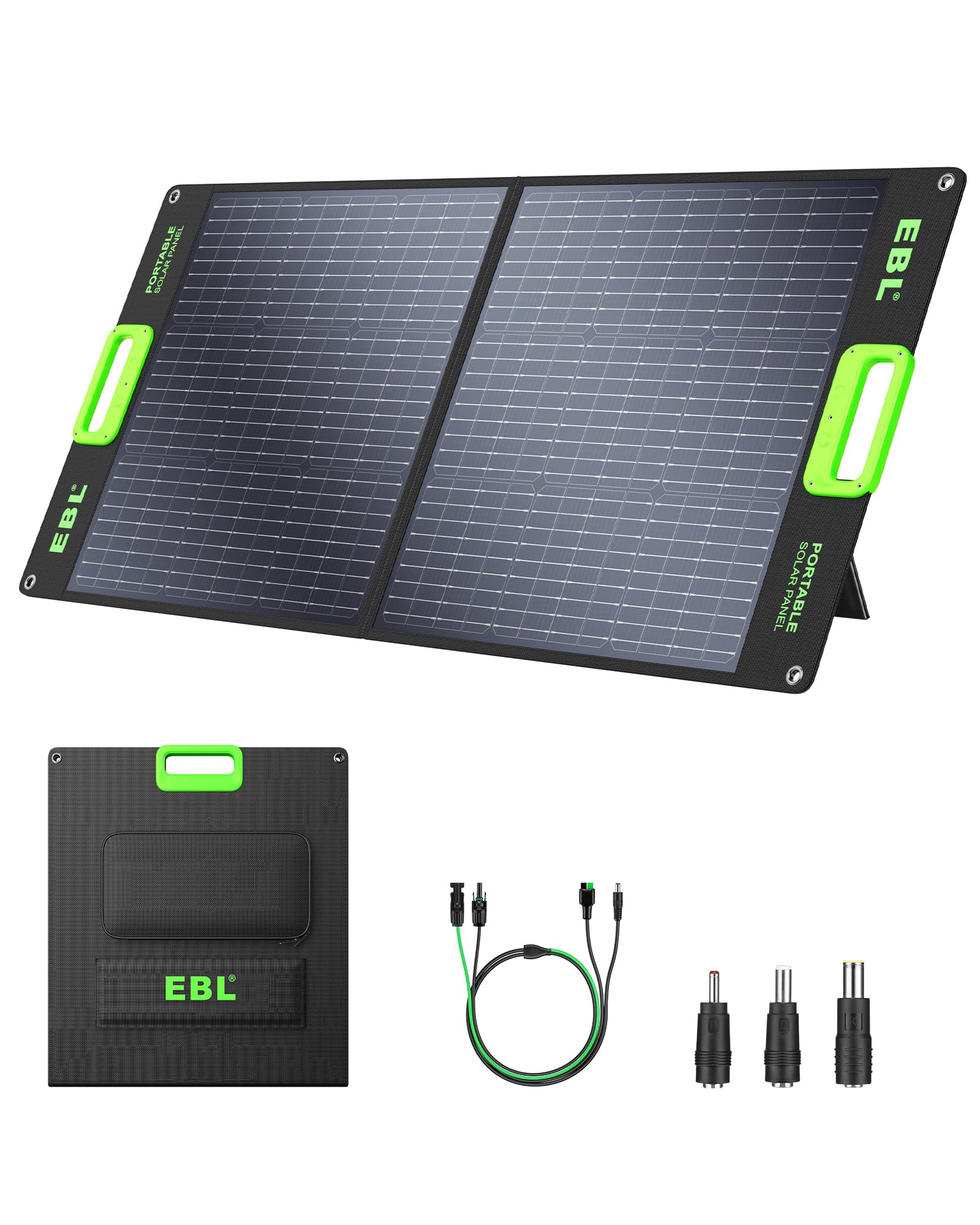
The EBL 100W panel is built around high-purity monocrystalline cells that achieve 23% efficiency—a solid figure at its price tier. The two integrated kickstands angle the panel at 45 degrees to capture up to 20% more sunlight than flat-laying designs. The magnetic handle simplifies folding and carrying, and the ETFE laminated front offers IP65 splash resistance for outdoor use.
Connectivity is where the EBL panel shows its flexibility: it ships with MC4-to-Anderson and MC4-to-DC5521 cables, plus a set of adapter tips covering 5.5mm×2.1mm, 5.5mm×2.5mm, 7.9mm×0.9mm, and 3.5mm×1.5mm configurations. This makes it compatible with most Jackery, EcoFlow, and Anker power stations out of the box. Owners have reported real-world output around 65-80W in full sun on standard 12V systems, and some have seen peak near 100W under ideal conditions with MPPT controllers.
Build quality is decent for the price, though the 6-foot MC4 cable is shorter than ideal for flexible positioning. The IP65 rating means it can handle splashes but shouldn’t be left in sustained rain. For those looking for a lightweight weekend camping companion that integrates well with existing name-brand power stations, the EBL strikes a practical balance between affordability and connectivity.
Why it’s great
- Comes with multiple adapter cables and tips for wide power station compatibility
- Magnetic handle and 45-degree kickstands simplify setup and transport
- ETFE coating offers better durability than PET-panel equivalents
Good to know
- 6-foot MC4 cable is shorter than many competitors
- IP65 rating handles splashes but not sustained rain exposure
6. NESTOUT Portable Solar Panel 14W
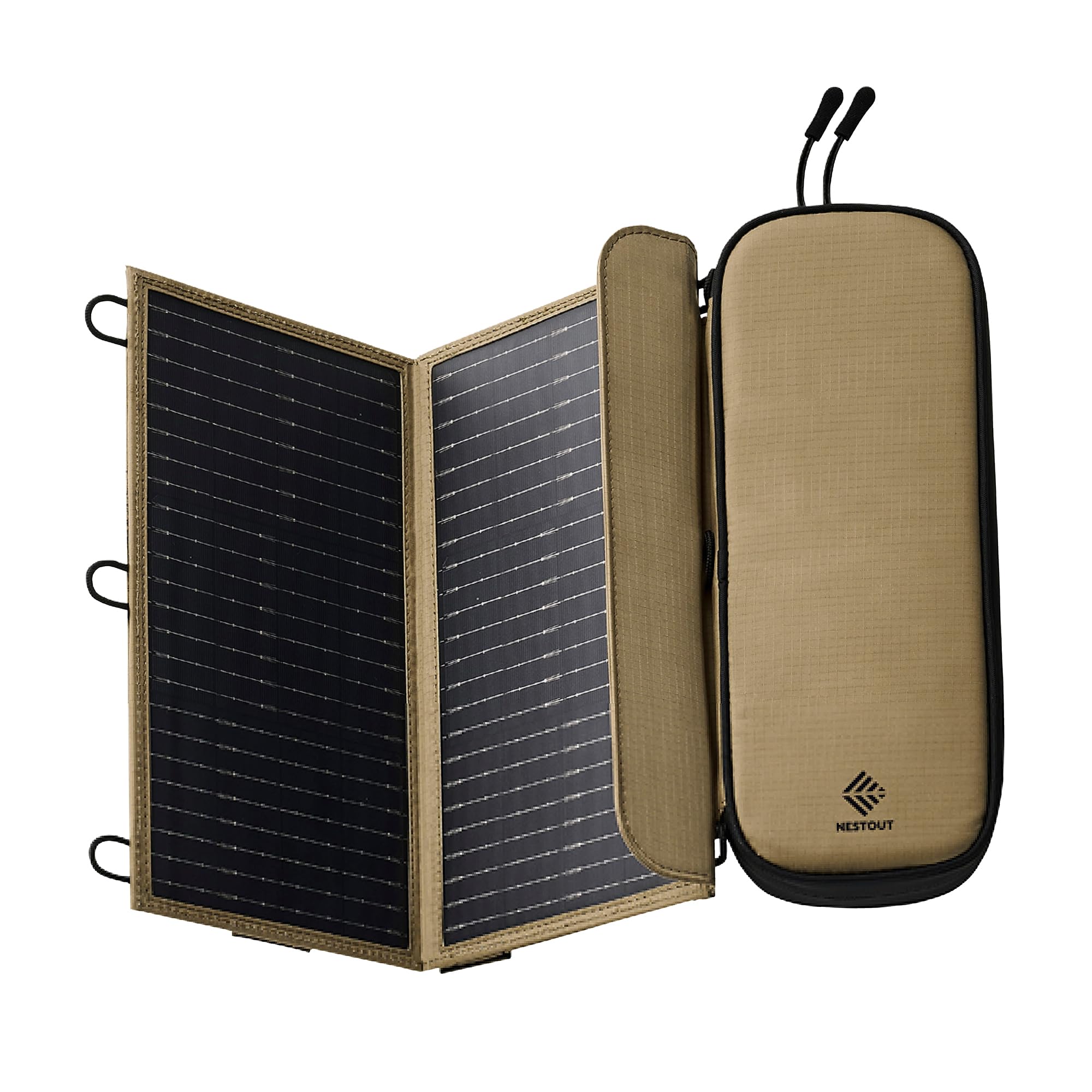
The NESTOUT 14W panel is designed for a specific use case: keeping phones, power banks, and GPS units alive during multi-day backpacking trips where every ounce counts. At just 610 grams (21.5 ounces) and folding down to 5.9×11.0×2.2 inches, it’s small enough to attach to the outside of a pack without noticeable bulk. The 24% efficient polymer cells maximize power extraction from the limited surface area.
The updated version includes both USB-C and USB-A ports, supporting up to 5V/2.8A total output. The built-in digital ammeter displays real-time charging current, allowing you to adjust panel angle for peak performance. The wide-angle adjustable stand and multiple hanging loops let you attach the panel to a backpack, tree, or tent guyline for hands-free charging around camp. Owners report charging a 5000mAh power bank in roughly 2.5-3 hours of good sun.
The water-repellent ripstop nylon construction with PET-coated solar surface handles light rain and trail conditions well. The interior zippered pocket stores cables and a small power bank. At this power level, you’re not charging laptops or running appliances—but for topping off small devices on the trail, it’s one of the most thoughtfully designed ultra-portable panels available at this price point.
Why it’s great
- Ultra-light 610g design with foldable form factor fits any backpack
- Built-in digital ammeter shows real-time charging performance
- USB-C and USB-A ports support wide device compatibility
Good to know
- 14W output limits charging to phones, power banks, and small electronics
- Full rated output typically requires both USB ports in use simultaneously
7. ELECOM NESTOUT 28W Portable Solar Panel

The 28W NESTOUT panel from ELECOM is the larger sibling in the modular NESTOUT ecosystem, and it earned an iF Design Gold award for its thoughtful integration. Using SunPower MAXEON cells for up to 24% efficiency improvement over traditional panels, this unit delivers enough power to charge tablets, multiple phones, and larger power banks in a single day. The dual USB-A ports push up to 4.8A total output.
What sets this panel apart is the ecosystem thinking: the NESTOUT system includes rechargeable battery packs designed to mimic vintage fuel bottles, and this panel is engineered to integrate seamlessly with them. The built-in current checker LED display shows generation in real time, and the two adjustable stands optimize sun angle. The water-resistant ripstop nylon bag with mesh storage pouches and exterior loops keeps everything organized for backpacking, hiking, and prepping use cases.
At 771 grams (about 1.7 pounds), it’s slightly heavier than the 14W version but still packable. Owners consistently praise the build quality and compact folded size. The main drawback is the absence of USB-C, which is an increasingly common omission in a premium product. If you’re building a modular outdoor power system and value design cohesion, the NESTOUT ecosystem delivers a charging experience that competitors haven’t matched in terms of accessory integration.
Why it’s great
- SunPower MAXEON cells deliver genuine efficiency gains over standard cells
- iF Design Gold Award-winning modular ecosystem with battery pack integration
- 2 adjustable stands and hanging loops provide flexible positioning options
Good to know
- Only dual USB-A ports—no USB-C output
- Premium design carries a cost premium over comparable 28W panels
FAQ
Why do some 100W portable panels only output 60-80W in real-world use?
Can I mix different wattage solar panels in the same array?
Final Thoughts: The Verdict
For most users, the cheap solar panels winner is the Renogy 100W N-Type because its 25% efficiency, 16BB design, and low degradation profile deliver the best long-term value in a rigid panel. If you want high portable wattage, grab the HQST 200W Ultra-Light. And for an ultra-compact trail companion, nothing beats the NESTOUT 14W in this budget range.