
Forget noisy, fume-belching gas generators. Modern solar battery banks deliver silent, emissions-free power for anything from a weekend camping trip to a multi-day home outage. The trick is matching your energy appetite to the right battery capacity (measured in watt-hours) and solar input rate (measured in watts) so you aren’t left in the dark.
I’m Min — the co-founder and writer behind Gadgets Feed. I study the real-world performance of solar generators by cross-referencing technical datasheets, user load tests, and charge-cycle data to find which units actually hold up under heavy use and cloudy skies.
If you want a portable energy source that recharges from the sun and powers your fridge, phones, and lights, you need the right battery bank for solar setup that pairs fast panel input with a durable LiFePO4 core.
How To Choose The Best Battery Bank For Solar
Picking a solar generator isn’t about grabbing the biggest battery. You need to balance capacity (watt-hours), inverter output (watts), solar charging speed (watts), and physical portability. Here are the three specs that separate a great setup from a frustrating one.
Battery Chemistry & Cycle Life
Stick with LiFePO4 (LFP) cells. They handle 3,000 to 4,000 full charge cycles before dropping to 80% capacity — roughly a decade of daily use. Older NMC or lithium-ion packs degrade after 500 cycles and pose a higher thermal runaway risk. LFP is heavier per watt-hour, but the longevity and safety make it the only sensible choice for a solar investment.
Solar Input Wattage & Voltage Range
Your battery bank for solar is only as good as its recharging speed. Check the max solar input (in watts) and the open-circuit voltage range. A unit that accepts 200W of solar will refill much faster on a cloudy day than one capped at 100W. Look for an MPPT charge controller — it extracts more power from your panels than a basic PWM controller, especially when sunlight is weak.
AC Output & Surge Capability
Make sure the inverter can start your appliances. Motors in fridges, sump pumps, and power tools draw 2-3x their running wattage for a split second. If your generator’s surge rating is too low, the fridge won’t start. Pure sine wave inverters are also essential for sensitive electronics like CPAP machines and laptops — modified sine wave can cause buzzing or damage.
Quick Comparison
On smaller screens, swipe sideways to see the full table.
| Model | Category | Best For | Key Spec | Amazon |
|---|---|---|---|---|
| Anker SOLIX C1000 + 200W Panel | Mid/High | Fast hybrid charging, whole-home backup | 1056Wh, 1800W output, 200W solar panel included | Amazon |
| Jackery Explorer 2000 v2 | Premium | Lightweight 2kWh power for extended trips | 2042Wh, 2200W output, 39.5 lbs | Amazon |
| GROWATT INFINITY 2000 Pro + 200W Panel | Premium | High solar input, RV TT-30 outlet | 2048Wh, 2400W output, 1200W solar input | Amazon |
| AFERIY 3840Wh Power Station | High-Capacity | Whole-home backup, expandable to 11.5kWh | 3840Wh, 3600W output, UPS <10ms | Amazon |
| Jackery HomePower 3000 + 2x200W Panels | Premium | Maximum home backup with included panels | 3072Wh, 3600W output, 400W solar panels | Amazon |
| BLUETTI Elite 30 V2 | Mid-Range | Compact UPS and CPAP backup | 288Wh, 600W output, 10ms UPS | Amazon |
| VTOMAN Jump 600X | Mid-Range | Car jump starter + power station combo | 299Wh, 600W output, 60W USB-C PD | Amazon |
| EF ECOFLOW RIVER 3 | Entry | Ultra-light daily UPS and device charging | 245Wh, 300W output, 1hr AC charge | Amazon |
| Apowking HP200L + 40W Panel | Budget | Affordable entry with included solar panel | 220Wh, 300W output, 40W solar panel | Amazon |
In‑Depth Reviews
1. Anker SOLIX C1000 + 200W Solar Panel

The Anker SOLIX C1000 strikes an exceptional balance between capacity, charging speed, and build quality. Its 1056Wh LiFePO4 battery powers 99% of home appliances thanks to SurgePad technology delivering 2400W peak, while the included 200W solar panel with an IP67 waterproof rating and 23% conversion efficiency ensures reliable off-grid recharging even in drizzle.
UltraFast recharging hits 80% in just 43 minutes via AC, making this a top pick for users who need rapid turnaround between outages. The 11-port array includes six AC outlets, USB-C, and USB-A, so you can run a fridge, router, and multiple devices simultaneously without adapters. The panel’s four adjustable angles (30° to 80°) help capture maximum sunlight regardless of season or latitude.
At 27.6 pounds, the C1000 is heavier than entry-level units, but that weight buys you a 10-year lifespan and 3,000 cycles. The trade-off is that the solar panel arrives separately from the power station, so plan for split delivery. For the combination of capacity, fast charging, and a truly weatherproof panel, this is the benchmark mid-range solar generator.
Why it’s great
- UltraFast AC recharge in 43 minutes to 80%
- IP67 waterproof solar panel with 23% efficiency
- 2400W SurgePad handles fridge and sump pump startup
Good to know
- Power station itself is not weatherproof
- Panel ships separately from the main unit
- Single 200W panel may feel slow for full 1056Wh recharge on cloudy days
2. Jackery Explorer 2000 v2

The Explorer 2000 v2 redefines what a 2kWh-class generator can weigh. At just 39.5 pounds, it’s 41% lighter than typical units in its capacity class, thanks to Jackery’s CTB (Cell-to-Body) technology borrowed from EV manufacturing. With 2042Wh of LiFePO4 storage and a 2200W pure sine wave inverter, it can run a full-size fridge for over 21 hours straight.
Fast AC charging hits 80% in 66 minutes, and Emergency Super Charging mode (controlled via the app) reaches full in 102 minutes. For quiet operation, Silent Charging mode keeps fan noise under 30 dB — quieter than a library. The 20ms UPS switch is UL1778 certified, meaning sensitive electronics like security cameras and network gear won’t glitch during a power transfer.
The unit includes three AC ports, USB-C PD 100W, and a clear LCD. Bluetooth connectivity can be inconsistent, and the solar barrel ports feel slightly flexible when plugging in panels. Still, for anyone who needs serious capacity without a hernia-inducing carry, this is the lightest 2kWh option on the market.
Why it’s great
- Only 39.5 lbs for a 2kWh-class battery
- Silent Charging mode under 30 dB
- UL1778 certified 20ms UPS for sensitive gear
Good to know
- Bluetooth pairing can be spotty at range
- Solar barrel connectors feel less robust than XT60
- Heavier than entry units, though light for its class
3. GROWATT INFINITY 2000 Pro + 200W Panel
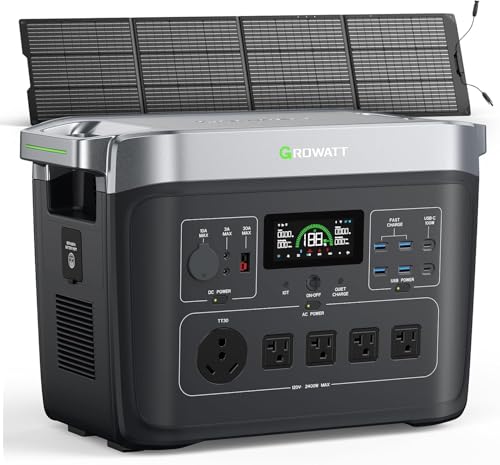
GROWATT, a global inverter giant, brings its utility-grade engineering to the portable market with the INFINITY 2000 Pro. Its standout spec is the 1200W maximum solar input — nearly double what most competitors offer — allowing a full 2048Wh recharge from panels in about 1.7 hours of strong sun. The 2400W inverter (4000W surge) uses EV-grade LFP cells rated for 4,000+ cycles.
The 15-port layout includes a dedicated TT-30 RV outlet, two USB-C ports, and a 30A Anderson connector for high-current accessories. The MyGro app provides WiFi and Bluetooth control with real-time power flow visualization. Cold Start technology lets it operate down to -22°F, making it viable for winter camping or mountain cabins.
Units ship with a 200W solar panel that connects via standard MC4 cables. Some users report that the included XT60i cable requires careful pin alignment, and customer support response times can vary. However, the combination of high solar throughput, expandability (up to 6100Wh with add-on batteries), and a 5-year warranty makes this a compelling high-end solar generator for serious off-gridders.
Why it’s great
- 1200W solar input for ultra-fast panel recharging
- TT-30 RV outlet built in, no adapter needed
- Cold Start operation down to -22°F
Good to know
- 78 lbs is hefty; plan for stationary use or a cart
- Solar cable requires correct pin orientation on XT60i
- Customer support responsiveness is inconsistent
4. AFERIY 3840Wh Power Station

The AFERIY delivers 3.8kWh of LFP storage right out of the box — enough to run a refrigerator for 1-2 days — and can be expanded to a whopping 11.5kWh with additional battery packs. The 3600W continuous inverter (7200W surge) handles heavy loads like well pumps and power tools, while the <10ms UPS transfer ensures seamless backup during outages for sensitive medical or networking equipment.
Recharging is flexible: AC input alone takes 1.5 hours to full, or you can use hybrid AC+solar for even faster top-ups. The 15-port panel includes five 120V AC outlets, USB-C PD 3.0, DC5521, XT60, and a 12V car socket. A pull handle and rugged wheels make the 80-pound unit easier to move than its weight suggests. UL listing and a 7-year support period add long-term confidence.
The smart app lets you monitor charge/discharge status, schedule charging, and control light modes remotely. Some early units had display readability issues, but AFERIY support has been responsive with replacements. For pure capacity per dollar, this is the hardest-hitting battery bank for solar in this lineup.
Why it’s great
- 3.8kWh expandable to 11.5kWh with add-on packs
- 3600W continuous / 7200W surge handles heavy loads
- UL listed with 7-year support period
Good to know
- 80+ lbs; wheel kit is essential for mobility
- Occasional display QC issues reported
- App lacks separate solar/AC input power display
5. Jackery HomePower 3000 + 2x200W Panels
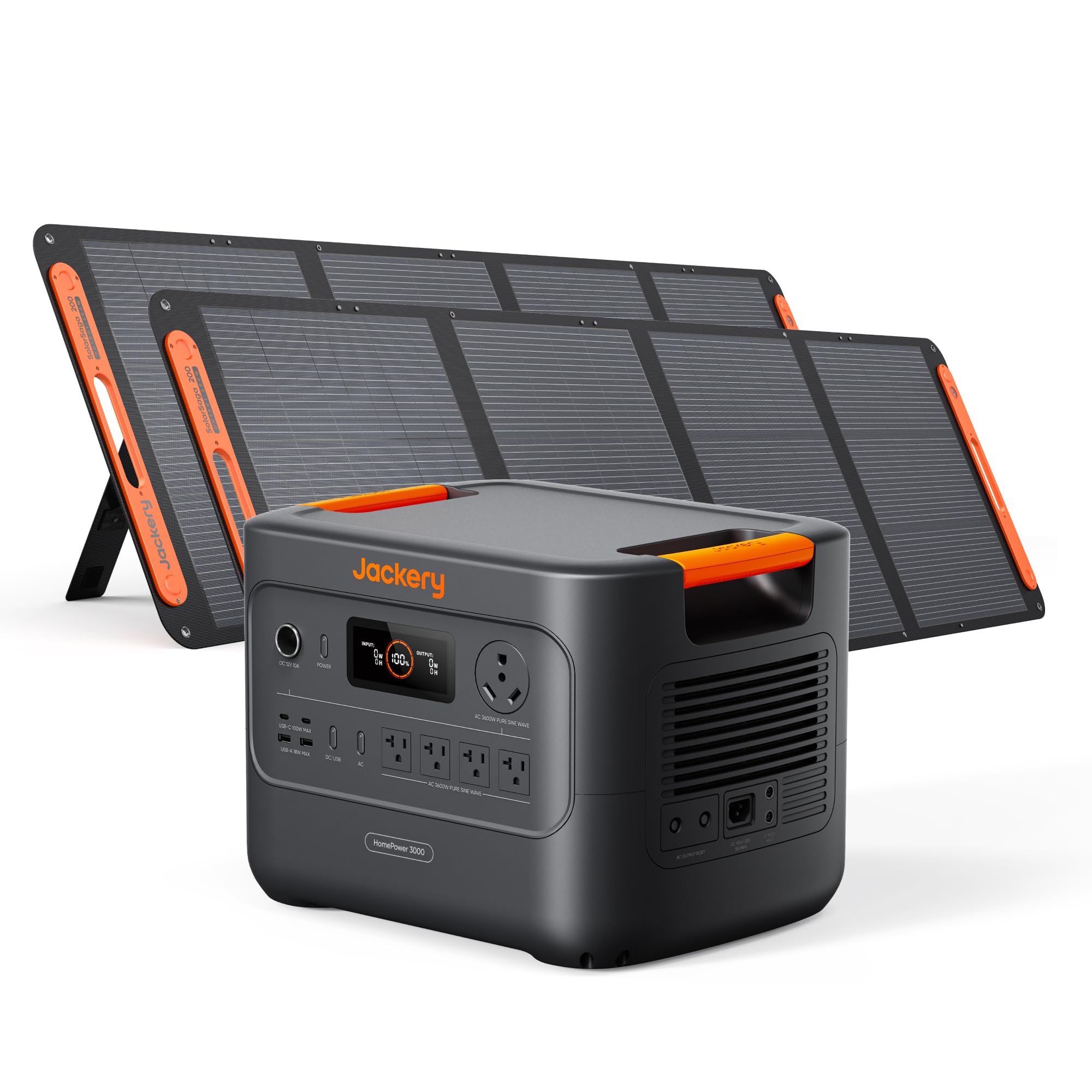
The HomePower 3000 is Jackery’s most powerful home-oriented generator, packing 3072Wh of LFP capacity and a 3600W inverter (7200W surge) that can run an entire household essential load for up to 15 hours. The bundle includes two 200W SolarSaga panels, giving you 400W of solar input right out of the box — enough to recharge the unit to 80% in about 9 hours of good sun.
ChargeShield 2.0 AI algorithms optimize charging speed while extending battery lifespan to 4,000 cycles. The ≤20ms UPS is UL-certified, so your router, security cameras, and medical devices stay online during grid flickers. Dual 100W USB-C PD ports fast-charge laptops and tablets simultaneously, and the built-in TT-30 RV port connects directly to camper electrical systems without adapters.
At 59.5 pounds, it’s 43% lighter than comparable 3kWh units thanks to CTB technology, and the honeycomb bottom shell adds structural rigidity. Solar panels and the power station ship separately. For anyone needing a week-long home backup solution with generous included solar capacity, this is the gold standard.
Why it’s great
- 3kWh capacity with two 200W panels included
- 4,000-cycle LFP battery with AI charge optimization
- TT-30 RV port and dual 100W USB-C PD
Good to know
- Heavy at 59.5 lbs; wheel kit sold separately
- Panels and station ship in separate packages
- Cannot expand battery capacity with add-on packs
6. BLUETTI Elite 30 V2
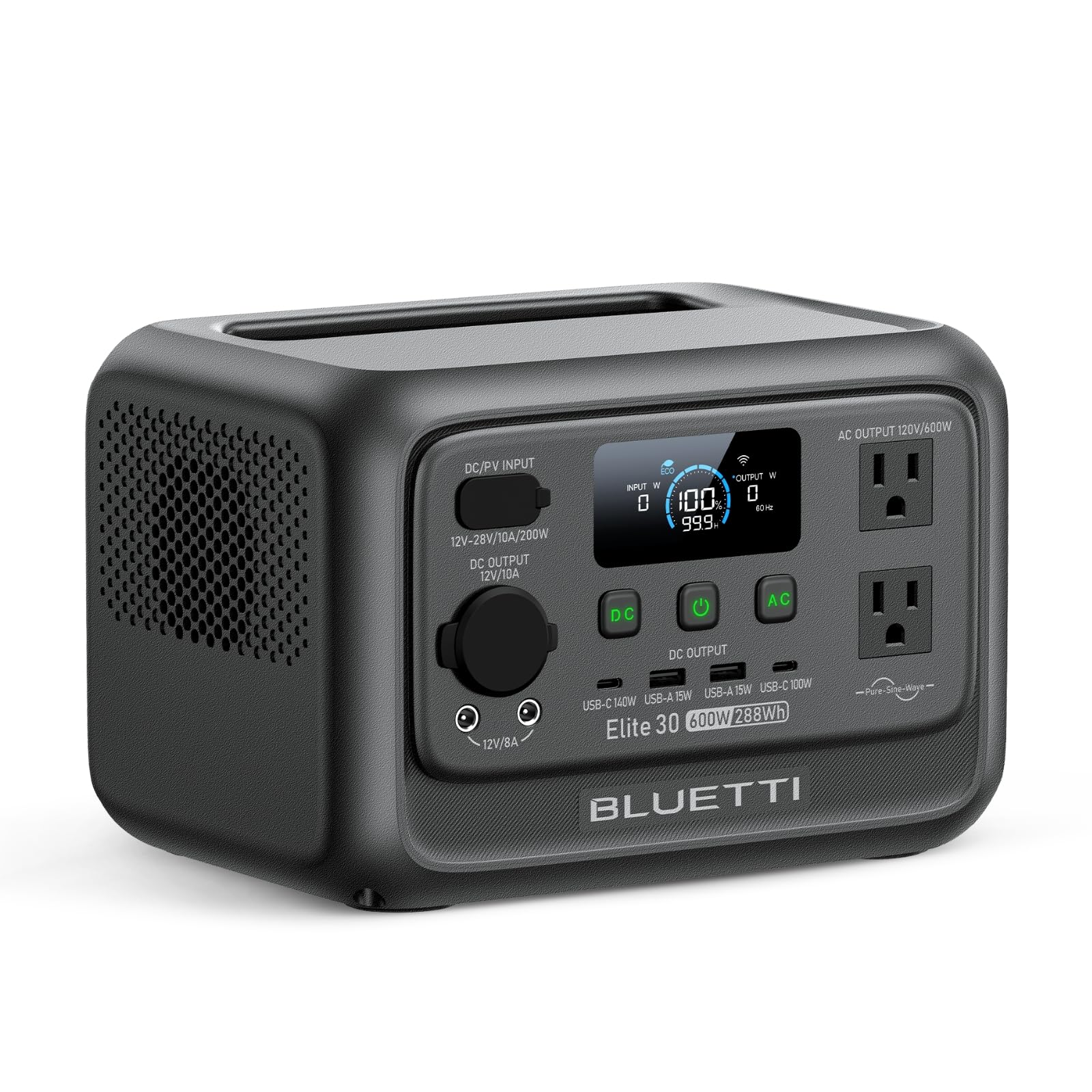
Don’t let the 288Wh capacity fool you — the Elite 30 V2 punches above its weight with a 600W continuous inverter that can Power Lift 1500W surge to run a small kettle or toaster. At just 9.4 pounds, it’s the lightest UPS-capable unit in this roundup, making it ideal for CPAP machines, laptop stations, or a mini-fridge during a short outage.
BLUETTI’s UltraCell technology cuts standby power consumption by 50% (4.5W standby, 8W AC idle), greatly extending usable runtime. The 10ms UPS switch is fast enough to keep a desktop PC or router running through a brownout without a hiccup. AC wall charging hits 0-80% in 45 minutes and full in 70 minutes, with adjustable 380W/200W charging speeds to match your outlet’s circuit breaker.
Two USB-C ports (140W + 100W) can fast-charge a MacBook Pro and an iPad simultaneously. The smart app adds WiFi control and battery monitoring. Some users report mild off-gassing on first use (normal for new LFP units), and the 9.4-pound weight means it’s genuinely backpack-portable. For a compact, ultra-efficient solar generator, this is the top choice.
Why it’s great
- Only 9.4 lbs with 10ms UPS for sensitive gear
- Power Lift 1500W surge handles small appliances
- 50% lower standby power consumption
Good to know
- 288Wh limits runtime for high-draw devices
- Initial off-gassing may require airing out
- Settings tweaks needed to optimize UPS mode
7. VTOMAN Jump 600X

The Jump 600X is a rare hybrid that combines a 299Wh LFP power station with a dedicated car jump-start port. Jumper cables are sold separately, but the unit itself can instantly start a dead 12V battery on a full-size truck or SUV even when the power station is at 9% charge — a lifesaver for overlanders and roadside emergencies.
Beyond jump-starting, it’s a fully capable solar generator with 600W constant power (1200W surge) and two regulated 12V/10A DC outputs that are perfect for car fridges and CPAP machines. The 60W USB-C PD port fast-charges laptops, and the three USB-A ports (one QC 3.0) handle phones and tablets. Capacity is expandable to 939Wh with an extra VTOMAN battery pack.
At 14.6 pounds, it’s heavier than similarly sized units due to the jump-start circuitry and beefy 12V output stage, but that weight also makes it feel tank-like. The LED light has five modes including SOS and strobe. Wall charging takes about 3 hours; solar charging via 110W panel takes 5-6 hours. For anyone who wants a solar generator that can also rescue a dead car battery, this is the only option that does both well.
Why it’s great
- Integrated car jump starter saves carrying separate gear
- Regulated 12V DC outputs for sensitive 12V devices
- Expandable to 939Wh with add-on battery
Good to know
- Jumper cables are not included
- Heavier than pure power stations of similar capacity
- Solar recharging is slower (5-6 hours with 110W panel)
8. EF ECOFLOW RIVER 3

The RIVER 3 is the most portable LFP generator in this lineup at just 7.8 pounds, yet it charges from 0-100% in one hour via AC thanks to ECOFLOW’s X-Stream GaN technology. The X-Boost feature allows the 300W inverter to handle loads up to 600W, so you can run a small fridge or power tool briefly. The <20ms auto-switching UPS keeps network gear alive during power blips — a feature confirmed by users running routers for days straight.
The LFP battery is rated for 3,000+ cycles (10-year lifespan), and the IP54-rated housing is waterproof, fireproof, and drop-resistant — unusual for a unit this small. Solar input accepts up to 110W, refilling the 245Wh pack in about 2.6 hours of good sun. The app adds WiFi control and real-time monitoring.
Noise level is under 30 dB at 1.5 feet, making it essentially silent for bedside or office use. The built-in handle and compact footprint (8.3 x 4.4 x 10 inches) mean it fits in a bag or closet corner. The trade-off is limited capacity — you won’t run a full-size fridge overnight — but for daily device charging, router UPS, and light camping, nothing beats its speed and portability.
Why it’s great
- 1-hour full AC recharge via GaN technology
- 7.8 lbs with IP54 weather resistance
- Silent operation under 30 dB
Good to know
- 245Wh capacity limits use for larger appliances
- No built-in wireless charging pad
- Premium price for the small capacity class
9. Apowking HP200L + 40W Panel

The Apowking HP200L is the most affordable complete solar generator bundle in this guide, pairing a 220Wh power station with a 40W monocrystalline solar panel right in the box. The 300W pure sine wave inverter (600W peak) can charge up to seven devices simultaneously via two AC outlets, three USB-A ports, one USB-A fast charge port, and one DC vehicle port.
The large LED backlight panel is unusually bright — useful as a campsite or emergency room light. The BMS manages voltage, temperature, and short-circuit protection, while silent cooling vents keep fan noise minimal. At 5 pounds and measuring 8.5 x 6.7 x 4.1 inches, it’s truly pocketable for a power station with an included panel.
The main limitation is solar charging speed: the included 40W panel is slow, taking a full day to replenish the 220Wh pack in anything less than direct overhead sun. Several users noted the lack of USB-C PD ports and that AC charging takes over 4 hours. However, for a budget-friendly entry point to solar power with everything included, this bundle gets you started without a separate panel purchase.
Why it’s great
- Complete bundle with 40W solar panel included
- Ultra-light at 5 lbs for true portability
- Bright full-back LED light for emergencies
Good to know
- No USB-C PD port for modern laptop charging
- 40W solar panel is very slow for a full recharge
- AC charging takes over 4 hours to full
FAQ
Can I leave my solar generator plugged into the panel all the time?
What size solar panel do I need for a 1000Wh battery bank?
Can I use a gas generator to charge my solar battery bank?
Final Thoughts: The Verdict
For most users, the best battery bank for solar is the Anker SOLIX C1000 with its 200W solar panel because it combines the fastest AC recharging in class with a truly weatherproof panel and enough 1056Wh capacity to carry a fridge and devices through an overnight outage. If you want the lightest 2kWh option for extended camping, grab the Jackery Explorer 2000 v2. And for maximum home backup with included solar, nothing beats the Jackery HomePower 3000 with two 200W panels.