
Mounting a permanent transducer to a kayak feels like a permanent commitment, and the cabling nightmares of traditional units often outweigh the benefit of knowing what’s below the hull. A dedicated sonar built for the paddle-boat lifestyle needs to be small, waterproof, and entirely self-contained to survive the splash zone.
I’m Min — the co-founder and writer behind Gadgets Feed. I’ve spent hundreds of hours cross-referencing sonar cone angles, battery runtimes, display resolutions, and transducer frequency data to separate the real performers from the noisy dead zones in the budget slimed pond.
Whether you are trolling a river, scanning a shallow flat, or probing a deep lake, this guide delivers the clearest path to the best budget kayak fish finder that matches your specific on-water style.
How To Choose The Best Budget Kayak Fish Finder
Picking a sonar for a kayak is different from a bass boat. The unit must tolerate water splashes, operate on a small battery, and often work without a permanent hull penetration. Three factors separate the junk from the real tools.
Castable vs. Fixed-Mount: The Core Split
Castable fish finders (the bobber style) throw the transducer from your rod, streaming data wirelessly to a handheld screen or your phone. They are zero-installation, perfect for rental kayaks or anglers who want to scout an area before paddling in. Fixed-mount units require a transducer bracket glued or screwed to the hull, then a cable running to a display mounted on the deck or rail. Fixed mounts give you continuous, real-time sonar while you paddle, without stopping to cast a sensor every time the depth changes.
Sonar Specs: Frequency, Cone Angle, and CHIRP
A 200 kHz frequency with a narrow 20-degree cone offers better detail in deeper water but misses fish hugging the side of the cone. A 83 kHz beam with a 60-degree cone covers more area but at lower resolution. Dual-beam units let you toggle between the two. CHIRP technology sweeps frequencies and separates targets more cleanly, though true CHIRP on a budget unit is rare — most use a single-frequency pulse. Target separation below 2.5 inches is where quality separates from noise.
Battery Runtime and Charging Convenience
A kayak trip can last six to ten hours. Internal rechargeable lithium batteries (measured in mAh) onboard the display and sensor are the standard for castable units. Some fixed-mount displays accept AA batteries, which get expensive. You want at least 8 hours of continuous use. Also check the charging port — USB-C is far more convenient than proprietary magnetic cables that are easy to lose on the water.
Quick Comparison
On smaller screens, swipe sideways to see the full table.
| Model | Category | Best For | Key Spec | Amazon |
|---|---|---|---|---|
| Garmin Striker Cast | Castable | Phone-based sonar on any kayak | 10-hr battery, 200-ft wireless | Amazon |
| Deeper PRO+ 2 | Castable/Wi-Fi | GPS mapping from a kayak | 0.4-in target separation, 330-ft | Amazon |
| Humminbird PiranhaMAX 4 | Fixed Mount | Down imaging, big display | 4.3-in color, Down Imaging | Amazon |
| Garmin Striker Plus 4 | Fixed Mount | CHIRP, GPS contours, kayak | 4.3-in, CHIRP sonar, Quickdraw | Amazon |
| Hawkeye FishPod 5X | Castable | Bluetooth to phone, AI modes | 5-in display, 199-ft depth | Amazon |
| Yoocylii XF-08 | Hybrid | Handheld with wireless probe | 3.5-in 480×320, 164-ft depth | Amazon |
| DANOPLUS DP-104 | Castable | All-in-one handheld, no app | 2.4-in LCD, 147-ft depth | Amazon |
In‑Depth Reviews
1. Garmin Striker Cast
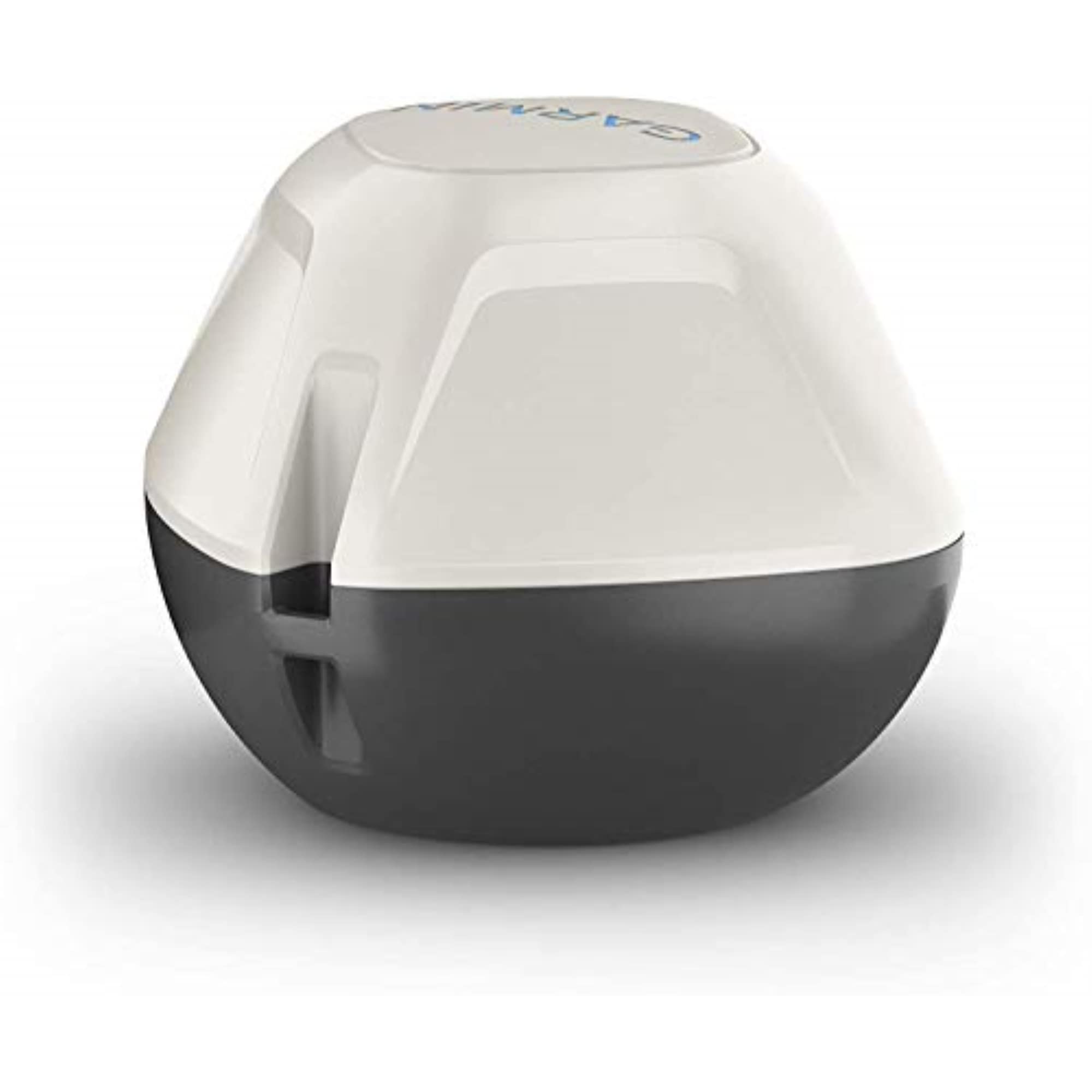
Garmin’s castable sonar streams 2-D traditional sonar and an ice-fishing flasher mode directly to your phone via the free Striker Cast app. The sensor auto-powers on when it hits water, preserving the internal USB-rechargeable battery for a full 10-plus-hour day on the water. Pairing takes under a minute, and the wireless range holds steady at the claimed 200-foot horizon in open water.
Unlike many castable units that rely on tiny LCD screens, the Striker Cast uses your phone’s high-resolution display, delivering crisp fish arches and bottom contours that are easy to read in direct sunlight. It includes a carrying bag, a 20-foot tether, and a USB cable. The rugged IPX7 housing handles accidental drops and full submersion without complaint.
Anglers report accurate depth readings in both shallow 2-foot ponds and deeper 100-foot reservoirs. The lack of built-in GPS is the only major compromise — the unit uses your phone’s GPS for location tagging. If you want a simple, reliable phone-based sonar that requires zero permanent installation on your kayak, this is the benchmark.
Why it’s great
- Excellent 10+ hour battery life from a single charge
- Fast Bluetooth pairing with crystal-clear phone display
- Auto power on/off in water saves battery and worry
Good to know
- Relies entirely on your smartphone for the screen
- No built-in GPS mapping without the phone
2. Deeper PRO+ 2
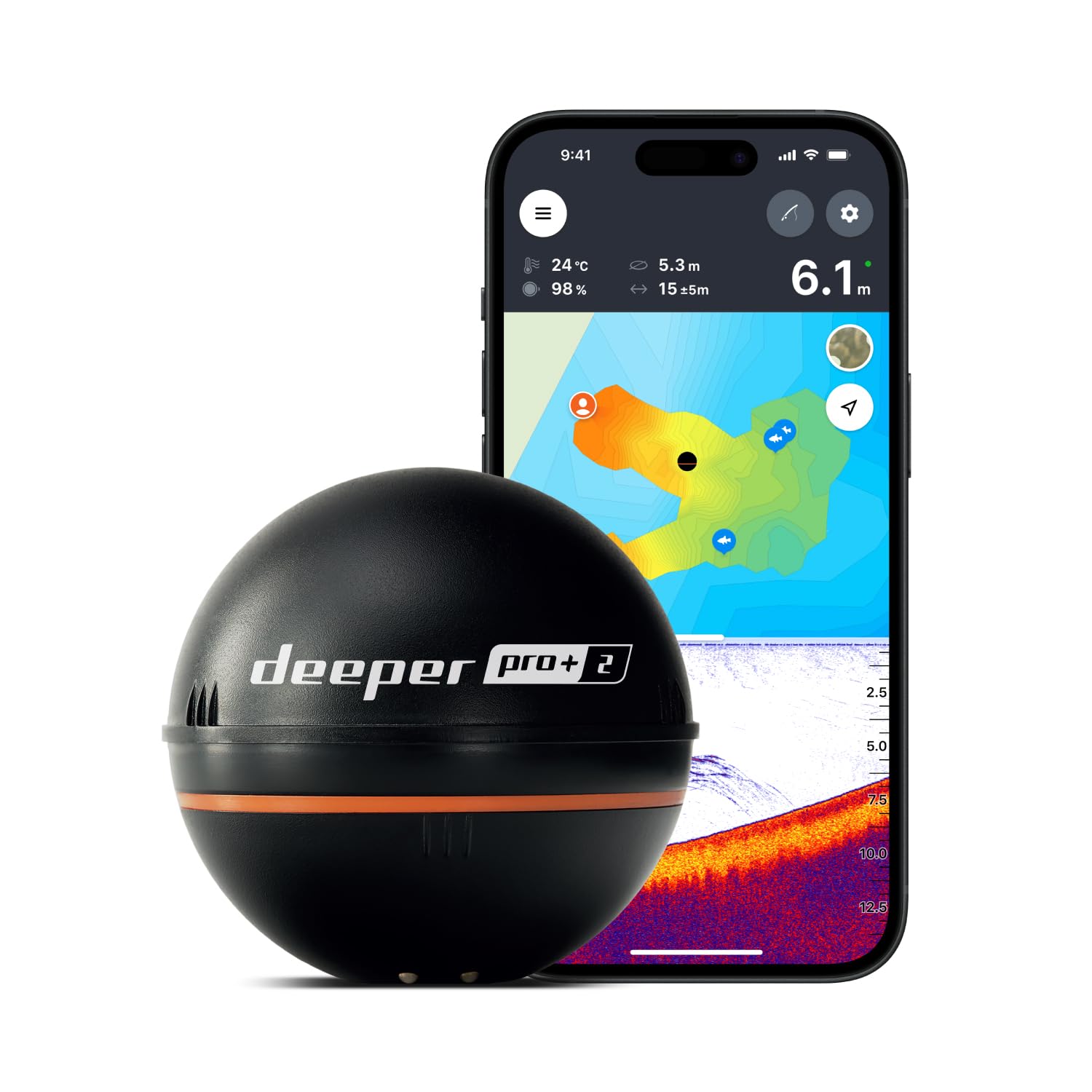
Deeper’s PRO+ 2 packs three beam frequencies (100/240/675 kHz) into a compact tennis-ball-sized castable sensor. It connects to your phone via Wi-Fi rather than Bluetooth, offering a longer 330-foot working range and faster data throughput for real-time sonar scrolling. The narrow 675 kHz beam delivers an impressive 0.4-inch target separation, letting you identify a single lure on the bottom.
Built-in GPS allows anglers to create bathymetric maps from a kayak, dock, or shoreline directly within the Fish Deeper app. You can mark waypoints, save contour maps, and revisit productive spots on later trips. The sensor weighs around 3 ounces, which requires a stout rod and at least 20-pound braided line for reliable casting.
Battery life runs five to seven hours of continuous use, and the USB-C recharge is fast. The only durability concern is that the WiFi radio lifespan may shorten after two to three years of heavy use. For kayak anglers who want GPS mapping capability in a portable castable package, the Deeper PRO+ 2 is unique at this price tier.
Why it’s great
- Three-frequency sonar with excellent detail on narrow beam
- Built-in GPS for creating custom bathymetric maps
- Long 330-ft Wi-Fi range for kayak trolling
Good to know
- Heavier sensor requires a stout rod and heavy braid
- WiFi range can drop around heavy structure or interference
3. Humminbird PiranhaMAX 4

Humminbird’s PiranhaMAX 4 is a fixed-mount unit with a 4.3-inch color TFT display and Down Imaging sonar technology, a rarity at this price point. Down Imaging provides photo-like clarity of submerged timber, brush piles, bridge pilings, and rocks directly below your kayak. The dual-beam sonar (200/455 kHz) lets you toggle between a wide 60-degree coverage and a narrow 20-degree detailed view.
The included XNT 9 DI T transom-mount transducer is designed for a motorboat transom, but kayak anglers can easily attach it to a rudder, a transducer arm, or a simple adhesive mount. The display is daylight-readable, the interface is intuitive, and the Fish ID+ feature assigns fish icons to sonar returns. Depth alarms and zoom round out the feature set.
The transducer cable length is on the shorter side — about 8.5 feet — which may require an extension cable for large kayaks or canoes where the display sits far from the transducer mount. There is no built-in GPS or mapping. For kayak paddlers who want the best underwater visual clarity for structure, this Down Imaging unit is a clear winner.
Why it’s great
- Down Imaging technology at a budget-friendly price point
- Large 4.3-in color screen readable in bright sunlight
- Dual-beam sonar for both detail and coverage
Good to know
- Transducer cable is short for large kayak runs
- No built-in GPS or contour mapping
4. Garmin Striker Plus 4
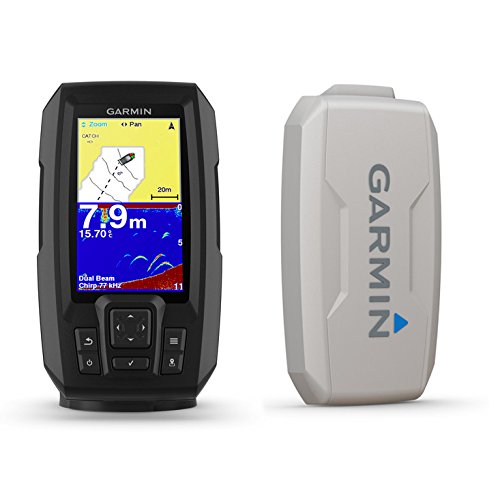
The Garmin Striker Plus 4 combines a bright 4.3-inch QSVGA display with built-in Garmin CHIRP traditional sonar and dual-beam transducer (77/200 kHz). CHIRP sweeps frequencies over a range, delivering clearer fish arches and better target separation than standard single-frequency pulses. The included protective cover and tilt/swivel mount make it rugged for kayak environments.
Built-in GPS and Quickdraw Contours mapping software allow you to create and save custom 1-foot contour maps for up to 2 million acres. You can mark waypoints, create routes, and view your boat speed — all without connecting to a phone. This level of GPS mapping integration is typically found in units costing twice as much.
The 4.3-inch screen is sunlight-readable, though the menu interface takes some button-mashing to navigate. The transducer cable is durable but the connector is somewhat delicate. Kayak users report good performance in both shallow rivers and deep lakes, with the float-and-swivel transducer surviving accidental drops. For a fixed-mount unit with CHIRP and GPS, this is the gold standard.
Why it’s great
- True Garmin CHIRP sonar with dual-beam transducer
- Built-in Quickdraw GPS contour mapping
- Sunlight-readable 4.3-in display with protective cover
Good to know
- Menu navigation can be complex for new users
- Transducer connector feels somewhat fragile
5. Hawkeye FishPod 5X

The FishPod 5X is a Bluetooth-connected castable sonar that sends data straight to an app on your phone, but it also includes a 5-inch LCD display on the sensor head itself — giving you a dual-view option. It offers four preset operating modes (FishEcho, BottomScan, Vertical Flasher, and a general mode) designed to filter clutter and emphasize fish returns.
The FishEcho mode effectively tunes out debris and false echoes in the water column, making it useful for kayak fishing in weedy or murky lakes. The TraxNut mounting system allows the sensor to attach to any standard 1/4 x 20 bracket, so you can mount it to an accessory arm or simply float it behind your kayak on a tether. Maximum depth is 199 feet, which covers most inland kayak fishing scenarios.
Battery life is around two hours while trolling at typical kayak speed, which is shorter than some competitors. The Bluetooth connection may occasionally drop at the edge of its range. For the money, the FishPod 5X offers a unique combination of a physical display plus phone integration with smart filtering modes that reduce screen noise.
Why it’s great
- Integrated 5-in display plus Bluetooth phone streaming
- Smart AI filtering modes reduce sonar clutter
- Universal TraxNut mounting system
Good to know
- Relatively short 2-hour battery life when trolling
- Bluetooth connection can drop at longer ranges
6. Yoocylii XF-08
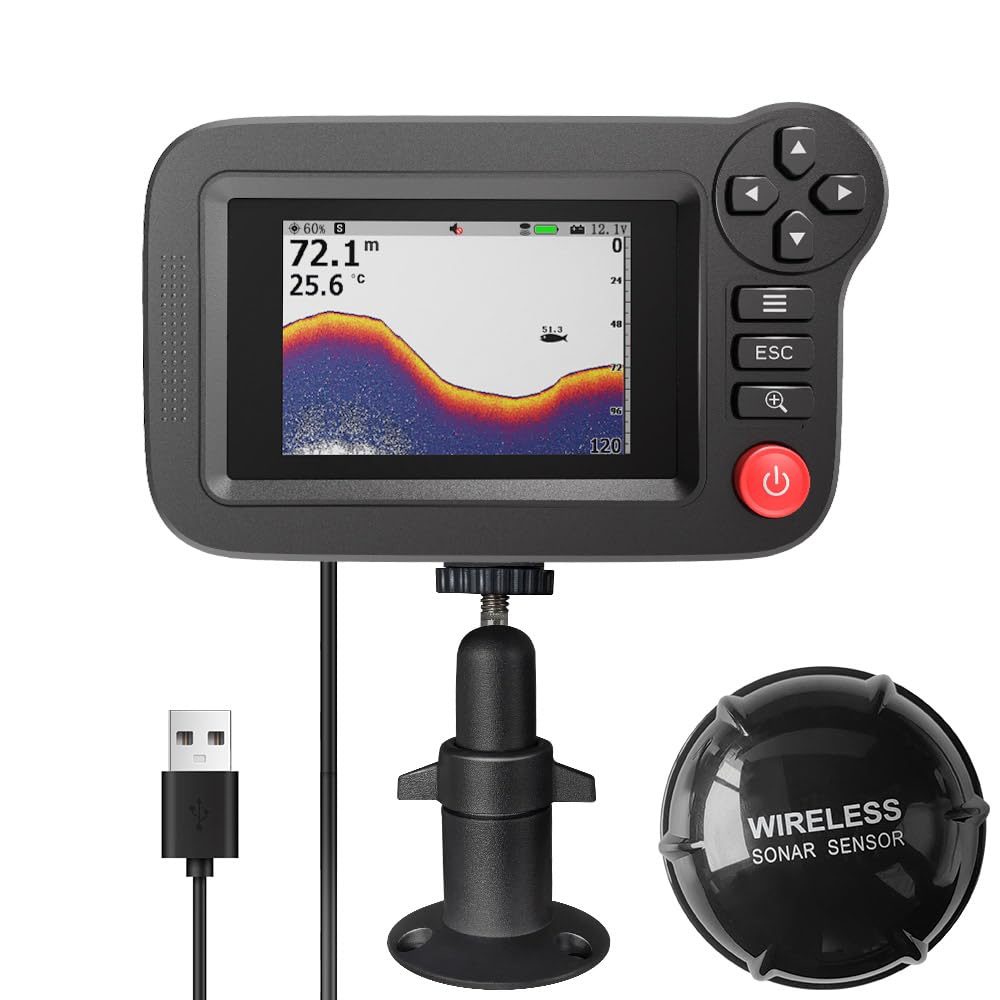
The Yoocylii XF-08 is a hybrid unit that combines a handheld 3.5-inch color LCD display with a wireless sonar probe. The 480×320 resolution screen is readable in daylight and displays fish size icons (small/medium/large), water temperature, bottom contours, and depth up to 164 feet. The sonar probe operates on the 125 kHz frequency with a wireless range of up to 656 feet.
Setup is simple — drop the IP67 waterproof probe in the water, and it automatically turns on and pairs with the handheld display. The kit includes a mounting bracket for attaching the display to a kayak rail, plus both USB and 12V power cables. The device runs on four AA batteries (included), which can be swapped easily during long trips.
Some users report that the locking nut on the mounting bracket can strip over time, and the antenna joint is somewhat delicate. But for the price, you get an all-in-one solution that does not require a smartphone. If you want a dedicated display unit with a wireless probe that works out of the box for kayak or shore fishing, the XF-08 is hard to beat.
Why it’s great
- All-in-one handheld display with wireless probe
- IP67 waterproof probe auto-activates in water
- Bright 3.5-in 480×320 color LCD screen
Good to know
- Mounting bracket locking nut can be fragile
- Runs on AA batteries rather than internal rechargeable
7. DANOPLUS DP-104

The DANOPLUS DP-104 is the most affordable entry in this lineup, built around a 2.4-inch color LCD display and a wireless sonar sensor that detects depth down to 147 feet with a 90-degree cone angle. Both the display and the sensor contain internal rechargeable batteries, and the sensor automatically activates when it touches water thanks to its attractive lamp feature.
Fish detection includes size icons and an audible fish alarm that beeps when sonar returns pass a threshold. The unit is compact enough to fit in a pocket (4.92 x 2.87 x 0.98 inches) and weighs just 5.28 ounces. It works well for kayak, ice, and shore fishing, with users reporting accurate depth readings and reliable fish alerts in typical pond and lake conditions.
The magnetic charging cable is proprietary, not USB-C, which makes it easy to lose or forget. Some users report occasional confusion between thick vegetation and fish targets. For the absolute lowest investment that still gives you a dedicated display and wireless sensor without needing a phone, the DANOPLUS DP-104 delivers surprisingly solid performance.
Why it’s great
- Complete system with handheld display and wireless sensor
- Internal rechargeable batteries in both units
- Fish alarm and size icons work well for the price
Good to know
- Proprietary magnetic charger is easy to misplace
- May confuse thick weed beds with fish returns
FAQ
Can I mount a fixed transducer on a plastic kayak hull?
Will a castable fish finder work while trolling?
Final Thoughts: The Verdict
For most users, the best budget kayak fish finder winner is the Garmin Striker Cast because it combines a reliable 10-hour battery, zero-installation castable design, and crystal-clear sonar on your phone at a price that undercuts anything with similar reliability. If you want GPS mapping and three-frequency sonar in a castable package, grab the Deeper PRO+ 2. And for fixed-mount enthusiasts who demand Down Imaging clarity, nothing beats the Humminbird PiranhaMAX 4.