
Bookshelf speakers are the single most impactful upgrade you can make to your music, movie, or gaming setup, yet the market is flooded with overpriced options and marketing fluff. Finding a pair that delivers genuine, transparent sound without forcing you to remortgage your living room requires sifting through driver sizes, impedance ratings, and amplifier requirements — a process that can quickly overwhelm even experienced listeners. The goal is simple: pinpoint the speakers that nail the fundamentals of clarity, balance, and dynamic range without adding unnecessary cost or complexity to your chain.
I’m Min — the co-founder and writer behind Gadgets Feed. I’ve spent hundreds of hours cross-referencing technical specifications like frequency response curves, sensitivity ratings, and crossover designs to separate genuine value from acoustic smoke and mirrors in this crowded category.
This guide cuts through the noise and delivers a curated selection of the very best affordable bookshelf speakers, pairing deep technical analysis with real-world performance insights you can actually use.
How To Choose The Best Affordable Bookshelf Speakers
Choosing the right bookshelf speaker is about matching the speaker’s design and power requirements to your room size, listening habits, and downstream gear. A speaker that excels in a nearfield desktop setup may sound thin in a large living room, and a passive speaker with low sensitivity will demand a much more powerful amplifier to produce the same volume. Understanding these trade-offs is the shortcut to a satisfying purchase.
Active vs. Passive: The Amplifier Question
Active speakers (powered) have an amplifier built inside one of the cabinets — you only need a source like a phone, computer, or turntable to play. Passive speakers require a separate amplifier or AV receiver to power them. Active options simplify setup and often cost less upfront, but passive speakers let you upgrade the amplifier later for better sound quality and typically offer more driver and cabinet options for the same budget.
Driver Size and Bass Extension
Larger woofers (5.25-inch to 6.5-inch) naturally produce deeper, more impactful bass than smaller ones (3.5-inch to 4-inch) at the same price point. However, a well-designed 4-inch woofer can outperform a poorly implemented 5.25-inch driver. Look at the stated bass extension (-3dB point) rather than just the driver diameter, and remember that ported cabinets extend bass at the cost of requiring more careful placement away from walls to avoid boomy or muddy low end.
Impedance and Sensitivity
These two specs determine how hard the speaker is to drive. A speaker rated at 4 ohms impedance is more demanding on an amplifier than an 8-ohm speaker. Sensitivity, measured in decibels (dB) at 1 watt per 1 meter, tells you how loud the speaker will play with a given amount of power. A speaker with 86dB sensitivity needs more than double the power of one with 89dB to reach the same volume. Matching these numbers to your amplifier is essential to avoid clipping or damage.
Quick Comparison
On smaller screens, swipe sideways to see the full table.
| Model | Category | Best For | Key Spec | Amazon |
|---|---|---|---|---|
| Fluance Ai41 | Active | Versatile all-in-one stereo | 90W integrated amp, 5-inch driver | Amazon |
| Polk Monitor XT20 | Passive | Home theater with punchy bass | 6.5-inch woofer, 38Hz extension | Amazon |
| Sony SS-CS5M2 | Passive | Detailed highs and wide soundstage | 3-way, 5.12-inch woofer, 53Hz | Amazon |
| JBL C1PRO | Passive | Compact rugged nearfield monitoring | 150W handling, 5.25-inch woofer | Amazon |
| PreSonus Eris Accent | Active | Powerful desktop with sub out | 50W RMS, 4-inch woofer, USB-C | Amazon |
| Micca RB42 | Passive | Compact speakers with surprising bass | 4-inch woofer, 10-element crossover | Amazon |
| Edifier MR3 | Active | Nearfield monitoring with Bluetooth 5.4 | 18Wx2 RMS, 3.5-inch driver | Amazon |
| Micca MB42X G2 | Passive | Budget-friendly balanced sound | 4-inch carbon fiber woofer, 86dB | Amazon |
| Mackie CR3.5 | Active | Compact desktop with tone adjustment | 3.5-inch woofer, front volume knob | Amazon |
In‑Depth Reviews
1. Fluance Ai41 Powered 2-Way Bookshelf Speakers

The Fluance Ai41 strikes a near-perfect balance of power, connectivity, and sound quality for the price. Its integrated 90W amplifier drives the 5-inch woven glass fiber woofers and neodymium tweeters with authority, delivering a clean, balanced presentation that works equally well for music and TV dialog. The internally braced MDF cabinets and rear bass port provide a natural, warm tonal character with minimal cabinet resonance — a detail that many options at this level overlook.
Connectivity is a strong suit: optical and RCA inputs join Bluetooth 5.0 wireless streaming, and the dedicated subwoofer output lets you add low-end extension without cluttering your setup. The included remote control makes it easy to adjust volume and source from across the room, a convenience rarely found in active speakers at this tier. The 5-inch driver cannot compete with a dedicated sub for sub-40Hz rumble, but for a two-channel system in a medium room, the bass weight is impressive and well-defined.
For the user who wants a complete stereo solution right out of the box — no separate amplifier, no complex wiring, just a turntable, TV, or phone plugged in and playing — the Ai41 is the obvious choice. Its combination of premium build, real wood veneer options, and flexible inputs makes it the most complete package in this roundup.
Why it’s great
- Integrated 90W amplifier simplifies setup and removes the need for a separate receiver.
- Optical, RCA, and Bluetooth 5.0 inputs cover nearly every modern audio source.
- Internally braced MDF cabinet minimizes resonance for a cleaner midrange.
Good to know
- 5-inch drivers limit deep bass extension; a subwoofer is recommended for theater use.
- DSP processing can feel a bit restrictive at maximum volume with bass-heavy tracks.
2. Polk Monitor XT20 Bookshelf Speakers

The Polk Monitor XT20 brings serious low-end firepower to the affordable passive speaker market with its 6.5-inch Dynamically Balanced woofer. Real-world measurements show this driver can reach down to 38Hz, delivering palpable bass weight that makes a subwoofer optional for many listeners — especially in smaller to medium rooms. The 1-inch Terylene tweeter is intentionally restrained to avoid brightness, producing a smooth, non-fatiguing top end that pairs well with movies and extended listening sessions.
At 8 ohms nominal impedance with 89dB sensitivity, the XT20 is relatively easy for most AV receivers and integrated amplifiers to drive, making it a versatile candidate for both stereo and home theater setups. The cabinet is solidly built with a modern aesthetic, and the magnetic grilles add a clean visual touch. Owners consistently note that a break-in period of several hours helps the woofer loosen up, transforming the sound from slightly congested to open and dynamic.
If your primary use case is a living room home theater where dialogue clarity and chest-thumping action sequences matter, the XT20’s larger driver and forgiving impedance make it the most compelling passive option in the lower-mid price tier. Just budget for a quality amplifier to unlock its full potential.
Why it’s great
- 6.5-inch woofer delivers genuine bass extension down to 38Hz, reducing subwoofer dependency.
- Smooth, non-fatiguing tweeter ideal for long movie and music sessions.
- High 89dB sensitivity makes it compatible with a wide range of modest amplifiers.
Good to know
- Requires a separate stereo amplifier or AV receiver to operate.
- Bass can become slightly unrefined at very high listening volumes.
3. Sony SS-CS5M2 3-Way Bookshelf Speakers

Sony’s SS-CS5M2 refreshes the classic CS5 formula with a true 3-way, 3-driver configuration — a rarity at this price point. A dedicated 5.12-inch woofer handles low frequencies, a high-precision tweeter reproduces mids and highs, and a separate wide-dispersion super tweeter extends the frequency response all the way to 50kHz for Hi-Res Audio playback. The result is an expansive, airy soundstage with exceptional clarity in the upper registers that reveals subtle details in cymbal crashes and string harmonics.
The bass reflex enclosure is tuned for distortion-free output, though the 53Hz low-end extension means these speakers still benefit from a subwoofer for full-range playback. They are also rear-ported, requiring at least 6 to 12 inches of clearance from the wall to avoid muddying the bass response. At 6 ohms impedance and moderate sensitivity, they demand a reasonably capable amplifier — entry-level receivers will drive them, but pairing them with a quality integrated amp unlocks noticeably better dynamics and control.
For the audiophile on a budget who prioritizes midrange and treble purity over thumping bass, the Sony SS-CS5M2 is a standout. Its ability to resolve fine detail and create a wide, holographic soundstage makes it an excellent choice for critical listening in a dedicated nearfield or small-room setup.
Why it’s great
- 3-way design with dedicated super tweeter delivers exceptional high-frequency detail and soundstage width.
- Hi-Res Audio certified with frequency response extending to 50kHz.
- Compact cabinet fits easily on desks and small shelves.
Good to know
- Rear port requires significant space from the wall for optimal bass performance.
- Limited bass extension; a subwoofer is strongly recommended for full-range listening.
4. JBL Professional C1PRO Bookshelf Speakers

The JBL Professional C1PRO has been a staple in commercial and pro audio environments for two decades, and its rugged build quality and clean sound have earned it a loyal following among home users as well. These passive speakers feature a 5.25-inch woofer and a 0.75-inch tweeter in a sealed, magnetically shielded molded enclosure that resists damage from transport and mounting. SonicGuard overload protection prevents the tweeter from frying if the amplifier clips, a feature that adds peace of mind in demanding setups.
The C1PRO’s frequency response of 100Hz to 18kHz is narrower than many competitors, but the presentation is exceptionally linear and undistorted within its range. They work best as nearfield monitors on a desk or as rear/surround channels in a home theater system where deep bass is handled by a subwoofer. Their 4-ohm impedance makes them power-hungry — a quality amplifier with current reserves is required to drive them properly, but the payoff is tight, controlled sound at moderate volumes.
If your priority is a durable, compact passive speaker that delivers honest, uncolored sound for mixing, gaming, or dedicated desktop listening, the C1PRO is a proven workhorse that has outlasted nearly every competitor at its price level. Keep a subwoofer in the chain, and you will have a remarkably capable system.
Why it’s great
- Rugged molded enclosure with SonicGuard protection is built to last decades.
- Linear, uncolored sound signature ideal for nearfield monitoring and dialog clarity.
- Compact footprint fits easily on crowded desks and small shelves.
Good to know
- 4-ohm impedance demands a powerful, stable amplifier — budget receivers may struggle.
- Limited bass extension necessitates a subwoofer for music with low frequencies.
5. PreSonus Eris Accent Powered Bookshelf Speakers
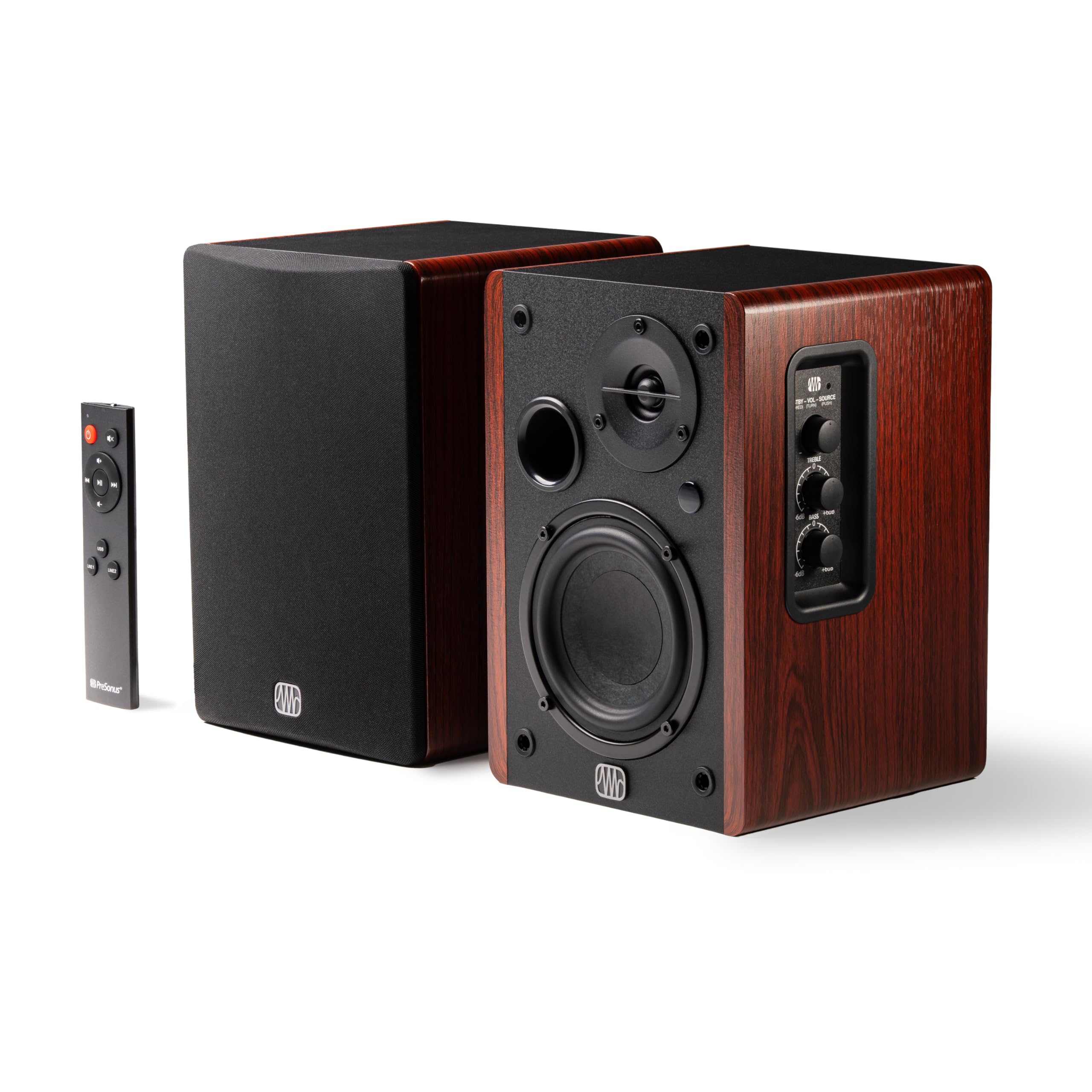
The PreSonus Eris Accent packs 50 watts of RMS power (25W per channel) into a compact, wood-grain finished cabinet. The 4-inch woven woofer and 0.5-inch silk dome tweeter, crossed over at 2.8kHz, produce a sound that is punchy and full for its size. Onboard treble and bass controls let you tailor the output to your room acoustics, and the inclusion of a remote control, RCA subwoofer output, and both USB-C and RCA inputs makes this one of the most feature-rich active speakers in its tier.
What sets the Eris Accent apart from its smaller siblings (like the 3.5-inch Eris series) is the noticeable bump in bass weight and overall headroom. The larger 4-inch driver and rear bass port allow it to fill a small to medium room without strain. The default tuning is slightly bass-heavy, but adjusting the rear EQ controls yields a flatter response suitable for critical listening. The remote control adds real convenience for adjusting volume from across the room — a feature often cut from active speakers at this level.
For anyone building a budget turntable setup, upgrading from laptop speakers, or equipping a secondary TV, the Eris Accent delivers surprising quality without the complexity of an external amplifier. The subwoofer output gives you a clear upgrade path to add deeper bass later, making it a system you can grow with over time.
Why it’s great
- Built-in 50W RMS amplifier with USB-C and RCA inputs for simple setup.
- Subwoofer output and remote control provide easy expansion and convenience.
- Adjustable treble and bass controls let you tune the sound to your space.
Good to know
- Bluetooth is not included — wired connections only.
- Default tuning can be bass-heavy; rear EQ adjustment is recommended for flatter response.
6. Micca RB42 Reference Bookshelf Speakers

The Micca RB42 has developed a cult following for one simple reason: its 4-inch woofer produces bass response that defies its physical size. A massive magnet structure, long-throw design, and a 10-element crossover with air core coils and film capacitors allow this compact speaker to reach lower and with more authority than almost any other speaker in its footprint. The result is a warm, full-bodied sound that can make classical piano sound rich and EDM tracks surprisingly punchy without a subwoofer.
However, that performance comes with a catch: the RB42 is notoriously inefficient. It requires a substantial amplifier, ideally delivering 50 to 80 watts per channel of clean power, to truly wake up. Underpowered amps will lead to distortion and port noise at moderate volumes, and the woofer can bottom out when pushed too hard with bass-heavy content. On a capable amplifier, the sound is smooth, dynamic, and engaging, with a soundstage that places instruments precisely across the listening field.
The RB42 is not a set-and-forget speaker — it demands a quality upstream chain and careful placement to shine. But for the enthusiast who already has a good amplifier and wants maximum bass extension from a bookshelf-sized package, it remains one of the most rewarding options at its price.
Why it’s great
- Remarkable bass output for a 4-inch woofer, often making a subwoofer optional.
- High-quality crossover with air core coils and film capacitors for clean signal path.
- Solid MDF cabinet with magnetic grille and premium Dark Walnut finish.
Good to know
- Very power-hungry; requires 50-80W per channel to perform optimally.
- Can produce port noise and woofer bottoming when overdriven on low-power amps.
7. Edifier MR3 Powered Studio Monitor Speakers

The Edifier MR3 punches well above its weight class with Hi-Res Audio certification, Bluetooth 5.4 with multi-point connection, and a flat frequency response extending to 40kHz. Its 3.5-inch mid-low driver paired with a 1-inch tweeter, driven by 18W per channel RMS, delivers a surprisingly clean and articulate sound that works beautifully for nearfield desktop listening. The MDF cabinet reduces unwanted resonance, and the Class D amplification runs cool enough for long sessions without thermal issues.
What makes the MR3 particularly adaptable is its three listening modes — Music, Monitor, and Custom — selectable via the front switch or the Edifier ConneX app. The Monitor mode delivers a flatter response for critical content creation, while Music mode adds a gentle touch of warmth. Balanced TRS inputs join RCA and AUX, making this one of the most versatile active speakers for connecting both consumer and pro-grade gear. The front headphone output is convenient for late-night sessions without waking the household.
For the desktop user who splits time between mixing tracks, gaming, and casual listening, the MR3 offers a level of clarity and connectivity typically found in pricier studio monitors. Its small footprint and attractive design make it a welcome addition to any workspace.
Why it’s great
- Balanced TRS, RCA, and AUX inputs plus Bluetooth 5.4 for maximum connectivity.
- Music, Monitor, and Custom EQ modes via the Edifier ConneX app.
- Hi-Res Audio certified with flat response up to 40kHz.
Good to know
- 3.5-inch drivers limit overall bass output and maximum volume.
- Bluetooth volume is not always fully controllable from the source device.
8. Micca MB42X G2 Passive Bookshelf Speakers

The Micca MB42X G2 takes everything that made the original MB42X a legend in the budget audiophile community and refines it. The most significant upgrade is the switch to a 4-inch carbon fiber woven woofer, which offers greater stiffness and lower mass than the original’s paper cone, resulting in tighter bass and lower distortion. The 0.75-inch silk dome tweeter has been re-voiced to reduce the brightness that some felt the original had, offering a more neutral and forgiving top end that works well for long listening sessions.
The crossover has also been updated to a 12dB/octave slope with improved time alignment, producing a more cohesive transition between the woofer and tweeter. The cabinet is less hollow-feeling than the first generation, with improved bracing that reduces coloration. Bass extension is rated down to 55Hz, though like most compact passive speakers, they benefit significantly from a subwoofer for movies and bass-forward music genres. Sensitivity remains at 86dB, meaning they need a reasonably powered amplifier to sound their best.
If you are building your first stereo system on a tight budget and already own a basic amplifier, the MB42X G2 is the smartest entry point available. It delivers a balanced, non-fatiguing sound that reveals the strengths of good recordings without punishing bad ones.
Why it’s great
- Carbon fiber woven woofer provides tighter bass and lower distortion than paper cones.
- Refined crossover with improved time alignment delivers a cohesive, neutral sound.
- Significant upgrade over Gen 1 at a minimal price increase.
Good to know
- Requires a separate amplifier; 86dB sensitivity means it needs moderate power.
- Limited bass extension makes a subwoofer necessary for full-range playback.
9. Mackie CR3.5 Creative Reference Powered Monitors

The Mackie CR3.5 is the quintessential entry-level active speaker for the user who wants better sound from their computer or gaming console without diving into the world of external amplifiers. Its 3.5-inch woven woofer and silk dome tweeter are housed in a compact cabinet with a front-facing volume knob, headphone output, and 3.5mm aux input, making it exceptionally easy to integrate into any desk setup. The tone knob lets you dial in extra bass and treble sparkle for casual listening, while the “location switch” toggles between desktop and bookshelf modes to optimize the frequency response for nearfield vs. room listening.
Sound quality is clear and articulate for the size, with well-defined mids and respectable low-end punch for a 3.5-inch driver. Customer feedback consistently praises the CR3.5 for outperforming other compact active speakers like the PreSonus Eris 3.5 in terms of bass weight and build quality. The included foam isolation pads reduce desk vibrations and improve clarity at moderate volumes. Like all small-driver speakers, the CR3.5 cannot reproduce deep bass — connecting to the optional CR8SBT subwoofer is the path to a more full-range experience.
For the budget-conscious gamer, student, or casual listener who wants a noticeable upgrade from built-in laptop or TV speakers without spending more than necessary, the Mackie CR3.5 is a straightforward, reliable choice that sounds better than its price suggests.
Why it’s great
- Front volume knob and headphone output make desktop integration effortless.
- Location switch optimizes sound for nearfield or room placement.
- Included foam isolation pads reduce desk resonance and improve clarity.
Good to know
- 3.5-inch drivers limit deep bass output; a subwoofer is recommended for fuller sound.
- Bluetooth is not built-in — wired connection only.
FAQ
Do I need a subwoofer with bookshelf speakers?
Can I use passive bookshelf speakers directly with my computer?
How close to the wall should I place rear-ported speakers?
Final Thoughts: The Verdict
For most users, the best affordable bookshelf speakers winner is the Fluance Ai41 because it combines a powerful integrated amplifier, versatile connectivity, and polished sound quality into a single, easy-to-use package. If you want deeper bass and are willing to add an external amplifier, grab the Polk Monitor XT20. And for nearfield desktop listening with studio-grade clarity, nothing beats the Edifier MR3.