
Tracing a parasitic drain or a melted wire harness without a dedicated circuit tester is like diagnosing a heart problem with a stethoscope that only says “beat” or “no beat”. You need to see voltage on a screen, hear continuity through a buzzer, and know instantly whether that wire is live, dead, or haunted by a bad ground. The right tool transforms a frustrating afternoon of probing blindly into a methodical, five-minute diagnosis.
I’m Min — the co-founder and writer behind Gadgets Feed. I’ve spent countless hours cross-referencing datasheets, watching real-world repair videos, and analyzing the build quality differences between sub- probes and professional-grade diagnostic kits to bring you a buying guide rooted in practical electrical troubleshooting.
Whether you are a weekend DIYer or a shop technician, selecting the best automotive circuit tester means understanding voltage range, probe tip durability, and whether you need a simple test light or a full power probe with component activation capabilities.
How To Choose The Best Automotive Circuit Tester
Automotive circuit testers range from simple incandescent test lights that only tell you “power or no power” to advanced power probes that display live voltage, resistance, and even generate activation signals for components. The right choice comes down to what you work on and how deep you need to diagnose.
Voltage Range and System Compatibility
A standard test light works on 6V and 12V systems, but modern cars, trucks, and heavy equipment often run 24V electrical architectures. Some premium units support up to 75V DC, covering everything from classic car electricals to modern diesel trucks. If you ever work on commercial vehicles or trailers, a wider voltage range is non-negotiable.
Passive Test Light vs. Active Power Probe
A passive test light simply grounds through its clip and lights up when it touches a live circuit — it is cheap and fast for checking fuses and power at connectors. An active power probe injects voltage or ground into a circuit to activate components like fuel pumps, fans, and relays without needing jumper wires. If you diagnose intermittent failures or bad grounds regularly, the active probe pays for itself in time saved.
Continuity, Resistance, and Overload Protection
Chasing shorts and open circuits demands a tester with a continuity buzzer and a resistance measurement mode. A “OL” display on an open circuit versus a solid “0.0Ω” reading instantly confirms a break. Equally important is built-in overload protection — a resettable circuit breaker that trips when current exceeds 8-10 Amps prevents damage to the tool and the vehicle’s wiring.
Quick Comparison
On smaller screens, swipe sideways to see the full table.
| Model | Category | Best For | Key Spec | Amazon |
|---|---|---|---|---|
| AWBLIN 4-75V DC | Test Light | Wide voltage range check | 4-75V DC range, LCD display | Amazon |
| AWBLIN Power Probe | Power Probe | Voltage and current testing | 1-60V, 0-8A current resolution | Amazon |
| OTC 3634 Cord | Test Light | Durability in a shop | 6-12V, 5-ft straight cord | Amazon |
| OTC 3633 Coil | Test Light | Tight space probing | 6-12V, 12-ft coiled cord | Amazon |
| Topdiag P100 | Power Probe | Component activation | 12-24V, 20+20ft cable | Amazon |
| Autel PS100 | Power Probe | Professional all-in-one diagnostics | 6-30V, 4 test modes | Amazon |
| VDIAGTOOL V200 Pro | Power Probe | Wire tracing and breaker finding | 6-42V, 2-in-1 modes | Amazon |
In‑Depth Reviews
1. Autel PowerScan PS100 Automotive Circuit Tester
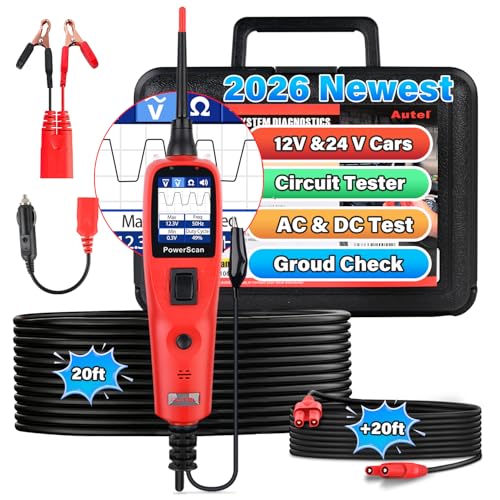
The Autel PS100 is the most versatile power probe in this roundup, offering four distinct modes — DC voltage, AC voltage, resistance, and tone on/off — all accessible through a single button press on the ergonomic handle. Its stainless steel probe pierces insulation cleanly, and the red/green polarity LEDs illuminate within ±0.8V for quick voltage drop checks without squinting at the LCD. The 20-foot main cord plus a 20-foot extension cable and included cigarette lighter adapter let you work from the tailgate to the dashboard without relocating the battery clamp.
Component activation is handled through a rocker switch at the top of the probe, letting you apply battery voltage or ground directly to a fuel pump, cooling fan, or relay without jumper wires. The resettable 10 Amp circuit breaker trips audibly on overload, protecting sensitive modules from accidental current spikes. In AC mode, the PS100 reads frequency and duty cycle, making it possible to check alternator PWM signals or crankshaft sensor outputs with a single connection.
What separates the PS100 from cheaper probes is the dual-head LED work light and the clarity of the backlit LCD in both direct sunlight and dark engine bays. The build quality — reinforced cable strain relief, zinc-alloy probe head, and rubberized grip — feels substantially better than sub- competitors. For a shop that sees mixed 12V and 24V vehicles daily, this is the one to grab first.
Why it’s great
- Four diagnostic modes (DC, AC, resistance, tone) cover nearly every automotive test scenario
- 20+20ft cable length and cigarette lighter plug eliminate range anxiety
- Dual-head LED flashlight illuminates dark work areas without a second hand
Good to know
- Battery clamps are the weakest mechanical point on an otherwise robust tool
- No standalone multimeter functions like capacitance or temperature measurement
2. VDIAGTOOL V200 Pro Automotive Circuit Tester
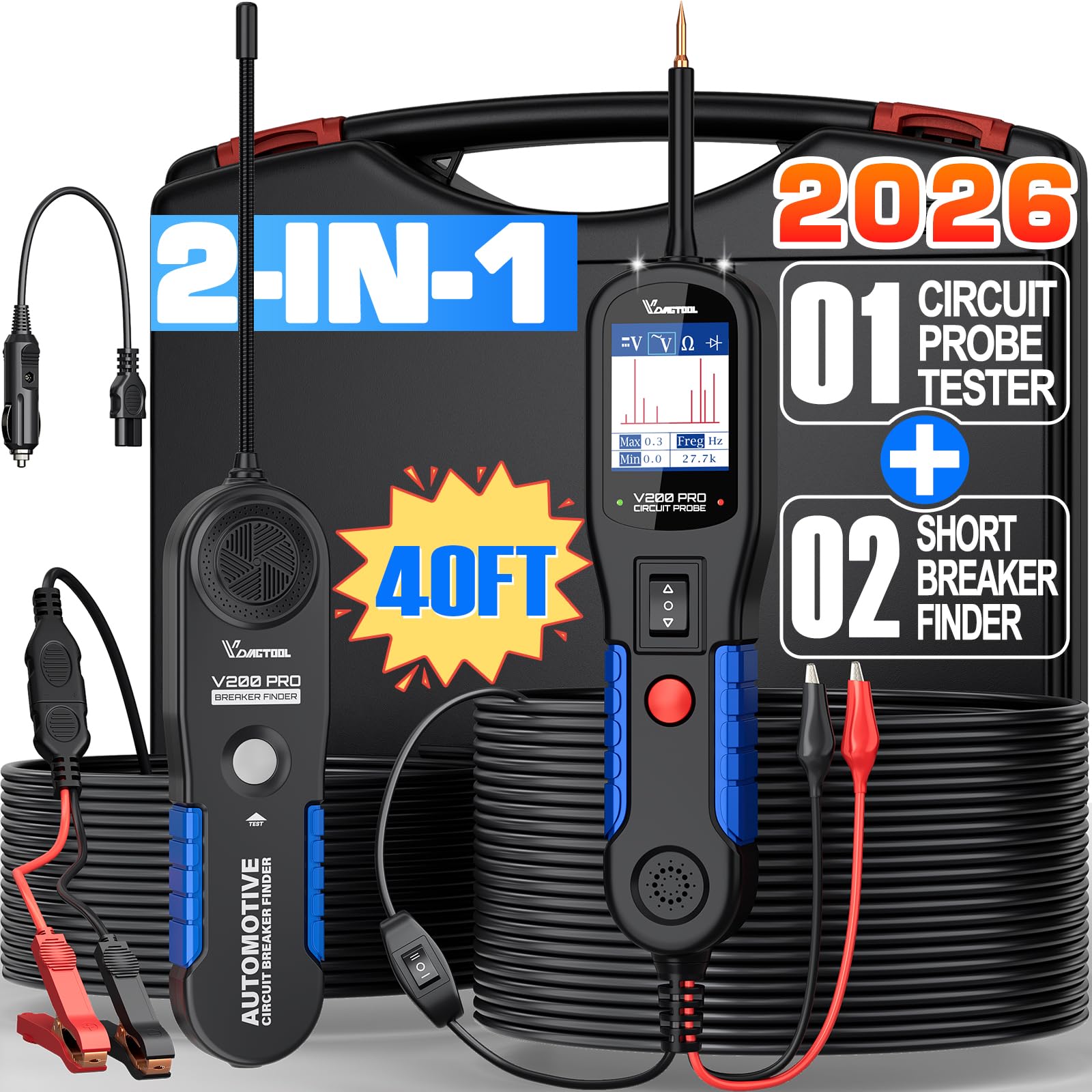
The V200 Pro is a true two-in-one tool: Mode I operates as a full power circuit probe tester covering AC/DC voltage, resistance, and diode testing, while Mode II transforms it into a dedicated circuit breaker finder that audibly and visually traces open connections and breaks in wiring without damaging insulation. This dual-mode design means you can diagnose a dead taillight circuit and then switch to trace the exact location of the wire break without swapping tools or reconnecting leads. The unit supports a wide 6-42V DC range, making it compatible with everything from motorcycles to heavy-duty 24V truck systems.
Component activation works seamlessly — press the rocker switch to send positive or negative power directly to a load, testing fans, injectors, and relays in seconds. The built-in overload protection automatically shuts down the output if a short is detected, protecting both the tool and the vehicle’s ECM. The V200 Pro includes a 20-foot extension cable, a padded carrying case, and a 9V battery (for Mode II) out of the box, a surprisingly complete accessory package at this price point.
Real-world feedback from technicians highlights the signal tracing capability as the standout feature — finding a rodent-chewed wire inside a harness loom that would otherwise require hours of disassembly. The stainless steel probe tip is sharp enough for back-probing weatherpack connectors without leaving permanent marks. If you chase electrical gremlins frequently and want a single tool that covers both power probing and wire tracing, the V200 Pro delivers professional functionality at a mid-range budget.
Why it’s great
- Two tools in one — power probe plus circuit breaker finder for wire tracing
- Wide voltage range (6-42V) covers cars, trucks, boats, and RVs
- Comes with padded case, extension cable, and cigarette lighter adapter
Good to know
- Mode II (breaker finder) requires a separate 9V battery, not included
- Instruction manual is dense and could benefit from clearer diagrams
3. Topdiag P100 Automotive Power Circuit Probe Tester
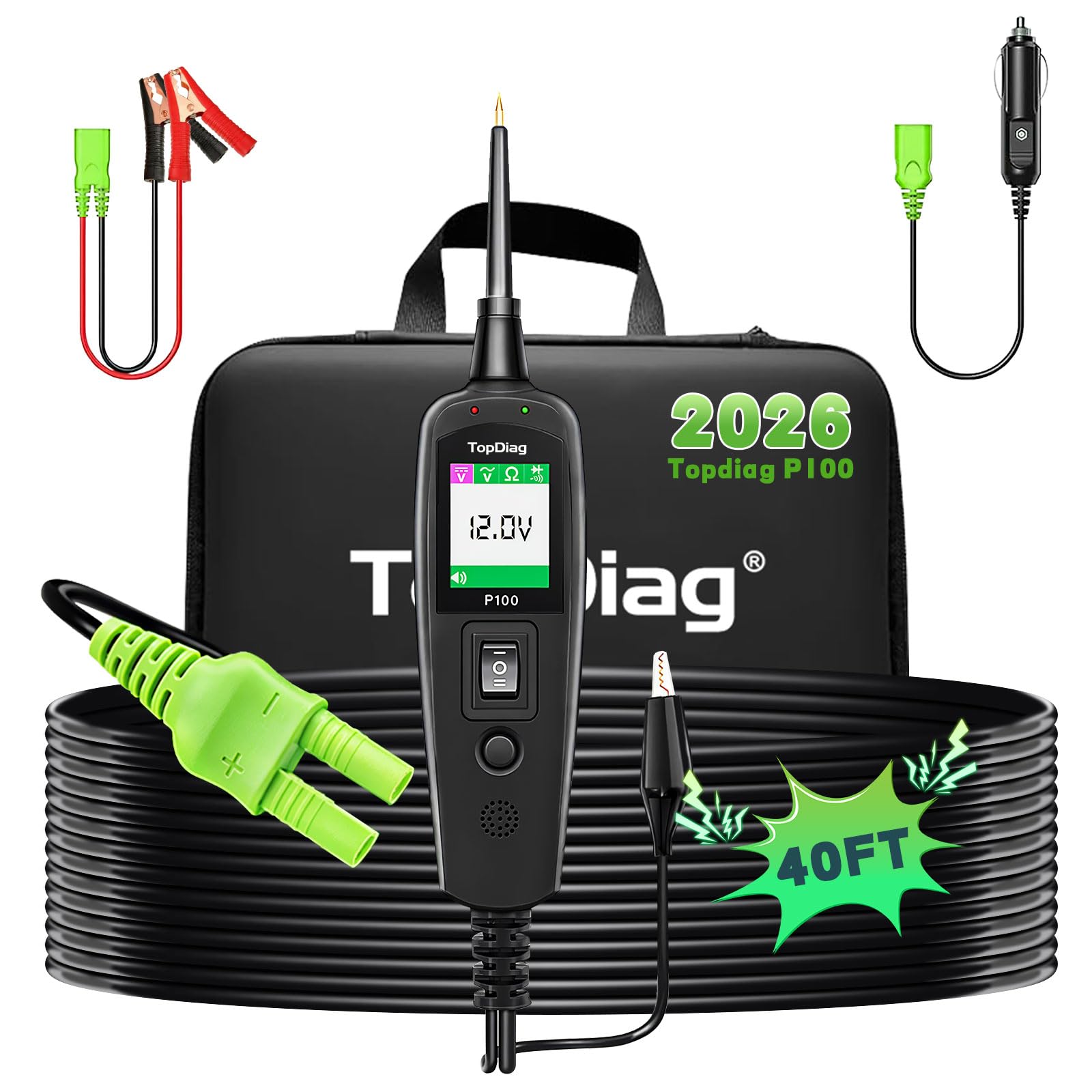
The Topdiag P100 brings multimeter-level functionality — AC/DC voltage, resistance, continuity, and diode testing — into a power probe form factor at a price that undercuts premium competitors by nearly half. The 20-foot + 20-foot extension cable arrangement is generous, letting you walk around a full-sized SUV without dragging the battery clamp. Its built-in circuit breaker trips audibly on overload, and the probe tip is sharp enough for back-probing weatherpack connectors without splitting the insulation.
Component activation is straightforward: a three-position rocker switch applies positive battery voltage, ground, or stays off, letting you test fuel pumps, cooling fans, and relays directly. The P100’s AC voltage mode reveals frequency and duty cycle data, which proved useful for checking alternator output waveforms and crankshaft sensor signals. Users have successfully diagnosed starter circuit failures and intermittent fuel pump issues by simulating power at the component and watching for voltage drop on the built-in LCD.
One quibble: the ground cable is noticeably shorter than the main lead, which can be awkward when you need to reach a ground point near the battery while probing a connector at the rear bumper. Some users have extended it with a standard jumper wire. For the price, the P100 offers an excellent balance of diagnostic depth and ease of use, especially for DIYers moving beyond a basic test light.
Why it’s great
- Multimeter functions (AC/DC, resistance, diode) integrated into a power probe grip
- Very long 40ft total cable allows testing from front to rear without repositioning
- Component activation works reliably for relays, fans, and fuel pumps
Good to know
- Ground lead could be longer for easier single-person operation
- No standalone wire tracing mode — relies on continuity tone
4. AWBLIN 4-75V DC Automotive Test Light with Buzzer Sound
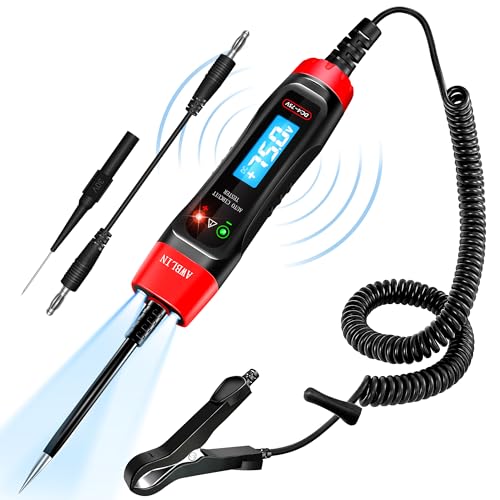
The AWBLIN 4-75V test light punches well above its price point by combining an LCD digital voltmeter with a traditional incandescent test light in a single compact body. The voltage display reads in 0.1V increments and the red/green LED polarity indicator makes positive/negative identification instant. The spring-loaded cord stretches to an impressive 141.74 inches, allowing you to reach from the engine bay fuse box to the taillight without unclipping the ground. An anti-loss probe cover is integrated into the design, preventing the tip from puncturing pockets or tool bags.
The buzzer alarm is a standout feature for a test light at this level — it audibly confirms continuity, so you do not have to look away from the probe tip to check for a signal. An overvoltage warning displays “OL” on the LCD and activates a red LED when voltage exceeds 75V DC, protecting the tool from accidental connection to higher-voltage systems. The build quality, with a reinforced strain relief at the handle, feels solid enough for regular professional use, and the UL/CE/ETL certifications back up the safety claims.
Customer feedback notes that the ground clip is somewhat bulky for tight spaces around the battery terminal, but several users simply swapped in a smaller aftermarket clamp. The voltage readings have been cross-checked against Fluke multimeters and found to be accurate within 0.1V — impressive for a sub- test light. If you need a wide-range voltmeter and a traditional test light in one tool and do not require component activation, this is the smartest buy on the list.
Why it’s great
- Digital voltage display with 0.1V resolution far exceeds a basic incandescent test light
- 4-75V range covers modern 12V, 24V, and even some 48V systems
- Buzzer alarm provides audible continuity confirmation without looking at the screen
Good to know
- Ground clip is large and may not fit cramped battery compartments
- No component activation mode — passive test light only
5. AWBLIN Power Circuit Probe Tester with Voltage Display
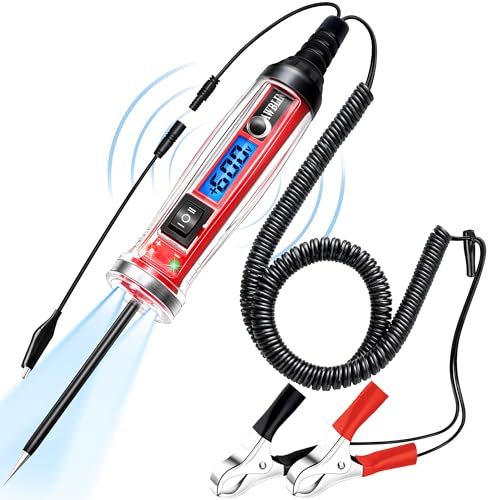
This AWBLIN model bridges the gap between a simple test light and a full power probe by offering both voltage and current measurement modes with a single button press. In voltage mode, it reads 1-60V DC with 0.1V resolution; switch to current mode, and the display shows DC amperage up to 8A with the same precision. The built-in LED flashlight automatically illuminates when the alligator clips are connected to the battery, a thoughtful touch for dark engine bays. The spring cord stretches to 196.85 inches, giving you nearly 17 feet of working range.
The buzzer alarm sounds during continuity checks and the red/green polarity LEDs indicate circuit status without needing to read the LCD. Overload protection kicks in at 61V DC (displaying “OL”) and in current mode the tool automatically disconnects above 8A, with the buzzer providing an audible warning. This safety feature is critical when probing unknown circuits that might have higher amperage than expected — the disconnect protects both the tool and the vehicle’s wiring.
Some users noted that the ground clip is again on the bulky side, and the lack of a true component activation mode limits its use for testing relays and actuators. However, for diagnosing voltage drop, checking fuses, and measuring current draw on individual circuits, this probe offers capabilities normally found in tools costing double. The integrated flashlight and long spring cord make it a very practical everyday diagnostic tool for the home mechanic.
Why it’s great
- Dual voltage and current measurement modes in one tool
- Auto-illuminating flashlight when connected to battery
- Overload protection with automatic disconnect above 8A
Good to know
- No rocker switch for active component testing
- Bulky ground clip limits access in tight spaces
6. OTC 3634 Heavy-Duty Straight Cord Circuit Tester

The OTC 3634 is the classic incandescent test light that professional mechanics have trusted for decades — no LCD, no buzzer, no modes, just a bright red replaceable bulb and a five-foot heavy-duty straight cord. The straight cord design is deliberate: it does not tangle, does not catch on sharp edges, and pulls straight through engine bay gaps without snagging. The positive-contact molded strain relief at the handle and the heavy-duty clamp are built to survive being dropped on concrete, stepped on, and yanked out of tight spots daily.
This tester is designed for 6V and 12V systems only, so it will not work on modern 24V trucks without burning out the bulb. The slim clear handle allows easy access to crowded fuse boxes under the dash, and the needlepoint stainless steel probe pierces wire insulation effortlessly for back-probing. There is no digital readout — you get a binary “bright light = power, dim light = low voltage, no light = dead circuit” signal that is fast and unambiguous.
Experienced diesel mechanics and automotive technicians consistently rate the OTC 3634 as the most reliable test light they own, often replacing budget units that fail within months. The bulb is user-replaceable, a critical feature since incandescent bulbs eventually burn out. If you want a no-nonsense, indestructible test light for basic power and ground checking and prefer tactile feedback over digital screens, the OTC 3634 is the gold standard.
Why it’s great
- Virtually indestructible build with heavy-duty cord and strain relief
- Replaceable incandescent bulb for low long-term cost of ownership
- Straight cord does not tangle or catch on engine bay components
Good to know
- Limited to 6V and 12V systems — not suitable for 24V vehicles
- No digital readout means no precise voltage measurement
7. OTC 3633 Mini-Coil Cord Circuit Tester

The OTC 3633 is the coiled-cord sibling of the 3634, offering the same legendary durability in a more compact and flexible package. The 12-foot coiled cord stretches to reach the rear of most vehicles without dragging on the ground, and retracts neatly when not in use, keeping the work area uncluttered. The mini-coil design is particularly appreciated by technicians who work in tight engine bays or under dashes where a straight cord can become a snag hazard. The handle is slim and ergonomic, fitting comfortably even in smaller hands.
A unique feature of the 3633 is the threaded stainless steel probe tip that accepts a screw-on alligator clip. This transforms the tool from a point probe into a hands-free connection, useful for monitoring a circuit while you operate switches or sensors elsewhere in the vehicle. The bright red incandescent bulb is replaceable and provides a clear, immediate indication of power presence. Like the 3634, this tester is designed for 6V and 12V systems only, with no digital readout or component activation.
Users consistently praise the build quality — the cord resists kinking, the clamp grips securely, and the probe tip remains sharp after months of regular use. The compact form factor fits easily in a tool bag drawer alongside a multimeter and pliers. If you prefer the coiled cord for its retractable convenience and want a test light that will outlast your car, the OTC 3633 is the best choice in its class.
Why it’s great
- Coiled cord retracts for storage and stretches 12 feet for reach
- Threaded probe tip with screw-on alligator clip for hands-free testing
- Compact ergonomic handle works well in tight dash and engine bay spaces
Good to know
- Limited to 12V and 12V systems — not for 24V electrical diagnostics
- No digital display or audible continuity tone
FAQ
What is the difference between an automotive circuit tester and a multimeter?
Can I use a 12V test light on a 24V truck system?
Why does my test light stay dim when I touch a wire?
Final Thoughts: The Verdict
For most users, the best automotive circuit tester winner is the Autel PowerScan PS100 because its four-mode operation, component activation, and professional-grade build quality make it the most versatile diagnostic tool for both DIYers and shop technicians. If you want a simple, indestructible test light that will never let you down, grab the OTC 3634 Heavy-Duty Straight Cord Tester. And for budget-minded buyers who need wire tracing on top of power probing, nothing beats the VDIAGTOOL V200 Pro.