
Knowing your exact blood alcohol concentration before getting behind the wheel is the only reliable way to avoid a DUI, and the difference between a trustworthy reading and a misleading one comes down to the sensor technology inside the device. Semiconductor sensors are affordable and fast, but they drift over time and react to mouth alcohol, while fuel cell sensors deliver lab-grade specificity that law enforcement agencies rely on for evidence-grade results.
I’m Min — the co-founder and writer behind Gadgets Feed. I’ve spent countless hours cross-referencing clinical accuracy data, fuel cell vs. semiconductor performance curves, and compliance certifications from the FDA, DOT, and NHTSA to separate pocket toys from genuine safety tools.
Whether you need a personal monitor for nightly peace of mind or a DOT-approved unit for workplace accountability, finding the right best bac tester depends entirely on how much precision your situation demands.
How To Choose The Best BAC Tester
The single most important decision you will make when buying a breathalyzer is the sensor type. Fuel cell sensors use an electrochemical reaction that is specific to ethanol, which means they ignore acetone, mouthwash, and other interferents that trip up semiconductor sensors. For anyone who needs a reading that could be compared to a law enforcement device, a fuel cell unit is non-negotiable. Semiconductor sensors are fine for casual party checks, but their readings can fluctuate with temperature, humidity, and the user’s recent intake of sugary drinks or food.
Certification and Legal Standing
FDA 510(k) clearance means the device has been reviewed for substantial equivalence to a legally marketed predicate device, which adds a layer of credibility that uncertified units lack. DOT and NHTSA compliance indicates the breathalyzer meets the standards used for roadside screening devices. If you are buying for a workplace safety program or for court-ordered monitoring, these certifications are the difference between a useful tool and a piece of plastic that holds no evidentiary weight.
Calibration and Long-Term Accuracy
Every breathalyzer drifts over time as the sensor degrades from repeated exposure to alcohol vapor. Fuel cell sensors typically require recalibration every 12 months or 1,000 tests, while semiconductor units drift faster and may need recalibration every 3–6 months. Some units, like the AlcoMate AL7000, use pre-calibrated replaceable sensor modules that eliminate the need to ship the device back to the manufacturer. Ignoring calibration schedules is the fastest way to turn an accurate tester into a random number generator.
Quick Comparison
On smaller screens, swipe sideways to see the full table.
| Model | Category | Best For | Key Spec | Amazon |
|---|---|---|---|---|
| BACtrack S80 | Premium | Professional-grade personal accuracy | Xtend Fuel Cell Sensor | Amazon |
| iSOBER 10 Fuel Cell | Premium | App-connected accountability | Fuel Cell Sensor with App Logging | Amazon |
| iSOBER 30 Fuel Cell | Mid-Range | DOT/NHTSA compliance at a value | Fuel Cell Sensor with Memory & Clock | Amazon |
| AlcoMate Premium AL7000 | Premium | Zero-maintenance calibration | PRISM Replaceable Sensor Module | Amazon |
| ALCO9 TX6010L | Mid-Range | FDA-cleared semiconductor option | Semiconductor Sensor, FDA Cleared | Amazon |
| VPOW Breathalyzer | Budget | Entry-level personal checks | Semiconductor Sensor, 10 Mouthpieces | Amazon |
| EEK Breathalyzer AT2700 | Budget | Budget-friendly party use | Semiconductor Sensor, LCD Display | Amazon |
In‑Depth Reviews
1. BACtrack S80 Breathalyzer

The BACtrack S80 is the only consumer breathalyzer that The Wirecutter endorsed after 65 hours of head-to-head testing against law enforcement-grade equipment, and it earned that reputation through the largest platinum-based Xtend Fuel Cell Sensor BACtrack produces. In practical terms, that sensor delivers readings consistent with the Intoxalock interlock devices used in court-ordered programs, which means you can trust the 0.00–0.40% BAC range with minimal drift between tests. The one-button operation eliminates menu scrolling, and the two included AA batteries keep it running for months of regular use.
DOT and NHTSA approval alongside FDA 510(k) clearance place the S80 in a class of devices that workplaces and safety-conscious individuals rely on for defensible data. The unit requires a 15–20 minute wait after your last drink or food to avoid mouth-alcohol contamination, which is standard for any fuel-cell device and not a design flaw. The carrying case and included mouthpieces make it practical for glovebox storage or home use.
The S80 has been on the market since 2009 without a major redesign because the sensor platform works — reviewers consistently report that the device matches their perceived intoxication level across multiple drinks and time intervals.
Why it’s great
- Professional-grade Xtend Fuel Cell Sensor matches law enforcement equipment accuracy
- DOT/NHTSA approved and FDA 510(k) cleared for legal credibility
- Simple one-button operation with no app dependency
Good to know
- Must wait 15–20 minutes after last drink for accurate readings
- Requires annual calibration to maintain sensor precision
2. iSOBER 10 Fuel Cell Breathalyzer

The iSOBER 10 combines a professional fuel cell sensor with a free companion app that captures your BAC result alongside a timestamp, GPS location, and a photo of the user, making it the strongest accountability tool in this lineup. The dual-mode design lets you run standalone tests without the phone for quick checks, then sync the data later for a complete history that can be shared via text or email. The 0.00–0.40% BAC range and 10-second response time match the performance of premium stationary units while keeping the footprint small enough for a pocket or purse.
Real-time sensor health monitoring is a rare feature at this level: the device runs a self-check before each test so you know the fuel cell is functioning, not after you get an unreliable number. Setting a personal BAC warning threshold inside the app gives you an audible and visual alert when you cross your chosen limit, which is useful for designated driver programs or personal sobriety goals. Calibration is recommended every 12 months or 1,000 tests, and the process is managed through the manufacturer’s US-based service center.
Reviewers consistently report repeatable readings within 0.001% BAC across back-to-back tests after a single drink, which is the hallmark of a well-tuned fuel cell sensor. The included hard case protects the unit during transport, and the battery life on two AAA cells extends well beyond a month of daily testing.
Why it’s great
- Free iSOBER app logs BAC with GPS, timestamp, and photo verification
- Sensor health check runs before every test for reliability
- Dual standalone and app-connected modes offer flexibility
Good to know
- Some users reported app pairing difficulty initially
- Requires annual or 1,000-test calibration schedule
3. iSOBER 30 Fuel Cell Breathalyzer

The iSOBER 30 delivers the same DOT/NHTSA compliance and FDA 510(k) clearance as the app-connected iSOBER 10 but strips away the smartphone integration to hit a lower price point, making it the most cost-effective entry into fuel-cell accuracy. The built-in memory stores your last 10 results with date and time stamps, so you can track BAC trends over a weekend or a week without needing a phone nearby. The dimensions — 3.94 x 1.73 x 0.59 inches — make it the slimmest fuel-cell unit in this roundup, fitting easily into a wallet pocket or the center console of a car.
Professional-grade fuel cell technology is the same sensor architecture used in law enforcement screening devices, and the iSOBER 30 uses a NHTSA-approved wet-gas calibration process that keeps the readings stable across temperature and humidity changes. The calibration reminder every 12 months or 1,000 tests is displayed directly on the screen, so you cannot accidentally run 1,500 tests and wonder why your numbers look funny. Two AAA batteries power the device, and the included hard case prevents damage during storage.
Customer feedback highlights the short blow time required — about 3–5 seconds — and the immediate digital readout, which eliminates the guesswork of cheaper semiconductor units that sometimes require multiple attempts. The memory function is particularly valuable for workplace safety programs where a log of recent tests needs to be reviewed periodically.
Why it’s great
- Full DOT/NHTSA and FDA clearance at a fraction of premium fuel cell prices
- Stores last 10 test results with date and time for trend tracking
- Slimmest fuel cell profile — fits wallet pocket or console
Good to know
- No smartphone app integration for remote logging
- Some units reported inconsistent readings, requiring return
4. AlcoMate Premium AL7000 Breathalyzer

The AlcoMate AL7000 eliminates the single biggest headache of long-term breathalyzer ownership — calibration — through patented PRISM technology that uses pre-calibrated replaceable intelligent sensor modules. Each module is factory-calibrated to ±0.01% BAC accuracy at 0.100% BAC and lasts for 200 tests or 12 months, after which you simply snap in a new module and the device is as accurate as day one. The second-generation precision oxide semiconductor sensor is not the same as a cheap semiconductor unit; it is a hybrid design that delivers a 0.000–0.400% BAC range with the consistency that earned it DOT and NHTSA approval for law enforcement use.
The 4-digit LED display is bright enough for low-light environments, and the one-button operation keeps the workflow simple even for high-volume testing in workplace or event settings. The robust chassis measures 9.5 x 5 x 1.5 inches, making it the largest unit in this lineup, but that size accommodates the modular sensor housing and the heavier-duty components designed for industrial environments. Two AAA batteries are included, and the unit ships with one pre-installed PRISM module.
The Achilles’ heel is the replacement module supply chain: some buyers have reported receiving modules that were close to their expiration date, and the manufacturer’s customer support has been inconsistent in resolving those issues. The 30-minute wait after eating or drinking is longer than the standard 15–20 minutes, which can be impractical for casual home use.
Why it’s great
- Patented PRISM replaceable modules eliminate recalibration downtime
- DOT/NHTSA approved for professional and law enforcement use
- Consistent ±0.01% BAC accuracy at the critical 0.100% threshold
Good to know
- Larger footprint than other portable units
- Replacement sensor modules may have limited shelf life upon arrival
5. ALCO9 TX6010L Breathalyzer
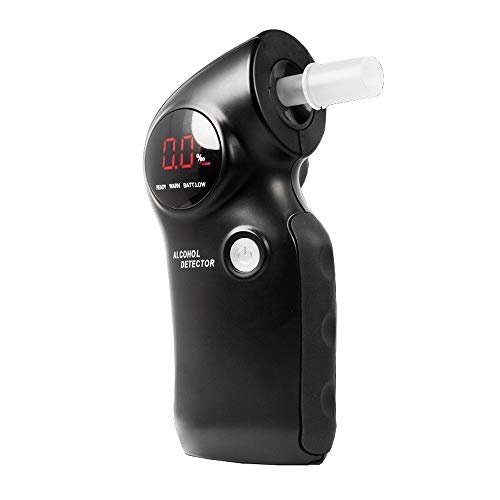
The ALCO9 TX6010L is one of the few semiconductor-based breathalyzers to earn FDA 510(k) clearance and DOT/NHTSA compliance, which gives it a regulatory pedigree that typical units lack. The semiconductor sensor is backed by a manufacturer with 20 years of breathalyzer production and distribution across 50 countries, so the build quality and component selection are a step above the generic white-label units flooding Amazon. The one-button operation with a bright LED display and audible alcohol alert makes it straightforward for workplace or home use, and the included carrying case protects the unit during transport.
Where the semiconductor limitation shows is in the calibration schedule: ALCO9 recommends recalibration every 6 months or 200 tests, which is twice as frequent as a fuel cell unit. The sensor is more susceptible to false positives from acetone in diabetics or residual mouth alcohol, so users need to rinse their mouth and wait 15–20 minutes after drinking to get reliable numbers. The audible alert beeps when alcohol is detected above the preset threshold, which is useful for self-monitoring but may be annoying in quiet environments.
Customer reviews are mixed: many users report consistent readings that match their expectations, but a significant minority describe wildly erratic results where blowing 0.10% and then 0.35% within a minute suggests a sensor that has drifted out of spec. For the price, you are paying for the FDA paperwork and the brand’s distribution network rather than sensor performance that competes with fuel cell units.
Why it’s great
- FDA 510(k) cleared and DOT/NHTSA compliant for regulatory credibility
- Audible alert provides immediate feedback without looking at the screen
- Backed by 20 years of breathalyzer manufacturing experience
Good to know
- Semiconductor sensor drifts faster than fuel cell — recalibrate every 6 months
- Inconsistent readings reported by some users, suggesting quality control gaps
6. VPOW Breathalyzer

The VPOW Breathalyzer is an entry-level semiconductor unit that covers the basics — a backlit LCD screen for night use, three measurement units (%BAC, ‰BAC, mg/L), and an auto-off feature that shuts down 10 seconds after each test to save battery. Ten washable and reusable mouthpieces come in the box, which is a generous supply for a device at this price point and allows for multi-person testing at gatherings without cross-contamination. The pocket-sized form factor at 3.52 ounces slips into a bag or car door pocket easily.
The semiconductor sensor requires a 15-second warm-up before each test, followed by a 3–5 second blow, and the digital readout shows results to one decimal place. Accuracy degrades over time as the sensor accumulates residues, but for casual use — checking yourself before a short drive home from a party — the VPOW provides a general sense of your BAC rather than a legally defensible number. The battery level indicator prevents the surprise of a dead unit when you need it most, and the three AAA batteries (not included) last through dozens of testing sessions.
Customer feedback is overwhelmingly positive for the price, with many users reporting that readings seemed consistent with their expected intoxication level. No one should mistake this for a fuel cell unit, but as a first breathalyzer or a backup for the car that you do not mind losing, the VPOW delivers functional results without breaking the bank.
Why it’s great
- 10 washable mouthpieces included for group testing
- Backlit LCD display works well in low-light car interiors
- Auto-off and battery level indicator extend usable life
Good to know
- Semiconductor sensor is not suitable for legally defensible results
- Requires 15-second warm-up before each test
7. EEK Breathalyzer AT2700
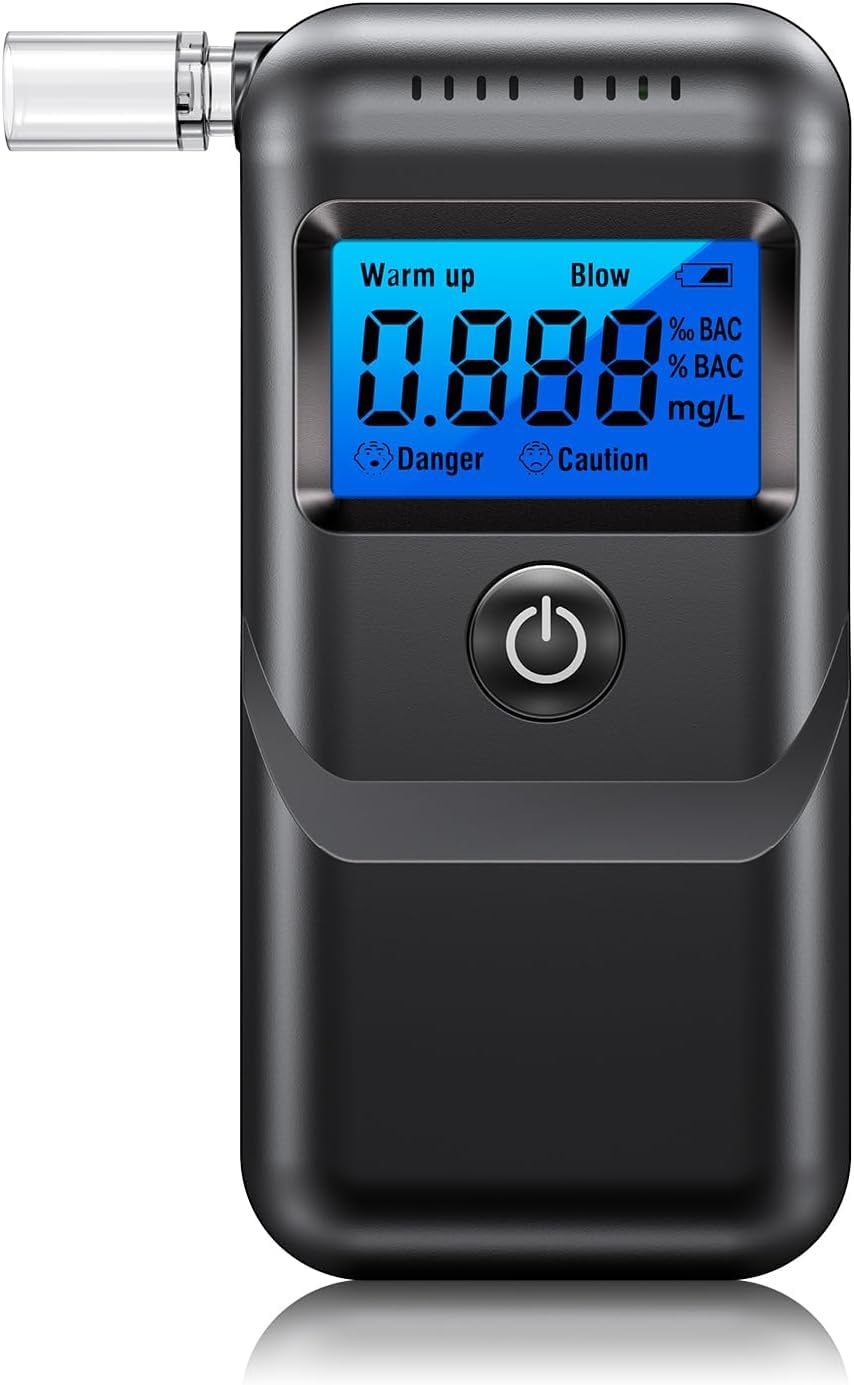
The EEK Breathalyzer AT2700 mirrors the VPOW in most functional aspects — semiconductor sensor, blue backlit LCD, 10 mouthpieces included — but adds a visual color indicator that shows green when your BAC is under 0.08% and red when you are above it, which eliminates the need to interpret the digital number. The one-button operation with a 15-second warm-up and 3–5 second blow is identical to the VPOW workflow, and the compact 2.89-ounce body is light enough to carry in a pocket without noticing it.
The three-unit measurement system (%BAC, ‰BAC, mg/L) accommodates international standards, which is useful if you travel across borders where different units are common. The auto-off function engages after 10 seconds of inactivity, and the battery level indicator prevents mid-party surprises. The protective storage case keeps the unit and mouthpieces organized, which is a thoughtful inclusion at this price point.
Customer reviews highlight the fun social aspect: groups of friends test themselves after rounds of drinks to see who is highest, and the green/red light makes it a game rather than a clinical exercise. Accuracy is typical of semiconductor sensors — adequate for entertainment and rough awareness, but not something you would stake your license on. The AT2700 is best understood as a conversation piece with a practical safety function, not as a precision instrument.
Why it’s great
- Green/red visual indicator makes BAC status instantly readable
- Small and lightweight at 2.89 ounces for pocket carry
- Includes storage case and 10 reusable mouthpieces
Good to know
- Semiconductor sensor has limited long-term accuracy compared to fuel cell
- Not suitable for legally defensible or workplace-monitoring use
FAQ
How long should I wait after drinking to blow into a fuel cell breathalyzer?
Can a semiconductor breathalyzer give a false positive from mouthwash or medication?
What does FDA 510(k) clearance actually mean for a breathalyzer?
How many tests does a typical fuel cell sensor last before needing calibration?
Final Thoughts: The Verdict
For most users, the best bac tester winner is the BACtrack S80 because its Xtend Fuel Cell Sensor delivers the same accuracy that law enforcement devices rely on, backed by DOT/NHTSA approval and FDA clearance that no semiconductor unit can match. If you want app-connected logging with photo and GPS verification for accountability programs, grab the iSOBER 10. And for a budget-friendly fuel cell option that still carries full regulatory compliance, nothing beats the iSOBER 30.