
A home studio’s biggest enemy isn’t budget—it’s uncontrolled slap echo and comb filtering that ruins recordings before they reach the DAW. Acoustic panels kill those early reflections, turn a boxy room into a controlled listening environment, and let your microphones capture what you actually intend. Without them, your microphone still sounds like it’s in a tiled bathroom.
I’m Min — the co-founder and writer behind Gadgets Feed. I’ve spent hundreds of hours reverse-engineering the marketing claims behind studio foam, filtering through real customer test data, and cross-referencing density specs against measurable NRC values so you don’t waste cash on decorative pillows that call themselves acoustic treatment.
This guide walks through seven different treatments, from ultra-thin polyester fiber panels to premium recycled PET kits, to help you find the right best acoustic panels for home studio.
How To Choose The Best Acoustic Panels For Home Studio
Choosing the right acoustic treatment for a home studio means ignoring the word “soundproof” entirely—acoustic panels absorb reflections, not block sound transmission. Your goal is to tame reverb time and flutter echo in the listening or recording position, and the material, thickness, and density determine how much low-frequency energy gets absorbed vs. reflected back into the room.
Material Density and NRC Ratings
Not all foam is equal. Open-cell polyurethane foam at 1-inch thickness absorbs mostly high frequencies, leaving the low-mid and bass region untreated. High-density polyester fiber (100% PET) or compressed recycled PET panels hit an NRC of 0.85 to 0.95, meaning they absorb 85–95% of incident sound across a broader frequency spectrum. Always check for an NRC value—if the listing doesn’t state one, assume the panel is decorative only.
Coverage Strategy and Placement
Rule of thumb: cover 20–30 percent of your total wall surface area to hear a meaningful difference. Focus on the first reflection points—the spots on the side walls where you see the edge of your monitor speaker in a mirror placed flat on the wall. The cloud panel above the listening position handles floor-ceiling flutter. A full-wall foam job without strategic placement still leaves a comb-filtered mess.
Installation Method and Wall Safety
Self-adhesive backing (peel-and-stick) works fastest on smooth drywall but can rip paint or leave residue on removal. For rental spaces, removable adhesive strips like 3M Command strips or nano tape let you reposition without damage. Permanent installation with brad nails or spray contact adhesive gives the flattest visual finish. If the product says “no adhesive included,” budget for adhesive strips before install day.
Quick Comparison
On smaller screens, swipe sideways to see the full table.
| Model | Category | Best For | Key Spec | Amazon |
|---|---|---|---|---|
| AudioSilk ROOM KIT | Premium | Home studio critical listening | NRC up to 0.91 | Amazon |
| UMIACOUSTICS 6-Pack | Premium | Decorative studio and office | 47.2″ x 23.6″ x 0.4″ | Amazon |
| TONOR Dual-Layer 4-Pack | Premium | Large wall coverage / noisy neighbors | 47.2″ x 23.6″ x 0.72″ | Amazon |
| 22-Pack GEO Panels | Mid-Range | Thin-profile echo reduction | 12″ x 12″ x 0.4″ | Amazon |
| 100-Pack Acoustic Foam | Mid-Range | Bulk coverage for game rooms | 12″ x 12″ x 1″ | Amazon |
| Knightsacoustic 96-Pack | Mid-Range | Small studio / vocal booth | 12″ x 12″ x 2″ | Amazon |
| Amantech 12-Pack Hex | Budget | Light echo / aesthetic wall art | 12″ x 10.23″ x 0.4″ | Amazon |
In‑Depth Reviews
1. AudioSilk ROOM KIT 4-Pack

AudioSilk’s ROOM KIT delivers exactly what your home studio needs: four large panels (45.7 x 22.8 inches each) made from post-consumer recycled PET with a measured NRC of up to 0.91. That rating means 91% of incident sound energy gets absorbed, not reflected—and in practice, it flattens flutter echo and tightens reverb tails without sucking the life out of your room. The 0.4-inch thickness feels thin, but the high-density fiber construction outperforms 2-inch open-cell foam in the critical 500 Hz to 4 kHz range where vocals and guitars live.
Installation requires removable sticky strips (sold separately), which is a deliberate trade-off: you avoid adhesive residue on rental walls and can reposition panels after a listening test. Users report measurable improvements in speakerphone clarity and stereo imaging after mounting at first-reflection points. The panels come in a neutral natural color that blends into most studios without looking like a mattress topper.
One real caveat: there’s no adhesive included in the box, so factor in the cost of eight to twelve 3M Command strips or nano tape before you start. Some reviewers also wish AudioSilk offered a thicker version for deeper bass trapping. But for pure acoustic performance per dollar in a 4-pack format, this is the cleanest solution for a critical listening environment.
Why it’s great
- NRC 0.91 delivers measurable reverb reduction
- Eco-friendly recycled PET with zero chemical smell
- Removable adhesive strips allow no-damage installation
Good to know
- No adhesive included in the pack
- 0.4-inch thickness limits deep bass absorption
2. UMIACOUSTICS 6-Pack Walnut Panels

UMIACOUSTICS bridges the gap between acoustic performance and interior design. Each of the six panels measures 47.2 by 23.6 inches with a wood-look veneer surface over a 100% polyester fiber core. The walnut finish closely mimics real wood slats, and the flexible backing makes cutting to irregular dimensions with a utility knife straightforward—a big plus when fitting around outlets or soffits.
Sound absorption is noticeably better than thin foam at the same 0.4-inch thickness, thanks to the dense fiber core that handles mid-range reflections efficiently. Users installing these in podcast studios report significantly reduced echo during spoken-word sessions. The panels sit flat when mounted with an 18-gauge brad nailer (six nails per panel), and the nail marks are practically invisible on the textured veneer.
Be aware that cutting the panels generates a dark felt dust that can splinter slightly, so wear gloves and work over a drop cloth. The product does not include adhesive, nails, or mounting hardware—plan for either construction adhesive, double-sided tape, or a nail gun. If your studio doubles as a living space and you need treatment that doesn’t scream “foam dungeon,” this is the most visually polished option.
Why it’s great
- Wood-look veneer blends with home décor
- Large panel size reduces install time
- Easy to cut with a standard utility knife
Good to know
- No mounting hardware included
- Cutting creates dark dust and splinters
3. TONOR Dual-Layer Thickened 4-Pack

TONOR’s dual-layer construction stacks two thickened absorption layers into a single 0.72-inch panel, making it one of the thickest non-foam options at this size. Each panel spans 47.2 by 23.6 inches and weighs about 4 pounds, giving you substantial low-mid absorption that thinner panels miss. Users report cutting washer/dryer rumble and neighbor bass by roughly 50% when covering 95% of a shared wall—a result that tracks with the higher density of the polyester fiber material.
The self-adhesive backing is strong enough to hold on smooth drywall without sagging, and the reinforced corner protectors mean the panels arrive flat even after shipping. The classic ribbed texture looks cleaner than wedge foam and reflects less visual noise in a studio environment. Reviewers who installed these in thin-walled apartments consistently mention the reduction in audible conversations through the wall, though full soundproofing still requires mass-loaded vinyl and decoupling.
The major trade-off is the adhesive’s permanence—removal with heat (hair dryer) is possible but risks pulling paint. The panels are not designed for frequent repositioning, so measure your first-reflection points carefully before peeling. For a semi-permanent install where you want maximum absorption from a single layer, the TONOR panels deliver the deepest frequency response in this line-up.
Why it’s great
- 0.72-inch dual-layer absorbs more low-mid energy
- Large panels cover wall area quickly
- Reinforced edges survive shipping without damage
Good to know
- Strong adhesive may peel paint on removal
- Not ideal for temporary or rental setups
4. 22-Pack GEO Acoustic Panels
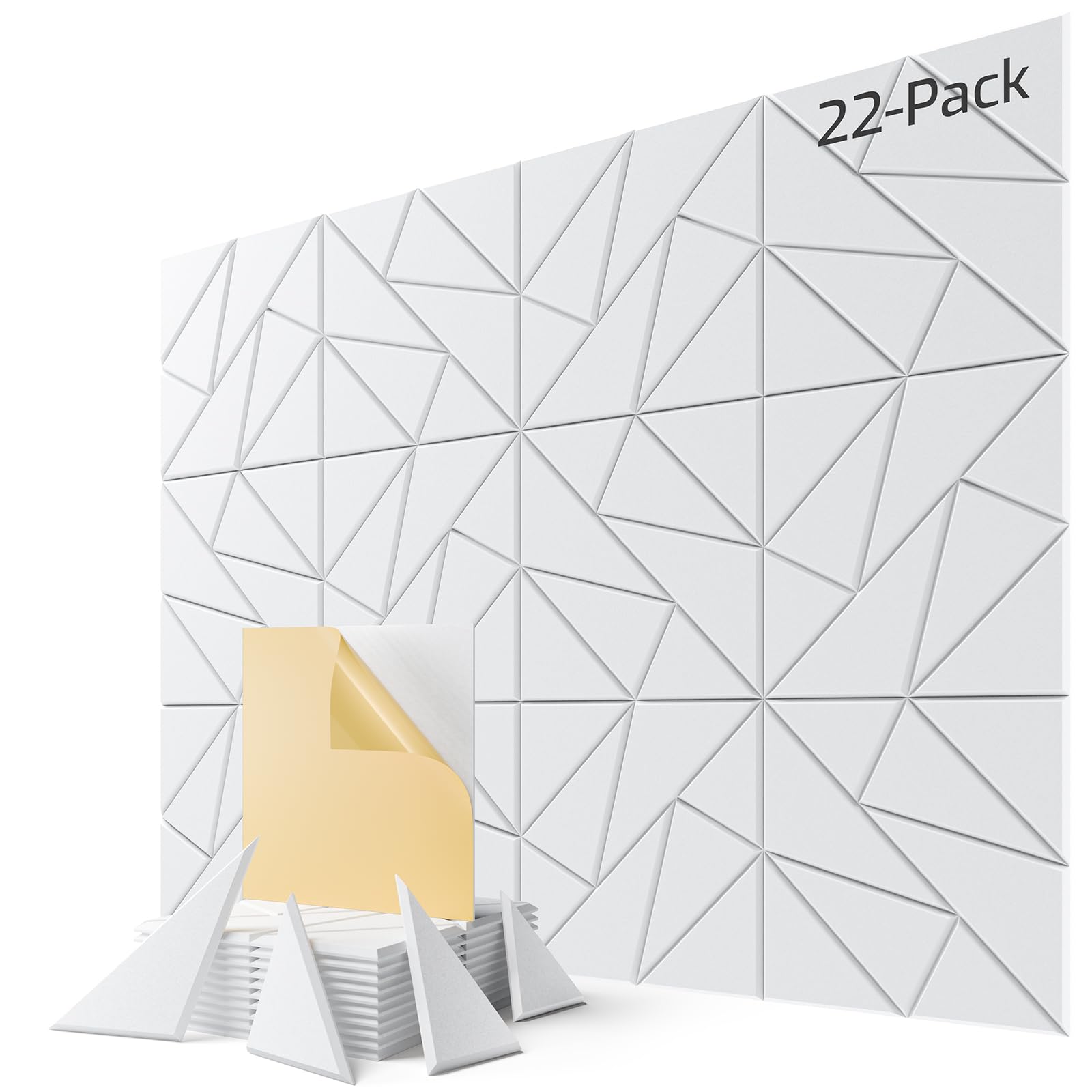
These 22-pack GEO panels tackle a specific pain point: high-pitched appliance whine and harsh room reflections in tight spaces. Each 12×12-inch panel is only 0.4 inches thick, made from odorless polyester fiber with a 45-degree chamfered edge that creates a geometric wall pattern. The self-adhesive backing sticks firmly to smooth surfaces—users report eliminating the high-frequency whine from 3D printers and refrigerators completely after placing panels directly behind the noise source.
The thin profile means they won’t solve heavy bass buildup or deep low-end flutter, but for taming sibilance, comb filtering, and slap echo in a small home office or vocal booth, they pull more than their weight. The 22-pack gives you roughly 22 square feet of coverage, which is enough to treat first-reflection points and a small ceiling cloud. The adhesive is extremely strong—reviewers warn it will peel paint if you try to remove the panels.
Because these are only 0.4 inches thick, they are not suitable as a standalone solution for a full mixing room. Pair them with thicker bass traps in corners and a dedicated cloud panel above the listening position. If your goal is to clean up mid and high-frequency reflections on a budget without losing floor space, the GEO panels are the most convenient peel-and-stick option in this guide.
Why it’s great
- Easy peel-and-stick install in seconds
- Effectively kills high-frequency appliance whine
- Chamfered edge looks intentional, not makeshift
Good to know
- 0.4-inch thickness does not absorb low frequencies
- Adhesive will damage paint on removal
5. 100-Pack Acoustic Foam Panels

With 100 panels at 12x12x1 inch each, this pack offers the highest per-unit coverage of any option here. The open-cell foam is designed to compress for shipping and expand over 48 hours to full thickness—a standard process for mass-market acoustic foam. Users covering entire furnace room walls with three boxes report a measurable reduction in ambient noise bleed into adjacent living spaces, confirming that quantity can compensate for material quality in broadband absorption.
The panels come with 250 adhesive dots, which is enough for five stickers per tile (corners plus center). Some users found the adhesive adequate but not perfect—a few tiles fell from ceilings after a week, suggesting that overhead installations may need a stronger spray adhesive. There is also a distinct chemical smell for the first week that requires airing out the room before recording sessions.
The biggest practical warning: these are not soundproofing panels. Several reviewers bought them expecting to block neighbor noise through walls and were disappointed. For echo control and reflection damping in a gaming room, vocal booth, or budget home studio, the 100-pack delivers the raw square footage needed to cover large surfaces. But the 1-inch foam density still leaves low frequencies largely untouched, so budget for separate bass traps if you’re mixing serious music.
Why it’s great
- 100 panels cover large wall areas cheaply
- Adhesive dots included for quick install
- Expands to full thickness after 48 hours
Good to know
- Strong chemical smell for first week
- Some ceiling tiles may fall without stronger adhesive
6. Knightsacoustic 96-Pack Wedge Panels
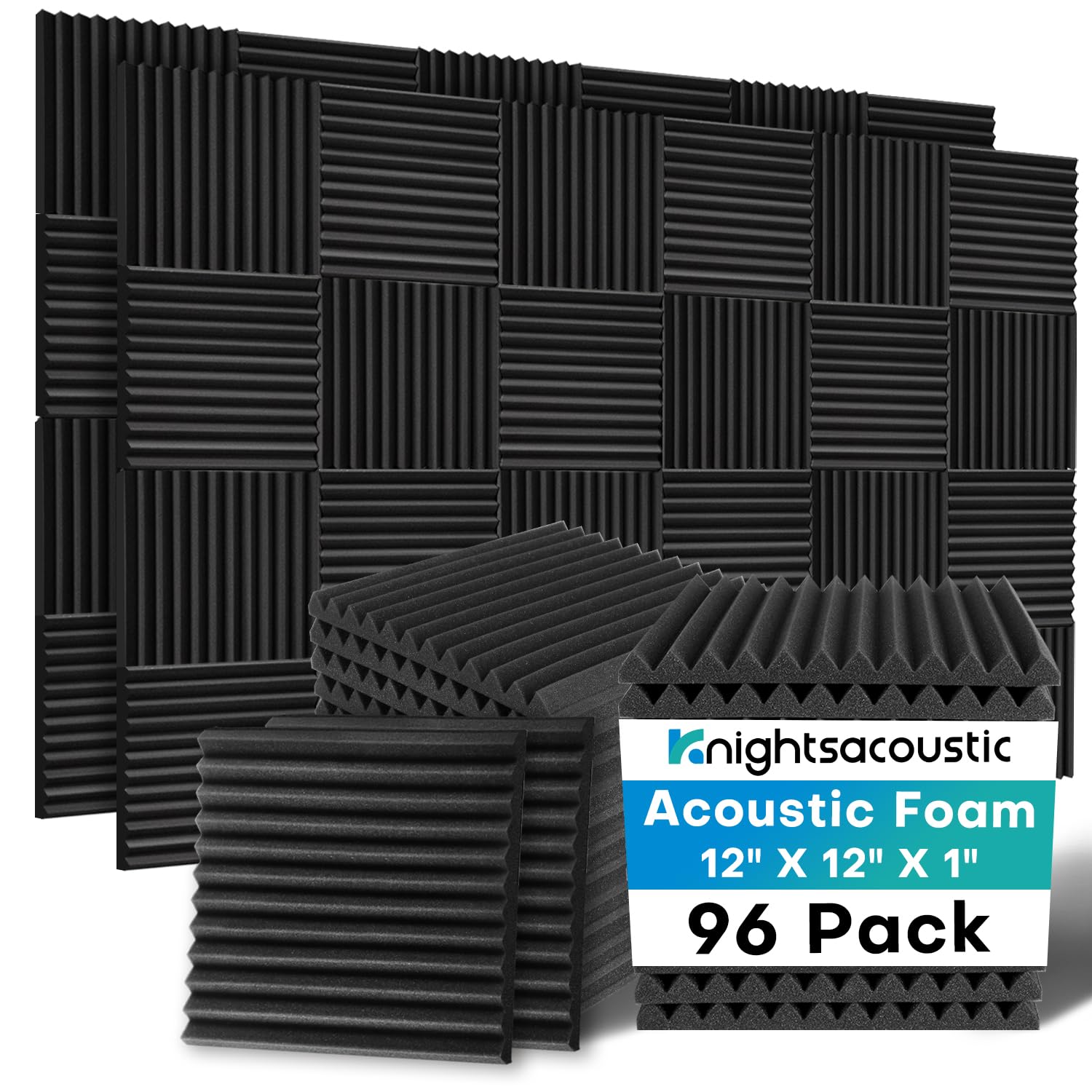
Knightsacoustic brings the thickest foam panels in this guide at 2 inches deep, with 96 panels covering approximately 96 square feet. The wedge profile targets flutter echo and standing waves in two dimensions—the 2-inch depth absorbs significantly more low-mid energy than the 1-inch alternatives. Users report a dramatic reduction in room reverb after installing these across first-reflection points, especially in smaller rooms where early reflections ruin stereo imaging.
A unique feature: the panels can be soaked in water, wrung out, and air-dried to accelerate expansion and eliminate any residual odor from factory compression. This works well, though some units arrived with inconsistent thickness after expansion (measuring closer to 1 inch in spots). The panels do not come with adhesive backing—you must buy separate adhesive dots or spray glue. Knightsacoustic recommends their own square adhesive (ASIN B0CFV11LVN) for a seamless install.
For a home studio that needs serious broadband absorption without stepping up to PET panels, this 96-pack gives you the volume density to treat an entire room. The lack of adhesive means you can mount them on poster board first and attach the board to the wall with minimal wall damage—a smart hack from experienced reviewers. If your room has noticeable low-mid buildup and you’re willing to buy separate adhesive, the Knightsacoustic wedges offer the best depth-to-dollar ratio here.
Why it’s great
- 2-inch thickness absorbs lower frequencies
- 96 panels cover nearly 100 sq ft
- Soak-and-dry method eliminates odor and flattens panels
Good to know
- No adhesive included in the box
- Some panels expand to only 1 inch after 48 hours
7. Amantech 12-Pack Hexagon Panels

The Amantech 12-pack brings a hexagonal honeycomb design that doubles as wall art while providing basic echo reduction. Each panel measures 12 by 10.23 by 0.4 inches and is made from 100% polyester fiber with self-adhesive backing—no extra glue or tape required. The beige color option blends into lighter walls without drawing attention, and the hexagon pattern allows creative arrangements beyond the standard grid layout.
Real-world performance is limited by the thin 0.4-inch profile. A single set will reduce high-frequency slap echo in a small vocal booth or podcast corner, but you need three or four packs to make a measurable difference in a 10×10 room. Users confirm that these effectively dampen flutter echo when placed at first-reflection points, but they do not block noise from neighbors or absorb any meaningful low-end. The adhesive is strong enough to hold on textured drywall, but removal left felt residue and pulled paint for several reviewers.
This is the entry-level option for someone starting their first home studio on a tight budget. But if you are already mixing or recording critical audio, the thin polyester fiber will leave your room’s mid-range and bass frequencies completely untreated—plan to upgrade to thicker panels or supplement with dedicated bass traps as your studio grows.
Why it’s great
- Hexagon design adds visual interest to walls
- Self-adhesive backing, no extra tools needed
- Effective at killing high-frequency slap echo
Good to know
- Very thin—minimal low-frequency absorption
- Needs multiple packs for a full room
FAQ
Will acoustic panels stop my neighbor’s bass from coming through the wall?
How many acoustic panels do I need for a 10×10 foot home studio?
Can I install acoustic panels without damaging rental walls?
Final Thoughts: The Verdict
For most users, the best acoustic panels for home studio winner is the AudioSilk ROOM KIT because its NRC 0.91 rating and recycled PET construction deliver professional-grade absorption without the chemical smell or visual bulk of foam. If you want the deepest bass absorption and the thickest panel, grab the TONOR Dual-Layer 4-Pack. And for a visually clean treatment that doubles as wall decor, nothing beats the UMIACOUSTICS 6-Pack with walnut veneer.