
A backpacking stove is the difference between a hot meal after a 15-mile day and choking down a cold energy bar. The wrong one leaves you waiting 20 minutes for water to boil while your fuel canister sputters in the wind. The right one fires up instantly, burns efficiently, and packs down to nearly nothing inside your cook pot.
I’m Min — the co-founder and writer behind Gadgets Feed. I’ve spent hundreds of hours digging through performance benchmarks, burn times, fuel consumption figures, and real-world customer feedback across dozens of stove models to find the units that actually deliver on their specs in the backcountry.
Whether you’re a weekend warrior or a thru-hiker counting every gram, this guide breaks down the seven best models on the market to help you find the ideal best backpacking stove for your cooking style, terrain, and budget.
How To Choose The Best Backpacking Stove
Selecting the right stove comes down to how you cook and where you camp. A thru-hiker who only boils water for dehydrated meals has completely different needs than a base-camp chef who wants to simmer a sauce. Understanding the trade-offs between weight, fuel type, wind performance, and control will save you money and frustration on the trail.
Weight vs. Boil Speed vs. Stability
Ultralight stoves under 3 ounces like the Fire-Maple Blade 2 disappear into your pack but often lack wind protection and wide pot supports. Heavier regulated stoves like the MSR PocketRocket Deluxe add stability and consistent performance but cost you a few ounces. If you’re cooking more than dehydrated meals, prioritize a wider burner head and stiffer pot supports to prevent tipping on uneven ground.
Regulated vs. Non-Regulated Pressure
A pressure regulator maintains a steady gas output as the canister pressure drops, which matters below 40°F or when the canister is half empty. Non-regulated stoves lose performance as the fuel depletes or the temperature falls. For shoulder-season backpacking or alpine trips above treeline, a regulated stove is worth the extra weight because it delivers predictable boil times every time you fire it up.
Integrated System vs. Standalone Burner
Integrated systems like the Jetboil Flash and MSR WindBurner pair the burner with a specific pot and heat-exchanger ring for maximum efficiency in wind. They boil water extremely fast and sip fuel, but you cannot use standard cookware with them. Standalone burners like the Snow Peak BiPod give you total pot flexibility — you can use any titanium mug, aluminum pot, or even a 10-inch pan — but you will lose heat to the wind without a separate windscreen.
Quick Comparison
On smaller screens, swipe sideways to see the full table.
| Model | Category | Best For | Key Spec | Amazon |
|---|---|---|---|---|
| Jetboil MightyMo | Mid-Range | Ultralight solo trips with simmer control | 3.36 oz / 2900W max output | Amazon |
| Fire-Maple Blade 2 | Mid-Range | Ultralight cold-weather remote-canister setups | 4.76 oz / 9500 BTU titanium | Amazon |
| Snow Peak BiPod | Premium | Stable cooking with large pots or pans | 8.47 oz / 11600 BTU | Amazon |
| MSR PocketRocket Deluxe | Premium | All-around regulated performance for backpackers | 2.9 oz / pressure regulated | Amazon |
| Fire-Maple Polaris | Premium | Integrated system for 2-3 people | 22 oz / 1L pot w/ heat exchanger | Amazon |
| Jetboil Flash | Premium | Fastest boil time in a compact integrated system | 13.1 oz / boils 16 oz in 2 min | Amazon |
| MSR WindBurner | Premium | Extreme wind and cold-weather performance | 15.36 oz / 1L pot + radiant burner | Amazon |
In‑Depth Reviews
1. MSR PocketRocket Deluxe Ultralight Camping and Backpacking Stove

The MSR PocketRocket Deluxe hits a remarkable balance of weight, performance, and regulation. At just 2.9 ounces, it is lighter than most non-regulated stoves but includes a pressure regulator that keeps the flame steady as the canister cools or empties. It boils one liter of water in about 3.5 minutes in moderate conditions, and its wider burner head improves wind resistance over the original PocketRocket without adding much bulk.
The built-in piezo igniter is protected inside the burner for durability, and the flame adjusts down to a true simmer — a rare feature among sub-3-ounce stoves. Users report reliable ignition and consistent output even at elevations above 10,000 feet and temperatures below freezing. The folding pot supports are wide enough for a standard 1-liter titanium pot but can feel tight with larger 1.5-liter cookware.
It packs into a tiny stuff sack that fits inside a 700 mL mug alongside a 100-gram fuel canister. The three-year MSR warranty backs the build, and replacement parts are widely available. For the solo backpacker who wants regulated performance without the weight penalty of an integrated system, this is the gold standard.
Why it’s great
- Pressure regulated for cold-weather and low-fuel consistency
- Ultralight at 2.9 oz with reliable piezo ignition
Good to know
- Pot supports are narrow for larger cookware
- No integrated windscreen — requires natural shelter or a separate shield
2. Jetboil MightyMo Ultralight and Compact Camping and Backpacking Stove

The Jetboil MightyMo brings Jetboil’s reputation for fast boil times into a standalone burner form factor at just 3.36 ounces. Its four-turn regulator is the standout feature here — it allows incremental heat adjustments from a delicate simmer up to a full boil in roughly three minutes, using half the fuel of traditional non-regulated systems. This makes it one of the few ultralight stoves that can actually sauté mushrooms or simmer a sauce without scorching.
The push-button piezo igniter fires reliably from the first click, and the regulator maintains consistent performance down to about 20°F. The open platform design accepts any standard pot, and it will also work with Jetboil’s FluxRing cookware and skillet for a semi-integrated experience. The included fuel canister stabilizer adds much-needed stability on uneven ground, though the stove itself sits a bit high on a tall canister.
Multiple users note the flame lacks a built-in windscreen, and a light breeze can knock the flame out entirely. A DIY or aftermarket windscreen is almost mandatory for exposed campsites. For the weight-conscious cook who wants real flame control, the MightyMo delivers premium simmer capability at a mid-range price.
Why it’s great
- Four-turn regulator provides genuine simmer control
- Fast 3-minute boil time with half the fuel of typical stoves
Good to know
- No wind protection — flame can be extinguished by a breeze
- Runs tall on a canister, less stable on uneven terrain
3. Snow Peak BiPod Stove, GS-370-US

The Snow Peak BiPod is the stove you grab when stability matters more than shaving grams. Its three-point tripod base, measuring 7 inches wide when set up, provides a rock-solid platform that handles a full 10-inch cast iron skillet without wobbling — something no other canister-top stove in this list can claim. The burner generates 11,600 BTU, which is enough output for serious group cooking without feeling underpowered.
The design is pure Japanese minimalism: aluminum body, stainless steel burner, and a locking mechanism that secures the canister firmly. It collapses to a compact 2.7 x 4.9 x 2.3 inches with the included storage bag. The piezo igniter is integrated, and users report it lasting through hundreds of meals. A unique rubber cap covers the gas connection when not in use, and Snow Peak’s lifetime product guarantee backs the whole unit.
The trade-off is weight at 8.47 ounces, which is more than double the PocketRocket or MightyMo. It also uses a direct-mount canister, so cold-weather inverted use is not possible without an adapter. For car campers, base camp setups, and backpackers who cook real meals with a frying pan, the BiPod’s stability is worth every extra gram.
Why it’s great
- Extremely stable tripod base supports large pans
- Backed by Snow Peak’s lifetime product guarantee
Good to know
- Heavier than typical ultralight stoves at 8.47 oz
- Cannot invert canister for cold-weather use
4. Jetboil Flash Portable Fast Boil Stove System
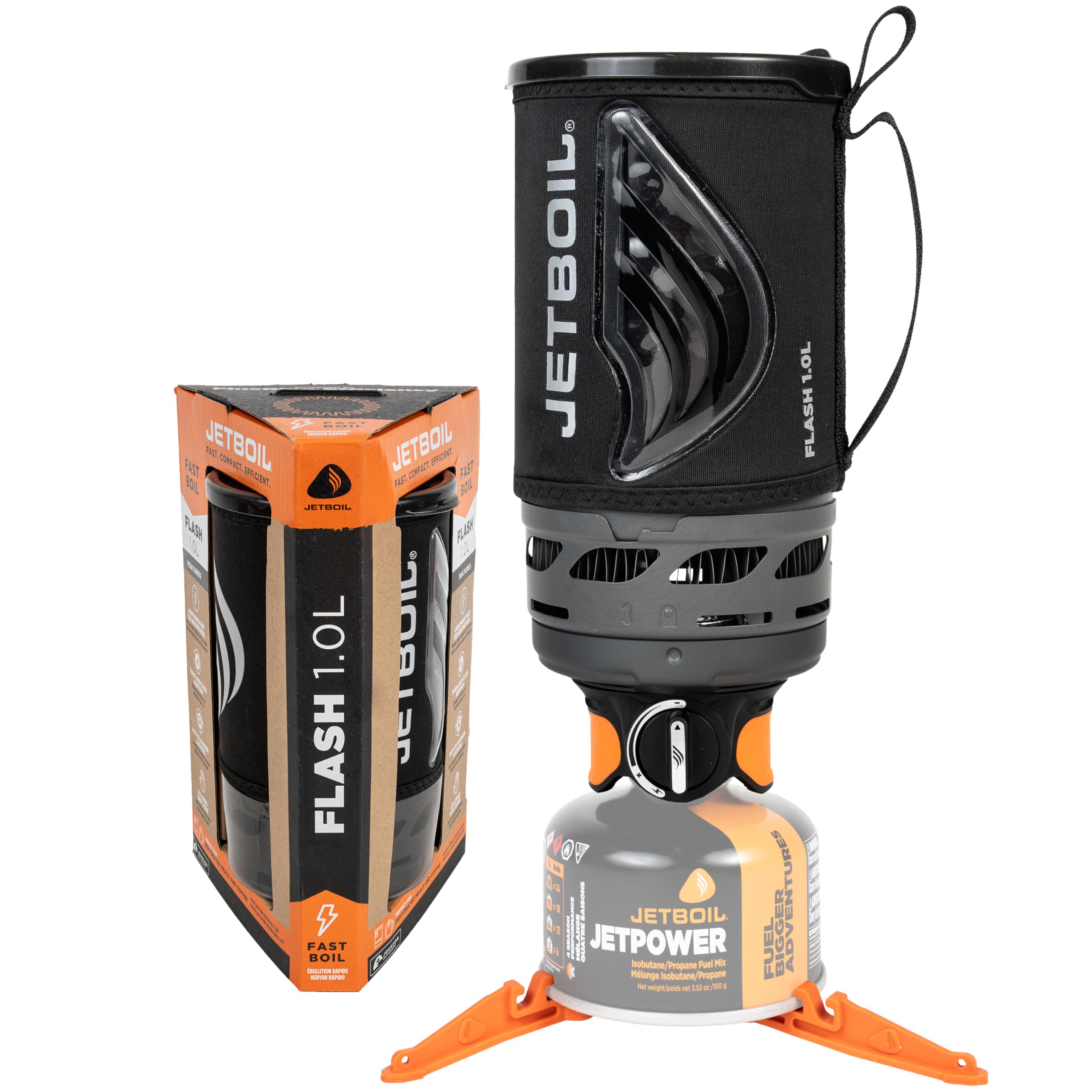
The Jetboil Flash is the integrated system that defines fast: it boils 16 ounces of water in two minutes flat. The 1-liter pot uses Jetboil’s FluxRing heat exchanger at the base to capture more heat, and the insulating cozy keeps the water hot long after the flame is off. The new one-step auto ignition works like a home stove — turn and click — and the Safe-Touch rubberized zone on the pot stays cool enough to grip securely while cooking.
The improved locking system uses three locking points with visual indicators so you know the pot is fully seated on the burner. The bottom cup doubles as a measuring cup or a bowl, and the entire system — burner, 100-gram canister, and stabilizer — packs inside the main pot. A thermochromatic heat indicator on the cozy changes color to show when the water is hot, which is a genuine safety feature for dark mornings.
This is a specialized system optimized for boiling water. It does not accept standard pots without an accessory pot support, and the flame control is coarse compared to a standalone burner like the MightyMo. For dehydrated meals, coffee, and tea on fast-paced trips where every minute matters, the Flash is the undisputed speed champion.
Why it’s great
- Boils 16 oz of water in 2 minutes
- Self-contained system packs burner, fuel, and pot together
Good to know
- Designed primarily for boiling water, not versatile cooking
- Flame control is limited to high and low
5. Fire Maple Polaris Pressure Regulator Cooking System

The Fire-Maple Polaris is an integrated canister system that competes directly with the Jetboil line at roughly half the price. Its micro-regulated valve maintains consistent output in cold weather, and the heat-exchanger pot boils one liter of water in about 3.5 minutes — competitive with systems costing significantly more. The entire setup packs into itself: the 1-liter hard-anodized aluminum pot fits the burner, a canister stabilizer, and a 220-gram fuel canister inside.
The BPA-free pot uses a locking stainless steel handle and a neoprene cozy for heat retention. The piezo igniter fires reliably, and the micro-regulator allows true simmering — a capability most integrated systems lack because their burners are designed for full-blast boiling only. Users in cold environments report reliable performance down to around 30°F without needing to invert the canister.
The trade-off for the sub-premium price is a heavier overall system at 22 ounces and a pot that is too large for solo coffee. The ignition wire is exposed and could snag inside a pack without care. For the two-to-three-person group that wants integrated efficiency at a reasonable cost, the Polaris delivers impressive value.
Why it’s great
- Integrated system with pressure regulation at half the Jetboil price
- True simmer control via micro-regulator valve
Good to know
- Heavier than premium integrated systems
- Exposed ignition wire needs careful packing
6. MSR WindBurner Personal Windproof Camping and Backpacking Stove System
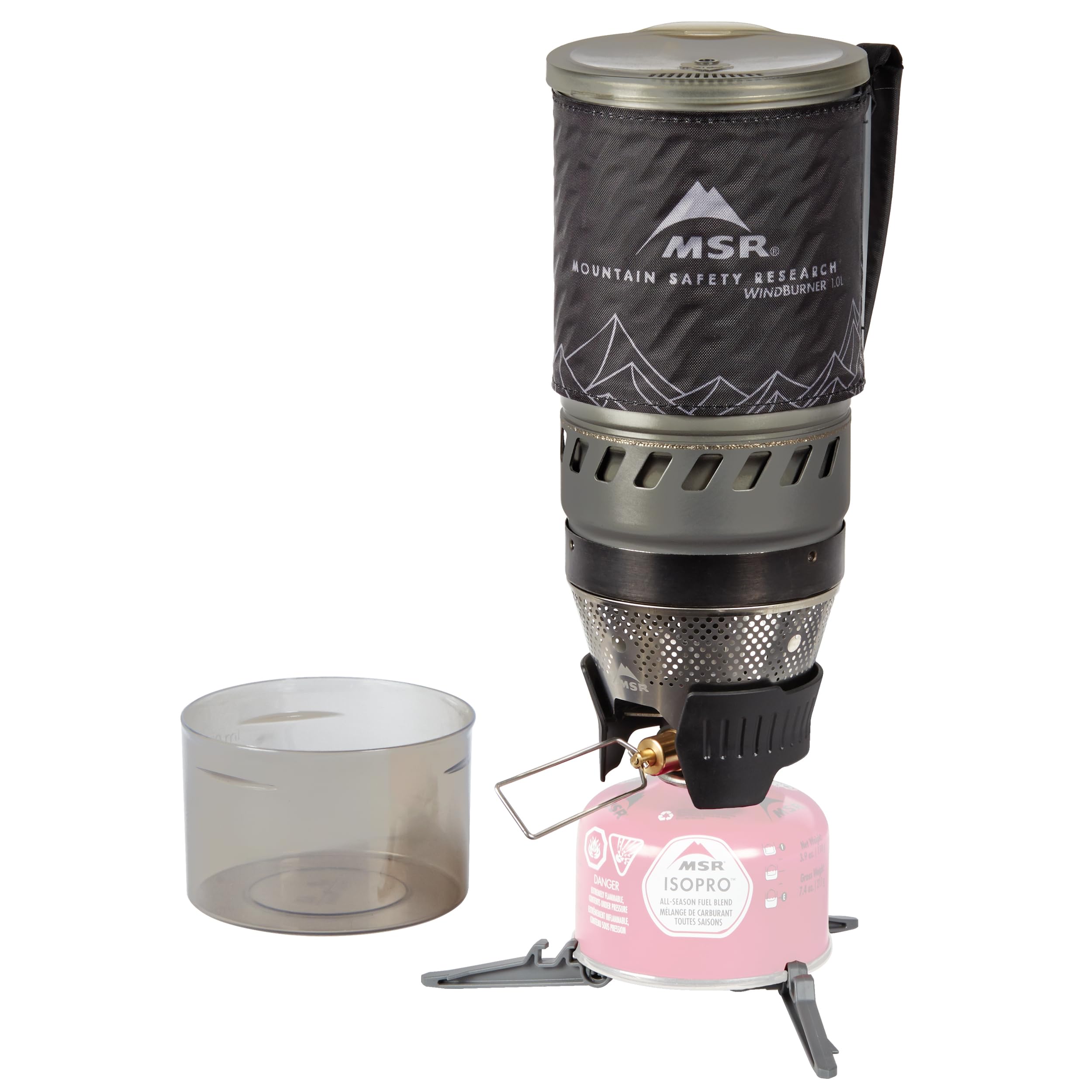
The MSR WindBurner is the ultimate solution for exposed alpine campsites where wind is a constant factor. Its radiant burner design — a fully enclosed flame chamber — makes it nearly impervious to gusts that would extinguish a conventional canister stove. It will boil half a liter of water in about two minutes even in a 7-8 mph wind, while unshielded stoves struggle to maintain a flame.
The 1-liter hard-anodized aluminum pot locks directly onto the burner and canister for a rigid, stable assembly that resists tipping. The system nests the stove, a 4-ounce fuel canister, and an extra 0.5-liter bowl inside the pot for a self-contained package. The pressure regulator ensures consistent output in cold weather, and the overall fuel efficiency often lasts multiple multi-day trips on a single canister.
The WindBurner does not include a piezo igniter — you need a spark lighter or match. The lid can be difficult to remove after boiling due to steam pressure, and the handle is functional but not as comfortable as others. It is also a specialized boiler; you cannot use standard cookware with it. For windy ridgeline camps and winter expeditions, this system pays for itself in frustration saved.
Why it’s great
- Windproof radiant burner works in gale-force conditions
- Boils 0.5L in ~2 min even in strong wind
Good to know
- No piezo igniter — requires separate lighter or matches
- Proprietary cookware system, not compatible with standard pots
7. Fire-Maple Blade 2 Portable Propane Camping and Backpacking Stove

The Fire-Maple Blade 2 is an ultralight remote-canister stove at just 4.76 ounces, built almost entirely from titanium. Its remote-canister design with a flexible hose lets you invert the fuel canister for better cold-weather performance — a feature that standalone burner stoves cannot match. The pre-heat tube runs the fuel past the burner before combustion, preventing flame sputtering when the canister gets cold.
The folding titanium legs and pot supports handle pots up to 10 inches in diameter, and the burner outputs 9,500 BTU. With a heat-exchanger pot like the Fire-Maple G3, users report boiling 500 mL of water in about 76 seconds — blistering speed for a remote stove. It folds flat and fits inside a 1-liter pot alongside the canister, making it a favorite among gram counters who cook in cold conditions.
The Blade 2 lacks a pressure regulator, so flame output drops as the canister pressure falls, and there is no piezo igniter. The simmer control is also coarse; this stove is built for full-blast boiling, not delicate cooking. For ultralight winter hikers and mountaineers who need a remote-canister stove that works when inverted, the Blade 2 is the lightest capable option on the market.
Why it’s great
- Remote-canister design allows canister inversion for cold weather
- Titanium construction is ultralight at 4.76 oz
Good to know
- No pressure regulator — flame output drops with canister pressure
- Not designed for simmering; best for high-heat boiling
FAQ
How long does a 100-gram fuel canister last on a backpacking stove?
Can I use a backpacking stove inside my tent?
What is the difference between a remote-canister stove and a canister-top stove?
Final Thoughts: The Verdict
For most users, the best backpacking stove winner is the MSR PocketRocket Deluxe because it combines pressure-regulated performance, ultralight weight, and reliable ignition into a package that handles everything from alpine trips to weekend car camping. If you need genuine simmer control for cooking real meals on the trail, grab the Jetboil MightyMo. And for exposed ridgeline camps where the wind never stops, nothing beats the windproof design of the MSR WindBurner.