
A 10-inch wet tile saw blade that chips your porcelain edge ruins an entire day of tiling. The wrong rim profile—continuous versus turbo versus segmented—dictates whether you get a polished, chip-free edge or a ragged line that needs hours of sanding. This category is defined by a single battle: cutting speed versus finish quality, and the blade you choose locks you into one side of that trade-off.
I’m Min — the co-founder and writer behind Gadgets Feed. I’ve spent hundreds of hours analyzing diamond-bond matrices, rim geometries, and kerf thicknesses across dozens of blade models to understand exactly which specs translate into straight, clean cuts on hard porcelain and dense marble.
A quality blade must balance segment height with arbor compatibility to maintain rigidity under a wet saw’s constant water flow. This guide cuts through the marketing noise to deliver the definitive verdict on the 10 inch wet tile saw blade that actually performs.
How To Choose The Best 10 Inch Wet Tile Saw Blade
The wrong blade choice is the single largest source of chip-out and wasted material in tiling. Three technical parameters separate a blade that glides through rectified porcelain from one that chatters and burns the edge.
Continuous vs Turbo vs Segmented Rim
Continuous rim blades have a smooth, unbroken diamond edge that produces the cleanest, most chip-free finish on glazed porcelain, marble, and granite. The trade-off is slower cut speed and heat buildup — continuous rims need constant water flow to stay cool. Turbo rims add serrated notches to the continuous edge, increasing cutting speed while still maintaining a relatively clean finish, making them ideal for wet saws cutting large-format tile. Segmented rims have gaps between diamond segments; they cut aggressively fast and stay cool in dry use, but they chip edges badly and are wrong for finished tile. For a wet saw cutting premium tile, continuous or turbo is the only choice.
Kerf Thickness and Blade Wander
Kerf is the thickness of the cut itself — determined by the blade’s steel core and diamond rim. Thinner kerf blades, around 0.060 inches, remove less material, cut faster, and produce less dust and slurry. But thin blades flex more under side load, causing wander on long rip cuts through thick porcelain. Thicker cores, around 0.090 to 0.100 inches, resist deflection and track straight on 24-inch tiles, critical for achieving square edges on large-format installations. The trade-off is slower cutting and more wasted material. Choose kerf based on your most common tile size: thin for mosaics and small-format tile, thicker for 12×24 and larger.
Segment Height and Diamond Bond Hardness
Segment height (the depth of the diamond-impregnated rim above the steel core) determines how much usable life the blade has before it becomes a plain steel disc. A 10mm segment height is standard; taller segments last longer but may crack under lateral stress. Bond hardness matters more: a soft bond releases worn diamond grit quickly to expose fresh sharp crystals, ideal for hard materials like porcelain. A hard bond holds diamond grit longer, suited for soft materials like marble or limestone. If your primary material is porcelain (industry standard for wet tile saw blade use), look for a relatively soft bond matrix. If you cut mixed materials, a medium-bond turbo blade offers the best compromise.
Quick Comparison
On smaller screens, swipe sideways to see the full table.
| Model | Category | Best For | Key Spec | Amazon |
|---|---|---|---|---|
| MK Diamond MK-225 Hot Dog | Continuous Rim | Premium chip-free porcelain cuts | 0.050-inch ultra-thin kerf | Amazon |
| DEWALT DW4764 | Continuous Rim | Long-lasting porcelain performance | 0.060-inch kerf, 18-segment | Amazon |
| FACHLICH 2-Piece Set | Turbo Mesh Rim | Value two-pack for mixed materials | 10mm segment height, X-teeth | Amazon |
| Diablo DMADC1000 | Continuous Turbo Rim | Smooth finish on granite and marble | 1.6mm kerf, 6150 max RPM | Amazon |
| Delta Diamond Boss Hog Turbo | Turbo Rim | Versatile wet/dry masonry cutting | 0.100-inch thick core | Amazon |
| OSTEK Super Thin | Continuous Rim | Budget-friendly ceramic cutting | 24 teeth, 10mm rim height | Amazon |
| ORIXTREME 5-Piece Set | Segmented Rim | High-volume concrete and brick cutting | 0.090-inch thick, 10mm segment | Amazon |
In‑Depth Reviews
1. MK Diamond 158436, MK-225 Hot Dog

The MK Diamond MK-225 Hot Dog is the gold standard for wet tile cutting because its continuous rim design, combined with an ultra-thin 0.050-inch kerf, produces the cleanest chip-free edges on rectified porcelain and vitreous tile. Experienced tile setters consistently report cutting 25 percent faster than a new DEWALT blade while maintaining edge quality, and the blade can slice 1/8-inch slivers off hard quarry tile without breaking — a stress test that separates premium diamond bonds from mid-range alternatives. The 5/8-inch arbor fits most stationary wet saws, and the limited lifetime warranty on the rim-to-core bond provides confidence for daily professional use.
The thin kerf does introduce slight wander on tiles larger than 12 inches during long rip cuts, but plunge-cutting the entry point minimizes this. The blade’s bond matrix is optimized for porcelain and ceramic, meaning it will cut marble and granite as well, though you lose some speed on softer stone. Users note that the blade requires ample water flow — a mist system won’t cool it sufficiently — but on a proper wet saw with a flooded tray, it runs cool and maintains its edge over hundreds of linear feet.
Some reviews indicate that the blade’s cutting quality declines noticeably after roughly one-third of its usable life, and the price has risen over time, making it less of a pure value proposition than it once was. Still, for a professional who needs reliability and finish quality on high-end tile jobs, the MK-225 is the benchmark that other blades are measured against.
Why it’s great
- Ultra-thin 0.050-inch kerf delivers the finest chip-free finish on porcelain
- Fastest cut speed among premium continuous rim blades
- Lifetime warranty against rim-to-core bond failure
Good to know
- Thin kerf wanders on rip cuts over 12 inches without plunge entry
- Cutting quality declines after about one-third of blade life
- Requires flooded water tray — mist systems insufficient for cooling
2. DEWALT Diamond Blade for Tile, 10-Inch (DW4764)

The DEWALT DW4764 is the workhorse of the professional tile installation world, and for good reason: its 18-segment continuous rim, running at a 0.060-inch kerf, delivers durability that regularly exceeds 700 square feet of ceramic or porcelain before needing replacement. The blade’s bond matrix is slightly harder than the MK Diamond’s, which means it holds its diamond grit longer on porcelain but requires periodic dressing with a silicon carbide grinding wheel or a scrap of brick to restore cutting speed once the diamonds glaze over. Users report minimal chipping on rectified porcelain, and the blade tracks straight with no wobble because of its reinforced steel core.
Where the DW4764 truly stands apart is in its consistency: it cuts 24×24-inch porcelain planks without runoff, and the edge quality improves after the first few cuts as the bond wears to expose fresh diamonds. The blade runs cool under constant water flow and flexes only slightly on the most delicate precision cuts. It is also one of the most versatile blades in the premium tier, handling paving bricks and hard agate stone without delamination.
The main drawback is that the blade clogs more easily than thinner-kerf competition when cutting soft-bodied ceramic tile, and the periodic sharpening requirement adds maintenance time. Several users noted that the blade cuts slower than the MK Diamond Hot Dog on initial use, but its longer overall life offsets the speed difference for large-volume jobs. At its price point, it delivers the best balance of cost per linear foot among premium options.
Why it’s great
- Proven durability exceeding 700 square feet on porcelain
- Straight tracking with zero wobble on large-format tile
- Versatile enough for agate, paving brick, and hard stone
Good to know
- Requires periodic dressing with brick or grinding wheel to maintain speed
- Slower initial cut speed compared to ultra-thin kerf blades
- Clogs more easily on soft ceramic tile
3. Diablo Diamond Continuous Rim Masonry Cut-Off Disc (DMADC1000)
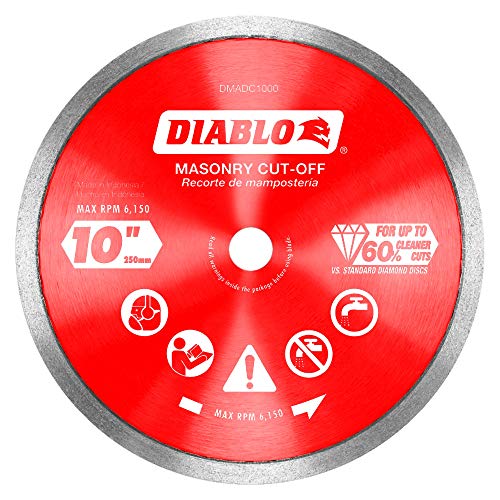
The Diablo DMADC1000 is built with a continuous turbo rim that bridges the gap between pure finish quality and aggressive cutting speed — the laser-welded diamond segments incorporate a slight serration that increases material removal rate while keeping the cut surface smooth enough for granite and marble vanity tops. Its 1.6mm kerf (roughly 0.063 inches) is thin enough for precise work but the hardened disc body resists deflection better than the ultra-thin MK Diamond. Users consistently report achieving up to 60 percent smoother cuts compared to standard segmented blades, with no burn marks even on dense granite slabs.
This blade is optimized for both dry and wet operation, but on a wet saw it excels because the turbo channels move water and slurry through the cut efficiently, preventing the blade from loading up. It supports a maximum safe operating speed of 6,150 RPM, which matches most stationary tile saws. The industrial-grade diamond rim holds up to extended use on porcelain and marble — reviewers note it lasts significantly longer than competitor blades at a similar spec level, though the initial cost is higher than mid-range options.
Some users found that the blade did not last as long as expected on very hard porcelain tile, experiencing accelerated wear after heavy use. The blade is also heavier than some alternatives, which can reduce maneuverability on handheld cut-off tools. For a professional who needs one blade that transitions between tile, stone, and masonry without switching, the Diablo is the strongest multi-material contender in this guide.
Why it’s great
- Continuous turbo rim balances clean finish with fast cutting speed
- 60 percent smoother cuts than standard segmented blades
- Hardened disc body resists deflection on long cuts
Good to know
- Accelerated wear reported on very hard porcelain
- Heavier mass reduces maneuverability on handheld tools
- Premium price does not always translate to longer life on porcelain
4. Delta Diamond Boss Hog Turbo Premium Diamond Blade
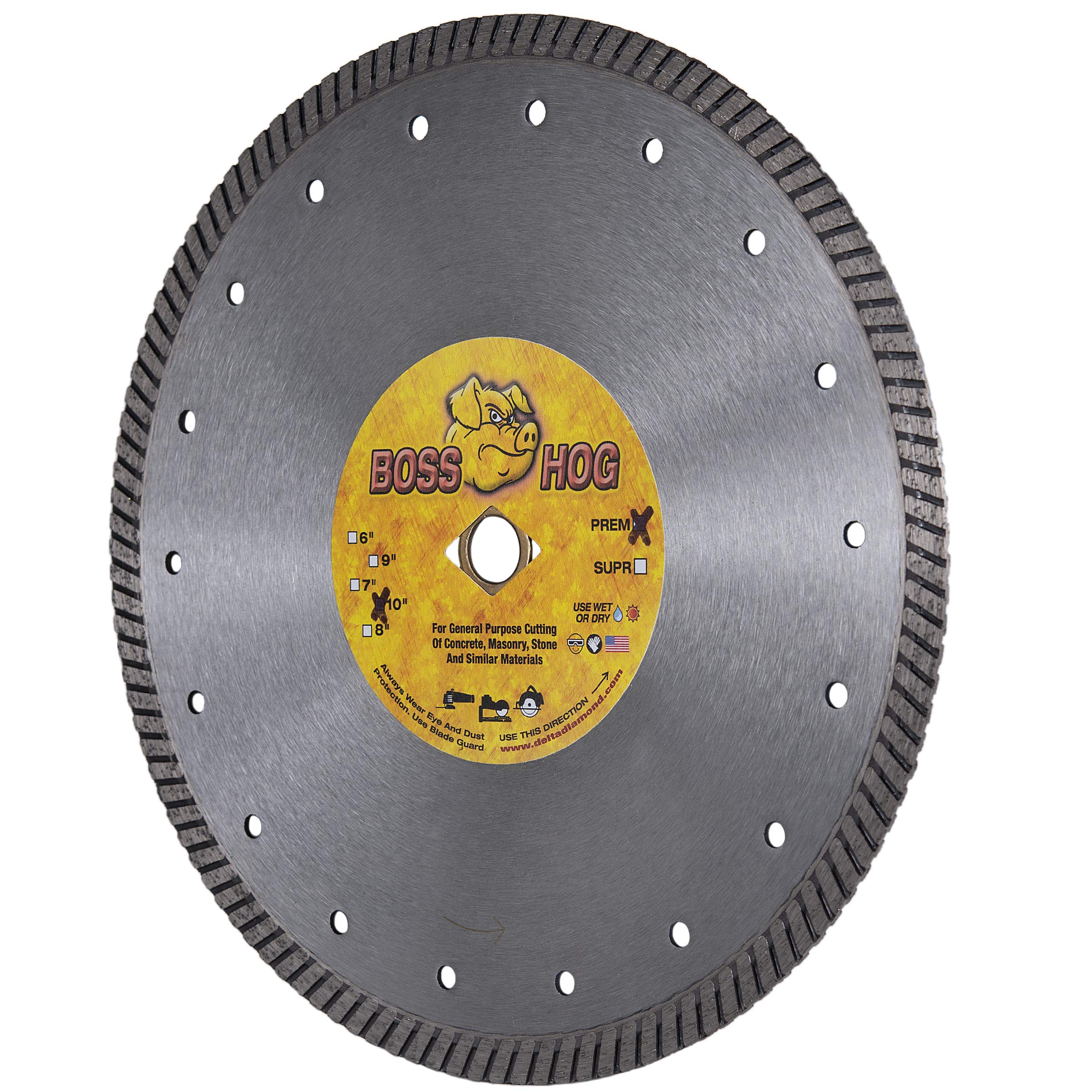
The Delta Diamond Boss Hog Turbo is the segment’s most versatile performer, using a turbo rim design with a thick 0.100-inch steel core that cuts through stone veneer, pavers, retaining-wall blocks, and roofing tile without deflection or heat buildup. Its maximum safe operating speed of 6,115 RPM makes it compatible with both handheld circular saws and stationary masonry saws, and the lifetime warranty — covering warping, cracking, and bond separation with at least 50 percent wear left — is the strongest guarantee in this guide. Users consistently describe cutting 1.5-inch stone veneer dry “like a hot knife through butter,” with the blade remaining cool enough to touch immediately after a cut.
The thick core is the Boss Hog’s defining advantage: it eliminates the lateral wander that plagues thin-kerf blades on long cuts through hard materials. This makes it ideal for large-format pavers and thick brick, where a straight cut line is essential. The turbo rim geometry produces a slightly rougher edge than a pure continuous rim, but the finish is more than acceptable for stone veneer and masonry where the cut face will not be visible. For tile work specifically, the edge quality is good but not as pristine as the MK Diamond or DEWALT.
Some users reported that the blade lost its cutting edge after roughly six hours of continuous use on very hard stone, though it can be easily sharpened in three minutes with a dressing stone. The blade is also heavier than the ultra-thin competition, which may cause fatigue in extended handheld use. For a contractor who cuts mixed masonry and tile on the same job site, the Boss Hog offers the best single-blade solution at a mid-range investment.
Why it’s great
- Thick 0.100-inch core eliminates wander on long masonry cuts
- Lifetime warranty against warping, cracking, and bond failure
- Runs cool enough to touch immediately after dry cutting
Good to know
- Edge finish is slightly rougher than continuous rim blades
- Heavier weight causes fatigue during extended handheld use
- Cutting speed declines after extended use on very hard stone
5. FACHLICH Diamond Porcelain Saw Blade, 2-Piece Set
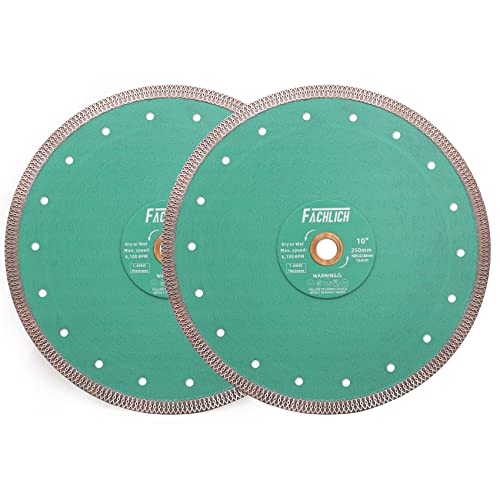
The FACHLICH two-piece set delivers exceptional value for tilers who need a spare blade on hand without buying a second single unit. Each blade uses a turbo mesh rim design with X-shaped teeth that improve cooling and dust extraction, and the 1.8mm segment thickness (roughly 0.071 inches) provides a balance of cutting speed and finish quality. The package includes 5/8-inch and 3/4-inch reducing washers to fit different saw arbors, and the reinforced center core adds rigidity for straight cuts. Users report cutting 45-degree bevels in marble chair rail with minimal chipping, and the blades work effectively on 12×24 inch porcelain tiles without heating up.
The diamond grit is rated at 60/70, which is coarser than the ultra-fine grit on premium single blades, meaning the FACHLICH cuts faster but leaves a slightly less polished edge. This trade-off is acceptable for most tile work where the cut edge will be against a wall or baseboard. The heavy center design improves tracking stability but can cause compatibility issues with some saws — one user noted that the one-piece washer and bolt assembly on certain tile saws provided insufficient clamping force, causing the blade to stall on thick material.
Durability is average for this price tier — one user reported the blade cutting marble well for one hour before noticeable wear, which is consistent with budget-oriented diamond blades. The set is best suited for DIY-ers or small-scale professionals who want two functional blades for the price of one mid-range unit, and who accept that blade longevity will be lower than premium options like the DEWALT or MK Diamond.
Why it’s great
- Two blades for the price of one mid-range unit
- Turbo mesh rim with X-teeth runs cool and cuts fast
- Includes reducing washers for 5/8 and 3/4 inch arbors
Good to know
- Coarser diamond grit leaves less polished edge than premium blades
- Average durability — noticeable wear after one hour on marble
- One-piece washer/bolt can cause clamping issues on some saws
6. OSTEK 10 Inch Super Thin Wet Diamond Porcelain Saw Blade
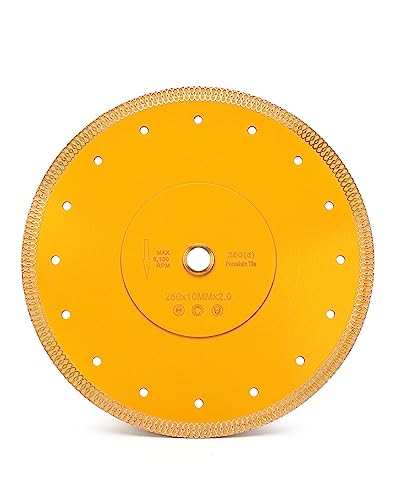
The OSTEK Super Thin blade proves that a budget-friendly 10-inch wet tile saw blade can still deliver clean cuts on glazed ceramic and porcelain tile without breaking the bank. Its 24-tooth continuous rim design uses a 10mm segment height and a super-thin profile that cuts through ceramic tile “like butter” according to multiple verified buyers, with minimal chipping on the glaze surface. The blade accepts both 5/8-inch and 7/8-inch arbors directly, making it compatible with most circular saws, tile saws, and handheld machines without adapter rings.
The blade’s diamond bond matrix is formulated for ceramic, porcelain, granite, and sandstone, but it performs best on softer ceramic and thin-glazed porcelain tiles where the thin kerf can work efficiently. Users with 20-plus years of tiling experience rated this blade highly for its price-to-performance ratio, noting that it cuts odd shapes and corners with precision. The super-thin design does require careful technique to avoid chipping the glaze on the exit side of the cut — a backing board or scoring the glaze first eliminates most chipping issues.
Where the OSTEK blade falls short is on thick, dense porcelain and large-format tiles. Several users noted that at 8,500 RPM, the cut was fast but not clean, and the blade lacked the rigidity to maintain a perfectly straight line on tiles larger than 12 inches. The blade is best viewed as a consumable — it performs well for finite jobs and small projects, but heavy daily use will wear it out quickly. For a homeowner laying a bathroom floor or backsplash, this is the most cost-effective entry point in the guide.
Why it’s great
- Exceptionally affordable for a continuous rim blade
- Cuts thin ceramic and glazed porcelain with minimal chipping
- Dual arbor (5/8 and 7/8 inch) fits most saws natively
Good to know
- Thin profile wanders on tiles larger than 12 inches
- Not built for heavy daily professional use
- Requires careful technique to avoid exit-side glaze chipping
7. ORIXTREME 10 Inch Diamond Saw Blade 5-Piece Set
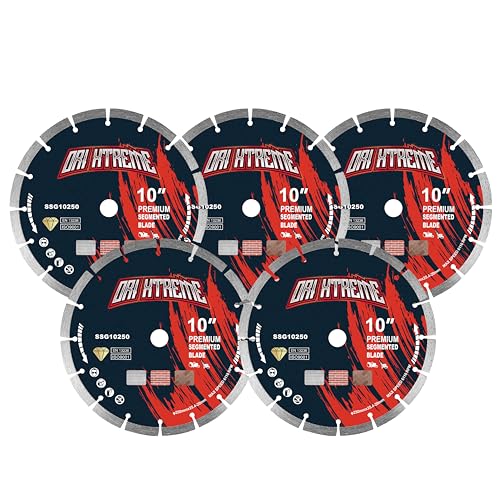
The ORIXTREME 5-piece set is the volume solution for contractors cutting concrete, brick, block, and masonry — not for finished tile. Each blade features a segmented rim design with a 0.090-inch thick core and 10mm segment height, optimized for wet and dry cutting on a wide range of masonry materials. The set includes five 10-inch blades with standard 7/8-inch and 5/8-inch arbors, providing enough blades to cover an entire job without downtime for resharpening. Users report that a single blade handles roughly 80 cuts through 2 5/8-inch brick before dulling noticeably, and the set as a whole offers the lowest cost-per-blade in this guide.
The segmented rim design uses cooling slots that improve airflow and remove slurry, preventing the blade from overheating during continuous use. The diamond bond matrix uses high-grade diamond powder in a premium alloy steel body, and the blades cut cleanly out of the box with minimal chipping on concrete and masonry. For tile specifically, these blades are too aggressive — the segmented rim will chip the glaze on finished tile and should only be used for cutting tile that will be hidden or covered.
The set’s primary weakness is that all five blades share the same general-purpose bond, optimized for concrete rather than hard porcelain or granite. Users who need a dedicated tile blade will find that even the cleanest segmented cut leaves a rough edge compared to a continuous rim blade. The ORIXTREME set is purpose-built for masons and concrete workers running large-volume jobs where blade longevity and cost matter more than surface finish.
Why it’s great
- Five blades provide exceptional cost-per-blade for large masonry jobs
- Segmented rim with cooling slots prevents overheating in continuous use
- Cuts clean out of the box on concrete and brick
Good to know
- Segmented rim chips glazed tile — not for finished tile work
- Bond matrix optimized for concrete, not hard porcelain or granite
- Each blade lasts roughly 80 cuts through thick brick before dulling
FAQ
Can I use a dry-cut diamond blade on a wet tile saw?
How do I know if my wet tile saw blade needs dressing?
What arbor size do most 10-inch wet tile saw blades use?
Final Thoughts: The Verdict
For most users, the 10 inch wet tile saw blade winner is the MK Diamond MK-225 Hot Dog because its ultra-thin 0.050-inch continuous rim delivers the highest-quality chip-free edge on porcelain tile, the material that accounts for the majority of professional wet saw work. If you want a blade that lasts longer with less maintenance, grab the DEWALT DW4764 for its proven 700-plus square foot lifespan and straight tracking on large-format tile. And for a versatile masonry blade that transitions from brick to porcelain pavers without switching, nothing beats the Delta Diamond Boss Hog Turbo with its lifetime warranty and thick 0.100-inch core.