
That jarring electrical thump every time your air conditioner kicks on isn’t just annoying — it’s a signal that your compressor is being slammed with a massive inrush current that strains your wiring, dims your lights, and can trip your breaker or overload your generator. A dedicated soft starter tackles this head-on by gently ramping up the compressor motor, dramatically reducing the starting surge and protecting your entire HVAC system from premature wear.
I’m Min — the co-founder and writer behind Gadgets Feed. I’ve spent countless hours dissecting the technical specifications and real-world performance data across dozens of soft starter models, from RV units to whole-home systems, to separate the genuine performers from the underpowered contenders.
This guide cuts through the noise to help you find the best aircon soft starter for your specific setup, whether you need to run your AC on a small generator or simply want to extend the life of your compressor.
How To Choose The Best Aircon Soft Starter
Selecting the right soft starter comes down to matching its electrical ratings to your specific air conditioner and power source. You cannot just pick the cheapest option — an underrated unit will fail to handle the locked rotor amperage of a larger compressor, while an overbuilt model may be overkill for a tiny RV AC. Focus on four core parameters: amperage range, voltage compatibility, physical size, and special features like reverse motor protection or Bluetooth monitoring.
Match the Amperage Range to Your Compressor
Every air conditioner has a nameplate listing its LRA (Locked Rotor Amperage) — the peak current it draws at startup. A soft starter is rated for a specific current window, typically 16–32 amps for residential units or 30–40 amps for larger systems. Choose a model whose upper limit comfortably exceeds your AC’s LRA. Most 3-to-5-ton residential units fall within the 16–32A sweet spot; RV units up to 15,000 BTUs generally need a model capable of handling 40+ amps at startup before the soft start engages.
Check Voltage Compatibility — 120V vs 240V
Residential central air conditioners in North America typically run on 240V, while RV air conditioners operate on 120V. Some premium soft starters like the TURBRO S15 Plus accept a broad 100-240V range, making them flexible across different vehicle electrical standards. Always verify that the voltage rating printed on the soft starter matches your AC’s supply line — mismatched voltage can cause immediate failure or dangerous arcing.
Prioritize Reverse Motor Protection for Generator Use
When power switches between utility and generator sources, the phase relationship can momentarily reverse, causing the compressor to spin backward. This can damage the scroll or reciprocating mechanism. Only a few models — notably the AIRGO and the SureStart by Eltwin Hyper — include proprietary Reverse Motor Protection that prevents this damage, making them essential for any setup relying on backup or portable generators.
Quick Comparison
On smaller screens, swipe sideways to see the full table.
| Model | Category | Best For | Key Spec | Amazon |
|---|---|---|---|---|
| MICRO-AIR EasyStart FLEX 398 | Premium | Best Overall Home AC | 75% LRA reduction / Bluetooth | Amazon |
| SoftStart Home | Premium | Large 6-Ton Systems | 72,000 BTU / 70% reduction | Amazon |
| MICRO-AIR EasyStart Breeze 399 | Premium | Premium RV Pick | 30A rating / compact design | Amazon |
| ICM Soft Start Kit ICM870-32A | Premium | Weatherproof Mounting | IP65 / built-in capacitor | Amazon |
| SureStart 16-32A | Mid-Range | Smallest Enclosure | Reverse Motor Protection | Amazon |
| Hyper Engineering SS1B16-32SN | Mid-Range | Durable 4-7 Ton Units | 70% LRA reduction / self-learning | Amazon |
| AIRGO Soft Starter | Mid-Range | Heat Pump Compatibility | Reverse Motor Protection / 32A | Amazon |
| Polar Start | Mid-Range | Value RV Upgrade | Reduces 32A to 16A startup | Amazon |
| TURBRO S15 Plus | Mid-Range | Best Budget RV Starter | 100-240V / 60-75% reduction | Amazon |
In‑Depth Reviews
1. MICRO-AIR EasyStart FLEX 398
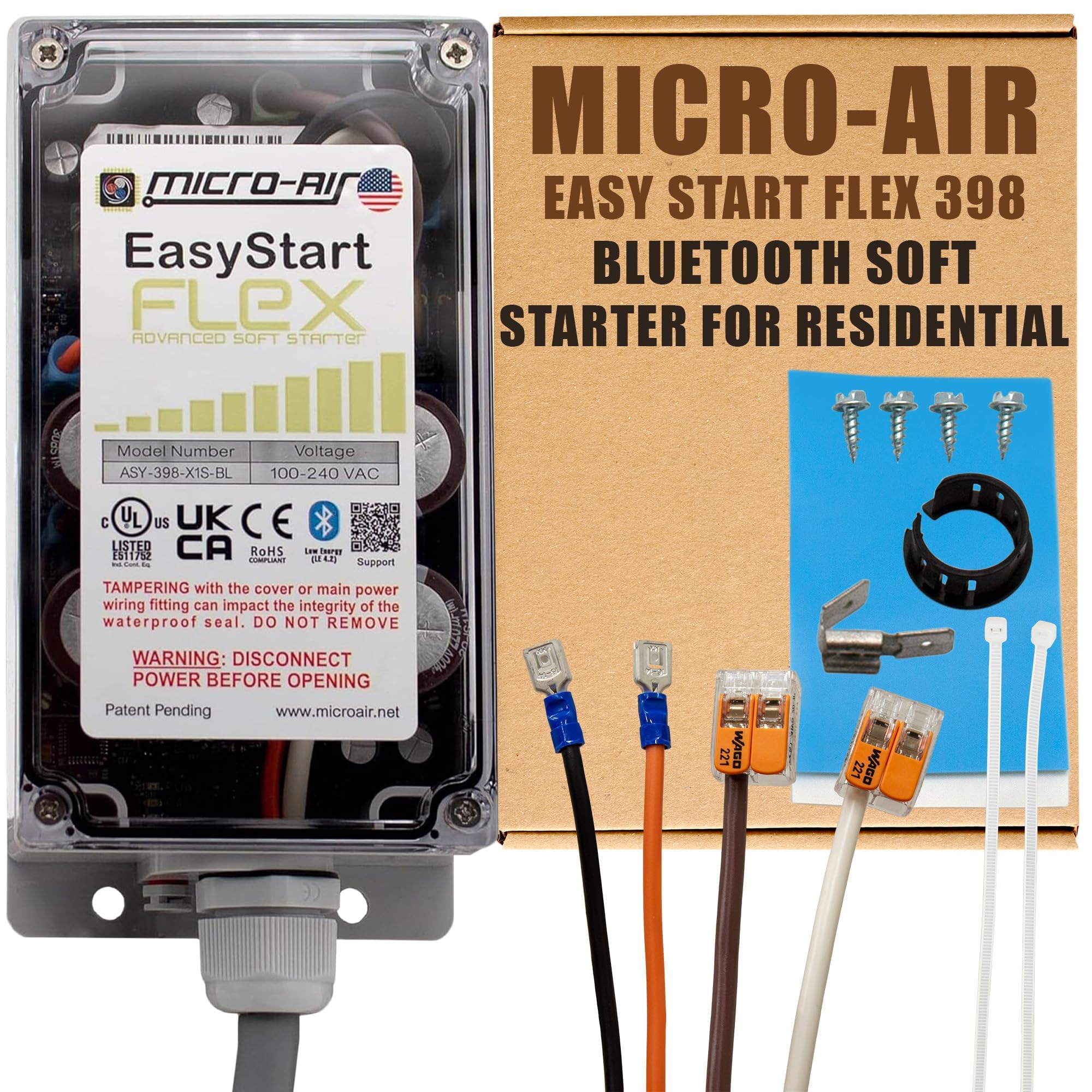
The EasyStart FLEX 398 from MICRO-AIR represents the current zenith of soft starter technology, offering a Bluetooth-enabled interface that lets you monitor inrush current reduction, total starts, and fault codes directly from your phone. In real-world testing on a 4-ton Carrier unit, it slashed starting amperage from 108A down to just 27.7A — a 75% reduction that turned a generator-killing startup into a whisper-smooth ramp. The unit supports compressors up to 6 tons and works with two-stage compressors and heat pumps, making it the most versatile option for residential setups.
Installation took under 15 minutes for most DIYers, with the included kit providing crimp connectors, zip ties, and an adhesive backing for mounting. The enclosure is 50% smaller than previous EasyStart generations, fitting easily into tight control cabinets. Users consistently report that the unit eliminated light flicker and allowed their AC to run on portable generators that previously tripped breakers instantly. The short-cycle delay timer also prevents the compressor from restarting too quickly, which protects against liquid slugging.
The only real trade-off is the premium investment, but the build quality and US-made components justify it for those who want the best diagnostic capability and the highest LRA reduction percentage on the market. Customer service is responsive, though some users reported slower turnaround during peak season. For anyone running a whole-home generator or solar system, the Bluetooth feedback alone is worth the step up.
Why it’s great
- 75% LRA reduction (108A to 27.7A verified)
- Bluetooth diagnostics show starts, faults, and real-time current
- 50% smaller enclosure for tight spaces
Good to know
- Premium pricing above many competitors
- Customer support can be slow during peak HVAC season
2. SoftStart Home
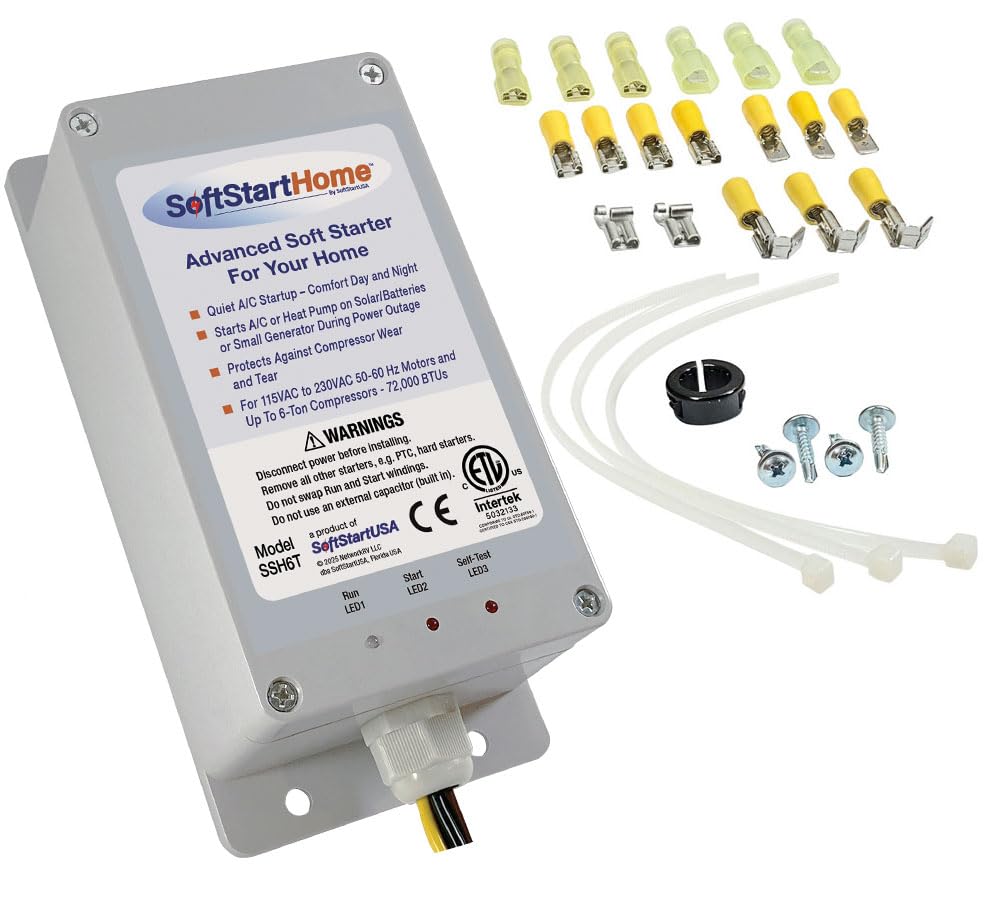
SoftStart Home is built specifically for larger systems, handling compressors up to 6 tons (72,000 BTUs) without breaking a sweat. On a 5-ton heat pump, it reduced the starting inrush from 25,000W to just 7,500W, enabling operation on a 15,000W generator that previously couldn’t handle the surge. The unit works across 110–240V power and includes a comprehensive install kit with crimp connectors, zip ties, adhesive backing, and detailed step-by-step instructions that make the advertised 15-minute install achievable even for beginners.
What sets this model apart is the personalized tech support — users frequently mention Danny by name, noting that he provided custom wiring schematics over the phone for specific HVAC brands. The build quality is excellent, with a robust enclosure that feels significantly more durable than some budget competitors. The unit also eliminates the loud mechanical “thump” that accompanies compressor startup, making the house noticeably quieter when the AC cycles on.
On the downside, a small number of users received units that appeared to be returns (brown box, pre-attached connectors), and the generous 4-minute built-in delay can feel long on hot days when you want immediate cooling. Despite these minor quirks, the performance and support make it a top-tier choice for homeowners with large central air systems or those running on solar or battery backup.
Why it’s great
- Supports up to 6-ton (72,000 BTU) compressors
- Personalized tech support with custom wiring diagrams
- Reduces 25,000W inrush to 7,500W on 5-ton units
Good to know
- 4-minute built-in delay may feel long in summer
- Occasional packaging inconsistencies reported
3. MICRO-AIR EasyStart Breeze 399
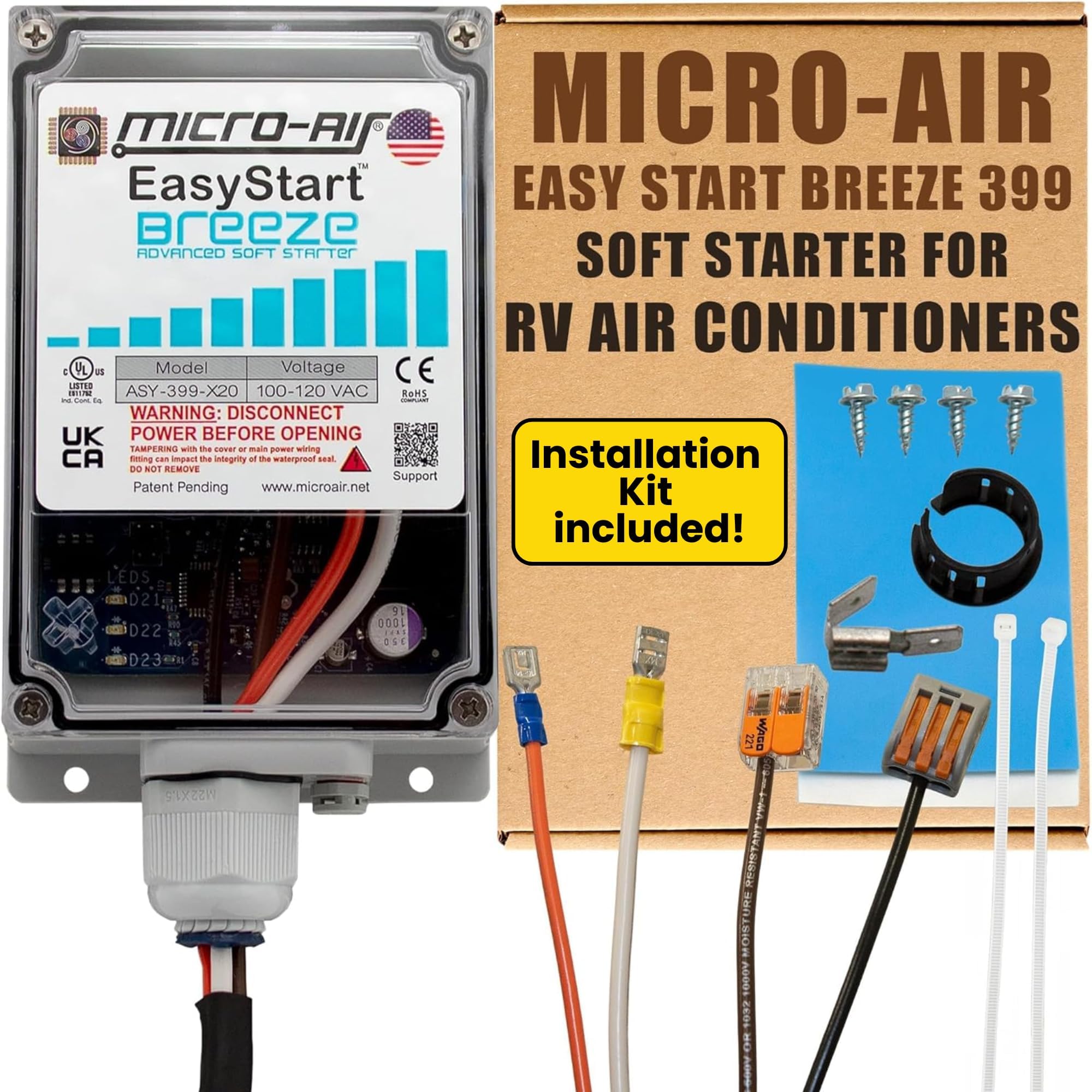
The EasyStart Breeze 399 is MICRO-AIR’s purpose-built solution for RV air conditioners, designed specifically for 13k to 15k BTU rooftop units. It’s rated at 30 amps continuous and works with a 2200-watt inverter generator, making it possible to run your RV AC off a Honda EU2200i or similar small generator that would otherwise trip its internal breaker. The compact form factor fits neatly inside the AC shroud, and the installation kit includes everything needed for a clean DIY job.
Real-world performance is stellar — one user on a 12-year-old Dometic AC saw the unit diagnose a failing run capacitor (17A draw vs normal 12-13A), which actually helped them identify a separate issue. After replacing the capacitor, the system ran at 14A as expected. The Breeze 399 also significantly reduces startup noise, which is a major quality-of-life improvement in a small RV where every sound is amplified. Customer service is exceptional, with some users receiving FaceTime support for installation troubleshooting.
The main limitation is that this is strictly an RV-focused unit — it won’t work on 240V residential systems. Additionally, while it handles 30A continuous, the maximum start surge capability is lower than some larger residential models, so it’s not suited for oversized RV ACs above 15,000 BTU. For anyone living or traveling in an RV who wants to boondock without a massive generator, this is the gold standard.
Why it’s great
- Works with 2200-watt inverter generators
- FaceTime installation support available
- Quieter compressor startup in RVs
Good to know
- RV-specific — not for 240V residential systems
- Maximum surge limited to 15,000 BTU units
4. ICM Soft Start Kit ICM870-32A
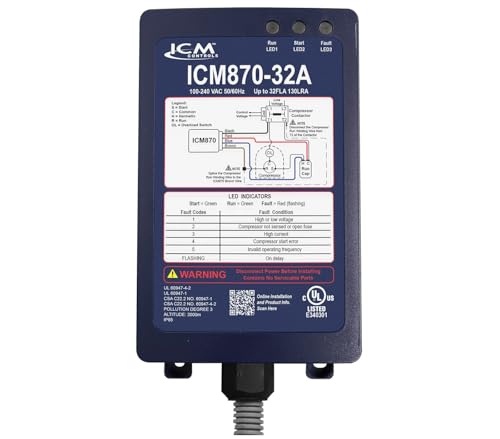
The ICM870-32A stands apart from nearly every other soft starter on the market thanks to its IP65 waterproof rating — an ultrasonic-sealed enclosure that resists moisture, dirt, and tampering. This makes it uniquely suitable for outdoor mounting or harsh environments where other units would need to be sheltered. It also integrates a built-in start capacitor and a dynamic start delay, creating a truly all-in-one solution that eliminates the need for separate hard-start components.
On a 4-ton solar-powered AC system, the ICM870 eliminated inverter shutdowns that previously occurred every time the compressor kicked on. The self-learning algorithm adapts to the specific motor characteristics over the first few start cycles, optimizing the ramp profile. Users report startup wattage dropping from over 10kW to around 4kW, with only a slight light blink instead of a near blackout. The LED fault indicators simplify troubleshooting, flashing specific codes for over/under voltage and overcurrent conditions.
The main drawback is the 4-minute built-in delay, which some users find excessively long for summer cooling cycles — combined with the AC’s own 5-minute delay, the total wait can reach nearly 10 minutes. A small number of units arrived with fault codes out of the box, and ICM’s support was reportedly unresponsive in those cases. Still, for anyone needing a rugged, weather-resistant soft starter for an outdoor compressor or marine application, this is the clear choice.
Why it’s great
- IP65 waterproof enclosure for outdoor installation
- Built-in start capacitor and self-learning algorithm
- Over/under voltage and overcurrent protection
Good to know
- 4-minute delay combined with AC delay totals ~10 minutes
- Some units reported DOA with poor manufacturer support
5. SureStart 16-32A (Eltwin Hyper)

The SureStart by Eltwin Hyper (model SS1B16-32SN) is the smallest soft starter on the market at just 1.96 inches wide, 2.94 inches high, and 5.3 inches deep, making it ideal for installations where space inside the electrical panel is at a premium. Despite its compact size, it packs Reverse Motor Protection — a feature usually reserved for more expensive units — which prevents compressor damage when switching between utility and generator power. On a 5-ton Trane AC, it reduced inrush from 132.5A to 70.9A (a 46.5% reduction), completely eliminating light dimming and generator RPM sag.
Installation is straightforward for anyone comfortable with basic electrical work, though the wiring can be tricky on Trane units that use two separate run capacitors instead of the standard Herm/Common configuration. The unit comes pre-wired with color-coded leads, and the included instruction manual covers most common scenarios. Users consistently praise the tech support line, which provides fast, helpful guidance for non-standard wiring situations. The unit also eliminates the loud compressor “bang” at startup, a detail that makes a real difference in perceived comfort.
The biggest concern is the warranty — only one year, which feels short for a durable good designed to last through thousands of start cycles. Some users estimate the unit’s lifespan at around six years of normal use, which is reasonable but not industry-leading. Additionally, it doesn’t include Bluetooth diagnostics or app connectivity, so you won’t have real-time data on start current or fault histories. For someone who values a tiny form factor and proven reliability without needing smartphone integration, this is a solid mid-range choice.
Why it’s great
- Smallest enclosure on the market (1.96″ wide)
- Reverse Motor Protection prevents phase-reversal damage
- Eliminates compressor startup bang and light flicker
Good to know
- Only 1-year warranty limits long-term confidence
- No Bluetooth or app-based diagnostics
6. Hyper Engineering SS1B16-32SN

Hyper Engineering’s SS1B16-32SN is purpose-built for large residential HVAC units in the 5-to-7-ton range, making it the go-to choice for homeowners with big central air systems who need to keep their AC running during hurricanes or power outages. The unit reduces LRA by up to 70%, with verified real-world results showing a drop from 128A to 67.5A on a 4-ton system and from 100A down to 30.5A on a Lennox. The self-learning algorithm automatically optimizes the start profile over the first few cycles, and the delay function limits the number of starts per hour to protect the compressor.
What users appreciate most is how dramatically the unit quiets compressor startup — one user described it as “only a contactor click” with no mechanical groan or shudder. The installation is straightforward for anyone who can read an AC schematic, and the supplied wiring harness covers most common configurations. The unit has proven reliable over extended use, with one reviewer reporting nearly four years of service without any degradation in performance. It works exceptionally well with portable generators, allowing computers and other sensitive electronics to stay online without voltage dips.
The main consideration is that this unit requires a split-system installation — it’s not designed for packed or window units. Some users also noted that the initial wiring diagram could be confusing, and a few needed to supply their own additional wire terminals for a perfect fit. For those with large central AC units who want a proven, durable solution without smartphone extras, this is the mid-range sweet spot.
Why it’s great
- Rated for 5-7 ton HVAC units with 70% LRA reduction
- Self-learning algorithm optimizes start profile
- Nearly silent compressor startup after installation
Good to know
- Wiring diagram may be confusing for beginners
- Not suitable for window or packaged terminal units
7. AIRGO Soft Starter

The AIRGO soft starter is one of the few models explicitly designed to work with heat pumps in both summer cooling and winter heating modes with no manual adjustment required. This is a critical feature because reversing the refrigerant flow changes the electrical load characteristics — many soft starters struggle with this, requiring separate settings or causing fault codes. The AIRGO handles it seamlessly, and its proprietary Reverse Motor Protection prevents compressor damage when switching between generator and utility power, a common failure mode in off-grid setups.
On a 5-ton Goodman condenser, the AIRGO completely eliminated the compressor start-up “thump” that was rattling the house, reducing inrush from 158A to just 57A (a 63.8% reduction). Installation was straightforward thanks to pre-crimped wires and clear color coding, though some users found the included instructions confusing — the unit has five wires but only four connections, with the brown “Run Capacitor” and red “Active” wires internally connected. The support team, particularly a representative named Bob, receives consistent praise for walking users through the wiring over the phone.
The unit is physically larger than the SureStart and doesn’t offer Bluetooth connectivity, but it’s priced competitively against its feature set. One potential concern involves the crankcase heater current path — some users flagged that the AIRGO might create an unintended current loop, so verification with a multimeter is recommended. For anyone with a heat pump who needs a soft starter that works year-round without seasonal adjustments, this is the best fit in its class.
Why it’s great
- Works in both cooling and heating modes without adjustment
- Reverse Motor Protection for generator switching safety
- Excellent customer support (Bob) with phone guidance
Good to know
- Wiring instructions can be confusing (5 wires, 4 connections)
- Potential crankcase heater current path needs verification
8. Polar Start RV Soft Start Kit
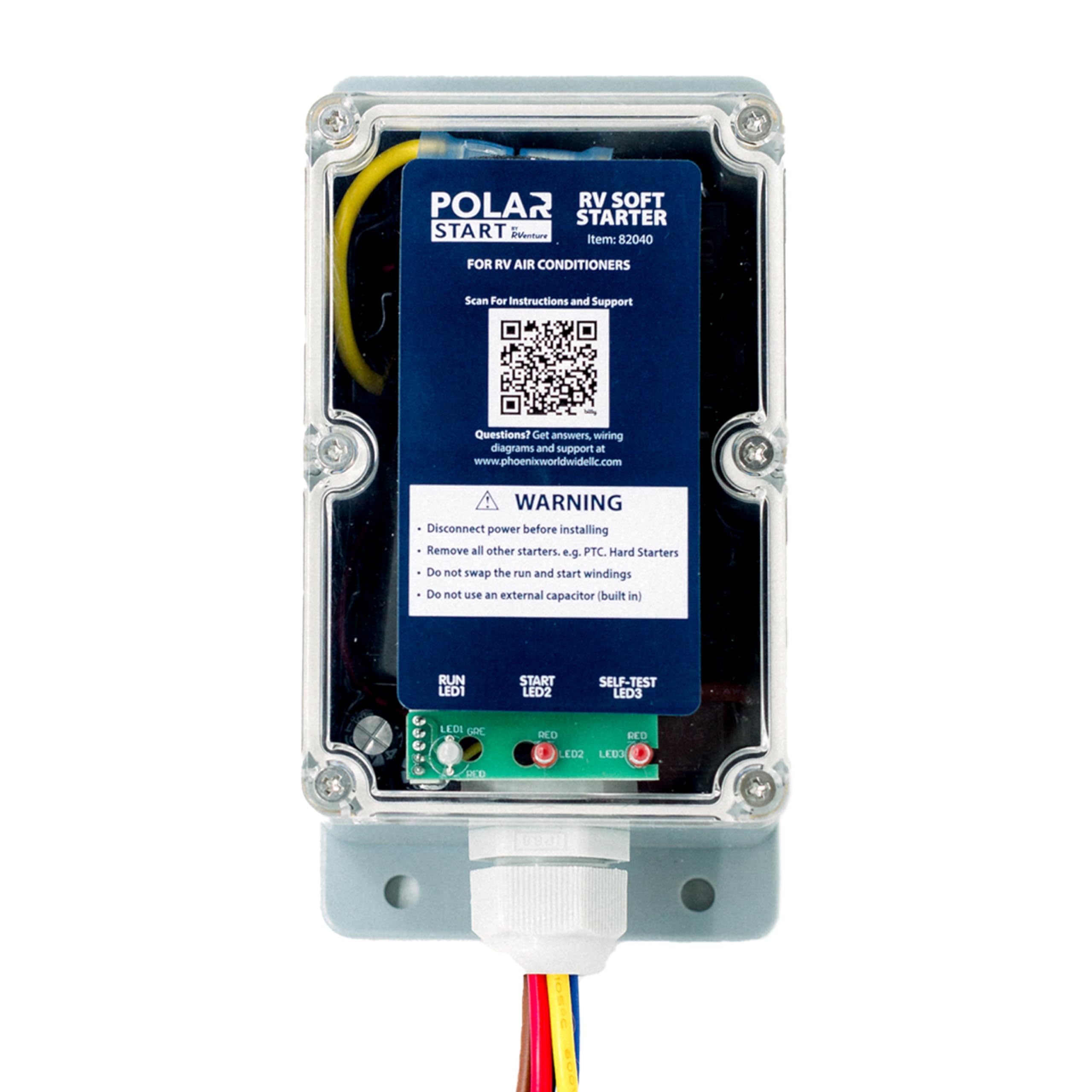
Polar Start fills the gap for RV owners who want a soft starter without paying a premium, delivering reliable performance at a compelling price point. The kit includes the soft starter module, a generous assortment of wire connectors, zip ties, and installation screws — everything needed for a clean install. The unit provides up to 30 amps of current to run two air conditioners simultaneously on a 30A hookup, and it includes installation guides covering over 70 different RV AC models from Dometic, Coleman, Furrion, Carrier, and LG, among others.
Real-world results are impressive for the price bracket. One user reported reducing AC startup current from 32A down to just 16A on their F-150 Powerboost’s 2.4kW generator, allowing the air conditioner to run without tripping the generator’s breaker. Another successfully powered a 13.5k BTU RV AC from a Honda EU2000i inverter generator that previously couldn’t handle the surge. The installation is straightforward and takes about an hour for most DIYers, though users with Furrion units noted the wiring differs slightly (no blue wire to chain) compared to the generic instructions.
The reliability record is mixed — while most users report perfect operation, a small number experienced failures after the first use. The build quality feels adequate but not overbuilt, reflecting the value-oriented positioning. For budget-conscious RVers who need a functional soft starter and don’t require premium features like Bluetooth or reverse motor protection, the Polar Start delivers where it counts: letting you cool your rig off-grid without a massive generator.
Why it’s great
- Reduces 32A startup to 16A for generator compatibility
- Instructions cover over 70 RV AC models
- Complete kit with connectors, zip ties, and screws
Good to know
- Some units failed after first use
- Furrion models require slightly different wiring
9. TURBRO S15 Plus

The TURBRO S15 Plus is the most affordable entry on this list, but it punches well above its price class with a broad 100–240V/60Hz operating range that sets it apart from most 115V-only RV soft starters. This voltage flexibility makes it suitable for AC units in RVs, travel trailers, camper vans, and even marine applications where electrical standards vary. It reduces starting power draw by 60–75%, handling up to 15,000 BTU units and allowing two ACs to run on a single 30A hookup when equipped with two soft starters.
The build quality includes a waterproof outer shell and epoxy-sealed PCBA circuit board, giving it genuine weather resistance that many budget units lack. The three indicator lights — TEST, START, and RUN — provide real-time status monitoring, making troubleshooting straightforward without needing a multimeter. Installation involves cutting the compressor’s R, S, and C wires and connecting them to the soft starter following the wiring diagram; users report 20-minute installs after watching a quick YouTube video. The included gasket and machine screws suggest attention to mounting detail that’s rare at this price point.
The main limitation is that it’s designed specifically for non-inverter RV ACs requiring over 40A startup current — it won’t work with inverter-type units or residential split systems. Some users expressed concern about long-term durability since it’s a newer model, but initial reviews are overwhelmingly positive, with five-star ratings across verified purchases. For RV owners on a tighter budget who still want a genuine soft starter with ETL safety certification and broad voltage compatibility, the S15 Plus is the smartest buy in its tier.
Why it’s great
- 100-240V wide voltage range — rare at this price
- Waterproof outer shell and epoxy-sealed PCBA
- 60-75% start power reduction for RV ACs
Good to know
- Only compatible with non-inverter RV ACs
- Long-term durability unproven due to new release
FAQ
Can a soft starter replace a hard start capacitor kit?
Will a soft starter void my AC manufacturer’s warranty?
How do I know if my RV AC needs a soft starter for generator use?
Can I install a soft starter on a window air conditioner?
Final Thoughts: The Verdict
For most users, the best aircon soft starter winner is the MICRO-AIR EasyStart FLEX 398 because it combines the highest verified LRA reduction (75%) with Bluetooth diagnostics that let you tune and monitor performance from your phone. If you need to handle large 6-ton residential systems, grab the SoftStart Home. And for RV owners who want the best generator compatibility without breaking the bank, nothing beats the MICRO-AIR EasyStart Breeze 399 or the more budget-friendly Polar Start.