
A poorly designed bag system leaves a trail of debris on your pants, a crusty deck, and a second pass with a rake. The right one seals tightly, holds enough volume for your lot size, and lets you empty it without wrestling the attachment free from the frame. That single detail separates a mower you’ll trust every Saturday from one you’ll curse by mid-summer.
I’m Min — the co-founder and writer behind Gadgets Feed. I’ve spent hundreds of hours analyzing bag-chute geometries, bushel capacities, and deck airflow patterns across gas and battery models to find the units that actually keep your lawn clean and your work rate high.
Whether you’re replacing a worn-out gas model or switching from a side-discharge setup, finding the right bag lawn mower means balancing engine displacement, bag size, and drive type to match your terrain and grass volume.
How To Choose The Best Bag Lawn Mower
Bagging performance depends on three interconnected factors: deck design, bag attachment, and drive system. A mower that mulches beautifully can fail at bagging if the chute clogs or the bag doesn’t create an airtight seal. Here’s what to prioritize.
Bushel Capacity and Bag Design
A bag’s volume matters less than how easily it fills and empties. A 1.4-bushel bag on a 21-inch deck will fill quickly in lush grass, forcing you to stop frequently. Look for bags in the 1.7- to 2.0-bushel range if your yard exceeds a quarter acre. The attachment mechanism also matters—bags that require a Dremel modification out of the box (as some budget models do) waste time. Check whether the bag has a rigid frame that holds its shape or a soft bag that collapses when half-full, reducing airflow and slowing collection.
Deck Width and Vortex Tunnel
A wider deck covers more ground per pass, but it demands higher airflow to push clippings into the bag. A 21-inch deck is the standard for mid-range gas mowers, while 22-inch decks give you an extra inch of cut without a proportional increase in weight. The vortex tunnel—the curved internal channel that directs clippings rearward—needs enough clearance to avoid clogging in damp grass. Mowers with a sealed, smooth tunnel and a rubber rear skirt (that doesn’t detach into the blade) deliver consistent bag fill rates.
Self-Propelled vs Push: Which Drive System Helps Bagging
Self-propelled drive reduces fatigue, which matters when you’re stopping every few minutes to empty a bag, restarting, and re-engaging the blade. Rear-wheel drive (RWD) provides better traction on slopes than front-wheel drive (FWD), but FWD makes pivoting around obstacles easier. If your yard is relatively flat, a push mower with a reliable engine and a good bag seal can still deliver excellent results—just be ready for more physical effort over a full property.
Engine Power and Bag Fill Rate
Bag fill rate is directly tied to blade tip speed. A 144cc gas engine pushing a 21-inch blade at roughly 3,200 RPM produces enough lift to fill a standard bag in thick grass. A 170cc or 201cc engine maintains that speed under load, reducing the number of passes needed to collect clippings. Battery-powered models with brushless motors match or exceed gas torque at the blade, but runtime limits how many bag-emptying cycles you can complete before recharging.
Quick Comparison
On smaller screens, swipe sideways to see the full table.
| Model | Category | Best For | Key Spec | Amazon |
|---|---|---|---|---|
| SENIX 21″ Self-Propelled | Gas Self-Propelled | 1/3 acre lots | 1.7-bushel bag | Amazon |
| YARDMAX 22″ CVT | Gas Self-Propelled | Hilly terrain | 201cc engine | Amazon |
| Greenworks 60V 21″ | Battery Self-Propelled | Quiet, eco-friendly | 60V 4.0Ah (×2) | Amazon |
| EGO LM2134SP-2 | Battery Self-Propelled | Large yards | 56V 6.0Ah (×2) | Amazon |
| SKIL PWR CORE 40V | Battery Self-Propelled | Small-medium yards | 40V 6.0Ah battery | Amazon |
| PowerSmart 22″ Self-Propelled | Gas Self-Propelled | Uneven ground | 22-inch steel deck | Amazon |
| SENIX 22″ 201cc | Gas Self-Propelled | Large, flat yards | 22-inch cutting width | Amazon |
| PowerSmart EasyGlide 21″ | Gas Push | Budget-friendly | 144cc 4-stroke | Amazon |
| AMERISUN 21″ | Gas Push | Entry-level | 1.4-bushel bag | Amazon |
In‑Depth Reviews
1. SENIX 21″ Self-Propelled Gas Lawn Mower
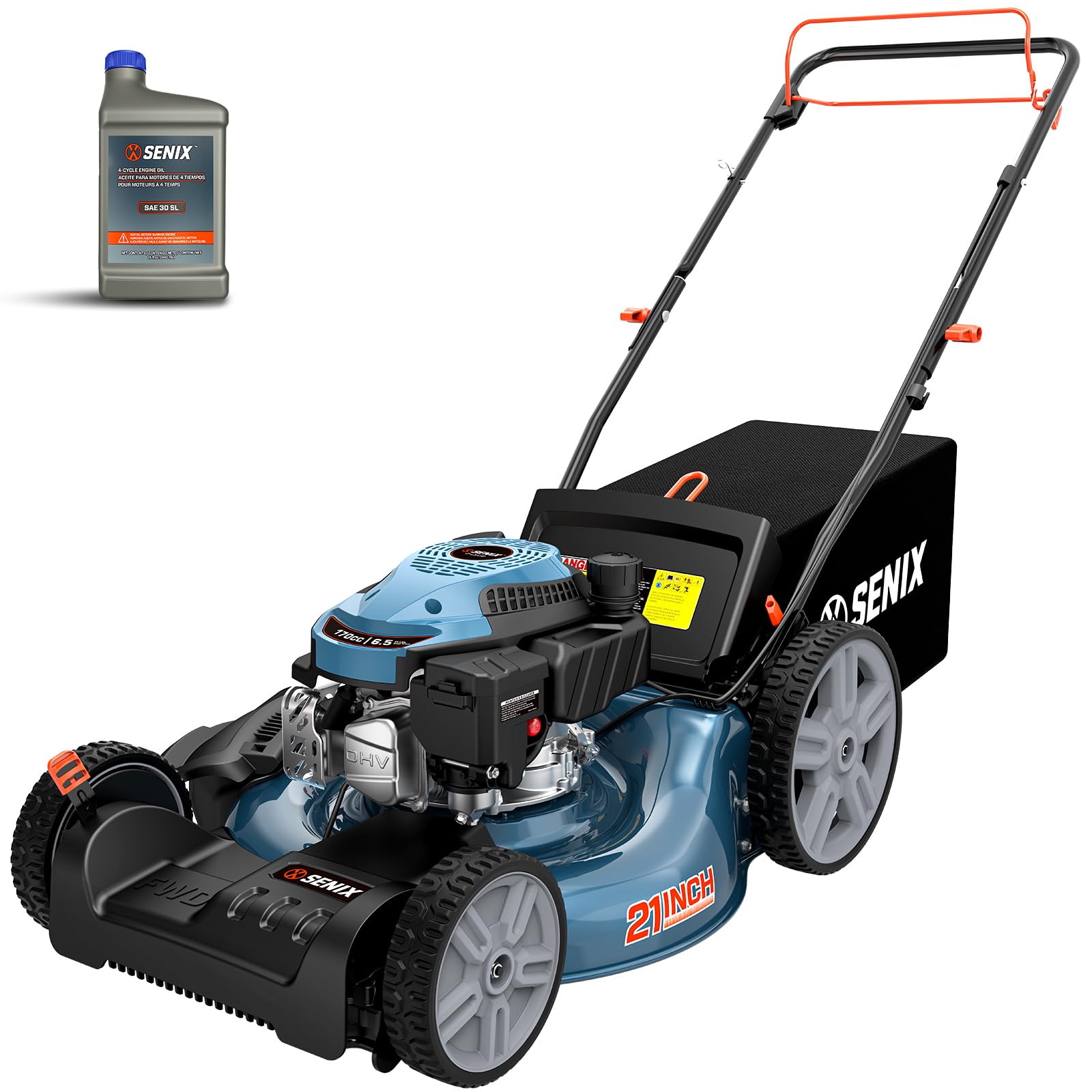
The SENIX 21″ Self-Propelled delivers a 170cc OHV engine paired with a 1.7-bushel grass bag—the largest standard bag in this lineup—so you can cover a third of an acre before emptying. The front-wheel drive pulls the mower forward, letting you pivot around trees and flower beds without fighting the weight of a full bag. The dual-lever height adjustment offers six positions from 1.25 to 3.75 inches, giving you fine control over how much grass reaches the bag in each pass.
The vortex tunnel airflow design keeps grass from building up under the deck, which directly improves bag fill consistency. Customers report that the mower cuts smooth and even, handles overgrown grass up to 18 inches, and only needs refueling after about half an acre of work. The pre-filled oil gets you started fast, but the primer bulb needs a firm 15 presses rather than the three indicated in the manual.
At 61.7 pounds, it’s relatively light for a self-propelled gas model, and the 8-inch front wheels with 11-inch rear wheels roll well over rough terrain. Some users note that restarting the engine after a brief stop takes extra pulls, which interrupts the rhythm of bagging multiple loads. Overall, this is the most balanced package for bag-focused mowing at a mid-range price.
Why it’s great
- 170cc engine produces enough torque to keep the bag filling in thick grass without slowdown.
- 1.7-bushel bag reduces emptying frequency compared to the 1.4-bushel standard on many competitors.
- Front-wheel drive makes it easy to maneuver around obstacles while the bag stays attached.
Good to know
- Primer bulb needs 15 presses instead of the three specified in the manual for reliable cold starts.
- The user manual is printed in tiny font, making maintenance procedures hard to read.
- Self-propelled speed is fixed and cannot be adjusted to match your walking pace.
2. YARDMAX 22″ Select PACE CVT
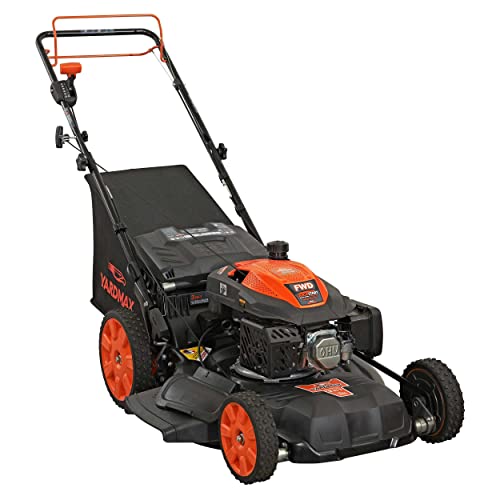
The YARDMAX 22″ uses a Continuously Variable Transmission (CVT) with six speed settings, letting you dial in the exact pace for bagging without fighting the mower’s natural gait. The 201cc engine spins a 22-inch blade, and the aggressive spiked-tread rubber tires provide strong traction on slopes where bag fill requires consistent forward motion. The automatic choke eliminates the primer-bulb guesswork—just pull and go.
Customers praise its fuel efficiency, noting that it covers three-quarters of an acre on a single tank. The deck cleanout port lets you blast away caked grass without tipping the mower, which keeps the vortex tunnel clear and the bag filling consistently. The single-lever height adjustment covers the same 1.5- to 3.75-inch range as most competitors, but the 22-inch cutting width means you shave time off every pass.
At 84.9 pounds empty, it’s heavy, and the front-wheel drive loses traction on wet grass, making turns harder when the bag is full. Some users report that the speed lever doesn’t stay locked in position, so you may need to reselect your speed mid-yard. For hilly, well-drained lawns, the CVT and large bag combination delivers premium bagging throughput.
Why it’s great
- 201cc engine with CVT provides smooth, variable-speed control for consistent bagging across terrain changes.
- Aggressive tire tread improves traction on inclines, keeping the blade engaged at full RPM.
- Deck cleanout port enables quick under-deck clearing without removing the bag.
Good to know
- Front-wheel drive struggles with traction on wet grass, which can slow bagging on damp mornings.
- Speed lever may drift out of position on bumpy ground, requiring manual readjustment.
- Heavy build at nearly 85 pounds makes it difficult to push manually if the self-propel fails.
3. Greenworks 60V 21″ Self-Propelled

The Greenworks 60V brings battery convenience to bagging without sacrificing power. The brushless motor drives a 21-inch blade with enough lift to fill the included bag consistently, and the rear-wheel self-propel handles slopes better than front-drive competitors. The two 4.0Ah batteries deliver up to 60 minutes of runtime, which covers about three-quarters of an acre in ideal conditions. The 4-in-1 system includes a dedicated leaf pickup mode for fall cleanups.
LED headlights allow early-morning or dusk mowing when bagging leaves is critical. The single-lever height adjustment offers seven settings from 1 to 4 inches, giving you flexibility to bag short or tall grass with one lever move. Users report that the bag fills evenly—no clumping at the chute entrance—and that the mower operates three times quieter than a comparable gas unit, which matters if you mow near neighbors.
The self-propel speed control slides out of position due to vibration, and the clutch doesn’t always disengage immediately when you release the paddle, forcing an extra forward push. While the bag seals well, the mower struggles with leaf pickup compared to a gas Honda. For eco-friendly buyers who want a quiet, gas-free bagging experience for a medium yard, this is the strongest battery contender.
Why it’s great
- 60V brushless motor provides gas-like blade torque for consistent bag fill in thick grass.
- Rear-wheel self-propel delivers better traction on slopes than front-drive gas competitors.
- LED headlights enable early-morning and evening mowing for leaf and grass bagging.
Good to know
- Self-propel speed control drifts during use due to chassis vibration.
- Clutch does not disengage instantly; you may need to push the mower forward to release it.
- Leaf pickup capability is weaker than traditional gas models with higher suction.
4. EGO POWER+ LM2134SP-2
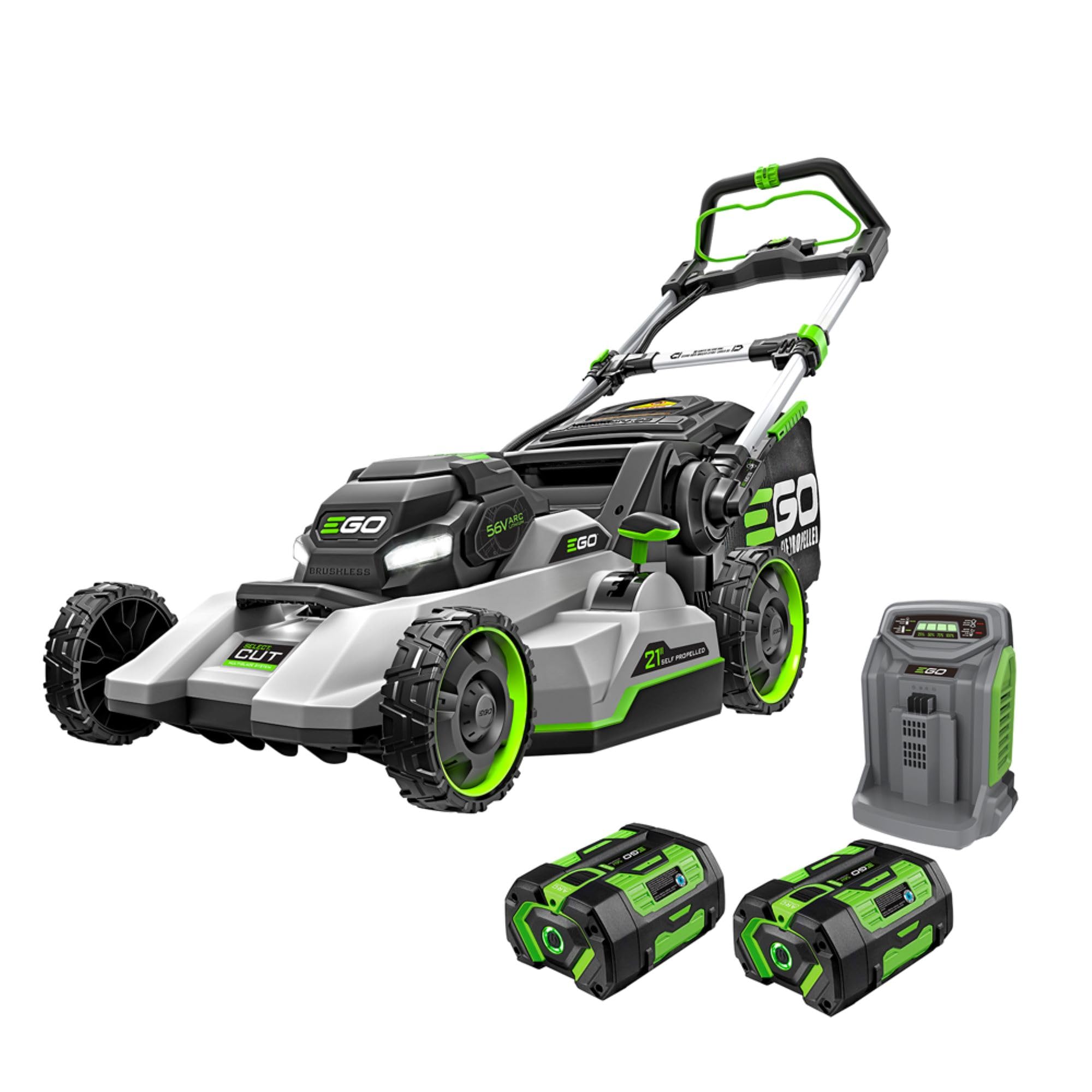
The EGO LM2134SP-2 is the runtime king of battery bag mowers. Two 56V 6.0Ah ARC Lithium batteries deliver up to 100 minutes of combined runtime, enough to bag a full acre without recharging. The Select Cut multi-blade system lets you switch between mulching and bagging performance, but in bag mode, the high-lift blade produces exceptional suction that fills the bag evenly with minimal clumping.
The Touch Drive self-propel lets you control speed by squeezing the handlebar, adjusting from 0.9 to 3.1 MPH in real time—perfect for matching your pace during bagging runs. The 21-inch deck cuts cleanly, and the brushless motor spins the blade faster than most gas engines, improving lift for wet clippings. Customers with a quarter-acre report completing the entire lawn on one set of batteries with charge to spare.
The plastic composite shell feels durable, but the mower weighs 96 pounds, making it the heaviest in this comparison. The self-propel thumb trigger can cause hand fatigue on longer mowing sessions, and the rear-wheel drive makes tight turns difficult when the bag is full—you’ll need to disengage the drive and pivot manually. For large properties where runtime and bag suction are non-negotiable, the EGO justifies its premium position.
Why it’s great
- 100-minute combined runtime from dual 6.0Ah batteries handles up to an acre on a single charge.
- Touch Drive variable-speed self-propel provides precise pace control for consistent bagging.
- High-lift blade option produces superior suction for filling the bag in thick or damp grass.
Good to know
- Thumb-operated self-propel trigger causes fatigue during extended bagging sessions.
- Rear-wheel drive complicates tight turns when the bag is fully loaded.
- Heavy at 96 pounds; manual maneuvering in confined spaces is difficult.
5. SKIL PWR CORE 40V Self-Propelled

The SKIL PWR CORE 40V proves that battery-powered bagging doesn’t require a flagship budget. The 40V 6.0Ah battery delivers up to 50 minutes of runtime, and the digital brushless motor provides enough blade speed to fill the bag effectively on a standard suburban lot. The variable-speed self-propel lets you adjust pace without losing deck momentum, and the push-button start eliminates pull-starts entirely.
The 20-inch cutting deck is narrower than the 21-inch standard, which means more passes per yard—but the tradeoff is a lighter, more maneuverable chassis that’s easier to push when the bag is full. The 3-in-1 system handles bagging well on medium-height grass, and the single-lever height adjustment offers seven settings from 1.5 to 4 inches. Customers appreciate how quiet the motor is compared to gas, and the folding handle makes vertical storage simple for small sheds.
Battery runtime drops noticeably when mowing tall or wet grass, and the self-propel mechanism is noticeably louder than the blade motor. The bag doesn’t pick up leaves as well as a gas Honda, and the small deck means you’ll make more passes—extending the runtime needed. For a compact, affordable entry into battery bagging, the SKIL delivers the essentials without the gas hassle.
Why it’s great
- Push-button start eliminates the pull-start frustration of gas mowers.
- Compact 20-inch deck and lightweight build make it easy to maneuver with a full bag.
- Folding handle and vertical storage capability save garage and shed space.
Good to know
- Battery runtime drops significantly in tall or wet grass, requiring careful yard planning.
- 20-inch deck requires more passes per yard compared to 21-inch standard models.
- Self-propel mechanism is noisier than the brushless motor itself.
6. PowerSmart 22″ Self-Propelled
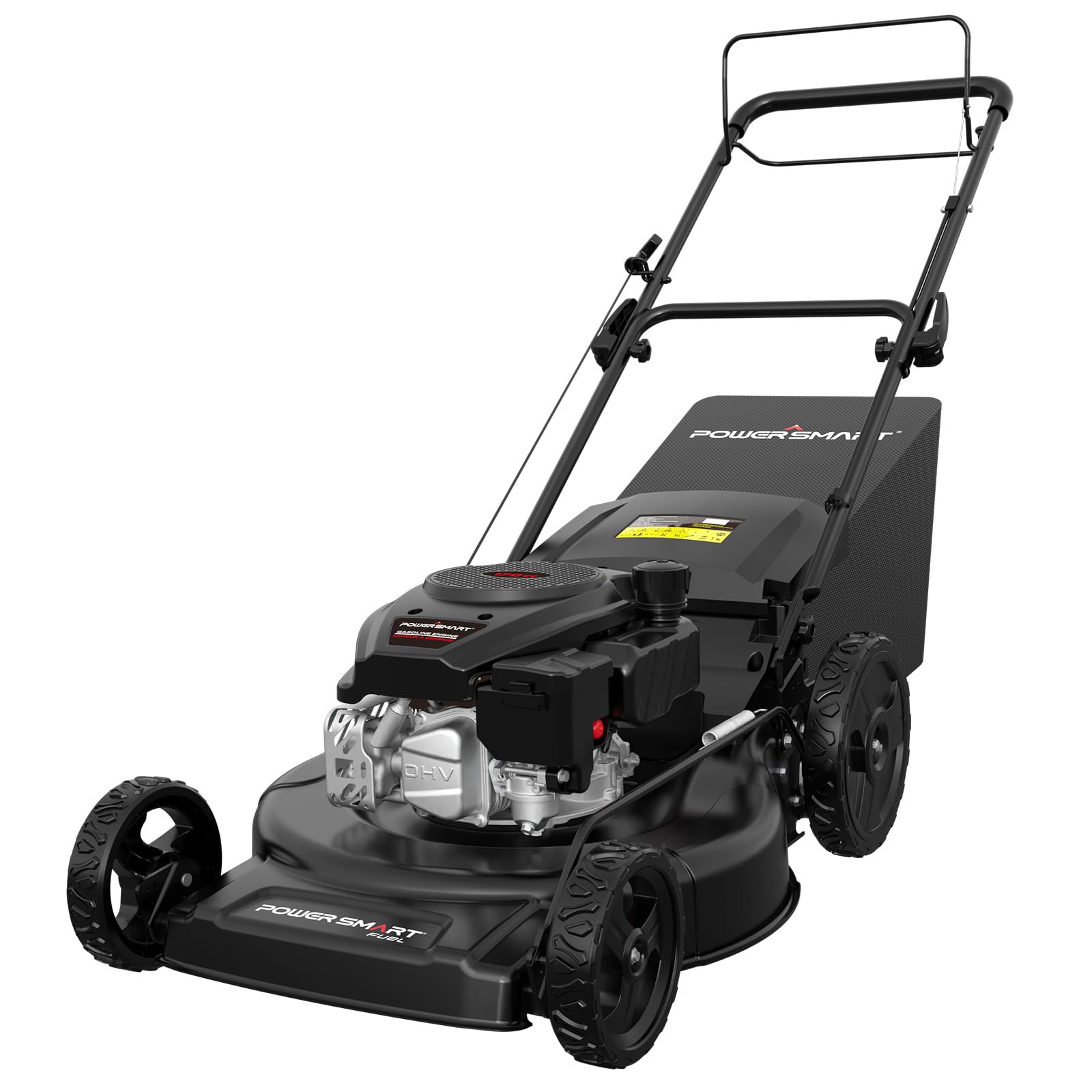
The PowerSmart 22″ combines a 170cc engine with rear-wheel drive, giving it strong traction on slopes and uneven ground where front-drive mowers spin out. The 22-inch steel deck cuts a wider path than most competitors in this segment, reducing the number of bag-filling passes per yard. The 60-liter (roughly 1.7-bushel) bag capacity matches the SENIX 21″ for volume, so you spend less time at the compost pile.
The auto choke system ensures reliable first-pull starts, even after sitting for weeks. The six-level rear-wheel height adjustment lets you set the cut height without leaving the handle, and the all-steel deck holds up well against rocks and roots. Customers consistently report that it starts on the first pull, cuts evenly, and handles thick weeds without bogging down.
The self-propel speed is single-speed, so you can’t adjust your pace mid-row. A few customers noted that the rubber rear skirt can detach and get caught in the blade, requiring removal to prevent damage. The 68-pound weight makes it one of the lighter self-propelled gas models, which helps when you need to push it manually on tight turns. For sloped yards where bagging momentum matters, this is the strongest gas option.
Why it’s great
- Rear-wheel drive provides superior traction on slopes compared to front-drive alternatives.
- 22-inch deck cuts wider than standard 21-inch, reducing total bagging passes per yard.
- Auto choke system delivers reliable first-pull starts every time.
Good to know
- Self-propelled drive is single-speed only; you cannot vary the pace during use.
- Rubber rear skirt may detach and contact the blade; some users remove it preemptively.
- Grass bag capacity is listed as 60 liters; the attachment mechanism can be finicky to seat correctly.
7. SENIX 22″ 201cc Self-Propelled
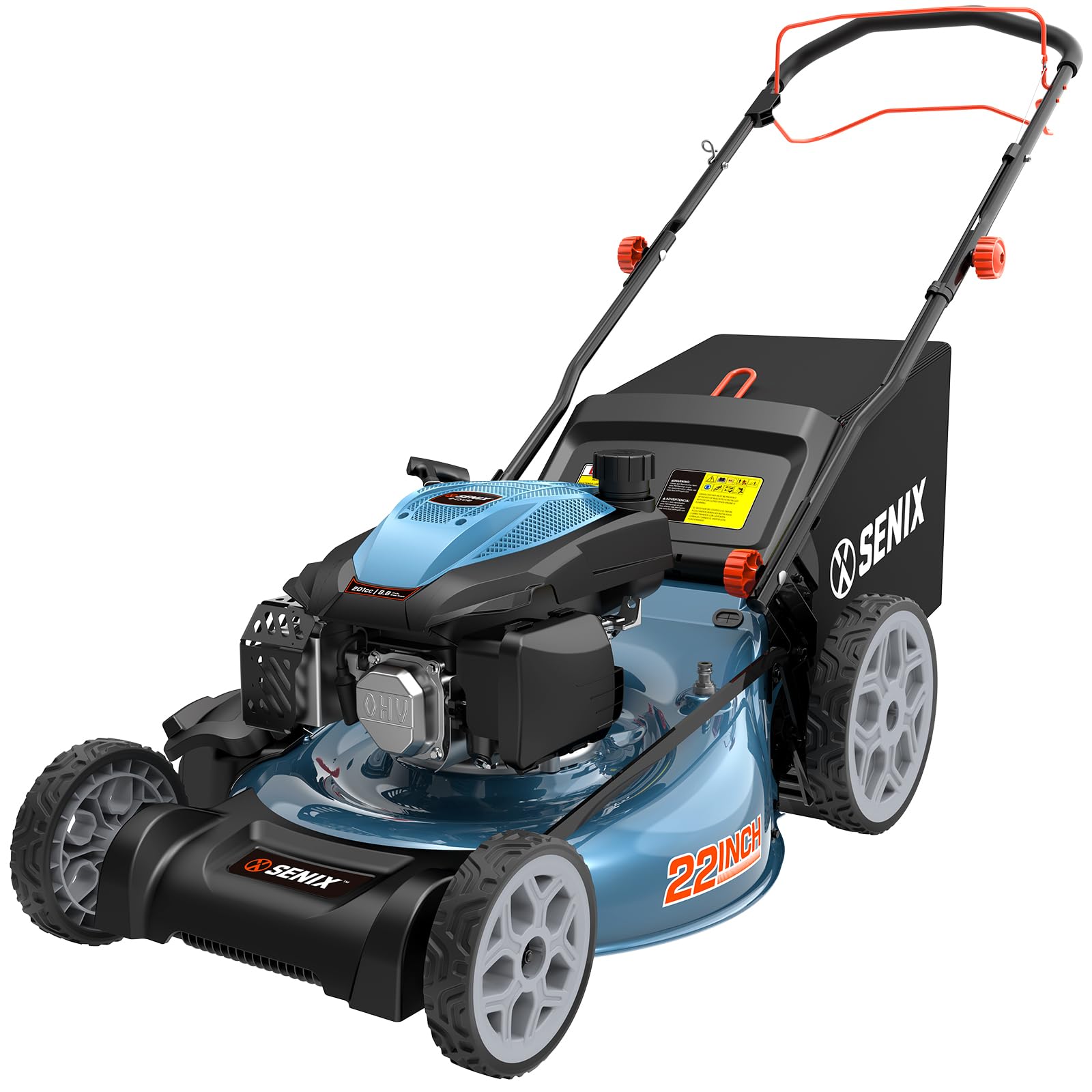
The larger SENIX 22″ houses a 201cc engine that produces 4.7 HP and 8.8 ft-lb of torque—enough to maintain blade speed under heavy bagging loads. The 22-inch heavy-duty cutting deck uses a manganese steel alloy blade (45–50 HRC hardness) that stays sharp longer than standard blades, maintaining clean cuts that help clippings flow into the bag rather than sticking to the deck. The single-speed rear-wheel drive runs at 2.9 MPH, which matches a brisk walking pace.
The unique vortex tunnel airflow design is specifically engineered to improve grass discharge efficiency, meaning less clogging at the chute opening and more consistent bag fill. The foldable handle compacts the mower for storage without removing the bag. Customers report that assembly requires no tools, that the mower starts on the first pull even after storage, and that it cuts large backyards in half the time of smaller-deck mowers.
Some users report missing information in the manual—no gas or oil capacity listed—and there’s no dedicated grass catcher accessory available from the manufacturer. A few customers experienced wheels falling off after several uses, requiring improvised repairs. The 72-pound weight is manageable for a 22-inch self-propelled mower, but the single speed limits precision on tight turns. For large, relatively flat yards where raw engine power determines bag fill rate, this is the most capable gas option.
Why it’s great
- 201cc engine delivers 4.7 HP for maintaining blade speed under heavy bagging loads.
- Manganese steel blade (45–50 HRC) stays sharp longer, improving clean cuts and bag flow.
- Vortex tunnel design reduces chute clogging for consistent bag fill.
Good to know
- User manual lacks basic information such as gas and oil capacity specifications.
- Some customers report wheels detaching after multiple uses due to inadequate fasteners.
- Single-speed self-propel limits maneuverability compared to variable-speed alternatives.
8. PowerSmart EasyGlide 21″
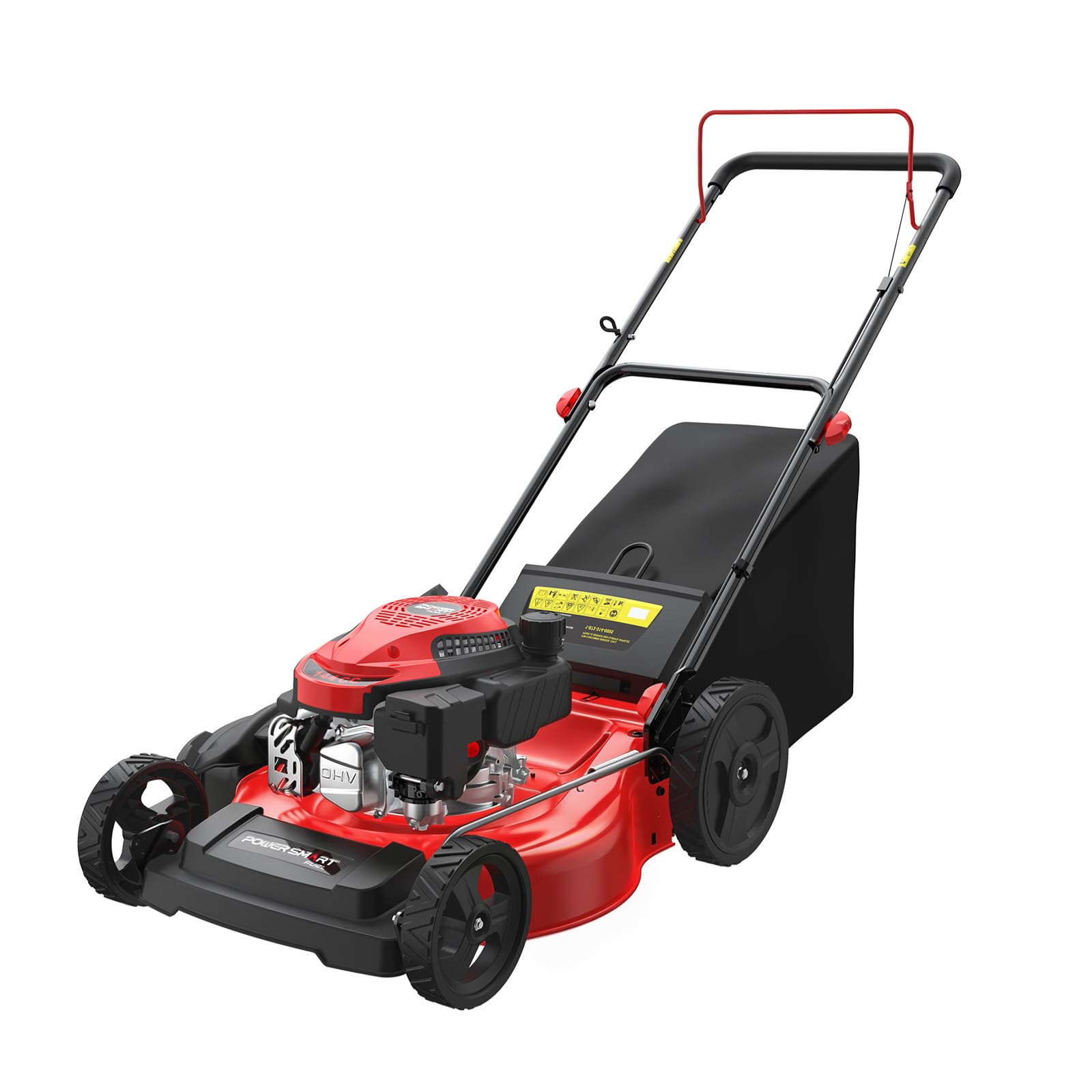
The PowerSmart EasyGlide 21″ delivers a 144cc 4-stroke OHV engine in a lightweight push configuration at a price that undercuts most self-propelled options. The auto choke and primer system make starting predictable, and the 21-inch steel deck cuts evenly with a specialized blade designed for fine mulching that also directs clippings efficiently to the included bag. The 1.4-bushel bag is standard for this class, but the double ball-bearing wheels (10-inch rear, 7-inch front) roll smoothly even when the bag is full.
Customers highlight the 20-minute assembly, the first-pull start even after weeks of storage, and the surprisingly powerful motor that handles thick grass and weeds without bogging. The EasyGlide design makes pushing less fatiguing than most push mowers, and the six-position single-lever height adjustment lets you switch cutting heights without bending down. For a small to medium yard, this is a reliable workhorse that doesn’t overcomplicate the bagging process.
The small fuel tank means you may need to refill mid-yard if your lot exceeds a quarter acre. The handle foam grip arrived damaged on some units, and the bag attachment doesn’t always seal perfectly, leading to minor clippings escaping onto trouser legs. For the price, the tradeoff is acceptable—you get the core performance of a gas push mower without the premium features that drive up cost.
Why it’s great
- 144cc OHV engine starts reliably on the first pull and maintains blade speed in thick grass.
- Double ball-bearing wheels (10″ rear, 7″ front) reduce pushing effort with a full bag.
- Quick 20-minute assembly gets you cutting immediately after unboxing.
Good to know
- Small fuel tank requires mid-yard refills on lots larger than a quarter acre.
- Bag attachment seal may allow clippings to escape onto clothing around the edges.
- Handle foam grip can arrive damaged due to packaging during shipping.
9. AMERISUN 21″ 3IN1 Gas Push Mower
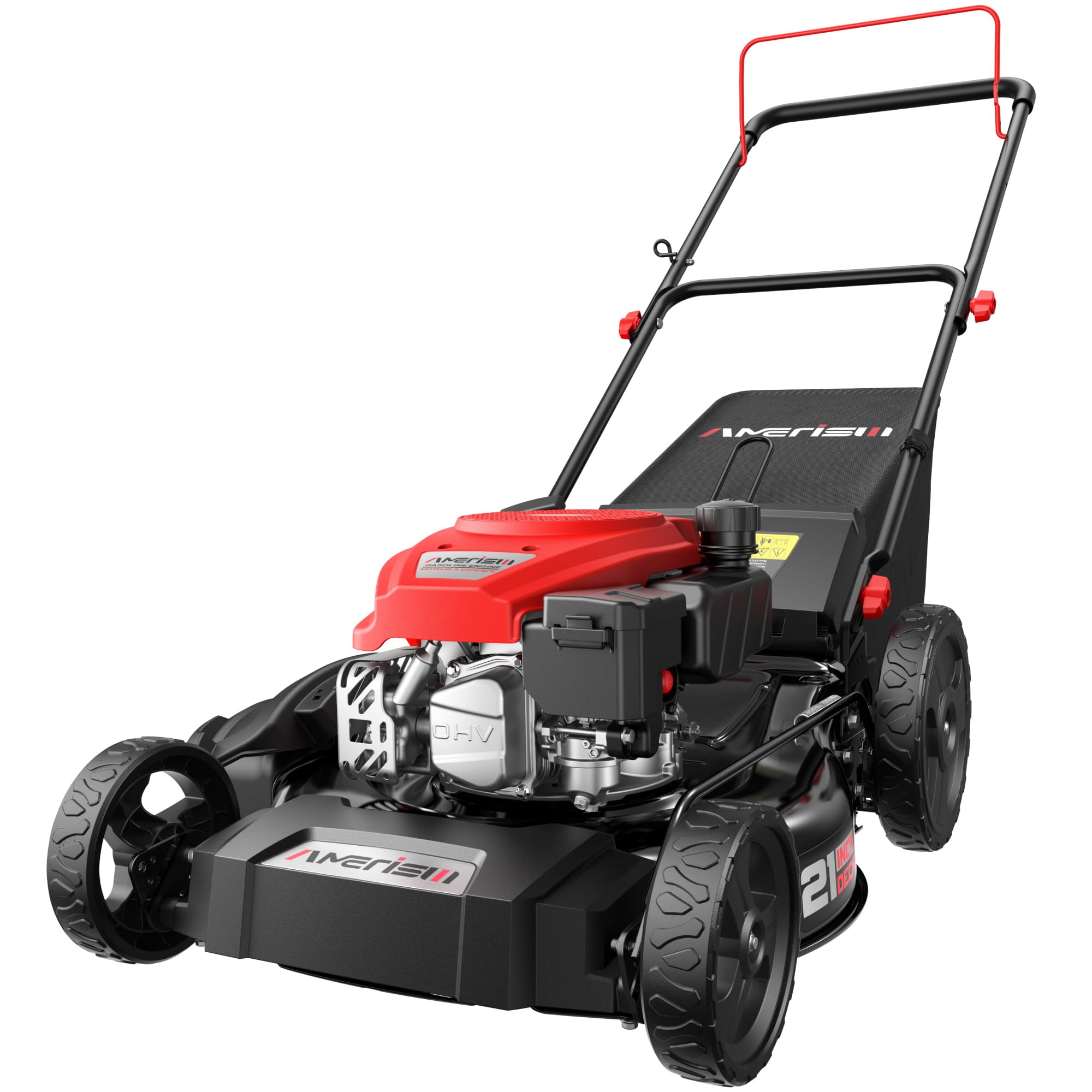
The AMERISUN 21″ is the most affordable gas push mower in this list, yet it still packs a 144cc 4-cycle OHV engine and a 21-inch steel deck. The 1.4-bushel grass catcher is standard for the budget tier, and the 3-in-1 system lets you switch between mulching, bagging, and side discharge with a simple lever change. The six-position height adjustment spans 1.5 to 3.9 inches, giving you enough range for seasonal grass management.
Customers consistently report easy assembly, reliable starting after adding oil and gas, and impressive mulching performance even in 4-5 inch grass. The 68-pound weight makes it one of the lightest gas mowers available, which helps when maneuvering around flower beds with a full bag. The foldable handle reduces storage footprint without removing the bag, and the 7-inch front and 10-inch rear wheels provide adequate stability for flat yards.
The bag attachment requires a Dremel modification to seat properly, and the bag doesn’t seal completely against the deck, causing clippings to fall onto your trousers during mowing. The rubber flap that seals the rear discharge opening broke off on some units due to weak plastic tabs. For a buyer on a strict budget who needs a gas mower that actually bags, the AMERISUN offers the core mechanicals but demands patience with fit and finish.
Why it’s great
- 144cc OHV engine starts reliably and handles thick grass up to 5 inches without stalling.
- Lightest gas mower in this lineup at 68 pounds, making it easy to push with a full bag.
- Foldable handle enables compact vertical storage without removing the grass bag.
Good to know
- Bag attachment slots require Dremel modification for proper seating against the deck.
- Bag does not seal completely, causing clippings to escape onto pants during mowing.
- Rubber rear flap can break off due to weak plastic mounting tabs.
FAQ
How often should I empty the bag while mowing?
Can I use a bagging mower for mulching without the bag?
Why does my bag fill slowly or leave clippings behind?
Final Thoughts: The Verdict
For most users, the bag lawn mower winner is the SENIX 21″ Self-Propelled because the 1.7-bushel bag and 170cc engine provide the best balance of capacity and power for the typical suburban yard. If you want battery convenience and top-tier runtime, grab the EGO LM2134SP-2. And for the tightest budget where reliability still matters, nothing beats the PowerSmart EasyGlide 21″.