
A miter saw that drifts off a 45-degree mark wastes material, time, and focus. The difference between a tight baseboard joint and a gap you have to caulk is often a single degree of slop in the saw’s pivot or a fence that was never squared from the factory. Choosing a 10-inch miter saw means balancing blade size against the material width you actually cut most often — and understanding that a heavy sliding rail system isn’t automatically more accurate than a fixed, well-machined pivot.
I’m Min — the co-founder and writer behind Gadgets Feed. I study the engineering trade-offs in these machines by cross-referencing motor specifications, arbor runout tolerances, and the real-world failure patterns that surface in owner forums and long-term use reports.
This guide breaks down the best models across every tier so you can match the right saw to your workshop reality and your cut budget. Whether you are trimming out a basement or building cabinets, I’ll help you find the best 10 miter saw for your specific workflow and material stack.
How To Choose The Best 10 Miter Saw
Selecting a miter saw starts with understanding the width of the material you will crosscut most often. A 10-inch blade handles dimensional lumber up to roughly 4×4 inches and most common trim sizes with authority, but it trades the 12-inch model’s ability to cut 6×6 posts and wider crown in a single pass. The first real fork in the road is whether you need the added horizontal travel of a sliding mechanism or if a fixed-arm saw with a single pivot will deliver cleaner, more consistent results for your typical work.
Sliding vs. Fixed-Arm
A sliding miter saw uses horizontal rails — either traditional nested steel tubes or a geared axial-glide system — to pull the blade through the workpiece. This adds several inches of crosscut capacity, often enough to handle 12-inch baseboards or wide shelving boards in one pass. The trade-off is mechanical complexity: rails can develop lateral play over time, which introduces wobble at the end of a long cut. A fixed-arm saw eliminates that variable entirely. The blade is mounted on a single, rigid pivot, which often yields better long-term squareness with zero maintenance, but limits you to the width the blade can reach when pulled straight down.
Cutting Guides: Laser vs. Shadow Line
A laser module projects a thin red line onto the material, showing exactly where the kerf will land. This works well indoors and in moderate light, but the beam can wash out under bright sunlight or floodlights. A shadow-line or LED guide uses an opaque edge behind the blade to cast a crisp black outline on the workpiece. That shadow is visible in any lighting condition and never shifts as batteries drain, making it the more reliable choice for job-site work and repeated trim runs.
Bevel and Miter Capacity
Single-bevel saws tilt the blade to the left only, which means you have to flip the workpiece over to cut matching compound angles for crown molding. Dual-bevel models tilt both directions, letting you cut mirrored bevels without reorienting the stock — a massive time saver on complex trim packages. Miter detents lock the table at common angles (15°, 22.5°, 30°, 45°) for fast repeatable cuts. The more detent positions and the easier the override lever, the quicker you can move between standard and custom angles without squinting at a scale.
Quick Comparison
On smaller screens, swipe sideways to see the full table.
| Model | Category | Best For | Key Spec | Amazon |
|---|---|---|---|---|
| Bosch CM10GD | Sliding | Precision trim work in tight spaces | Axial-Glide; 64 lbs | Amazon |
| Delta 26-2241 | Sliding | Wide crosscuts with sliding action | Shadow line; 4000 RPM | Amazon |
| Dewalt DCS714WW1 | Cordless | Job-site portability without a cord | 20V MAX; 434 cuts per charge | Amazon |
| Einhell TC-SM 216 | Sliding | Budget-friendly drag saw with laser | 1600 W; 12.5 kg | Amazon |
| Makita LS1040 | Fixed | Reliable trim saw with lightweight frame | 15 Amp; 27 lbs | Amazon |
| DOVAMAN DMS01A | Sliding | Multi-material cutting on a budget | Dual speed; 3 TCT blades | Amazon |
| Evolution R185SMS+ | Sliding | Cutting steel and aluminum with same blade | 1500 W; 7-1/4″ blade | Amazon |
| Genesis GMS1015LC | Fixed | Entry-level compound miter cuts | Laser guide; 9 positive stops | Amazon |
| Metabo HPT C10FCG2 | Fixed | Lightweight everyday cutting | 24 lbs; shadow line | Amazon |
In‑Depth Reviews
1. Bosch CM10GD Compact Miter Saw

The Bosch CM10GD eliminates the sliding rail entirely with its Axial-Glide system, using articulating arms that require no rear clearance — you can push this saw flush against a wall and still get the full crosscut width. That design also removes the lateral play that traditional steel rails develop after a few hundred cuts, so the blade tracks straight through the material every time. The 15-amp motor delivers 4,000 RPM, and the 60-tooth carbide blade that ships with the saw cuts cleanly out of the box.
The dual-bevel capability tilts 45 degrees left and right, and both the bevel and miter controls are mounted up front, so you never have to reach behind the saw to loosen a lock nut. The base weighs 64 pounds, which dampens vibration but makes it less portable than a fixed-arm unit. The dust collection chute works well when connected to a shop vacuum, but the included dust bag is only marginally effective and will leave fine particles settling on the bench top.
The ergonomic ambidextrous trigger handle uses a soft-grip overlay that reduces hand fatigue during long trim runs, and the clear lower guard improves visibility of the cut line. Setup takes about ten minutes out of the box, and the square-lock precision fence holds its adjustment even when you repeatedly clamp and unclamp tall baseboard stock. For a finish carpenter who needs compact storage and dead-accurate miters, this is the benchmark of the 10-inch sliding category.
Why it’s great
- Axial-Glide system needs zero rear clearance and eliminates rail play.
- Up-front bevel and miter controls enable fast angle changes without reaching behind the saw.
- Near-zero runout out of the box for finish-grade cuts on crown and base.
Good to know
- Dust bag is largely ineffective; a shop-vac adapter is almost mandatory for clean operations.
- At 64 pounds, this is not a tool you want to carry across a job site daily.
2. Delta 10″ Sliding Compound Miter Saw 26-2241

The Delta 26-2241 uses a belt-driven sliding mechanism that produces a noticeably quieter cut than direct-drive saws in this class, and the 15-amp motor spins the blade at 4,000 RPM with enough torque to push through pressure-treated 4x4s without bogging. The shadow-line guide casts a crisp, battery-independent cut line that remains visible under direct sunlight — a distinct advantage over laser guides that wash out in bright conditions. The sliding rails feel buttery smooth when new, and the 5.5-inch maximum cut thickness covers almost all common dimensional lumber in a single pass.
Dual-bevel capability tilts 45 degrees left and right, and the front bevel release lever makes it easy to switch without walking around the machine. The miter detents include 10 positive stops with an override lever for custom angles. The 62-pound mass gives the saw a planted feel, but the dust collection system is the unit’s weakest link — the included bag collects almost nothing, and even a shop-vac connection leaves a surprising amount of debris on the table and floor.
The molded trigger handle accommodates both left- and right-handed users without pinching, and the push-button miter detent override lets you sweep past the detents smoothly when you need a fractional angle. Owners consistently report that the saw arrived square from the factory, requiring no out-of-the-box calibration for 90-degree and 45-degree cuts. If you need wide crosscut capacity and a shadow-line guide that never fades, this Delta delivers professional-grade consistency at a mid-range price point.
Why it’s great
- Belt-driven slides produce quieter operation and smoother travel than gear-driven rails.
- Shadow-line guide works in all lighting conditions without batteries.
- Arrives square from the factory for most users.
Good to know
- Dust collection is poor and will require a better solution or frequent cleanup.
- Arms can show slight play when crosscutting material wider than 6 inches.
3. DEWALT 20V MAX XR 10 in. Double Bevel Fixed Miter Saw Kit (DCS714WW1)
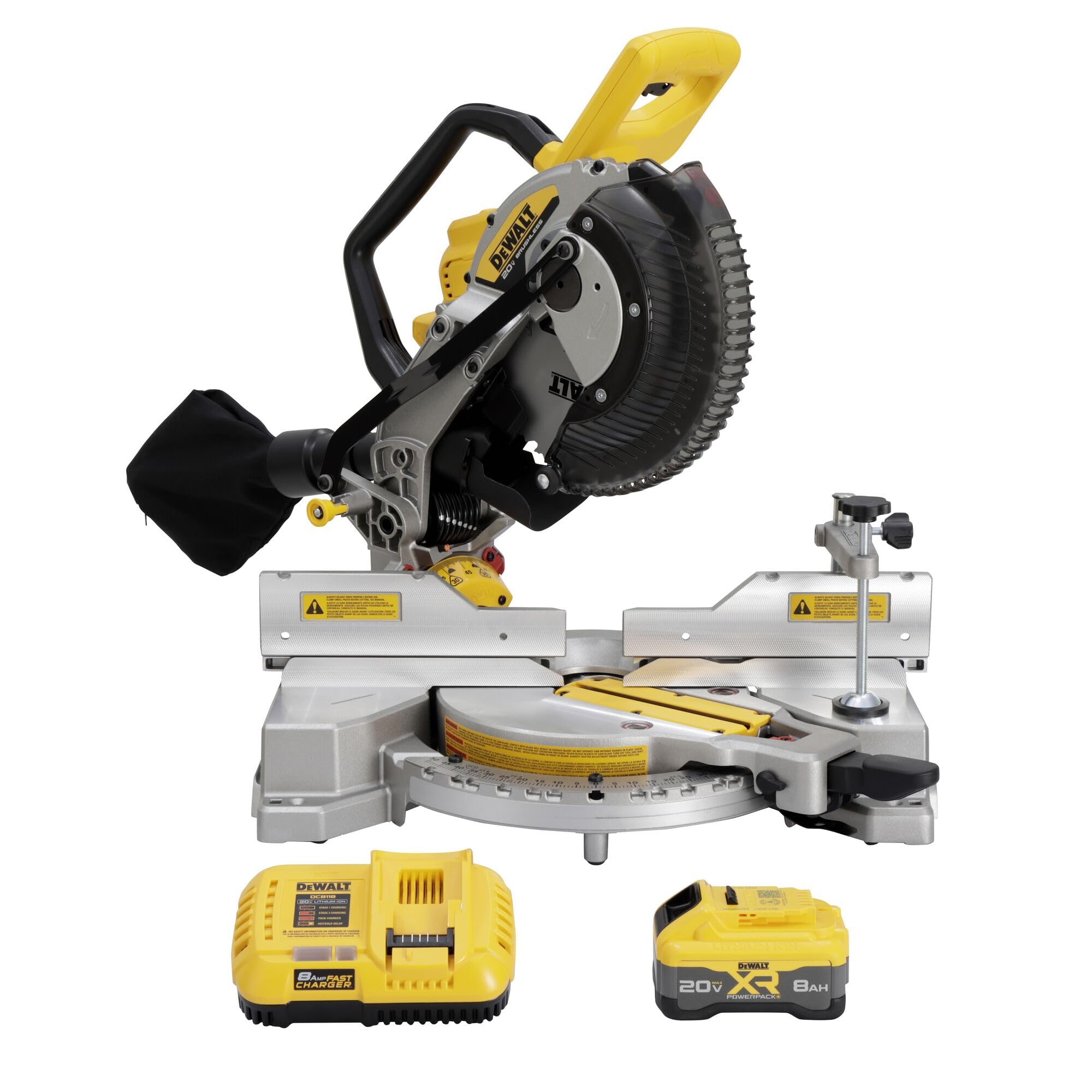
The DCS714WW1 is DEWALT’s first cordless 10-inch miter saw that works across both the 20V MAX and FLEXVOLT battery families, and it delivers up to 434 cuts in 3-1/4-inch MDF base molding on a single charge of a 4Ah battery. The bevel-gear transmission minimizes power loss through the drivetrain, so the brushless motor pulls through 2×4 SPF studs at roughly the same speed as the corded equivalent. At well under 40 pounds with the battery installed, this saw is significantly lighter than any corded sliding model, making it a natural choice for trim carpenters who move between rooms or floors all day.
The double-bevel capability tilts left and right, eliminating the need to flip material for mirrored crown molding cuts. The shadow-line cut guide is visible in any light, and the dust collection captures up to 97 percent of the debris when connected to a vacuum. The included 1.7Ah battery will deliver roughly 130 cuts in 2×4 material, but most users will want the larger 4Ah or 6Ah packs that ship with the kit version to avoid swapping mid-project. The original blade that arrives on the saw is functional but rough; swapping to a premium 60-tooth Diablo blade dramatically improves cut quality on hardwood trim.
The fixed-arm pivot eliminates the rail slop that plagues many compact sliding saws, and the sightline tripod mechanism gives a clear view of the cut line from above. The clamp feels slightly flimsy compared to the saw’s otherwise robust build, but it holds stock firmly enough for trim work. If your job site lacks reliable power or you simply hate managing extension cords, this cordless kit delivers corded-rivaling performance in a portable, double-bevel package.
Why it’s great
- True cordless freedom with cut counts that rival corded saws on a single 4Ah battery.
- Double-bevel head eliminates flipping material for mirrored compound angles.
- Shadow-line cut guide works in broad daylight without batteries.
Good to know
- Stock blade is rough out of the box — budget for an upgrade if you work with hardwoods.
- Clamp feels less substantial than the rest of the saw’s build quality.
4. Einhell Drag, Crosscut and Miter Saw TC-SM 216
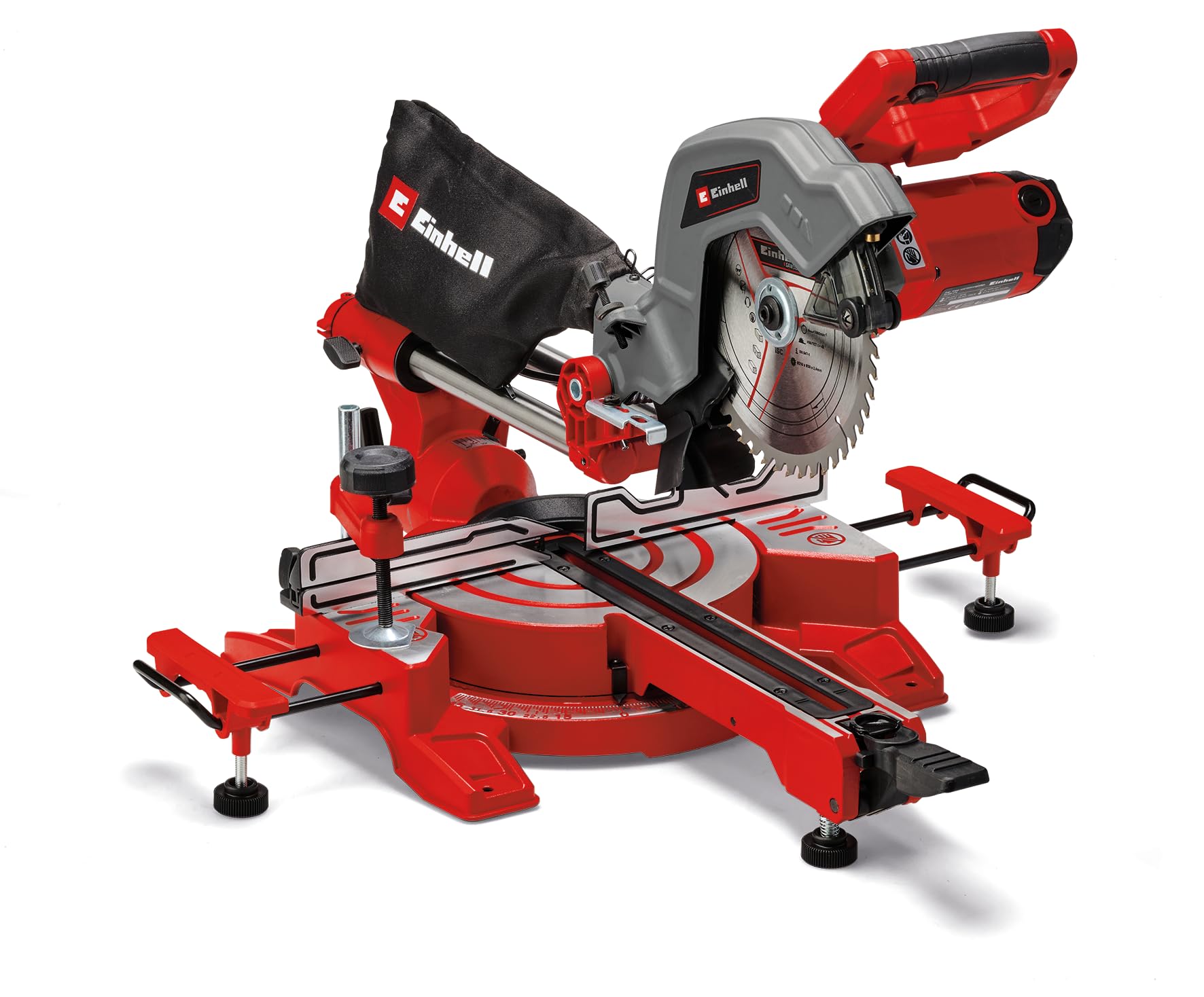
The Einhell TC-SM 216 is a drag-style miter saw — its 1600-watt motor and articulated arm provide sliding action without the long rear rails that limit wall-adjacent placement. The turntable includes quick-adjust angle settings with positive locking positions, and the saw head tilts left for bevel cuts. An integrated laser guide projects the cut line, and the included carbide blade is ready for immediate use on softwood and construction lumber. At roughly 27.5 pounds, it occupies a middle ground between ultra-light fixed saws and heavy sliding units.
The saw ships with two extension wings that fold out for additional workpiece support, making it easier to handle long trim stock without a separate roller stand. The dust collection port accepts standard shop-vac hoses, and several users report that the dust capture is surprisingly effective for a saw in this range — far better than the near-useless cloth bag found on many low-cost alternatives. The plastic handle and base components feel less premium than the die-cast aluminum of more expensive saws, but the overall construction is solid for home workshop duty.
Several owners have noted that the angle detents require careful verification after assembly because the factory calibration can be slightly off, especially for the 45-degree bevel stop. The laser is a helpful guide but should be confirmed by lowering the blade next to the workpiece rather than trusted blindly. If you need a sliding saw with a laser for weekend projects and occasional furniture builds, the TC-SM 216 delivers reliable cuts without the premium price tag of a Bosch or a Delta.
Why it’s great
- Drag-style arm provides sliding action with zero rear clearance needed.
- Dust collection performs significantly better than the cloth-bag standard at this price tier.
- Extension wings add useful support for longer workpieces right out of the box.
Good to know
- Angle detents often need re-calibration after assembly for accurate bevel and miter cuts.
- Laser position should be verified against the blade kerf on every setup.
5. Makita LS1040 10″ Compound Miter Saw

The Makita LS1040 is a fixed-arm compound miter saw that prioritizes portability and pivot rigidity over crosscut width. The 15-amp direct-drive motor spins to 4,600 RPM, and the machined aluminum base provides a dead-flat reference surface for the workpiece. The dual-post compound arm pivots on a single axis, meaning there are no sliding rails to develop play — every cut is as repeatably square as the last. At 27 pounds, this is one of the lightest full-featured 10-inch saws on the market, which makes it easy to carry up stairs or toss into a truck bed.
Miter capacity spans 0-45 degrees left and 0-52 degrees right, with positive stops at 15, 22.5, 30, and 45 degrees on both sides plus the 90-degree zero position. Bevel cuts go up to 45 degrees left only — you will need to flip workpieces for mirrored bevels on crown molding. The included 40-tooth micro-polished blade cuts cleanly on pine and PVC but struggles with dense hardwoods and thick oak trim. The vertical vise and triangular rule are useful extras, but the blade change bolt is notoriously tight and may require a rubber mallet on the first removal.
Several long-term owners note that the saw emits a loud mechanical “bang” on startup, which is normal for this direct-drive motor design but can be startling in a quiet workshop. The compact footprint and single-pivot arm make this an excellent choice for trim carpenters who need a saw that fits in a small work van and delivers reliable 90-degree and 45-degree cuts all day. If you primarily cut dimensional lumber and standard trim and want a saw that stays square without annual adjustments, the LS1040 is a proven classic.
Why it’s great
- Fixed-arm pivot delivers long-term squareness with zero rail maintenance.
- At 27 pounds, it is one of the lightest 10-inch saws for job-site portability.
- Machined aluminum base provides a precision reference surface.
Good to know
- Single-bevel design requires flipping material for mirrored crown molding cuts.
- Blade change bolt is factory-tight and often needs significant force to loosen.
6. DOVAMAN Updated 10-Inch Sliding Miter Saw DMS01A

The DOVAMAN DMS01A brings sliding capacity and multi-material flexibility to a price point usually reserved for fixed-arm saws. The 15-amp pure copper motor operates at two speeds — 5,000 RPM for wood and PVC, and 3,200 RPM for softer metals — and the saw ships with three TCT blades: two 40-tooth for general cutting and one 48-tooth for finer work on trim and hardwood. The extendable side tables and 13-inch sliding rail give a maximum cut width of roughly 4 by 13 inches, enough for most shelving boards and wide base stock in one pass.
The ambidextrous design includes dual lock switches that allow left- and right-handed operation without awkward reaching, and the built-in laser guide provides a clear cut line for alignment. The 34-inch depth requires more bench space than a compact fixed saw, but the sliding mechanism itself feels smooth and the rails show minimal lateral play out of the box. The included blades are serviceable for rough construction lumber but lack the edge retention and carbide quality of Diablo or Freud replacements — several owners report dramatically cleaner cuts after upgrading the blade.
The fence and base are made from cast aluminum rather than stamped steel, which contributes to the 37-pound weight but also improves long-term flatness compared to cheaper pressed-metal designs. The dust port accepts a standard shop vac, though some fine debris still escapes around the blade guard. For a hobbyist who cuts wood, MDF, PVC, and aluminum flashing on the same afternoon, the DMS01A offers sliding versatility and useful extras without stretching the budget.
Why it’s great
- Dual-speed motor handles wood, PVC, and soft metals from one tool.
- Three included TCT blades cover both construction lumber and finer trim work.
- Ambidextrous switch design works naturally for left-handed users.
Good to know
- Stock blades cut adequately but benefit significantly from a higher-quality aftermarket upgrade.
- 13-inch rail depth requires a deeper workbench than a compact fixed-arm saw.
7. Evolution Power Tools R185SMS+ Sliding Miter Saw

The Evolution R185SMS+ is built around the company’s patented multi-material cutting technology, which uses a 1500-watt motor and an optimized gearbox to cut steel, aluminum, wood with embedded nails, and plastic with minimal sparks, heat, or burrs. The included TCT blade handles ferrous and non-ferrous metals without needing to swap blades between materials, and the ball-bearing slides maintain smooth travel even under the lateral load of cutting angle iron or rectangular tubing. The 7-1/4-inch blade diameter is smaller than a standard 10-inch saw, but the trade-off is that the blade itself is significantly cheaper to replace and spins faster through thin-wall metal stock.
The bevel range covers 0 to 45 degrees, and the miter settings span 50 degrees left and right, covering the full set of common trim and metalwork angles. The laser cutting guide and three-piece clamp add precision and holding power, though the clamp’s reach is limited on wider pieces. The included dust collection bag is adequate for wood but fills quickly with metal shavings — users cutting steel regularly should connect a shop vac to the port. The saw’s 0.01-ounce specified weight is clearly a listing error; actual shipping weight is around 30 pounds, making it portable enough for occasional job-site runs.
The lack of a ground plug on the cord is unusual for a metal-cutting tool and suggests the saw is intended for finish work rather than heavy fabrication. If you need a single saw that switches between wood trim and steel angle for welding jigs or railing projects without a blade change, the R185SMS+ eliminates material-change downtime.
Why it’s great
- Cuts steel, aluminum, and embedded-nail wood with the same blade and no changeover.
- Ball-bearing slides maintain smooth travel and reduce blade wander on metal stock.
- Laser guide helps align cuts on dark steel surfaces where shadow lines disappear.
Good to know
- The 7-1/4-inch blade limits crosscut depth compared to standard 10-inch saws.
- Cord lacks a ground plug, which is atypical for metal-cutting tools.
8. Genesis GMS1015LC 15-Amp 10-Inch Compound Miter Saw

The Genesis GMS1015LC proves that a functional compound miter saw with a laser guide and electric brake doesn’t have to cost a week’s groceries. The 15-amp motor delivers enough torque to cut 2x4s and 4x4s cleanly, and the nine positive miter stops lock into commonly used angles — 15, 22.5, 30, and 45 degrees left and right plus the 90-degree zero — for quick repeatable setup. The die-cast aluminum base provides a flat, stable platform that resists warping, which is a meaningful upgrade over the stamped steel found on ultra-budget saws.
The laser guide runs on two AAA batteries and casts a visible line for alignment, though the beam can wash out in bright sunlight or under work lights. The electric brake stops the blade within seconds of releasing the trigger, adding a layer of safety that is welcome on a saw at this price tier. The included 60-tooth carbide-tipped blade cuts adequately on pine, poplar, and MDF but should be replaced with a higher-quality blade if you plan to cut oak or maple trim. The dust bag is essentially cosmetic — most of the debris collects on the table or the floor.
The extension wings provide limited support for long stock; boards over 8 feet will sag without a separate roller stand. Several reviewers note that the motor uses bushings rather than ball bearings, which is acceptable for hobby use but means the saw will wear faster under daily professional use. For a first-time buyer building a home workshop or a DIYer who needs a capably angled miter saw for weekend fence repairs and shelving, the Genesis GMS1015LC delivers the essential features with no unnecessary frills.
Why it’s great
- Die-cast aluminum base resists warping and maintains flatness better than stamped steel.
- Electric brake stops the blade quickly for added safety during frequent angle changes.
- Nine positive miter detents allow fast repeatable positioning for common trim angles.
Good to know
- Laser guide is less visible under bright overhead lighting or direct sun.
- Motor uses bushings instead of ball bearings, limiting longevity under heavy daily use.
9. Metabo HPT 10-Inch Single Bevel Compound Miter Saw C10FCG2
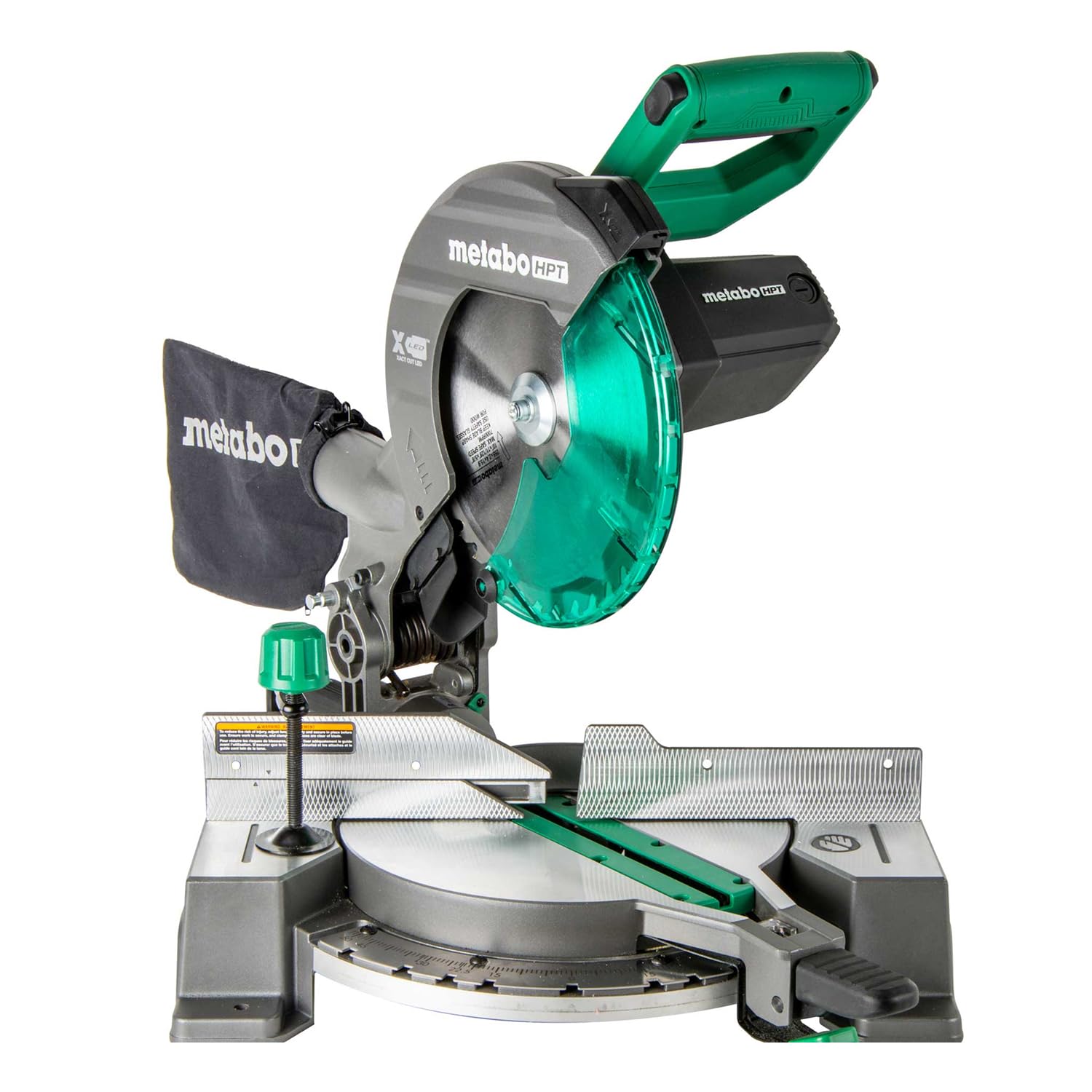
The Metabo HPT C10FCG2 is a second-generation redesign that shaves weight to just 24 pounds while retaining the Xact Cut shadow-line guide and a 15-amp motor that spins the 10-inch blade to 5,000 RPM. The shadow line projects a crisp, battery-free cut indicator that stays sharp under any lighting, making it easy to align the blade without fiddling with a laser module that could drift. The single-bevel head tilts 0-45 degrees to the left, and the miter angle sweeps 0-52 degrees left and right with detents at the standard trim angles.
The large table provides generous material support despite the saw’s compact footprint, and the vice clamping system secures the workpiece firmly against the fence. The improved miter scale and controls allow for more precise angle adjustments than the previous generation, and the whole unit sets up in under 15 minutes out of the box. Some users report that the motor runs unevenly or emits a brief burning smell during the first few cuts, but this typically normalizes as the brushes seat. The included 40-tooth TCT blade is adequate for softwood and construction lumber but will struggle on hard maple or thick oak.
A few owners noted that the blade wrench can be missing from the packaging — worth checking immediately upon arrival. The depth adjustment set screw is a thoughtful inclusion for cutting shallow dados or kerfs. For a homeowner or DIYer who needs a saw that can be hauled from garage to driveway to basement without straining a back, the C10FCG2 offers an unbeatable weight-to-power ratio and shadow-line accuracy at a price that leaves room for a better blade upgrade.
Why it’s great
- At 24 pounds, it is one of the lightest 10-inch miter saws available for easy transport.
- Shadow-line guide provides a battery-free, lighting-independent cut indicator.
- Improved miter scale and controls offer better precision than the previous generation.
Good to know
- Some units may arrive with a missing blade wrench — verify contents immediately.
- Stock blade is entry-level and should be upgraded for hardwoods and dense trim.
FAQ
What is the practical crosscut difference between a fixed and a sliding 10-inch miter saw?
How often should I calibrate the miter and bevel stops?
Final Thoughts: The Verdict
For most users, the best 10 miter saw winner is the Bosch CM10GD because its Axial-Glide system eliminates rail slop and allows zero-clearance wall placement while delivering dual-bevel precision for finish-grade trim work. If you want cordless job-site portability, grab the DEWALT DCS714WW1. And for a lightweight fixed-arm saw that stays square and costs less than a tank of gas, nothing beats the Metabo HPT C10FCG2.