
If you’ve ever wrestled a balky PLC input, chased a phantom 3.8 mA on a 4–20 loop, or swapped a transmitter only to find the scale still reads nonsense, you know the pain. A precise, reliable signal source turns that debugging gamble into a predictable process. Without one, you are blindly guessing which end of the loop is lying to you.
I’m Min — the co-founder and writer behind Gadgets Feed. My research for this guide involved cross-referencing hundreds of user reports and spec documents to separate the genuinely accurate tools from the ones that only look good in marketing photos.
This guide breaks down seven different models to help you identify the best 4-20ma signal generator for your specific bench, panel, or field needs based on real accuracy claims, battery life, and interface quality.
How To Choose The Best 4-20mA Signal Generator
A signal generator’s job sounds simple: produce a precise current. But the wrong choice can introduce more uncertainty than it removes. Focus on these three criteria to avoid wasting time and money.
Basic Accuracy and Resolution
The specification that matters most is basic accuracy, usually stated as a percentage of reading (e.g., 0.2%). A 0.2% meter at 20.00 mA can be off by 0.04 mA — acceptable for most PLC tuning. A 0.5% meter doubles that error. Resolution, measured in microamps (µA) or digits, determines how finely you can dial in a setpoint. Look for at least 0.01 mA resolution for fine calibration work.
Sourcing vs. Simulating Mode
This is the most misunderstood distinction in the category. A source mode generates current to power a loop and provide a signal. A simulate mode acts like a 2-wire transmitter, sinking current from an external loop supply. Many budget units only source. If you need to replace a transmitter for testing, you need a unit that explicitly supports the 2-wire simulate function.
Power Source and Portability
Field work demands a unit that lasts a full shift. Internal rechargeable batteries (3000 mAh or larger) are convenient, but some tools use 9V disposable cells. Check the operating time: 20+ hours is ideal. Also verify the unit provides a 24V loop supply if you plan to power unknown devices during testing — many sources top out at a nominal 24V, and a weak supply can distort readings.
Quick Comparison
On smaller screens, swipe sideways to see the full table.
| Model | Category | Best For | Key Spec | Amazon |
|---|---|---|---|---|
| Riiai SG003A | Mid-Range | Feature-rich bench testing | 3000 mAh battery, 0.01 mA resolution | Amazon |
| TestHelper TH-71B | Mid-Range | Field troubleshooting & thermocouple | 0.2% basic accuracy, 24V supply | Amazon |
| T-king LB78 | Value | Compact dedicated source | Long battery life, dedicated keys | Amazon |
| T-king LB02 | Premium | Multi-function process calibrator | RTD/TC resistance, 0.1% accuracy | Amazon |
| DROK Generator 2pcs | Budget | Simple bench checks & LED testing | 1-piece kit, dual V/mA output | Amazon |
| Aitoserlea LB06 | Premium | Professional HART/Modbus work | HART communicator, two-jack design | Amazon |
| OWON HDS2202S | Premium | Ultimate diagnostic combo tool | 200 MHz scope, 25 MHz AWG | Amazon |
In‑Depth Reviews
1. Riiai SG003A 4-20mA Signal Generator

The Riiai SG003A is the most compelling all-rounder in this class, packing a 2.4-inch TFT color screen, a built-in 3000 mAh battery rated for 26 hours of operation, and the ability to source mA (0–24 mA), voltage (0–24 V), passive current, and frequency pulses (0–9999 Hz) — all with a resolution of 0.01 mA. That resolution alone elevates it above most competitors in its pricing tier, allowing fine adjustments for valve positioners and analog input cards.
The programmable output mode lets you set automatic ramps — single ascent, single drop, or loop cycling — which is invaluable for commissioning control loops without standing at the panel pressing buttons. Users report the output accuracy calibrated to within 0.005 mA relative to a Fluke process meter, which is remarkable for a unit costing a fraction of a dedicated calibrator.
The downsides are the manual (poorly translated, dense, and missing menu explanations) and a few on-screen typos in the interface. A quick YouTube search bridges the documentation gap, but out of the box you may need patience to navigate the submenus. The micro USB charging port feels dated, though the battery life more than compensates.
Why it’s great
- 0.01 mA resolution for precise loop tuning
- 3000 mAh battery lasts over 26 hours on a charge
- Multiple signal types (mA, V, Hz, passive current)
- Programmable auto-ramp and cycle modes
Good to know
- Manual is difficult to follow; requires external video guidance
- Micro USB charging could be more robust
- Firmware update process is not well documented
2. TestHelper TH-71B Handheld Signal Generator
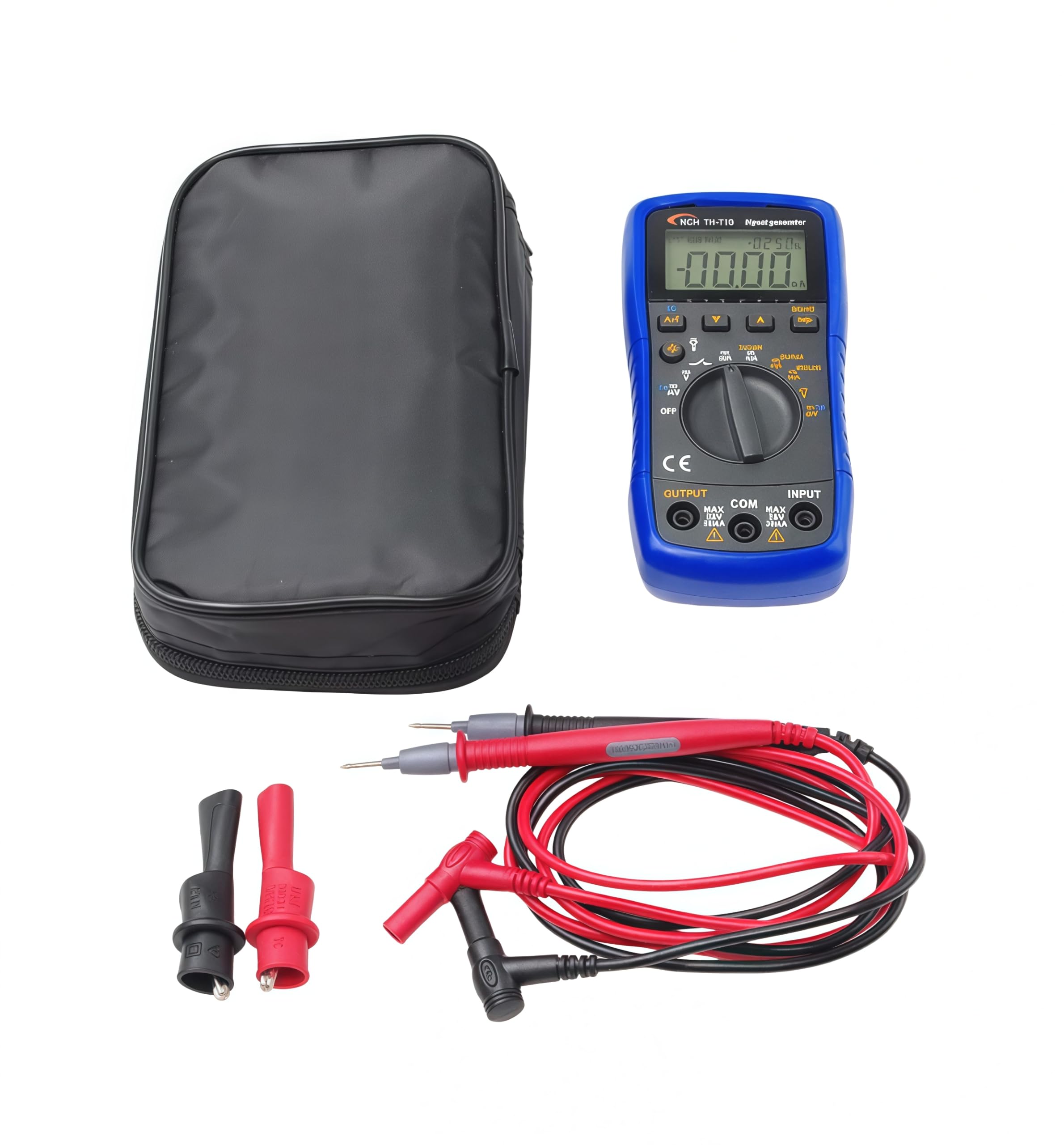
The TH-71B is a handheld calibrator that doubles as a signal generator and meter, supporting voltage, current, and thermocouple measurement/output (types K, E, J, T, B, R, S, N). The basic accuracy is rated at 0.2% for both measure and source functions, which puts it on par with many entry-level Fluke calibrators at roughly half the price. It also provides a 24V loop supply, essential for powering unknown 2-wire transmitters during troubleshooting.
Users consistently highlight the excellent backlit display and built-in flashlight — minor details that make a huge difference in dim control cabinets. The unit can source and measure simultaneously, and the manual step output for V and mA is straightforward for quick sanity checks. Offshore technicians report six months of daily use without drift or mechanical failure.
The included test leads are a weak point; they feel cheap and are among the first things to replace. The unit is also lightweight and tends to tip over on a flat surface thanks to its rounded stand. It is not recommended for official calibration records unless you have a way to verify it against a certified standard.
Why it’s great
- 0.2% basic accuracy for both source and measure
- Includes thermocouple simulation and measurement (8 types)
- Built-in 24V loop supply
- Backlit display and flashlight for dark cabinets
Good to know
- Test leads are low quality and should be replaced
- Tendency to tip over on flat surfaces
- Manual is sparse and lacks depth for advanced features
3. T-king LB78 Signal Generator

The LB78 is a compact, no-nonsense signal source that covers the basics: 4–20 mA, 0–10 Vdc, and mV output. What sets it apart is the dedicated key layout — each function gets its own button, so there is no menu diving to switch from sourcing to simulating. Experienced technicians appreciate the zero-delay key response, which makes fast adjustments in the field feel natural.
Battery life is excellent; users report months of intermittent use without needing a recharge, and the unit can be charged while in operation. It fits easily into a tool bag alongside a multimeter, and the internal quick-blow fuse offers genuine protection if someone accidentally connects 110V to the output terminals. Several users also mention that it works well with HART modems for calibrating valve positioners.
The manual is notoriously difficult to read, and the port labeling does not clearly indicate which terminals correspond to which range or function. A few units arrived with defects (faulty firmware or non-responsive keys), though the seller is reportedly responsive with replacements. The supplied leads are not removable, which limits flexibility for panel wiring.
Why it’s great
- Zero-delay dedicated keys for each function
- Excellent battery life with charging while in use
- Quick-blow fuse protects against miswiring
- Compact enough for a jacket pocket or tool bag
Good to know
- Manual is nearly incomprehensible
- Supplied leads are non-removable and short
- Some units have had reliability issues early on
4. T-king LB02 Process Calibrator

The LB02 elevates signal generation to full process calibrator territory. Beyond 4–20 mA sourcing and 0–10 Vdc output, it measures and simulates resistance (RTD) and thermocouples across multiple types, making it suitable for technicians who maintain temperature instrumentation alongside analog loops. The two-jack design eliminates the need to swap leads when switching functions — a major convenience in busy panel work.
Accuracy checks against a Fluke 2000 bench meter show the LB02 to be within 0.1% for current and voltage outputs. The unit sources a reliable 24V loop power and includes rise-and-fall as well as cycle modes for automated testing. The bright LCD is readable in direct sunlight, and the rechargeable battery easily lasts a full shift.
The primary frustration is the documentation: the manual is poorly translated and omits key details for the resistance and thermocouple functions. Several users note that the product image shows HART and Modbus connectivity labels, but the unit itself does not support those protocols — a misleading detail that has caused returns. The unit is also smaller than expected, which can make the buttons feel cramped for large-handed operators.
Why it’s great
- RTD and thermocouple simulation for temperature loops
- Two-jack design eliminates lead swapping
- 0.1% accuracy verified against high-end bench meters
- 24V loop supply with auto-ramp modes
Good to know
- Manual is difficult to decipher for RTD/TC functions
- Advertised HART/Modbus in photos; unit does not support it
- Buttons are small for larger hands
5. DROK 4-20mA Generator 2pcs
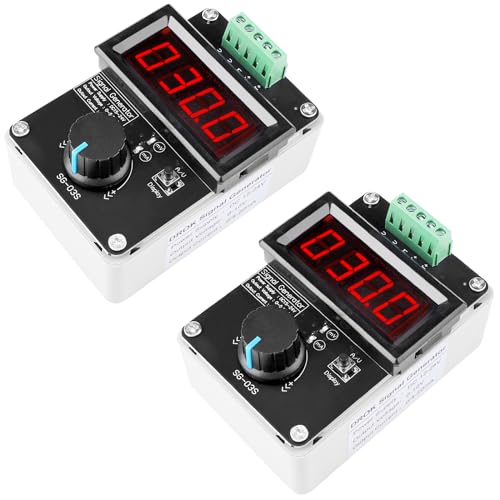
The DROK kit provides two compact signal modules capable of generating 0/4–20 mA and 0–10 Vdc using a multi-cycle precision potentiometer. The 3-digit LED display is straightforward — it shows output current or voltage and includes a physical switch to toggle between them. This is the simplest tool on this list, requiring no menus, firmware, or batteries (it runs on 24 VDC or two 9V cells).
Initial accuracy checks using a Fluke 87 multimeter showed the modules to be spot-on at multiple setpoints, and the onboard calibration potentiometers allow fine-tuning if the display drifts. The wider body (5.75 x 5.16 inches) is stable on the bench, and the price of a two-pack makes it painless to keep one in the panel and one in the service van.
Long-term reliability is the trade-off. One user reported the signal starting to drift after a few days due to cheap, overheating components. Another noted that the housing feels hollow and the plastic is brittle. These are not rugged field units — they are bench tools for quick checks, not for permanent calibration duty. Also the module requires an external 24V supply in its default configuration.
Why it’s great
- Two modules for the price of one, great for backup
- 3-digit LED display with calibration trimmers
- Stable bench footprint
- Works as a simple, low-cost voltage/current source
Good to know
- Not reliable for continuous use; drift reported
- Requires external 24V supply or 2x 9V batteries
- Plastic housing feels brittle
6. Aitoserlea LB06 Source Process Calibrator
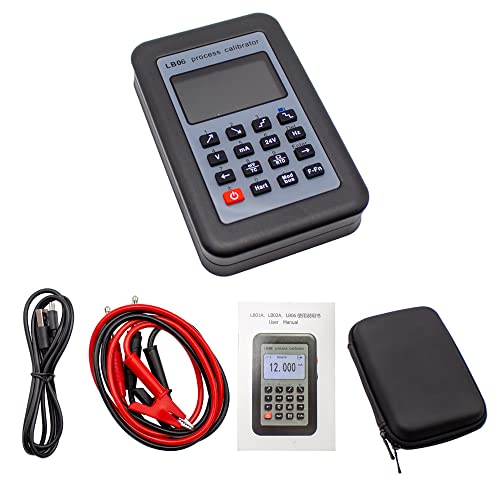
The LB06 is the step-up from the LB02, adding HART communicator and Modbus protocol support to the already robust process calibrator feature set. It can measure and source V, mV, mA, resistance, and Hz signals, all through a single pair of jacks. The key philosophy is simplicity: every function has a corresponding button, so you never need a combination key press to switch modes.
The build quality is a significant notch above the LB78 and LB02. The outer casing gets a matte finish that resists scratches and dirt, and the banana plugs and clips included are noticeably higher quality. Bench accuracy testing against a precision multimeter confirmed the specifications, and users in building automation systems (BAS) praise it for verifying 4–20 mA and 0–10 volt inputs across hundreds of devices.
The low-end accuracy (below 1 mA) has been flagged as problematic by at least one reviewer, who found the output inconsistent at very small currents. The manual lacks depth for the HART and Modbus features, leaving users to figure out the configuration on their own. The unit also does not include a comprehensive calibration certificate, so it cannot substitute for an ISO-labelled instrument in regulated environments.
Why it’s great
- HART communicator and Modbus protocol support onboard
- Single pair of jacks for all input/output functions
- Durable matte casing, high-quality included accessories
- Direct button access for every function, no menu diving
Good to know
- Low-end mA accuracy ( below 1 mA) can be inconsistent
- Manual lacks detailed explanation for HART/Modbus setup
- Not supplied with an ISO 17025 calibration certificate
7. OWON HDS2202S 3-in-1 Oscilloscope
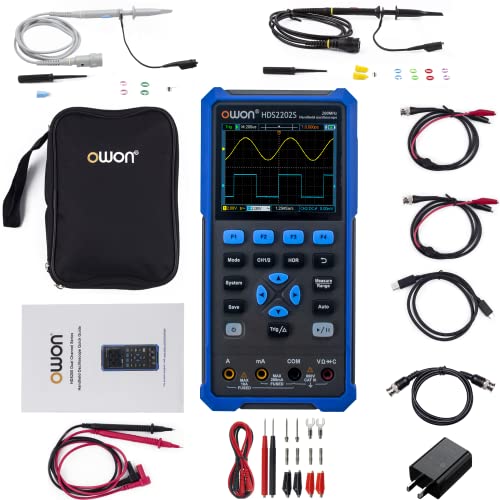
The HDS2202S is a completely different beast: a 200 MHz dual-channel oscilloscope, a 20,000-count True RMS multimeter, and a 25 MHz arbitrary waveform generator packed into a single handheld unit. The signal generator side produces sine waves up to 25 MHz, plus square, ramp, pulse, and arbitrary waveforms. While it supports the 4–20 mA range via the multimeter, its primary purpose is signal diagnostics, not dedicated loop calibration.
The 3.5-inch color screen is crisp, and the interface is logically organized for an oscilloscope — auto-set, edge trigger, and 1 GSa/s single-channel sampling make it a capable troubleshooting tool for analog electronics, VFD outputs, and sensor waveforms. The built-in multimeter can measure 4–20 mA current with reasonable accuracy for quick checks. The replaceable 18650 batteries and USB Type-C connectivity are thoughtful touches for field portability.
As a pure signal generator, it is overkill and under-specialized. The waveform output maxes out at 5 Vpp, and there is no dedicated 24V loop supply. The multimeter lacks AC frequency display and advanced ranges. Battery life is around 3–4 hours under active use, far below dedicated generators. This device belongs in the toolkit of an advanced electronics troubleshooter, not a technician who only needs a mA source.
Why it’s great
- 200 MHz oscilloscope and 25 MHz AWG in one portable package
- True RMS multimeter for AC/DC current measurement
- Replaceable 18650 batteries and USB Type-C charging
- Arbitrary waveform generation for advanced signal simulation
Good to know
- Signal generator output limited to 5 Vpp, no 24V loop supply
- Battery life is short (3-4 hours) for field use
- Multimeter lacks advanced features and high AC frequency range
FAQ
What is the difference between sourcing and simulating 4-20 mA?
Can I use a cheap multimeter to measure the output of my signal generator?
Why does my signal generator only output 3.8 mA instead of 4.0 mA when I set it?
Final Thoughts: The Verdict
For most users, the best 4-20ma signal generator winner is the Riiai SG003A because it delivers 0.01 mA resolution, a 3000 mAh battery, and multiple signal types in a compact form that outperforms tools costing three times as much. If you need thermocouple support for temperature loop work, grab the TestHelper TH-71B. And for a dedicated, single-purpose unit that fits in a pocket and lasts months, nothing beats the T-king LB78.