
If your living room TV stutters through every live game or weather report, the problem isn’t your TV — it’s the aerial fighting to pull a clean UHF/VHF signal from distant broadcast towers. A passive indoor rabbit-ear simply cannot match the raw capture area and mast-mounted stability of a properly aimed outdoor Yagi, especially when trees, hills, or roof materials stand between your antenna and the transmitter cluster. The difference between choppy, pixelated reception and a rock-solid HD stream often comes down to one decision: choosing an amplified outdoor TV aerial with enough forward gain and interference rejection for your specific building and terrain.
I’m Min — the co-founder and writer behind Gadgets Feed. I’ve spent countless hours cross-referencing FCC signal maps, gain specs in dBi, LTE filtering schemas, and wind-load ratings to build this guide around real-world reception patterns, not marketing ranges.
This narrows the field to seven models that deliver measurable performance across different distances and budgets. Whether you need a compact attic solution or a full triple-boom beast for fringe reception, this deep dive into the best amplified outdoor tv aerial covers the smart trade-offs between gain, filtering, and installation complexity.
How To Choose The Best Amplified Outdoor TV Aerial
Not every aerial with a built-in preamp is right for your location. The key variables are the distance to broadcast towers, the terrain between them and your home, and whether interference from cellular towers or FM radio stations is present. These four factors will guide your decision.
Gain and Directivity
Gain, measured in dBi, defines how well the aerial focuses on signals from a specific direction. A higher-gain Yagi (30+ dBi UHF) pulls in weak stations from 50+ miles away, but it is more directional — precise aiming becomes critical. Lower-gain models (15-20 dBi) are more forgiving but struggle with fringe signals. For most suburban homes within 35 miles of towers, an aerial with 25-34 dBi UHF gain hits the sweet spot.
LTE and 5G Filtering
Cellular towers operating on frequencies above 600 MHz can saturate an aerial’s preamp, causing pixelation or total signal dropout on UHF channels. Modern aerials with integrated notch filters reject LTE and 5G interference without sacrificing VHF sensitivity. If you live near a cell tower, filtering is not optional — it is the difference between a stable picture and constant breakup.
Built-in Amplification vs. External Preamp
Aerials with a built-in preamp simplify installation by eliminating a separate power inserter box at the mast. However, automatic gain control (AGC) matters: without it, a preamp can overload when signals are strong, introducing distortion. Premium models like the Televes Ellipse Mix dynamically adjust gain per band (High VHF and UHF independently) to prevent overload while preserving weak-station reception.
Build Quality and Weather Resistance
An outdoor aerial must survive direct rain, snow, and sustained wind. Look for aluminum elements with stainless steel hardware and a UV-stable ABS radome if the preamp is exposed. All-metal Yagis shed ice better than plastic composites but require greased electrical joints to prevent corrosion over years of outdoor service.
Quick Comparison
On smaller screens, swipe sideways to see the full table.
| Model | Category | Best For | Key Spec | Amazon |
|---|---|---|---|---|
| Televes Ellipse Mix 148883 | Premium | Fringe reception + AGC | 40 dBi UHF gain | Amazon |
| Televes DiNova Boss Mix 144286 | Premium | Attic install + interference | 34 dBi UHF, TForce AGC | Amazon |
| Five Star Outdoor HDTV Antenna | Mid-Range | Multi-TV distribution | 200 mi claim, 46″ length | Amazon |
| GE Outdoor Yagi 33685 | Mid-Range | Reliable brand + J-mount | 80 mi range, ATSC 3.0 | Amazon |
| PBD Outdoor Yagi | Value | Budget pick + preamp ready | 150 mi with optional amp | Amazon |
| CeKay Outdoor Yagi HD | Value | Entry-level all-metal | 70 mi, includes 40ft RG6 | Amazon |
| McDuory UHD-3968 Yagi | Budget | Quick attic test | 150 mi claim, LPDA design | Amazon |
In‑Depth Reviews
1. Televes Ellipse Mix 148883
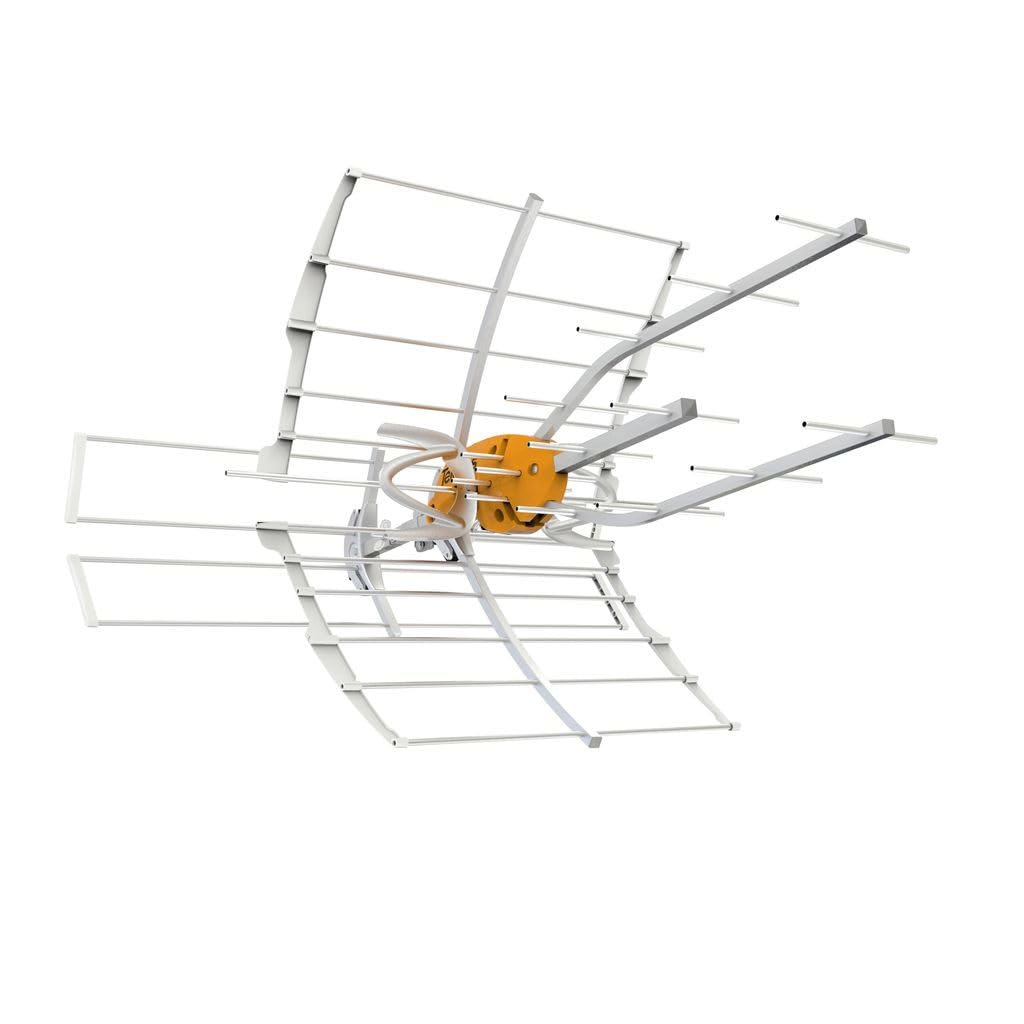
The Televes Ellipse Mix is the most technically sophisticated amplified outdoor TV aerial in this lineup. Its triple-boom curved reflector array delivers 40 dBi UHF gain and 36.5 dBi High VHF gain — figures that dwarf every other model here. The built-in TForce preamplifier adjusts gain independently per band, so strong local UHF stations do not overload the input while weak VHF fringe signals still get clean amplification. Integrated LTE/4G/5G filtering rejects interference from nearby cellular towers above 608 MHz without attenuating the channels you actually watch.
Assembly takes under 60 seconds with no tools, and the corrosion-resistant aluminum elements with stainless steel hardware are designed for years of outdoor exposure. Real-world owners 40 miles from towers report jumping from 85 to 113 channels, with rock-solid pull on low-power stations that previously broke up. The 75-mile range is honest rather than inflated — a rarity in this category. The dual-output power inserter supports long coax runs (100+ feet) with a splitter without starving the preamp.
For suburban or rural households where towers sit 35-70 miles away and cellular interference is a problem, the Ellipse Mix justifies every cent of its premium price through consistent signal lock and hardware that will outlast a decade of weather. No other aerial in this review combines this level of filter quality, gain, and AGC precision.
Why it’s great
- Highest raw gain (40 dBi UHF) in the roundup
- Independent band-by-band AGC prevents overload
- Toolless assembly in under 60 seconds
- Integrated LTE/5G filter protects all UHF channels
Good to know
- Price is in the premium tier
- Highly directional — precise aiming is critical
- Does not include a J-mount bracket
2. Televes DiNova Boss Mix 144286

The DiNova Boss Mix packs Televes’ TForce intelligent gain control into a compact radome-housed package that looks more like a modern Wi-Fi access point than a traditional Yagi. The 29 dBi High VHF and 34 dBi UHF gain figures are lower than the Ellipse Mix, but the real draw here is the weather-sealed ABS radome that protects the preamp from attic dust and outdoor moisture. The built-in FM/LTE/4G/5G filtering is identical to the Ellipse — meaning cell tower interference is handled just as aggressively.
Owners consistently report picking up 40-53 channels in attic installations 30-50 miles from towers, with no pixelation even during heavy rain. The dual-output power inserter allows one aerial to feed two TVs without an external splitter. Assembly is literally zero: the radome snaps together, and all electronics are pre-wired. For HOA communities or homes with strict exterior rules, the low-profile white housing blends into rooflines far better than bare aluminum.
If you need an amplified outdoor TV aerial for an attic install where aesthetics matter and the distance to towers is under 50 miles, the DiNova Boss Mix delivers Televes-grade filtering and AGC in a package that will not offend the neighbors. The passive pass-through mode also ensures the aerial still works if the power inserter fails.
Why it’s great
- Zero-assembly radome design
- Full LTE/5G filtering in a small footprint
- AGC prevents overload in strong-signal zones
- Dual-output power inserter included
Good to know
- Lower gain than the Ellipse Mix for fringe use
- Range is realistically 40-50 miles
- Mast fasteners not included
3. Five Star Outdoor HDTV Antenna

Five Star takes a brute-force approach: a massive 46-inch-long boom with oversized receiving elements designed for maximum physical capture area. The 200-mile claim is aggressive, but real-world users 45 miles from towers are picking up 90-128 channels with clear reception, including stations that flatline on smaller antennas. The kit includes a J-pole, mast bracket, and a TV splitter for multi-room distribution, making it a complete package for cord-cutters wiring a whole house.
The aerial is ATSC 3.0 ready and handles both VHF and UHF naturally without a separate preamp — it ships as a passive high-gain Yagi. Owners note that the VHF vibrator alignment needs attention during assembly (screw heads must face the same direction), but the build is sturdy enough for roof mounting. At 46 inches, it is noticeably larger than the GE or CeKay models, so confirm your mounting space before buying.
If you need to feed three or four TVs from a single roof-mounted aerial and your local towers are within 40-50 miles, the Five Star offers the best balance of included accessories, physical capture area, and price. Pairing it with an external preamp extends useful range beyond 60 miles for fringe scenarios.
Why it’s great
- Largest physical capture area (46″ boom)
- Includes J-pole, splitter, and mast bracket
- ATSC 3.0 ready
- Strong real-world results at 45+ miles
Good to know
- No built-in preamp (passive design)
- Large footprint requires ample mounting space
- Instructions could be clearer on VHF alignment
4. GE Outdoor Yagi 33685

GE’s Yagi-style outdoor aerial is the most widely sold model in this guide for a reason: the 80-mile range claim is conservative by the brand’s own testing, and the limited-lifetime replacement pledge removes the risk of a bad unit. The all-metal Yagi supports 4K and ATSC 3.0, and the included J-mount is weather-resistant enough for direct roof exposure. Owners consistently report 30-50 channels from 20-35 miles away with zero pixelation, even through concrete tile roofs when installed in an attic.
The 75-ohm impedance is standard, but the aerial works best with a separate preamp if coax runs exceed 50 feet or if you split the signal to multiple TVs. Assembly requires a few steps, and several owners note the instructions are sparse — but the build quality is solid enough that YouTube guides fill the gap. The GE brand also means US-based technical support is a phone call away, which is uncommon in this category.
For a homeowner looking for a dependable mid-range amplified outdoor TV aerial without the complexity of Televes’ AGC or the bulk of the Five Star, the GE delivers reliable reception at a mid-range price backed by the industry’s best warranty. It is the safest all-around recommendation for suburban installs within 35 miles of towers.
Why it’s great
- Limited-lifetime replacement pledge
- US-based technical support available
- ATSC 3.0 ready
- Solid 80-mile rated range, conservative rating
Good to know
- No built-in preamp
- Assembly instructions are minimal
- Best results with an external amplifier
5. PBD Outdoor Yagi

The PBD Yagi is a compact 33-inch passive aerial designed to be paired with a separate preamp (sold separately) for scenarios where a built-in amplifier is unnecessary. Without a preamp, owners 25 miles from towers pull in 50-60 crystal-clear channels. With the matching PBD preamp, the useful range extends past 100 miles in favorable terrain. The all-metal construction survived major storms according to real-world reports, and the small size makes it easy to maneuver on a balcony or roof eave.
Several owners mention the customer support is excellent — one user called Bill directly for help with intermittent pixelation in rural Iowa, and a preamp fix resolved years of frustration. The aerial works with Fire Recast DVRs and Plex setups, making it a strong choice for tech-savvy cord-cutters who want to pair a simple Yagi with an aftermarket preamp of their choice. The VHF/UHF separation is clean, though the included hardware may need anti-corrosion grease for long-term outdoor exposure.
If you are on a strict budget but need a reliable amplified outdoor TV aerial (even if the amp ships separately), the PBD Yagi gives you a high-quality passive start that you can upgrade over time. It is the smartest entry point for buyers who want modularity without overspending on a preamp they may not need.
Why it’s great
- Compact 33-inch boom fits tight spaces
- Modular — add preamp only if needed
- Excellent customer support
- Strong UHF/VHF reception when paired with amp
Good to know
- Preamp not included in price
- Hardware may rust without grease
- No ATSC 3.0 certification
6. CeKay Outdoor Yagi HD

CeKay bundles a 70-mile-rated all-metal Yagi with a 40-foot RG6 coax cable and a J-mount at a price point that undercuts most competitors. The real-world performance is solid: owners 20 miles from towers report 50-78 channels with zero pixelation. The all-metal construction is rated for extreme weather (heat, rain, snow), and the ATSC 3.0 compatibility future-proofs the aerial for NextGen TV broadcasts. The 75-ohm impedance matches standard TV inputs without adapters.
Assembly is mostly pre-assembled, though the rubber element holders fit tightly — several owners used a hammer to seat the rods. The included RG6 cable is decent but prone to kinking if bent sharply. The J-mount is functional but lightweight, so outdoor roof mounting in high-wind zones may require upgrading to a sturdier mast. Inside an attic, however, the CeKay performs flawlessly for distances up to 30 miles.
If you need a complete amplified outdoor TV aerial kit that includes the coax and mount out of the box, the CeKay delivers strong entry-level value. It is ideal for a first-time cord-cutter mounting in an attic or on a low roof within suburban range of broadcast towers.
Why it’s great
- Includes 40ft RG6 and J-mount
- ATSC 3.0 ready
- All-metal construction
- Good performance at 20-30 miles
Good to know
- Rubber rod holders require force to assemble
- J-mount is lightweight, not for high wind
- Coax is thin and kink-prone
7. McDuory UHD-3968 Yagi

The McDuory UHD-3968 uses an LPDA (log-periodic dipole array) design that handles VHF and UHF across a wide frequency range without the narrow banding of traditional Yagis. The 150-mile range claim is optimistic, but real-world owners within 50 miles of towers report solid reception of all major networks (Fox, NBC, ABC, CBS) with full signal bars. The passive design means no built-in preamp — but at this price point, the LPDA architecture offers better frequency coverage than comparably priced Yagis.
Assembly requires pushing long elements into plastic sockets, and several owners fixed loose fittings with pop rivets for long-term durability. The hardware can rust over time, so applying dielectric grease to electrical joints is recommended. The aerial is lightning-protected and weather-resistant, but the plastic sockets degrade faster than all-metal designs in direct UV exposure. For attic mounting within 25 miles of towers, the McDuory is a perfectly capable starter aerial that proves the concept of OTA television without a large upfront investment.
If you are testing the cord-cutting waters and want the lowest entry cost for an amplified outdoor TV aerial (with the understanding that you may upgrade later), the McDuory is the most budget-conscious option that still delivers real reception. Just budget for grease and a mast if you plan to put it outdoors.
Why it’s great
- Lowest price point in the roundup
- LPDA design offers wide frequency coverage
- Works well within 25 miles of towers
- Lightning protection built in
Good to know
- Plastic sockets may loosen over time
- Hardware prone to rust without grease
- Claimed range is significantly inflated
FAQ
Can an amplified outdoor TV aerial work indoors in an attic?
What does “ATSC 3.0 ready” mean for an aerial?
How do I ground an outdoor aerial for lightning safety?
Final Thoughts: The Verdict
For most users, the best amplified outdoor tv aerial winner is the Televes Ellipse Mix 148883 because its independent band-by-band AGC, filtering, and honest gain figures solve fringe reception and interference simultaneously. If you want a compact attic-friendly design with the same Televes filtering, grab the Televes DiNova Boss Mix. And for a budget-conscious whole-home setup, nothing beats the included accessories and range of the Five Star Outdoor HDTV Antenna.