
Automatic door sensors have gone from a convenience feature to a near-necessity in modern homes and businesses. Whether you need your garage door to reverse when a child’s toy blocks its path, or you want your shop lights to kill themselves the moment you walk away, the core component is the same: a reliable sensor that distinguishes between a real obstruction and a passing shadow.
I’m Min — the co-founder and writer behind Gadgets Feed. I’ve spent hundreds of hours analyzing technical specifications, customer feedback, and real-world performance data to bring you a breakdown that cuts through the marketing noise and focuses on what actually works in the field.
After evaluating dozens of models across every major brand and price tier, this guide narrows the field to the best automatic door sensors for residential, commercial, and smart-home setups.
How To Choose The Best Automatic Door Sensors
Picking the wrong sensor can mean a door that refuses to close on a sunny afternoon or a light that clicks on every time a car passes your driveway. The decision comes down to three core factors: sensing technology, mounting environment, and electrical compatibility.
Passive Infrared vs. Microwave vs. Photocell
PIR sensors detect body heat and are ideal for indoor rooms like bathrooms and laundry areas because they rarely false-trigger on moving air or small pets. Microwave sensors emit a Doppler radar signal and can see through thin walls, making them better for commercial sliding doors where rapid detection is critical. Photocell beam sensors create an invisible tripwire: when the beam is broken, the door reverses. This is the gold standard for garage and gate safety, but alignment is everything—even a loose bracket can turn a safety feature into a nuisance.
Mounting Height and Detection Pattern
A sensor designed for a 20-foot ceiling creates a 360-degree detection zone that covers a large commercial space. The same sensor placed in a residential garage at 8 feet will be far less effective, with a dead zone directly below it. Match the sensor’s specified mounting height to your actual installation point. For gate applications, the photocell must sit at least 8 inches above ground to avoid triggering on dirt, leaves, or small animals while still catching a vehicle’s bumper.
Wiring and Compatibility
Some sensors require a neutral wire, others work with a two-wire system. If you are retrofitting an older garage opener, look for non-polarized sensors that cannot be wired backward. For smart-home integration, a sensor like the Philips Hue model demands its own proprietary bridge—make sure that hub is already in your ecosystem before you buy. If you are replacing sensors on a Stanley or Moore-o-Matic opener, a universal model with a jumper wire loop will save you hours of frustration.
Quick Comparison
On smaller screens, swipe sideways to see the full table.
| Model | Category | Best For | Key Spec | Amazon |
|---|---|---|---|---|
| TOPENS TRF3 | Premium | Outdoor gate safety | Retro-reflective, 12–30VDC/10–25VAC | Amazon |
| Philips Hue Outdoor | Premium | Smart-home porch & driveway | PIR, 160° detection, 39-ft range | Amazon |
| ECOELER Ceiling Mount 5-Pack | Mid-Range | Commercial & shop lighting | 360° PIR, 20-ft height, 24-ft range | Amazon |
| Lutron Maestro MS-OPS2H-2-WH | Mid-Range | Bathroom & laundry auto-lighting | PIR, 150°, 2-Amp, single-pole | Amazon |
| Digi-Code CR2149 | Mid-Range | Universal garage safety retrofit | Non-polarized, wire-loop compatibility | Amazon |
| Chamberlain 820CB | Mid-Range | Chamberlain/LiftMaster garage safety | Low-profile, sunlight-resistant | Amazon |
| MENGQI-CONTROL 24G Sensor | Budget | Commercial sliding door trigger | 24 GHz microwave, 4m detection | Amazon |
In‑Depth Reviews
1. TOPENS TRF3 Safety Reflection Photocell Sensor
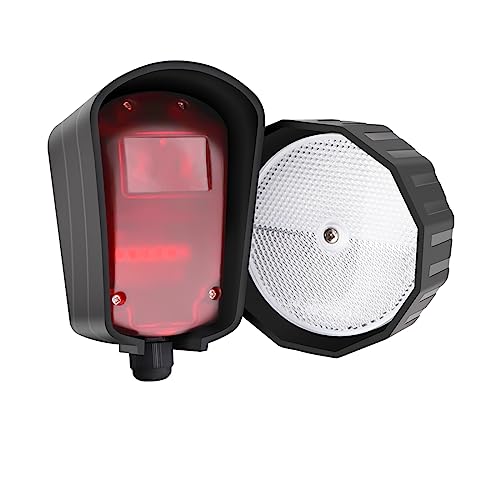
The TOPENS TRF3 stands out because it uses a retro-reflective design—the transmitter and receiver live in one housing, and a reflector on the opposite side bounces the beam back. This halves the wiring effort compared to traditional through-beam photocells and makes alignment less finicky. The unit draws power from 12 to 30 VDC or 10 to 25 VAC, giving it flexibility across both TOPENS gate openers and third-party control boards that accept a dry-contact NO/NC signal.
The beam creates a reliable safety barrier for swing and sliding gates. Once triggered, the sensor commands the opener to stop or reverse, which is critical for preventing vehicle or pedestrian injury. The UV-resistant, flame-retardant housing holds up well under direct sun and rain, though one reviewer reported water ingress after heavy rain, so careful sealing of the cable entry point is advised during installation.
Setup requires aligning the invisible beam between the sensor and its reflector. Use the green LED as your alignment guide, and mount the photocell at least 8 inches above ground. The 12-month warranty and responsive support from TOPENS provide solid backup if any issues arise. For anyone building or upgrading an automatic gate system, this is the sensor that balances long-range reliability with straightforward DIY installation.
Why it’s great
- Reflective design means only one wired housing, reducing installation complexity
- Wide voltage range (12–30VDC or 10–25VAC) works with most gate controllers
- Green LED alignment guide makes beam targeting much easier than guessing
Good to know
- Waterproofing at the cable entry point needs extra attention in wet climates
- Adjusting NO/NC signal logic may be required depending on your controller
2. Philips Hue Outdoor Motion Sensor

The Philips Hue Outdoor Motion Sensor is purpose-built for the Hue ecosystem and requires a Hue Bridge, which adds a layer of cost but unlocks powerful automations. The sensor detects motion across a 160-degree arc at up to 39 feet, which easily covers a standard driveway or porch. Beyond basic motion, it also reports ambient temperature and light level, allowing automations that react to sunset or chill.
Its sensitivity is almost too good—several reviewers noted false triggers from pedestrians on the sidewalk or cars across the street, even on the low setting. A 10-second activation delay helps filter out momentary events, and the adjustable timer (which resets with each new motion event) gives you control over how long your Hue lights stay on. The IP44 weatherproof rating ensures it survives rain and snow, though battery replacement (4x AA) will be required every 6–12 months depending on traffic.
Installation is straightforward: mount it on a wall or corner using the included bracket, pair it with the Hue app, and build your routines. For anyone already invested in Hue lights, this sensor is the natural choice for automating outdoor lighting without dealing with wiring. If you are not a Hue user, the bridge requirement makes this a non-starter—look at a standalone PIR switch instead.
Why it’s great
- Seamless integration with Hue Bridge for complex, sunset-aware automations
- Reports temperature and light level for context-sensitive triggers
- IP44 weatherproof rating handles rain, snow, and direct outdoor exposure
Good to know
- Requires a Hue Bridge (sold separately)—no standalone Bluetooth mode
- High sensitivity may pick up distant motion; a delay setting helps reduce false triggers
- Battery-powered design means periodic replacement in high-traffic zones
3. ECOELER Ceiling Occupancy Motion Sensor (5-Pack)

The ECOELER occupancy sensor is designed for ceiling mounting in commercial and workshop environments. Its 360-degree PIR detection pattern covers a 24-foot diameter circle when mounted at 20 feet high, making it ideal for large spaces like warehouses, showrooms, and storage areas. The sensor supports 120/277 VAC and works with LED, CFL, incandescent, and low-voltage loads—a broad compatibility that eases retrofitting.
Adjustability is the key advantage here. You can set the time delay anywhere from 15 seconds to 30 minutes, dial the motion sensitivity from 20% to 100%, and enable ambient light level sensing so the lights stay off during bright daylight. One commercial installer reported deploying 30 units across a light store and cutting electricity bills noticeably. The five-pack is a strong value proposition for multi-zone installations.
The sensor requires a neutral wire—this is non-negotiable, so check your junction box wiring before purchasing. The included mounting accessories and ample wire length make installation manageable for anyone with basic electrical experience. If your project involves high-bay fixtures or open-plan rooms where you want lights to follow occupancy, the ECOELER five-pack is the most cost-effective route to full coverage.
Why it’s great
- 360-degree coverage with a 20-ft maximum mounting height suits high ceilings
- Three adjustable parameters (time, sensitivity, light level) offer fine-grained control
- Five-pack pricing delivers strong value for multi-room or large-area installation
Good to know
- Neutral wire is mandatory—incompatible with older switch boxes that lack it
- At lower mounting heights, the 360° pattern may detect motion well beyond the intended area
4. Lutron Maestro Motion Sensor Switch MS-OPS2H-2-WH
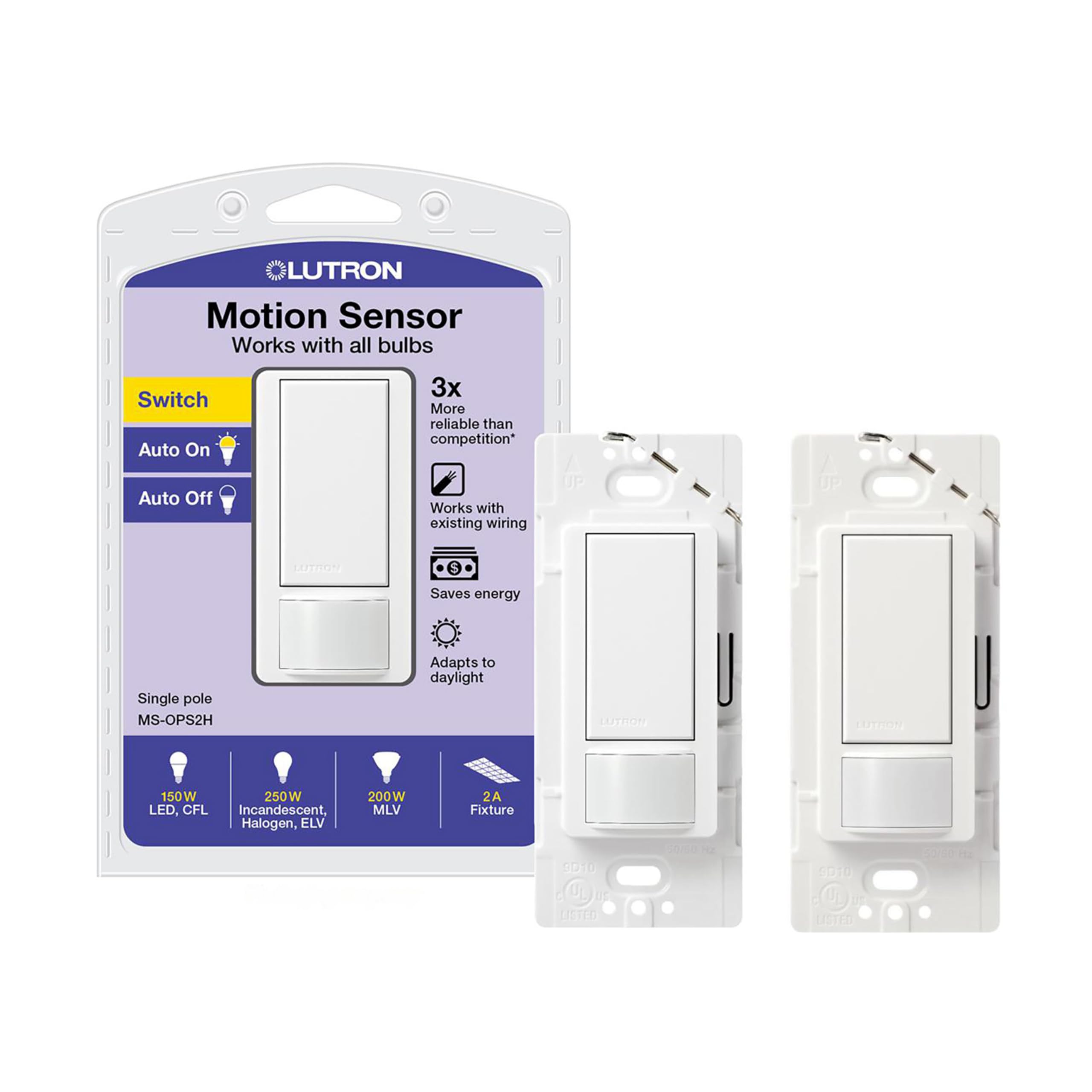
The Lutron Maestro MS-OPS2H-2-WH is the go-to wall-switch replacement for bathrooms, laundry rooms, closets, and pantries. It operates in both Occupancy mode (auto-on/auto-off) and Vacancy mode (manual-on/auto-off), giving you full control over whether you want the lights to spring to life as soon as you enter or only after you manually flip the switch. The 150-degree detection zone covers the typical small-room entrance area without false-triggering through walls.
Installation takes about 15 minutes if you have a neutral wire available—though Lutron includes a ground-wire option for homes without a neutral. The switch handles up to 150 watts of CFL/LED or 250 watts of incandescent, making it compatible with most residential fixtures. Multiple reviewers noted that the audible relay click confirms activation, though some find it noticeable in quiet spaces. The programmable timeout (1, 5, 15, or 30 minutes) is set using the front button, and the included 2-pack covers two rooms at once.
This sensor excels at eliminating the “did I leave the light on?” anxiety. It learns ambient light levels over time and keeps lights off during bright daylight, further reducing energy waste. For a straightforward, reliable, and well-documented switch that requires no smart hub, the Lutron Maestro is the standard against which other wall-mount PIR sensors are measured.
Why it’s great
- Dual occupancy/vacancy modes cover both automatic and manual-on preferences
- 15-minute install with neutral OR ground wire wiring—rare flexibility
- Ambient light learning prevents unnecessary activation during daytime
Good to know
- Wallplate sold separately—not included in the box
- Audible relay click may be noticeable in very quiet bathrooms or bedrooms
- Single-pole only—not designed for 3-way or 4-way switch configurations
5. Digi-Code CR2149 Universal Safety Beam Sensor

The Digi-Code CR2149 is a universal through-beam sensor designed to work with Chamberlain, LiftMaster, Craftsman, Genie, Stanley, Overhead Door, and many other brands manufactured from 1995 onward. Its non-polarized wiring is a standout feature: you cannot hook it up backward, which saves a headache during installation. A yellow wire loop on the receiver unit acts as a compatibility jumper—clipping it adapts the sensor to openers that use a yellow terminal block.
Installation requires aligning the infrared beam between the two small plastic housings, which should be mounted on your garage door tracks about 6 inches above the floor. The LEDs glow red on both units when alignment is correct, and fine-tuning is often needed to get the beam perfectly square. Reviewers report successful retrofits on Stanley, Moore-o-Matic, and Challenger openers that otherwise seemed unsupported. The 15-minute install time is realistic if your existing brackets align.
One potential issue: the manual is sparse, and wiring diagrams are minimal. If your opener uses a 2-wire sensor setup, you will need to combine the positive and negative wires from the receiver before connecting to the opener. This sensor is the right choice when you have a legacy opener that no longer has OEM parts available, and you want a drop-in replacement without changing your entire garage system.
Why it’s great
- Non-polarized wiring eliminates the risk of reverse-connection damage
- Yellow wire jumper adapts compatibility to a wide range of opener brands
- Works with openers from the mid-90s, ideal for legacy system repairs
Good to know
- Manual lacks detailed wiring guidance; some trial-and-error may be required
- Beam alignment can be finicky and may need several adjustment attempts
6. Chamberlain 820CB Replacement Garage Door Safety Sensor (2-Pack)

The Chamberlain 820CB is the factory replacement sensor for all Chamberlain, LiftMaster, and most Craftsman openers made after 1997. It is a through-beam pair: one unit emits an infrared beam, the other receives it. Any break in the beam signals the opener to reverse, which is the core safety function. The low-profile design sits closer to the track than older bulkier sensors, reducing the chance of being knocked out of alignment by a bump or vibration.
A common failure mode for these sensors is sunlight interference—direct light from a low-angle sun can mimic a broken beam and cause the door to reverse when no obstruction exists. The 820CB uses brighter amber and green LEDs that help confirm alignment at a glance, and several reviewers report that swapping their old sensors for these solved the sunlight problem entirely. The package includes 18 inches of extension wire and mounting brackets, though the supplied wire connectors are small—some users prefer to use their own wire nuts.
Installation is straightforward if you are replacing an existing set: loosen the wing nuts, unclip the old sensors, and attach the new ones using the same brackets. If you need to mount new brackets, be prepared to drill holes and run wire. With a typical install time of 45 minutes, this is an accessible DIY fix that avoids the + cost of professional service. If your garage door is erratic on sunny afternoons, start here.
Why it’s great
- Brighter indicator LEDs make alignment troubleshooting much easier
- Low-profile design reduces risk of misalignment from accidental bumps
- Direct OEM fit for 1997+ Chamberlain, LiftMaster, and Craftsman openers
Good to know
- No printed manual included—installation relies on online guides or prior experience
- Included wire connectors are small and may not grip 18-gauge wire firmly
7. MENGQI-CONTROL Request to Exit PIR/Microwave Sensor

The MENGQI-CONTROL sensor uses 24 GHz microwave Doppler radar rather than PIR, which lets it detect motion through thin non-metallic surfaces and in environments with temperature swings that would confuse an infrared sensor. This makes it an excellent choice for commercial automatic sliding doors and request-to-exit (REX) access control systems. The sensor outputs a dry-contact relay signal (NO and COM, no NC supported), which triggers the door lock or opener when motion is detected.
Detection range is rated at 4 meters wide by 2 meters deep when mounted at the maximum height of 3–4 meters (roughly 10–13 feet). The adjustable angle and sensitivity allow you to create a focused detection zone that ignores activity outside the entrance area. Several reviewers note that the sensor is actually microwave, not PIR as the listing initially suggests, and that this is a benefit: it eliminates the false triggers from direct sunlight or HVAC vents that plague PIR sensors in commercial settings.
Wiring is simple—connect the NO/COM terminals to your door controller or relay board. The sensor is not smart-home compatible, so do not expect app integration or scheduling. One reviewer noted excellent support from the manufacturer when wiring a specific sliding-door controller. If you need a reliable, low-cost sensor for a commercial automatic door or access control system and do not require remote management, this is a solid pick that has held up for users over three-plus years.
Why it’s great
- 24 GHz microwave sensing ignores ambient heat and sunlight, reducing false triggers
- Adjustable angle and sensitivity let you carve out a precise detection zone
- Proven reliability with reports of 3+ years of continuous operation
Good to know
- Supports NO/COM only—not compatible with NC (normally closed) alarm circuits
- No smart-home connectivity; purely a dry-contact relay trigger for access systems
FAQ
Why does my garage door reverse on sunny days but not on cloudy ones?
Can I mix a new automatic door sensor with an old garage door opener?
What is the difference between occupancy and vacancy mode on a wall-switch sensor?
Final Thoughts: The Verdict
For most users, the best automatic door sensors winner is the TOPENS TRF3 because its retro-reflective design simplifies installation on any automatic gate while providing robust weather resistance and broad voltage compatibility. If you want to automate your porch and driveway lighting within the Hue ecosystem, grab the Philips Hue Outdoor Motion Sensor. And for fixing a legacy garage door opener on a budget, nothing beats the universal compatibility of the Digi-Code CR2149.