
A basement flood during a thunderstorm isn’t a question of if — it’s a question of when the power goes out. Your primary sump pump is useless without grid electricity, and a heavy rain that knocks out your power also brings the water your pump can’t touch. That’s the exact scenario a dedicated battery backup sump pump system is engineered to solve, providing automatic, instant water removal when your main pump goes silent.
I’m Min — the co-founder and writer behind Gadgets Feed. For this guide, I’ve analyzed pitch, GPH (gallons per hour) ratings at specific lift heights, battery type compatibility, charger behavior (float vs. fixed voltage), and real-world runtime claims across over two dozen product data sheets and hundreds of verified customer reviews to separate the systems that truly protect a basement from those that just take up space.
best battery backup for sump pump systems must balance reliable automatic switchover, adequate pumping volume, and a charger that won’t silently destroy your expensive deep-cycle battery. This guide breaks down nine market-leading options to help you choose the right flood defense for your home.
How To Choose The Best Battery Backup For Sump Pump
Selecting the right battery backup system isn’t just about matching a brand to your existing pump. You need to evaluate pumping capacity, battery chemistry, charger intelligence, and the physical dimensions of your sump pit. Ignoring any one of these factors can leave you with a system that fails when you need it most.
Pumping Capacity: Look Beyond the Maximum GPH
Every backup sump pump lists a peak flow rate, often 2,500 GPH or higher. That number is measured at 0 feet of lift — basically, pumping water sideways into a ditch. In a real basement, your pump must lift water 8 to 15 vertical feet out of the pit and through a check valve. Focus on the GPH rating at 10 feet of lift. A pump that delivers 25 GPM (1,500 GPH) at 10 ft is significantly more capable than one that drops to 10 GPM at that height. Check the spec sheet for the “maximum lifting height” and the curve table if available.
Battery Type: AGM vs. Wet-Cell vs. Lithium
Most systems require a separate deep-cycle battery. AGM (Absorbent Glass Mat) batteries are the dominant choice because they are maintenance-free, spill-proof, and tolerate deep discharges better than standard car batteries. Wet-cell (flooded lead-acid) batteries cost less initially but require periodic water top-ups and venting for hydrogen gas. Lithium deep-cycle batteries offer lighter weight and longer cycle life but cost significantly more and may require a compatible smart charger. Never use a standard automotive starting battery — it will fail after a few deep discharge cycles.
Charger Intelligence: Float vs. Fixed Voltage
The charger built into the backup control unit determines battery lifespan. A smart “float” charger drops to a lower maintenance voltage (typically 13.2V – 13.8V) once the battery is full, preventing overcharging and gassing. A fixed-voltage charger that stays at 14.1V or higher indefinitely will slowly destroy an AGM or gel battery within 12–18 months. Look for systems that explicitly state a multi-stage charging profile or float mode. This single spec can save you the cost of a replacement battery every two years.
Switch Mechanism: Redundancy Matters
A single float switch is a single point of failure. The best backup systems use a dual float switch — two independent float mechanisms wired in parallel. If one sticks or fails, the other activates the pump. Vertical float switches are more space-efficient in narrow pits, while tethered floats require more clearance to swing freely. Avoid pumps that rely solely on a diaphragm or pressure switch for activation, as these are prone to clogging in debris-laden sump water.
Quick Comparison
On smaller screens, swipe sideways to see the full table.
| Model | Category | Best For | Key Spec | Amazon |
|---|---|---|---|---|
| Wayne WSS30VN | Premium Combo | All-in-one dual pump system | 5,100 GPH / 1/2 HP AC + DC backup | Amazon |
| Westinghouse WH50BBU | Premium Dual Pump | Cast-iron / stainless durability | 87 GPM max / 1/2 HP + 12V backup | Amazon |
| Zoeller Aquanot 508 | Premium Standalone | American-made quality | 40 GPM / Aluminum control box | Amazon |
| Wayne ESP25n | Mid-Range Standalone | Proven, quiet backup pump | 2,700 GPH / Cast-iron base | Amazon |
| PumpSpy 2000W | Inverter/UPS System | Powering existing AC pump | 2,000W pure sine wave | Amazon |
| Viopumpo 2500W | Inverter/UPS System | High-wattage pure sine backup | 2,500W / LCD remote display | Amazon |
| Basement Watchdog BWE | Value Standalone | Budget-friendly entry point | 2,500 GPH / Dual float switch | Amazon |
| Superior Pump 92910 | Value Standalone | Compact budget backup | 1,380 GPH / Thermoplastic | Amazon |
| Basement Watchdog BW-27AGM | Replacement Battery | High-capacity AGM battery | 27 Ah / Maintenance-free | Amazon |
In‑Depth Reviews
1. Wayne WSS30VN 1/2 HP Combo System

The Wayne WSS30VN is the rare all-in-one solution that integrates a 1/2 HP primary AC pump with a 12V DC backup pump in a single pre-assembled unit. Rated at 5,100 GPH, it delivers 85 GPM through its primary motor while the backup can move up to 2,700 GPH — enough to keep up with heavy inflow even during an extended outage. The pre-assembled design means you’re drop-in ready in about 15 minutes, a significant time saving over separate-pump installations.
At a 10-foot lift, the backup pump still handles serious throughput thanks to its efficient DC motor, and the system has been tested to 1 million cycles. The pump uses two separate float switches — one for the AC primary and one for the DC backup — allowing independent operation and redundancy. It fits 16-inch or larger basins and requires no weep hole drilling, reducing installation complexity.
The included charger is a potential weak point in the ecosystem. Reports indicate the charger can supply clean power, but pairing the system with a quality AGM or marine battery and monitoring voltage levels yourself ensures the battery isn’t silently overcharged. At 44 pounds, this is a substantial unit that signals durable construction. The 3-year warranty is among the best in the category, reflecting Wayne’s confidence in the system’s longevity.
Why it’s great
- Pre-assembled combo saves hours of setup work
- Powerful 5,100 GPH primary with robust DC backup
- Separate float switches for AC and DC pumps
Good to know
- Heavy at 44 pounds — needs sturdy basin support
- Some users recommend a separate smart charger for battery health
2. Westinghouse WH50BBU 1/2 HP Dual Pump
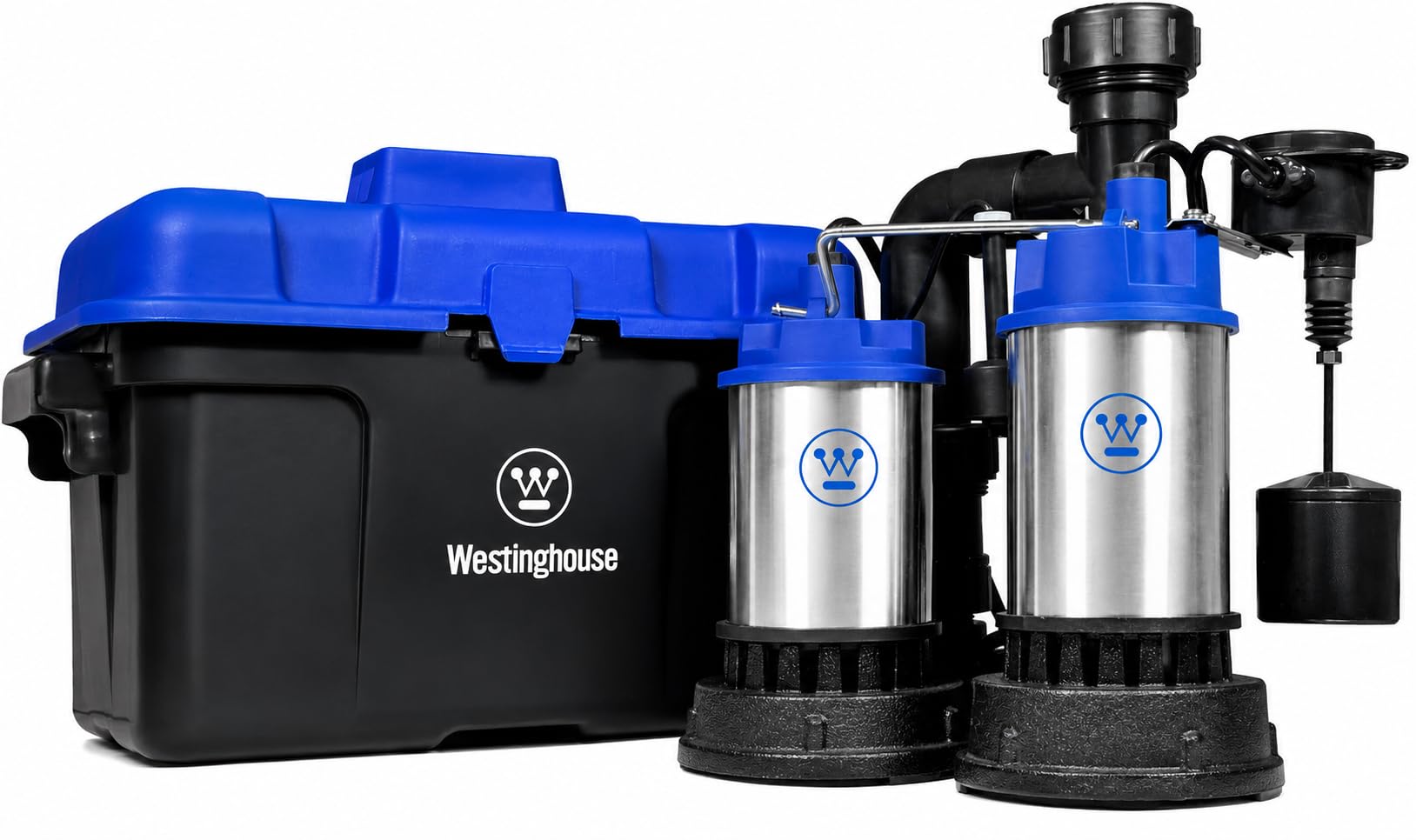
The Westinghouse WH50BBU stands apart with its stainless steel pump housing and cast-iron base, a combination that resists the corrosion common in wet basement environments. Both the 1/2 HP primary pump and the DC backup share this durable construction, and the top-suction design prevents airlock while reducing debris intake — a clear upgrade over traditional bottom-suction pumps that can clog more easily.
Flow rate hits 87 GPM (5,220 GPH) from the primary motor, with a 30-foot maximum lift height, meaning this system can handle deep basement pits without losing significant performance. The thermal-overload-protected PSC motor runs quietly, and the backup pump automatically switches on the instant AC power drops. The compact footprint — just 14.4 x 9.3 x 15 inches — fits tighter sump pits where larger combos won’t squeeze in.
The charger cable on the backup power supply is short, which may require an extension or creative placement of the battery. Westinghouse doesn’t include a battery, so budget for a Group 27 or larger deep-cycle AGM. The combined weight of 50 pounds means this is a permanent installation. Users consistently praise the quiet operation and the solid feel of the metal construction over cheaper thermoplastic alternatives.
Why it’s great
- Stainless steel housing resists rust far better than plastic
- Top-suction design cuts airlock and clog risks
- High 30-foot lift capacity for deep sump pits
Good to know
- Charger adapter cable is short — plan battery placement carefully
- Heavier than most combos at 50 pounds
3. Zoeller Aquanot 508 Battery Back-Up System
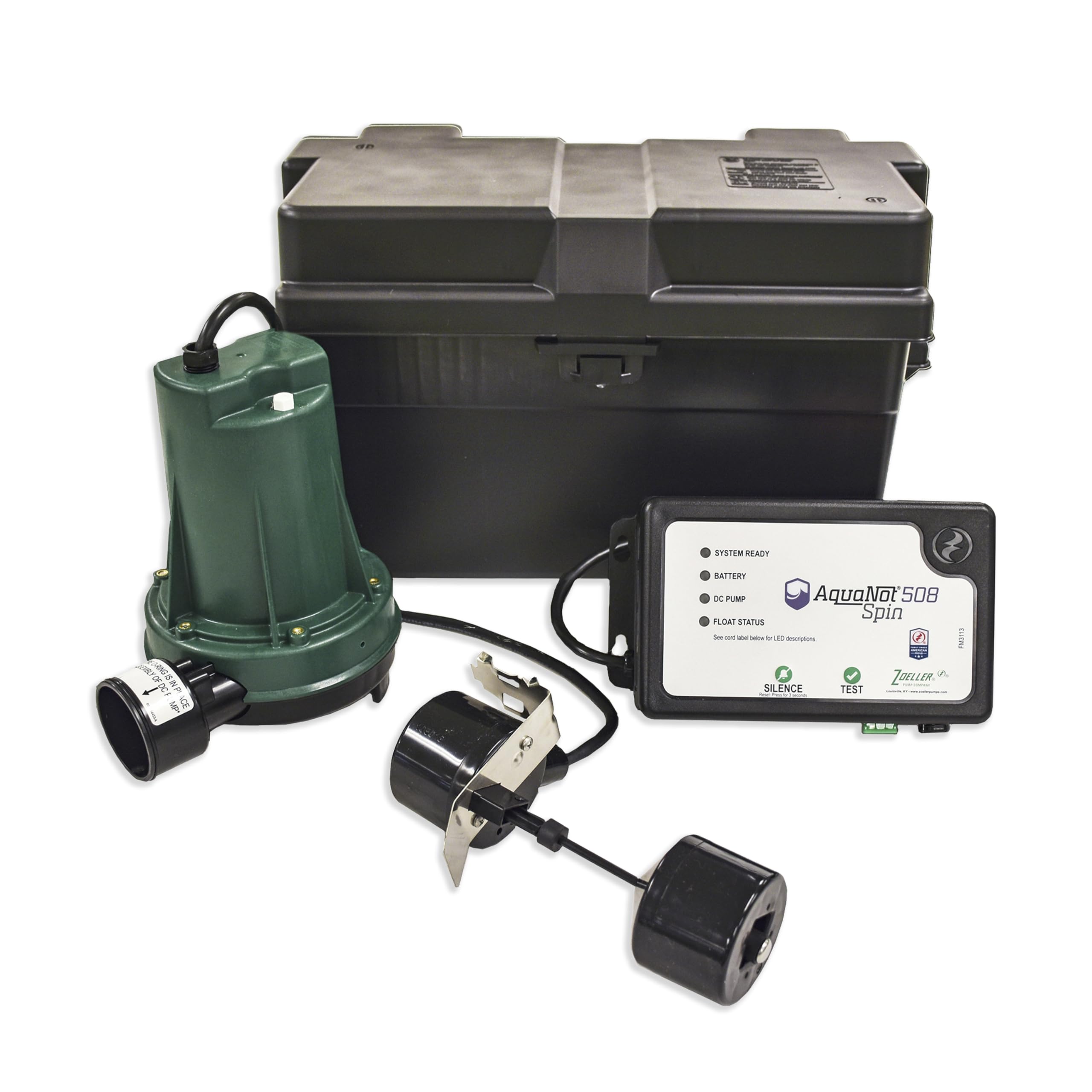
Zoeller has been hand-building pumps in the USA since 1939, and the Aquanot 508 carries that legacy with a non-corrosive pump construction, an aluminum control box with an integrated LCD, and an aluminum seal pocket and cooling plate that dissipate heat far better than plastic housings. It’s a standalone backup system, meaning you pair it with your existing primary AC pump — and that gives you the flexibility to choose your preferred primary unit.
The 508 delivers 40 GPM at 0 feet of lift and handles a 25-foot maximum lift height. It includes an integrated check valve and a quick-disconnect discharge, simplifying installation and future maintenance. The float switch is a tethered design that requires adequate clearance inside the sump pit — Zoeller recommends an 18-inch minimum basin diameter for proper operation.
The control unit features an audible alarm that sounds when the backup activates, but it is notably loud — a deliberate design choice to ensure you hear it. The built-in charger is a multi-stage unit that properly floats the battery, addressing the fixed-voltage overcharging issue found in some competitors. Zoeller extends the warranty to 36 months when you purchase an Aquanot battery alongside the system, a strong incentive to stay within the ecosystem. The 508 is a premium investment, but its build quality and support justify the entry fee for owners who prioritize reliability above all else.
Why it’s great
- Hand-built and 100% tested in the USA
- Aluminum control box with LCD for clear system status
- Three-year warranty with Aquanot battery purchase
Good to know
- Alarm is very loud — some users find it startling
- Standalone backup requires a separate primary pump
4. Wayne ESP25n 12 Volt Battery Back Up
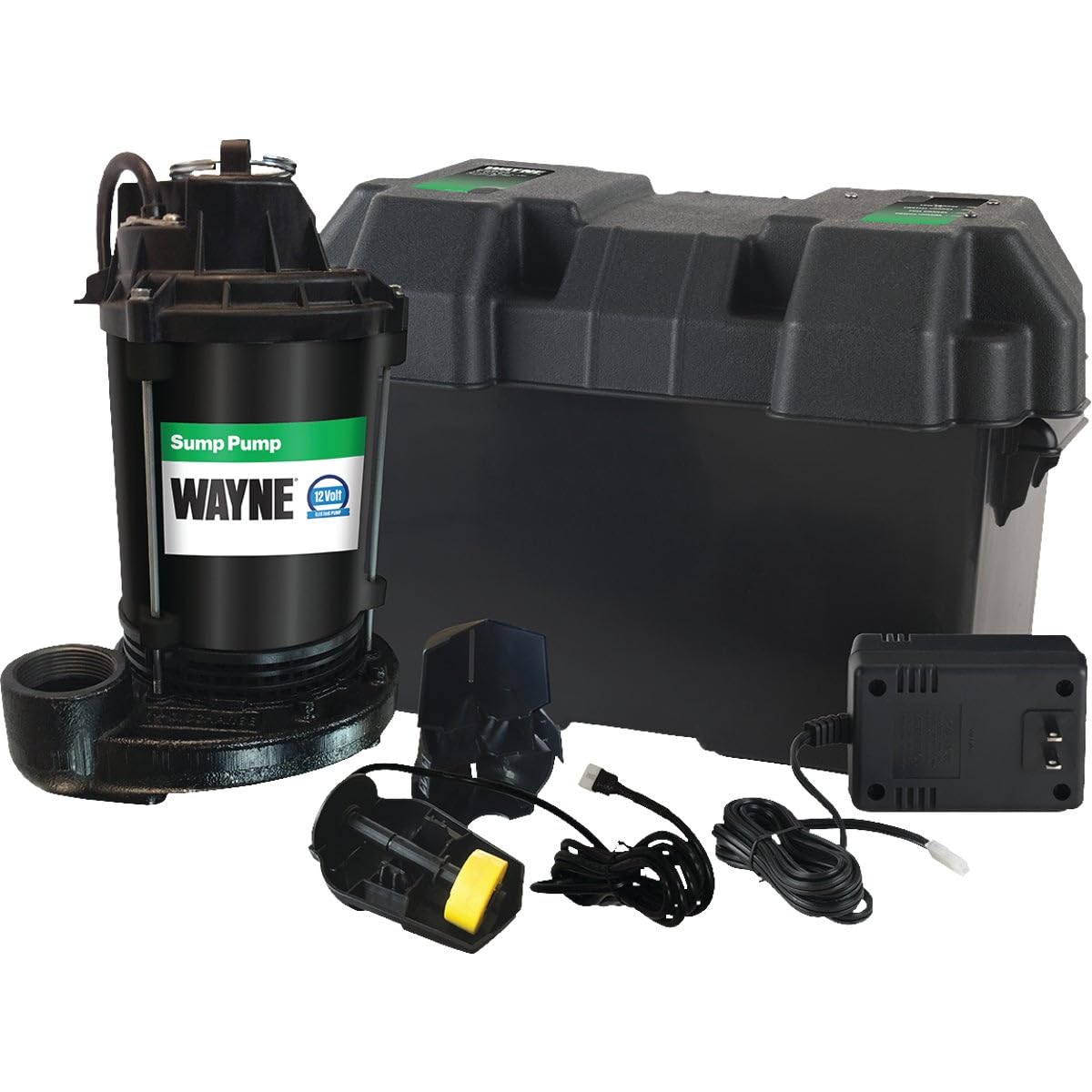
The Wayne ESP25n is the most popular standalone battery backup pump on the market for good reason. It moves 2,700 GPH (45 GPM) at 0 feet of lift and a solid 1,500 GPH at 10 feet, emptying a typical sump pit quickly even under moderate head pressure. The epoxy-coated steel housing combined with a cast-iron base provides corrosion resistance where it matters most — at the bottom of a wet pit.
The included battery box features an LED display and an audible alarm, keeping you informed about battery status and backup activation. The float switch is a reed-style design that fits inside 14-inch or larger basins, making it compatible with most residential sump pits. Installation is straightforward for a DIYer with basic plumbing skills, and the pump is exceptionally quiet during operation — a common point of praise in user reviews.
A critical consideration: the built-in “smart” charger does not drop to a true float voltage, instead maintaining a fixed 14.1V output. This is fine for the occasional discharge cycle but will slowly degrade AGM and gel batteries over 12-18 months if left on continuous charge. Budget-conscious owners can mitigate this by wiring in an external multi-stage charger. Despite this quirk, the ESP25n’s pumping performance and build quality make it a strong mid-range contender for those willing to manage battery charging.
Why it’s great
- Proven 2,700 GPH performance with strong 10-ft lift rating
- Cast-iron base and epoxy-coated steel resist corrosion
- Quiet operation and simple DIY installation
Good to know
- Fixed-voltage charger can shorten AGM battery life
- Battery box lid doesn’t fully seal against moisture
5. PumpSpy 2000W Sump Pump Battery Backup System

The PumpSpy 2000W takes a different approach from dedicated backup pumps: it’s a pure sine wave inverter/UPS system that powers your existing AC sump pump from a 12V deep-cycle battery. This means you keep your primary pump (which is likely higher quality than most backup pumps), while the PumpSpy handles the emergency power switching. The 2,000-watt output can run a 1/3 HP or even a 1/2 HP pump with headroom to spare, and it can simultaneously power two pumps as long as combined current stays under 16.6 amps.
The unit auto-switches to battery power in milliseconds when AC fails, then instantly recharges when power returns. It includes two grounded outlets and a USB port, offering flexibility to power additional devices like a Wi-Fi router or phone charger. The aluminum enclosure measures 17.5 x 6.75 x 4 inches and can be wall-mounted using the included hardware and concrete bit — a nice touch for permanent installation.
PumpSpy is manufactured and tested in Kalamazoo, Michigan, and the company provides US-based technical support. The kit does not include a battery, and the red/black battery cables are on the shorter side — some users needed to drill a hole through the battery box or buy longer cables for comfortable placement. The intelligent cooling fan extends the unit’s lifespan, and the trickle-charge maintenance keeps the battery ready without overcharging. For homeowners who already own a reliable primary pump and want a pure UPS-style backup, this is the cleanest solution.
Why it’s great
- Pure sine wave output — safe for all pump motors and electronics
- Can power two sump pumps simultaneously
- US-based technical support and included wall-mount hardware
Good to know
- Battery cables are quite short — plan placement accordingly
- Requires a separate deep-cycle battery (not included)
6. Viopumpo 2500W Battery Backup System
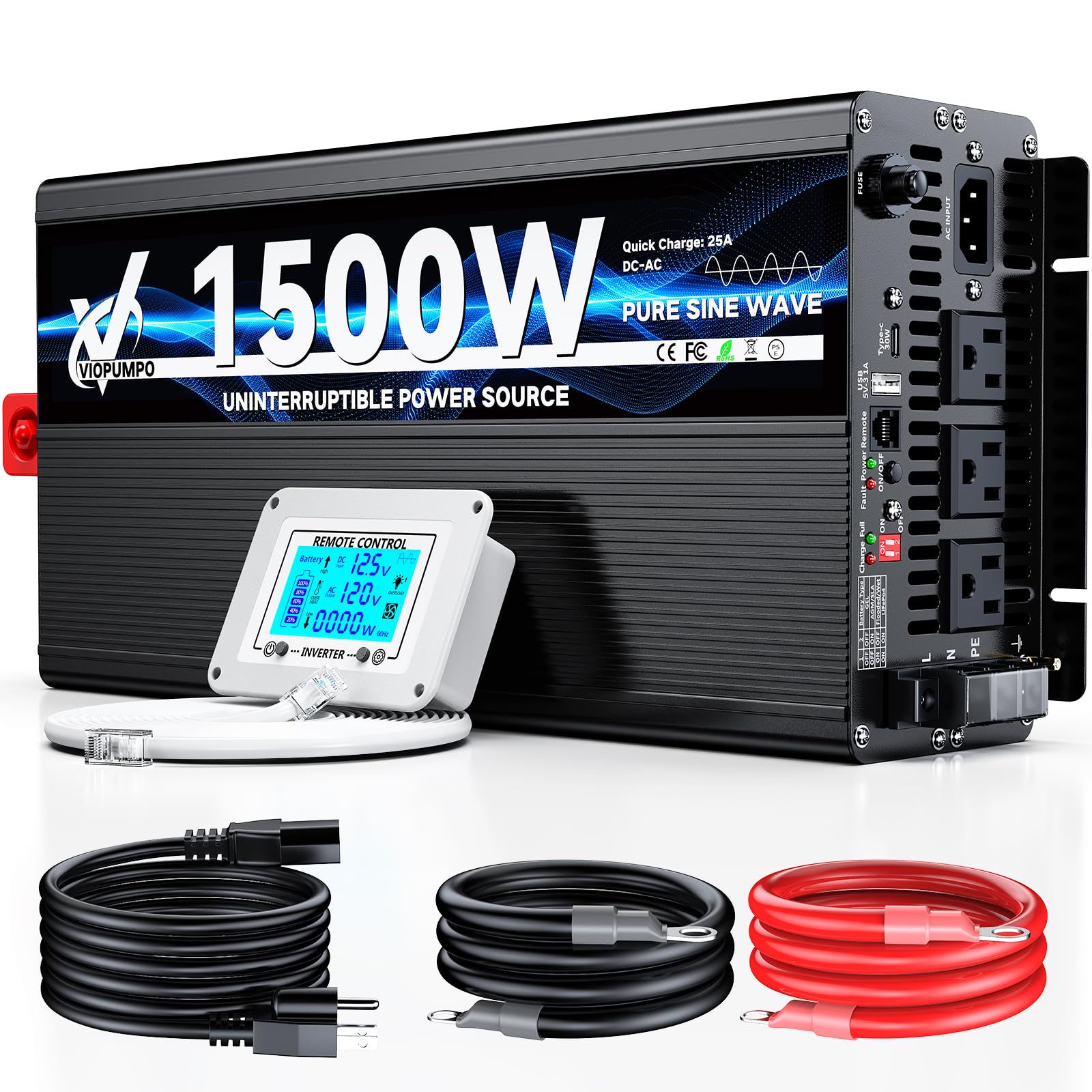
The Viopumpo 2500W pushes the inverter/UPS concept further with a 2,500-watt continuous output and a built-in 25A battery charger that supports fast charging and trickle charging for AGM, lithium, and deep-cycle batteries. The pure sine wave output is clean enough for any inductive load — including larger 3/4 HP sump pumps — without the humming or overheating that modified sine wave inverters can cause.
A standout feature is the high-definition LCD remote controller, which displays voltage, power draw, and battery charge status in real time. You can mount this remote near your main panel or in a living area while keeping the inverter itself in the basement. The unit includes multiple protection circuits: overload, overheat, short circuit, low voltage, and overcharge protection — all of which contribute to system longevity.
Installation is genuinely simple: connect AC and DC cables, plug your sump pump into the unit’s outlet, and the system handles the rest. The Viopumpo can be wall-mounted via side fixing holes or placed flat on a shelf. The inverter is certified with CE compliance, but note that the instructions could be clearer — a quick YouTube video will fill in the gaps. For homeowners with a larger pump or who want headroom for additional loads like a small refrigerator or lights during an outage, this 2,500W unit is a compelling choice.
Why it’s great
- 2,500W pure sine wave handles larger 3/4 HP pumps
- Remote LCD monitor shows real-time voltage and power
- 25A smart charger supports lithium and AGM batteries
Good to know
- Installation manual could be more detailed
- Not compatible with non-deep-cycle batteries
7. Basement Watchdog Emergency BWE System

The Basement Watchdog Emergency BWE system is the entry-level champion for value-conscious buyers who still want dual-float reliability. It pumps 2,500 GPH (42 GPM) at 0 feet and 1,500 GPH at 10 feet of lift — performance that directly matches the Wayne ESP25n at a lower entry point. The copper-wound motor and thermoplastic housing provide adequate durability for typical residential use, though not as heavy-duty as cast-iron options.
The control panel is user-friendly: it monitors power, battery condition, and pump status 24/7 with visual alerts and audible alarms that describe the specific issue — a helpful touch over simple beep-only alarms. The automatic 0.4-amp charger is basic but functional, and the system is compatible with both AGM and wet-cell batteries, giving you flexibility at purchase time. The pump body is compact enough to fit in small or narrow sump pits, a practical advantage in retrofits.
Installation is well-documented with a manual featuring over 90 pictures, making this one of the most approachable systems for first-time DIYers. The battery and battery box are not included, so factor that into your total cost. The 2-year limited warranty is standard for the tier. While it lacks the premium build of Zoeller or the combo convenience of Wayne, the BWE delivers core backup functionality at a price that leaves room in the budget for a quality AGM battery — arguably a smarter allocation of funds.
Why it’s great
- Dual float switch adds critical redundancy at this price point
- User-friendly control panel with descriptive audible alerts
- Detailed installation manual — great for DIY beginners
Good to know
- Thermoplastic housing less durable than cast-iron alternatives
- Battery and battery box sold separately
8. Superior Pump 92910 12V Back Up
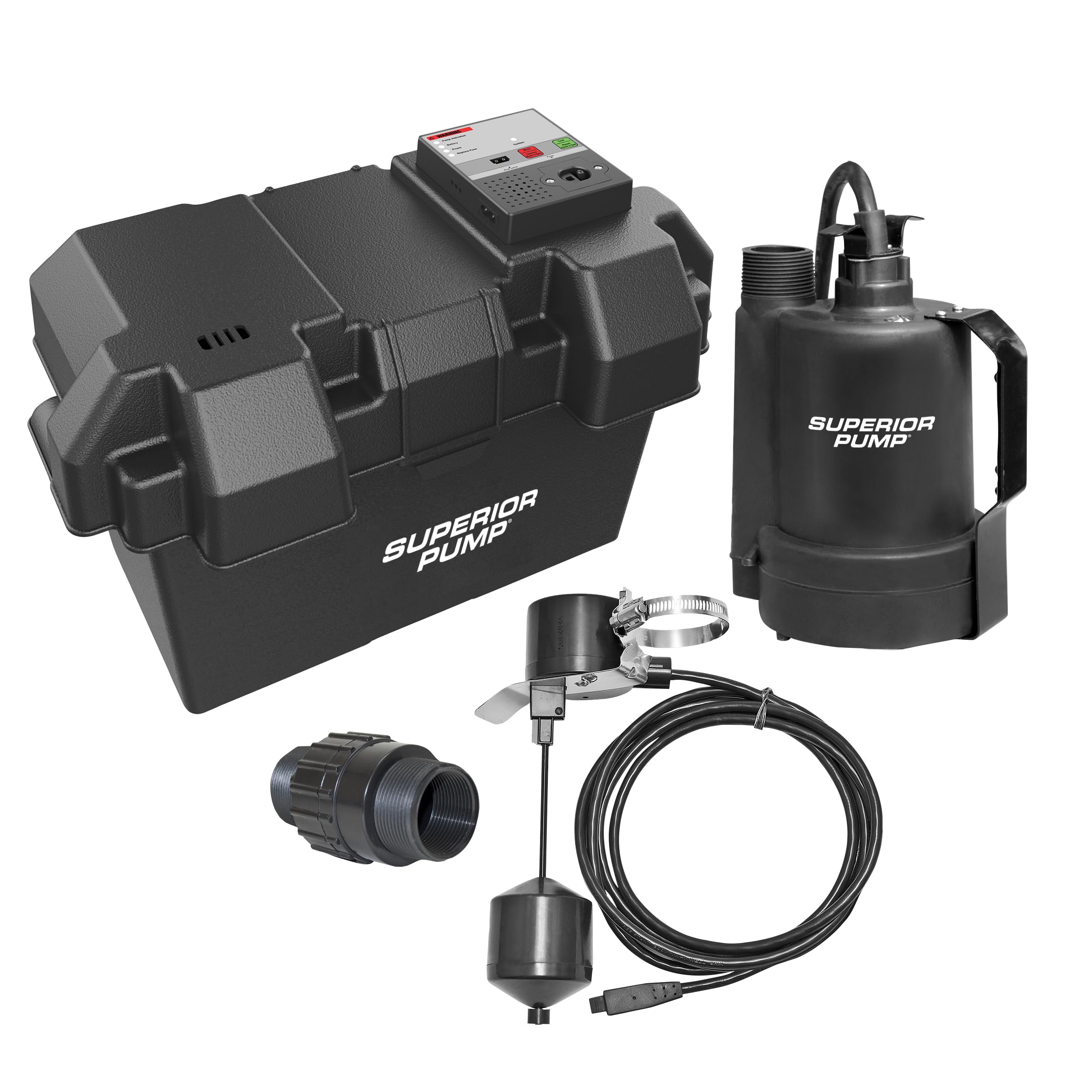
The Superior Pump 92910 targets the critical budget segment where every dollar matters. It delivers 1,380 GPH (23 GPM) with a 25-foot maximum lift height, using a 12V DC motor and a vertical float switch. The thermoplastic construction keeps weight down to 12.25 pounds and cost low, but it comes with trade-offs in long-term durability compared to the metal-bodied pumps higher on this list.
Installation is straightforward for a backup system: the pump connects to either 1-1/4 inch or 1-1/2 inch NPT discharge, and the vertical float switch is space-efficient, making it a decent fit for smaller sump pits where a tethered float won’t swing. It is 100% factory tested, and Superior Pump offers a 1-year limited warranty — the shortest coverage among our picks, which reflects the entry-level positioning.
Users frequently pair the 92910 with a MightyMax or similar 75Ah AGM battery and a separate battery box with a charger. The system does not include a battery or control panel, so you must assemble the full solution yourself. The check valve included in some kits may be prone to cracking — upgrading to a Zoeller or other brass check valve is a common recommendation. For a secondary backup in a low-water-risk area or as a temporary solution, the 92910 provides functional protection at the lowest entry cost.
Why it’s great
- Lowest entry price for a functional 12V backup pump
- Vertical float switch fits tight sump pits well
- Light at 12.25 pounds — easy to handle during installation
Good to know
- Lower flow rate — not ideal for high-water inflow areas
- Included check valve may have quality issues
9. Basement Watchdog BW-27AGM Battery

The Basement Watchdog BW-27AGM is a dedicated AGM battery designed specifically for use with Basement Watchdog backup sump pump systems, though it works with any 12V backup pump system rated for AGM batteries. It offers up to 80 hours of intermittent protection (at a 10% duty cycle) when paired with the BWE system, or up to 40 hours with the larger Big Dog system — enough runtime to cover all but the longest multi-day outages.
Being maintenance-free is the key advantage: there’s no need to add distilled water or check specific gravity levels, which makes this battery ideal for homeowners who want a set-and-forget experience. The BW-27AGM is compatible with Basement Watchdog systems manufactured after 2014. Older units (pre-2014) may require a remote terminal adapter to avoid false alarms. At 22.6 kilograms (approximately 50 pounds), this is a heavy sealed battery that should be placed in the included battery box with proper ventilation.
This battery is also compatible with other brands’ backup systems as long as the charger is set to AGM mode or can be used with a separate smart charger. Users report reliable performance over several years, with many replacing older lead-acid batteries and appreciating the no-maintenance advantage. If you are building a system around a pump that does not include a battery, the BW-27AGM is a solid, compatible drop-in choice that eliminates the guesswork from battery selection.
Why it’s great
- Zero maintenance — no water refills or acid checks needed
- Long runtime with Basement Watchdog BWE system (up to 80 hours)
- Spill-proof AGM design is safer for indoor installation
Good to know
- Only compatible with Basement Watchdog systems after 2014
- Heavy at ~50 pounds — needs sturdy battery box placement
FAQ
Can I use a regular car battery for my sump pump backup?
How long does a battery backup sump pump run during an outage?
Should I get a dedicated backup pump or an inverter/UPS system?
What size battery do I need for my sump pump backup?
Do I need a professional to install a battery backup sump pump?
Final Thoughts: The Verdict
For most users, the best battery backup for sump pump is the Wayne WSS30VN because it combines a powerful 1/2 HP primary pump with an integrated DC backup in a single pre-assembled drop-in unit, offering the best balance of convenience, performance, and value. If you want premium American-made build quality and are comfortable with a standalone backup solution, grab the Zoeller Aquanot 508. And for homeowners who already own a reliable primary pump and want a pure UPS-style backup that can also power other devices during an outage, nothing beats the PumpSpy 2000W inverter system. Whatever your choice, pairing any of these systems with a quality AGM deep-cycle battery ensures your basement stays dry — even when the grid goes dark.