
When you push magnification to 12x with a 50mm objective, you trade stability for raw reach. A shaky image defeats the purpose of those extra 2x over a standard 10x, so your choice hinges on how well optical coatings, prism quality, and chassis rigidity compensate for that inherent wobble. The right pair turns a distant bird, a lunar crater, or a buck at the treeline into a crisp, color-true postcard without requiring a concrete tripod every time.
I’m Min — the co-founder and writer behind Gadgets Feed. I’ve spent hundreds of hours comparing ED glass formulations, dielectric prism coatings, and phase-correction specs to isolate the binoculars that deliver genuine low-light performance and edge-to-edge clarity without demanding a second mortgage.
This guide dissects the seven most compelling options so you can confidently invest in a pair of 12×50 binoculars that will serve you for years of wildlife observation, celestial exploration, and outdoor discovery.
How To Choose The Best 12X50 Binoculars
Selecting a 12×50 pair means accepting that every optical flaw is magnified 12 times. A mediocre coating that looks fine at 8x becomes a washed-out, chromatic mess at 12x. Focus on four pillars: glass quality, prism type, coating layers, and environmental sealing. Ignore marketing gimmicks and check the exit pupil, eye relief, and field of view numbers.
Glass and Prism Architecture
Extra-low Dispersion (ED) glass is the single most important upgrade for a 12×50. Standard glass produces purple/green fringing on high-contrast edges — tree branches against a bright sky, for example. ED glass virtually eliminates that artifact. Combine ED with BaK-4 prisms (not BK-7) and you start with a clean, bright image. Roof prisms also require phase-correction coatings; without them, you lose resolution on fine detail like feather patterns or distant text.
Coating Arsenal and Light Transmission
Fully Multi-Coated (FMC) optics are table stakes at this aperture. Premium models add dielectric coatings on the prism surfaces to push light transmission past 99%, directly translating to brighter views at dawn and dusk. Some also layer an external hydrophobic/oleophobic coating — EXO Barrier on Bushnell or XPL on Athlon — that repels water, dirt, and smudges so you wipe less and see more in wet conditions.
Exit Pupil and Eye Relief Ergonomics
A 12×50 produces a 4.17mm exit pupil (50mm ÷ 12). That’s smaller than an 8×42’s 5.25mm, meaning precise eye alignment is more critical. Eye relief of 15mm or more is vital for eyeglass wearers to see the full field without vignetting. Twist-up eyecups with multiple click stops let you fine-tune that distance. If your eye relief is too short, you’ll chase the image like you’re peering through a keyhole.
Quick Comparison
On smaller screens, swipe sideways to see the full table.
| Model | Category | Best For | Key Spec | Amazon |
|---|---|---|---|---|
| Pentax Jupiter 12×50 | Porro Prism | Budget stargazing | Anti-Reflective Coating | Amazon |
| Sogries 12×50 ED | Roof ED | Travel and birding | ED Glass + BaK-4 | Amazon |
| Nikon PROSTAFF 5 12×50 | Mid-Range Roof | All-weather durability | Multicoated + 15.5mm ER | Amazon |
| Celestron Nature DX ED 12×50 | ED Roof | Astronomy and birding | ED Glass + Phase Coat | Amazon |
| Bushnell Engage 12×50 | Premium ED | Harsh weather conditions | EXO Barrier + Dielectric | Amazon |
| Athlon Midas G2 UHD 12×50 | Ultra HD | Critical resolution | UHD Glass + 99% Reflection | Amazon |
| Vortex Viper HD 12×50 | Flagship HD | All-day hunting | XR Coat + Argon Purge | Amazon |
In‑Depth Reviews
1. Vortex Viper HD 12×50 V203

The Viper HD balances a high-density optical system with XR anti-reflective coatings that deliver exceptional resolution and edge-to-edge clarity even as the sun drops below the tree line. The 16mm eye relief is generous enough for eyeglass wearers to soak in the full 4.2mm exit pupil, and the locking right-eye diopter prevents accidental drift during a stalk or scan. At 12x, the argon-purged, O-ring-sealed chassis keeps internal fogging at bay through rain, snow, and humid mornings.
Ergonomically, the thumb indents and rubber-armored body provide a confident grip for extended glassing sessions. The included GlassPak chest harness distributes the weight of the 50mm objectives across your torso rather than your neck, which makes a real difference during a full-day hunt. Owners consistently report that the Viper HD matches or approaches the optical quality of binoculars costing twice as much, making it the clearest path to premium performance without stepping into the ultra-premium tier.
Field reports highlight the fast, smooth center focus wheel that snaps from infinity to close range with a single thumb roll. The twist-up eyecups offer customized eye relief in multiple click stops, and the Armortek coating on external lenses resists scratches and oil buildup. For anyone serious about hunting, birding, or astronomy who wants a single do-everything 12×50, this is the benchmark.
Why it’s great
- Industry-best VIP unconditional lifetime warranty
- Argon purging for fogproof performance in extreme weather
- Locking diopter maintains your setting during transport
Good to know
- Chest harness strap configuration takes a moment to dial in
- At the premium end of the market, the investment is significant
2. Athlon Optics 12×50 Midas G2 UHD

The Midas G2 UHD packs UHD-grade ED glass into a magnesium chassis that sheds 35% of the weight of a standard aluminum housing — a critical advantage when you’re holding 12x steady for minutes at a time. The ESP dielectric coating on the prisms reflects over 99% of incident light, which directly translates to brighter, more color-accurate views in the low-contrast light of dawn or deep woods. The 15mm eye relief and 4.17mm exit pupil are well matched for this magnification class.
XPL surface coating adds a layer of protection against dirt, oil, and scratches on the external lenses, so you spend less time cleaning and more time observing. The focus wheel operates with smooth, backlash-free precision, and the twist-up eyecucks lock firmly in place. Birders and astronomers alike note that chromatic aberration is virtually nonexistent even on high-contrast targets like a full moon or a white egret against dark water.
Customer feedback consistently praises the lifetime warranty and responsive customer service from Athlon — one user reported a replacement case shipped with zero hassle. The only trade-off is the weight: at roughly 1.8 pounds, it’s not ultralight, but the magnesium construction makes it noticeably less fatiguing than its all-steel competitors. For the resolution-hungry observer who wants ED glass without jumping to the flagship tier, this is a compelling middle ground.
Why it’s great
- UHD ED glass virtually eliminates chromatic aberration
- Magnesium chassis reduces weight by 35% vs. aluminum
- ESP dielectric coating exceeds 99% light reflection
Good to know
- Rubber rings on objective covers may interfere with IPD adjustment
- Still on the heavier side for extended neck-carry use
3. Bushnell Engage 12×50
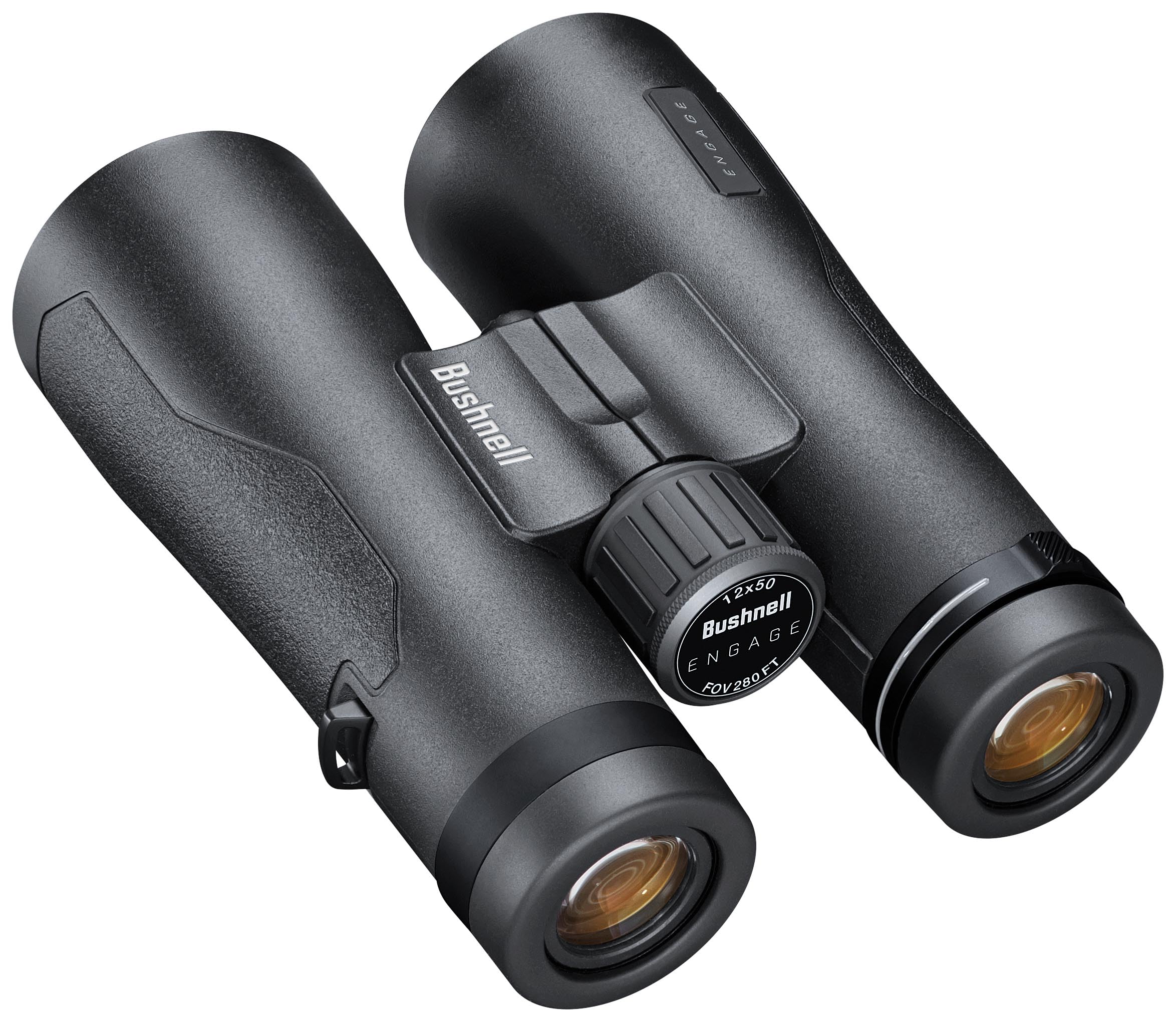
The Engage series brings Bushnell’s EXO Barrier technology to the 12×50 format — a molecular bond that repels water, oil, dust, and fog from the external lens surfaces. This coating, paired with fully multi-coated ED Prime glass and dielectric prism coatings, produces an image that stays bright and clear even in rain, sea spray, or dusty conditions. The 15mm eye relief and 4.17mm exit pupil are standard for the class, but the locking diopter ring prevents accidental adjustments when the binoculars are jostled in a pack.
Build quality centers on a lightweight magnesium chassis wrapped in thin, textured rubber armor that provides a secure grip without adding bulk. The wide field of view (8.33 degrees) helps mitigate the natural jitter of 12x handheld use by keeping your target within the frame during small movements. Users consistently highlight the sharp, low-chromatic-aberration image and the intuitive handling of the center focus wheel, though a minority note that the focus tension can feel stiff initially.
The included accessories are basic — a case, neck strap, and lens caps — and some owners feel the case lacks the padding of premium competitors. But the optical performance at this price point is hard to fault: bright colors, high contrast, and a large sweet spot that makes scanning comfortable. Environmentally, Bushnell uses lead-free glass, which appeals to eco-conscious buyers without compromising optical quality.
Why it’s great
- EXO Barrier coating sheds water, oil, and debris effectively
- Locking diopter ring maintains your setting in the field
- Magnesium chassis is both lightweight and rugged
Good to know
- Accessories (case, strap, caps) feel basic for the price
- Some units have reported quality control inconsistencies
4. Celestron Nature DX ED 12×50
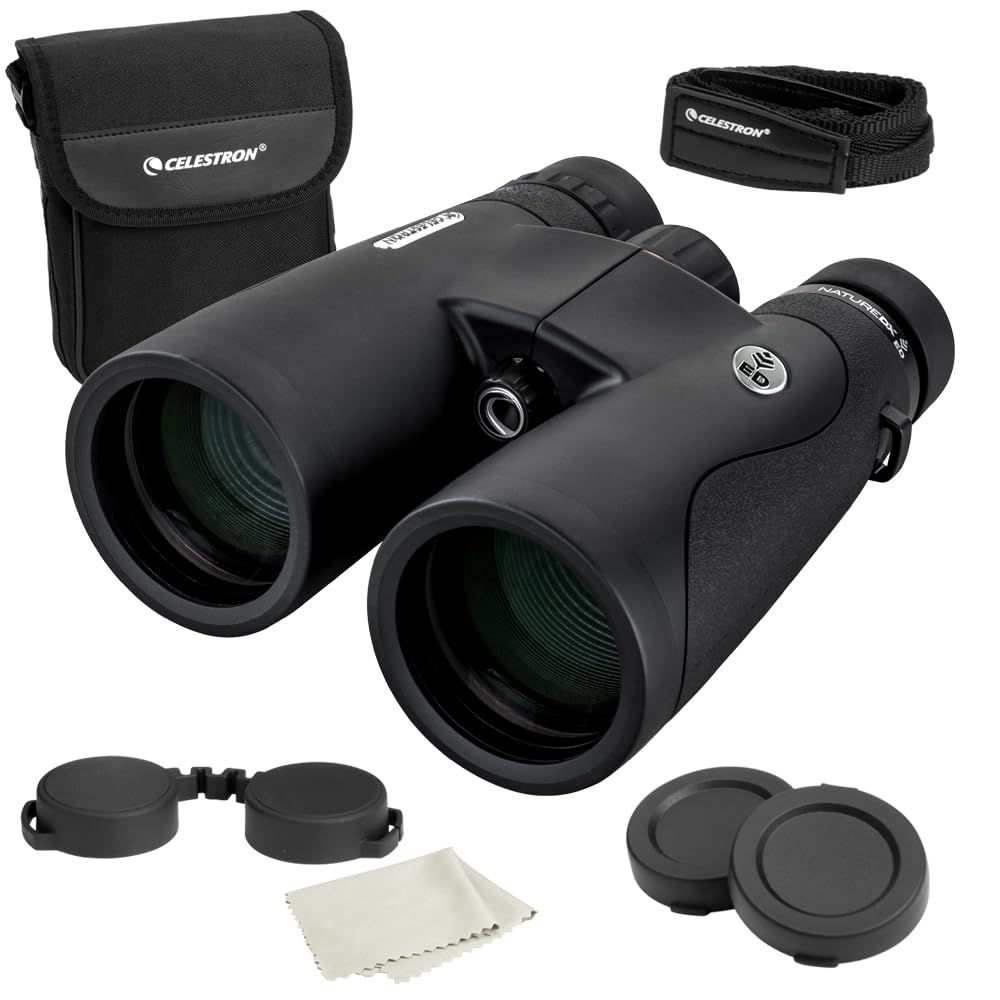
Celestron’s Nature DX ED delivers Extra-low Dispersion glass at a price that undercuts most ED-equipped competitors by a significant margin. The 12×50 configuration uses phase-coated BaK-4 prisms and fully multi-coated optics to maximize light transmission through its 4.1mm exit pupil. While the 14.3mm eye relief is slightly shorter than ideal for eyeglass wearers, the twist-up eyecucks with multiple stops provide enough adjustment for most users to see the full 252-foot field at 1000 yards.
The rubber-armored polycarbonate housing is waterproof and nitrogen-purged, preventing internal fogging in humid or rainy environments. A built-in tripod adapter socket allows for stable long-duration viewing, which is especially useful for astronomy — the ED glass renders the moon’s surface with crisp, color-accurate detail and reveals the four Galilean moons of Jupiter without chromatic fringing. Users who own higher-end Nikons or Zeiss report that the Nature DX ED holds its own surprisingly well in daylight, with slightly deeper color saturation on the pricier models but comparable sharpness.
The main compromises are weight (896g / 1.98 pounds) and the lack of a locking diopter. The center focus is smooth with no backlash, but the twist-up eyecucks can feel loose on some units. For the birdwatcher or casual astronomer who wants ED glass performance without paying for a flagship brand name, this binocular represents the strongest value proposition in the 12×50 category.
Why it’s great
- ED glass delivers near-total elimination of chromatic aberration
- Nitrogen-purged, waterproof, and fogproof for all-weather use
- Excellent value compared to other ED-equipped binoculars
Good to know
- Heavy at 896g — extended handheld sessions can fatigue arms
- Twist-up eyecucks may not lock firmly on every unit
5. Sogries 12×50 ED Binoculars

The Sogries 12×50 ED binoculars bring professional-grade ED glass and BaK-4 roof prisms to a price point that challenges expectations for the category. Fully multi-coated anti-reflective purple film and an ultra-wide 5.8-degree angle of view yield a massive 335-foot field at 1000 yards — noticeably wider than the 252-ft fields on most competitors. This wider FOV helps counteract the natural instability of 12x magnification, making it easier to locate and track fast-moving birds or sporting action.
IPX7 waterproofing and nitrogen filling ensure the optics stay clear in rain, coastal humidity, or accidental submersion. The 18mm eye relief is among the longest in this roundup, making these binoculars exceptionally comfortable for eyeglass wearers who need distance between the ocular lens and their corrective lenses. The ergonomic matte-textured rubber armor and large center focus wheel provide positive grip even in wet conditions.
Users report minimal chromatic aberration — a direct benefit of the ED glass — and a refined overall build that feels more expensive than the price suggests. The only caveat is that at 12x, the ultra-wide field can exaggerate the rolling ball effect during panning, and a tripod is recommended for sustained astronomy sessions. For the traveler, birder, or hunter seeking ED performance with a wide FOV at a friendly cost, this is a strong contender.
Why it’s great
- ED glass minimizes chromatic aberration effectively
- Ultra-wide 335-ft FOV at 1000 yards for easy target tracking
- 18mm eye relief is excellent for eyeglass wearers
Good to know
- Wide field can cause rolling ball effect when panning
- Tripod recommended for steady long-range viewing
6. Nikon PROSTAFF 5 12×50 (7573)

Nikon’s PROSTAFF 5 series uses a fiberglass-reinforced polycarbonate resin body that is exceptionally light yet durable enough for the harshest backcountry conditions. The 12×50 version delivers a bright, multi-coated image through BaK-4 roof prisms with a 15.5mm eye relief that accommodates most eyeglass wearers. O-ring seals and nitrogen purging make the binocular fully waterproof and fogproof, and the rubber-armored exterior absorbs shocks from accidental drops.
The turn-and-slide multi-click eyecucks allow precise adjustment of eye relief, and the center focus wheel operates with the smooth, predictable tension Nikon is known for. Bundled accessories include a Nikon lens pen and cleaning cloth, which are genuinely useful for maintaining the optics in the field. The PROSTAFF 5 has been a trusted choice for decades, and the 12×50 configuration benefits from the larger 50mm objective that gathers more light than the 42mm versions favored by hikers.
The main limitation is the coating: it’s multi-coated rather than fully multi-coated, which means slightly less light transmission than premium competitors. Users note that the image is still bright and crisp in daylight, but low-light performance edges out budget binoculars rather than premium ones. The carrying case lacks shoulder straps — a minor but frequently noted omission. For the reliability of the Nikon brand and a build that can survive years of abuse, the PROSTAFF 5 is a solid mid-range choice.
Why it’s great
- Fiberglass-reinforced body is exceptionally durable yet light
- Turn-and-slide eyecucks offer precise eye relief adjustment
- Nikon’s reputation for consistent quality and service
Good to know
- Multi-coated (not fully multi-coated) limits low-light brightness
- Case lacks shoulder straps for hands-free carry
7. Pentax Jupiter 12×50 Easy Viewing

The Pentax Jupiter 12×50 is a porro prism design that leverages the classic optical architecture for superior light transmission at a low cost. The 50mm objective lenses with anti-reflective multi-coating gather ample light for bright, clear views, and the large aperture excels in moderately low-light conditions like pre-dawn or twilight. The relative brightness rating of 17.6 and 4.2mm exit pupil are competitive with more expensive roof prism models, making this a legitimate option for budget-conscious stargazers.
The rubber-coated exterior provides a slip-resistant grip, and the focus ring is positioned for easy access during handheld use. An optional TP-3 tripod adapter lets you mount the binocular for shake-free astronomical observation — a smart addition since 12x porro prisms are heavier than roof prism equivalents. Users specifically praise the sharp lunar views and the solid, heavy feel that dampens small vibrations during handheld use.
The trade-offs are visible when you push the optic: the anti-reflective coating is basic compared to the FMC and dielectric layers on pricier binoculars, so edge softness and mild chromatic aberration appear on high-contrast subjects. The 11mm eye relief is short — eyeglass wearers will struggle to see the full field. For the casual observer who wants a 12×50 for occasional moon gazing and daytime scanning without spending above the entry-level threshold, the Jupiter delivers reliable Pentax optics.
Why it’s great
- Porro prism design offers excellent light gathering for the price
- Rubber coating provides a secure, non-slip grip
- Tripod adapter available for stable astronomy viewing
Good to know
- 11mm eye relief is too short for eyeglass wearers
- Basic coatings show chromatic aberration on high-contrast scenes
FAQ
Can I handhold a 12×50 binocular steadily, or do I always need a tripod?
What is the practical difference between ED and non-ED glass in a 12×50 binocular?
Why are roof prism 12×50 binoculars generally more expensive than porro prism models?
What does nitrogen or argon purging actually do for a 12×50 binocular?
Final Thoughts: The Verdict
For most users, the 12×50 binoculars winner is the Vortex Viper HD 12×50 V203 because it combines premium XR-coated optics, argon purging, and a legendary unconditional warranty in a package that competes with binoculars costing twice as much. If you want ED glass with a magnesium chassis at a more accessible price, grab the Athlon Midas G2 UHD 12×50. And for budget-conscious stargazing with classic porro prism light gathering, nothing beats the Pentax Jupiter 12×50.