
There is nothing worse than crawling into a sweltering tent after a long day of hiking or trying to sleep in an RV that feels like a convection oven. Standard AC units are useless off-grid, and those “evaporative” swamp coolers just turn your sleeping bag into a damp sponge. A dedicated camping air conditioner must handle a brutal mix of high ambient heat, limited power budgets, and cramped spaces—all while staying quiet enough for a 2 a.m. bathroom run.
I’m Min — the co-founder and writer behind Gadgets Feed. I’ve spent countless hours tearing through the spec sheets and customer feedback on over 40 portable AC units to find the ones that actually work in a tent, truck, or van, not just a climate-controlled bedroom.
From a 12V split system built for a week-long overland trip to a battery-powered unit that can run all night on a power station, this guide covers every serious option for the best camping air conditioner rated by real-world off-grid performance.
How To Choose The Best Camping Air Conditioner
Camping ACs are a completely different beast from home units. You are balancing three conflicting demands: cooling power (BTUs), power consumption (watts), and portability (pounds). The wrong choice either drains your battery in 30 minutes or fails to drop the temperature in your tent. Here are the specific specs that separate a good camping AC from a waste of cargo space.
BTU vs. Space Size — The Real Equation
Manufacturers love to advertise BTU numbers, but a camping AC operates in much tighter quarters than a living room. A 3,500 BTU unit can drop the temperature inside a 6-person tent by 18°F in 15 minutes if it’s well-vented. For an RV or van, you need at least 5,000 BTU to handle the higher ceiling and larger windows. The key is not just the BTU output, but how efficiently that cold air stays in your space — every seam and zipper leak reduces the effective cooling.
Power Source Compatibility — The Real Limiter
This is where most buyers get burned. A camping AC that draws 800 running watts will drain a typical 1,000Wh power station in just over an hour. You need to check both the running wattage and the starting (surge) wattage. Units with an inverter compressor (like the EcoFlow Wave 3) have much lower surge current and can run on smaller generators or lithium batteries. If you plan to run it from your vehicle’s 12V system, you absolutely must verify that the AC accepts native 12V DC input — many “12V compatible” units require a boost converter.
Form Factor — Self-Contained vs. Split System
Self-contained portable units place the compressor and evaporator in one box, requiring you to exhaust hot air through a window or vent hose. These are easy to set up but take up interior space and can leak hot air back into the room if the hose seal is poor. Split systems (like the UAHKPA 12V unit) put the noisy compressor outside the vehicle, resulting in much quieter operation and zero interior heat output. However, split systems require permanent mounting and refrigerant line connections, making them better for dedicated overland vehicles or vans than for a weekend tent setup.
Quick Comparison
On smaller screens, swipe sideways to see the full table.
| Model | Category | Best For | Key Spec | Amazon |
|---|---|---|---|---|
| EF ECOFLOW WAVE 3 | Premium Battery | Off-grid battery camping | 6,100 BTU / 1,024Wh battery | Amazon |
| BAYKUL 6-in-1 | Compact Heat/Cool | Tent & RV with generator | 6,800 BTU / 550W consumption | Amazon |
| Cybertake S2 Pro | Multi-Volt | Van & RV – no generator | 5,100 BTU / 40 dB / 48V DC | Amazon |
| Ivation 6,500 BTU | Saddle Mount | RV window sill install | 6,500 BTU / split saddle design | Amazon |
| OUTOHOME 5,200 BTU | Low Wattage | Small tent & pet cooling | 5,200 BTU / 400W max draw | Amazon |
| BougeRV PC35 | Value Portable | Tent & truck cab cooling | 3,500 BTU / app control | Amazon |
| UAHKPA 9,000 BTU Split | 12V Split | Truck & heavy equipment | 9,000 BTU / 12V / 800W | Amazon |
| Antarctic Star 8,000 BTU | Budget Home-AC | Large RV with shore power | 8,000 BTU / 55 dB | Amazon |
| Uhome 8,000 BTU | Budget Portable | RV or room with 110V | 8,000 BTU / 3-in-1 | Amazon |
In‑Depth Reviews
1. EF ECOFLOW WAVE 3

The EcoFlow Wave 3 is the gold standard for off-grid camping because it solves the power problem that kills every other portable AC. Its built-in 1,024Wh LFP battery delivers up to 8 hours of cordless runtime on a single charge, and the 1,000W AC input refills that battery in just 75 minutes. With 6,100 BTU of cooling and 6,800 BTU of heating, it can drop the temperature in a van or large tent by 15°F in 15 minutes — real-world performance that matches its spec sheet.
The real differentiator is the power flexibility. The Wave 3 accepts AC wall power, 12V/24V vehicle input, solar panels, and even DC from an EcoFlow power station via an optional cable. The companion app gives you real-time power draw monitoring, a pet-care auto-cooling mode, and a sleep mode that drops noise to 44 dB — quieter than a typical box fan. It cools up to 180 sq. ft., making it viable for everything from a rooftop tent to a small RV.
The main trade-offs are weight and cost. At 32 pounds with the battery installed, it is not a backpacking item, and the price places it in premium territory. A few units have shipped with non-functional fans (Error 38), and EcoFlow has no global warranty, so US buyers should test the unit immediately. When it works, however, it is the only camping AC that offers true all-night cordless operation without a generator.
Why it’s great
- 8 hours of cordless runtime on internal battery
- Ultra-fast 75-minute recharge via AC
- 44 dB sleep mode is genuinely quiet
- Pet-care mode auto-cools if cabin overheats
Good to know
- No global warranty — US support only
- Expensive compared to plug-in units
- Requires extra battery cable for third-party power stations
2. BAYKUL 6-in-1 6,800 BTU
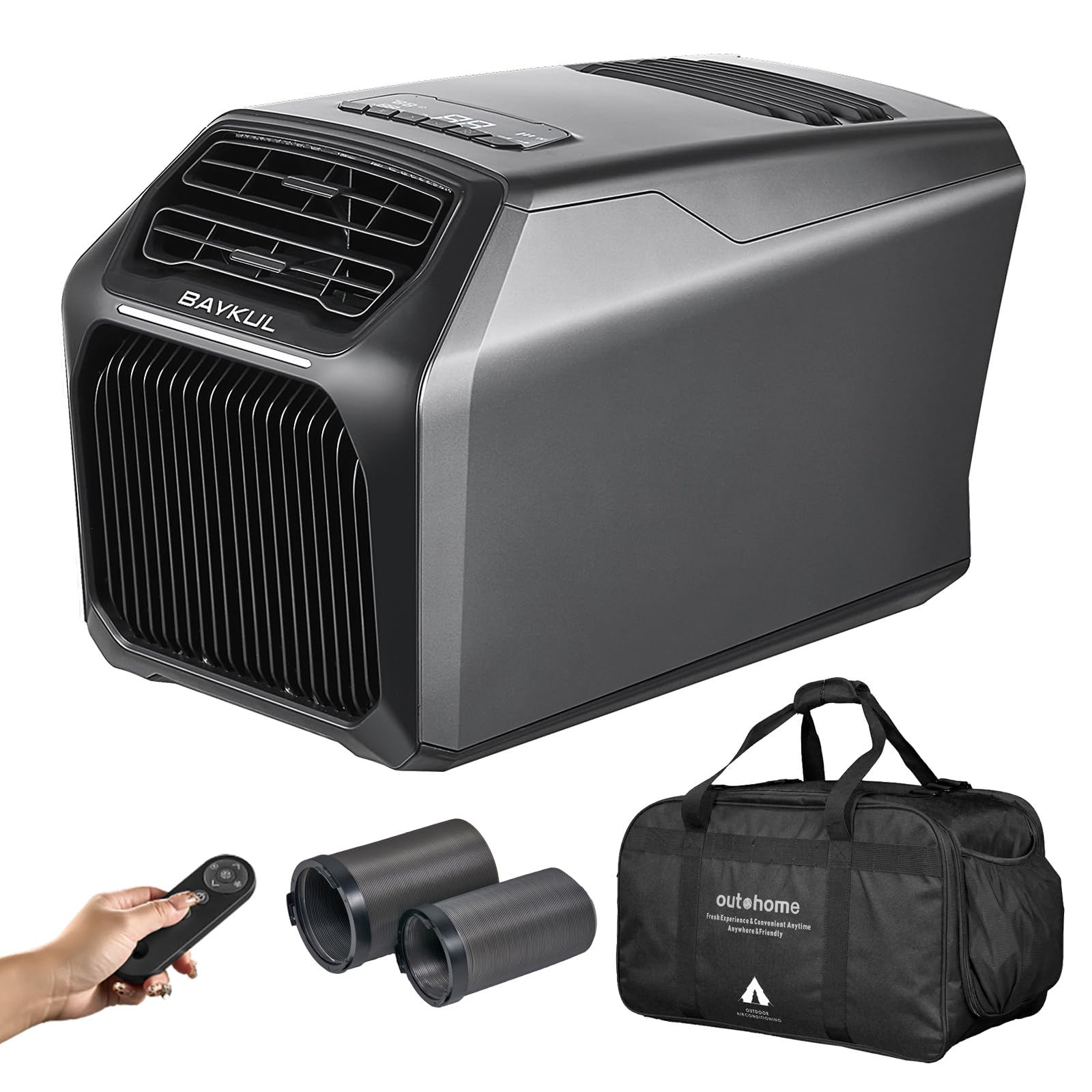
The BAYKUL 6-in-1 delivers a rare combination: 6,800 BTU of cooling and 7,500 BTU of heating in a compact 35.7-pound package that includes a carrying bag. It runs on standard 110V AC outlets or a car inverter, drawing just 550 watts on average — low enough to pair with a mid-sized generator without tripping breakers. The R-32 refrigerant makes it more environmentally friendly and allows a smaller compressor footprint than older R-410A designs.
What sets it apart for campers is the flex ventilation: set it up with the exhaust hose venting out a window for indoor use, or place the unit outside and route the cool air hose into the tent. The included pre-cut foam window barrier makes installation a five-minute job. An RF remote works through tent walls, so you can adjust the temperature without unzipping your sleeping bag. At 46 dB, it is whisper-quiet and has a dedicated sleep mode that holds a steady 65°F for eight hours.
The dual-duct design is slightly bulky — at 22 inches deep, it takes up floor space in a small tent. A few units have arrived with a loose rattle in the fan assembly, so inspect the blower wheel on unboxing. For anyone running a generator or shore power at a campground, this unit provides year-round climate control in a single carry bag.
Why it’s great
- Heating and cooling in one portable unit
- Very low 550W average power draw
- RF remote works through tent walls
- Includes carrying bag for easy transport
Good to know
- Bulky footprint — 22 inches deep
- Potential fan rattle on early units
- 110V only — not native 12V
3. Cybertake S2 Pro
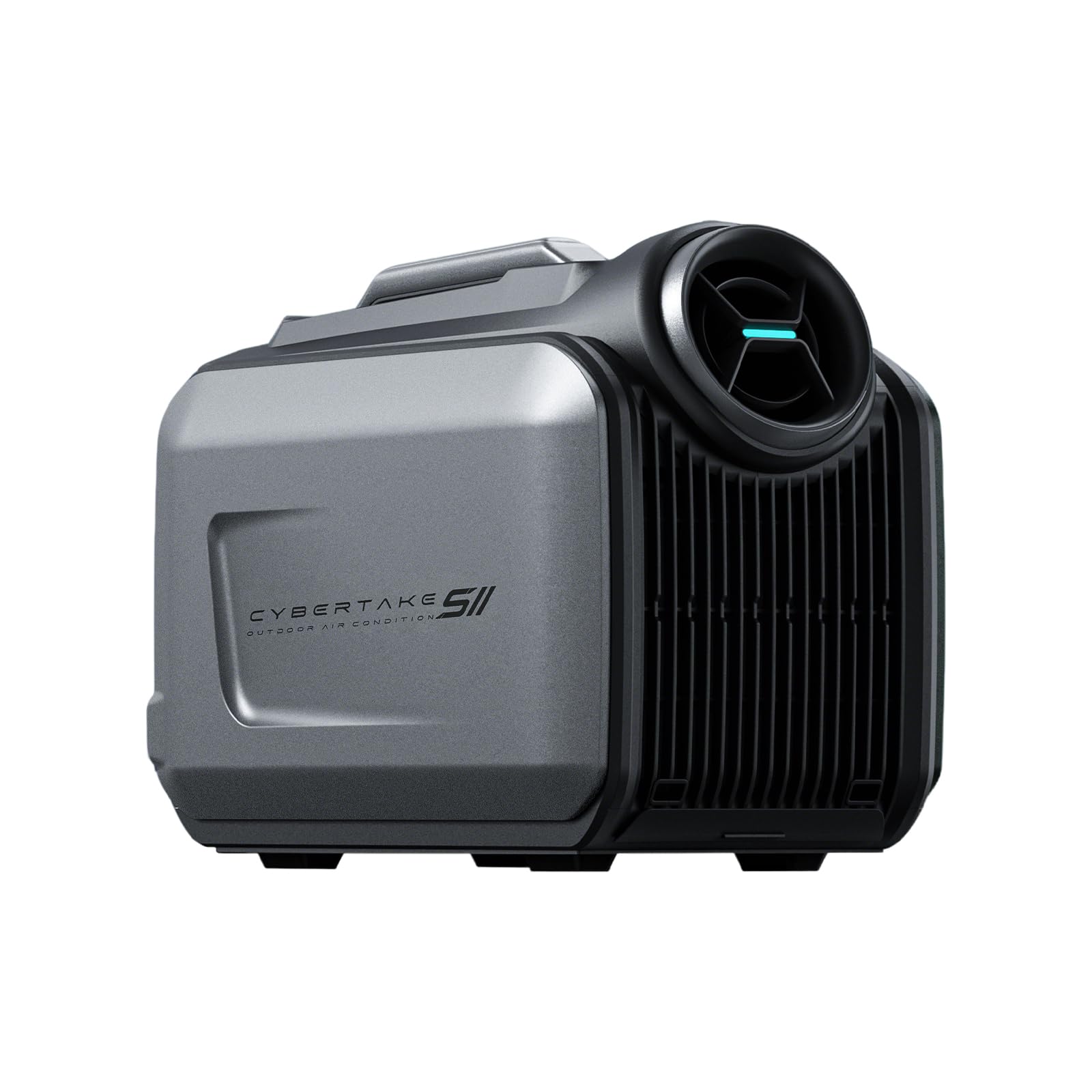
The Cybertake S2 Pro is the most power-source-agnostic camping AC on the market, accepting 48V DC directly from a power station, 12V or 24V from a vehicle system, or 100-240V AC from a wall outlet. This flexibility means you can run it from a dedicated LiFePO4 battery bank without an inverter, eliminating the 10-15% inverter efficiency loss. The 5,100 BTU cooling and 6,100 BTU heating are adequate for spaces up to 130 sq. ft., and the Eco+ mode uses just 1 kWh over 8 hours — roughly 125 watts per hour.
Build quality is adventure-focused: an IPX4 water-resistant shell protects against rain and splashes, and the silicone waterproof buttons survive wet campsite conditions. Noise is rated at a very low 40 dB, which is quieter than a library. The Bluetooth app allows remote control of temperature, fan speed, and timer, and you can set it to start cooling 15 minutes before you return to camp. Setup takes about 30 seconds with the included dual hoses and adapters.
The main complaint is that the “12V/24V vehicle power” option requires a separate boost converter to reach the unit’s ideal 48V input — a critical detail buried in the fine print. Some users also report that the temperature sensor is located too close to the intake, causing the compressor to cycle on and off incorrectly in very hot conditions. For those willing to wire it properly with a 48V battery, it is one of the most efficient and quiet camping ACs available.
Why it’s great
- Native 48V DC input for max efficiency
- IPX4 water-resistant exterior
- Super quiet 40 dB operation
- Eco+ mode draws only 125W average
Good to know
- “12V direct” requires a boost converter
- Tricky temperature sensor placement
- Limited to 130 sq. ft. coverage
4. Ivation 6,500 BTU

The Ivation solves a unique RV problem: how to add a powerful AC without cutting a roof hole or losing your window view. Its split saddle design places the noisy compressor portion outside the window, while the quiet indoor unit hangs inside and blows cool air. With 6,500 BTU of cooling power, it matches a typical RV rooftop unit but operates at a fraction of the noise level thanks to shockproof rubber dampers that absorb compressor vibration.
Installation is genuinely tool-free for vertical sliding windows — the brackets clamp onto the windowsill, and the unit rests in place without permanent modification. The digital display shows the current temperature in both Fahrenheit and Celsius, and the 24-hour timer allows you to set the AC to turn on just before you return from a hike. The three-in-one functionality includes a dehumidifier that pulls up to 40 pints of moisture per day, which is a huge benefit for humid campgrounds in the Southeast.
Because the compressor sits outside, the indoor unit is very quiet — quieter than most portable fans. The main downside is that installation requires a window that slides vertically; horizontal-sliding camper windows may need custom bracket modification. A few units have shipped with missing hardware, so verify the bracket kit on arrival. For anyone living or traveling in an RV, this is the most elegant way to add cold air without a roof modification.
Why it’s great
- Compressor stays outside — whisper-quiet inside
- Tool-free installation on vertical windows
- Full window function preserved
- Strong dehumidifier for humid climates
Good to know
- Only works with vertical sliding windows
- Hardware kit may arrive incomplete
- Not portable — requires window mount
5. OUTOHOME 5,200 BTU
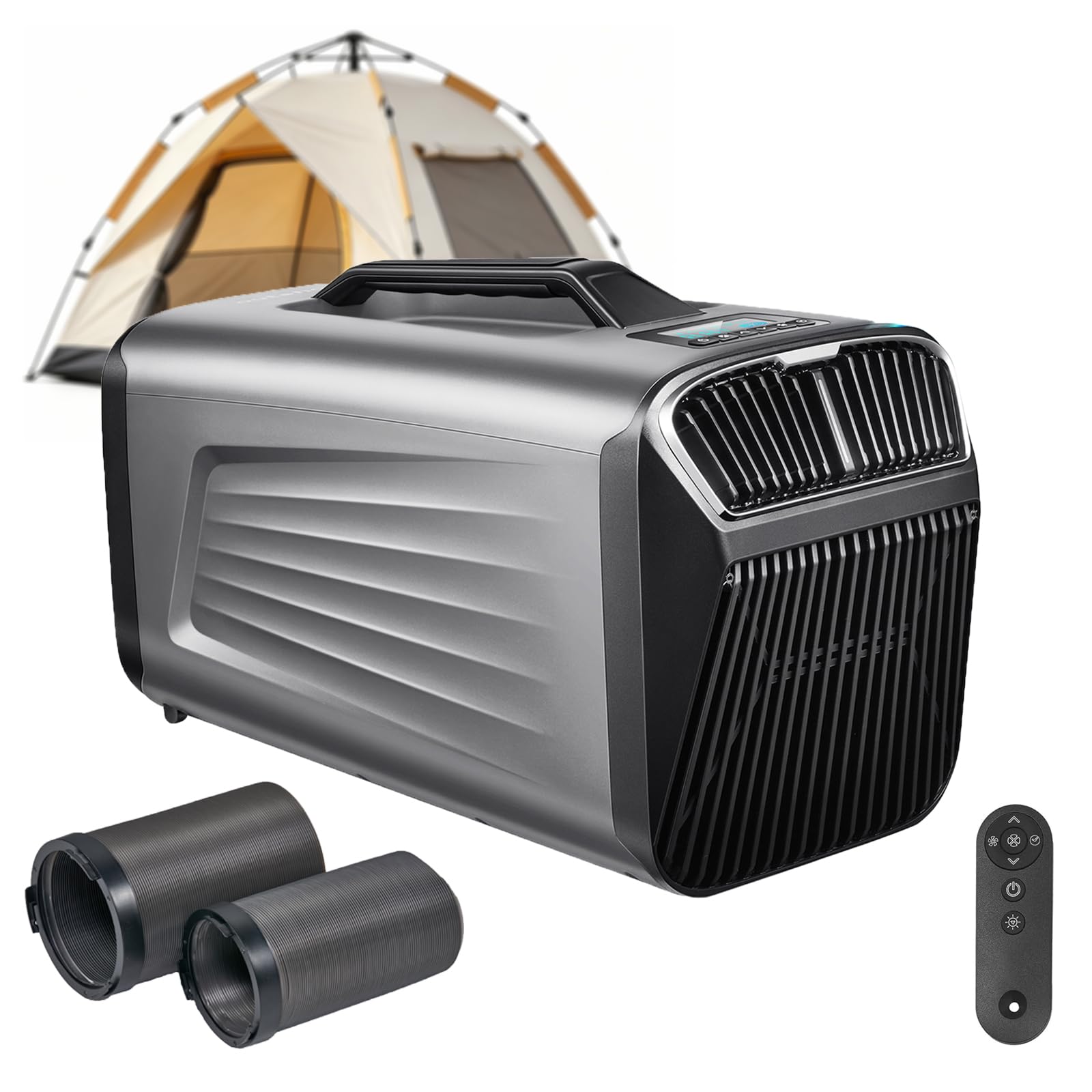
The OUTOHOME 5,200 BTU stands out for its class-leading efficiency: it consumes under 400 watts per hour while delivering 5,200 BTU of cooling — a roughly 13:1 BTU-to-watt ratio that outperforms most portable units. This means you can run it for over 2.5 hours on a standard 1,000Wh power station, or all night on a larger 2,000Wh system. The GMCC compressor is a high-end component typically found in premium mini-splits, and it drops the temperature by 18°F in just 5 minutes in strong cooling mode.
The 31-pound weight and integrated handle make it genuinely one-hand portable, and the dark silver metallic finish resists scratches from campsite gear. The dehumidification function works down to 70% relative humidity without needing a drain hose — a huge convenience for tent camping. Sleep mode operates at just 46-50 dB, with the compressor noise disappearing and only a faint fan sound remaining.
The 22.4 x 11.2 x 13.8 inch footprint is compact enough to sit on a camp table or cooler. A few users report that the default temperature display is Celsius and resets back to metric after each power cycle, which is annoying for US campers. Some units have also failed to maintain set temperature in very high ambient conditions (over 100°F). For the majority of summer camping in the 80-95°F range, this is the most power-efficient option short of a battery-integrated unit.
Why it’s great
- Only 400W max draw — power station friendly
- GMCC compressor delivers fast 18°F drop
- No drainage needed below 70% humidity
- Lightest self-contained unit at 31 lbs
Good to know
- Display defaults to Celsius each power cycle
- May struggle above 100°F ambient heat
- Drainage required above 70% humidity
6. BougeRV PC35
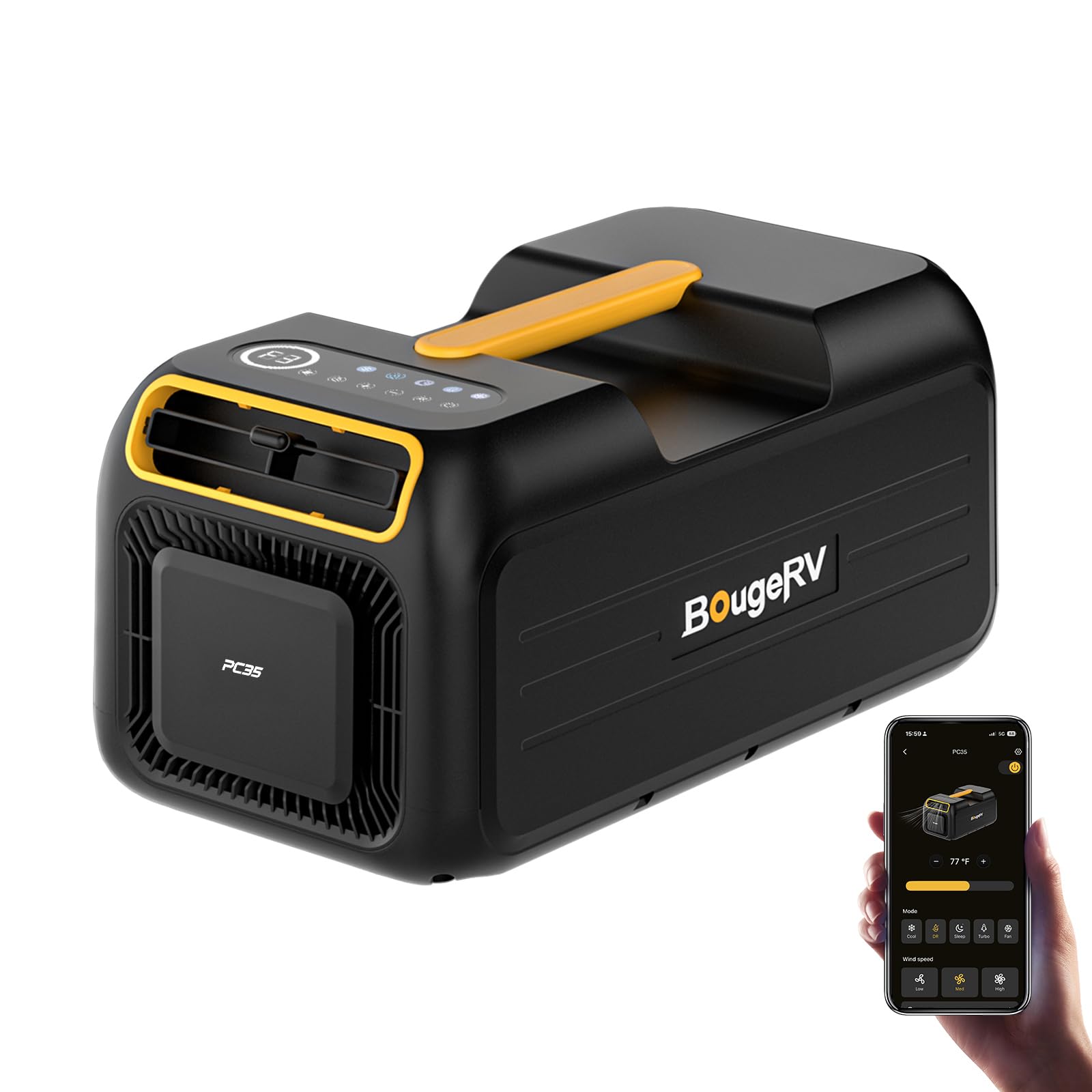
The BougeRV PC35 is the most affordable dedicated camping AC that actually works for tent and truck cab cooling. Its 3,500 BTU output is specifically designed for small spaces up to 64 sq. ft., and BougeRV claims an 18°F temperature drop in 15 minutes on strong mode — which real-world tests confirm when the unit is properly vented. The included adapter means you can run it from a 110V wall outlet or a car inverter, and the app control works up to 33 feet away.
The five-in-one functionality covers cooling, dehumidifying, fan, high power mode, and sleep mode with a 24-hour timer. The ergonomic handle and 34.17-pound weight make it easy to carry from the car to the tent, and the black-and-yellow styling is distinctive enough that you won’t confuse it with someone else’s gear. The long-range airflow design pushes cold air up to 10 feet, which is useful for larger tents with multiple sleeping areas.
The biggest limitation is that the PC35 struggles in extreme heat. Several users report the compressor shutting off after a few minutes in 105°F ambient temperatures, triggering an E3 error. It is best suited for moderate summer nights (75-95°F). The app is also functional but buggy — it may lose connection or fail to update the temperature readout. For fair-weather camping on a budget, it is a solid entry-level unit, but it is not built for desert conditions.
Why it’s great
- Lowest entry price for a dedicated camping AC
- App control for remote temperature adjustment
- 10-foot long-range airflow
- Compact footprint for small tents
Good to know
- Compressor fails above 100°F ambient
- App connectivity is unreliable
- Underpowered for RV or large spaces
7. UAHKPA 9,000 BTU 12V Split

For overland trucks, excavators, and vans where roof space is non-existent, the UAHKPA 9,000 BTU split system is the most powerful 12V DC option available. It runs directly from the vehicle’s battery system without an inverter, drawing 800 watts and 75A on startup. The split design keeps the condenser outside (mounted on a truck bed or van roof), while the evaporator hangs inside the cabin, delivering 9,000 BTU of cooling — enough to keep a full-size van cab comfortable even in direct sun.
The unit uses a scroll compressor and R134a refrigerant with a 600g charge, and the 5-speed fan pushes 450 m³/h of airflow. The control panel includes a digital display and a remote, allowing adjustment of fan speed, temperature, and operating mode. Build quality uses a thickened hard shell on the outdoor unit with hollow heat dissipation vents, and aluminum alloy construction resists corrosion better than steel equivalents.
The main concern is the installation complexity and reliability. The included power wires are undersized — experienced users recommend upgrading to 2-gauge cable to prevent fire risk. The indoor temperature sensor is located right behind the evaporator coil, causing the compressor to cycle on and off rapidly. The fix requires extending the sensor probe away from the coil, which voids the “simple installation” claim. With careful DIY work, this system delivers massive cooling on a pure 12V system, but it requires mechanical confidence.
Why it’s great
- Pure 12V DC — no inverter needed
- Powerful 9,000 BTU for large cabins
- Split design keeps noise outside
- Scroll compressor is durable and efficient
Good to know
- Power wires are undersized — upgrade required
- Poorly translated documentation
- Sensor location causes short-cycling
- Difficult to return to overseas seller
8. Antarctic Star 8,000 BTU
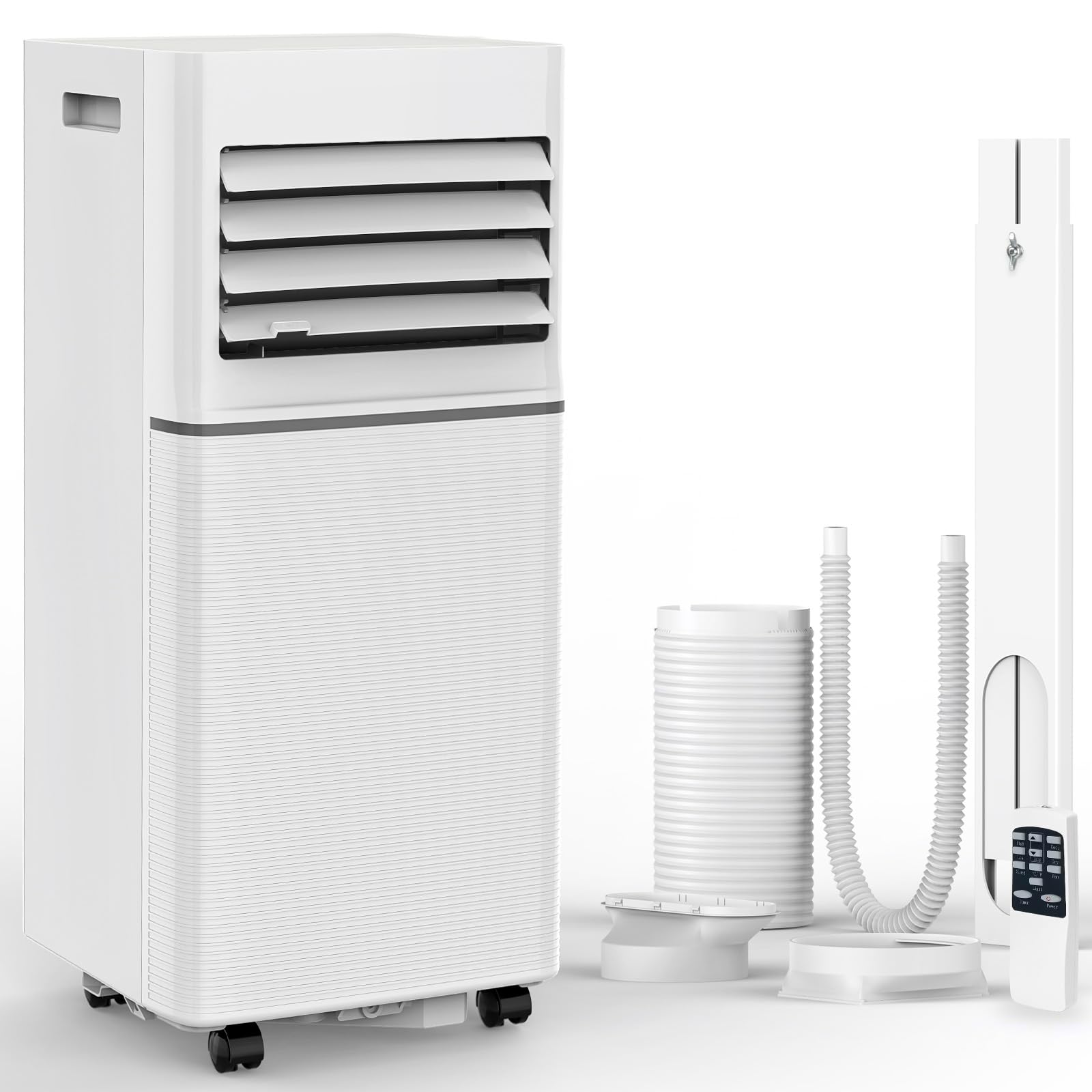
The Antarctic Star is a standard 110V portable AC that works well in RVs with shore power or a generator. Its 8,000 BTU ASHRAE rating cools spaces up to 350 sq. ft., which covers most travel trailers and pop-up campers. The three-in-one functionality includes a dehumidifier that removes 51 pints of moisture per day, a fan mode with high/low speeds, and a 24-hour programmable timer. The sleep mode maintains a steady 65°F for 8 hours without temperature swings.
Installation on a double-hung or horizontal sliding window takes about 7 minutes with the included adjustable window kit. The rolling wheels make it easy to move between the bedroom and living area of a larger RV. The washable slide-out mesh filter is easy to clean without tools, and the inverter compressor technology keeps the unit quieter (55 dB) than traditional portable ACs of similar BTU rating.
The biggest downside is that it is a standard home AC repurposed for camping — it requires 110V AC, so it is useless without generator or shore power. Some owners report that the temperature control has a 3-4°F deadband, meaning it overshoots your set point before cycling back. It is also fairly loud compared to purpose-built camping units, though the compressor hum acts as white noise for some sleepers. For budget-conscious RVers with generator access, it delivers far more cooling per dollar than any RV-specific unit.
Why it’s great
- Highest BTU per dollar in this list
- Sleep mode holds 65°F for 8 hours
- Rolling wheels for easy interior moves
- 51-pint dehumidifier for humid camps
Good to know
- 110V only — requires generator or shore power
- Temperature control has wide 4°F deadband
- 55 dB is loud for a tent
- Window hose seal can leak hot air
9. Uhome 8,000 BTU

The Uhome 8,000 BTU is another 110V portable AC adapted for RV use, offering the simplest feature set at the lowest cost. It cools up to 200 sq. ft. with a temperature range of 60-86°F, and the 24-hour timer allows you to pre-cool the camper before bedtime. The three modes — cooling, dehumidifying, and fan — cover the basics without unnecessary complexity. The self-evaporating operation means you rarely need to drain the bucket, which is a major convenience for RV use.
Setup is straightforward: install the window kit, plug it in, and set the desired temperature via the LED touch panel or remote. The 6-foot power cable is long enough for most RV layouts, and the rolling wheels make repositioning easy. The washable filter requires cleaning every two weeks, and lifting it out is a one-handed operation. Customer feedback consistently highlights that this unit cools a 10×10 foot RV bedroom like an icebox, and the remote adjustment is responsive.
The trade-offs are noise and build quality. Multiple users rate the noise level as “very loud” even on the low fan setting, and some units have arrived with a warped plastic faceplate that looks cheap. The bright LED display cannot be dimmed, which can be annoying in a dark RV at night. Sleep mode automatically turns off after a few hours, which may leave you waking up hot. For the price, it is the cheapest big-BTU option for a stationary RV setup, but the noise and plastic build reflect the budget price point.
Why it’s great
- Lowest price for 8,000 BTU cooling
- Self-evaporating — minimal draining
- Simple LED controls with remote
- Effective for 10×10 ft spaces
Good to know
- Very loud — not suitable for tents
- Warped plastic faceplate on some units
- Bright display cannot be dimmed
- Sleep mode auto-shuts off prematurely
FAQ
Can any of these camping air conditioners run all night on a Jackery or EcoFlow power station?
What is the difference between a self-contained portable AC and a split-system AC for camping?
How do I vent a camping air conditioner in a tent without a window?
Why do some camping ACs use R-290 refrigerant and is it safe?
Final Thoughts: The Verdict
For most users, the best camping air conditioner winner is the EF ECOFLOW WAVE 3 because it is the only unit that delivers genuine all-night cordless operation with enough BTU to cool a van or large tent. If you want heating and cooling in a single carry bag without the premium battery cost, grab the BAYKUL 6-in-1. And for off-grid, pure-12V installations where noise must stay outside and you have the wiring know-how, nothing beats the raw cooling power of the UAHKPA 9,000 BTU Split System.