
A 4/0 cable is the heavy lifter of the electrical world. It’s the cable you reach for when you’re pulling 300 amps continuous to an inverter, wiring a solar battery bank, or running a service entrance for a sub-panel. The difference between a voltage drop that shuts down your equipment and a stable, full-power connection comes down to the purity of the copper, the strand count for flexibility, and the quality of the insulation jacket.
I’m Min — the co-founder and writer behind Gadgets Feed. I’ve spent countless hours analyzing the technical specifications, stranding data, and ampacity ratings across dozens of 4/0 cable offerings to identify which ones truly deliver on their rated capacity without hidden compromises like copper-clad aluminum or brittle insulation.
Whether you’re building an off-grid solar system, upgrading an RV electrical setup, or wiring a high-power car audio system, choosing the correct 4/0 ser cable means the difference between reliable performance and a costly, fire-prone installation.
How To Choose The Best 4/0 SER Cable
Selecting a 4/0 cable is not a casual purchase — this is the main arterial conduit for high-amperage DC and AC power. A mistake here can lead to resistive heating, voltage drop, and equipment failure. Focus on three critical areas: conductor purity, stranding construction, and insulation integrity.
Conductor Metal: Pure Copper vs. CCA vs. Aluminum
The conductor is everything. Pure copper (often labeled OFC for oxygen-free copper) delivers the highest conductivity and lowest resistance per foot. Copper-clad aluminum (CCA) uses an aluminum core with a thin copper coating — it is lighter and cheaper but has roughly 60% the conductivity of pure copper. Full aluminum conductors are common in service entrance cables but require larger diameter lugs and careful torque specifications. For any application demanding sustained high amperage — inverters, battery banks, welders — pure copper is the only safe choice.
Stranding and Flexibility
A 4/0 cable with a high strand count (1900+ individual strands) is significantly more flexible and easier to route through tight compartments than a cable using fewer, thicker strands. Fine-stranding also reduces bending fatigue over time. Look for cables that specify their strand count — products listing 1950/30 or 3415 strands of 0.2mm wire are engineered for maximum flexibility. Cables with fewer strands, while cheaper, will be stiff and prone to work-hardening in tight bends.
Insulation Jacket and Temperature Rating
The jacket protects against abrasion, chemicals, moisture, and heat. EPDM rubber insulation is the gold standard for welding and battery cable, offering an operating range of -58°F to +221°F (-50°C to +105°C) and resistance to solvents and flame. For marine environments, tinned copper conductors with a jacket meeting UL 1426 and ABYC standards are essential to prevent corrosion from saltwater vapor. Always verify the voltage rating — all quality 4/0 cables are rated for 600 volts.
Quick Comparison
On smaller screens, swipe sideways to see the full table.
| Model | Category | Best For | Key Spec | Amazon |
|---|---|---|---|---|
| WindyNation 10ft Black + 10ft Red | Premium | Solar & RV battery banks | 2047 strands, pure copper, SAE J1127 | Amazon |
| NOVINO Marine Wire 10ft Red + 10ft Black | Premium | Saltwater & marine installations | Tinned copper, UL 1426, ABYC | Amazon |
| NASSAU ELECTRICAL Wake Forest Quadruplex | Specialty | Underground direct burial service | Aluminum, 290A burial ampacity | Amazon |
| TEMCo Easy-Flex 10ft Black + 10ft Red | Mid-Range | High-amp inverter runs | 1950/30 strands, 440A max, OFC | Amazon |
| iGreely 5ft Black + 5ft Red Kit | Value | Car audio & short-run battery | 3415 strands, lugs & shrink included | Amazon |
| WindyNation 5ft Black + 5ft Red | Mid-Range | General-purpose battery cables | Pure copper, USA made, EPDM jacket | Amazon |
| WindyNation 10 Pair Battery Terminals | Accessory | Terminal replacement & repair | Tin-coated pure copper, RoHS | Amazon |
In‑Depth Reviews
1. WindyNation 4/0 Gauge 10 ft Black + 10 ft Red
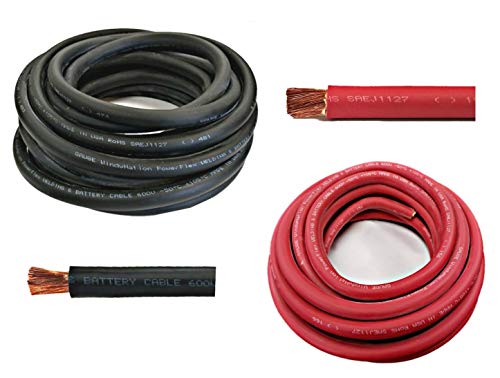
This WindyNation Power-Flex cable uses 2047 strands of fully annealed pure copper, making it notably more pliable than typical 4/0 cables with coarser stranding. Users consistently report that it bends into tight 90-degree angles without fighting back, a critical advantage when wiring inside cramped RV battery compartments or inverter enclosures. The EPDM jacket is rated from -58°F to +221°F and resists solvents, oil, and abrasion effectively.
The cable carries a 600-volt rating and complies with SAE J1127, IEC, and RoHS standards. Multiple verified buyers have used this exact cable for 300A+ solar inverter setups and 54V lithium battery banks, reporting zero measurable voltage drop over 10-foot runs. The jacket strips cleanly with a razor, and the fine strands crimp uniformly into 4/0 lugs without stray copper whiskers.
What separates this WindyNation offering from budget cable is the documentation of its strand count and the consistent feedback that it measures true to 4/0 AWG size — no undersizing tricks. It is heavier than entry-level cable, but that mass comes from real copper content, not thick insulation hiding a thinner conductor.
Why it’s great
- 2047 strands deliver excellent flexibility for tight routing
- Pure copper with documented ASTM compliance
- EPDM jacket handles extreme temperature ranges
Good to know
- Requires a heavy-duty crimper for proper lug termination
- Premium pricing reflects USA manufacturing
2. NOVINO 4/0 AWG Marine Wire 10 ft Red + 10 ft Black
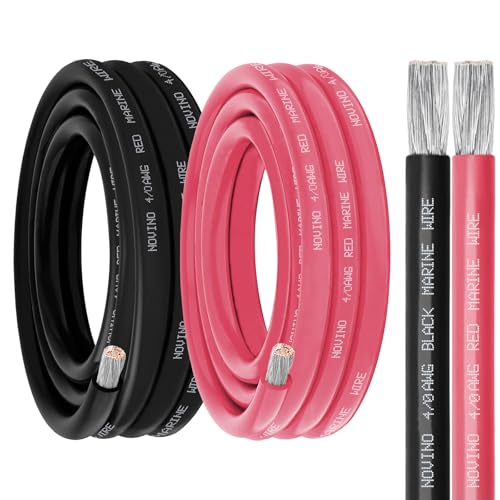
Marine environments demand protection against saltwater corrosion, and this NOVINO cable delivers with a true tinned copper conductor. The tin coating resists the oxidation that quickly degrades bare copper in bilge compartments, helm consoles, and deck wiring. The jacket meets UL 1426 and ABYC standards, rated to 600 volts with a wet temperature rating of 75°C — a critical safety margin for enclosed marine spaces.
Buyers have successfully used this wire for relocating trolling motor batteries from bow to stern, wiring dual battery banks, and feeding amplifier power from engine compartments. The stranding uses fine copper wires that crimp cleanly into lugs, and the insulation is thick enough to resist cuts from sharp fiberglass edges without sacrificing flexibility. The cable is available in separate red and black sheaths, simplifying polarity identification.
The trade-off is that tinned copper commands a premium over bare copper. For freshwater boats or indoor use, a standard pure copper cable delivers equivalent performance at a lower cost. For saltwater vessels, open-bow boats, or any installation exposed to spray, the corrosion resistance justifies the higher price.
Why it’s great
- Full tinned copper conductor resists saltwater corrosion
- UL 1426 and ABYC certified for marine use
- Thick, abrasion-resistant insulation jacket
Good to know
- Higher cost than equivalent bare copper options
- Stiffer jacket may require careful routing in tight spaces
3. NASSAU ELECTRICAL SUPPLY Wake Forest Quadruplex 40′

This is not a welding or battery cable — it is a 600-volt URD (underground residential distribution) cable designed for direct burial. The configuration is 4/0-4/0-4/0-2/0, meaning three 4/0 phase conductors and one 2/0 neutral conductor made from 19-strand aluminum. It is built for feeding a sub-panel or service entrance from a main disconnect, with a rated ampacity of 290 amps when buried directly in earth.
Verified buyers report running 200 amps through this cable for over two years in extreme conditions from 100°F to -20°F with zero issues. The quadruplex design means you can pull a complete feeder circuit on a single reel, saving the labor and cost of running separate cables. The aluminum construction makes it significantly lighter than copper, reducing strain during installation in trenches.
Aluminum requires specific lugs and antioxidant compound at connections to prevent galvanic corrosion. This cable is also not intended for indoor use in conduit unless checked against local electrical codes. For a service entrance or barn sub-panel run, it is a cost-effective solution versus the copper equivalent.
Why it’s great
- Complete 4-conductor run on one reel
- Lightweight aluminum for easier trench pulling
- Proven 200A+ continuous performance in diverse climates
Good to know
- Aluminum needs antioxidant and torque-specific lugs
- Not suited for high-moisture interior battery rooms
4. TEMCo Easy-Flex 4/0 10 ft Black + 10 ft Red

TEMCo’s Easy-Flex uses 1950 strands of 30 AWG oxygen-free copper, producing a cable that buyers say can be bent to a diameter under three inches. The nominal OD is 0.686 inches with a rugged EPDM jacket rated for cuts, tears, abrasion, water, oil, grease, and flame. It is rated for 440 max amps up to 50 feet, making it one of the highest ampacity-rated cables in this comparison.
Verified users have deployed this cable in 300A solar projects and Jupiter pure sine inverter installations on semi trucks, reporting consistent no-load voltage retention and ice-cold operation under sustained draw. The cable measures true to AWG sizing and the jacket strips without nicking the fine copper strands. TEMCo also backs the cable with a one-year full refund policy, reflecting confidence in their manufacturing.
The cable is USA-made and uses OFC copper, which has slightly higher conductivity than ETP copper due to reduced oxide content. This matters less in short runs but becomes measurable in runs exceeding 20 feet. For high-amp inverter feeds or battery bank interconnects, this cable delivers the engineering margin you want.
Why it’s great
- OFC copper with 1950 fine strands for maximum flexibility
- 440A rating provides generous engineering margin
- USA manufacturing with strong warranty support
Good to know
- Heavy cable requires robust support and anchoring
- Premium pricing reflects OFC construction
5. iGreely 4/0 Gauge Wire 5 ft Black + 5 ft Red Kit
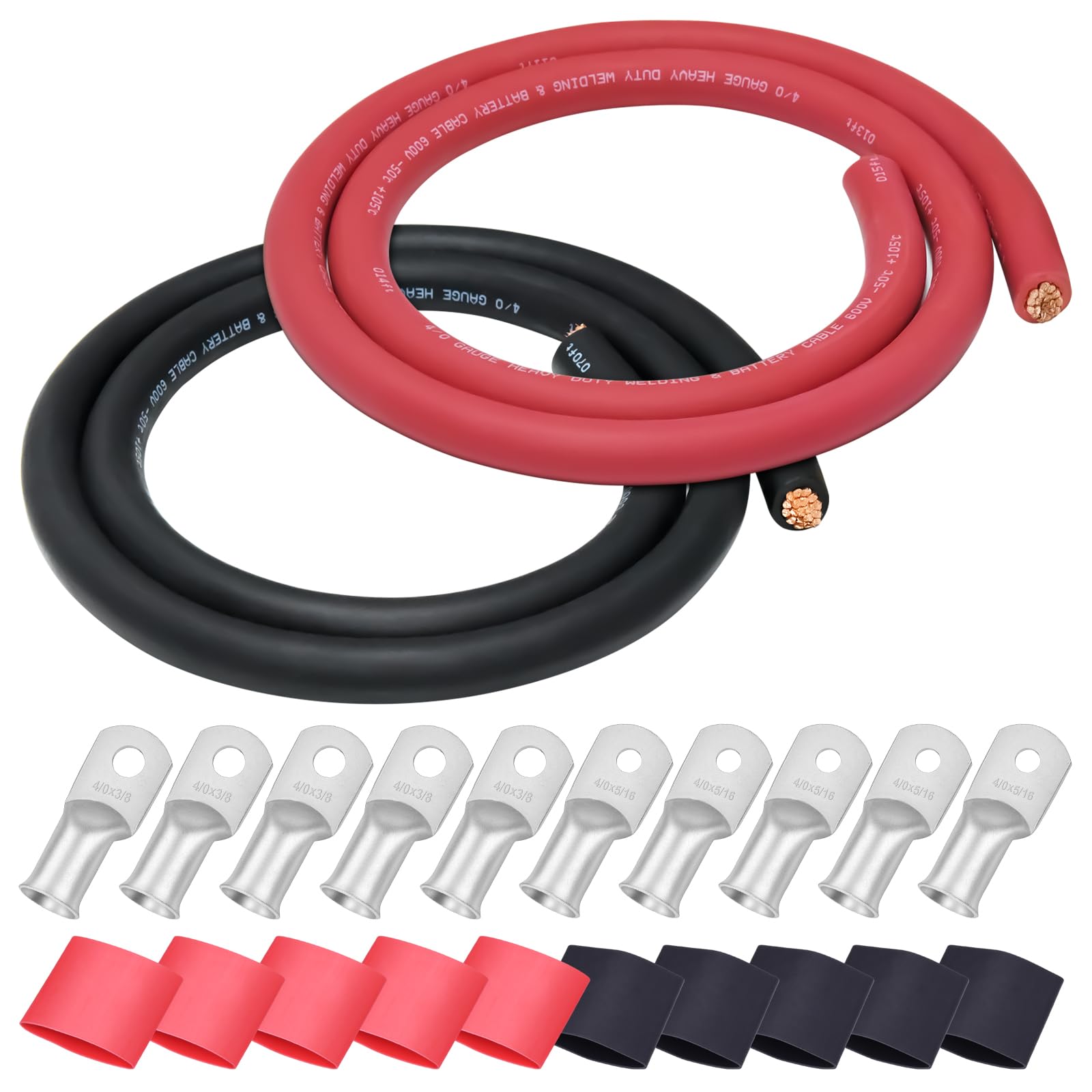
This iGreely kit bundles 5 feet each of red and black 4/0 cable with 10 copper lugs (five 5/16-inch and five 3/8-inch) plus five pairs of heat shrink tubing. The cable itself uses 3415 strands of 0.2mm oxygen-free copper — the highest strand count in this lineup — resulting in exceptional flexibility for short, tight battery runs. The EPDM jacket has a 22.6mm OD and operates from -58°F to +221°F.
Car audio enthusiasts have used this cable to power 3000W amplifiers at 1 ohm with no measurable power loss. RV builders have incorporated it into bus bar wiring, noting that having both 5/16 and 3/8 lugs on hand eliminates the need for a second trip to the hardware store. The included heat shrink is polyolefin rated to 600 volts and shrinks to create a water-resistant seal over the crimped lug.
The cable is rated to 440 max amps and 600 volts. The trade-off for the bundled convenience is that you get exactly 10 feet total — enough for most single-battery-to-inverter runs but short for longer feeder circuits. For a complete one-stop battery cable solution, this kit removes the hassle of sourcing lugs and tubing separately.
Why it’s great
- All-in-one kit includes lugs, heat shrink, and cable
- 3415 strands provide extreme flexibility
- Includes both 5/16 and 3/8 lug sizes
Good to know
- Only 5 feet per color — limited for long runs
- Lugs are tin-plated copper, not pure OFC
6. WindyNation 4/0 Gauge 5 ft Black + 5 ft Red
The entry-level WindyNation Power-Flex cable delivers the same pure copper construction and SAE J1127 compliance as its longer sibling, but in a shorter 10-foot total length (5 feet black, 5 feet red) at a significantly lower cost. It uses multi-strand pure copper with EPDM insulation rated to 600 volts and -58°F to +221°F. Verified buyers report using it for RV electrical projects and OTR truck inverter setups with excellent results.
One user tested this cable at 300A continuous draw over 5 feet and reported it ran ice cold with zero voltage drop. The jacket is solvent repellent and abrasion resistant, and the cable cuts cleanly with an angle grinder or cuts cleanly with a razor blade. The wire is manufactured and annealed to ASTM standards in the USA, giving confidence in the metallurgy.
The shorter length makes it ideal for connecting a single battery to a nearby inverter or bus bar. If your run needs exceed 5 feet per polarity, you will need to buy multiple sets or step up to the 10-foot version. For compact installations, this is the most affordable pure-copper USA-made 4/0 option available.
Why it’s great
- USA-made pure copper at a competitive price
- Runs ice cold at 300A continuous over 5ft
- Flexible enough for tight battery box routing
Good to know
- 10 feet total may be too short for some projects
- No lugs or heat shrink included
7. WindyNation 4/0 Gauge 10 Pair Battery Terminal Ends Set
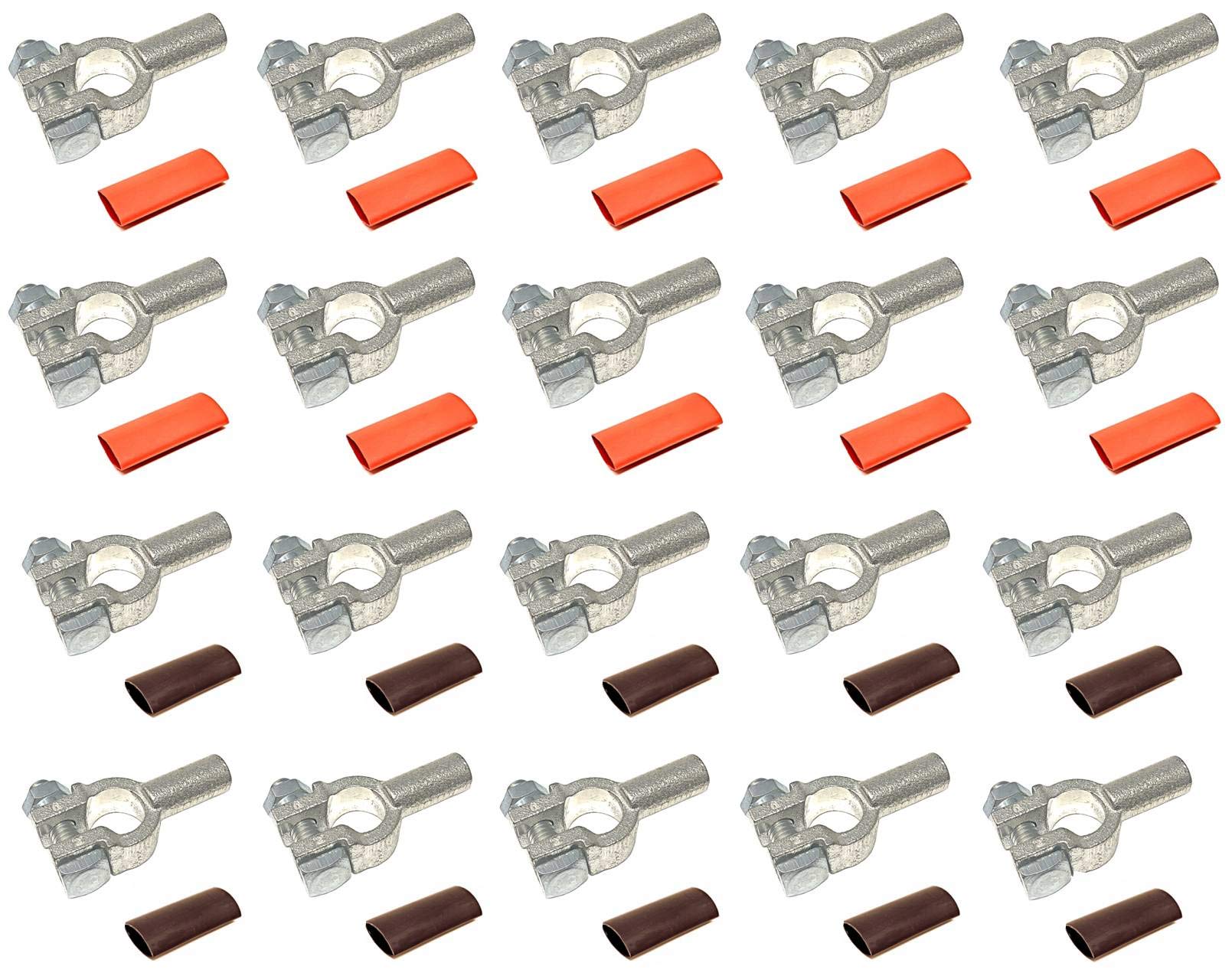
When your 4/0 cable run terminates at a battery, you need a terminal that can handle the amperage without resistive loss. This WindyNation set includes 10 positive and 10 negative top post terminals made from solid pure copper with a tin coating for corrosion resistance. Each terminal can be crimped using a hexagonal die or soldered for a permanent connection. The package also includes 1.5 inches of dual-wall adhesive heat shrink per connector — black for negative, red for positive.
Buyers consistently praise the solid copper construction, noting that the terminals clamp down securely and maintain full conductivity without the resistance that plagues stamped brass or zinc terminals. The tin coating prevents the white oxidation that typically forms on copper battery terminals in humid environments. The terminals fit all standard top post batteries and are RoHS compliant and lead-free.
This is a bulk set — 20 terminals total — making it a practical purchase for someone building multiple battery banks or a shop that does frequent cable repairs. For a single battery project, you will have spare terminals for future use. The heat shrink included is adhesive-lined, meaning it seals out moisture and prevents the terminal from loosening due to vibration.
Why it’s great
- Solid pure copper with tin plating for conductivity
- Accepts both crimp and solder termination
- Adhesive-lined heat shrink included
Good to know
- 10 pairs is a bulk quantity for small projects
- Crimping requires a hexagonal die, not standard crimpers
FAQ
Can I use 4/0 welding cable for a service entrance feed?
How do I crimp 4/0 cable lugs without a hydraulic crimper?
Is 4/0 cable suitable for 48V solar battery banks?
Does tinned copper handle vibration better than bare copper?
What is the difference between 4/0 AWG and 4/0 SER cable?
Final Thoughts: The Verdict
For most users, the best 4/0 ser cable winner is the WindyNation 4/0 10ft Black + 10ft Red because its 2047-strand pure copper construction provides the ideal balance of flexibility, ampacity, and documented quality for solar, RV, and inverter installations. If you need true marine-grade corrosion resistance for a saltwater boat, grab the NOVINO Marine Wire 10ft Red + 10ft Black. And for a direct-burial service entrance run to a sub-panel, nothing beats the NA$$AU ELECTRICAL Wake Forest Quadruplex for its cost-effective aluminum construction and complete 4-conductor configuration.