
For any cyclist, the blind spot behind the bike is a constant source of anxiety. Traditional handlebar mirrors offer a small, shaky reflection, often forcing you to take your eyes far off the road or crane your neck at a critical moment. A dedicated camera system changes that entirely, delivering a live, wide-angle view of everything approaching from the rear directly to a handlebar-mounted display.
I’m Min — the co-founder and writer behind Gadgets Feed. I’ve spent countless hours sifting through technical specs, lens quality metrics, battery capacity figures, and real-world user reports to isolate the bicycle camera systems that actually solve the rearward visibility problem without introducing new headaches.
After analyzing dozens of models, I’ve assembled this focused guide to the best bicycle camera front and rear systems available now, matching each option to a specific riding need and budget tier.
How To Choose The Best Bicycle Camera Front And Rear
Not every camera system serves the same purpose. Some are designed as pure rearview monitors with no recording capability, while others function as full-fledged dash cameras that capture and save video evidence. Your choice depends on whether your primary goal is real-time situational awareness or post-ride documentation and security.
Live-View Monitor vs. Recording Dash Cam
A live-view system like the PARKVISION or ATOVANKA options provides a constant video feed to a handlebar screen. These units excel at giving you immediate awareness of traffic behind you without recording anything. They typically feature massive batteries (5000mAh to 10000mAh) because the screen is always on. A recording dash cam, like the AKEEYO or INNOVV, captures footage to a memory card. These units usually have smaller batteries (1800mAh range) because they are designed to be always connected to a power source, but they provide the crucial ability to review an incident after the fact.
Battery Life and Capacity
For a live-view monitor, battery life is the single most important spec. A 5000mAh battery typically delivers around 5 hours of continuous screen-on time. A 10000mAh battery can push that to 10 hours, covering a full day of touring or a week of commuting. For recording cameras, battery life is often secondary to the ability to hardwire the unit to a power bank or the bike’s electrical system for continuous operation.
Camera Resolution and Lens Quality
For live-view safety, a 1080P sensor is more than sufficient — clarity is about real-time awareness, not cinematic quality. Look for a wide field of view (110° to 130°) to minimize blind spots. For recording cameras, a Sony STARVIS or STARVIS 2 sensor makes a dramatic difference in low-light conditions, pulling detail from shadowy streets and twilight rides where cheaper sensors produce only noise.
Mounting and Waterproofing
Any outdoor cycling camera must have an IP67 waterproof rating as a baseline. This ensures the camera survives rain, splashes, and even short submersion. The mounting system should be tool-free and vibration-dampened. A camera that loosens over bumpy terrain or requires Allen keys to adjust angle will quickly become a frustration rather than a safety tool.
Quick Comparison
On smaller screens, swipe sideways to see the full table.
| Model | Category | Best For | Key Spec | Amazon |
|---|---|---|---|---|
| ATOVANKA M40 | Live-View Monitor | All-day touring & commuters | 10000mAh battery, 10hr runtime | Amazon |
| AKEEYO AKY-710S | Recording Dash Cam | Evidence capture & commuting | 4K sensor, 1800mAh battery | Amazon |
| VSYSTO D6L | Recording Dash Cam | Motorcycle & moped riders | Dual 1080P, Wi-Fi, 256GB support | Amazon |
| PARKVISION Base | Live-View Monitor | Budget entry to rear visibility | 5000mAh battery, IP68 camera | Amazon |
| ROVE R2-4K DUAL | Recording Dash Cam | High-res front evidence | 4K front + 1080P rear, 5GHz Wi-Fi | Amazon |
| REDTIGER F7N Touch | Recording Dash Cam | Touch-screen control & GPS | 4K front + 1080P rear, voice control | Amazon |
| INNOVV K6 | Recording Dash Cam | Durable all-weather riding | 2K front + 1080P rear, IP67, aluminum | Amazon |
In‑Depth Reviews
1. ATOVANKA M40
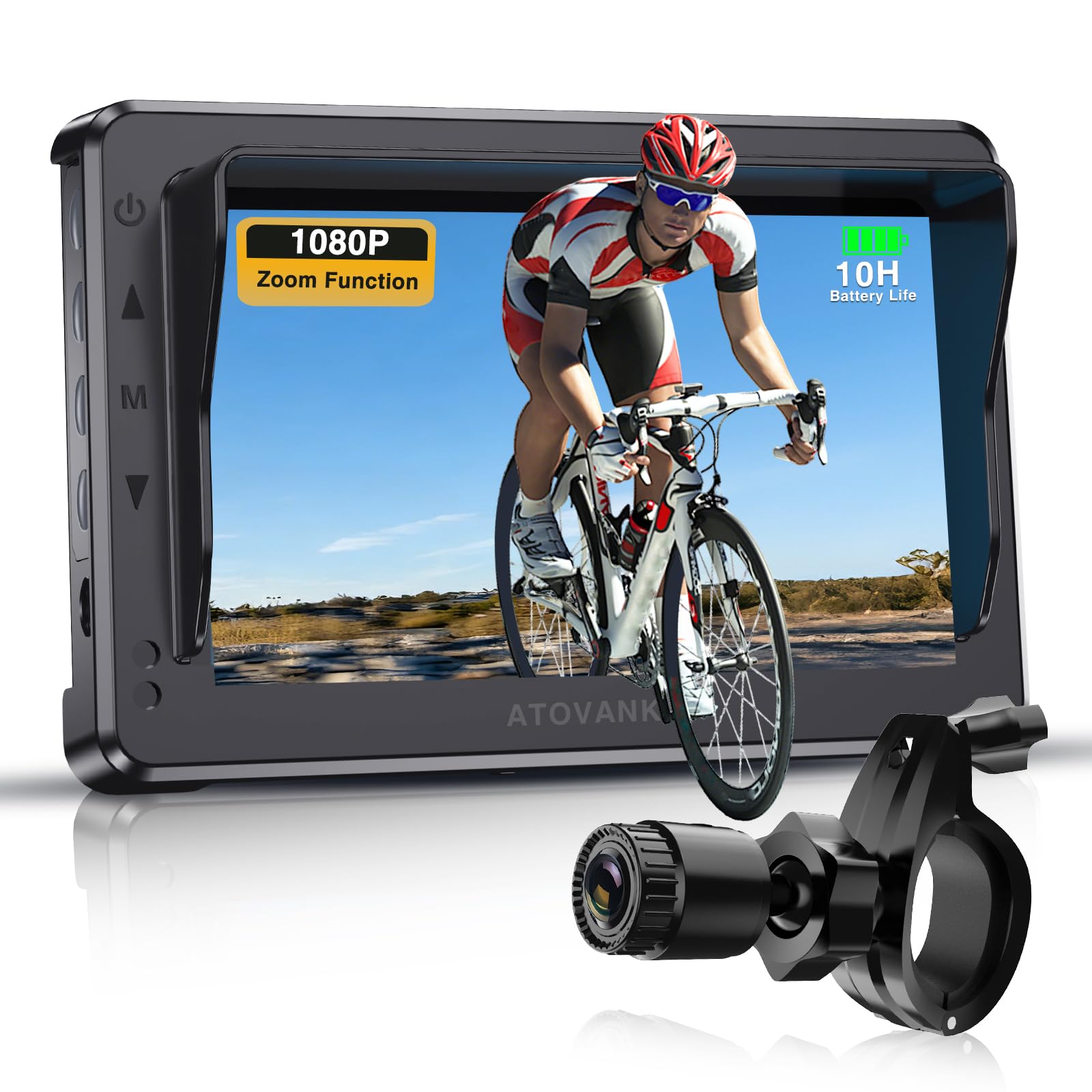
The ATOVANKA M40 is the most thoughtfully engineered live-view rear-camera system on this list, solving the battery anxiety that plagues lesser models. Its 10000mAh lithium-ion battery delivers a genuine 10 hours of continuous runtime on a single charge — enough for a full century ride or a week of daily commutes without reaching for a charger. The USB-C fast charging port cuts downtime to a minimum when you do need to top up.
Where this system truly differentiates itself is the four adjustable viewing angles — 60°, 90°, 110°, and 130° — accessible via a single button while riding. The 60° mode is excellent for close-quarters lane filtering where precise distance judgment matters, while the 130° panoramic mode eliminates blind spots on multi-lane roads. The 4.3-inch display features an ambient light sensor that automatically adjusts brightness, remaining legible even under direct midday sun, a common pain point with many LED-backlit screens. The image itself is delivered at zero-latency 1080P, meaning what you see on screen is exactly what is happening behind you in real time.
Installation is genuinely tool-free: connect the rear camera via the included 9.8-foot cable, strap the display mount to any handlebar between 22.2mm and 31.8mm, and you are riding in under three minutes. The IP67 waterproof rating on the rear camera means it can survive heavy rain and trail splashes without a second thought. Users consistently praise the crisp picture, the long battery life that lasts “several days” between charges, and the confidence boost of seeing rear traffic without turning your head. The only trade-off is that this is a pure live-view system — it does not record footage to a memory card. If your priority is real-time rear awareness with zero setup complexity, this is the gold standard.
Why it’s great
- Massive 10000mAh battery delivers reliable 10-hour runtime for all-day touring.
- Four adjustable viewing angles (60°/90°/110°/130°) give precise rear coverage for any traffic situation.
- Auto-brightness screen stays readable in direct sunlight and dims in tunnels.
Good to know
- No recording or video storage function — this is a live-view monitor only.
- Controls are not backlit, making button identification in the dark a slight challenge at first.
2. ROVE R2-4K DUAL

The ROVE R2-4K DUAL is a dash camera platform built for evidence-grade video capture, making it the ideal choice for cyclists who want to document every ride. The front camera records at a full 3840x2160P at 30fps using a Sony STARVIS 2 IMX675 sensor, while the rear camera simultaneously captures 1080P footage at 30fps. The STARVIS 2 sensor is the defining feature here — its back-illuminated architecture pulls usable color and detail from near-dark conditions, giving you readable plate numbers and vehicle shapes in twilight where conventional sensors deliver only black silhouettes. The package includes a 128GB microSD card, so you do not need to source storage separately.
Connectivity is a strong suit. The built-in dual-band 5GHz Wi-Fi reaches download speeds up to 20MB/s, letting you pull full 4K clips to your phone quickly via the ROVE app. The GPS module overlays real-time speed, compass heading, and precise route data onto the video stream, which can be viewed on the included PC/Mac GPS Player. The 3-inch IPS display provides a bright, wide-viewing-angle preview for positioning the cameras during setup. A supercapacitor replaces the traditional lithium battery for power backup, which extends the unit’s lifespan significantly in hot environments where dash cams typically cook their cells.
The ROVE system is primarily designed for cars, but its compact form factor and included sticky mount make it adaptable to handlebars. The 24-hour parking mode with three options (1fps timelapse, motion detection, collision detection) is overkill for a parked bike but can function as a security camera when the bike is stationary at a cafe. Customer support is notably responsive, with multiple users reporting rapid warranty replacements when units developed issues. The trade-off is that this is a camera designed for continuous hardwired power — the included car charger assumes a 12V source, meaning cyclists will need a USB power bank to keep it running on long rides.
Why it’s great
- Sony STARVIS 2 sensor delivers exceptional low-light clarity on the front camera.
- Ultra-fast 5GHz Wi-Fi transfers large 4K video files to your phone in seconds.
- Includes a 128GB microSD card and built-in GPS for evidence-grade recordings.
Good to know
- Designed for 12V car power — cyclists will need a USB power bank for extended use.
- Suction cup mount is less secure on uneven handlebars; a sticky mount is more reliable for bikes.
3. REDTIGER F7N Touch
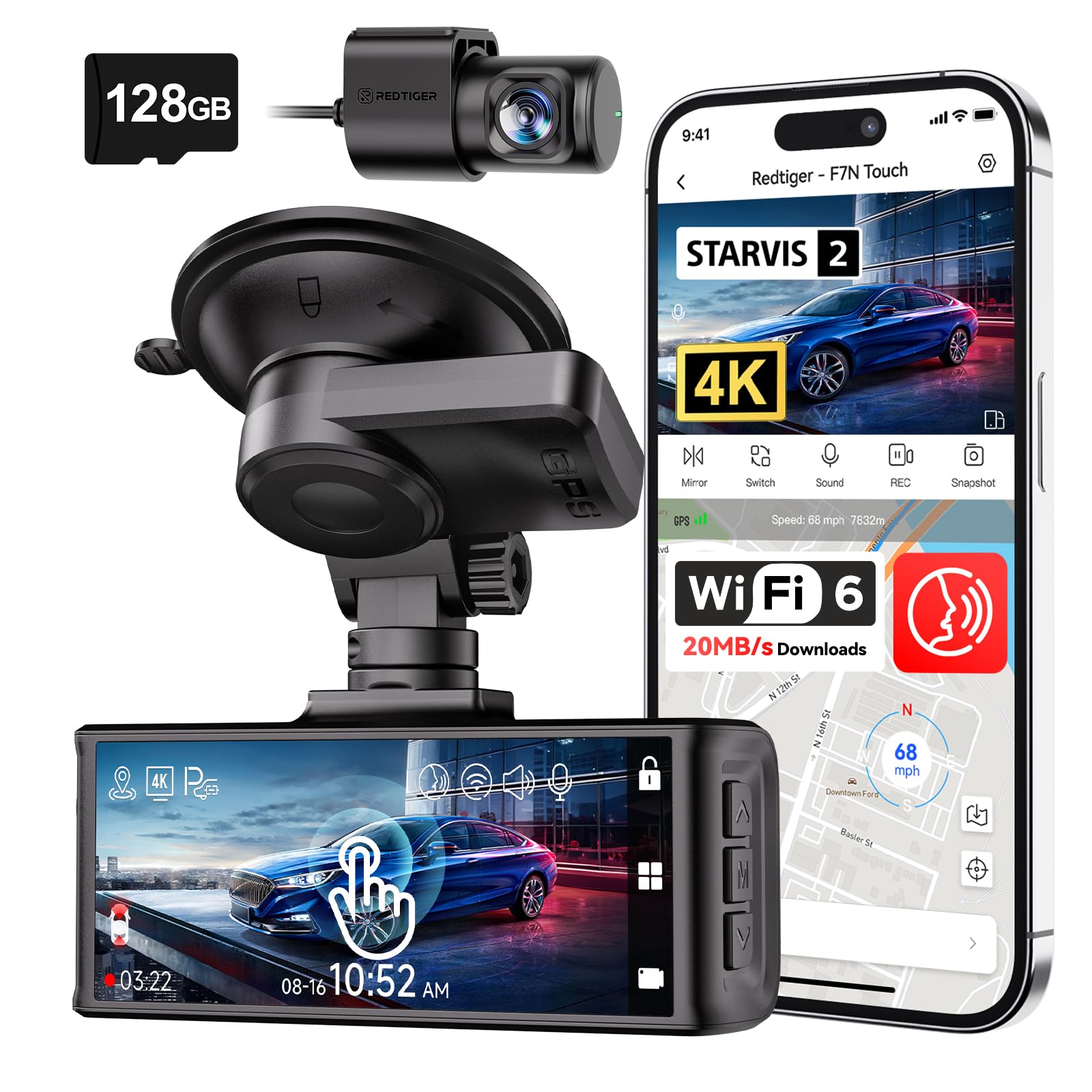
The REDTIGER F7N Touch delivers a user experience that feels more modern than most dash cameras, pairing a responsive 3.18-inch touchscreen with hands-free voice control. The front camera shoots 4K UHD at a wide 170° field of view using a STARVIS 2 sensor with HDR and WDR processing, while the rear camera captures 1080P at 140°. The 170° front angle is notably wider than competitors, reducing the blind spots at the edges of your peripheral vision when riding through intersections. Voice commands like “lock video” or “take photo” let you capture a moment without taking your hands off the handlebars.
The 5.8GHz Wi-Fi connectivity reaches the same 20MB/s download speed as the ROVE unit, and the “REDTIGER Cam” app provides a clean interface for viewing, downloading, and sharing clips. The built-in GPS logs speed and route data, and the loop recording with G-sensor automatically locks footage during a detected impact so it is not overwritten. The included 128GB card is generous, though the official compatibility spec lists a maximum of 64GB — in practice, the 128GB card included works out of the box, and users have reported success with larger cards. The parking monitoring mode requires a separate hardwire kit, which is standard for this feature.
Day and night video quality is consistently praised by users, who note that license plates remain readable in the 4K front footage even in low-light suburban streets. The touchscreen interface is intuitive, and the physical button backup gives you a fallback if the screen is wet. The main challenge for cyclists is packaging — this is a windshield-mounted car unit, so adapting it to a bicycle requires some creativity with zip ties or a third-party mount. The rear camera cable at 21.3 feet is ample for even a long-tail cargo bike. The 18-month warranty and responsive support team provide peace of mind for a mid-premium investment.
Why it’s great
- Voice control allows hands-free operation while keeping focus on the road.
- 170° front field of view is among the widest, minimizing peripheral blind spots.
- Strong 4K video quality with clear plate capture in both day and night conditions.
Good to know
- Designed for car windshields, not bicycle handlebars — requires DIY mounting adaptation.
- Max official SD card support is 64GB, despite the included 128GB card working in practice.
4. AKEEYO AKY-710S

The AKEEYO AKY-710S strikes an impressive balance between recording capability and form factor, delivering a dedicated bicycle camera at a mid-range price that undercuts many car-derived units. Its Starvis IMX335 sensor captures video at 2K 55fps or 4K 28fps through a 142° wide-angle lens. The 55fps mode at 2K is the sweet spot for cycling — it delivers noticeably smoother footage than standard 30fps, reducing the motion blur on passing vehicles and making plate numbers easier to read when reviewing clips. The 4K mode is available for scenic shots or stationary evidence capture.
This is one of the few cameras on this list that ships with a dedicated bicycle mount. The quick-release bracket allows you to detach the camera from the handlebar in seconds when locking up your bike, preventing theft. The IP66 rating handles rain and dust well, though it falls short of the IP67 standard found on some competitors. The 1800mAh battery records over 4.5 hours of 1080P video on a charge, ample for most commutes. The package includes a 64GB microSD card, saving an immediate accessory purchase.
The Wi-Fi app connection for real-time preview and video playback works well, with OTA firmware updates keeping the camera current without needing to connect to a computer. A wired remote control (sold separately) can start/stop recording from the handlebar. The parking surveillance mode with G-sensor detection automatically saves clips when a bump is detected while parked. Users report solid video quality and good battery life covering 50-plus miles of riding per charge. Some users noted the plastic bracket screws can strip if over-tightened, so a gentle touch and thread locker on the final install are recommended. For the price, the combination of dedicated bike mount, smooth 2K 55fps video, and included storage is hard to beat.
Why it’s great
- Dedicated quick-release bicycle mount included — no DIY adaptation needed.
- 55fps at 2K resolution delivers smoother, less blurry footage than standard 30fps cameras.
- Includes a 64GB microSD card and OTA firmware updates for future-proofing.
Good to know
- Plastic bracket screws can strip easily — hand-tighten and consider thread locker.
- 1800mAh battery requires regular charging for all-day rides beyond 4.5 hours.
5. INNOVV K6
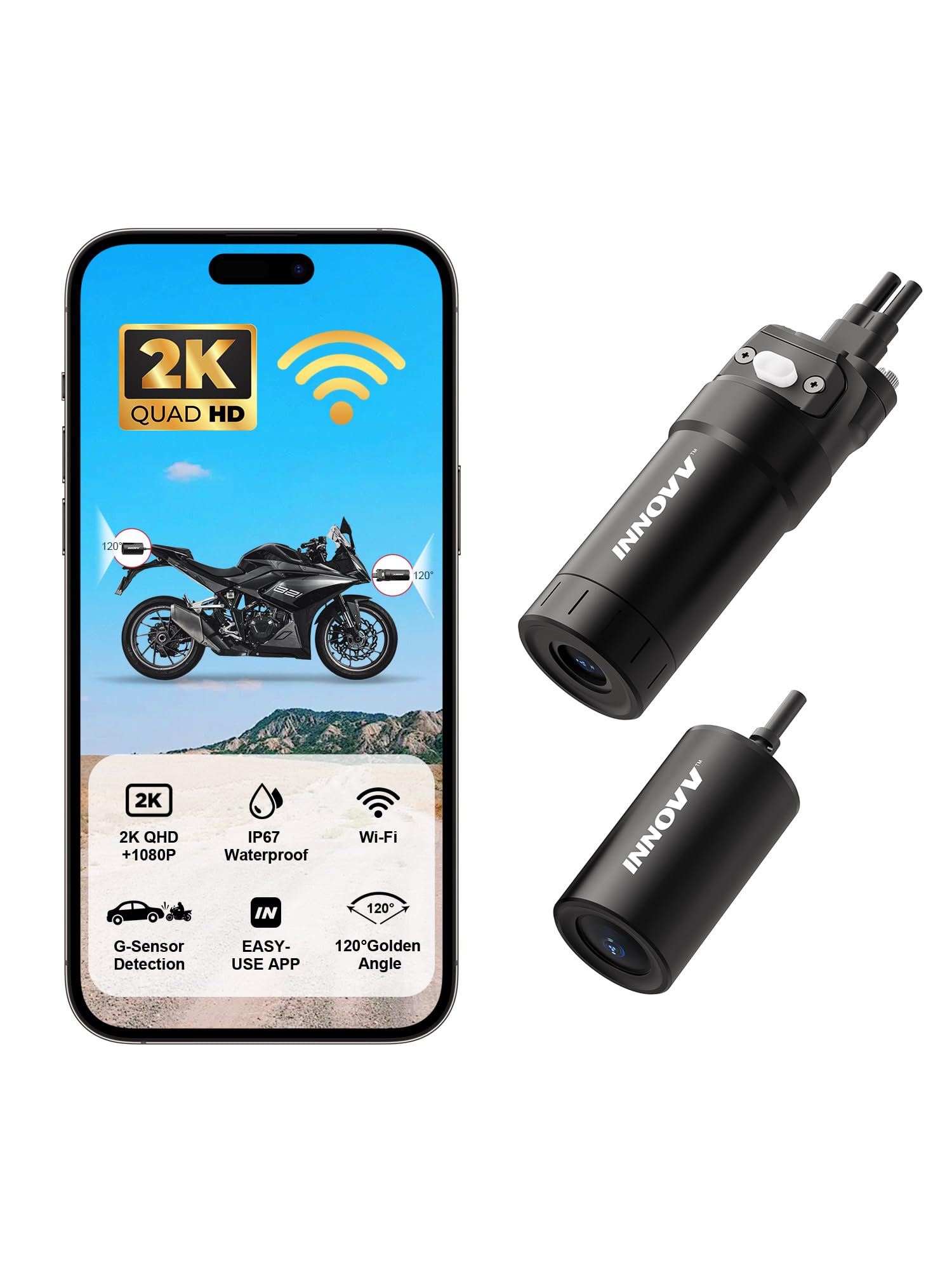
The INNOVV K6 is purpose-built for the harsh realities of two-wheeled riding, with an IP67 waterproof and dustproof rating that means it can be completely submerged in half a meter of water for 30 minutes without damage. The full aluminum alloy body dissipates heat effectively and resists the vibration fatigue that kills plastic-mounted cameras over time. The front camera captures at 2K QHD 1440P 30fps using a STARVIS sensor, while the rear camera records at 1080P 30fps. The 120° golden-angle lenses are specifically calibrated to reduce fisheye distortion while maintaining wide coverage, producing footage where lane markings and plate numbers remain geometrically accurate.
The K6’s design philosophy is “integrate and conceal.” The DVR is integrated directly into the compact front camera body (80.5mm x 28mm), eliminating the need for a separate control box that must be hidden under the seat. This makes installation simpler and the system more weather-sealed as a whole. The Wi-Fi connection to the INNOVV app provides smartphone access for footage management and camera settings without needing to pull the microSD card. The system supports cards up to 256GB (sold separately), giving you plenty of storage for long rides.
Users report that the image stabilization is excellent for a motorcycle-mounted camera, with stable footage even on bumpy roads. Road signs and license plates remain readable at reasonable distances. The setup is designed to trigger automatically when the ignition turns on, though for pedal bikes you would want to connect it to a switched power bank. The sticky mount screw can be difficult to access once installed, so plan your mounting position carefully. The K6 requires a U3/V30 microSD card — using a slower card can cause lockups and battery drain. For the hardcore cyclist who rides in all weather and wants a permanent, near-invisible recording system, the K6 is the most durable option available.
Why it’s great
- IP67 waterproof rating and full aluminum body deliver maximum durability in all conditions.
- Integrated DVR in the camera head eliminates the need for a separate control box.
- Stable 2K QHD footage with minimal fisheye distortion for accurate evidence capture.
Good to know
- Requires a U3/V30 microSD card — slower cards cause system lockups.
- Sticky mount screw is inaccessible after installation; choose mounting position carefully.
6. VSYSTO D6L

The VSYSTO D6L brings a motorcycle-oriented dual-channel recording system into the bicycle world, offering two 1080P cameras with starlight night vision and a compact main unit that tucks away under the seat. The front and rear cameras each feature a 130° wide-angle lens and an IP67 waterproof rating, with dedicated starlight sensors that produce usable color footage in very low light without relying on harsh IR LEDs. The main DVR body is small enough to fit under a bicycle saddle or inside a frame bag, and the included wired controller provides an LED status indicator and a button to manually lock an emergency recording.
Connectivity is handled through Wi-Fi and the “WiFi Camera” app, which allows real-time preview, clip download, and settings adjustment on your phone. The loop recording can be set to 1, 2, 3, or 5-minute intervals, and the G-sensor automatically locks footage when it detects a collision or hard bump. The system supports microSD cards up to 256GB, giving you substantial storage capacity. The starlight night vision performs particularly well — users report clear, color-accurate footage at dusk and on unlit roads, a distinct advantage over cheaper sensors that switch to noisy black-and-white mode in the dark.
Installation is straightforward for anyone comfortable routing a cable along a bike frame: connect the cameras, attach the main unit, and run power. The system is designed to turn on and off with the bike’s ignition, so pedal cyclists will want a switchable power bank. Some users have reported overheating in direct sun after extended use, and the audio quality is described as poor — adequate for detecting an impact sound but not for conversation-level recording. The actual field of view is closer to 120° than the advertised 170°, but the image quality and stability remain solid. For the price, the dual-camera starlight recording capability makes this a strong contender for night riders who need incident documentation.
Why it’s great
- Starlight sensors deliver clear color night vision without harsh IR LEDs.
- Compact main unit hides easily under a saddle or in a frame bag.
- Supports microSD cards up to 256GB for extensive recording capacity.
Good to know
- Audio quality is poor — adequate for impact detection but not spoken recording.
- Some units have shown overheating in direct sunlight; ensure airflow around the main body.
7. PARKVISION Base

The PARKVISION Base model is the most accessible entry point into rear-camera cycling safety, offering a functional 1080P AHD live-view system at a budget-friendly price. The 4.3-inch display connects to a rear camera with a 110° wide-angle lens and a CMOS sensor that provides clear, distortion-free images with good color reproduction in daylight. The 5000mAh battery delivers around 300 minutes (5 hours) of continuous runtime, which covers most daily commutes and recreational rides without needing to recharge. The camera itself is IP68 rated, exceeding the IP67 standard of many competitors and making it resilient to extended rain exposure.
Installation is genuinely tool-free: the camera mounts to the rear of the bike, the display attaches to the handlebar via a 360° rotatable bracket, and the cable connects the two. The mount fits handlebar diameters from 20-30mm, covering most standard bikes, e-bikes, and city bikes. The 110° field of view is calibrated to show what is directly behind you without the severe fisheye distortion that makes distance judgment difficult. The camera uses glass lens elements for improved transparency and low-light transmission compared to cheaper plastic lenses.
Users consistently report that the camera makes them “feel safer” by revealing approaching vehicles — especially quiet electric cars — that would otherwise go unnoticed. The night vision performance is noted as excellent, producing clear color images without noisy IR bloom. The main trade-off at this price point is screen brightness: some users in consistently sunny climates find the display hard to read in direct sunlight, requiring manual brightness/contrast adjustment. The charging indicator is a dim light recessed inside the input jack, making it hard to check charge status. For the budget-conscious cyclist who wants the safety benefits of a rear camera without the expense of a recording system, the PARKVISION provides a reliable foundation.
Why it’s great
- IP68 waterproof rating exceeds the standard IP67 for exceptional weather resistance.
- Tool-free 3-minute installation with a 360° adjustable bracket for perfect camera angle.
- Glass lens and CMOS sensor deliver clear, color-accurate footage in daylight and night conditions.
Good to know
- Display can be hard to read in direct bright sunlight; manual brightness adjustment helps.
- No recording capability — this is a live-view safety system only.
FAQ
Is a live-view monitor or a recording dash cam better for cycling safety?
How do I power a bicycle dash cam on a pedal bike without an electrical system?
Can I use a car dash cam on my bicycle?
What is the difference between AHD 1080P and standard 1080P for a bicycle camera?
How do I protect a bicycle camera from theft when parking?
Final Thoughts: The Verdict
For most riders, the best bicycle camera front and rear is the ATOVANKA M40 because its 10000mAh battery eliminates range anxiety, the four adjustable viewing angles adapt to any traffic situation, and the auto-brightness screen stays visible in direct sun — delivering the purest rear-awareness experience available. If you need recorded evidence of close passes or incidents, grab the AKEEYO AKY-710S for its dedicated bicycle mount, smooth 55fps video, and included storage at a mid-range price. And for all-weather durability and a permanent recording setup that you can install and forget, nothing beats the INNOVV K6 with its IP67 aluminum body and integrated DVR design.