
Every electrical gremlin in your vehicle — dimming headlights, a stereo that cuts out, a starter that struggles on cold mornings — can trace back to one single point of failure: the connection between your battery and your wiring. A cheap, corroded, or undersized terminal introduces resistance that robs your system of voltage, generates heat, and leaves you stranded. Upgrading your automotive battery terminals is the single highest-return electrical fix you can make, and the difference between a terminal that delivers full cranking amps and one that costs you 0.5 volts is measured in material, contact area, and clamping force.
I’m Min — the co-founder and writer behind Gadgets Feed. I’ve spent hundreds of hours dissecting the technical specs, customer feedback, and real-world performance data for over 70 battery terminal models, mapping the engineering choices — brass versus aluminum versus zinc, clamping mechanisms, wire gauge capacity, and corrosion resistance — against the needs of daily drivers, off-road builds, and high-demand audio systems.
This guide ranks seven of the most compelling terminals available, sorting by build quality, current-handling capacity, and installation flexibility to help you find the best automotive battery terminals for your specific vehicle and electrical load.
How To Choose The Best Automotive Battery Terminals
Selecting battery terminals involves balancing material conductivity, wire gauge capacity, physical compatibility with your battery posts, and how many accessory cables you need to land. A terminal that fits poorly or uses low-grade alloy will increase resistance and accelerate corrosion, undermining every other electrical component downstream.
Material and Conductivity
Brass is the gold standard for conductivity and corrosion resistance — it offers excellent current flow and won’t gall against lead battery posts. Copper is a close second but is softer and more prone to deformation under high clamping torque. Aluminum (typically 6061 alloy) is lighter and cheaper but requires a larger cross-section to carry the same current as brass; it also forms an oxide layer that can resist current flow unless the contact zone is machined or the anodization is removed. Zinc and pot-metal terminals are the cheapest option but have poor conductivity and corrode rapidly — avoid these for any vehicle that sees regular use.
Wire Gauge Capacity and Multi-Way Terminals
Standard terminals accept one or two cables. Multi-way terminals (6, 8, or even 12 connection points) let you run the main starter cable plus multiple accessory wires — ideal for trucks with lighting upgrades, winches, sound systems, or auxiliary battery banks. Look for terminals that explicitly support the wire gauge you need: 2/0 AWG for large inverters or winches, 1/0 AWG for heavy stereo amplifiers, and 4–8 AWG for smaller accessories. Check whether the terminal uses set-screw holes, threaded studs, or a combination — studs are easier to connect ring terminals to without removing the entire cable.
Battery Post Compatibility
The vast majority of automotive batteries use SAE tapered top posts (positive is larger in diameter). DIN and EN posts are common in European vehicles and have a slightly different taper angle. JIS pencil posts, found in Japanese motorcycles and some small vehicles, are thin and cylindrical — no terminal in this guide works with JIS posts. Always confirm your battery post type before buying; a mismatch means the clamp won’t grip securely, leading to intermittent electrical contact and voltage drop.
Corrosion Resistance and Insulation
Corrosion at the terminal is caused by acid fumes escaping the battery and by galvanic reaction between dissimilar metals. Brass and tin-plated copper resist this well; bare aluminum does not. A good terminal includes anti-corrosion washers, protective covers, or a sealed design that prevents fumes from reaching the metal. Insulating covers (red for positive, black or blue for negative) are not just cosmetic — they prevent accidental short circuits if a metal tool or body panel contacts the positive terminal.
Quick Comparison
On smaller screens, swipe sideways to see the full table.
| Model | Category | Best For | Key Spec | Amazon |
|---|---|---|---|---|
| Kaas Anodized 12-Way | Premium | Multi-accessory builds | 6061-T6 aluminum, 12-way, conductive zone | Amazon |
| Vgate 8-Way Lead Acid | Premium | Custom setups, audio/lighting | 8-way, 4/0 XL max, machined aluminum | Amazon |
| Vgate 6x 1/0 AWG | Mid-Range | RV, marine, heavy wire | 6-port, 1/0 AWG, 6061 aluminum | Amazon |
| Recoil BTO Solid Brass | Mid-Range | Factory wiring upgrade | Forged brass, dual-gauge outputs | Amazon |
| BetyBedy 12-Way Aluminum | Mid-Range | General car audio additions | 12-way, 6061 aluminum, 4/0 max | Amazon |
| Bateria Power Copper Kit | Budget | Quick replacement, budget build | Copper, anti-corrosion washers | Amazon |
| DLronwey Military Spec | Budget | Basic replacement, RV/marine | Alloy, 2-gauge copper lugs included | Amazon |
In-Depth Reviews
1. Kaas Anodized 12-Way Battery Terminal Connectors

The Kaas terminals are precision-machined from 6061-T6 aluminum and feature a unique anodization process where the anodic layer is removed at the contact zone to ensure direct metal-to-metal conductivity. This is a rare engineering detail — most anodized aluminum terminals insulate the connection, but Kaas has solved that by targeting conductivity exactly where it matters. The 12-way layout (six holes plus six threaded studs) accepts wire from 8 AWG up to 4/0 XL, making it an effective distribution block for vehicles running a winch, air compressor, lighting, and a high-power stereo on a single terminal pair.
The easy-to-tighten head design and anti-loosening screws address the common complaint of terminals that unscrew over time due to vibration. Users on Ford Excursions and F-350s report that the mounting is secure and the included accessories fit without modification. The red and blue color scheme is not just visual — it provides instant polarity identification during installation, which reduces the risk of reversing connections.
One consideration: because these are aluminum, the overall conductivity per cross-section is lower than brass. For a high-compression diesel starter pulling 500+ cold cranking amps, the larger contact area compensates. The anti-corrosion properties of anodized aluminum are excellent, and the included anti-corrosion washers further protect the post interface. This is a premium solution for anyone who needs a clean, expandable electrical foundation.
Why it’s great
- Removable anodized layer at contact points ensures conductivity
- 12-way capacity handles massive accessory loads without a separate block
- Anti-loosening hardware stays tight under vibration
Good to know
- Aluminum is less conductive than brass per unit volume
- Does not fit JIS pencil posts
2. Vgate 8-Way Lead Acid Battery Terminal Connector

Vgate’s 8-way terminal is machined from solid aluminum and is designed to clamp onto SAE, DIN, and EN tapered posts. It offers two 2/0 AWG hole holders and two 1/0 AWG holders, plus four threaded studs — a configuration that prioritizes large-gauge main cables while still providing points for smaller accessories. This is a deliberate trade-off: if you’re running 4/0 welding cable to a massive inverter, the oversize holes handle it without reaming or adaptation.
A standout detail is the machined pocket that accommodates the battery post lip — this prevents the terminal from walking upward over time. The plastic insulator on the back provides extra protection against accidental shorting to body panels. Users on Chevy Duramax trucks and custom audio builds have reported that the Vgate terminals eliminated voltage drop and improved stereo clarity. The package includes star washers and metric hardware (13mm nuts, 5mm Allen key), so no trips to the hardware store are required.
The main caveat is that these are not plug-and-play for factory configurations — they reward a custom wiring approach. Some users noted that overtightening can distort the clamp if the post is slightly undersized. Following Vgate’s tip to fully loosen the clamp before installation ensures a proper grip. The two-year warranty provides additional peace of mind.
Why it’s great
- Two 2/0 AWG and two 1/0 AWG large-gauge ports
- Machined pocket prevents terminal walk-off
- Includes metric hardware and star washers
Good to know
- Best suited for custom wiring, not direct OEM replacement
- Over-tightening can distort clamp on small posts
3. Vgate 6x 1/0 AWG Lead-Acid Battery Terminals Clamp

This Vgate model is a simpler, focused alternative to the 8-way version — six ports all sized for 1/0 AWG wire, machined from the same 6061 aluminum. It is designed for owners who need one or two large-gauge cables (starter and alternator) plus a few accessories, without the extra bulk of a 12-way block. The smaller footprint is easier to fit in tight battery trays where clearance is limited.
Users on RVs and motorhomes have praised these terminals for their ability to handle multiple taps without needing a separate distribution block. The tapered clamp design grabs SAE top posts securely, and the included protective film keeps the surface pristine during installation. The terminals come with a polished finish that resists corrosion, and the design includes a groove at the bottom to prevent acid contact with the post — a thoughtful engineering touch that reduces long-term corrosion at the critical interface.
The most common feedback is that the 1/0 AWG ports are slightly undersized for some true 1/0 welding cables, requiring the wire to be trimmed or compressed. This is a known tolerance variance in aftermarket wire sizing. For standard 1/0 AWG, it fits cleanly. The lack of rubber insulation on the back means you should ensure no metal is exposed after wiring, or use heat shrink on the cables.
Why it’s great
- Compact size fits tight battery trays
- Six ports handle starter and multiple accessories cleanly
- Bottom groove prevents acid post corrosion
Good to know
- 1/0 AWG ports may be tight on oversized welding cables
- No rear insulation cover included
4. Recoil BTO Solid Brass Positive Negative Battery Terminals

The Recoil BTO terminals are forged from solid brass and finished with a marine-grade satin chrome layer, which provides superior corrosion resistance — especially important for vehicles exposed to salt, humidity, or off-road conditions. Unlike zinc or pot-metal terminals that degrade quickly, brass offers excellent conductivity and the chrome plating prevents oxidation while maintaining a clean factory look.
The key design feature is the split output configuration: one port accepts 0/2/4 gauge wire and the other accepts 4/8 gauge wire, plus a top-mounted power ring provision. This makes the Recoil terminals an ideal choice for upgrading a factory wiring system without cutting the OEM clamp — the included adapter collars allow you to connect the new terminal over the existing post adapter. Users on Jeeps and Lexus vehicles report that the install is straightforward and the oversized convex screws provide rock-solid connection pressure that won’t loosen with vibration.
The package includes red and black silicone covers that provide insulation and a professional appearance. The main limitation is the limited expansion capacity — with only two output paths, this is not a terminal for a full accessory build. It excels as a drop-in replacement that improves conductivity over stamped factory terminals. Some users found the removable post adapter had thin walls that felt less substantial, but the primary clamp body is robust.
Why it’s great
- Solid brass construction with satin chrome finish
- Adapter collars allow OEM integration without cutting
- Oversized screws provide high clamping force
Good to know
- Only two output ports — limited for accessories
- Removable post adapter feels less robust than main body
5. BetyBedy 12-Way Battery Terminal Connectors

The BetyBedy 12-way terminal is machined from 6061 aluminum and provides six hole-holders plus six threaded studs, accommodating wire from 8 AWG up to 4/0 XL. It targets the same use case as the Kaas terminal but at a lower entry point. The design is straightforward: the clamp body tightens onto the tapered battery post with a single set screw, and the accessory ports are arranged radially around the top.
Users on diesel Ford trucks and second battery setups have reported that these terminals eliminated trickle charge issues and improved starting performance. The included hardware pack — Alan wrenches, fiber washers, copper lugs, and heat shrink — covers most installation scenarios without additional purchases. The terminals are compatible with 6V to 48V systems, making them suitable for marine, forklift, and RV applications beyond standard automotive use.
The primary concern is that the set-screw design for the main post clamp can be difficult to tighten sufficiently on some battery posts without stripping the threads. Users recommend applying anti-seize on the Allen bolt threads to prevent galling. Additionally, the aluminum body is not as conductive as brass, so for very high-current applications (winch or inverter over 2000W), a brass terminal may be the better choice. For general car audio and lighting additions, this is a solid performer.
Why it’s great
- 12-way ports provide excellent accessory expansion
- Compatible with 6V to 48V systems
- Includes copper lugs, heat shrink, and wrenches
Good to know
- Set-screw clamp can be hard to tighten without stripping
- Aluminum less conductive than brass for extreme loads
6. Bateria Power Battery Terminal Connectors Kit
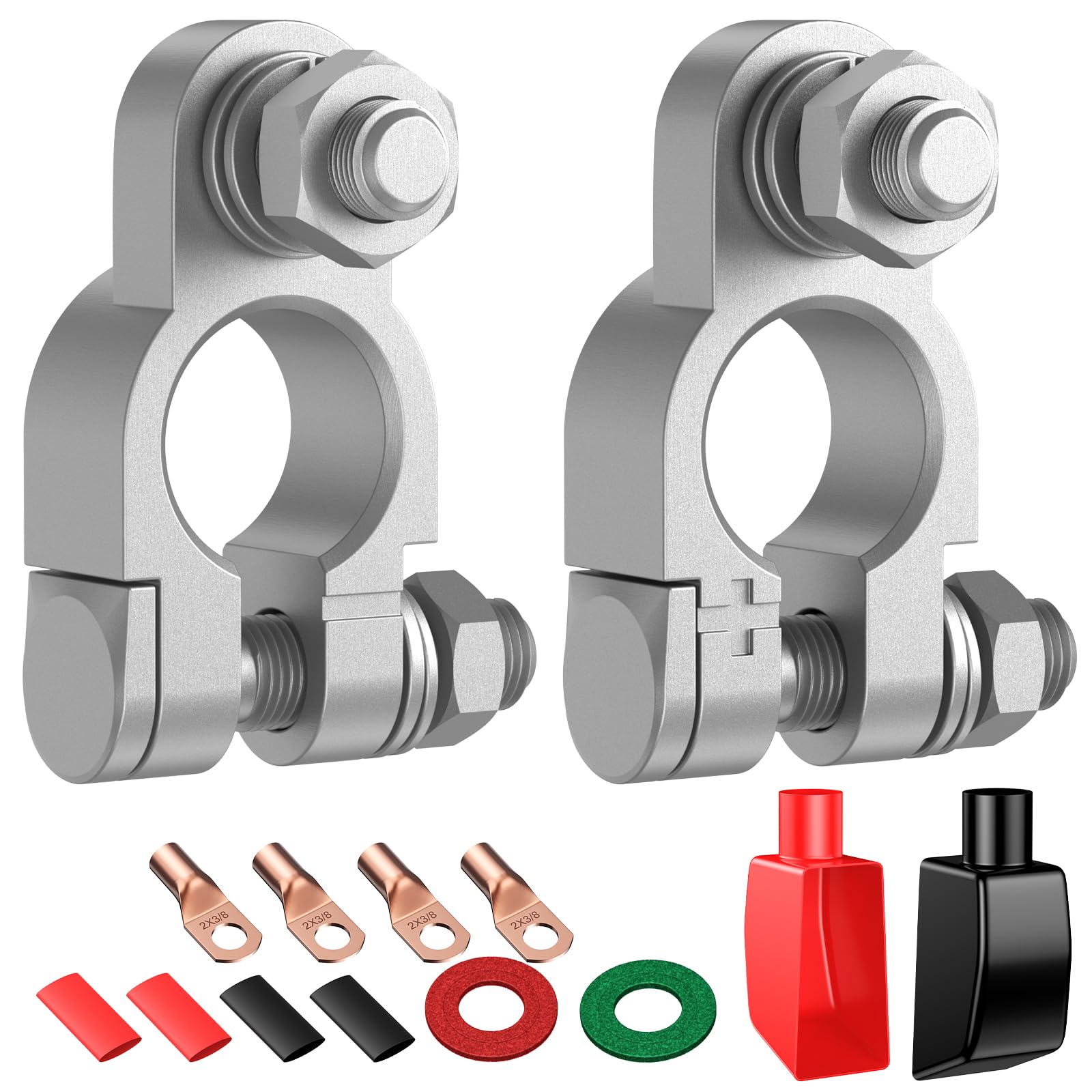
The Bateria Power kit delivers copper-alloy terminals at a price that competes with cheap zinc options, but the material difference is important. Copper alloy offers significantly better conductivity than zinc, and the tin-plated hardware resists corrosion that can degrade plain copper over time. The kit includes two terminals, two protective covers, two anti-corrosion washers, four heat shrink tubes, and four 2-gauge 3/8-inch copper lugs — everything needed for a basic replacement.
Users report that the terminals fit securely on Subaru and Dodge applications, with the positive and negative posts clearly differentiated. The clamping action is solid — reviewers specifically note that they are “not cheap pos” and provide a connection that eliminates intermittent shut-off issues. The anti-corrosion washers add a layer of protection that bare terminals lack.
The limitations are clear at this tier: the included lugs are only sized for 2-gauge wire, so if you’re using 4-gauge or 1/0, you’ll need to source your own. The terminal body is not machined — it appears to be a cast design, which can have microscopic voids that slightly reduce current capacity. For a daily driver replacing corroded terminals with no additional accessory wiring, this is a highly effective and cost-efficient solution.
Why it’s great
- Copper alloy with tin-plated hardware for corrosion resistance
- Complete kit includes covers, washers, lugs, and heat shrink
- Excellent value for a basic replacement
Good to know
- Included lugs are 2-gauge only
- Cast body may have minor internal voids
7. DLronwey Military Spec Heavy Duty Battery Terminals
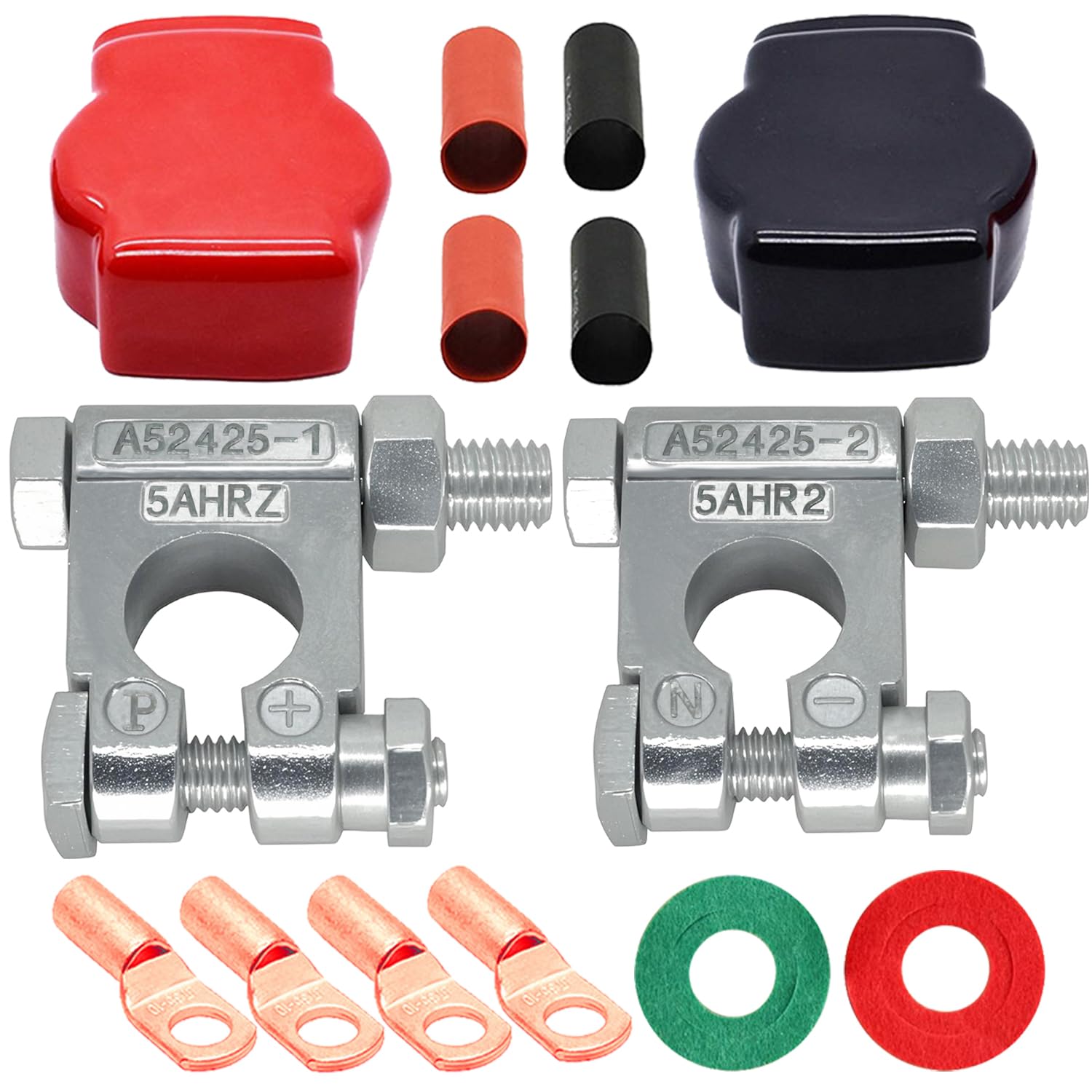
The DLronwey terminals use an alloy material that balances conductivity and cost, and the kit is the most complete in the budget tier. It comes in a storage case with two terminals, two waterproof covers, two anti-corrosion gaskets, four heat shrink tubes, and four 2-gauge 3/8-inch copper lugs. The “military spec” branding mainly refers to the durable construction and included covers that provide aesthetics and water protection.
Users on Dodge Ram 3500 diesel trucks have reported that these terminals fit with slight modification and saved significant money compared to expensive factory cable ends. The positive and negative posts are clearly labeled, and the terminals can accommodate multiple battery wires. The one-year quality guarantee with 24-hour response is a useful safety net at this price point.
The key compromise is the alloy material — it is not specified whether this is brass, copper, or zinc alloy, and the thermal and electrical performance of generic “alloy” can vary. The terminals are machined, which provides better consistency than cast options. For a second vehicle, a backup, or a basic repair where budget is the primary constraint, this kit provides everything needed and has verified positive feedback from heavy-duty applications.
Why it’s great
- Complete kit with storage case and all accessories
- Waterproof covers add protection and aesthetics
- Verified fit on heavy-duty trucks with minor modifications
Good to know
- Exact alloy composition is unspecified
- Requires a crimping tool for cable installation
FAQ
What is the difference between SAE, DIN, and EN battery posts?
Should I use anti-corrosion washers on my battery terminals?
Can I use aluminum battery terminals with lithium batteries?
How many wires can a multi-way terminal safely handle?
Final Thoughts: The Verdict
For most users, the best automotive battery terminals are the Kaas Anodized 12-Way terminals because they combine a massive 12-way distribution capacity with a precision-engineered conductive zone that eliminates the typical anodized-aluminum conductivity problem. If you need a clean OEM-integrated upgrade with solid brass construction, the Recoil BTO terminals deliver superior conductivity and corrosion resistance in a factory-friendly form factor. And for a no-fuss budget replacement that outperforms cheap zinc terminals, the Bateria Power kit gives you copper alloy hardware at an entry-level price.