
Scheduling a hose to water the garden while you’re on vacation used to require a clunky mechanical timer with a single dial setting. Today’s automatic systems combine multi-zone scheduling, WiFi connectivity with smartphone apps, and weather-based adjustments that respond to real-time rain and temperature data. Choosing the right unit means matching zone count, valve type, and wireless range to the specific layout of your property and the plants you’re watering.
I’m Min — the co-founder and writer behind Gadgets Feed. I’ve researched dozens of irrigation controllers, comparing RF range specifications, app compatibility, brass versus plastic fittings, and battery life across the current market to separate the genuinely smart systems from the ones that drop connectivity or leak after a single season.
This guide compares seven top contenders, from basic WiFi hose timers to 12-station whole-yard controllers. You’ll learn which specs matter most and what the right automatic outdoor watering system looks like for your specific setup.
How To Choose The Best Automatic Outdoor Watering System
Selecting the right system starts with mapping your yard’s physical zones — a single outdoor faucet can power multiple hose timers, but each zone needs its own valve and programming slot. Prioritize brass inlet threads over plastic for any unit that stays connected year-round, and ensure the WiFi module or hub supports 2.4 GHz networks only, as most smart timers do not work with 5 GHz bands. Understanding these three factors will narrow the field quickly.
Zone Count and Your Yard’s Layout
The number of programmable zones determines whether you can water a lawn, a vegetable patch, and a row of shrubs on separate schedules from one controller. A two-zone hose timer works for paired faucet splits, but in-ground sprinkler systems often need four to twelve stations. Overestimating zone requirements leads to unused capacity, while underestimating forces you to buy a second unit later. Match zone count to the number of distinct valve circuits or hoses you intend to control independently.
Connectivity Range and Hub Requirements
WiFi hose timers vary wildly in range. Some rely on a hub that plugs into an indoor outlet and communicates with the timer via Bluetooth or a proprietary RF signal, while others connect directly to your home router from up to 300 meters away. If your outdoor faucets sit behind thick masonry walls, a system with a separate hub or a long-range RF gateway will maintain a stable connection. Always check whether the required hub is included in the box or sold separately — that detail alone can double the effective cost.
Build Material and Weather Resistance
The fitting that screws onto your faucet is the most failure-prone component. Brass inlets resist corrosion, cracking, and cross-threading far better than plastic, especially in regions with temperature swings. The rest of the housing should carry an IP rating or at least a weatherproof seal against direct rain and UV exposure. Battery-powered units need easy access for annual swaps, and the battery compartment must seal completely to prevent moisture from corroding contacts.
Quick Comparison
On smaller screens, swipe sideways to see the full table.
| Model | Category | Best For | Key Spec | Amazon |
|---|---|---|---|---|
| RainPoint WiFi Timer | Mid-Range | Two-zone hose setups | Brass inlet, 6 schedules per zone | Amazon |
| Orbit B-hyve Gen 2 | Mid-Range | Remote app control | Hub-based WiFi, weatherproof housing | Amazon |
| XinFuture 3-Zone Timer | Value | Budget multi-zone hose watering | 984 ft RF range, misting mode | Amazon |
| Rain Bird ARC8 | Premium | In-ground 8-zone systems | EPA WaterSense, Wi-Fi built-in | Amazon |
| Orbit B-hyve XR | Premium | Large 16-zone properties | 16 zones, Weather Aware scheduling | Amazon |
| Hunter X2 4 Zone | Mid-Range | Reliable 4-zone in-ground control | WiFi-ready, Cycle and Soak | Amazon |
| Rain Bird ESP-TM2 12 | Premium | High-zone professional installs | 12 stations, LCD display, WiFi-ready | Amazon |
In‑Depth Reviews
1. RainPoint WiFi Water Timer with Brass Inlet

The RainPoint WiFi timer delivers the best balance of build quality and smart features for standard two-faucet hose setups. The brass inlet immediately sets it apart from cheaper all-plastic units — it resists cracking and cross-threading when you tighten the connection for the season. Each of the two zones supports up to six independent schedules, so you can run a morning soak on the lawn and a light evening mist on the flower bed from the same controller.
Smart Scenes allow the timer to adjust watering duration based on real-time weather data from the RainPoint Home app, and seasonal adjustment automatically shifts run times between 10% and 200% month by month. The unit requires the included smart hub for WiFi connectivity over 2.4 GHz, and the hub also enables Alexa and Google Assistant voice control. Setup takes roughly three minutes, though the app interface has a slight learning curve when first configuring interval modes.
Users consistently praise the independent zone programming and the five-year warranty backing the electronics. Some report that the Bluetooth pairing process between the hub and timer can drop once or twice before stabilizing, and the rain delay feature must be triggered manually through the app rather than automatically via forecast data. Overall, it is the strongest mid-range pick for anyone who wants brass durability and two-zone flexibility without jumping to a premium 8-station controller.
Why it’s great
- Brass inlet eliminates cracking issues seen on plastic timers
- Six watering schedules per zone offer extreme programming flexibility
- Seasonal adjustment automates run-time tweaks month to month
Good to know
- Large housing takes up more space at the faucet
- Rain delay must be set manually, not triggered by live weather data
2. Orbit B-hyve Gen 2 Smart Hose Watering Timer
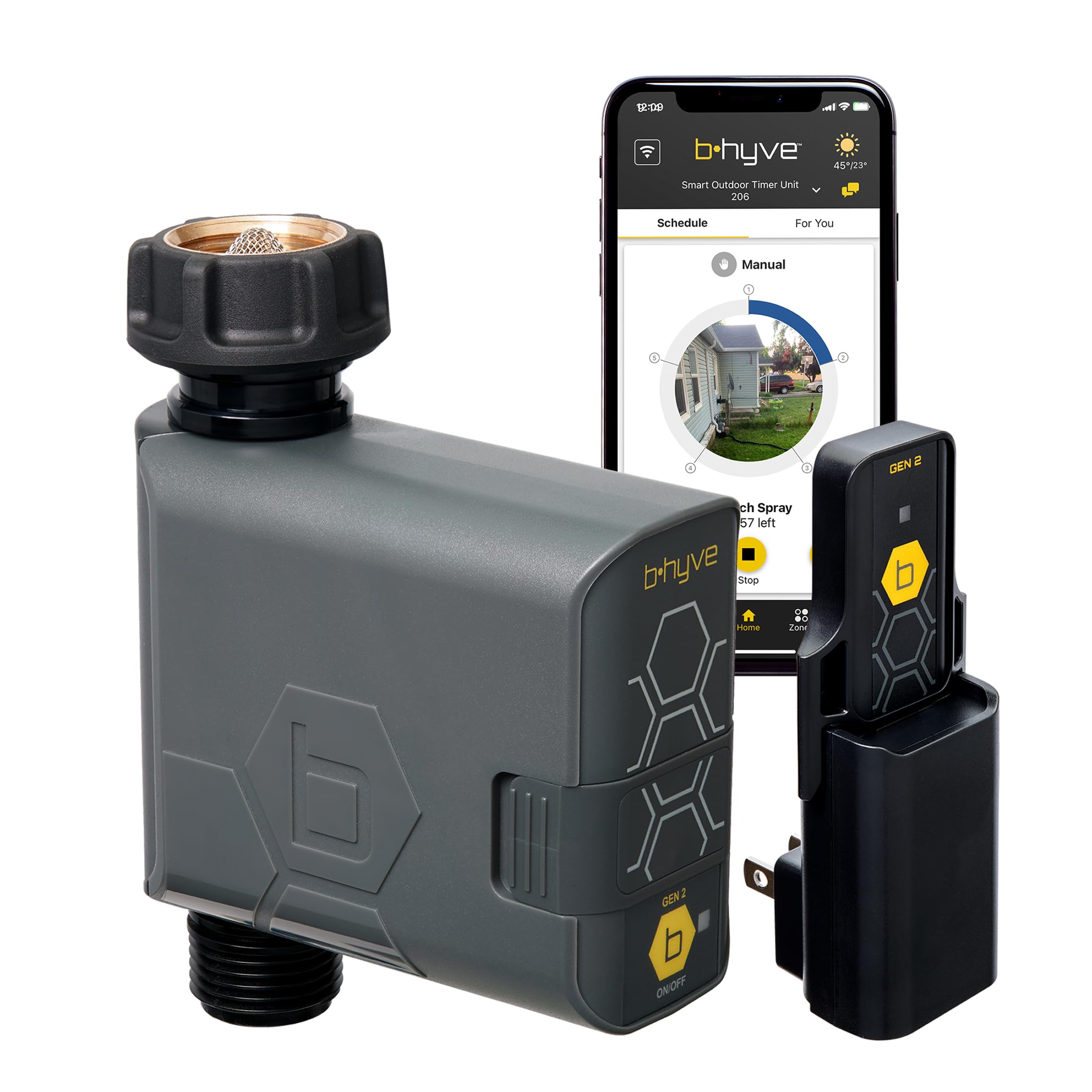
Orbit’s second-generation B-hyve refines the original formula with a dedicated WiFi hub that bridges the timer to your home network. The timer itself runs on four AA batteries and sports a weatherproof housing that withstands direct sun and rain, making it suitable for hose bibs in exposed locations. The app provides remote on/off control, multi-schedule programming, and flow-rate monitoring — a feature rarely seen on hose timers.
Weather-based watering adjusts schedules automatically based on local forecast data, and the system sends push notifications when the timer activates or completes a cycle. The hub must be plugged in indoors within Bluetooth range of the timer, which typically reaches about 50 feet through walls. Users report reliable connectivity once paired, though the initial Bluetooth-to-WiFi handshake can take a few attempts on networks running mixed 2.4/5 GHz bands.
The primary downside is the hub dependency — if the hub loses power or the timer drifts out of Bluetooth range, remote control is lost until the link re-establishes. A small number of users report the app interface as less intuitive than competitors, and the unit lacks integration with home automation platforms like Home Assistant. For anyone who wants a proven, battery-powered timer with robust app features and weather adaptation, this Orbit model remains a strong choice.
Why it’s great
- App displays flow rate data for leak detection
- Weather-based scheduling auto-adjusts for rain and heat
- Weatherproof housing survives direct outdoor exposure
Good to know
- Hub must stay plugged in indoors near the faucet
- No Home Assistant or SmartThings integration available
3. XinFuture 3-Zone WiFi Sprinkler Timer
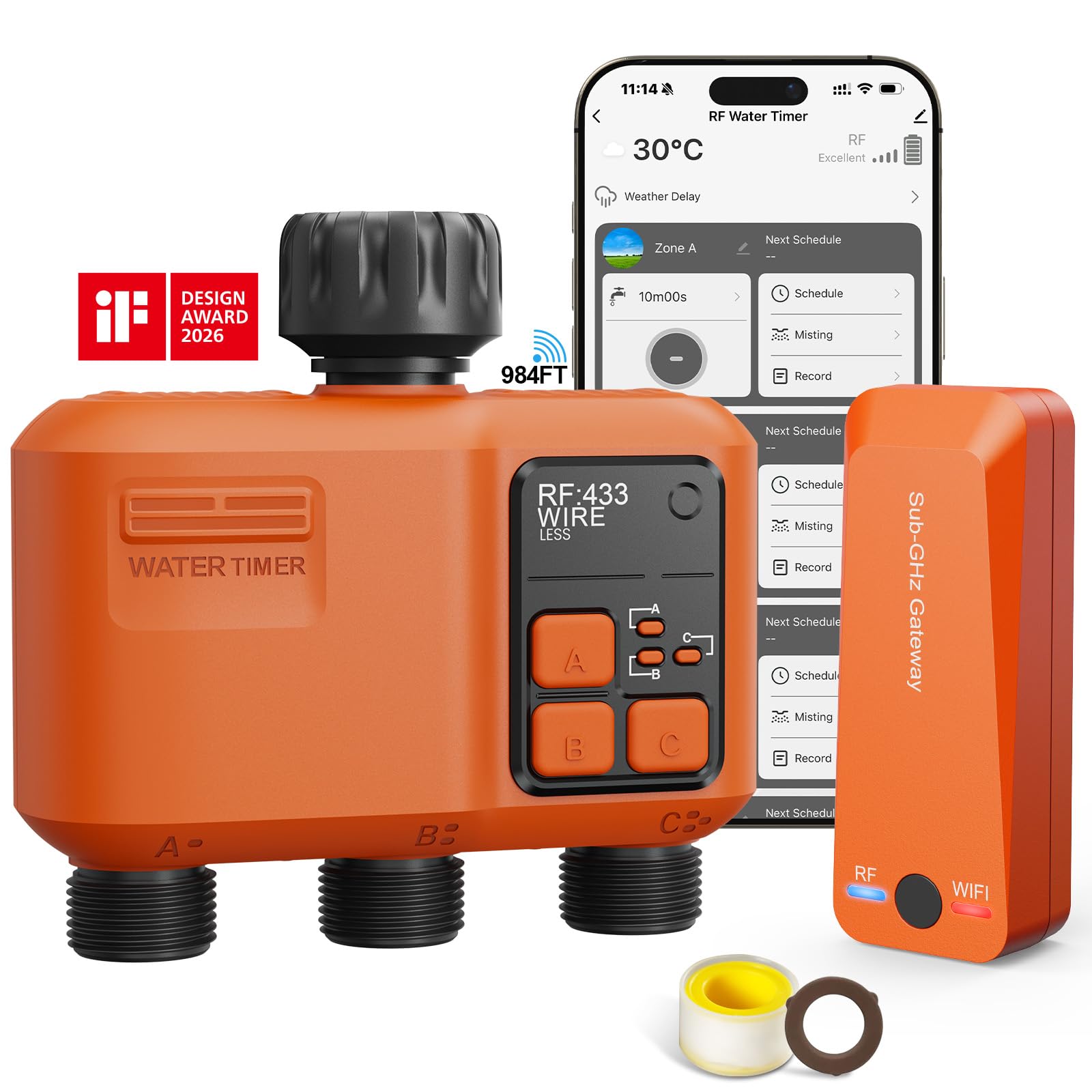
The XinFuture timer stands out with a 984-foot RF range that penetrates walls far better than typical Bluetooth-based hose timers. The kit includes three zone valves on a single controller, letting you run separate schedules for a lawn, a garden bed, and a row of shrubs from one faucet connection. The system uses the Smart Life or Tuya Smart app for remote control, and the RFID gateway transmitter plugs in anywhere with a standard outlet to relay commands over 2.4 GHz WiFi.
Programming supports single irrigation mode with durations from one second to nearly twelve hours, recirculating mode for weekly scheduling, and a misting option for delicate plants. The rain delay function pauses watering for one to seven days with a single tap in the app, and the irrigation record logs start time, duration, and end time for every cycle. The unit also includes a manual button for instant watering tasks like filling a pool or washing a car.
Early reviews praise the easy app setup and strong connectivity, though some units originally shipped with plastic hose fittings that cracked after months of use. The manufacturer has since switched to brass fittings on replacement units, and customer support is responsive about sending updated parts. A handful of users report that the app language changed to Chinese in a 2024 update, making schedule configuration difficult — a firmware issue the company is actively addressing.
Why it’s great
- 300-meter RF range maintains signal through thick walls
- Three independent zones for less than many two-zone models
- Misting mode supports delicate plant watering needs
Good to know
- Plastic fittings on early units prone to cracking
- App language bug reported after firmware update
4. Hunter X2 4 Zone Sprinkler Controller

The Hunter X2 is a professional-grade in-ground controller that focuses on reliable standalone operation with the option to add WiFi later. It controls up to four zones with three custom programs, each supporting four start times and run durations up to six hours — enough flexibility for most residential lawns and garden beds. The backlit LCD screen is crisp and readable in direct sunlight, a detail that matters when programming at the panel without a phone.
The Cycle and Soak feature delivers water in short bursts to prevent runoff on sloped or compacted soil, and the Seasonal Adjustment dial lets you scale run times up or down by a percentage for winter versus summer without reprogramming each zone. The QuickCheck wiring diagnostics scan for shorts on each valve circuit before the system runs, protecting solenoids from damage. The optional WAND module (sold separately) enables full Hydrawise cloud control with real-time weather data and remote alerts.
Users consistently rate the build quality and ease of installation very high, especially as a drop-in replacement for older Hunter controllers. The main criticism is that the WiFi module costs well over half the price of the base unit, making the “WiFi-ready” claim feel like a bait-and-switch to some buyers. If you don’t need remote app control, the X2 is a fantastic offline controller; if you want WiFi from day one, a model with built-in connectivity may be more satisfying.
Why it’s great
- Cycle and Soak prevents water pooling on slopes
- Backlit LCD screen legible in bright sun
- QuickCheck wiring diagnostics catch shorts automatically
Good to know
- WiFi add-on module sold separately and expensive
- Limited to four zones without upgrading the hardware
5. Rain Bird ARC8 Smart WiFi Irrigation Timer

The Rain Bird ARC8 packs eight stations of control into a compact unit that can mount indoors or outdoors, with WiFi and Bluetooth built right in — no separate hub needed. The Rain Bird mobile app allows schedule creation, adjustment, and manual watering from anywhere in the world, and you can share control with family members or a landscaping service. The EPA WaterSense certification confirms the device meets strict water-efficiency standards, and many municipalities offer rebates for installing this specific model.
Weather-based adjustment uses the postal code location to pull forecast and historic averages, automatically skipping or shortening watering cycles when rain is predicted. The controller is compatible with Amazon Alexa and Google Assistant for voice commands, and it supports up to four independent watering programs per station with multiple start times. Installation is straightforward for anyone comfortable connecting zone wires to screw terminals, and the app walks through initial setup in about 15 minutes.
Positive reviews highlight the simple 10-minute installation and the dramatic convenience of tweaking schedules from the phone instead of walking to the garage panel. A minority of users report WiFi disconnection issues that cause missed watering cycles, and the documentation online is sometimes outdated or contradicts the current app version. For a fully integrated smart controller at a competitive price point, the ARC8 is a top contender for 8-zone properties.
Why it’s great
- Built-in WiFi means no hub to buy or plug in
- EPA WaterSense certified and eligible for utility rebates
- Weather-based adjustments skip watering before rain
Good to know
- Some units experience WiFi dropout causing missed schedules
- Online documentation sometimes conflicts with app behavior
6. Orbit B-hyve XR Smart Sprinkler Timer
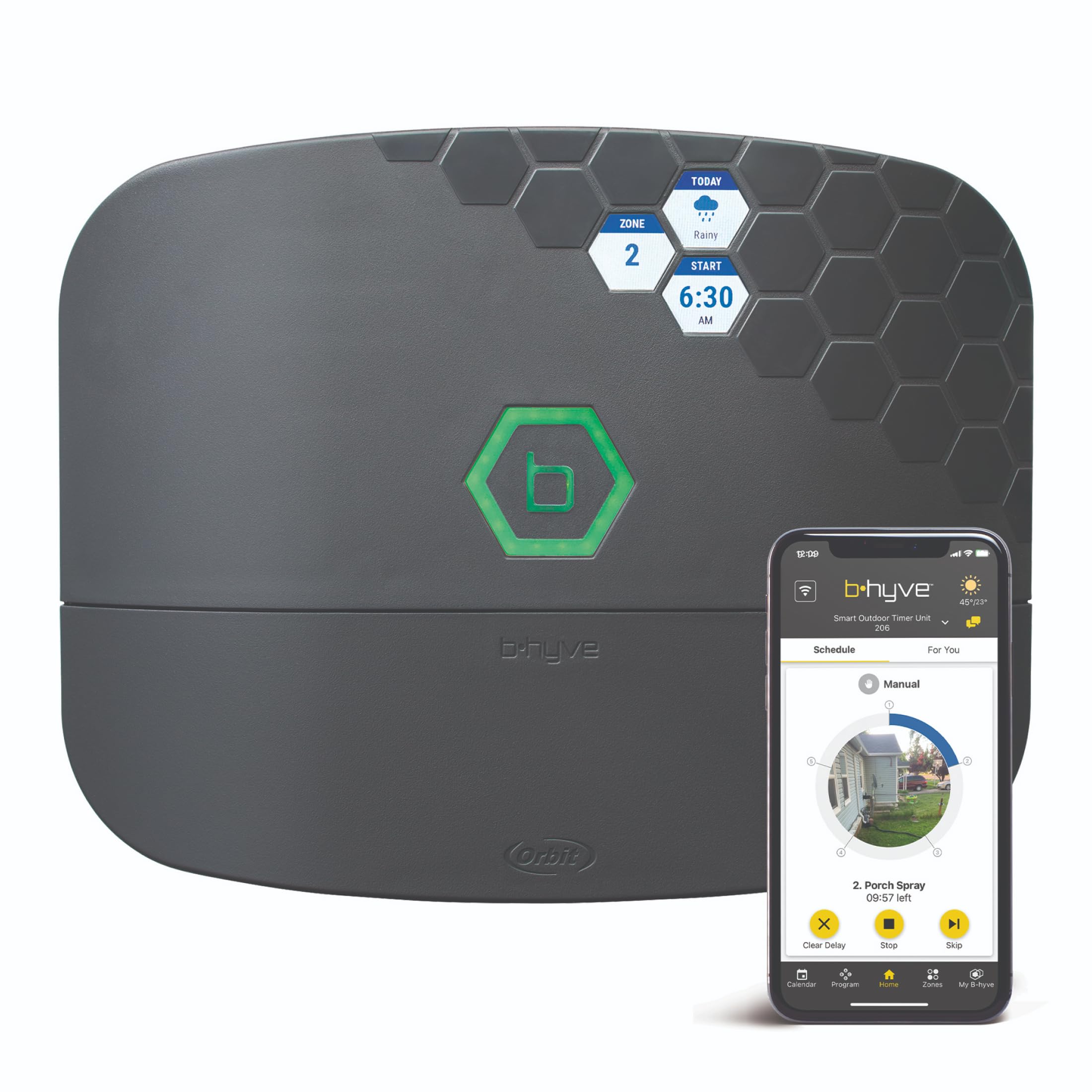
The Orbit B-hyve XR scales up to 16 zones, making it suitable for larger properties with extensive in-ground sprinkler networks. The controller is WiFi-enabled out of the box and connects directly to the B-hyve app without needing an external hub, though the indoor/outdoor rating means you can mount it on a garage wall exposed to temperature swings. Each of the 16 stations can be named and associated with a photo in the app, so you can visually confirm which zone is the back lawn versus the side garden.
Weather Aware scheduling factors in soil type, sun exposure, slope, and even the number of sprinkler heads per zone to calculate watering times automatically. The app allows manual watering from anywhere, and fault detection alerts you when a station draws abnormal current — useful for catching a broken wire or failed solenoid. Installation uses push-button wire clamps that grip solid copper without needing screwdrivers, and the unit supports up to four programs (A, B, C, D) for grouping zones by plant type.
Positive feedback centers on the intuitive app design and the live weather data integration. Some users report persistent WiFi connectivity issues, particularly on dual-band networks where the controller fails to maintain a steady link even a few feet from the router. The four-program limit for 16 stations can feel restrictive if you need highly granular scheduling across many zones. For large properties where remote app control is essential, this is a capable system — but a stable nearby WiFi signal is non-negotiable.
Why it’s great
- 16-zone coverage handles complex sprinkler layouts
- Photo association helps identify zones in the app
- Weather Aware adjusts for soil type and slope
Good to know
- WiFi connectivity can be unreliable on mixed-band networks
- Only four programs for 16 stations limits scheduling granularity
7. Rain Bird ESP-TM2 12 Station Controller

The Rain Bird ESP-TM2 is built for installations where reliability and expandability matter more than app-first design. It supports up to 12 stations in a single compact housing, with the ability to expand further using additional modules if your property grows. The LCD screen and dial-based programming interface let you set schedules without a smartphone — useful for contractors or homeowners who prefer physical controls. The controller is WiFi-ready, meaning you can add an optional LNK WiFi module for app connectivity later.
The built-in rain sensor port accepts the included sensor that suspends watering when it detects precipitation, saving water automatically. Programming supports three independent programs with multiple start times per station, and the unit retains your schedule in non-volatile memory even during power outages. The 120-volt AC input powers standard 24-volt irrigation solenoids, and the ample wiring compartment makes connecting zone wires simple even for 12-station layouts.
Long-term users praise the ESP-TM2’s durability — many have replaced older Rain Bird units that lasted over a decade. The WiFi module is sold separately, and the overall feature set lags behind fully smart controllers like the ARC8 in terms of weather-based automation. If you need a straightforward, rock-solid controller for a large property and don’t mind missing live weather adaptation, the ESP-TM2 delivers professional-grade reliability.
Why it’s great
- Expandable up to 12+ stations with add-on modules
- Intuitive dial and LCD programming without a phone
- Included rain sensor stops watering automatically
Good to know
- WiFi module must be purchased separately for app control
- No built-in weather-based scheduling without WiFi module
FAQ
Will a WiFi hose timer work if my outdoor faucet is far from the house?
Why does my smart sprinkler controller need 2.4 GHz WiFi and not 5 GHz?
Can I leave the hose timer connected to the faucet during winter?
What does Cycle and Soak mean for my watering schedule?
Final Thoughts: The Verdict
For most users, the automatic outdoor watering system winner is the RainPoint WiFi Timer with Brass Inlet because it combines a durable brass fitting, two independent zones with six schedules each, and reliable hub-based WiFi at a mid-range price point. If you want a built-in weather-based smart controller for an 8-zone in-ground system, grab the Rain Bird ARC8. And for large properties requiring 16 zones of coverage, nothing beats the Orbit B-hyve XR.