
Passive speakers leave you hunting for a separate amp, and most consumer-grade powered speakers can’t deliver the transient response needed to reveal a mix’s true detail. An active bookshelf speaker solves this by pairing purpose-built amplification with precisely matched drivers, delivering a coherent soundstage straight out of the box—no guesswork, no mismatch, just pure audio fidelity.
I’m Min — the co-founder and writer behind Gadgets Feed. I spend thousands of hours cross-referencing frequency response curves, amplifier topologies, and DSP tuning across the entire active speaker market to build guides that cut through the marketing noise.
Whether you are setting up a desktop studio, upgrading a living room stereo, or building a high-end listening environment, finding the right best active bookshelf speaker means evaluating driver size, amplifier wattage, connectivity protocols, and cabinet construction to match your specific room and listening preferences.
How To Choose The Best Active Bookshelf Speaker
Active bookshelf speakers integrate amplification and drivers into a single cabinet, eliminating the complexity of matching separate components. Your choice hinges on three interconnected factors: the amplifier’s power and class, the driver’s size and material, and the range of connectivity options that match your source gear. Each element directly influences the system’s dynamic headroom, tonal accuracy, and long-term usability.
Amplifier Power and Class
The amplifier delivers the current that drives the woofer and tweeter. Look for total system power—measured in RMS watts—which dictates how loud and cleanly the speaker can play before distortion sets in. Class-D amplifiers are now dominant in active designs for their efficiency and low heat output, but not all Class-D modules sound alike. Higher-end models use custom DSP-tuned Class-D stages that rival traditional Class-AB in transparency while consuming far less energy. For a medium-sized room (150–300 sq ft), aim for at least 60W RMS per channel to avoid strain at moderate volumes.
Driver Configuration and Materials
A two-way design (dedicated woofer and tweeter) is the standard for active bookshelf speakers. The woofer size—typically 4 to 6.5 inches—determines bass extension: larger drivers move more air, producing deeper low frequencies without requiring a subwoofer. Driver material matters even more. Woven glass fiber offers stiffness and lightness for clean midrange, Kevlar provides excellent damping for reduced breakup, and aluminum or planar magnetic tweeters deliver extended, low-distortion high frequencies. Listen for materials that match your preferred genre: metal-diaphragm drivers suit analytical listening, while soft-dome tweeters lean toward a warmer, more forgiving presentation.
Connectivity and Source Compatibility
Modern active speakers must accommodate both wired and wireless sources. RCA analog inputs are universal for turntables with a built-in preamp, while optical (TOSLINK) and coaxial digital inputs connect directly to TVs, game consoles, and CD transports. USB-C input is increasingly valuable for high-resolution playback from a computer without an external DAC. For wireless streaming, Bluetooth 5.0 with aptX HD or LDAC codecs ensures low-latency, near-CD-quality transmission. Wi-Fi-enabled models with AirPlay 2 or Spotify Connect offer multi-room flexibility and higher bitrate streaming than Bluetooth, at the cost of a more involved setup.
Quick Comparison
On smaller screens, swipe sideways to see the full table.
| Model | Category | Best For | Key Spec | Amazon |
|---|---|---|---|---|
| Fluance Ai61 | Powered | Versatile home listening | 120W Class-D amplifier | Amazon |
| JBL 306P MkII (Pair) | Studio Monitor | Critical mixing | 6.5″ woofer, 56W per channel | Amazon |
| KRK RP5G5 ROKIT 5 (Pair) | Studio Monitor | Accurate production | Kevlar woofer, DSP room tuning | Amazon |
| Edifier S2000MKIII | Audiophile | Hi-Fi wireless streaming | Planar tweeter, aptX HD | Amazon |
| Edifier S1000W | Wi-Fi Powered | Multi-room streaming | AirPlay 2, Spotify Connect | Amazon |
| JBL 305P MkII (Pair) | Studio Monitor | Entry-level production | Image Control Waveguide | Amazon |
| Pioneer DJ DM-40D-W | DJ Monitor | DJ practice & mixing | DECO convex diffuser | Amazon |
| Audio-Technica AT-SP3X | Compact Powered | Turntable and desktop | Bluetooth multipoint | Amazon |
| KEF LS50 Meta (Pair) | High-End Passive | Reference-level soundstage | MAT technology, Uni-Q driver | Amazon |
In‑Depth Reviews
1. Fluance Ai61 Powered Bookshelf Speakers

The Fluance Ai61 packs a 120W integrated Class-D amplifier into an internally braced MDF cabinet, delivering the muscle to fill a living room without a separate subwoofer. The 6.5-inch woven glass fiber woofer produces articulate midbass and clean low-end extension down to around 50Hz, while the neodymium tweeter provides airy highs with spacious off-axis dispersion. The rear bass port is precisely tuned to reduce chuffing, so the low end stays tight even during complex passages.
Connectivity is broad: you get RCA, optical, USB-C, and Bluetooth 5 with aptX HD support, plus a subwoofer output for future expansion. The included remote controls volume, input selection, and a basic tone adjustment. Users consistently note that after a 10–12 hour break-in period, the drivers relax and the soundstage opens up significantly, revealing new detail in familiar tracks. The natural walnut veneer finish adds a furniture-grade aesthetic that blends into any room.
Where the Ai61 really shines is its dead-quiet amplifier floor—no hiss or hum even with ears close to the tweeter. That low noise floor makes it equally suitable for near-field desktop listening and medium-field living room setups. The trade-off is that the 6.5-inch woofer can sound slightly restrained on the deepest bass notes of electronic or orchestral music; a paired subwoofer solves this cleanly.
Why it’s great
- 120W amplifier drives clean, room-filling sound with low distortion
- USB-C input enables direct high-res playback from a computer
- Minimal self-noise; dead quiet amp floor
Good to know
- Requires break-in period for optimal driver compliance
- Deep sub-bass extension benefits from an external subwoofer
2. JBL 306P MkII 6.5″ Studio Monitors (Pair)

The JBL 306P MkII is a proper studio monitor, not a consumer bookshelf speaker in disguise. The 6.5-inch woofer with a new transducer design delivers impressive deep bass and lower harmonic distortion than the previous generation, while the Image Control Waveguide ensures a wide sweet spot for off-axis listening—critical when you are moving around a mixing desk. The dual 41W Class-D amplifiers (one per driver) provide ample headroom for dynamic peaks without compression.
The Boundary EQ and HF Trim controls are genuine tools for room correction: they let you dial back low-frequency buildup when the monitors are placed against a wall or recessed into a shelf. The enclosure is MDF with internal bracing that keeps resonance at bay, and the XLR and ¼-inch TRS inputs ensure interference-free connections with professional audio interfaces. Users report that the 306P MkII reveals mix errors that cheaper speakers mask, making it a reliable tool for critical mastering tasks.
These monitors are noticeably larger and heavier than 5-inch alternatives, so measure your desk or stand depth before buying. The amplifier is fan-cooled, which produces a faint but continuous whisper in a silent room—fine for mixing sessions but potentially distracting for casual listening at low volumes.
Why it’s great
- Boundary EQ and HF Trim allow precise room acoustic compensation
- Wide sweet spot from Image Control Waveguide improves off-axis accuracy
- Low distortion and high dynamic headroom for professional monitoring
Good to know
- Fan noise may be audible in near-field, quiet environments
- Large cabinet size requires generous desk or stand space
3. KRK RP5G5 ROKIT 5 Generation Five (Pair)

The KRK ROKIT 5 Gen 5 refines a studio-monitor classic with DSP-driven room tuning that analyzes and compensates for your listening environment’s acoustic anomalies. The 5-inch Kevlar woofer is stiff and lightweight, reducing cone breakup to deliver a clean, punchy low-midrange. The new 1-inch silk dome tweeter improves high-frequency phase coherence and extends the top end smoothly without the harshness that plagued earlier generations.
Custom Class-D amplifiers run cooler than the previous gen, improving thermal stability during long sessions. The Low Diffraction Baffle design minimizes edge reflections, resulting in a stereo image that stays locked even when you move off the central sweet spot. XLR and ¼-inch TRS combo inputs provide flexible connectivity for any audio interface, and the included acoustic foam isolation pads decouple the monitors from the surface for tighter bass response.
Reviewers consistently praise the RP5G5 for its clarity and detail retrieval at moderate volume levels, making it ideal for near-field mixing in smaller rooms. The DSP tuning app is intuitive but limited to a few preset curves—power users may want more granular parametric EQ control. The 5-inch woofer means sub-50Hz frequencies roll off quickly, so adding a KRK S10.4 subwoofer is recommended for full-range electronic or cinematic music production.
Why it’s great
- DSP-driven room tuning adapts to your space’s acoustics
- Kevlar woofer delivers tight, articulate midbass with low distortion
- Low Diffraction Baffle ensures stable off-axis imaging
Good to know
- DSP EQ adjustment is limited to a few preset curves
- 5-inch driver requires a subwoofer for deep sub-bass extension
4. Edifier S2000MKIII Bookshelf Speakers
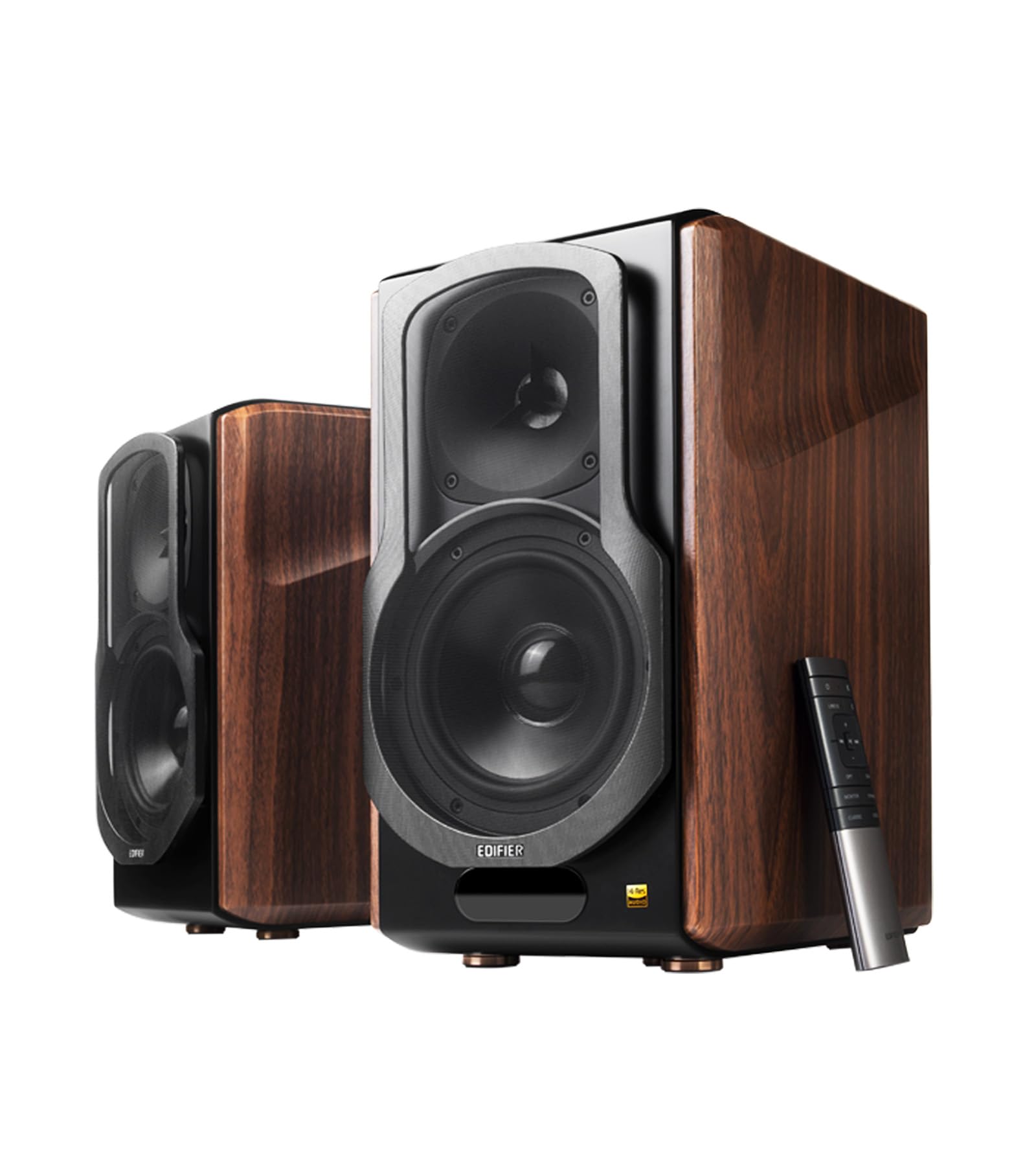
The Edifier S2000MKIII bridges the gap between consumer bookshelf speakers and true audiophile gear with a tri-amped 130W design: separate amplifier modules for the planar diaphragm tweeter, the 5.5-inch aluminum woofer, and a midrange driver. This tri-amplification architecture minimizes intermodulation distortion and allows each driver to operate within its optimal frequency band. The result is a coherent, layered soundstage with crisp transients and detailed microdynamics that many passive audiophile speakers at the same price struggle to match.
Bluetooth 5.0 with aptX HD delivers near-CD-quality wireless streaming, while line-in, optical, and coaxial inputs cover every wired source. The walnut wood-grain cabinet is heavy and dead—internal bracing and damping material eliminate cabinet resonance. Users consistently report that the S2000MKIII produces deep, controlled bass without a subwoofer, hitting around 45Hz in-room. The included remote allows quick switching between three sound modes (Monitor, Dynamic, and Classic), though the remote buttons are hard to read in dim light.
This speaker is not small: each unit weighs about 18 pounds and measures 14 inches tall, so placement on standard bookshelves may require reinforcement. The rear porting demands at least 6 inches of clearance from the wall to avoid bass bloat. At modest volume levels (40–47 out of 60), the sound is balanced and fatigue-free for all-day listening.
Why it’s great
- Tri-amped architecture eliminates intermodulation distortion
- Planar tweeter delivers extended, low-distortion high frequencies
- Deep bass extension without requiring a subwoofer
Good to know
- Heavy cabinet (18 lbs each) may need reinforced shelf support
- Remote control buttons are difficult to read in low lighting
5. Edifier S1000W WiFi Audiophile Speakers

The Edifier S1000W takes the established S1000 platform and adds Wi-Fi connectivity with AirPlay 2, Spotify Connect, and Tidal Connect support—making it a true multi-room streaming speaker system. The 5.5-inch aluminum diaphragm woofers and 1-inch titanium dome tweeters are driven by a 120W RMS amplifier, producing a clean, powerful output that handles complex orchestral arrangements without congestion. The internal DAC supports sample rates up to 24-bit/192kHz, ensuring high-resolution playback from any wired digital source.
Setup via the Edifier Home app is straightforward: you assign the speakers to your Wi-Fi network and group them with other Edifier units for synchronized playback across rooms. Voice control through third-party Alexa devices adds hands-free convenience. The cabinet is CNC-machined MDF with real wood veneer side panels, giving it a premium aesthetic that fits nicely into a traditional living room.
The primary trade-off is that the S1000W is not a near-field monitor; its ported design and 5.5-inch woofers need some room to breathe—placement on a wide desktop or speaker stands is recommended. The remote control is small and the membrane buttons can be unresponsive over time. Also, the Wi-Fi connection is relegated to the master speaker only; the slave speaker still requires a wired connection, which limits placement flexibility.
Why it’s great
- AirPlay 2, Spotify Connect, and Tidal Connect for seamless multi-room streaming
- 24-bit/192kHz DAC ensures high-resolution wired playback
- Premium MDF cabinet with real wood veneer
Good to know
- Slave speaker still requires wired connection to master
- Remote control buttons can feel unresponsive over time
6. JBL 305P MkII 5″ Studio Monitors (Pair)

The JBL 305P MkII is the benchmark for entry-level studio monitoring, combining a 5-inch woofer with JBL’s proprietary Image Control Waveguide to deliver a wide, precise stereo image. The dual 41W Class-D amplifiers provide ample headroom for near-field mixing, and the Slip Stream port reduces turbulence to deliver punchy, clean bass down to about 43Hz. The waveguide’s broad dispersion pattern means you do not have to sit dead-center to get an accurate representation of the stereo field.
With XLR and ¼-inch TRS inputs, the 305P MkII connects directly to any audio interface without adapters. The Boundary EQ and HF Trim switches let you adjust for desk or wall placement, restoring neutral response when the monitors are in less-than-ideal positions. Users upgrading from consumer speakers consistently report hearing mix details—reverb tails, stereo panning, and ambient noise—that were previously masked by colored playback.
These monitors are remarkably quiet for a self-powered design; the amplifier floor is nearly silent even in a dead-quiet room. The 5-inch cabinet is compact enough for most desks, but buyers should budget for TRS cables since none are included in the box. The provided manual is minimal, so first-time studio monitor users may need to research proper gain staging and placement.
Why it’s great
- Wide, accurate stereo imaging from Image Control Waveguide
- Very low self-noise; amplifier floor is near silent
- Boundary EQ corrects for desk and wall placement
Good to know
- TRS/XLR cables not included; must purchase separately
- Limited bass extension compared to 6.5-inch models
7. Pioneer DJ DM-40D-W Studio Monitor, White

The Pioneer DJ DM-40D-W is purpose-built for DJs who need punchy, energetic playback for beatmatching and mixing, not near-field analytical monitoring. The 4-inch woofer and DECO convex diffuser tweeter produce a forward, exciting sound signature with pronounced bass and crisp high frequencies that cut through a noisy environment. A three-position switch lets you toggle between DJ and Production modes, engaging DSP presets that respectively boost bass punch or flatten the response for basic track arranging.
The front panel includes a 3.5mm headphone jack for silent cueing and a volume knob that’s easy to reach during sets. RCA and mini-jack inputs connect easily to DJ controllers and mixers, and the compact cabinet fits tight booth setups. Users report that the DM-40D gets loud without obvious distortion—critical for hearing beatgrids at performance volumes.
The neutrality of the DM-40D is distinctly colored: the upper mids and vocals have a noticeable dip, and the bass is artificially enhanced, making it unsuitable for critical mixing or casual audiophile listening. The DJ/Production switch only partially compensates for this curve. Several users have modified the crossover or added polyfill damping to improve accuracy, but that is beyond what most buyers should expect to do.
Why it’s great
- DSP presets tuned for DJ performance and basic production needs
- Front-panel headphone jack enables silent cueing without an external mixer
- Compact size fits easily into tight DJ booths
Good to know
- Non-neutral frequency response with upper-mid dip
- DSP modes do not fully flatten the sound signature for neutral mixing
8. Audio-Technica AT-SP3X Bookshelf Speakers

The Audio-Technica AT-SP3X is a compact-powered bookshelf speaker system built for casual listeners who prioritize easy Bluetooth connectivity over absolute sound quality. The 3-inch (76mm) drivers are smaller than most competitors, but the cabinet tuning adds a bass boost that gives these speakers a surprising amount of low-end weight for their size. Dual RCA jacks accommodate wired sources like a turntable or TV, while Bluetooth multipoint pairing lets you stay connected to two devices simultaneously—great for switching between a phone and a laptop.
The included AC adapter comes with three international plug adapters, making it travel-friendly for those who move between countries. The front-mounted power button with an LED indicator and volume dial provides straightforward control without needing a remote. Users pairing this with an Audio-Technica AT-LP120 turntable report quick toggling between the phono source and Bluetooth streaming, and the speakers get loud enough to fill a small room without audible distortion.
The plastic cabinet construction and 3-inch drivers cannot match the clarity, dynamic range, or bass extension of larger speakers with MDF enclosures. At high volumes near their limit, the bass boost can overwhelm the mids and highs, producing a slightly muddy presentation. These are best suited for small desks, dorm rooms, or secondary setups where compact size and convenience outweigh absolute audio fidelity.
Why it’s great
- Bluetooth multipoint keeps two devices connected simultaneously
- Compact size fits small desks and travel bags
- Bass boost adds surprising low-end weight for the driver size
Good to know
- Plastic cabinet limits overall sound quality and resonance control
- Bass boost can muddy the midrange at high volume levels
9. KEF LS50 Meta (Pair, Mineral White)

The KEF LS50 Meta represents a leap in driver technology with Metamaterial Absorption Technology (MAT), a maze-like structure that absorbs 99% of unwanted sound radiating from the rear of the tweeter. The 12th-generation Uni-Q driver—a 1-inch aluminum dome tweeter nestled at the acoustic center of a 5.25-inch magnesium/aluminum alloy woofer—produces a coherent point-source radiation pattern that locks the stereo image into a precise, holographic soundstage. THD is rated at just 0.07%, a figure that rivals many high-end electrostatic designs.
These are passive speakers, so you must add a high-quality amplifier capable of driving the 3-ohm minimum impedance dips. Paired with the right amp, the LS50 Meta reveals depth, decay, and spatial cues that cheap speakers simply cannot resolve. The tightly braced cabinet eliminates all audible resonance, and the Mineral White finish is both acoustically inert and visually refined. Users who match these with a proper subwoofer report a full-range system that competes with speakers costing multiple times more.
These speakers demand careful setup: they need a powerful, high-current amplifier (40W+ per channel minimum), a listening position within the relatively narrow sweet spot, and stands that isolate them from structure-borne vibrations. At low listening volumes, the LS50 Meta can sound compressed; they perform best at moderate to high levels where the drivers are fully engaged. The bass rolls off below about 50Hz, so a subwoofer is practically mandatory for full-range content.
Why it’s great
- MAT technology eliminates 99% of rear-wave distortion for cleaner midrange
- Uni-Q driver creates a coherent point source for stunning imaging
- Exceptionally low THD (0.07%) for transparent, uncolored sound
Good to know
- Passive design requires a high-current, high-quality external amplifier
- Narrow sweet spot and limited bass extension (subwoofer recommended)
FAQ
Can I use active bookshelf speakers with my turntable?
Do I need a subwoofer with active bookshelf speakers?
What is the difference between active and powered speakers?
Final Thoughts: The Verdict
For most users, the best active bookshelf speaker winner is the Fluance Ai61 because it combines a 120W amplifier, versatile connectivity including USB-C, and warm, accurate sound in a furniture-grade cabinet. If you need accurate studio monitoring for mixing and production, grab the JBL 306P MkII pair for its boundary EQ and wide sweet spot. And for multi-room wireless streaming with AirPlay 2 and high-resolution DAC support, nothing beats the Edifier S1000W.