
Mobile homes present unique HVAC challenges that standard residential systems aren’t designed to solve. The limited space for ductwork, the lower ceiling heights, and the specific electrical configurations found in manufactured housing all demand an air handler engineered to match. Choosing the wrong unit means battling uneven temperatures, high energy bills, and equipment that doesn’t fit the physical footprint of your home.
I’m Min — the co-founder and writer behind Gadgets Feed. My research focuses on matching HVAC equipment to the specific structural and electrical constraints of manufactured homes, analyzing SEER ratings, BTUs, and inverter technology to find systems that deliver consistent comfort without overcomplicating installation.
Whether you’re upgrading from a noisy window unit or replacing an aging furnace-based system, finding the right air handler for mobile home means balancing efficiency, quiet operation, and a form factor that works within your home’s dimensional limits.
How To Choose The Best Air Handler For Mobile Home
Selecting an air handler for a mobile home requires more than just matching a square footage number. You have to consider voltage requirements—most mobile homes run on 115V or 120V circuits, not the 230V that many central systems demand. You also need to think about physical installation: does the unit mount through a window, sit on the floor as a portable, or hang on the wall as a mini-split? Each form factor brings trade-offs in cooling capacity, noise, and how much floor space you lose.
Inverter vs. Fixed-Speed Compressors
The compressor is the heart of any air conditioning system. Inverter-driven compressors adjust their speed continuously to match the cooling demand, which means they don’t cycle on and off like traditional fixed-speed units. This delivers three benefits that matter specifically in a mobile home: quieter operation because the compressor rarely runs at full blast, more stable indoor temperatures because there are no recurring temperature swings, and lower electricity consumption because the unit uses only the energy needed at that moment. For a mobile home where insulation levels may not match a standard house, an inverter system’s ability to modulate its output is a real advantage.
BTU Capacity and Square Footage
BTU ratings tell you how much heat the unit can remove per hour. A 9,000 BTU unit typically handles around 400 square feet, while 12,000 BTU models cover up to 750 square feet. Mobile homes often have open floor plans that blur the lines between rooms, so you need to consider the total area you want to cool, not just the room where the air handler sits. Oversizing a unit causes short cycling and poor humidity removal, while undersizing leaves you sweaty. Measure the entire living space and choose a BTU rating that matches the upper end of that square footage range.
Form Factor and Installation Type
There are three main ways to install an air handler in a mobile home. Window units fit into a standard double-hung opening and require no permanent modification, but they block the window and can be a security concern. Portable units sit on the floor and use an exhaust hose to a window, offering mobility at the cost of floor space and generally lower efficiency due to the single-hose negative pressure problem. Ductless mini-splits mount the air handler on the wall and connect to an outdoor condenser via a small refrigerant line, delivering the highest efficiency and quietest operation but requiring a professional installation to drill through the wall and connect the line set. For most mobile home owners, the mini-split represents the best long-term value despite the higher upfront cost.
Quick Comparison
On smaller screens, swipe sideways to see the full table.
| Model | Category | Best For | Key Spec | Amazon |
|---|---|---|---|---|
| Goodman GLXS4BA3610 / AMST36CU1300 | Ducted Central | Whole-home mobile home cooling | 3 Tons (36,000 BTU) / 14.5 SEER2 | Amazon |
| Temprium 12,000 BTU Mini Split | Ductless Mini-Split | Premium quiet and efficiency | 22 SEER2 / 23 dB noise floor | Amazon |
| Gasbye Dual Hose Portable AC | Portable | Rental-friendly mobile home cooling | 10,500 BTU SACC / 13.6 CEER | Amazon |
| Midea Duo 14,000 BTU Portable | Portable | Heating and cooling in a portable | 12,000 BTU SACC / Inverter + Heat Pump | Amazon |
| Midea 12,000 BTU Window AC | Window | Budget window install with heat | 12,000 BTU / 45 dBA noise | Amazon |
| Hykolity 18,000 BTU Mini Split | Ductless Mini-Split | Large mobile home zones | 18,000 BTU / 19 SEER2 / Wi-Fi | Amazon |
| MEPTY 12,000 BTU Mini Split | Ductless Mini-Split | Fast cooling and budget price | 12,000 BTU / 19 SEER2 / 35 dB | Amazon |
| YITAHOME 12,000 BTU Mini Split | Ductless Mini-Split | Smart home integration | 12,000 BTU / 20 SEER2 / Wi-Fi + Alexa | Amazon |
| Bonnlo 11,500 BTU Mini Split | Ductless Mini-Split | Whisper-quiet operation | 11,500 BTU / 17 SEER2 / 30 dBA | Amazon |
| Mountman 9,000 BTU Mini Split | Ductless Mini-Split | Small rooms and tight budgets | 9,000 BTU / 19 SEER2 / 26 dB | Amazon |
| Humhold 14,000 BTU Portable AC | Portable | Budget portable with 3-in-1 function | 10,000 BTU SACC / 48 dB sleep mode | Amazon |
In‑Depth Reviews
1. Goodman 3 Ton 14.5 SEER2 Condenser with Multi-Position Air Handler R32 GLXS4BA3610 / AMST36CU1300
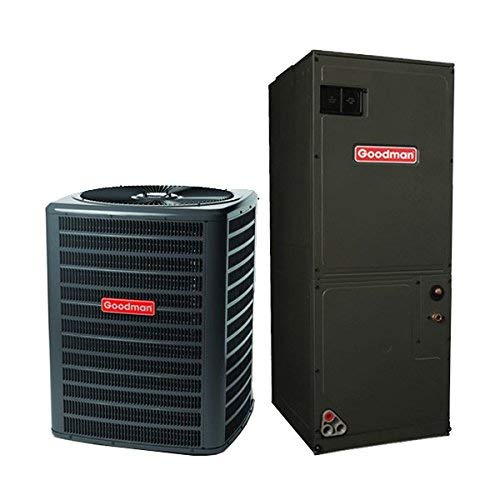
This Goodman setup is the only true ducted central air system on this list, and it is designed for mobile homes that already have ductwork in place. The 3-ton, 36,000 BTU condenser paired with the multi-position AMST36CU1300 air handler delivers enough cooling capacity for homes up to 2,100 square feet, which covers even larger double-wide manufactured homes. The air handler uses a 9-speed ECM blower motor and an R-32 refrigerant system with a factory-installed thermal expansion valve, both of which contribute to consistent humidity removal and stable temperatures across multiple rooms.
The multi-position design means this air handler can be installed in upflow, horizontal right, or horizontal left configurations, a critical feature for mobile homes where crawl space and attic access are limited. The 10-year parts warranty (when registered within 60 days by a qualified installer) provides long-term peace of mind. Keep in mind that this system does not include a heat pump — for heating you would need to add a heat kit or a separate furnace, which is common in mobile home setups where gas or electric strip heat already exists.
Installation requires professional HVAC experience and access to a 230V electrical circuit. The condenser is pre-charged for 15 feet of line set, but the system must be evacuated and the lines purged before opening the service valves. Owner reviews consistently praise the quiet operation compared to older split systems, and the cooling performance easily handles the oppressive summer heat common in the southern United States where many mobile homes are located.
Why it’s great
- The ECM blower motor draws less power than a standard PSC motor, trimming your monthly operating cost.
- Multi-position cabinet gives you flexibility to route ductwork around tight crawl spaces typical of mobile homes.
- Factory TXV ensures precise refrigerant metering regardless of ambient temperature swings.
Good to know
- Requires 230V power and professional installation; not a DIY project for most homeowners.
- No heating function built in — you must supply your own furnace or heat kit.
- Weight and bulk of the air handler make it difficult to maneuver through a small access hatch.
2. Temprium 12,000 BTU Mini Split Air Conditioner 115V, 22 SEER2
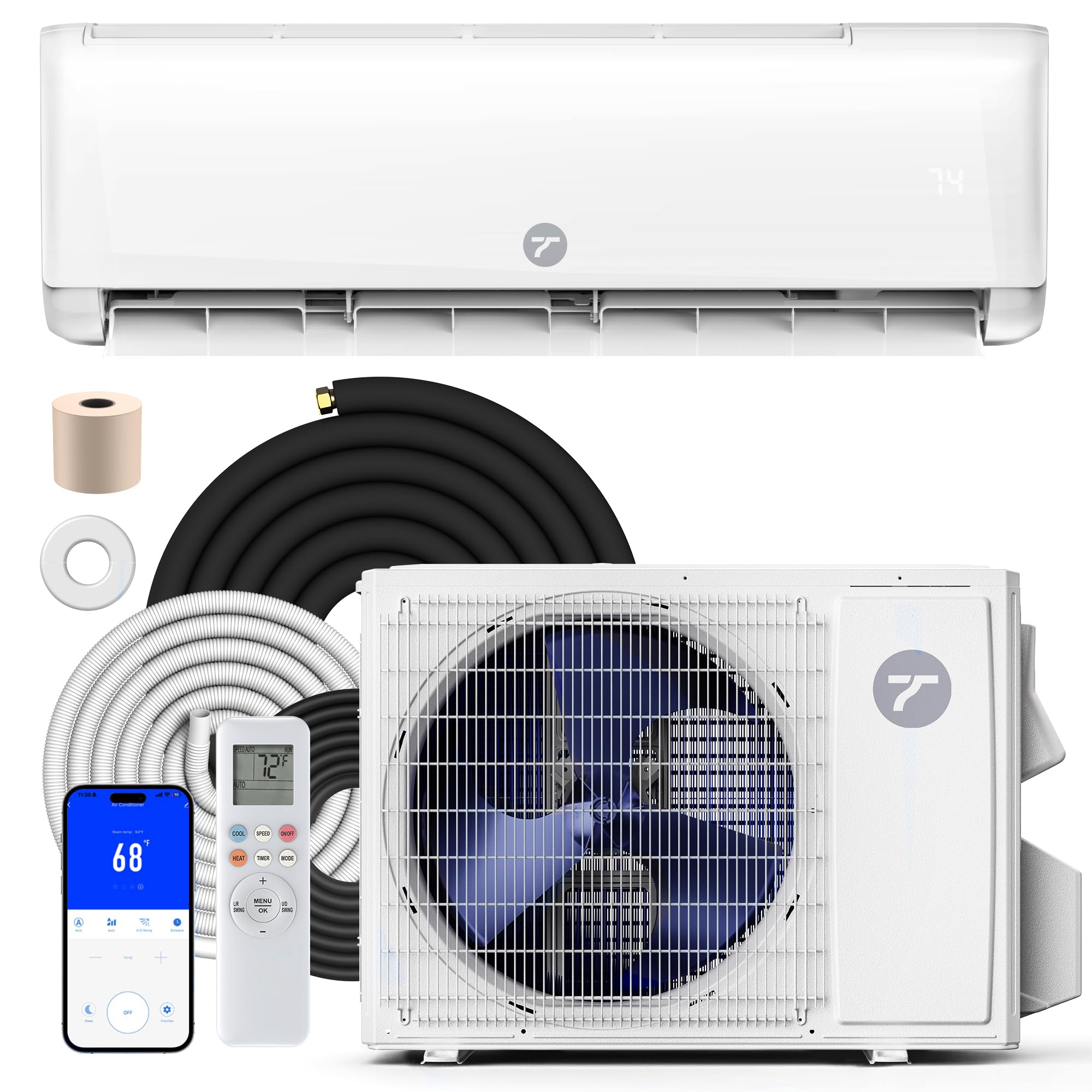
The Temprium mini-split sets the efficiency benchmark on this list with a 22 SEER2 rating, which translates to roughly 545 kWh per year of energy consumption — lower than any other 12,000 BTU unit here. It operates on a standard 115V household circuit, so you won’t need to run a new 230V line. The inverter compressor paired with R-32 refrigerant achieves a noise floor as low as 23 dB in sleep mode, which is quieter than a typical refrigerator hum and well below the threshold of most window units.
Covering up to 750 square feet, this unit fits the main living area of most single-wide mobile homes. The 4D auto-swing and 7 fan speeds give you fine-grained control over airflow direction, while the Wi-Fi app provides scheduling and remote control via Alexa or Google Assistant. The Follow-Me (I-Feel) mode uses the remote’s built-in temperature sensor to adjust the setpoint based on the spot where the remote is placed, a useful feature if your mobile home’s thermostat location gives a skewed reading.
Installation requires the standard mini-split process: mounting the indoor bracket, drilling a 3-inch hole through the wall for the line set, and connecting the pre-charged lines to the outdoor unit before pulling a vacuum. The kit includes the installation accessories, but you need a vacuum pump and manifold gauge set. Customer reviews note that the app setup can be finicky if you scan the wrong QR code — use the “SmartLife-SmartHome” app, not the one in the manual. The self-cleaning function at 133°F keeps the indoor coil dry and reduces mold growth in humid climates.
Why it’s great
- At 22 SEER2, this is the most energy-efficient split system on the list, saving about 30% over a 16 SEER unit.
- The 23 dB sleep mode won’t disturb light sleepers — the indoor blower is nearly silent at low speed.
- 115V operation means it plugs into a standard outlet with no electrical panel upgrade needed.
Good to know
- Line set is pre-charged, but you still need a vacuum pump and gauges to purge the lines before opening the service valve.
- The 10-foot line set is short for some layouts; you may need to buy a longer one and add R-32 refrigerant.
- Wi-Fi setup instructions in the manual are confusing; follow the app’s in-software prompts instead.
3. Gasbye Dual Hose Portable Air Conditioner, 14,000 BTU
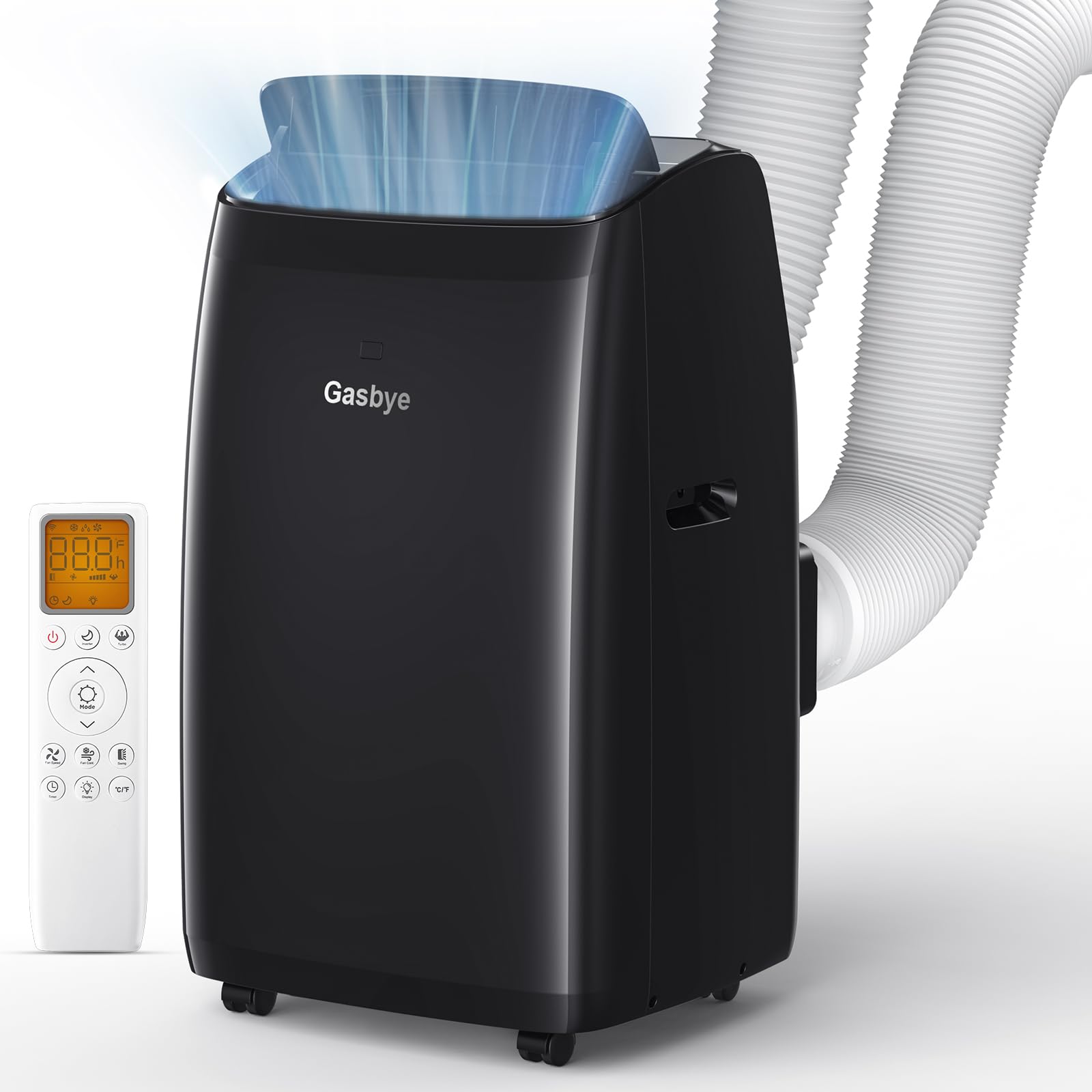
The Gasbye is the only portable unit on this list that uses a full DC inverter compressor, which gives it a 13.6 CEER rating — significantly higher than the 8.0 to 10.0 CEER range of typical portable ACs. The dual-hose design pulls outdoor air for condenser cooling and exhausts hot air separately, preventing the negative pressure problem that makes single-hose units pull warm air in through every gap. This matters especially in mobile homes, where window and door seals are often less airtight than site-built homes.
Rated at 10,500 BTU SACC (14,000 BTU ASHRAE), this unit handles up to 500 square feet. The compressor can ramp down to about 50% load within two minutes in Inverter Mode, dropping noise to around 45 dB while cutting power consumption from 1,300 watts to the 500–800 watt range. The backlit remote is handy for nighttime adjustments, and the display-off feature eliminates glow that could disturb sleep. The unit also includes a 3-year quality coverage warranty with responsive customer service — a level of support rare among portable AC brands.
Setup requires connecting the dual 5.9-inch-diameter hoses to the included window bracket kit. The exhaust and intake hoses are 59 inches long, so you may need to place the unit on a low table or stand if your window is higher than that. In high-humidity conditions above 85% RH, the auto-evaporation system may be overwhelmed and you will need to manually drain water from the higher-placed auxiliary drain port — a design improvement over bottom-drain units that are harder to access.
Why it’s great
- The dual-hose design eliminates negative pressure, so your mobile home stays cooler and doesn’t suck in hot outside air.
- Inverter Mode drops power consumption to around 500-800 watts, saving significant energy during mild evenings.
- The 3-year quality coverage and responsive customer support are rare in the portable AC category.
Good to know
- In humid climates, the auto-evaporation system may fall behind, requiring manual draining once or twice a day.
- The remote control has a weak signal and needs direct line-of-sight to the unit.
- Extension hoses are not recommended, which limits placement flexibility if your window is far from the unit.
4. Midea Duo 14,000 BTU Portable Air Conditioner with Heat

Midea’s Duo series uses a patented dual hose-in-hose design where the exhaust and intake air paths share the same physical hose assembly, reducing the window footprint to a single panel while still delivering the efficiency of a two-hose system. This is a space-saver advantage when your mobile home window has limited clearance. The inverter compressor and heat pump provide both cooling and heating down to 41°F outside, making this a genuine year-round solution for manufactured homes in temperate climates.
The unit delivers 12,000 BTU SACC (14,000 BTU ASHRAE) and covers up to 550 square feet. Midea claims the Duo cools more than twice as fast as single-hose portables, and owner reviews confirm that it drops the temperature noticeably within minutes. The variable-speed inverter cuts energy use by more than 40% compared to the federal standard, which translates to real savings if you run the AC through a hot summer. Smart control works with the SmartHome app as well as Alexa and Google Assistant, and the heat pump function adds value for mobile homes that currently rely on electric resistance heaters.
Installation takes roughly 30 minutes and involves attaching the hose assembly to the window kit and plugging the unit into a standard 115V outlet. The included hoses are relatively short, so the unit must sit close to the window. The remote control lacks a backlight and has limited range, which is a minor irritation. Also note that the heat pump stops working when the outdoor temperature drops below 41°F, so this is not a primary heat source for cold climates.
Why it’s great
- The single-hose-in-hose window panel takes up less space than traditional dual-hose setups, ideal for small mobile home windows.
- Heat pump function provides efficient winter heat down to 41°F, reducing reliance on baseboard heaters.
- Inverter technology keeps the temperature stable and the power bill lower than any non-inverter portable.
Good to know
- The remote control is not backlit and has short range, making nighttime adjustments difficult.
- Heat pump stops working below 41°F; not a full winter solution for cold northern climates.
- Some owners report inconsistent cooling performance between different units, suggesting quality control variation.
5. Hykolity 18,000 BTU Mini Split Air Conditioner & Heater, 19 SEER2 230V

At 18,000 BTU with a 1.5-ton compressor and 19 SEER2 rating, the Hykolity mini-split delivers the highest raw cooling output of any ductless unit on this list. It covers up to 1,250 square feet, enough for an entire single-wide mobile home or the main zone of a larger double-wide. The 230V power requirement means a dedicated circuit and possibly an electrician visit, but the payoff is cooling that keeps up with the hottest days without struggling.
The 4D airflow and I-Feel mode allow you to direct air exactly where you need it, and the 24-hour timer let you schedule operation around your daily routine. Wi-Fi control is standard, so you can adjust settings from anywhere. The kit includes a 16-foot line set, vibration absorber feet for the outdoor condenser, and all necessary installation accessories. A 3-year compressor warranty backs the unit.
Owners report dramatic cooling performance even in extreme heat — one reviewer notes the unit maintained 70°F inside a 750-square-foot metal shop when outdoor temperatures exceeded 105°F. The unit runs very quietly, especially when compared to window ACs. The main drawback is the lack of a current room temperature display on the remote or indoor unit; you only see the set temperature, which makes it trickier to know the actual room condition. Also, the flare seals provided with the unit are known to be a weak point, and many owners replace them with higher-quality flare nuts during installation.
Why it’s great
- 18,000 BTU output is more than enough for the largest mobile home single zones, with no struggle on hot days.
- The 19 SEER2 rating keeps operating costs reasonable for a unit this powerful.
- Complete installation kit includes line set, condenser pads, and even vibration absorber feet.
Good to know
- Requires a 230V circuit — most mobile homes need an electrician to run this unless you already have a dryer outlet nearby.
- The remote and unit only show set temperature, not actual room temperature, which is annoying for fine-tuning.
- The factory-supplied flare seals may leak; replacing them with quality aerospace-grade flare nuts during install is advised.
6. MEPTY 12,000 BTU Mini Split AC/Heating System, 19 SEER2 110V
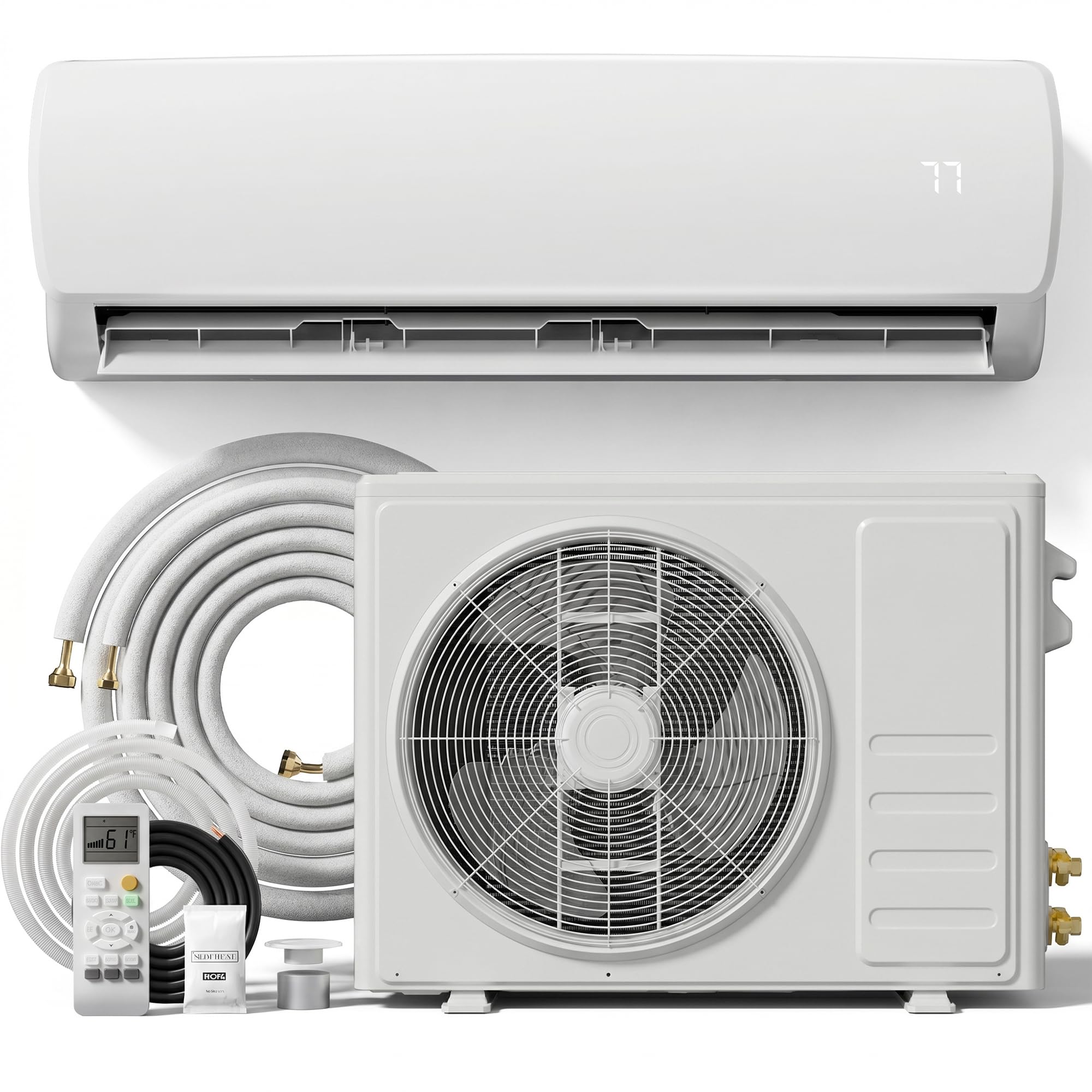
The MEPTY mini-split targets buyers who want fast cooling without paying for a premium brand. The 12,000 BTU system runs on 110V and achieves a 19 SEER2 rating, which is solid for the price tier. The inverter compressor modulates its speed to match demand, and the unit can reach your set temperature in roughly 30 seconds of turning on the cooling function — a boast backed up by multiple owner reviews describing “instant cold air.”
Covering up to 750 square feet, this is a strong fit for the main bedroom or living area of a mobile home. The 4-in-1 design includes cooling, heating, fan, and dehumidifying modes, with four fan speeds and up-and-down swing to distribute air evenly. The mute mode drops noise to 35 dB, which is quieter than most window units but slightly louder than the Temprium or Bonnlo mini-splits. The pre-charged R-32 refrigerant line set is included, though at 10 feet it may be short for some layouts.
Owner reviews highlight the unit’s ability to cool a large living room quickly and the quiet operation of the indoor blower. However, the included copper tubing is reported to be lower quality than industry-standard American-made copper, with some owners choosing to replace it to avoid flare failures later. Professional installation is strongly recommended unless you have experience with HVAC and vacuum pump operation.
Why it’s great
- Almost instant cooling from the start — you feel cold air within 30 seconds of turning it on.
- Runs on standard 110V, so you can plug into any existing outlet without electrical work.
- The 19 SEER2 efficiency rating keeps operating costs well below budget-friendly mini-splits.
Good to know
- The included copper line set is lower quality than American-made tubing; consider replacing it during install.
- At 35 dB in mute mode, it’s quiet but not the quietest mini-split on this list.
- The 10-foot line set is short for some layouts; you may need to buy a longer set and add R-32 refrigerant.
7. YITAHOME 12,000 BTU Mini Split AC/Heating System, 20 SEER2 115V

The YITAHOME mini-split combines a 20 SEER2 rating with Wi-Fi and Alexa compatibility, making it one of the most technologically connected units in this roundup. It covers up to 750 square feet on 115V power, so no electrical panel upgrade is needed. The inverter compressor is paired with a heat pump that operates between 5°F and 118°F ambient, offering genuinely wide operating range for four-season use in most mobile home climates.
The unit features five operating modes (auto, cool, dry, heat, fan) plus an “iFEEL” mode that follows the remote’s sensor, a 24-hour timer, sleep mode, energy-saving mode, and a “HEALTH” mode that uses negative ions and electrostatic filtration for PM2.5 removal. The self-diagnosis and self-cleaning functions reduce maintenance. Noise levels are rated below 41 dB, which is comfortable for sleeping. The kit includes the indoor unit, outdoor unit, remote control, and installation accessories (excluding shutoff valves and side protection grille).
Owner reviews are generally very positive, with praise for the efficient cooling and quiet operation. One owner reported the unit overcooled to 51°F when set to 65°F because the blower didn’t cycle off at the setpoint — this appears to be a quirk of the blower logic rather than a defect. Installation requires a vacuum pump and manifold gauge set, and the app setup process was described as frustrating by some. Professional installation is advised.
Why it’s great
- Wi-Fi and Alexa control let you start cooling your mobile home from your phone on the way back.
- 20 SEER2 is one of the highest efficiency ratings on the list, directly lowering your electric bill.
- The HEALTH mode with negative ion filtration helps keep air fresher in a well-sealed mobile home.
Good to know
- The blower logic may not shut off when the setpoint is reached, leading to potential overcooling in some units.
- Wi-Fi app setup instructions are poor — expect to spend 20-30 minutes figuring out the connection process.
- Shutoff valves and side protection grille for the outdoor unit are sold separately.
8. Bonnlo 11,500 BTU Wifi Enabled Mini Split Air Conditioner & Heater, 17 SEER2 115V

The Bonnlo 11,500 BTU mini-split stands out for its whisper-quiet operation, claiming just 30 dBA at low speed — about the same as a quiet library. It runs on 115V with a 17 SEER2 rating, which is respectable for the price. The unit covers up to 550 square feet, making it a strong choice for the main living area or master bedroom of a mobile home. Wi-Fi and voice control via Alexa or Google Assistant are built in, and the 24-hour timer lets you schedule operation.
The system includes an indoor unit, outdoor unit, multi-function remote control, and a 16.4-foot copper line set. Pre-charged with R-32 refrigerant, the system requires a professional installation to pull a vacuum and connect the lines. The self-cleaning function reduces coil buildup, and the indoor unit’s display can be turned off completely for undisturbed sleep. The ambient operating range is 5°F to 122°F, covering the full temperature swing of most US climates.
Owner reviews are overwhelmingly positive, with comments focusing on the quietness of both the indoor blower and the outdoor condenser. One owner described the outdoor unit as “unbelievably quiet,” which is an important consideration if your condenser sits near a bedroom window. The included installation kit is comprehensive but does not include a power cord — you must supply one or have an electrician wire the disconnect. The flares on the pre-charged line set were reported as clean and well-formed on several units.
Why it’s great
- At 30 dBA in low mode, this is one of the quietest mini-splits on the market — you will barely hear it.
- The 16.4-foot line set is longer than most kits, giving you more flexibility for outdoor unit placement.
- Wi-Fi and voice control come standard without a price premium over non-smart units.
Good to know
- The power cord is not included — you need to supply one or have an electrician wire the disconnect box.
- At 17 SEER2, it is less efficient than the Temprium or YITAHOME options on this list.
- Installation is not DIY-friendly; you need gauges, a vacuum pump, and a willingness to learn the process.
9. Mountman 9,000 BTU Mini Split AC/Heating System, 19 SEER2 110/120V
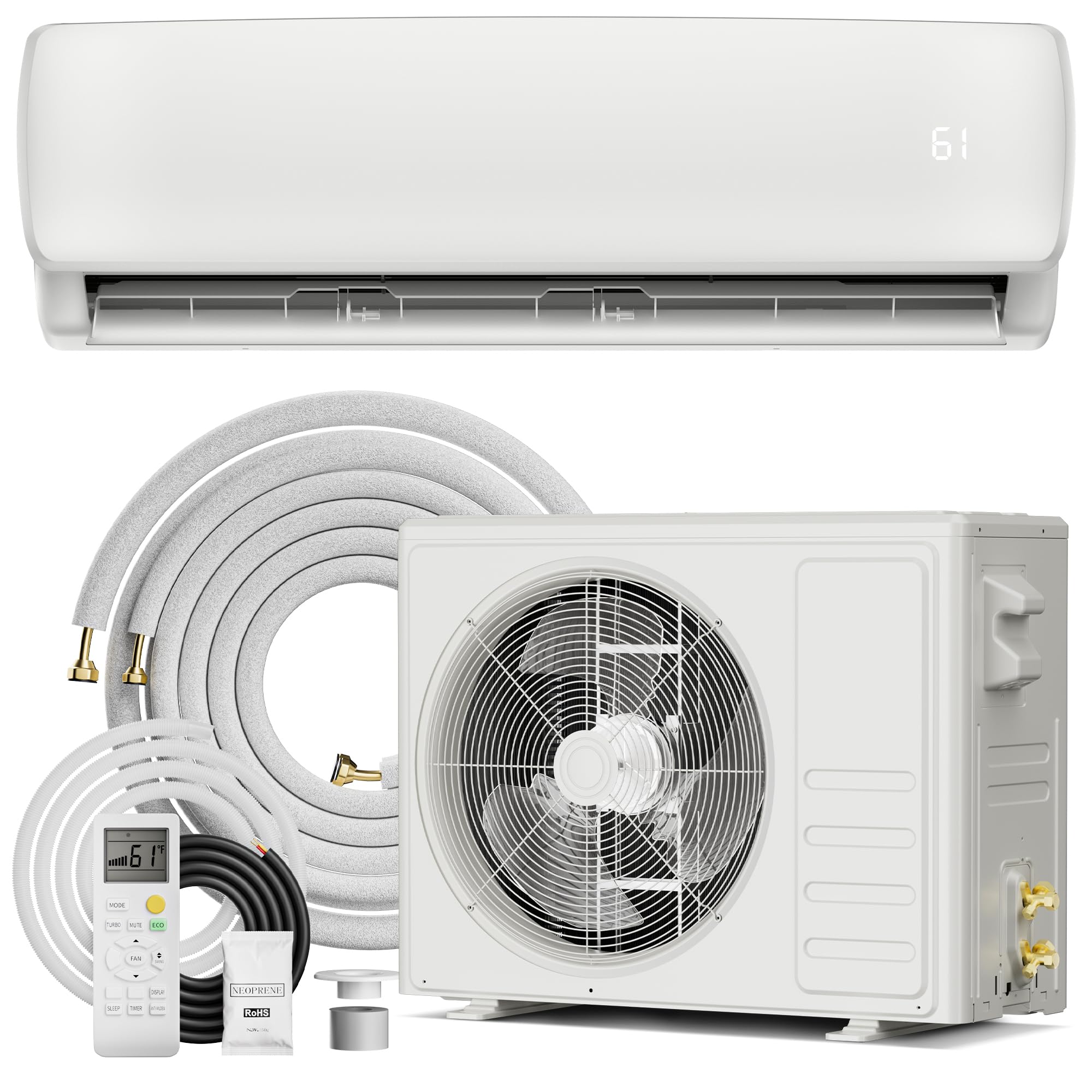
The Mountman 9,000 BTU mini-split is an entry-level ductless system that still manages to deliver a 19 SEER2 rating and a sleep mode noise level of just 26 dB. It runs on 110/120V and covers up to 450 square feet, making it ideal for a single bedroom or small living room in a mobile home. The price point undercuts most mini-splits, but the spec sheet doesn’t feel budget — the inverter compressor, auto-swing, self-cleaning, and automatic defrost functions are all present.
The unit includes four operating modes (cool, heat, dry, fan) with four fan speeds plus sleep, ECO, and turbo modes. The remote control’s display automatically shuts off after 10 seconds of inactivity, which is a thoughtful touch for light-sensitive sleepers. The pre-charged R-32 refrigerant system includes a 6-foot line set — shorter than average, but fine if you mount the condenser directly outside the wall behind the air handler. The washable anti-dust filter requires only a monthly rinse.
Owner reviews highlight the unit’s quiet operation, energy savings, and straightforward installation. Some shorter owners note that fitting the air handler onto the wall-mount bracket can be awkward due to its weight and the limited space to maneuver. The instructions are detailed but reportedly lack full charging procedures, which can be confusing for first-time installers. A vacuum pump and manifold gauge set are mandatory for proper setup.
Why it’s great
- The 26 dB sleep mode is genuinely quiet — you may not notice the unit is running at all.
- It delivers 19 SEER2 efficiency at a budget-friendly price point that undercuts most competitors.
- Self-cleaning and auto-defrost functions reduce maintenance and keep performance consistent year-round.
Good to know
- The 6-foot line set is unusually short — you need the condenser close to the indoor unit.
- Installation instructions skip some critical charging details; watch a YouTube video before starting.
- At 9,000 BTU, this unit only covers small rooms — not suitable for open-plan areas over 450 sq ft.
10. Humhold 14,000 BTU Portable Air Conditioner, 3-in-1 Cooling AC

The Humhold portable AC offers a budget-friendly entry point for mobile home cooling, with a 14,000 BTU ASHRAE rating (10,000 BTU SACC) that covers up to 700 square feet in its marketing claim. In reality, the SACC rating is the number that matters for performance, and 10,000 BTU SACC is adequate for rooms around 350-400 square feet in a mobile home. The 3-in-1 design includes cooling, fan, and dehumidifier modes with an auto-swing louver that distributes air across a wide angle.
The sleep mode targets 48 dB, which is noticeable but not disruptive for most sleepers. A 24-hour timer and remote control with backlit display add convenience. The unit uses self-evaporation for normal operation, meaning you don’t need to drain water manually in typical conditions — only in high-humidity environments or when running the dry mode separately. Four casters and hidden handles make it easy to move between rooms.
Owner reviews are mixed. Positive reviews praise the cooling performance and ease of setup, while critical reviews point out that the noise level is louder than the advertised 48 dB (some measured 59-61 dB in their own testing) and that the window kit doesn’t fit all window sizes well. The unit is also on the heavier side at 65 pounds, so moving it up stairs requires effort. For the price, it offers decent value as a supplemental cooler but should not be considered primary cooling for a large mobile home.
Why it’s great
- The 3-in-1 function gives you cooling, dehumidification, and fan mode in one box, useful during humid summers.
- Self-evaporation means you rarely need to manually drain water in normal conditions.
- Four casters and hidden handles make it easy to roll from bedroom to living room as needed.
Good to know
- The 48 dB sleep mode claim is optimistic; many owners report closer to 59-61 dB in real use.
- Window kit does not fit all window sizes well; you may need to buy a third-party universal kit.
- Performance is based on 10,000 BTU SACC, not the 14,000 BTU ASHRAE number — don’t expect it to cool 700 sq ft effectively.
11. Midea 12,000 BTU Inverter Window Air Conditioner with Heat
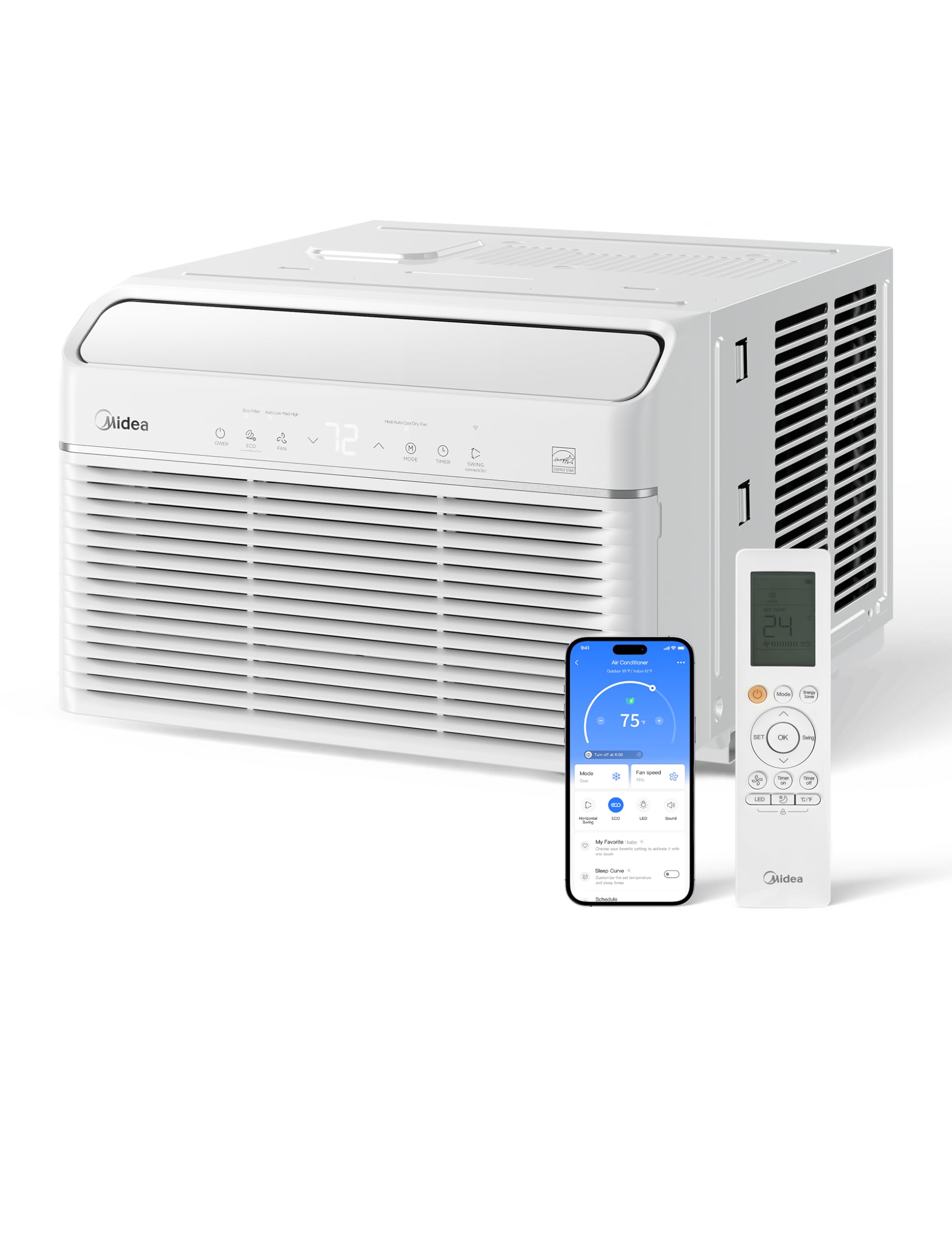
The Midea 12,000 BTU window AC is a strong contender for mobile home owners who want a simple, permanent installation without the complexity of a mini-split. It features inverter technology that delivers up to 35% energy savings compared to standard window units, and the integrated heat pump provides supplemental heat down to 41°F outside — effectively turning it into a year-round climate control device for a single room. The unit covers up to 550 square feet.
Noise is rated at 45 dBA, which is quieter than most window ACs. The Midea SmartHome app, Alexa, and Google Assistant support let you control the unit remotely. Five modes (cool, heat, fan, dry, ECO) and three fan speeds give you plenty of options. The washable filter and auto-shutoff features reduce maintenance. Fitment requires a double-hung window with an opening width of 24 to 38.5 inches and a vertical clearance of 14.5 inches — standard dimensions that match most mobile home windows.
Owner reviews highlight the clean, modern appearance that doesn’t look like an industrial window unit, the quiet operation even on high fan speed, and the effective heat pump function that warms a room faster than expected. The main limitation is the heat pump’s 41°F minimum outdoor operating temperature, so it cannot serve as primary heat during freezing winters. Installation is straightforward for a window unit, but at around 65 pounds, it is a two-person job to lift into place.
Why it’s great
- Inverter technology makes this much quieter and more efficient than a standard window AC — no loud compressor cycling.
- The integrated heat pump provides free heat down to 41°F, extending your mobile home’s heating season without baseboard electricity use.
- Smart control via app and voice is rare in window units at this price.
Good to know
- The heat pump stops working below 41°F, so it cannot be your primary heat source in a cold climate.
- At 65 pounds, installation is a two-person job, especially if your mobile home window is high off the ground.
- Window opening dimensions are specific — measure your window carefully before buying.
FAQ
What voltage air handler should I choose for a mobile home?
Can I install a mini-split air handler in a mobile home myself?
How do I size a portable air conditioner for my mobile home?
Is a dual-hose portable AC better than a single-hose for a mobile home?
Do mini-split air handlers work with mobile home duct systems?
Final Thoughts: The Verdict
For most users, the air handler for mobile home winner is the Temprium 12,000 BTU Mini Split because it combines the highest efficiency rating (22 SEER2), the quietest noise floor (23 dB), and 115V operation that requires no electrical panel upgrades — a rare combination that fits perfectly into the constraints of manufactured housing. If you want whole-home ducted cooling and already have ductwork in place, the Goodman 3-Ton Air Handler is the only genuine central option on this list and delivers proven reliability. And for a portable solution that doesn’t demand permanent installation, the Gasbye Dual Hose Portable AC offers inverter efficiency and dual-hose performance that outperforms any single-hose unit on the market.