
An AC/DC power converter is the bridge between your 12V DC vehicle battery and the 110V AC appliances you depend on, but choosing the wrong waveform or wattage can damage sensitive electronics. Whether you need to charge a laptop on a cross-country road trip, run a CPAP machine while camping, or power a ham radio base station in your garage, the converter’s input voltage range, output waveform type, and continuous wattage rating are the three specs that determine whether your equipment runs safely or fails prematurely.
I’m Min — the co-founder and writer behind Gadgets Feed. I’ve spent countless hours analyzing the technical specifications, customer feedback, and real-world performance data across dozens of power converter models to build a guide that cuts through the marketing jargon.
After researching waveform purity, thermal management, and protection circuitry, this guide ranks the top-performing models to help you confidently select the best ac/dc power converter for your specific application.
How To Choose The Best AC/DC Power Converter
Selecting the right converter means matching its output waveform, wattage capacity, and physical design to your equipment’s electrical demands. A hobbyist running a soldering iron has different needs than an RVer powering a refrigerator, so understanding these three criteria will save you from buying a unit that either fails to start your gear or introduces destructive electrical noise.
Waveform Purity: Pure Sine Wave vs. Modified Sine Wave
Pure sine wave inverters produce clean AC power virtually identical to household wall outlets, making them mandatory for motors, medical equipment, and any device with a switching power supply that expects a smooth sinusoidal curve. Modified sine wave units use a stepped approximation that works fine for resistive loads like incandescent lights and basic chargers, but can cause audible hum in audio gear, overheating in refrigerators, or outright failure in variable-speed tools.
Continuous Wattage and Surge Capacity
The continuous wattage rating determines how much power the converter can deliver indefinitely, while surge capacity handles the momentary inrush current when motors start. A 3000W inverter might surge to 6000W for a few seconds, enough to start a small refrigerator, but its continuous rating must exceed the total running wattage of all connected devices. Undersizing the continuous wattage leads to thermal shutdown precisely when you need power most.
Protection Circuitry and Safety Certifications
Over-voltage, under-voltage, short-circuit, and over-temperature protection prevent catastrophic failures when a battery voltage drops or a load shorts. ETL and UL certifications mean an independent lab validated the unit’s safety design, which is especially important for hardwired installations in RVs or off-grid solar systems where a fire could have serious consequences.
Quick Comparison
On smaller screens, swipe sideways to see the full table.
| Model | Category | Best For | Key Spec | Amazon |
|---|---|---|---|---|
| VOLTWORKS 3000W Pure Sine | Premium | Off-grid solar and RV | 3000W continuous pure sine wave | Amazon |
| Jesverty SPS-1330 | Mid-Range | Ham radio base stations | 30A at 13.8V DC regulated | Amazon |
| Pyramid PSU990KX | Mid-Range | CB radio bench testing | 7A regulated with cigar lighter | Amazon |
| WANPTEK 0-30V Variable | Mid-Range | Lab bench electronics work | 0-30V 0-10A adjustable output | Amazon |
| Yaheeda 600W AC to DC | Mid-Range | Garage workshop 12V gear | 50A peak on 12V DC rail | Amazon |
| ISELECTOR 300W Inverter | Budget | Daily car laptop charging | 300W with PD 65W USB-C | Amazon |
| Vansoet 200W Inverter | Budget | Compact road trip essentials | 200W with dual PD USB | Amazon |
In‑Depth Reviews
1. VOLTWORKS 3000W Pure Sine Wave Inverter

The VOLTWORKS 3000W delivers true pure sine wave output at a price point that undercuts competitors by a wide margin, making it the go-to choice for off-grid solar systems, RV living, and emergency backup. Its 3000-watt continuous rating handles a microwave, refrigerator, and laptop charging simultaneously, while the built-in AC hardwire terminal supports permanent 30A installations without needing a separate transfer switch. The included 30-foot remote controller with battery monitoring lets you power-cycle the unit from inside the cabin without walking to the battery compartment.
Thermal management is well-executed: the cooling fan only activates when the internal temperature reaches 104°F or the load exceeds 1400W, which keeps noise to a minimum during light loads like TV and phone charging. The aluminum housing provides solid impact protection for truck-bed or compartment mounting, and the UL-listed fuses add a layer of safety that budget inverters skip entirely. Users report clean power for single-phase AC motors without the buzzing or overheating common with modified sine wave inverters.
The 12.6-pound weight and 18.3-inch length require substantial mounting space, and the remote gauge’s battery state readout is optimized for lead-acid rather than LiFePO4 chemistries, so owners of lithium batteries should monitor cell voltage independently. Still, for anyone needing high-capacity pure sine wave power with professional-grade safety features, this unit is the clear frontrunner.
Why it’s great
- True pure sine wave output eliminates motor buzz and device interference
- 30 ft remote controller with battery monitoring enables convenient placement
- AC hardwire terminal supports permanent 30A installation without adapters
Good to know
- Remote battery gauge is less accurate with LiFePO4 battery chemistry
- Large footprint requires dedicated mounting space
2. Jesverty SPS-1330 30 Amp Bench Supply
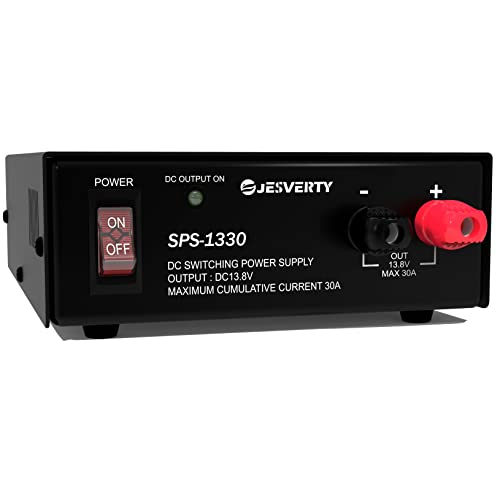
The Jesverty SPS-1330 converts 120V AC wall power into a regulated 13.8V DC output at up to 30 amps, making it an ideal bench supply for CB radios, ham transceivers, and other 13.8V equipment that demand stable voltage under transmit load. Users report zero voltage drop when keying a 50-watt radio, and the switch-mode design runs whisper-quiet with the cooling fan rarely activating even during extended transmissions. The screw-type terminals accept bare wire up to 8 AWG, providing a more reliable connection than banana jacks for high-current setups.
At just 3.1 pounds and measuring 8.66 inches deep, this unit slides easily onto a crowded workbench without dominating the space. Over-voltage, over-current, and short-circuit protection are all built in, and owners confirm no detectable RF noise leaking back into their radio receivers — a common complaint with poorly filtered switch-mode supplies. The alloy steel enclosure feels robust for the price bracket, and the simple plug-and-play operation means no configuration beyond connecting your load cables.
The 414-watt maximum power covers most mobile radios on the market, but operators running high-power linear amplifiers will need to step up to a 50A or 100A unit. Additionally, the unit lacks a front-panel voltage display, so you’ll need an external multimeter to verify output if you’re dialing in a precise voltage for sensitive gear.
Why it’s great
- Zero voltage sag during peak radio transmit draws up to 30A
- No detectable RF interference on receiving frequencies
- Ultra-quiet fan operation ideal for indoor bench use
Good to know
- No built-in voltage display requires external monitoring
- 414W limit insufficient for high-power linear amplifiers
3. Pyramid PSU990KX 7 Amp Bench Supply
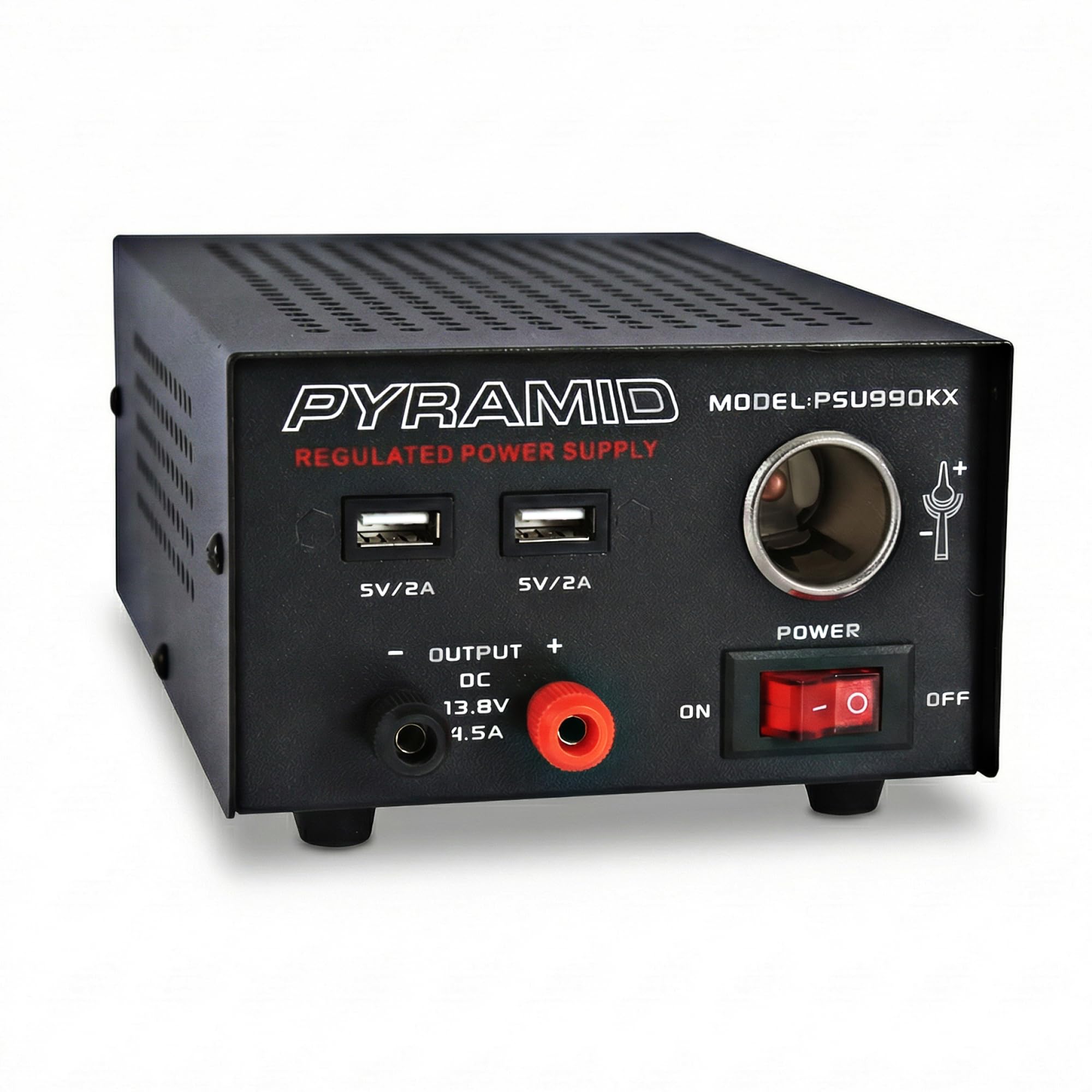
The Pyramid PSU990KX is a classic linear-regulated bench supply that delivers a clean 13.8V DC at 4.5 amps continuous and up to 7 amps surge, specifically designed for powering CB radios, scanners, and small ham transceivers without the RF noise that plagues cheap switching units. Its compact metal chassis — just 7.7 x 4.9 x 2.8 inches — fits comfortably on a crowded desk, and the inclusion of dual USB charge ports and a cigarette lighter socket makes it versatile for charging phones, tablets, and 12V accessories simultaneously while running your radio.
The linear regulation topology means slightly lower efficiency than switch-mode designs, but the trade-off is exceptionally clean DC output that won’t introduce hash into your receiver audio. Built-in electronic overload and short-circuit protection provide peace of mind during bench testing, and the switch-activated power control lets you kill power without unplugging cords. Owners consistently praise its reliability for powering dual-band radios and base station scanners 24/7.
The 4.5-amp continuous rating limits its use to mobile radios drawing under 60 watts transmit power — higher-power units will trip the overload protection during sustained key-down. The unit also runs noticeably warm under continuous load, so it needs airflow clearance on the bench.
Why it’s great
- Linear regulation produces zero RF interference for clean radio reception
- Dual USB ports and cigarette lighter add multi-device charging
- Compact footprint saves valuable bench real estate
Good to know
- 4.5A continuous limit restricts use to low-power radios under 60W
- Linear design runs warmer than switch-mode equivalents
4. WANPTEK DPS3010U Variable Bench Supply
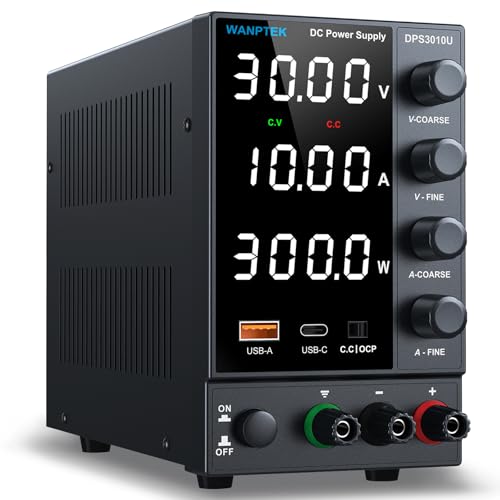
The WANPTEK DPS3010U is a variable DC power supply offering a 0-30V voltage range and 0-10A current limit, making it indispensable for electronics repair, battery charging, and prototyping where you need precise control over voltage and current. Its encoder-based coarse and fine knobs let you set voltage to two decimal places quickly — the coarse knob adjusts the whole number, while the fine knob tweaks the decimal — without the fiddly multi-turn pots found on older supplies. The bright four-digit display shows voltage, current, and power simultaneously, so you always know exactly what your circuit is drawing.
This unit includes both USB-A and USB-C fast-charging ports with 5V/3.6A output, allowing you to charge phones or power small projects without occupying the main output terminals. The short-circuit alarm triggers an audible buzzer and immediately cuts output, protecting both the supply and your project from accidental shorts during breadboarding. The intelligent temperature-controlled fan keeps the unit cool during heavy 10A draws while staying nearly silent at low loads, and the auto-sensing input voltage eliminates the need for a manual 115V/230V switch.
A small number of units have shipped with a cold solder joint on the power switch wire, causing intermittent power-on behavior that requires re-soldering. While this is a quality-control outlier rather than a systemic flaw, it’s worth checking the switch connection upon arrival if you experience power issues.
Why it’s great
- Coarse and fine encoder knobs enable fast, precise voltage selection
- USB-C fast charge port adds bench convenience beyond the main outputs
- Short-circuit alarm with automatic cut-off protects sensitive circuits
Good to know
- Occasional cold solder joint on power switch requires inspection
- No remote sense terminals for compensating voltage drop in long leads
5. Yaheeda 600W AC to DC Converter

The Yaheeda 600W converter steps 110V AC wall power down to 12V DC with a peak rating of 50 amps, purpose-built for running automotive accessories in the garage — electric scissor jacks, ATV winches, car stereo amplifiers, and 12V pumps that would otherwise require a running vehicle battery. The aluminum alloy housing with integrated heat sink dissipates heat efficiently, and the built-in cooling fan remains quiet enough for indoor use. The unit includes ring terminals and a UL-listed power cord, so you can wire it directly to your equipment without sourcing additional hardware.
Safety features include automatic overload, over-voltage, thermal, and short-circuit cut-off, though the unit lacks a user-replaceable fuse — a point noted by auto-electrical owners who prefer being able to swap a blown fuse rather than replace the entire converter. The adjustable voltage and current potentiometers inside the case let experienced users fine-tune the output, but the housing is intended for fixed installation rather than frequent adjustment. The compact form factor, roughly the size of a 3/8-inch socket set, fits easily on a shelf or inside a cabinet.
This converter is designed for resistive and simple inductive loads — it is explicitly not recommended for PWM motors, dimmable lighting, or programmable speed controllers, as the switching regulation can cause erratic behavior in those devices. Owners running it continuously at 40A recommend mounting it on a flat, clutter-free surface with adequate airflow to keep the fan from cycling excessively.
Why it’s great
- High 50A peak handles heavy 12V garage equipment like winches and jacks
- Includes ring terminals and UL power cord for immediate wiring
- Compact aluminum housing fits in tight cabinet spaces
Good to know
- No replaceable fuse — internal failure requires unit replacement
- Not compatible with PWM motors or dimmable LED controllers
6. ISELECTOR 300W Car Inverter
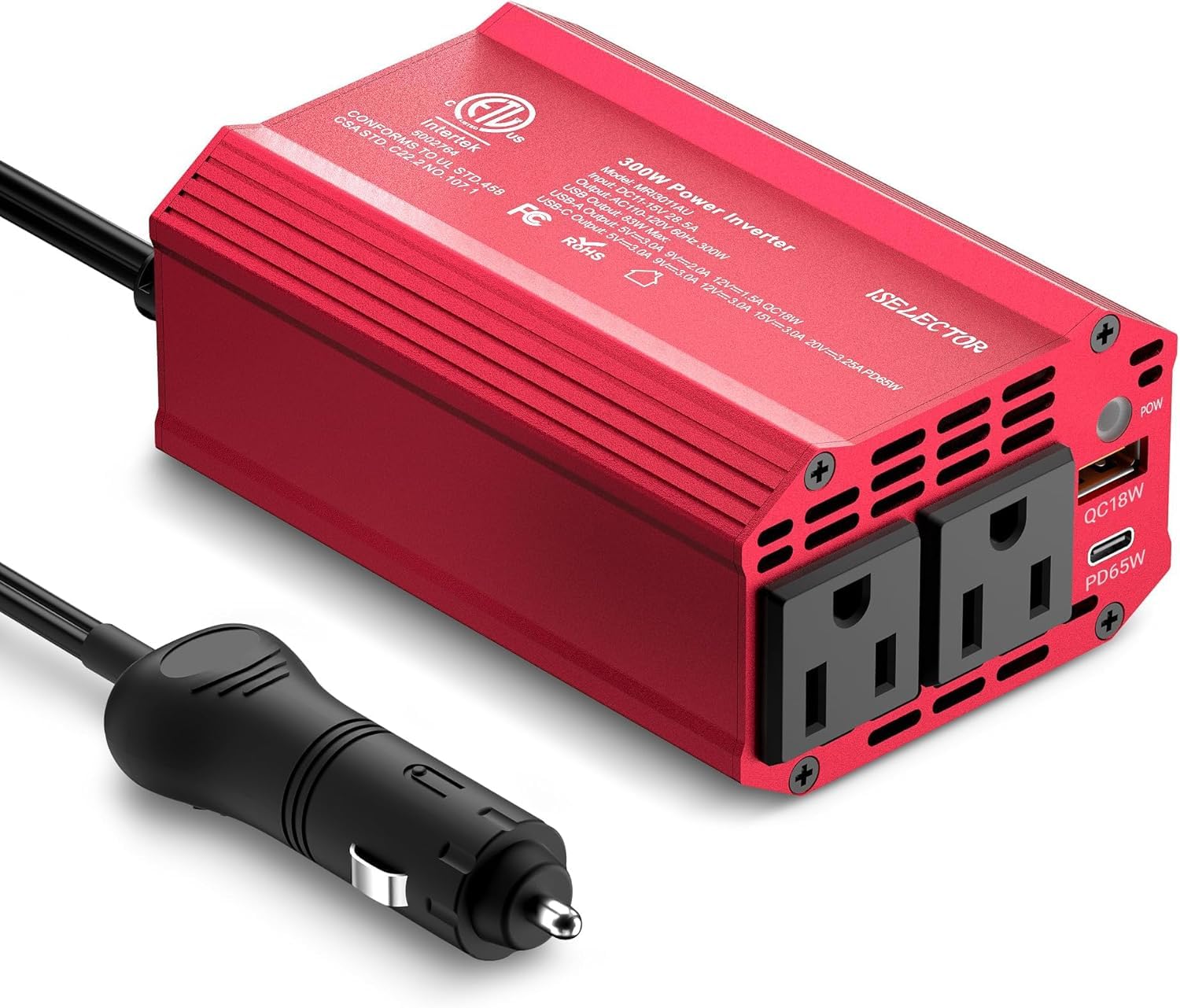
The ISELECTOR 300W inverter converts 12V DC to 110V AC with a modified sine wave output, providing enough power for laptop chargers, phone adapters, and small electronics during road trips without the weight or cost of a pure sine wave unit. Its standout feature is the 65W USB-C Power Delivery port, which charges a MacBook Pro or Dell XPS at full speed — six times faster than standard 2.4A USB ports — while the second USB-A QC 18W port handles phones and tablets. The unit itself measures just 4.37 x 3.47 x 1.89 inches, small enough to slip into a glove box or cup holder.
The ETL certification confirms the built-in 40-amp fuse and protection circuitry meet safety standards, and the smart cooling fan ramps up only when internal temperatures demand it, keeping noise low during normal laptop charging. The detachable DC cable is a thoughtful durability upgrade — if the cigarette lighter plug wears out, you can replace the cable rather than the entire inverter. Owners report that the unit stays cool and silent during multi-hour laptop charging sessions on cross-country drives.
Modified sine wave output makes this unsuitable for anything with a motor — CPAP machines with heated humidifiers, mini-fridges, and power tools will either run inefficiently or refuse to start. The AC outlet spacing is also slightly tight, so bulky wall warts may block the adjacent port, requiring a short extension cord for dual AC use.
Why it’s great
- 65W USB-C PD charges full-size laptops at native speed from the car
- Detachable DC cable extends lifespan compared to fixed-cord designs
- Ultra-compact footprint fits in cup holder or glove box
Good to know
- Modified sine wave incompatible with motors and CPAP humidifiers
- AC outlets are closely spaced — large adapters may block the second outlet
7. Vansoet 200W Car Inverter
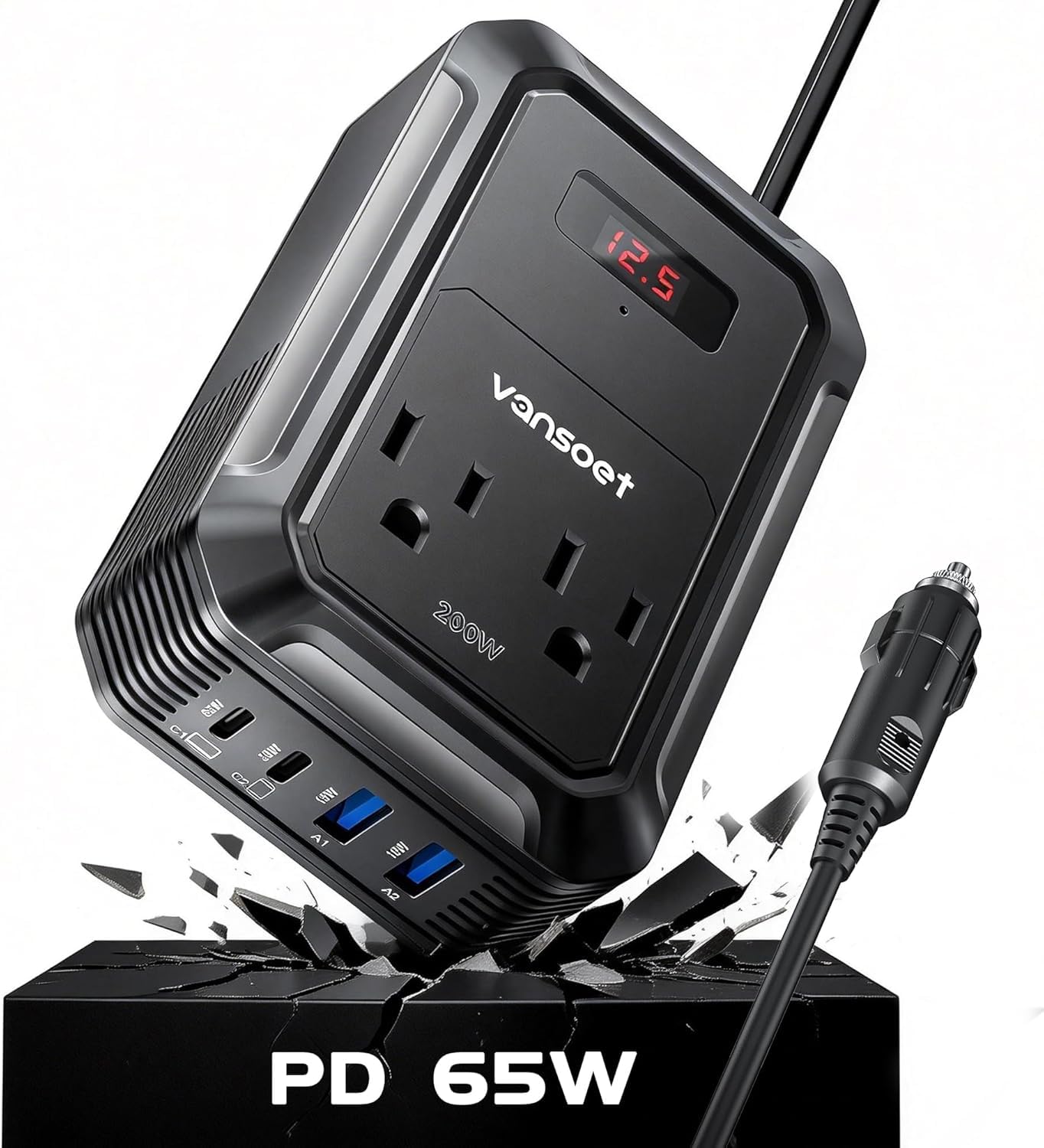
The Vansoet 200W inverter is a compact, entry-level power converter designed for light-duty car charging — laptops, tablets, phones, and small string lights — where every ounce of space and dollar of budget matters. It includes two USB-C PD ports (65W and 30W) plus two USB-A QC 18W ports, giving a total USB output of 131W that can fast-charge multiple devices simultaneously while still leaving two AC outlets for a laptop brick and a camera charger. The LCD display shows input voltage and output wattage in real time, helping you avoid overloading the 200W limit.
The ETL-certified design includes a smart cooling fan that varies speed based on load and temperature, keeping noise to a minimum during light phone charging and ramping up only when pushing near the limit. The 23.8-inch cable with cigarette lighter plug reaches from the center console to the passenger footwell easily, and the 18-month replacement warranty exceeds the industry standard for budget inverters. Owners confirm it handled a 90-watt laptop charger plus phone charging for a 1,000-mile road trip without any thermal shutdown.
Real-world testing confirms the 200W rating is conservative for the cigarette lighter port — sustained loads above 120-150W risk blowing the vehicle’s fuse, so this inverter is realistically a 120W unit for continuous use. It cannot power hair dryers, mini-fridges, or any motorized appliance, so it’s strictly for charging electronics, not running appliances.
Why it’s great
- Two USB-C PD ports (65W+30W) charge multiple laptops simultaneously
- LCD display provides real-time voltage and wattage monitoring
- 18-month warranty exceeds typical budget inverter coverage
Good to know
- Real-world continuous limit is ~120W before vehicle fuse blows
- No capability for motor loads — strictly for charging electronics
FAQ
Can I run a CPAP machine on a modified sine wave inverter?
How do I calculate the right inverter wattage for my RV fridge?
Why does my inverter shut off after 10 minutes with no load?
Can I hardwire a car inverter directly to my vehicle’s battery?
Final Thoughts: The Verdict
For most users, the best ac/dc power converter winner is the VOLTWORKS 3000W Pure Sine Wave Inverter because it delivers true sine wave output with professional-grade protection circuitry at a price that undercuts competitors by hundreds of dollars, making it the ideal choice for off-grid solar, RV, and emergency backup systems. If you need a regulated 13.8V bench supply for ham radio operation without RF noise, grab the Jesverty SPS-1330. And for road warriors who just need to charge laptops and phones from the car, nothing beats the ultra-compact ISELECTOR 300W with its 65W USB-C PD support.